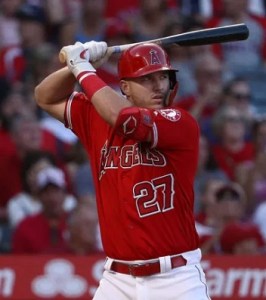
Now, if only his Angels could build a team their .675 batter can be proud of . . .
Few things in baseball are beyond true debate, but one of them is this: As I write, Mike Trout’s major league career could end this instant, and he would be a no-questions-asked Hall of Famer. With the minimum ten major league seasons to qualify on his jacket, Trout has credentials that mark him objectively as the fifth best center fielder ever to play the game.
If you’re my age and you, too, remember seeing Willie Mays and Mickey Mantle still within their primes, you probably thought you’d never see anyone better. Until Barry Bonds, before that other stuff compromised his image, his reputation, and his true value in the eyes of many still. Then, you might have thought you’d never see better than Bonds, until you saw Trout.
For the decade of 2012-2020, Trout joined the arguments over the greatest player who ever suited up for a major league team. His achievements are laid out in enough black ink to fill a regular-size bottle for a fountain pen. One of them isn’t, however. The minute I say it, you’re probably going to sense a few million tempers—including your own, possibly—throwing the kind of tantrums that would make Earl Weaver resemble Edmund Burke:
Mike Trout at this writing is a lifetime .675 batter.
And only one member of the Hall of Fame who played all or most of his career in the post-World War II/post-integration/night baseball era batted higher than Trout.
Trout is a lifetime .304 hitter, of course. For those comparing him to incumbent or should-be Hall of Famers, he’s one point ahead of a guy who’d be there if he hadn’t treated Rule 21(d) like an unwritten rule. He’s also two points ahead of a guy once thought to have the cleanest shot at pushing Babe Ruth out of the career home run leadership until age caught up to him a little too soon.
I hope you noticed I began by saying Mike Trout is a lifetime .675 batter but continued by saying he’s a lifetime .304 hitter. As Edward R. Murrow used to say, I can hear it now: What manner of brain damage prompted you to do that? you may ask. What manner of brain damage prompts you to continue placing a badly-flawed, even fraudulent statistic, on the highest pedestal from which you judge a player? I would ask in reply.
The brain damage is actually not with either you or me. You’ve been misled. The “batting average” to which you still plight your measurement troth deceives you. You’ve known for a lifetime that it’s calculated with hits divided by official at-bats. You may or may not notice that to qualify for the “batting title” a player must have 3.1 plate appearances per team game; or, 501 plate appearances in a full 162-game season.
Perhaps it didn’t cross your mind before that something’s wrong right then and there. You didn’t think to ask, and it’s not even close to your fault, what is the logic or common sense when you need X number of plate appearances to qualify for the “batting title,” but your “batting average” divides only your hits by your official at-bats?
The 2019 National League “batting title” was a dead heat between Arizona’s Ketel Marte and Milwaukee’s Christian Yelich: they each hit .329. Marte had 569 official at-bats and Yelich had 489 official at-bats and 580 plate appearances. Between them, there were 150 times (Marte: 59; Yelich: 91) that they didn’t exist at the plate according to official at-bats.
Except that they did exist at the plate those 150 additional times. You saw them there. Unless mine eyes have been deceived, I saw them there. They had bats on their shoulders. They didn’t exactly plan to leave those bats on those shoulders, either. They also did things other than making 734 outs between them (Marte: 393; Yelich: 341) or bagging 348 hits between them (Marte: 187; Yelich: 161)—and those hits weren’t all a pile of singles, either.
“Batting average,” Branch Rickey once wrote, “is only a partial means of determing a man’s effectiveness on offense.” (1) Partial, my foot. Not only does it reject everything else you do at the plate when you’re not making outs, it says, essentially, that all hits are equal. Unless you and me both have been deceived more deeply than I suspect, all hits are not equal.
You may be the most stubbornly pigheaded clinger to “batting average” as the alpha and omega of prowess at the plate, but quick. Tell me a single equals a double. Tell me a double equals a triple. Tell me a triple equals a home run. Tell me a solo home run equals a two-run homer. Tell me a two-run homer equals a three-run homer. Tell me any of those bombs equal a grand slam.
Remember when you played baseball growing up? Remember hearing your coaches hollering while you were at the plate, “A walk’s as good as a hit?” Well, if a walk’s as good as a hit, why doesn’t it factor into the “batting average?” The last time I looked, a batter who took a walk or accepted an intentional walk didn’t return to the dugout until or unless he was out further along on the bases.
If you can tell me yes about the hits, I still have a beach club for sale below market rate—in Antarctica. If you know in your heart that you can’t tell me yes, with a straight face or otherwise, then I feel safer telling you that, in 2019, Mike Trout was a .745 batter. I feel just as safe, too, telling you that Pete Alonso, the New York Mets’ 2019 Rookie of the Year, was actually a .600+ batter. (Come to think of it, what first baseman Alonso was in 2019, Hall of Fame first baseman Jim Thome was for his entire career: a .sub-.280 hitter but a .600+ batter.)
Welcome to my world of Real Batting Average.
This is the world in which I determine, as best I can with what I have, the total value of everything a man does to reach base from the batter’s box. The world in which I satisfy myself—and hope to satisfy you, dear reader—that there just might be teams who haven’t lost their minds signing “dinky” .260 hitters to luminous lucre because those teams know those players are run creative and productive above and beyond enough to be. 400, .500, or even .600 batters. Even if they don’t yet refer to Real Batting Averages. The world in which the “batting average”—which shall be called a hitting average from this point forward—is sent to jail. Directly to jail. Do not pass Go, do not collect $20,000. (Ever wonder why Monopoly has never adjusted for inflation?)
I’ll pause so you can stop laughing.
Good. Catch a breath. Now hear (well, read) me out.
For one thing, I don’t know for dead last certain if I actually invented Real Batting Average. I’ve read exquisite arguments against the hitting average by Branch Rickey, Keith Law, Brian Kenny, and other analysts, in which one and all of them referenced the elements that go into Real Batting Average . . . without putting them into a formula and giving the result the name I’ve given it.
But since I’ve put it into a formula and given it a name, you might as well credit me or blame me, depending on your point of view. I will hand Law a tip of the beak; it was while reading his imperative book, Smart Baseball, that I first thought of the term Real Batting Average. Law’s leadoff batter was a takedown of “batting average” in which he mentioned the elements I’d put into a formula for tabulating it but never suggested such a formula himself. (If you think you’re going to be P.O.ed at me, you should know that Kenny, writing Ahead of the Curve, titled one chapter, “The Tyranny of the Batting Average.” Bless him.)
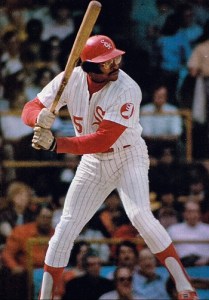
Dick Allen, .612 batter.
At the time I finally began reading Smart Baseball, I had concurrent occasion to review the late Dick Allen’s Hall of Fame case. (Two words: He belongs. I will show you soon enough that Allen, too, was a lifetime .600+ batter.) The review was instigated by a fellow online forum participant who said he didn’t want to see the Hall of Fame open to men like Allen who fell short of 3,000 lifetime hits. The fact that there are legitimate Hall of Famers who fall short of the Talismanic Three Thousand tends to elude recall on many occasions. (Feel free. Tell the world you think Babe Ruth has no business in the Hall of Fame because he didn’t reach the Talismanic Three Thousand, either.)
The Hall of Fame is (or should be) about greatness, and not compilation. So I looked closely at Allen’s record as it actually was. Yes, it’s true: Allen and his great contemporary, Tony Oliva, who also deserves to be in the Hall of Fame, came up short of 3,000 hits. What the hell, Allen and Oliva each came up short of 2,000 hits. Their careers were compromised enough by injuries that they didn’t get to experience the natural, expected decline phase great hitters usually experience.
What Allen did when healthy was beyond extraordinary. It only began with his rookie season comparing with extreme favour to Joe DiMaggio’s. We don’t consider Hall of Famers by what they could/might/would have done, but a fair calculation would tell you that injury-free Allen would likely have hit over 500 home runs and injury-free Oliva would likely have hit more than 300. But I digress.
Thus I began my review by asking myself what might be everything we should want to know about Allen at the plate. What did he bring to the table by himself that wasn’t team-dependent, as runs scored and runs batted in are? What was he doing during 983 trips to the plate that didn’t exist because they weren’t “official” at-bats?
(Down, boy/girl. You can’t score without hitting home runs unless the guys behind you in the lineup can drive you home. You can’t drive anyone home if the guys ahead of you can’t reach base in the first place—except yourself, when you hit one out with the bases empty. If you think you can, I’ve just taken a couple of grand off the price of that Antarctican beach club.)
I saw that we ought to look at Allen’s total bases, since that is the number that treats hits the way they should be treated—unequally. If you agree, right then and there you should hold the hitting average in contempt and sentence it to a couple of nights in the clink.
I saw that we should look at Allen’s walks, never mind the poor souls who think even today that they are either cheap, lazy, or both. It doesn’t seem to cross their minds that the batter with the eye acute enough and the concentration strong enough to stop him from swinging at pitches that can’t be hit—because they’re filthy enough to tie even a Hall of Famer into knots, because they’re out of the strike zones, because he lacks the reach, because he’s a batter and not a golfer or a tennis player—is superior to the batter who’ll swing at anything within sight, unless the latter is named Yogi Berra or Vladimir Guerrero. He’d rather reach base, anyway, than strike out swinging or whack into an out. Who the hell does he think he is?
I saw, too, that we should look at Allen’s intentional walks. Of course those are folded into his walk totals. But I believe, and so should you, that a batter should get all due extra credit when the other guys would rather he take his base than their pitcher’s head off.
I saw further that we should look at Allen’s sacrifice flies. They mean runs crossing the plate. Unlike the sacrifice bunt, a batter isn’t going up to the plate determined or under orders to hit into an out. He wants to rip a base hit or even a home run. Ted Williams didn’t spend his baseball career and afterlife preaching the virtues of sacrifice flying. (Except, most likely, after he agreed by implication to perform such flying when necessary as a Marine pilot.)
And, I saw even further that we should look at the times he was hit by pitches. If the pitcher is willing to drill him, or if the pitcher isn’t trying to drill him but an inside pitch collides with his assorted anatomy anyway, let it be to his credit and on the other guy’s head for letting him reach base on the house. Sure it shows up in his on-base percentage. But he didn’t take one for the team because he took a wild one off his globe in the on-deck circle. (Unless Dr. Anthony Fauci was pitching.)
When I first tinkered with Real Batting Average, I included sacrifice bunts. Then, I thought twice. Why on earth should I give credit for a deliberate, pre-meditated out, regardless of what that out is designed to accomplish? Because 1) there’s no guarantee that the man you just sacrificed is going to end up scoring. And, 2) I am against wasting outs. Outs to work with in baseball are commodities as precious as jadeite is on the mineral exchange. ($3 million a carat; yes, you can look it up.)
Give the other guys an out on the house, and you give yourself one less piece of extremely important wiggle room to put runs on the scoreboard. (Bunt in the ninth inning, when outs make jadeite look about as precious as aluminum foil, and someone should be beaten senseless—except that you can’t beat someone into a pre-existing condition.)
There’s only one time you and me should really want to see a bunt—when there’s one of those defensive overshifts in play, and the batter has acres and acres of yummy real estate offered up as a free gift. I’ll say it again: show me the batter who shenks the Sacred Unwritten Rules and pushes a bunt onto that terrain just begging to be homesteaded, and I’ll show you a man on first on the house.
Total bases. Bases on balls. Intentional bases on balls. (Never mind the still-new rule about just handing the man first base without having to throw four wide ones.) Sacrifice flies. Hit by pitches. Add those, and divide by total plate appearances. Recorded in math, the formula for this Real Batting Average (RBA from now on) isn’t extraterrestrial calculus:
TB + BB + IBB + SF + HBP
PA
A baseball editor of my acquaintance suggested that I was really headed toward just another way to measure weighted on-base average. But then I looked at the wOBA formula and noticed two things:
Thing One—wOBA assigns assorted numbers to unintentional walks, singles, doubles, triples, and home runs that aren’t the bases gained but are intended to suggest their value toward runs. (They fluctuate yearly, depending upon each season’s actual run creation, seemingly.) I get that.
Thing Two—wOBA removes intentional walks from the divisor that equals plate appearances. Remember: Extra credit if they want to put you on first instead of their pitcher into the mausoleum. (Grant that, as a formula, wOBA is a fruit cup compared to the chopped number salads Branch Rickey developed over half a century ago. But still.)
RBA addresses how the batter reached base in the first place. It goes deeper than the hitting average doing so. In that regard, why should a walk, a hit by pitch, or a single be fractions of bases or less than the bases gained with each act?
Now comes the fun part. I’m going to show you all 2019 players who qualified for the “batting title” in each league. (Why not 2020? Short season. Equivalent, more or less, to the first two-fifths of a full season, and wanting a full-season analysis I chose the most recent full season.) Now we’re going to see who the real batting champions were, based on the same 501 plate appearances required to qualify for the “batting title.”
First, the National League, in which 69 players had 501 plate appearances or more in 2019, and sixteen batted .600 or better:
| 2019 NL Qualifiers |
PA |
TB |
BB |
IBB |
SF |
HBP |
RBA |
| Christian Yelich |
580 |
328 |
80 |
16 |
3 |
8 |
.750 |
| Cody Bellinger |
661 |
351 |
95 |
21 |
4 |
3 |
.717 |
| Anthony Rendon |
646 |
326 |
80 |
8 |
9 |
12 |
.673 |
| Josh Bell |
613 |
300 |
74 |
13 |
7 |
5 |
.651 |
| Pete Alonso |
693 |
348 |
72 |
6 |
3 |
21 |
.649 |
| Nolen Arenado |
662 |
343 |
62 |
11 |
8 |
0 |
.640 |
| Eugenio Suarez |
662 |
329 |
70 |
4 |
6 |
11 |
.634 |
| Ketel Marte |
628 |
337 |
53 |
2 |
2 |
4 |
.633 |
| Anthony Rizzo |
613 |
266 |
86 |
3 |
3 |
27 |
.628 |
| Freddie Freeman |
692 |
328 |
87 |
11 |
2 |
6 |
.627 |
| Charlie Blackmon |
634 |
334 |
40 |
1 |
5 |
9 |
.614 |
| Bryce Harper |
682 |
292 |
99 |
11 |
4 |
6 |
.604 |
| Josh Donaldson |
659 |
286 |
100 |
2 |
2 |
8 |
.604 |
| Kyle Schwarber |
610 |
281 |
70 |
5 |
6 |
5 |
.602 |
| Trevor Story |
656 |
326 |
58 |
0 |
3 |
7 |
.601 |
| Max Muncy |
589 |
251 |
90 |
1 |
4 |
8 |
.601 |
| Joc Pederson |
514 |
242 |
50 |
2 |
2 |
12 |
.599 |
| Kris Bryant |
634 |
283 |
74 |
1 |
2 |
15 |
.591 |
| Jeff McNeil |
567 |
271 |
35 |
2 |
1 |
21 |
.582 |
| Ronald Acuna, Jr. |
715 |
324 |
76 |
4 |
1 |
9 |
.579 |
| Michael Conforto |
648 |
271 |
84 |
5 |
5 |
10 |
.579 |
| Mike Moustakas |
584 |
270 |
53 |
5 |
2 |
6 |
.575 |
| Justin Turner |
549 |
244 |
51 |
1 |
5 |
14 |
.574 |
| Yasmani Grandal |
632 |
240 |
109 |
2 |
5 |
5 |
.571 |
| Juan Soto |
659 |
297 |
65 |
3 |
6 |
3 |
.567 |
| Rhys Hoskins |
705 |
259 |
116 |
6 |
6 |
11 |
.565 |
| Javier Baez |
561 |
282 |
28 |
3 |
2 |
0 |
.561 |
| Eduardo Escobar |
699 |
325 |
50 |
3 |
10 |
3 |
.559 |
| Ozzie Albies |
702 |
320 |
54 |
6 |
4 |
4 |
.553 |
| Bryan Reynolds |
546 |
247 |
46 |
0 |
3 |
6 |
.553 |
| Christian Walker |
603 |
252 |
67 |
6 |
1 |
6 |
.551 |
| Ryan Braun |
508 |
232 |
34 |
1 |
3 |
8 |
.547 |
| Trea Turner |
569 |
259 |
43 |
2 |
2 |
3 |
.543 |
| Starling Marte |
586 |
271 |
25 |
1 |
4 |
16 |
.541 |
| Paul Goldschmidt |
682 |
284 |
78 |
2 |
3 |
2 |
.541 |
| J.T. Realmuto |
593 |
265 |
41 |
2 |
8 |
5 |
.541 |
| Starling Marte |
586 |
271 |
25 |
1 |
4 |
16 |
.541 |
| Corey Seager |
541 |
236 |
44 |
3 |
4 |
4 |
.538 |
| Marcell Ozuna |
549 |
229 |
62 |
2 |
1 |
1 |
.537 |
| Brian Anderson |
520 |
215 |
44 |
1 |
3 |
14 |
.533 |
| Jean Segura |
618 |
242 |
73 |
1 |
3 |
8 |
.529 |
| Manny Machado |
661 |
271 |
65 |
3 |
3 |
6 |
.526 |
| Paul DeJong |
664 |
259 |
62 |
1 |
6 |
13 |
.514 |
| Jason Heyward |
589 |
220 |
68 |
5 |
3 |
5 |
.511 |
| Ryan McMahon |
539 |
216 |
56 |
1 |
1 |
1 |
.510 |
| Nick Ahmed |
625 |
243 |
52 |
2 |
12 |
4 |
.501 |
| Evan Longoria |
508 |
198 |
43 |
1 |
5 |
7 |
.500 |
| Dexter Fowler |
574 |
199 |
74 |
1 |
4 |
8 |
.498 |
| Brandon Belt |
616 |
212 |
83 |
3 |
4 |
3 |
.495 |
| Joey Votto |
608 |
216 |
76 |
2 |
3 |
4 |
.495 |
| Kolten Wong |
549 |
202 |
47 |
5 |
5 |
13 |
.495 |
| Adam Eaton |
656 |
242 |
65 |
0 |
3 |
13 |
.492 |
| Dansby Swanson |
545 |
204 |
51 |
2 |
5 |
5 |
.490 |
| Kevin Newman |
531 |
220 |
28 |
2 |
1 |
7 |
.486 |
| Kevin Newman |
531 |
220 |
28 |
2 |
1 |
7 |
.486 |
| Wilson Ramos |
524 |
197 |
44 |
5 |
3 |
4 |
.483 |
| Victor Robles |
617 |
229 |
35 |
3 |
5 |
25 |
.481 |
| Colin Moran |
503 |
200 |
30 |
4 |
4 |
3 |
.479 |
| Kevin Pillar |
628 |
263 |
18 |
4 |
6 |
9 |
.478 |
| Starlin Castro |
676 |
277 |
28 |
2 |
9 |
3 |
.472 |
| Eric Hosmer |
667 |
263 |
40 |
3 |
5 |
3 |
.471 |
| Adam Frazier |
608 |
231 |
40 |
4 |
1 |
9 |
.469 |
| Amed Rosario |
655 |
266 |
31 |
2 |
3 |
3 |
.465 |
| Adam Jones |
528 |
201 |
31 |
2 |
3 |
8 |
.464 |
| Cesar Hernandez |
667 |
250 |
45 |
4 |
4 |
0 |
.454 |
| Jose Iglesias |
530 |
205 |
20 |
3 |
2 |
3 |
.440 |
| Lorenzo Cain |
623 |
209 |
50 |
0 |
4 |
6 |
.432 |
| Miguel Rojas |
526 |
183 |
32 |
2 |
5 |
5 |
.432 |
| Brandon Crawford |
560 |
175 |
53 |
5 |
4 |
3 |
.429 |
| Orlando Arcia |
546 |
173 |
43 |
5 |
6 |
1 |
.418 |
Now, the American League, in which 63 players had 501 plate appearances or more in 2019, and sixteen batted .600 or better:
| 2019 AL Qualifiers |
PA |
TB |
BB |
IBB |
SF |
HBP |
RBA |
| Mike Trout |
600 |
303 |
110 |
14 |
4 |
16 |
.745 |
| Nelson Cruz |
521 |
290 |
56 |
8 |
3 |
7 |
.699 |
| Alex Bregman |
690 |
328 |
119 |
2 |
8 |
9 |
.675 |
| Francisco Lindor |
654 |
310 |
98 |
9 |
6 |
3 |
.651 |
| George Springer |
556 |
283 |
67 |
1 |
4 |
6 |
.649 |
| Eddie Rosario |
590 |
281 |
86 |
2 |
6 |
0 |
.636 |
| Jorge Soler |
679 |
335 |
73 |
3 |
4 |
10 |
.626 |
| J.D. Martinez |
657 |
320 |
72 |
9 |
5 |
4 |
.624 |
| Austin Meadows |
591 |
296 |
54 |
6 |
0 |
7 |
.614 |
| Xander Bogaerts |
698 |
341 |
76 |
2 |
6 |
2 |
.612 |
| Carlos Santana |
686 |
295 |
108 |
12 |
2 |
3 |
.612 |
| Mookie Betts |
706 |
313 |
97 |
6 |
9 |
3 |
.606 |
| Rafael Devers |
702 |
359 |
48 |
7 |
2 |
4 |
.598 |
| Trey Mancini |
679 |
322 |
63 |
3 |
5 |
9 |
.592 |
| Yoan Moncada |
559 |
280 |
40 |
2 |
3 |
4 |
.589 |
| Jose Altuve |
548 |
275 |
41 |
0 |
3 |
3 |
.588 |
| Gleyber Torres |
604 |
292 |
48 |
3 |
6 |
3 |
.583 |
| Marcus Semien |
747 |
343 |
87 |
2 |
1 |
2 |
.582 |
| Yuli Gurriel |
612 |
305 |
37 |
2 |
6 |
5 |
.580 |
| Max Kepler |
596 |
272 |
60 |
0 |
4 |
8 |
.577 |
| Hunter Dozier |
586 |
273 |
55 |
2 |
5 |
3 |
.577 |
| Matt Chapman |
670 |
295 |
73 |
0 |
3 |
11 |
.569 |
| Danny Santana |
511 |
253 |
25 |
2 |
5 |
6 |
.569 |
| D.J. LeMahieu |
655 |
312 |
46 |
0 |
4 |
2 |
.556 |
| Brett Gardner |
550 |
247 |
52 |
0 |
3 |
4 |
.556 |
| Luke Voit |
510 |
199 |
71 |
2 |
1 |
9 |
.553 |
| Jose Abreu |
693 |
319 |
36 |
4 |
10 |
13 |
.551 |
| Eloy Jimenez |
504 |
240 |
30 |
0 |
2 |
4 |
.548 |
| Kole Calhoun |
632 |
258 |
70 |
7 |
2 |
7 |
.544 |
| Jose Ramirez |
542 |
231 |
52 |
3 |
6 |
2 |
.542 |
| Shin-Soo Choo |
660 |
256 |
78 |
3 |
1 |
18 |
.539 |
| Daniel Vogelbach |
558 |
203 |
92 |
2 |
2 |
2 |
.539 |
| Jorge Polanco |
704 |
306 |
60 |
2 |
7 |
4 |
.538 |
| Tommy Pham |
654 |
255 |
81 |
4 |
1 |
5 |
.529 |
| Tim Anderson |
518 |
253 |
15 |
0 |
2 |
3 |
.527 |
| Matt Olson |
547 |
263 |
51 |
7 |
1 |
12 |
.527 |
| Christian Vazquez |
521 |
230 |
33 |
3 |
3 |
0 |
.516 |
| Whit Merrifield |
735 |
315 |
45 |
9 |
5 |
4 |
.514 |
| Renato Nunez |
599 |
249 |
44 |
1 |
4 |
10 |
.514 |
| Avisail Garcia |
530 |
227 |
31 |
2 |
3 |
7 |
.509 |
| Jonathan Villar |
714 |
291 |
61 |
0 |
4 |
4 |
.504 |
| Domingo Santana |
507 |
199 |
50 |
1 |
2 |
2 |
.501 |
| Rougned Odor |
581 |
229 |
52 |
2 |
1 |
5 |
.497 |
| Andrew Benintendi |
615 |
233 |
59 |
1 |
5 |
7 |
.496 |
| Jackie Bradley, Jr. |
567 |
208 |
56 |
3 |
2 |
12 |
.496 |
| Randal Grichuk |
628 |
268 |
35 |
0 |
2 |
5 |
.494 |
| Albert Pujols |
545 |
211 |
43 |
1 |
8 |
3 |
.488 |
| Vlad. Guerrero, Jr. |
514 |
201 |
46 |
0 |
2 |
2 |
.488 |
| Michael Brantley |
637 |
289 |
51 |
3 |
4 |
7 |
.484 |
| Jurickson Profar |
518 |
188 |
48 |
2 |
3 |
8 |
.481 |
| Alex Gordon |
633 |
220 |
51 |
4 |
6 |
19 |
.474 |
| Willy Adames |
584 |
222 |
46 |
1 |
1 |
3 |
.467 |
| Miguel Cabrera |
549 |
196 |
48 |
4 |
5 |
3 |
.466 |
| Jason Kipnis |
511 |
188 |
40 |
2 |
6 |
2 |
.466 |
| Josh Reddick |
550 |
205 |
36 |
1 |
9 |
0 |
.456 |
| Khris Davis |
533 |
186 |
47 |
3 |
2 |
3 |
.452 |
| Hanser Alberto |
550 |
221 |
16 |
1 |
3 |
4 |
.445 |
| David Fletcher |
653 |
229 |
55 |
2 |
1 |
0 |
.440 |
| Elvis Andrus |
648 |
236 |
34 |
1 |
10 |
4 |
.440 |
| Leury Garcia |
618 |
218 |
21 |
0 |
3 |
11 |
.409 |
| Mallex Smith |
566 |
171 |
42 |
0 |
1 |
11 |
.398 |
| Yolmer Sanchez |
555 |
159 |
44 |
1 |
3 |
5 |
.382 |
Go ahead and say it. RBA says it. There were three .700+ batters in the Show in 2019. Maybe it’s time to quit saying baseball’s a game of 70 percent failure because RBA says baseball can be and sometimes is a game of 50, 60, 70 percent success.
When the Washington Nationals let Bryce Harper walk as a free agent and won the 2019 World Series in their first season without him, enough Nats and other fans crowed as if according to a script that lo! we were right, the Nats were better off with the guy who replaced him in right field to reach the Promised Land.
Oh? Aside from Harper hitting better in high leverage situations than Adam Eaton hit that year (Harper: 1.037 OPS; Eaton: .638 OPS), RBA says otherwise, too:
| |
PA |
TB |
BB |
IBB |
SF |
HBP |
RBA |
| Bryce Harper, 2019 |
682 |
292 |
99 |
11 |
4 |
6 |
.604 |
| Adam Eaton, 2019 |
656 |
242 |
65 |
0 |
3 |
9 |
.486 |
Harper’s detractors love to carp about his .276 lifetime hitting average. They loved snorting that the Philadelphia Phillies overpaid squared for him when he signed that $330 million/thirteen-year contract. Well, snort this:
| |
PA |
TB |
BB |
IBB |
SF |
HBP |
RBA |
| Bryce Harper, career to date |
4883 |
2088 |
733 |
89 |
40 |
31 |
.610 |
RBA says Harper is better than his detractors think, and that’s despite the injuries that often compromise his seasons. It also says that, sure, the 2019 Nats won the World Series without him, but they’d have had an easier time doing it with him. Harper’s not exactly Mike Trout’s level of all-around great (and Trout has dealt with a few injury issues himself), but a healthy Harper entering his age 28 season, and an on-base machine still, could find himself back on the Hall of Fame track soon enough.
How about some truly mad fun? Let’s examine through RBA all the Hall of Fame position players who played all or most of their careers in the post-World War II/post-integration/night-ball era.
For the sake of Dick Allen, who deserved the honour before his death in December 2020, I’ll include him and his great contemporary Tony Oliva. I’ll include Minnie Minoso—like Allen, he should have been elected to Cooperstown during his lifetime. (I would love to have Minoso’s complete Negro Leagues numbers to factor in, but the complete statistical story isn’t available yet.)
I’ll also include one man who would be in the Hall of Fame, if not for (ahem) the other stuff, including him among the men who played the position where he was actually the most valuable among the several positions he did play throughout his career. I’ll even include another man who would be in the Hall of Fame, if not for his other stuff, actual or alleged; I’ll consider just the seasons that even his most tunnel-visioned detractors acknowledge would have made him a Hall of Famer if he had just those seasons to show. (Please try to resist cracking wisenheimer when you see the result.)
And, just for fun, I’ll include further that certain Angel who’d be a no-questions-asked Hall of Famer if his career ended unexpectedly, right now, since his peak and career values a) are both higher than the average Hall of Fame center fielder; and, b) rank him the number five center fielder ever. You’ll see Allen, Oliva, Minoso, Mr. Other Stuff, Mr. Other Other Stuff, and That Certain Angel in bold.
There’s one catch, however—sacrifice flies. The sacrifice fly wasn’t made an official statistic until the 1954 season. Several of the following Hall of Famers played a third or more of their seasons prior to the rule coming on line. How to overcome that hole?
I tinkered with a few ideas until I tripped over a best-case scenario. I took those players’ numbers of recorded sacrifice flies and divided them by the number of seasons they played under the rule. Then, I took that result and multiplied it by the number of Show seasons they actually played. The formula is sacrifice flies (SF) divided by sacrifice fly-rule seasons (SRS), multiplied by MLB seasons. Or, if you insist on seeing it in mathematese:
SF / SRS x YRS
Thus I had as best as I could get to the total number of sacrifice flies you could have expected those players to hit all career long. I marked their sacrifice fly numbers with (*).
Now, on to those Cooperstown RBAs.
| Catchers |
PA |
TB |
BB |
IBB |
SF |
HBP |
RBA |
| Mike Piazza |
7745 |
3768 |
759 |
146 |
45 |
30 |
.613 |
| Roy Campanella |
4815 |
2101 |
533 |
113 |
50* |
30 |
.587 |
| Johnny Bench |
8674 |
3644 |
891 |
135 |
90 |
19 |
.551 |
| Yogi Berra |
8359 |
3643 |
704 |
91 |
95* |
52 |
.549 |
| Carlton Fisk |
9853 |
3999 |
849 |
105 |
79 |
143 |
.525 |
| Ted Simmons |
9,685 |
3793 |
855 |
188 |
100 |
39 |
.514 |
| Gary Carter |
9019 |
3497 |
848 |
106 |
99 |
68 |
.512 |
| Ivan Rodriguez |
10270 |
4451 |
513 |
67 |
76 |
58 |
.503 |
| HOF AVG |
.543 |
| First Base |
PA |
TB |
BB |
IBB |
SF |
HBP |
RBA |
| Jim Thome |
10313 |
4667 |
1747 |
173 |
74 |
69 |
.653 |
| Jeff Bagwell |
9431 |
4213 |
1401 |
155 |
102 |
128 |
.636 |
| Willie McCovey |
9692 |
4219 |
1345 |
260 |
70 |
69 |
.615 |
| Harmon Killebrew |
9833 |
4143 |
1559 |
160 |
77 |
48 |
.609 |
| Orlando Cepeda |
8698 |
3959 |
588 |
154 |
74 |
102 |
.561 |
| Eddie Murray |
12817 |
5397 |
1333 |
222 |
128 |
18 |
.554 |
| Tony Perez |
10861 |
4532 |
925 |
150 |
106 |
43 |
.526 |
| HOF AVG |
.593 |
| Second Base |
PA |
TB |
BB |
IBB |
SF |
HBP |
RBA |
| Jackie Robinson |
5804 |
2310 |
740 |
61 |
30* |
72 |
.550 |
| Joe Morgan |
11329 |
3962 |
1865 |
76 |
96 |
40 |
.533 |
| Ryne Sandberg |
9282 |
3787 |
761 |
59 |
71 |
34 |
.507 |
| Roberto Alomar |
10400 |
4018 |
1032 |
62 |
97 |
50 |
.506 |
| Craig Biggio |
12504 |
4711 |
1160 |
68 |
81 |
285 |
.504 |
| Rod Carew |
10550 |
3998 |
1018 |
144 |
44 |
25 |
.496 |
| Red Schoendienst |
9224 |
3284 |
606 |
30 |
38* |
21 |
.431 |
| Nellie Fox |
10351 |
3347 |
719 |
30 |
76* |
142 |
.417 |
| Bill Mazeroski |
8379 |
2848 |
447 |
110 |
70 |
20 |
.417 |
| HOF AVG |
.484 |
| Shortstop |
PA |
TB |
BB |
IBB |
SF |
HBP |
RBA |
| Ernie Banks |
10395 |
4706 |
763 |
202 |
96 |
70 |
.562 |
| Barry Larkin |
9057 |
3527 |
939 |
66 |
67 |
55 |
.514 |
| Cal Ripken |
12883 |
5168 |
1129 |
107 |
127 |
66 |
.512 |
| Derek Jeter |
12602 |
4921 |
1082 |
39 |
58 |
170 |
.498 |
| Robin Yount |
12249 |
4730 |
966 |
95 |
123 |
48 |
.487 |
| Alan Trammell |
9376 |
3442 |
850 |
48 |
76 |
37 |
.475 |
| Pee Wee Reese |
9470 |
3038 |
1210 |
67 |
64* |
26 |
.465 |
| Phil Rizzuto |
6719 |
2065 |
651 |
35 |
26* |
49 |
.416 |
| Ozzie Smith |
10778 |
3084 |
1072 |
79 |
63 |
33 |
.402 |
| Luis Aparicio |
11230 |
3504 |
736 |
22 |
76 |
27 |
.387 |
| HOF AVG |
.472 |
| Third Base |
PA |
TB |
BB |
IBB |
SF |
HBP |
RBA |
| Mike Schmidt |
10062 |
4404 |
1507 |
201 |
108 |
79 |
.626 |
| Chipper Jones |
10614 |
4755 |
1512 |
177 |
97 |
18 |
.618 |
| Dick Allen |
7315 |
3379 |
894 |
138 |
53 |
16 |
.612 |
| Eddie Mathews |
10100 |
4349 |
1444 |
142 |
58 |
26 |
.596 |
| George Brett |
11625 |
5044 |
1096 |
229 |
120 |
33 |
.561 |
| Ron Santo |
9397 |
3779 |
1108 |
94 |
94 |
38 |
.544 |
| Wade Boggs |
10740 |
4064 |
1412 |
180 |
96 |
23 |
.538 |
| Paul Molitor |
12167 |
4854 |
1094 |
100 |
109 |
47 |
.510 |
| Brooks Robinson |
11782 |
4270 |
860 |
120 |
114 |
53 |
.458 |
| HOF AVG |
.563 |
| Left Field |
PA |
TB |
BB |
IBB |
SF |
HBP |
RBA |
| Ted Williams |
9788 |
4884 |
2021 |
243 |
57* |
39 |
.740 |
| Barry Bonds |
7403 |
3343 |
1227 |
260 |
62 |
42 |
.666 |
| Ralph Kiner |
6256 |
2852 |
1011 |
90 |
40* |
24 |
.642 |
| Willie Stargell |
9027 |
4190 |
937 |
227 |
75 |
78 |
.610 |
| Billy Williams |
10519 |
4599 |
1045 |
182 |
73 |
43 |
.565 |
| Jim Rice |
9058 |
4129 |
670 |
77 |
94 |
64 |
.556 |
| Carl Yastrzemski |
13992 |
5539 |
1845 |
190 |
105 |
40 |
.552 |
| Minnie Minoso |
7713 |
3023 |
814 |
43 |
85* |
192 |
.539 |
| Rickey Henderson |
13346 |
4588 |
2190 |
61 |
67 |
98 |
.525 |
| Tim Raines |
10359 |
3771 |
1330 |
148 |
76 |
42 |
.518 |
| Pete Rose |
15890 |
5752 |
1566 |
167 |
79 |
107 |
.483 |
| Lou Brock |
11240 |
4238 |
761 |
124 |
46 |
49 |
.464 |
| HOF AVG |
.563 |
| Center Field |
PA |
TB |
BB |
IBB |
SF |
HBP |
RBA |
| Mike Trout |
5514 |
2642 |
838 |
104 |
52 |
84 |
.675 |
| Mickey Mantle |
9907 |
4511 |
1733 |
148 |
47 |
13 |
.651 |
| Willie Mays |
12496 |
6066 |
1464 |
214 |
91 |
44 |
.631 |
| Ken Griffey, Jr. |
11304 |
5271 |
1312 |
246 |
102 |
81 |
.620 |
| Duke Snider |
8237 |
3865 |
971 |
154 |
54* |
21 |
.615 |
| Larry Doby |
6299 |
2621 |
871 |
60 |
39* |
38 |
.576 |
| Andre Dawson |
10769 |
4787 |
589 |
143 |
118 |
111 |
.534 |
| Kirby Puckett |
7831 |
3453 |
450 |
85 |
58 |
56 |
.524 |
| Richie Ashburn |
9736 |
3196 |
1198 |
40 |
30* |
43 |
.463 |
| HOF AVG |
.588 |
| Right Field |
PA |
TB |
BB |
IBB |
SF |
HBP |
RBA |
| Stan Musial |
12718 |
6134 |
1599 |
298 |
110* |
53 |
.644 |
| Larry Walker |
8030 |
3904 |
913 |
117 |
65 |
138 |
.640 |
| Vladimir Guerrero |
9059 |
4506 |
737 |
250 |
64 |
103 |
.625 |
| Frank Robinson |
11742 |
5373 |
1420 |
218 |
102 |
198 |
.624 |
| Henry Aaron |
13941 |
6856 |
1402 |
293 |
121 |
32 |
.624 |
| Reggie Jackson |
11418 |
4834 |
1375 |
164 |
68 |
96 |
.573 |
| Al Kaline |
11596 |
4852 |
1277 |
133 |
104 |
55 |
.554 |
| Dave Winfield |
12358 |
5221 |
1216 |
172 |
95 |
25 |
.545 |
| Tony Oliva |
6880 |
3002 |
448 |
131 |
57 |
59 |
.537 |
| Roberto Clemente |
10211 |
4492 |
621 |
167 |
66 |
35 |
.527 |
| Tony Gwynn |
10232 |
4259 |
790 |
203 |
85 |
24 |
.524 |
| HOF AVG |
.583 |
| Designated Hitter |
PA |
TB |
BB |
IBB |
SF |
HBP |
RBA |
| Frank Thomas |
10075 |
4550 |
1667 |
168 |
121 |
87 |
.654 |
| Edgar Martinez |
8674 |
3718 |
1283 |
113 |
77 |
89 |
.609 |
| Harold Baines |
11092 |
4604 |
1062 |
187 |
99 |
14 |
.538 |
| HOF AVG |
.600 |
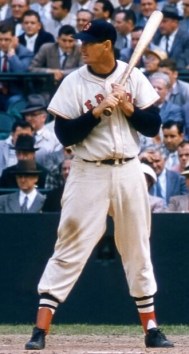
Ted Williams–The Red Sox didn’t have too many teams for their .740 batter to be proud of, either.
You notice that there’s only one among the Hall of Famers of this era who batted .700+ lifetime. Twenty-one others (including Trout) batted .600+ lifetime. The middle-infield Hall of Famers average to sub-.500 RBAs. The center fielders and right fielders are tied for the most .600+ batters among them (five each). But am I the only one shocked to see three .600+ batters among third basemen, who play one of the harshest positions around the infield?
You might notice, too, that the largest distinction for any position between the average RBA and the lowest RBA is Richie Ashburn (-113), while the highest such distinction is Ted Williams (+177). But I’ll bet you didn’t think Mike Trout’s first ten Show seasons would finish with him owning the second-highest RBA among all incumbent or in-waiting Hall of Famers, including the untainted version of Barry Bonds.
There are other factors to consider when measuring these players objectively. Some players are in Cooperstown as much or more because of their defense as their work at the plate. (See Bill Mazeroski, Ozzie Smith, and Brooks Robinson.) Several have bucketfuls of black ink. A few got there as much because of what they did after reaching base as what they did at the plate and/or in the field. (Jackie Robinson turned baserunning into guerrilla warfare whether or not he stole a base; Luis Aparicio returned the stolen base as a prime weapon in the mid-1950s; Lou Brock swiped Ty Cobb out of the career stolen base record; and, Rickey Henderson did likewise to Brock.)
We may also ponder the point that Roy Campanella, Ryne Sandberg, Jackie Robinson, Pee Wee Reese, Ernie Banks, Ron Santo, Billy Williams, and Duke Snider might lose RBA points if only through total bases if they played more of their careers in homes other than bandbox ball parks. So might Larry Walker if his six seasons in Coors Canaveral had been played elsewhere, even in a neutral park, though observed fairly those plunks he took for his teams probably inflate his RBA, too.
We might see likely RBA spikes for Jeff Bagwell, Craig Biggio, and Joe Morgan if much of their home cooking wasn’t served in the Astrodome. Or, for Gary Carter, if so much of his wasn’t served in two killer kitchens named Olympic Stadium (Montreal) and Shea Stadium (New York). Maybe even for Trout, who is devilishly close to being the same in both hitter-unfriendly Angel Stadium and on the road:
| Mike Trout RBA Splits |
PA |
TB |
BB |
IBB |
SF |
HBP |
RBA |
| Home |
2696 |
1273 |
444 |
58 |
26 |
41 |
.683 |
| Road |
2818 |
1369 |
394 |
46 |
26 |
43 |
.666 |
Did you realise that Frank Robinson, Henry Aaron, and Vladimir Guerrero could be that exact a trio of matches when it came to their whole pictures? It should also be comforting that—bandbox home park or otherwise—RBA helps settle once and for all an argument that was stupidity personified no matter when it was waged, and it was waged too damn often in the past: Jackie Robinson would be a Hall of Famer even if he was white.
You may have noticed that the so-called Hit King—if he hadn’t written the script himself that keeps him out of the Hall of Fame—would be the second-lowest RBA among Hall of Fame left fielders. You may have noticed, too, that the guy who’s blocked from Cooperstown because of continuing suspicion about actual or alleged performance-enhancing substances would have the number two RBA among the left fielders behind Teddy Ballgame.
Christian Yelich and Ketel Marte led the 2019 National League with their .329 hitting averages. Tim Anderson led the 2019 American League with his .335 hitting average. But Yelich in the National League and Mike Trout in the American League were the true 2019 batting champions.
Says who? Says Real Batting Average, says who.
—————————————————————–
(1) Branch Rickey, “Goodby to Some Old Baseball Ideas”; Life, 1954.



 Throneberry Fields Forever