Yes he did pitch a no-hitter. Wanna fight?

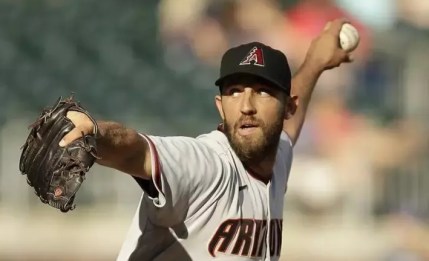
Madison Bumgarner

Bumgarner won’t get credit for his no-hitter because . . . seven innings, in a doubleheader now mandated as two seven-inning games. But he damn well should get it.

Repeat after me: Madison Bumgarner pitched a no-hitter Sunday afternoon. Madison Bumgarner pitched a no-hitter Sunday afternoon. See? Simple, and appropriate.

The carpers carp that MadBum won’t and shouldn’t get credit for a no-hitter because of the seven-inning rule applied to doubleheader games. That’s almost as bad as saying Bumgarner himself decided to help make the rule so let it be on his head and to his discredit. They’re both false, too.

Bumgarner worked his seven innings, struck out seven, and might have had a perfect game if not for Diamondbacks shortstop Nick Ahmed’s throwing error on Braves second baseman Ozzie Albies’s grounder leading off the bottom of the second. MadBum’s mates gave him a cozy five-run lead before he even had to throw a pitch, then tacked on single runs in the third and the sixth.

The lefthander with the 747 wingspan spread as he’s about to deliver is being cheated out of his propers because of a strange contradiction. A 1991 rules change declared no-hitters to be nothing less than nine innings with the pitcher finishing on the winning side. That was prodded by Yankee pitcher Andy Hawkins’s no-hit loss to the White Sox in Chicago, where he didn’t have to pitch the ninth.

The rule changers then didn’t ponder what didn’t occur to them, the wherefores of un-hit pitchers in official games made less than nine innings by future rule changes. Such as the pan-damn-ic safety protocols prompting makeup games required for any reason being parts of doubleheaders and going only seven innings each.

That doubleheader rule was held over for this season, of course. When last I looked, those between the commissioner’s office and the Major League Baseball Players Association who agreed to keep such doubleheaders this year didn’t include Madison Bumgarner.

So playing within both the 1991 no-hitter rule adjustment and the pan-damn-ic doubleheader innings limit does him no favours. He gets credit for a complete game but not a no-hitter. Bumgarner wuz robbed.

Let me go back on record right now to say again that I approve of doubleheaders with seven-inning games—because they make just plain common sense. Old Fart Contingency members who denounce them as just more kowtowing to candy-ass contemporary players are invited hereby to stuff those denunciations, then learn or re-learn a little baseball history.

In Game of Inches, Peter Morris—a baseball historian whose specialty is the earliest baseball generations and the debunking of longtime myths about them—recorded that the doubleheader actually predated the professional game, until it died awhile because when the game went professional team ownerships felt a little (ho ho) funny about two for the price of one keeping money out of their kitties.

“When the National Association began in 1871, there were no doubleheaders. Nor were there any the next year,” noted The Hardball Times‘s Chris Jaffe in 2010. “Professional baseball had its first one in 1873, and it would prove to be the only one in the five-year history of the NA. It took place on the Fourth of July, which was fitting because this would quickly become one of the great days for doubleheaders in baseball.”

Fast forward. The ancient American Association challenged the National League as a major baseball league. By 1891, the upstarts finally so inspired the National League that, in that season, the NL played more doubleheaders than the AA.

Mostly a holiday occurrence at first (Jaffe notes Memorial Day 1883 as the first time all Show teams played doubleheaders on the same day), the full decade of the 1890s showed the National League—having it all to itself with the AA’s collapse—playing doubleheaders a quarter of the time all decade long.

Oh, yes. There was one distinctive trend within the NL’s growing doubleheader friendliness: the bottom-feeding teams played the most doubleheaders. “This was an especially important development, because it remained true for decades,” Jaffe observed.

That makes sense if you think about it. Poor teams need an added inducement to convince the fans to come out and see them. Perhaps more importantly, when they traveled on the road their opponents needed an extra bit of persuasion to convince rooters to see what promised to be some lackluster on-field performances.

After the American League formed and joined in the Show fun, times came when teams often played 25 doubleheaders a season and sometimes more. The doubleheader had far less to do with the good of the game than with making money for the owners—especially those owning the also-ran teams who needed whatever they could get to draw fans at home, and those owning the more powerful teams who needed to draw fans when the also-rans came to town.

The Great Depression really exposed that one. From 1930-34, the National League teams averaged 36 percent a year’s schedule in doubleheaders and the American League teams, 30 percent. During World War II, the NL’s teams averaged 46 percent of their schedule in doubleheaders and the American League’s teams, 45 percent—including AL teams playing practically half their schedule in doubleheaders in 1943 and the NL teams doing likewise in 1945.

If a National League team had played just one more doubleheader, it would have meant over half the league’s games being played in twin bills.

Naturally enough, nobody gave much thought to what it might take out of players to play so many doubleheaders in a season. Especially the 1943 White Sox. For whatever reasons, those White Sox alone played an unconscionable 44 doubleheaders. Those included eleven in July, eleven between September’s beginning and the 1 October regular-season finish, and 27 pairs of doubleheaders played either on back-to-back days or with an off-day between them.

Never mind Hall of Famer Ernie Banks’s fabled watchword, “It’s a beautiful day—let’s play two!” You try thinking about playing 36 innings of baseball in two or three days by design rather than by extra innings happenstance. You might be at least as exhausted thinking about it as the men who played those innings in that stretch must have been playing them.

Doubleheaders began fading away little by little by the end of the 1950s. But it’s to wonder why baseball’s overlords of the era previously discussed didn’t even think about considering seven-inning games for doubleheader days. The ’43 White Sox played 774 innings worth of doubleheaders before extra-inning games are considered (eight times a White Sox doubleheader game went to extras that year); if they’d been seven-inning games, they would have played 602 doubleheader innings.

Discussing in February the pan-damn-ically inspired rule changes that should be kept or dumped, CBS Sports writer Mike Axisa applauded keeping doubleheaders of seven-inning games:

Games are going to be postponed, potentially a lot of games, and they will have to be made up at some point later in the season. We saw teams play three doubleheaders in a single week at times last year. MLB has to assume something like that will happen again, in which case seven-inning doubleheaders are a necessity. You can’t ask players to run themselves into the ground like that.

. . . [O]f all the 2020 rule changes MLB and the MLBPA should consider for 2021, this is the one that most has to happen . . . It’s less wear and tear on the players, and less time at the park equals less exposure to the pandemic for players, coaches, stadium workers, and fans. Seven-inning doubleheaders are a must.

They should be a must even beyond the eventual end of the pan-damn-ic. Especially for the reason Axisa said primarily. Baseball players aren’t automatons who can play endlessly, no matter what the Old Fart Contingent thinks or maybe even wishes. They’re human beings, with human limitations, no matter how much baseball talent and skill they bring while it’s there for them to bring. (“By the time you finally learn how to play,” mammoth bombardier Frank Howard once said, “you can’t play anymore.”)

Forget how much money they’re earning. Forget Hall of Famer Willie Stargell’s memorable observation, during a long and arduously-traveled road trip, “The umpire doesn’t say, ‘Work ball’.” Professional baseball requires hard work to play. It’s not a question of just suiting up, going out to play seven or nine innings, then changing clothes with a shower and heading home.

Madison Bumgarner went to the mound Sunday in a lawfully-scheduled seven-inning game under rules he didn’t make . . . and didn’t surrender a single hit. He earned credit for the win. The 1991 no-hitter rule change didn’t account for arbitrarily but necessarily changed structures of doubleheaders, and Bumgarner didn’t ask for a seven-inning game to start half a twin bill.

Officially, MadBum gets credited with a complete game. Also officially, he gets no credit for a no-hitter. If you can tell me how much sense that makes without tripping over both of us, you’re a better manperson than I. Far as I’m concerned, the seven-inning doubleheader needs to stay beyond the pan-damn-ic . . . and Madison Bumgarner damn well did pitch a no-hitter.

Tatis and Bauer continue defunding the Fun Police

Fernando Tatis, Jr.; Trevor Bauer

Trevor Bauer (27) wasn’t thrilled about surrendering bombs to Fernando Tatis, Jr.—but Bauer didn’t mind Tatis trolling him over them, either.

If the Dodgers and the Padres are really brewing baseball’s best rivalry since the Dodgers and the Giants, or the Yankees and the Red Sox, you can count on one less Fun Police officer overloading the Tabasco sauce. Turns out that the sense of humour of Trevor Bauer, Dodger pitcher, includes taking his lumps in the troll department.

Padres shortstop Fernando Tatis, Jr. accounted for the only two runs Bauer allowed Friday night with a pair of delicious looking home runs. He hit the first in the top of the first, sending a slightly hanging cutter clean over the left center field fence on the second pitch of the game.

After rounding first, Tatis put his right hand over his eye as he turned around toward the mound, then turned to continue running it out. When he hit the second bomb in the top of the sixth, following a six-pitch, full count wrestling match, Tatis crossed the plate with a move made familiar to UFC fans by Conor McGregor. It just so happens to be the move Bauer himself busts after he has a particularly controlling inning’s work.

By his own admission Bauer missed the hand-over-eye move, which referenced Bauer’s own one-eyed pitching against the Padres during a spring training contest, but he couldn’t help noticing the Padres dugout covering single eyes after Tatis’s second homer landed about three or four rows up the left center field bleachers.

Bauer didn’t mind any of the moves at all. In fact, talking to reporters after the game, which the Dodgers yanked out to win 5-4 despite Tatis’s mayhem, the righthander whose own trolling stones make him as controversial as he is colourful sent a message to every other pitcher on the third stone from the sun who thinks letting the kids play is tantamount to heresy.

“I like it. I think that pitchers who have that done to them and react by throwing at people, or getting upset and hitting people or whatever — I think it’s pretty soft,” Bauer told reporters after the game. “If you give up a homer, the guy should celebrate it. It’s hard to hit in the big leagues. So, I’m all for it. And I think it’s important that the game moves in that direction, and we stop throwing at people because they celebrated having some success on the field.”

Where was Bauer when the Cardinals got soft on Nick Castellanos a couple of days after Castellanos smashed a home run off Jack Flaherty? When Jack Woodford drilled him with a pitch, then bumped him as he crossed the plate beneath a sliding tag attempt, before Castellanos sprung up from his slide, barked a bit at Woodford, then started walking away from the plate area when Yadier Molina returned to the plate area and gave Castellanos a shove by his neck—when Castellanos wasn’t even looking behind him?

Rest assured, Bauer would have had a lecture to deliver Madison Bumgarner two years ago, after Max Muncy launched one of his first-inning services into McCovey Cove. “Don’t watch the ball—run!” Bumgarner barked. Rounding first and heading to second as he ran it out, Muncy by his own admission hollered back, precisely, “If you don’t want me to watch the ball, go get it out of the ocean.”

Perhaps if Bauer was a Dodger then, he’d have been the first to buy the blue T-shirt that hit the ground flying after that, with “Go Get It Out of the Ocean” emblazoned in white, over an upside-down reproduction of the flying baseball that’s part of the Dodgers’ official team logo.

Bauer knows Tatis has reasons enough to celebrate his handiwork lately. Friday night’s flogs came one night after the kid who’s must-see television did what no major leaguer had done before—hit a pair of bombs on the 22nd anniversary date of his father hitting a pair of salamis in the same inning against the same opponent.

Friday night also made Tatis the first player to hit a pair of bombs on back-to-back nights against Cy Young Award-winning pitchers, says the Elias Sports Bureau. On the anniversary of Pop’s pops, Tatis wreaked his two-bomb havoc on Clayton Kershaw’s dollar.

Tatis returned Bauer’s compliment, whether or not he’d actually heard Bauer say it immediately. “Payback time,” the lad told reporters, referencing Bauer’s one-eyed-jack pitching in that spring game.

It’s just fun. When you know you’re facing a guy like that — he’s doing his stuff, he’s having fun on the mound, and when you get him you get him, and you celebrate, too. He’s a hard guy to deal with.

Bauer didn’t even mind when Padres first baseman Eric Hosmer got even in the sixth for what Bauer did in the fourth. Hosmer struck out awkwardly in the fourth and Bauer delivered his pulling-the-sword-out bit, “sword” considered contemporary baseball lingo for the broken swing a hitter often delivers when he’s been fooled like a rookie on a pitch. In the sixth, though, Hosmer nearly drilled a hole in Bauer with a hard liner up the pipe, then pulled a sword of his own out after reaching first.

Once again, Bauer had no intention of ducking into a nearby phone booth and changing from your everyday not-so-mild-mannered pitcher into the Fun Cop ready to clunk all miscreants with his nightstick and drag them off to the hoosegow.

“That’s what it is to be a competitor,” the righthander said. “I’m gonna go at you. I’m gonna get you sometimes, and you’re gonna get me sometimes. We can have fun, we can celebrate it while we’re still competing at the highest level. I just thought that was important to note tonight.”

I’ve been saying for how long that pitchers need to start thinking, “Hey, you got me good this time. Have your fun. I’ll get you out the next time, and I’ll have my fun?” I’m not even close to the only one. There was Sean Doolittle two years ago, when he was still a hard-toiling and popular National. “If a guy hits a home run off me, drops to his knees, pretends the bat is a bazooka, and shoots it out at the sky, I don’t give a shit,” he said emphatically in an interview I cited at the time.

When you’re in the backyard as a kid playing and falling in love with the game and you crush the ball? You do a celebration. You stand and watch it like Ken Griffey, Jr. You don’t hit the ball and put your head down and run as fast as you can. That’s not fun. It’s okay to embrace that part of a game.

To which I wrote, myself, “I hope a lot of hitters drop to one knee and point their bats to the sky like bazookas when they hit one out. I hope a lot of pitchers start channeling their inner Dennis Eckersley and start fanning pistols after they strike someone out. I’d kill to see a hitter moonwalk around the bases after hitting one out. Let’s see more keystone combinations chest bump or make like jugglers after they turn a particularly slick and tough double play.”

The new Murphy’s Law ought to be, “Celebrate!” Said Dale Murphy himself, in one of his first essays as a contributor to The Athletic. It must have sent the Fun Police to the whiskey bottles when Murphy called out Bumgarner over that Muncy waterball:

Admiring a home run is OK. Bat-flipping is OK. Emotion is OK. None of that is a sign of poor sportsmanship or disrespect for an opponent. It’s a celebration of achievement — and doing so should not only be allowed, but encouraged. Pitchers can shout excitedly after an important out. They can pump their fist after a clutch strikeout. Players, fans—and basically any rational-thinking human—will understand that no harm is intended by these spontaneous expressions of joy.

Wouldn’t you love to know what Bauer thought, when the Rangers decided it was right and proper to wait, until near the end of the final game of their final season series against the Blue Jays in May 2016, to repay Jose Bautista for an epic bat flip the previous October?

Bautista hit a monstrous three-run homer in the seventh to give the Jays a 6-3 lead that held up to send them to the previous American League Championship Series. He flipped his bat whirlybird style as he left the plate to run it out. Rogers Centre went nuclear. The Rangers pitcher who surrendered that bomb, Sam Dyson, spoke as a Fun Policeman after the game.

“Jose needs to calm that down, just kind of respect the game a little more,” Dyson said after the game. “He’s a huge role model for the younger generation that’s coming up playing this game, and I mean he’s doing stuff that kids do in Wiffle ball games and backyard baseball. It shouldn’t be done.” (I couldn’t resist rejoining, “That’s how many kids playing Wiffle ball who grow up to hit postseason-advancing skyrockets?”)

Bautista was hit by a pitch late in that mid-May 2016 game. Then, he delivered a hard slide at second to let the Rangers know he didn’t appreciate the too-long-delayed “message.” Then he had to bear the brunt of the followup brickbats when Rougned Odor swung on him. Pretty soft? The Rangers were squishy cowards in tough guy clothing behind Mommy’s dress when Matt Bush—a relief pitcher who wasn’t even a Ranger in October 2015—delivered that seven-months delayed drill.

Bauer has his faults. Misogynistic harassment of women online is known to be one of them. But he’s never been accused of being physically abusive with any woman he’s dated or associated with. The Dyson who demanded Bautista “just kind of respect the game a little more” is the one who got suspended for this season for abusing his former girlfriend.

You can hear the Old Fart Contingent [OFC] who didn’t or don’t play the game fuming about Respect For The Game, too. Most of the same OFC want to see players treat baseball like Serious Business on the field or at the plate or around the bases—but they  become the first to scream, “It’s a [fornicating] game!” when it’s free agency contract time.

Bauer and Tatis have just fired off significant shots in what should be a continuing, baseball-wide campaign to defund the Fun Police. The defunding shouldn’t be limited to players alone.

No, it wasn’t Baldelli’s fault

Luis Arraez

This off-balanced throw from third by Luis Arraez finished what Travis Blankenhorn’s bobble at second started for the Twins Wednesday. Neither was the manager’s fault.

Sometimes you can believe to your soul that second-guessing is in a dead heat with cheating as baseball’s oldest profession. Twins manager Rocco Baldelli may be re-learning the hard way since Wednesday’s 13-12 loss against the Athletics.

All Baldelli did was make one smart move in the top of a tenth inning the Twins shouldn’t have had to play in the first place . . . and watch in horror with every Twin fan in creation when it blew up in his face in the bottom of the tenth. Through absolutely no fault of his own.

Baldelli inserted a speedy young pinch runner, Travis Blankenhorn, for his slower free half inning-opening cookie Josh Donaldson. He found himself with a swift and fresh two-run lead after Byron Buxton, who may yet prove the Twins’ answer to Mike Trout, hit a two-run homer to return the Twins a two-run lead.

With Donaldson out of the game Baldelli shifted his second base incumbent Luis Arraez to third and inserted Blankenhorn at second. Bottom of the tenth: the pillows stuffed with A’s after Twins reliever Alex Colome walked veteran Elvis Andrus to load them up after he opened the inning with two outs and nobody on.

Then A’s left fielder Mark Canha whacked a none-too-sharp grounder right to Blankenhorn. And Blankenhorn—with double play obviously on his mind—lost his grip on the ball as he made a right-arm motion to throw without the ball secure in hand, the ball hitting the ground and A’s inning-opening free cookie Matt Chapman coming home.

And then Arraez double-clutched before throwing Ramon Laureano’s grounder with his right leg slightly unbalanced. The throw sailed wide enough behind first base to pass a train through the space, but this time the only things passing through were Andrus and pinch-runner Tony Kemp scoring the tying and winning runs.

The A’s ought to send Colome roses for really enabling the sweep that shouldn’t have been. Twin Territory ought to knock it off with hanging the goat horns on Baldelli’s none-too-bald head.

This game had no business getting to the extra innings in the first place. Not until Colome opened the bottom of the ninth by hitting Laureano with a pitch, continued by surrendering a one-out base hit to Matt Olson roomy enough for Laureano to take third, and finished by surrendering a game-tying sacrifice fly to Chapman. Picking Olson off for the side with Stephen Piscotty at the plate didn’t quite atone for Colome’s original sin.

“It’s just baseball and it’s hard to understand,” said Laureano, taking the simpler view. “We were still loose and having fun, so we knew we would win.”

“The way the first two games went and then neither team could hold either down,” said A’s manager Bob Melvin after putting his gift an an eleven-game A’s winning streak safely in the bank, “it was almost like it was going to go down to the last at-bat regardless. And then you know what? You put a ball in play. At that point in time it’s not about walks and strikeouts and all that. Put it in play and something good can happen.”

That’s a matter of opinion, of course. Put a ball in play and something terrible can happen, too. If you’re an A’s fan, something wonderful happened. If you’re a Twins fan, you might want to think back to why the game shouldn’t have gotten to the extras in the first place.

For Baldelli to want some extra speed on the bases to open the top of the tenth wasn’t even close to the dumbest baseball move you’ll see. Blankenhorn had an .844 stolen base percentage in the minors. He was also a rangy enough second baseman who projected as a potential plus defender particularly adept at turning double plays.

You want to blame Baldelli for a rookie mistake, feel free. But a rookie mistake is just what Blankenhorn committed on the Canha grounder. A guy who turned 120 double plays in the minors should have remembered not to count his double plays before he turns them.

Arraez hasn’t played half the Show games at third that he’s played at second, and he isn’t the rangiest man on the planet at either position. But what he reaches or comes right to him, he handles under normal circumstances. Over three Show seasons Arraez entered Wednesday’s game with a measly four errors.

“In extra innings, if you don’t find a way to put a run on the board, you’re going to end up losing a lot of those games,” Baldelli told reporters after the game. “Doing everything possible to put that first run on the board is, I think, instrumental to finding ways to win those games.”

He did just what he thought possible opening the tenth and got immediate return when Buxton turned on Lou Trivino’s meatball up and drove it about seven rows into the high left center field seats.

And that was after Buxton spent the earlier portion of his evening going 2-for-5 with a double and taking an Olympics-like dive to spear Olson’s long sinking liner for the side, in the bottom of the sixth, preserving what was then a 10-9 Twins lead. Not to mention Nelson Cruz’s two-bomb night.

The Twins’ Wednesday starting pitcher, Kenta Maeda, the former Dodger, blamed himself for the disaster, after surrendering seven runs (three in the second, four in the third) to tie his career worst. “I could not set the tone,” he mourned. “If I had done that, we would have gotten that W.”

Yet the Twins hung up three-spots in the third, fifth, and sixth, after Donaldson himself hit A’s starter Frankie Montas’s first pitch over the left field corner fence in the top of the first.  That’d teach him.

“It’s been a hell of a trip, and not in a good way,” Baldelli said of the Twins’ now-concluded road trip, which involved postponements against the Angels due to COVID concerns followed by a loss to those Angels and now three straight losses to the A’s.

“Today was a game where we’re finding ways to not win games, even games that we should be winning,” he told the postgame questioners. “What we saw today is something we haven’t seen a ton from our group, and I stand in the front of it and take responsibility for all of it. It was a very difficult day.”

It wouldn’t have been that difficult if his man on the mound held fort in the ninth and his tenth-inning smarts weren’t rendered dumb by an anxious rook and an off-balance leg at third. Those mistakes can make Casey Stengel resemble Clyde Crashcup.

On top of old Smoky

Pablo Sandoval

Kung Fu Panda’s become Kung Fu Pincher this season . . .

Pablo Sandoval is making more noise at the plate this season than he’s made since the 2012 World Series. Some guys are lucky to hit one pinch home run? Sandoval’s hit three of them in twelve plate appearances in the role. Some guys are lucky to hit .250 in the role? He’s  hitting .333 with a 1.833 OPS in the role so far this year.

As a matter of fact, Sandoval’s lifetime slash line as a pinch hitter (he’s batted in the role 149 times) is .309/.362/.537 with an .899 OPS. Full-time players with career slash lines like that might fantasise about their Hall of Fame plaques, sooner or later.

At 34, who would have thought Kung Fu Panda—the roly-poly third baseman who hit like a Hall of Famer one minute (especially when he blasted three home runs in Game One of the 2012 World Series) but looked like a Hall of Shamer the next half hour—would find a home in both a Braves uniform and what’s normally the most thankless job in baseball?

You think relief pitchers have a stressful existence? Pinch hitters live “a baseball lifestyle that would drive a saint to drink,” Thomas Boswell wrote in an early 1980s profile of the breed, “then they expect you to play it like a straight man . . . Pinch hitting is baseball’s mission impossible.”

If you think that’s overstating the case, be advised that only one pinch hitter was ever added to an All-Star team because he was that prolific a pinch producer. “Pinch hitting was great to me,” that man told Boswell, when he was a robust 58 and claiming he might still be playing then if they’d let him use an aluminum bat. “I can sit right here in my den and look at a plaque they gave me with every one of the 145 hits and who it was off, where, and when.”

That man was Smoky Burgess. A catcher by trade, a pinch hitter by early enough co-trade, and owner of the most pinch hits in Show history when he retired after the 1967 season. Not every man who wore the pinch hitter’s fatigues could be as sanguine as he was about the job.

“If I had to do it all over again,” said Gates Brown, whose first major league plate appearance was pinch hitting for Tigers pitcher Don Mossi in the fifth inning on 19 April 1963—and hitting one into the right field seats, “I wouldn’t. Hell, nobody wants to be a pinch hitter. I had to do it to survive.”

Survival of the pinch fittest. Brown should only know. According to my Real Batting Average metric, Brown remains the number eight pinch hitter ever. The Gates of Wrath was certainly number one among pinch hitters who got the call after he’d gotten himself a couple of hot dogs, thinking he wasn’t going to get the call. Until he did.

He all but inhaled one of the hots and stuffed the other quickly into his jersey, lined what proved the winning run home, then slid into second on his belly subsequently—and felt the doggie  explode upon landing. He looked as though he’d been opened for heart surgery without being undressed and shaven first.

Some of baseball’s most famous hits were pinch hits. Two of them—Dusty Rhodes in 1954, Kirk Gibson in 1988—won World Series games by flying over fences. Most of the time, the pinch hits aren’t that dramatic even if they do prove bank for a game. Sometimes too-early success in the role marks you for life, or so you think.

“I was Old Terry Crowley before I was thirty,” said Terry Crowley to Boswell. Crowley’s mistake: a .290 hitting average as a pinch hitter in his rookie major league season; the Orioles outfielder/first baseman averaged 58 games a year in fifteen seasons. “Being known as a pinch hitter adds five years to your age.”

Many are called, few enough are chosen. Fewer than that survive at all, never mind shine in the role. Lenny Harris is the pinch-hit volume leader (212); Matt Stairs is the pinch home run leader (23). Crowley and Brown may have doomed themselves in their estimation to the wrong baseball life with their early pinch hitting success, but it could have been worse.

Smoky Burgess

Smoky Burgess, the patron saint of pinch hitters . . .

They could have been Brooks Conrad. He pinch hit a pair of game-winning grand slams in 2010. Then he committed three errors at second base in Game Three of that year’s division series against the Giants, prompting manager Bobby Cox to keep him out of the Game Four starting lineup. He was sent up to pinch hit to lead off the bottom of the ninth—and flied out for the first of the final three outs and the Atlanta series loss.

Conrad’s career lasted only three more MLB seasons and one Japanese season from there. He finished with 29 MLB pinch hits in 181 pinch appearances. He still holds the record for most pinch hit game-winning salamis in Show history. It could have been far worse.

“You pitcha the ball, I hitta the ball,” said Manny Mota, the man who broke Burgess’s lifetime pinch hits record. Harris broke Mota by 62 before he retired after 2005; Mark Sweeney got past Mota by 75 before his 2008 retirement, not even close to Harris. But remember we’re talking volume alone there.

Harris played eighteen seasons with 883 pinch hit appearances. To call him the greatest pinch hitter of all time requires an imaginative stretch. (Well, so does calling Pete Rose the greatest hitter of all time on the sole basis of 4,256 lifetime hits.) As a matter of fact, when looking at 33 players with 300+ lifetime pinch-hitting plate appearances each, then calculating their Real Batting Averages in the role (total bases + walks + intentional walks + sacrifice flies + hit by pitches, divided by total plate appearances), Harris comes out dead. last.

That was only slightly less shocking than who came out on top of the RBA heap. Relax, folks—Smoky’s still in the top five:

PINCH HITTERS (300+ PA) PA TB BB IBB SF HBP RBA
Cliff Johnson 344 138 59 11 6 2 .628
Matt Stairs 490 198 64 10 4 6 .576
Smoky Burgess 589 218 74 21 9 5 .555
George Crowe 303 134 22 5 3 1 .545
Oscar Gamble 334 105 57 10 2 6 .539
Jerry Lynch 491 187 51 17 3 2 .530
Merv Rettenmund 305 96 59 3 1 2 .528
Gates Brown 500 178 70 8 5 2 .526
Rusty Staub 418 144 49 16 10 1 .526
John Vander Wal 624 218 87 11 3 0 .511
Johnny Blanchard 408 167 34 1 5 1 .510
Jose Morales 486 189 31 17 5 3 .504
Steve Braun 482 158 70 6 4 2 .498
Kurt Bevacqua 376 118 46 10 9 0 .487
Gerald Perry 429 134 64 5 6 0 .487
Ed Kranepool 370 126 36 8 8 1 .484
Jim Dwyer 502 152 68 11 11 1 .484
Dave Hansen 703 212 104 14 4 1 .477
Mark Sweeney 799 258 99 6 10 7 .476
Denny Walling 438 159 42 4 2 0 .472
Dave Clark 413 143 42 5 5 0 .472
Matt Franco 399 116 53 12 5 0 .466
Manny Mota 594 183 63 14 12 4 .465
Del Unser 323 89 45 6 6 1 .455
Terry Crowley 494 145 63 5 7 1 .447
Mike Lum 473 150 47 4 6 4 .446
Dave Philley 337 119 26 1 3 1 .445
Dalton Jones 351 107 34 7 5 2 .442
Greg Gross 733 168 117 19 13 4 .438
Jay Johnstone 454 138 43 11 2 2 .432
Red Lucas 474 154 39 3 6 0 .426
Orlando Palmeiro 525 157 50 2 4 3 .411
Vic Davalillo 390 131 20 3 3 0 .403
Lenny Harris 883 271 63 8 5 2 .395
Cliff Johnson

Cliff Johnson—has Hammerin’ Heathcliff really surpassed Smoky and the pinch-bandits?

If Lenny Harris’s partisans think they’re shocked to see him at the bottom of the RBA heap, would it be fair to guess a bigger shock from everyone seeing Cliff Johnson at the top?

Old Mets fans can smile broadly seeing old favourites Rusty Staub (ninth) and Ed Kranepool (sixteenth) among the top twenty. I’m willing to wager that nobody thought number two would be Stairs, right smack in between Johnson and Burgess. Or that Oscar Gamble would nudge ahead of Jerry Lynch, the semi-legendary pinch hitter on the Reds’ 1961 World Series team, for fifth place by nine points.

But Cliff Johnson?

The bad news may still be that Johnson’s remembered mostly, if at all, for the incident that helped make him an ex-Yankee: his April 1979 locker-room fight with Hall of Fame relief pitcher Goose Gossage. All it took was Gossage kidding Johnson about being unable to hit righthanded pitching and Johnson to shoot back, “I sure could hit you” before giving Gossage a punch Johnson only meant to be playful.

Johnson was “a bruiser who didn’t know his own strength . . . who often, like Lenny in [John Steinbeck’s] Of Mice and Men, hurt people without meaning to,” wrote Bill Madden and Moss Klein of Johnson in Damned Yankees. The playful punch turned into a swing back, a pair of hard pushes, and the torn thumb ligament that knocked Gossage out of action for twelve weeks.

“I knew I was gone,” rued Johnson, who was indeed traded to the Indians in mid-June 1979. “After the thing with Goose, I was an outcast.”

Harris, Sweeney, Burgess, John Vander Wal, and Dave Hansen are the total bases champions among the pinchers, but RBA says Burgess gave you more heft. Longtime Phillies pincher Greg Gross is his profession’s Eddie Yost—the Walking Man—but RBA puts him sixth from the bottom.

If you believe the intentional walk equals a fear factor, then Ol’ Smoky remains the pincher most likely to strike fear into the hearts of enemy pitchers with his 21, followed by Gross (nineteen) and, in a dead heat, Lynch and Jose Morales (seventeen).

If Pablo Sandoval really is taking up a second act as a pinch hitter, he’s got time but a lot of work to do. The single-season pinch home run record (seven) belongs to Hansen and Craig Wilson. The single-season record for pinch hits (28) belongs to Vander Wal. Sandoval should hope the Braves set men on base up for him continuously if he wants to make some RBI noise: the single-season pinch rib record (25) is shared by Lynch, Staub, and Hall of Famer Joe Cronin.

And however low Harris sits on the RBA survey, he still has those record 212 pinch hits to be proud of, however long it took him to nail them. The Panda has a measly 170 to go to catch him.

Decades ago, William Conrad playing Marshal Matt Dillon on radio’s Gunsmoke described his line of work before each episode thus: It’s a chancy job, and it makes a man watchful . . . and a little lonely. Dillon should only have tried pinch hitting. One minute, you might be the man of the hour. The next, you might be handed a message to get out of Dodge—on the stage that left town five minutes ago.

Right now, Sandoval’s the man of the hour. Right now, he’s also the brightest offense on the Braves this side of Ronald Acuna, Jr. Right now, manager Brian Snitker must ponder the wherefores if he could somehow send to the plate a lineup of one Acuna and eight Pandas—when he isn’t reminding himself of the chancy side of Sandoval’s current line of work.

Kung Fu Panda’s RBA as a pinch hitter (149 lifetime appearances and counting) is .597 at this writing. He’s playing in Smoky’s league and beyond. Imagine if he keeps that up over his next 149 pinch hitting calls. He may not be quite in Johnson’s league, but he might  be numero two-o on the survey.

But Johnson held the record for lifetime pinch homers (twenty) until Stairs passed him with 23. A first baseman by original trade, whom the Astros (then in the National League) tried perhaps foolishly to turn into a catcher, Johnson was really a DH type who was more or less wasted by his five and a third early seasons in Houston. He deserves to be remembered for more than the Gossage incident.

So let us remember Johnson as one of Smoky’s Children—who went above and beyond Pop. For as long as he sits there, until Sandoval or someone else passes him, let us remember Hammerin’ Heathcliff as what Real Batting Average calls him. The Crown Prince of Pinch.

Sacred cows are worth one thing—steak

Warren Spahn, Johnny Sain

“Spahn (left) and Sain (right) and we don’t need the rain . . . really . . . “

In the too-often-factually challenged film Quiz Show, about the late-1950s scandal centered on the infamously fixed television game Twenty-One, John Turturro’s Herb Stempel is unamused when his wife, Toby, proclaims he should worship the ground upon which she walks. “You want to be worshipped,” Turturro’s Stempel snaps back, “go to Bombay, stand in the middle of the street, and moo.”

Of course, the reference is to the manner in which Hindus regard the common cow. By dictionary definition, specifically the Oxford Languages edition, the sacred cow is “an idea, custom, or institution held, especially unreasonably, to be above criticism.” And if there’s one sport whose fans continue worshipping sacred cows, it’s baseball.

Letting facts get in the way of juicy stories is as old as the game itself. You’d have almost as hard a time isolating the first such sacred cow in baseball as you’d have discovering the precise human being who invented the wheel. You can know the when and where (approximately 3,500 B.C., Mesopotamia) but as for the who only God knows, and He isn’t available for an interview as I write.

It works with juicy doggerel, too. Baseball’s loaded with it. A social media baseball group yielded one this morning when he proclaimed the Boston Braves once had a motto: “Spahn and Sain and a day of rain.” That wasn’t their motto, but it was a pleasant little doggerel dreamed up by Boston Post sports editor Gerald V. Hern in 1948:

First, we’ll use Spahn,
Then we’ll use Sain,
Then an off day,
Followed by rain.

Back will come Spahn
Followed by Sain
And followed,
We hope,
By two days of rain.

Hern dreamed it up during a 7-10 September stretch during which the Braves didn’t play because of bad weather, presumably. As Frank Jackson observed four years ago in The Hardball Times, sportswriters get awful creative when there are no games on their beats. Often as not, they’re more awful than creative.

“One suspects the Braves’ other starters were less than enthusiastic about Hern’s little ditty,” Jackson wrote. “Certainly, none came close to having the season that Johnny Sain had in 1948, and none had the career that Warren Spahn had. But that doesn’t mean they were a bunch of humpty-dumpties.”

Sain didn’t exactly do terribly for himself. After his pitching career ended he became one of the game’s most respected pitching coaches—by the pitchers he coached, if not always by the managers to whom he reported. Spahn, of course, became a Hall of Famer against whom future lefthanded pitchers would be measured, if it hadn’t been for a few to follow him named Sandy Koufax, Steve Carlton, and Randy Johnson.

But Jackson was right. The rest of the pennant-winning Braves’ 1948 starting rotation wasn’t exactly two pounds of baloney in a half-pound sack. Sain led the starters with his 2.60 earned run average and 3.41 fielding-independent pitching rate . . . but Spahn was actually last among them with his 3.71 ERA and second to Sain with his 3.64 FIP. Vern Bickford’s 3.27/3.99 and Bill Voiselle’s 3.63/4.21 would, as Jackson noted, get them both sweet contracts as free agents in today’s game.

As a matter of fact, Spahn and Sain may have inspired Hern to channel his inner Ogden Nash but Bickford started six games down that September stretch—and got credit for four wins, no losses, and one no-decision game in which he pitched well enough to beat the Phillies in the nightcap of a doubleheader—nine innings, eight scattered hits, one run surrendered, and five strikeouts (scattering four walks). But he came out after nine, the game went thirteen innings, and the Braves scored what proved the winning run on a fly out. (The sacrifice fly rule wasn’t in effect then.)

Bickford was a rookie in 1948, his arrival at 27 delayed by World War II service, yet he wasn’t exactly the kind of pitcher who’d really make you pray for rain between Spahn and Sain in 1948-50. Two years later, he’d pitch the seventh no-hitter in Braves history. He was through after 1954 (injuries provoked inconsistency after 1950, it seems); he died of cancer at 39 in 1960.

How about baseball’s most famous previous piece of doggerel? It was written by Franklin P. Adams of The New York Evening Mail in 1910. If not for that, Adams might be remembered best as one of the regular panelists on radio’s long-running brain-food quiz Information, Please. (The Boys of Summer author Roger Kahn was the son of a teacher who may actually have originated the idea behind the show.) Here was Adams in the 12 July 1910 Mail, writing doggerel he called “Baseball’s Sad Lexicon”:

These are the saddest of possible words
Tinker to Evers to Chance.
Trio of bear Cubs and fleeter than birds
Tinker to Evers to Chance.
Ruthlessly pricking our gonfalon bubble
Making a Giant hit into a double
Words that are weighty with nothing but trouble
Tinker to Evers to Chance.

Joe Tinker, Johnny Evers, Frank Chance

Those ruthless prickers of gonfalon bubbles . . .

“As the story goes,” wrote Tim Wiles in The New York Times in 1996, “Adams was told that he needed eight lines of filler for an empty spot on the sports page. Thus, the ‘Sad Lexicon.’ Never mind that some baseball historians have observed that Tinker, Evers and Chance did not dazzle as a double-play combination. After being forever linked by Adams’s poem, the three men were elected to the Hall of Fame together in 1946.”

Assessed objectively, Joe Tinker was the best defender of the trio by far, Frank Chance was the best hitter among them, and it’s entirely possible that there but for the grace of “Baseball’s Sad Lexicon” would the trio have been forgotten as a double play combination that didn’t really dazzle that often. The Old-Timers Committee elected the three to Cooperstown despite at least one double play combination—Joe Cronin (SS), Buddy Myers (2B), Joe Judge (1B)—proving far better between 1929-34.

Cronin-to-Myers-to-Judge doesn’t quite have the same rhythmic grace as Tinker-to-Evers-to-Chance. They also have something else in common with TEC: they’re not even among the top 25 double play combinations of all time. They were prime in their times, of course, but they’ve been eclipsed thoroughly by several combos that followed. Even if reciting “Tram to Whit to Evans” ain’t got that swing.

Adams’s doggerel eclipsed the previous most famous verse, about a particularly colourful and daring 1880s player who caught, played third base, and played right field, though he wasn’t more than fair-to-mediocre in the field:

Slide, Kelly, Slide!
Your running’s a disgrace!
Slide, Kelly, Slide!
Stay there, hold your base!
If some one doesn’t steal you,
And your batting doesn’t fail you,
They’ll take you to Australia!
Slide, Kelly, Slide!

Mike (King) Kelly was a terrific hitter who led his league in doubles three times, in on-base percentage twice, and in OPS+ once, while playing on eight championship teams. Kelly  was also considered baseball’s first matinee idol and known to be the first player to write an autobiography.

He was also the game’s highest-paid player at his peak and most popular off-season vaudeville performer, never mind that he died penniless of pneumonia a year after he played his final game, so profligate was he when it came to spending money.

Kelly has another distinction: he may also have been a rather profligate cheater. “He had a large effect on the game,” wrote the Society for American Baseball Research’s Peter M. Gordon in The Glorious Beaneaters of the 1890s.

It was said that half the rules in the baseball rule book were rewritten to keep Kelly from taking advantage of loopholes. He played the game with gusto and looked for every edge he could get to win, and his teams won eight championships in 16 years. We are not likely to see a player like King Kelly again.

The arguable inventor of the hook slide, Kelly also took advantage of the single-umpire presence in 19th century baseball and became infamous for cutting bases—from first to third without going near second; from second home without going near third—when the ump wasn’t looking. “This made him popular amongst fans and teammates,” wrote Sports Stories‘ Eric Nusbaum in November 2019. “It didn’t go over great among opposing players, or the embarrassed umpires.”

Kelly may also have been credited with inventing the thing that eventually became the focus of baseball’s worst cheating scandal of the 21st Century. He may (underline that) have been the first man behind the plate to use finger signals to tell a pitcher what to throw up to the plate.

Players and teams have been stealing signs since, usually on the field, though some have gotten illegally creative about it. See Philadelphia Athletics, 1910s (said to have posted a telescope viewer atop a building beyond Shibe Park’s center field); Detroit Tigers, 1940 (a player or two in the stands using pitcher Tommy Bridges’s hunting rifle scope); Cleveland Indians, 1948 (hand-held telescopers posted inside the scoreboard); New York Giants, 1951 (Leo Durocher’s infamous telescope-to-bullpen-buzzer posted in the clubhouse/ office building behind the Polo Grounds’ center field); Houston Astros, especially, 2017-18 (the infamous center field camera-to-clubhouse monitor-to-bang the can slowly).

Who would have thought that the multi-position player who showed the world how a baseball player could become a popular idol before Babe Ruth even gestated might also have been the unintended creator—thought he might well have just winked and nodded if he’d known—of that which eventually inspired Astrogate? Slide, Kelly, slide!

Babe Ruth

The Big Fella went out not with a bang but a whisper.

Of course, baseball’s most sacred cow may well remain Ruth, who made Kelly resemble a one-hit wonder as a public sports property. Speak any degree less than reverentially about the Big Fella, and you may lure about a hundred times more people than yourself out to march you on the perp walk toward the stake against which they’ll burn you.

There isn’t enough room to review in full the deets behind the point that Ruth shouldn’t be considered the greatest player who ever was. Suffice to say it’s absolutely fair to call him the greatest player of the pre-World War II/pre-integration/pre-night games era—but nothing more. (It’s not the Babe’s fault he played a segregated game, of course, but that doesn’t change the conditions in which he played.)

I’d be hard pressed to think of how many myths surrounding the Big Fella prove to be just that. But there’s one that still stands out particularly, despite its debunking: the myth of Ruth going out absolutely in a blaze of home run glory with the 1935 Boston Braves, who signed him purely as a gate attraction despite his aging, and who may well have reeled him in with a phony promise to make him their manager.

The longtime myth was that—40 years old, showing every year of it, a shell of his old self (as a player; he still looked as though he’d eaten a cow or two, sacred or otherwise)—the Mighty Bambino rose up in one final burst of pride, blasted three home runs in a game against the Pirates, then walked away forever as a player. I saw it referenced that way on a social media group about a week or so ago. If only.

Ruth’s image remains so outsized that it makes perfect sense to think he’d end his playing career with that kind of eruption. In the game in question, he hit a trio of two-run homers in the top of the first, the top of the third, and the top of the fifth. The first pair put the Braves up 4-0. The bad news: the Pirates went on to win the game, 11-7.

The worse news, for the Ruthian myth: those three bombs were the last hits of Ruth’s Hall of Fame career . . . but he played five more games with the Braves and went hitless in all five. He scored two more runs on someone else’s dimes; he got credit for one run batted in . . . on 29 May 1935, when he drew a bases-loaded walk against Phillies pitcher Euel Moore, who’d just relieved Tommy Thomas. The next Braves batter, Wally Berger, smashed a grand slam, giving the Braves a 7-0 lead. (They went on to win—8-6.)

Ruth’s slash line for those final five games: .000/.308/.000. That’s not the way you want to think of an all-time baseball idol going out, of course. They can’t all be Ted Williams on 28 September 1960, inspiring one of the most memorable essays by a Pulitzer Prize-winning author. The Big Fella wasn’t the first or last of baseball’s giants (or ex-Giants, if you remember Willie Mays’s sad final seasons) to go out not with a bang but a whisper.

But it doesn’t diminish the game, its inspirations, its pleasures, or its true legends, to acknowledge that a sacred cow is still worth what the Big Fella probably put away in over-abundance—steak.