On self-appointed Yankee security censors

Yankee Stadium

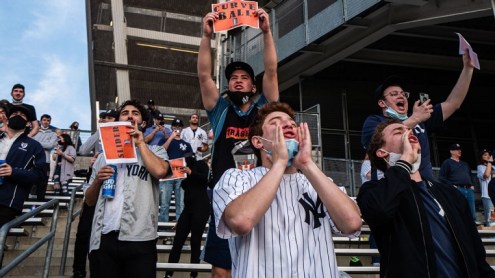
Yankee fans let the Astros have it Tuesday night. Did stadium security eject some protesting fans under false pretenses?

The worst kept secret in baseball opening this week was Yankee fans liable to let the visiting Astros have it, but good, when they visited Yankee Stadium for the first time since the 2019 American League Championship Series. The second-worst thing about that worst-kept secret was Yankee Stadium censorship.

The first-worst thing was this not-so-little red flag raised in the account by Sports Illustrated writer Stephanie Apstein, about a fan costumed like Oscar the Grouch in a trash can, and who only thought he’d gotten assurance from stadium personnel that there’d be no issue with him wearing it at Tuesday’s game:

When [David Taub] arrived wearing the costume and carrying a sign reading YOU AIN’T STEALING THIS COSTUME TRASHTROS, he drew laughs and cameras. Unfortunately, he also drew attention from security. “Our policy changed,” he said the guard told him. He said the guard added that the Astros had complained to MLB about fans in other cities, and MLB had told the Yankees to tighten their rules. (Officials from the Astros and the commissioner’s office said they were unaware of any such complaints or directives.)

Censorship at Yankee Stadium isn’t exactly virgin territory. Ask any frustrated Yankee fan present in the 1980s who had an anti-Boss placard or sheet banner confiscated under George Steinbrenner’s orders. Or, such frustrated Yankee fans who had their placards and banners confiscated before they were ejected from the stadium themselves.

Ask especially the Yankee fan who won a Banner Day contest by wearing the garb of a monk and carrying a Grim Reaper’s scepter from the scythe of which hung a large placard pleading, “Forgive him, Father, for he knows not what he does.”

If Yankee Stadium personnel purging David Taub for a non-destructive demonstration against Astrogate and its most questionable net result (no players disciplined in return for spilling about the scheme) is bad enough, what would you suggest we call the possibility that stadium security lied through their teeth while censoring him and other fans?

“I hope the Yankees fans smell blood tonight,” Taub told a reporter. “I hope we don’t do anything irresponsible, but I hope we give our shares of boos and let them hear it. We definitely got robbed of a World Series. There’s no question about that.”

Other fans brought inflatable trash cans to the park, similar to the one that fell onto the right field warning track at Angel Stadium when the Astros played a set there last month. Two of them were confiscated by stadium security, too.

Apparently, Astros manager Dusty Baker is a little more sanguine and a lot less censorious about the reception he knows his team can expect when they’re on the road this year. “It sounded like a packed house tonight even though it wasn’t,” he told reporters after the Yankees trashed the Astros, 7-3. “We kind of expected that reception. We’ll probably get more of that tomorrow and the next day.”

“I wouldn’t want to be on the other side of that,” said Yankee outfielder Giancarlo Stanton of the fans’ night-long booing, catcalling, and occasional swearing (F– Altuve! F–Altuve!) after the game. “They brought some heavy.” (And, a lot of funny, including a placard depicting Altuve the Grouch in a somewhat battered metal trash can.)

Stadium security brought heavier. This was a look no better than that ancient Banner Day ejection.

Last year’s pan-damn-ically inspired, cutout-occupied stands kept legions of fans from letting the Astros know just how they felt about the Astro Intelligence Agency’s singular take on sign stealing. Unless they bought cutouts showing imagery against it, there was little they could do other than whoop, holler, and catcall if they saw the Astro team bus pulling up to the ballpark.

But fans are back at the ballparks now to whatever limited extent continuing safety protocols allow. Unless their racket includes true violence, or throwing debris on the field (as a few reckless Angel fans did throwing a real, not inflatable trash can onto the right field warning track), or attacking Astro players or personnel physically, Yankee Stadium’s security was way out of line.

Whether they like it or not, the right to protest comes with the purchase of a ticket. Fans can boo truly bad plays, truly bad plate appearances, truly bad umpiring to their hearts’ content. They can even boo visiting teams verified for all time as barely-apologetic illegal  high-tech cheaters.

Even if their own team got caught trying a little high-tech hijacking once upon a time? Not so fast. The Yankees got caught only with someone in the dugout using an AppleWatch to steal signs. They weren’t accused of or proven to have either a) altered an existing camera off its mandatory eight-second transmission delay, or b) installed another, illegal, real-time camera to steal signs.

Realistically, the Yankee fans made one mistake that everyone else continues to make. There are only five actual Astrogate team members left on this year’s edition: Altuve, Alex Bregman, Carlos Correa, Yuli Gurriel, and Lance McCullers. Chanting “Mother Tucker!” at hapless outfielder Kyle Tucker isn’t fair to a guy who wasn’t even there to be part of the 2017-18 can can.

Unfortunately, if it isn’t fair to hold the entire 2021 Astro roster responsible for what the 2017-18 edition did, it’s also unlikely that the Astros will be done hearing the protests until the last man standing from the Astrogate team doesn’t wear their uniform any longer.

Not every security force in every ballpark practises fan censorship at all. Never mind claiming the visiting team complained to baseball’s government and baseball’s government told the home team “to tighten their rules.” I suspect Apstein meant that to mean, “to quash the anti-Astrogate protests.”

The Astros have had enough bad looks since Astrogate’s exposure and official consequences. Would they really be stupid enough to compel baseball government to strong-arm road teams into censoring road fans bent on letting them have it over a script they and nobody else wrote in the first place?

It was one thing when the worst Yankee fans rained nasty upon Astros pitcher Zack Greinke during the 2019 ALCS—based on Greinke’s very well known battle with clinical depression. Those fans were ejected properly for assaulting a human being verbally over an illness for which he takes prescribed medication and through which he works and lives with courage his assailants probably lacked.

Ejecting fans protesting a team’s well-exposed and (in more ways than one) institutionalised cheating? That demands a formal MLB investigation. Post haste. No waiting. The Yankees themselves should have no issue with cooperating. If they do, they should be sanctioned heavily.

The House That Ruthless Built isn’t private property. The ballpark’s official ownership is listed as the New York Industrial Development Agency, a subsidiary of the city’s Economic Development Corporation whose board is appointed by the city’s mayor. Government or government-overseen agencies at any level, from the village up to the nation, have no business trucking with or allowing censorship.

If Yankee Stadium security people spoke out of line while confiscating Yankee fans’ properties and/or ejecting them from the stadium, because they took it upon themselves to neutralise or silence Astrogate protests, they need to be held accountable. Strictly.

Lindor’s April shudders

Francisco Lindor

He’s his usual high-flying self at shortstop, but Francisco Lindor seems pressing too hard at the plate. So far.

It’s not even close to a new story, and it won’t be the last time you hear or see it. Star player signs gigabucks deal and presses out of the season gate to have first month about which “terrible” gets applied liberally. Anywhere else it might be merely alarming. But New York isn’t anywhere else, alas.

You’d think the watchword of the New York sports fan is, “To err is human, to forgive is not New York policy.” They’re not going to sink—yet—to the reputed depths of Philadelphia fans who inspire such gags as the Philly wedding clergyman pronouncing a newlywed couple husband and wife before telling new husband and gathering alike, “You may now boo the bride.”

New York fans have their own expectations and demands, evidence and actualities be damned, even if they’re not going to go Philadelphia just yet. (Or are they?)

Yankee fans, of course, have the patience of a barracuda whose three squares of the day are delayed; to them, anything less than an annual World Series ring is treason. When the Yankees lose it’s God’s will, somebody else’s fault, or time to throw out the first manager of the season. And that’s with George Steinbrenner gone to the Elysian Fields for over a decade.

Who’d have thought they’d see the day when Yankee fans make The Boss resemble Job? Who’d have thought another Steinbrenner (Hal) would epitomise calm seas compared to (a favourite phrase of his father’s) the fannies in the seats?

Met fans are a little more patient. It’s in their DNA. The team was born making edgy comedy while finishing below the basement. They’ve won a few pennants and a couple of World Series, experienced times troubled enough to make the Black Plague resemble the Paisley Underground, watched excellent teams collapse, and survived team overseers and administrations that could be tried in court for premeditated malfeasance.

But even the most patient, good-humoured Met fan has limits.

It’s one thing for the Citi Field boo birds to beat their wings and squawk every time Jacob deGrom pitches knowing there’s no jury on earth who’d rule against him if he files non-support papers on his mates—or entertains even microscopic thoughts of post-game manslaughter.

They’re watching virtuoso pitching on behalf of a team whose bats are so inexplicably paralysed on his game days deGrom himself has to think about delivering base hits (the outlier has six in thirteen plate appearances) and even runs batted in (he has two), when he checks in at the plate and sees the unlikely presence of a man on base ahead of him.

Come to think of it, Met fans are probably unsure what to make of a segment almost as bright so far as deGrom is virtuosic continously: the bullpen that once caused seven-eighths of New York to consider filing arson charges. The five main bulls—Edwin Diaz, Miguel Castro, Trevor May, Jeurys Familia, and Aaron Loup—have a combined 1.46 ERA/1/49 fielding-independent pitching rate in 41 collective gigs over which they’ve surrendered a mere (count them!) seven earned runs.

Right now, they’ll cheer and holler wildly for that livestock. Let those April showers turn into Mayhem, however, and Met fans will treat that cattle like burnt meatloaf almost in the same time it takes to snap their fingers for the waiter.

The bad news is that Mets bats not belonging to Pete Alonso (.837 OPS), Brandon Nimmo (.870 OPS), and J.D. Davis (1.089 OPS) are a stalled production line. None is singled out more for his season-opening plate futility than a freshly-minted import shortstop.

Getting used to deGrom pitching like a Hall of Famer with his mates hitting like Hall of Shamers in his starts is one thing. But flapping and squawking over Francisco Lindor is something else entirely. They didn’t quite bargain on SuperLindor showing up with only half his A-game calibrated for the new season.

Let’s get the contract business out of the way first. Lindor wouldn’t be the first gigabucks player to sign his first serious big-bucks deal and press it at the plate trying too hard to live up to it. If you want a single example, hark back to Hall of Famer Mike Schmidt. He signed his first big multi-year deal starting in 1978—and had a rather down season at the plate to start that term.

The most cynical of the most cynical Phillies fans dismissed Schmidt as dogging it. Those who paid the closest attention to him knew he was only too anxious to live up to the new deal’s notices and implications. Even if he did win one of his ten Gold Gloves that year. The following year, Schmidt hit like his usual self again (40+ home runs, 210+ runs produced, etc.), led the National League in walks, and made one of his twelve All-Star teams.

For all his pressing at the plate now, Lindor’s still an above-plus study at shortstop. He’s still helping save runs with the leather, legs, and arm. He still has a fielding average 22 points above the rest of the league’s shortstops, and his range factors are still about 30-35 points above the rest. He’s also turned fourteen double plays thus far, well enough on pace to get near his career average 72.

He’s also picking it up when it comes to ducking the strikeout at the plate. Now, I don’t go as nutshit as too many others seeing high strikeout totals, if only because I’d rather see a batter strike out than whack into a double play, but Lindor’s striking out only 11 percent of the time he’s at the plate . . . and taking walks 11 percent of the time. The strikeout rate is lower than his career percentage; the walk rate, higher.

Lindor’s been hitting about as many ground balls as fly balls and that may equal hard batting luck, since he’s not hitting too many weak balls so far. When he does reach base, so far he’s taking extra bases on followup hits 88 percent of the time—his career such average is 47 percent, which is more than just a good rate.

Joe and Jane Fan forget something about baseball players. Allow me to remind you: They’re not automatons or holograms, they’re human beings. No two of them are alike entirely. For every Mike Trout or Mookie Betts who lives up to the implied mandate of a new gigabucks deal right out of the proverbial chute, there’ll be ten struggling powerfully to live up to such deals at the outset or even through the first full season after they sign them.

“It’s interesting and it’s funny, and it sucks,” the usually ebullient shortstop told reporters on a conference call last week. “It doesn’t feel right, for sure. Interesting because it’s the first time that it happened in my career. And funny because I’m getting booed and people think I’m going to go home and just think, oh, why am I getting booed? I get it. They’re booing because there’s no results. That’s it.”

Derek Jeter would empathise. He was as close to a Yankee god as you could get and ended up in the Hall of Fame. But even he took it on the nose and in the brain on the bad days and nights. “I don’t blame them. We would have booed ourselves tonight,” he often said after such games. Jeter understood only too well how quickly a ballplayer might go from hero to villain—sometimes before 24 hours passed.

Don’t kid yourself that it doesn’t really sting. Lindor’s learning fast enough: Come up short as far as New York Fan is concerned and you’re the worst thing to hit town since the November 1965 power blackout. Come up long, you’ll find fewer places more ready to shower you with their love, affection, keys to the city, and maybe first born children, too.

If the right to boo, hiss, catcall, hang snarky banners, or flood Twitter indignantly comes with the price of a ticket to the ballpark, there’s an implicit correlation that says you don’t really know whether a player is just dogging it or is driving himself to nineteen nervous breakdowns trying to deliver.

The appropriate answer when Joe or Jane Fan huffs, “For x hundred bazillion dollars I could hit the you-know-what out of that slop,” is to reply, “If you could, you’d have been there instead.”

“I can’t hit like Vada Pinson,” said a social media baseball group member discussing the old Reds outfielder, “but he can’t make strawberry shortcake like me.” Lucky him. By age fifteen I couldn’t even hit like Strawberry Shortcake. I made a major leaguer with a paltry .200 hitting average and a mere .300 Real Batting Average (RBA) resemble Mike Trout.

A shortstop with a .537 lifetime RBA (once again: total bases + walks + intentional walks + sacrifice flies + hit by pitches, divided by total plate appearances) might also suggest that if one must endure a slump for any reason, it’s better to slump in April than down the stretch of a pennant race.

New York Fan still needs to be reminded that pennant races won in April and May are the exceptions, not the rules, outside a closet full of Yankee pennants in the last century plus the 1986 Mets. That one player won’t make or break a pennant except in very extraordinary conditions. Not even if he signs for nine figures over the ten years to follow this one.

No, Roberto Alomar wasn’t Pete Rosed

Roberto Alomar

Roberto Alomar’s new baseball ineligibility doesn’t mean a backdoor pass into Cooperstown for Charlie Hustler.

Let’s get this out of the way first and foremost, since (it almost figures) at least a few social media tweeters raised it. Hall of Fame second baseman Roberto Alomar’s fresh ineligibility to work in baseball doesn’t mean Pete Rose suddenly gets a pass to stand for Hall of Fame election.

The news broke Friday that Alomar—working as an advisor to baseball’s government and a Blue Jays special assistant concurrently—is now on baseball’s ineligible list over sexual misconduct said to have occurred in 2014, at the sad expense of a baseball industry employee. He’d been elected to Cooperstown on his second try in 2011.

“Roberto Alomar got Pete Rose’d today,” tweeted Ice Cat Sports Cards, from South Dakota. “If Roberto Alomar is on the Ineligible list,” asked a tweet by someone handling himself ElScorcho, “how can he stay in the Hall of Fame? I mean that says Pete Rose should be in right?”

Wrong.

Specific details of Alomar’s sexual misconduct aren’t disclosed as I write. But it happened three years after he was elected and inducted into the Hall of Fame. (To its credit, the commissioner’s office engaged an independent law firm to investigate.) If he’d committed the misconduct that now has him purged before 2011, Alomar wouldn’t have even been on the ballot, never mind elected.

Rose violated Rule 21(d) before he would have made his first Hall ballot. The very likelihood that he might be elected despite his ban prompted the Hall to rule: if you’re ineligible to associate with organised baseball, you’re not eligible to appear on a ballot conferring the game’s highest honour.

No, ladies and gentlemen, Roberto Alomar did not get Pete Rosed on Friday. Any drumbeating for shoving Rose into the Hall of Fame on the basis of Alomar’s banishment is factual and moral idiocy. So don’t even think about hammering the Hall of Fame for refusing to purge Alomar.

“When he was elected to the Hall of Fame by the Baseball Writers’ Association of America in the Class of 2011, Alomar was an eligible candidate in good standing,” the Hall said in a formal Friday statement. “His plaque will remain on display in the Hall of Fame in recognition of his accomplishments in the game, and his enshrinement reflects his eligibility and the perspective of the [Baseball Writers Association of America] voters at that time.”

Alomar isn’t the first to land on baseball’s permanently ineligible list over sexual misconduct or its concurrent behaviours. Former Astros assistant general manager Brandon Taubman got there for crowing he was so [fornicating] glad they obtained relief pitcher Roberto Osuna while Osuna was still under investigation for domestic abuse. A rant delivered in the presence of three female reporters in the Astro clubhouse after they won the 2019 American League Championship Series.

The persona non grata list also includes one-time Cardinals scouting director Chris Correa, thanks to his being caught red-handed hacking into the Astros’ databases. It also includes former Braves general manager John Coppolella, after he inflated or deflated signing bonuses for Dominican prospects to maneuver around baseball’s international signing rules.

Maybe the BBWAA will fume over the Hall of Fame refusing to purge Alomar. But at least  one member might advise not so fast. “I don’t disagree with the Hall’s more measured response,” wrote Toronto Star columnist Rosie DiMinno Friday, after commissioner Rob Manfred announced the Alomar termination and purge.

It would be insupportable to retroactively banish someone from Cooperstown when egregious conduct comes to light. Just imagine going backwards in time and stripping a player of that specific honour, a summation of career brilliance, for behaviour which is now recognized as reprehensible but wasn’t then. So many scoundrels are in the Hall and, at least figuratively, their statues would have to be toppled.

Please don’t ask which such scoundrels not named Cap Anson and Kenesaw Mountain Landis would be removed from the Hall right now. You won’t like a lot of the answers. They might or might not only begin with Babe Ruth.

Lisa Banks, the attorney for the unnamed woman at the center of the Alomar purge, sent a statement out as well. Quoted by DiManno, Banks said, “We applaud MLB for having this matter thoroughly investigated and for taking meaningful action against Mr. Alomar . . . My client has no plans to file a lawsuit or take further action. She has not exposed Mr. Alomar’s behaviour for notoriety or for money and looks forward to moving on with her life. She simply wants to ensure that Mr. Alomar is held accountable.”

But DiManno goes forward saying that while baseball has a perfect right to purge someone over particular misbehaviours, since being in professional baseball is not an absolute right but an absolute privilege, something about the Alomar case isn’t quite passing the proverbial smell test yet.

. . . I don’t know what Alomar is alleged to have done and Manfred isn’t telling. I do know that some accusations, when exposed in a court of law, criminal or civil, do not rise to the threshold of conviction. And nowhere have I seen a claim that Alomar’s conduct was criminal. It might or might not pass the sniff test of a human rights complaint. It clearly did not pass scrutiny of the MLB investigation — conducted independently by an external legal firm . . .

I wish there were more details disclosed about the alleged incident, which surely could have been done without identifying the complainant . . . I’ve covered enough legal proceedings on this subject to understand that a great deal of nuance separates accusation from even the lower bar of civil action proof. The vacuum of information leaves a worrisome gap for warranting so ham-fisted a decision.

And that, she continues, “comes from someone who was once called a [fornicating (four-letter euphemism for ‘vagina’ starting with ‘c’)] by a player in the Jays clubhouse; who, on another occasion, had a player simulate pelvis thrusting from the rear while I was bending over to conduct an interview with another player at his stall. These were not incidents I reported to the club or to my employer. I’m just not that delicate a flower.”

The Blue Jays will disappear Alomar’s presence promptly enough, the team has said, including pulling his commemorative banner down from Rogers Centre and removing him from its Level of Excellence. The Jays also said in their own statement they’re committed to an environment of respect for everyone in their organisation, applauding concurrently the unnamed woman who stepped forward in the first place.

This is not a pleasant denouement for the man who hit what DiMinno says remains, arguably, the single most important home run in Blue Jays history. That would be the Game Four-tying two-run homer off Hall of Famer Dennis Eckersley in the top of the ninth, finishing a comeback from a five-run deficit, pushing the Jays to the eleven-inning win that gave them a 3-1 American League Championship Series advantage in 1992. En route their first World Series conquest.

I’m not entirely convinced that launch compares to Joe Carter’s World Series-winning three-run bomb in 1993. But you can’t convince me Alomar’s blast off Dennis the Menace wasn’t just as important in Jays history. “Emotional bonds are difficult to sever,” DiManno opened. “Historical facts can’t be expunged.”

Neither can a Hall of Famer eligible for election and getting elected well enough before the acts that got him banished from baseball eligibility. Alomar’s behaviour as a three-year Hall incumbent is terrible enough, without using it to argue Rose into the Hall when Rose’s rule breaking got him blocked before he was eligible for a Cooperstown ballot at all.

Harper’s class can’t fix a true pitching dilemna

Bryce Harper

Bryce Harper took the highest road before Thursday’s Phillies-Cardinals game. Phillies reliever Hector Neris took the lowest in the ninth Thursday night.

When the Phillies and the Cardinals tangled the night after Bryce Harper and Didi Grigorius took back-to-back drills, from Cardinal reliever Genesis Cabrera’s first two pitches of the top of the sixth, you’d have understood almost completely if the Phillies came out bent on making the Cardinals pay.

You’d have understood because a) Harper’s was the truly frightening one, taking a runaway 97mph fastball on the left side of his nose that knocked his helmet clean off and him to the ground; and, b) the umpires saw fit to issue nothing but warnings to both side, without doing what one of today’s most foolish new rules bars a manager from doing.

But therefore you wouldn’t have known that Harper himself put a stop to any possibility of all-out war before the Phillies and the Cardinals met again Thursday. Until Phillies reliever Hector Neris said not so fast in the bottom of the ninth at Cardinals third baseman Nolan Arenado’s expense.

I couldn’t find the exact words in question, but Harper sent Cardinals manager Mike Schildt a text message saying, essentially, Your guy wasn’t trying to decapitate me, he had an off night, you know it and I know it, and I didn’t get my brains blown out or my head torn off, so don’t let it blow you or him apart, my dudes, we’re good.

Whatever the actual words Harper sent Schildt the day after he nearly went from Genesis to Revelation, Schildt was nothing but appreciative. It’s not every day that an almost-headless man shows a little empathy for the unintended executioner.

“Whoever’s a fan of Bryce Harper, whoever has children that are fans of Bryce Harper, support that guy,” Schildt told reporters. “Because what he sent over in a message today was completely a class act.”

If anyone knows the difference between lack of intent and deadly intent, it should be Harper. Four years ago, almost, then-Giants pitcher Hunter Strickland opened the top of the eighth facing then-National Harper by hitting Harper in the hip—in payback for a three-year-old pair of postseason home runs—with a pitch so obvious that Stevie Wonder would have seen intent without blinking twice.

Before the rule mandating relief pitchers face three batters at minimum unless he came in mid-inning and ended the inning before a third batter faced, Schildt by his own Wednesday night post-game admission would have gotten Cabrera the hell out of there after following Harper’s near-beheading with a drill through Grigorius’s ribs.

Why the umpires didn’t remains a mystery at this writing. The umps have been asleep at the switches an awful lot this season thus far, on the field and even in the replay review rooms in New York. If they’re not calling strikes on pitches far enough from the zone that you could fly a plane through the space, they’re calling walkoff hit by pitches on near-flagrant bids to take one for the team with the pillows stuffed.

On Wednesday night, they warned both the Phillies and the Cardinals against any further funny business. Then, they ejected Phillies manager Joe Girardi when he sailed out of his dugout demanding accountability for Cabrera’s obvious wildness following the Grigorius drill.

“I understand they don’t want things to escalate. They don’t want people to get hit. But if a guy hits a guy in the face and a guy in the ribs with two pitches, he’s got to go, right?” Schildt himself told the press post-game. “If you’re really protecting the players, obviously, he doesn’t have command. He’s got to go.”

The official rules don’t specify when an umpire can order a wild pitcher out of a game on behalf of keeping peace. But The Baseball Codes author Jason Turnbow, writing on his Website of the same name, says the arbiters have the option by default: “[U]mpires have one more wrinkle to consider in the same spirit as bench warnings: Those times when ejecting a pitcher for his own good might actually serve to cool tensions from both sides of the field.”

Sometimes it seems as though almost nobody wants to address a concurrent issue that Harper’s former Nationals teammate Ryan Zimmerman does: baseball organisations seeking and finding pitchers who can throw supersonic pitches but haven’t learned to control them properly.

“You see these teams just call up these guys that throw 95 or 100 mph and the team doesn’t really care. They’re just trying to see if they have anything in them,” Zimmerman told the 106.7 radio station’s Sports Junkies podcast after his old mate and friend nearly lost his head Wednesday night.

A couple years ago, these guys would be in Double-A or Triple-A for another year trying to learn how to pitch but these teams just call them up to see if they can kinda hit lightning in a bottle. If not, they send them back down. They don’t care if they hit four guys on the other team. What does it matter to them? The [general manager] of the other team is not in the box, so he doesn’t care. It’s a different kind of game but it is what it is and that’s where we’re at.

You almost predict what those clubs want: floods of strikeouts. But Hall of Famer Bert Blyleven got floods of strikeouts (3,701 lifetime) and his money pitch was maybe the third most monstrously voluptuous curve ball yours truly has ever seen. (Numeros two-o and uno: Dwight Gooden, and Hall of Famer Sandy Koufax.)

It’s bad enough that the three-batter relief minimum throttles managers from getting wild pitchers out of there before they do worse damage than turned out done to Harper and Grigorius Wednesday night. It’s worse when baseball organisations seem to believe pitching is purely a matter of who can throw the lamb chops faster and farther past the wolves.

“Hitting is timing,” Hall of Fame lefthander Warren Spahn once said. “Pitching is destroying timing.” That was then, this is now, and for once the Old School has it right. Today hitting may still be timing, for all the overstated obsession with launch angles and exit velocities, but pitching today often seems oriented on destroying batters instead of their timing.

In case you were curious, the prankish Spahn—whose money pitch was a screwball and who happened to be one, himself, especially allied to longtime Braves buddy Lew Burdette—averaged two hit batsmen a year.

That was also then: minor league legend Steve Dalkowski could throw a cruise missile past a fighter jet on Mach-plus cruising speed. But he couldn’t find the strike zone with a search party and bloodhounds half of the time. (The ill-fated Dalkowski never saw one inning’s major league action: he’d barely made the ’63 Orioles roster in spring training when he blew his elbow out during an exhibition game.)

This is today: If Zimmerman is right, today’s organisation wouldn’t care half as much for Dalkowski’s inability to find and keep the strike zone as for his ability to scare the opposition to death and back.

NBC Sports writer Matt Weyrich says there are some hard numbers supporting Zimmerman’s theory: In 2018, the Show set a new record with 1,922 pitches hitting batters. Then, in 2019, the Show broke that record by 62. The wild pitches also climbed, with the Show’s seven highest wild pitch totals “all recorded in the seven seasons from 2013-2019.” This year’s 291 wild pitches and 354 pitches hitting batters, Weyrich adds, threaten to set new league records yet again.

Remember the postgame exchange between fictitious Durham Bulls manager Skip Riggins and coach Larry Hockett about Dalkowski-inspired pitching prospect Nuke LaLoosh in Bull Durham?

Riggins: He walked eighteen.
Hockett: New. league. record.
Riggins: He struck out 18.
Hockett: Another new. league. record. In addition, he hit the sportswriters, the public-address announcer, the bull mascot— twice—also new. league. records. But, Joe—this guy’s got some serious shit.

In theaters and on DVD, that’s about ten laughs. In the real game, it’s as funny as a shave with a Mixmaster. “You’re in the big leagues,” Zimmerman told that podcast. “There’s kind of a thought that if you’re at this level, you should be able to control — especially if you’re throwing 97 mph.”

Did any rough stuff happen between the Phillies and the Cardinals on Thursday night, then? Well, yes, there was—briefly. And that was with neither Harper nor Grigorius playing, Girardi having added that both players would be re-examined when the team returned to Philadelphia today to open a weekend set with the Mets.

With the game tied three-all, and two outs in the bottom of the ninth, Neris decided Harper didn’t speak for him when sending Schildt that pregame, give-peace-a-chance text.

Neris gave his own piece a chance at the expense of Cardinals third baseman Nolan Arenado—hitting him up and in and on the back of the shoulder on the only pitch of the plate appearance.

Would Girardi or any other Phillie care to expose just who whacked Neris with the stupid stick? The righthander resembled a bullying coward willing to endanger his own team for the sake of who the hell knew exactly what. He was lucky the benches didn’t clear after betraying the letter and intent behind Harper’s olive branch.

It wasn’t as though the next Cardinal batter was liable to blast a two-run homer to win it on the spot. Tyler O’Neill plays major league baseball in the first place because he’s a very plus outfielder. At the plate, calling him a spaghetti bat might be putting things politely. Don’t think Neris wasn’t aware of it when he did what four Phillies pitchers preceding him didn’t even think about doing.

He hit one of the Cardinals’ big sticks to take the easy out, striking O’Neill out on three pitches. Neris is lucky Schildt took the higher road likewise, applauding the Arenado hit as “old school baseball.”

Then another Phillie reliever, David Hale, threw a wild pitch past Cardinals shortstop Edmundo Sosa, a pitch catcher J.T. Realmuto might or might not have been able to block successfully considering its movement. It allowed O’Neill—who began the inning as the free cookie on second to open it, and took third when Cardinals catcher Andrew Knizner grounded out leading off—to score the winner in the bottom of the tenth.

Neris should count his blessings that it looks as though he won’t get a week’s detention.

From Genesis to Revelation

Bryce Harper

Bryce Harper, a split second before his nose met Genesis Cabrera’s fastball leading off the sixth Wednesday night.

Eons ago, it seems now, Yogi Berra had a handy response to those who thought he looked like one of the title supporting players in Edgar Rice Burroughs’s Tarzan of the Apes. “It don’t matter if you’re ugly in this racket,” the Hall of Famer said, “All you have to do is hit the ball. And I never saw anybody hit one with his face.”

Berra got a few laughs while he drove home one point. But the flip side is that you can see one hitter too many take one with his face, which is every hitter who ever had to do it.

Thank God and His servant Stengel that it’s still the exception. It still doesn’t erase the fear of longtime watchers and fans that the latest such victim will be the game’s next Tony Conigliaro. Such fears even among his critics struck when Bryce Harper’s face was in the top of the sixth Wednesday night.

Hit one with his face? Harper led off the inning seeing one pitch from Cardinals reliever Genesis Cabrera. The pitch sailed up and into Harper’s nose on the left side while knocking his batting helmet clean off his head and the Phillies’ right fielder crumpling to the ground in the batter’s box.

The man who nearly went from Genesis to Revelation merely picked himself up, dusted himself off, and walked away from the plate under his own power. Rather gutsy for a man who was lucky he wasn’t decapitated by a fastball that veered so far off course it would have inspired “Mayday! Mayday!” calls from the crew if it was an airplane.

What we ought to be hearing now is louder demands that the ridiculous three-batter minimum for relief pitchers unless they ended an inning facing fewer needs to go the way of the Oldsmobile. Faster than the Oldsmobile went away, too.

Phillies manager Joe Girardi anguished for his man but maintained in the moment, sending Matt Joyce out to pinch run. Then Phillies shortstop Didi Gregorius checked in at the plate. He saw one pitch from Cabrera, too. This time, the errant fastball didn’t sail up toward his sight lines but, rather, did a magnificent job of trying to bore a hole in his ribs.

The umpiring crew issued warnings to both sides. Nothing more. Since a manager can’t remove an out-of-control relief pitcher until he’s seen three batters minimum under the current and extremely dubious rule, it should be on their heads as to why Cabrera was allowed to remain in the game despite two pitches dropping two batters dangerously enough.

That was enough to send Girardi sailing out of his dugout in raw fury. As might you if you’d seen the first two of your men scheduled to bat in the inning coned and drilled back-to-back, on two pitches, courtesy of a pitcher who’d just entered the game but shown as much control as a runaway truck.

Raw fury and naked fear. Girardi knows only too well the terror of fastballs reaching your face. He took one in his own pan from then-Padres pitcher Woody Williams in 2000. As happened to Harper Wednesday night, that Williams pitch drew blood from Girardi’s own schnozzola. “It’s extremely scary,” he said of Harper’s drop, “and I can tell you from experience.”

Under normal circumstances, Girardi is one of the more mild-mannered men in baseball, even given his well-known competitiveness. But he was enraged almost as much by the umps not even thinking of sending Cabrera to the rest of the night off as he was by his first two sixth-inning swingers getting hit by those out-of-control fastballs.

“I understand why they give the warnings, right?” he told reporters. “I understand they don’t want things to escalate. They don’t want people to get hit. But if a guy hits a guy in the face and a guy in the ribs with two pitches, he’s got to go, right? If you’re really protecting the players, obviously, he doesn’t have command. He’s got to go.”

So Girardi fumed to the umpires and, rather theatrically, turned to Cabrera and made the gesture umpires usually use when they’re giving someone the ho-heave. If you can think of any precedent for a manager throwing an opposing player out of the game, Girardi might like to know it. The gesture proved only that, lawfully.

But it also proved Girardi’s own departure, when plate umpire Chris Segal promptly did to him what he believed appropriately should have been done to Cabrera. As he walked off the field following the thumb, Girardi barked at Cabrera, “Throw the [fornicating] ball over the plate!” Not an unreasonable demand.

He also exchanged a bark or three from a distance with Cardinals manager Mike Schildt, who spoke after the game like a man who didn’t exactly have in mind trying to beat the other guys by assassination instead of playing baseball.

Schildt also admitted something that flies in the face of the pan-damn-ic inspired three-batter relief minimum rule. If not for that rule, Schildt told reporters, he would have gotten Cabrera out of the game the moment Harper hit the deck.

“That’s a failure of the three-batter minimum,” he told the press. “It absolutely is that. Completely, absolutely, no doubt. But that’s an outlier of it.” He’s right about the hit batsmen issue with one pitcher whose control went AWOL for the evening. But as The Athletic’s Matt Gelb observes rightly enough, “The rule was designed to quicken games (it has not) and has generated unintended consequences (too many to count).”

Schildt won’t hear Girardi complain. This very circumstance—a pitcher brought in with his control missing stuck for three batters even if he hits one, never mind two—has been one of Girardi’s primary exhibits when fuming, as he’s done from the moment it poked its nose out of its hole, against the three-batter minimum.

After Grigorius took his base to set up first and second, Andrew McCutchen singled Joyce home to break the three-all tie and chase Cabrera out of the game. One inning later, Grigorius himself sent Alec Bohm home on a bases-loaded sacrifice fly with what proved to be the final score, 5-3 Phillies.

Then things got a little testy in the bottom of the eighth, after Phillies reliever Sam Coonrod shook off Nolan Arenado’s leadoff single to strike Paul DeJong out and lure Tyler O’Neill—who’d hit a two-run homer in the bottom of the second—into a broken-bat grounder to short that Grigorius might have caught but took on the hop for a step-and-throw, inning-ending double play.

Viewers at home then saw a commercial followed by Coonrod walking off the field, but not without pointing and hollering at the Cardinals dugout. Small wonder. During the commercial break, Coonrod looked as though he wanted nothing more than to bake five and twenty Redbirds in a pie.

Phillies third baseman Brad Miller—whose own two-run bomb tied the game at three in the first place an inning before Harper and Grigorius got coned and drilled—tried to stop Coonrod before inadvertently letting go of the reliever’s hand. But Coonrod, himself a St. Louis product, put all thoughts of one-man demolition out of his mind and settled for a few hollerings, though he knew in his heart of gut Cabrera wasn’t exactly trying to vapourise his two teammates.

“As a teammate, you appreciate the intensity,” Miller told reporters after the game. “The dude came in and got some big outs for us. It’s a close game. And, yeah, he was a little fired up, obviously. Three getting hit like that was pretty scary.” “Three,” of course, refers to Harper’s uniform number.

Cabrera himself was genuinely contrite after the game—wasn’t he? “I want to apologise for all of the action that happened, especially to Harper,” he said through his translator. “I really wish him the best. I hope he has a speedy recovery, in whatever it is that happened, and that he’ll be able to return to baseball activities. The game got away from me at that point. I’m really sorry for everything that happened today. None of it was intentional. And again, I’m sorry for everything.”

Is it just me, or did a lot of Cabrera’s remark sound like prepared boilerplate?

Struggling teams are known to feel more than a little fired back up after confronting near-disaster. Until Wednesday night, the Phillies were a back-and-forth .500 team with inconsistency at the plate and arson out of the bullpen. What they showed after Harper and Grigorius got drilled reminds you that it’s a somewhat sad thing if and when a team rehorses and irons up after coming face to face with near manslaughter.