On “booing” the boo birds right back

Francisco Lindor, Javier Baez

A creative way to zap the boo birds the way maybe every other ballplayer has ever wanted to boo them right back?

Oh. The horror. You’d think they shot the Thunderbirds down during a pre-game flyover.

If the Citi Field boo birds were going to boo the Mets when they tried their best and came up short, a few Mets decided they were going to give the boo birds a thumbs-down of their own when they tried their best and came up big enough.

They didn’t hand Afghanistan back to the Taliban, blow up the number 7 el, stink bomb the New York Stock Exchange, incincerate the Metropolitan Museum of Art, or resurrect the Pontiac Aztek.

Javy Báez, Francisco Lindor, Kevin Pillar, and a few other of their Mets mates, have had it with the boo birds. After hits in Sunday’s 9-4 win against the likewise tumbling Nationals, they either stood on base or crossed the plate with thumbs-downs. Almost at once, social media and enough of the media media exploded like Little Boy at Hiroshima.

Báez seemed to be singled out especially for such use, misuse, and abuse. By God, we’ve had it with him. Never mind how slick he is playing second base, who needs this prima donna who can’t stop swinging at the unhittable? 

Note that Báez and Lindor were pretty much in the thick of the Mets’ win. Lindor scored the game’s first run on a balk, after reaching on a force out and taking third on a passed ball in the first. Báez took a Mets lead back with a two-run homer in the fourth. Lindor sent home the Mets’ final two runs with a double to left in the eighth.

When we don’t get success, we’re going to get booed,” Báez told reporters after Sunday’s game. “So they are going to get booed when we get success.” Since the players aren’t likely to be heard if they actually boo vocally, it seems, Báez and his mates took up the playful thumbs-down as the next best thing.

Seemingly, it began early in August. Apparently, assorted Yankees once picked up the same idea from a visiting Met fan in 2017.

They’re only too well aware that the Mets entered August three and a half ahead in first place in the National League East and approach August’s end having gone 8-19 for the month thus far. They don’t have to flip on the next television newscast, hit Twitter running, or read the horror stories in the next newspaper editions to know it.

Owner Steve Cohen needled the Mets’ offensive woes in a tweet almost a fortnight ago. Even he didn’t quite go full George Steinbrenner about it. Lindor himself agreed with Cohen. Bank on every Met agreeing. Nobody else had to tell them.

If there’s one thing a professional baseball player knows, it’s when he’s not getting the maximum desired result out of his work. But he also knows how helpless he really is against fans who don’t really see or couldn’t care less about the grand paradox that playing a game professionally requires work. More work than people think.

He also knows there are times when he might have been booing himself right along with the boo-birds in the seats. But there’s an ocean-wide divide between booing an apparent lack of hustle and booing a lack of result despite the hardest hustle, the hardest-hit ball, the best-thrown pitch that disappeared over the fence.

It’s bad enough that Mets team president Sandy Alderson fired a shot back that looks only too well as though he or the entire team administration waited for just the right (wrong?) moment to ignite:

Mets fans are understandably frustrated over the team’s recent performance. The players and the organization are equally frustrated, but fans at Citi Field have every right to express their own disappointment. Booing is every fan’s right.

The Mets will not tolerate any player gesture that is unprofessional in its meaning or is directed in a negative way toward our fans. I will be meeting with our players and staff to convey this message directly.

“Upon further reflection,” tweeted Sports Illustrated writer Emma Baccellieri, “what’s really amazing to me is that the Mets *already had a statement* to use in the event of wanting to apologize for gestures made toward the crowd (Mr. Met flips off a fan, 2017), and they just made a new, worse, more dramatic statement.”

“Last thing and then I’m going to bed and trying to erase this stupid day from my memory,” tweeted Alison McCague, a Ph.D. geneticist and policy analyst by profession, who also writes for the online Mets journal Amazin’ Avenue. “It’s not just the booing. It’s the going after players’ wives and kids online and DMing slurs to them all the time. Large chunks of sports fans just don’t see players as human beings.”

I’ve been saying that for years.

It’s tempting to wonder whether Alderson would have threatened any Met players responding in kind to such death threats. It’s also to wonder why certain other teams weren’t tempted to do something similar to what Báez, Lindor, Pillar, and other participating Mets have been doing this month.

Teams such as practically every St. Louis Brown that ever showed up at the ballpark at all.

Teams such  as the ones that inspired the gag about the Philadelphia wedding in which the clergyman pronounced the happy couple husband and wife and then told the gathering, “You may now boo the bride.”

Teams such as the one caught red-handed in an illegal, off-field-based, extralegal-camera-aided, electronic sign-stealing scheme—but who now have only five players from that team left on this year’s roster.

I’ve also been saying something else for years, too. Let’s give Alderson one benefit of the doubt and agree that the right to boo comes with the price of a ticket. But let’s give Báez, Lindor, Pillar, and any other thumbs-downing Mets the benefits of certain doubts, too.

What would Joe and Jane Fan do if they had to go to their jobs every day—in the office, in the board room, on the dock, in the warehouse, behind the wheel of their truck or bus or cab, at the clinic, on the assembly line, at the drive-through, you name it—knowing 55,000 people would be right there on top of them and a few million more would be watching on television or the Internet or listening next to a radio?

What would Joe and Jane Fan do, if the merest missed or mistakenly sent memo, bad merger, slip on a puddle, dropped parts box, missing package, missed red light, hastily and imperfectly affixed component, or misinterpreted order, resulted in 55,000 people live and a few million more clinging to broadcasts booing their heads off, or even sending them death threats, for either simple human mistakes or despite-best-effort shortfalls?

How would Joe and Jane Fan like it when the media hammer them unto eternity for such mistakes and shortfalls, even if they proved the lone mistakes of otherwise respectable careers?

If Joe and Jane Fan think they could step in for the Báezes, Lindors, Pillars and company that effortlessly, ask them if they could take the demoralising grief heaped eternally upon baseball’s hapless designated goats.

Ask whether Bill Buckner, John McNamara, Fred Merkle, Freddie Lindstrom, Mickey Owen, Johnny Peskyheldtheball (so help me God, you’d have thought that’s the way Red Sox fans of yore pronounced his name between 1946 and 1967) Ralph Branca, Gene Mauch, Willie Davis, Tom Niedenfuer, Don Denkinger, Donnie Moore, Mitch Williams, and Grady Little weren’t tempted to boo right back when the opportunities arose.

Ask Joe and Jane Fan if they would have succeeded where the 1964 Phillies, the 1969 Cubs (and every Cub on the planet from 1909 through the end of 2015), the 1978 Red Sox, the 2006-07 Mets, the 2017 Nationals, this year’s Orioles, and maybe every last Washington Senator not of the 1924 model didn’t.

Joe and Jane will answer “yes” at the drop of a hat, a beer, or a ground ball. Ken Griffey, Jr. jumping fences to snatch home runs into long outs didn’t jump as big as the lie detector needles will at that answer.

All Báez, Lindor, Pillar, and maybe a couple of other Mets did was something close enough to something maybe every other man who’s ever worn a major league uniform has wanted to do, when they know good and bloody well that they’re doing the best they can with what they’ve got and they’re still being treated like criminals on the perp walk.

If you think otherwise, you’re missing a great deal on my Antarctican beach club.

One night in the San Diego zoo

Will Smith

Will Smith had no idea in the moment that the game-tying homer he hit in the eighth Wednesday night would lead to hoisting Manfredball and enough of the old school by their own petards.

There it was. An extra-inning game that went sixteen innings and exposed both the worst possible side of Rob Manfred’s would-be new-school tinkerings and the worst possible side of the old school’s ongoing romance with insisting the worst bats in the lineup hold a place in the order.

What do you call a game in which each team got a free cookie on second base to open each extra half inning and, for five full innings straight, none of those cookies got eaten? That’s right: ten cookies on second to open ten half-innings in San Diego on Wednesday night, and not a one of them came home.

Zombieball? Manfredball? Your Sham of Shows? Monty Python and the Holy Hell? The Smothered Brothers Comedy Hours? A ballpark named for a pet store chain as the world’s largest zoo arena—with the animals holding the keys?

Until the Dodgers’ A.J. Pollock hit a leadoff two-run homer (that sounds bizarre to say, right, but that’s the Zombie Runner Era for you) in the top of the sixteenth, the longest extra-inning game since Manfred imposed the free cookie on second to open each extra half-inning was thirteen innings.

Pollock’s blast pretty much finished a 5-3 Dodger win in which Padres manager Jayce Tingler outsmarted himself with lineup maneuverings that brought his pitchers into batting behind Fernando Tatis, Jr., Manny Machado, and Jake Cronenworth with his bench emptied out previously.

It compelled Dodger manager Dave Roberts to do exactly what the now-retired Thomas Boswell pointed to as one of his prime reasons for finally deciding the designated hitter needed to be universal and permanently so:

It’s fun to see Max Scherzer slap a single to right field and run it out like he thinks he’s Ty Cobb. But I’ll sacrifice that pleasure to get rid of the thousands of rallies I’ve seen killed when an inning ends with one pitcher working around a competent No. 8 hitter so he can then strike out the other pitcher. When you get in a jam in the AL, you must pitch your way out of it, not ‘pitch around’ your way out of it.

Roberts forced Tingler’s hand twice—in the thirteenth, when his empty bench forced him to send pitcher Ryan Weathers out to the plate after intentional walks to Machado and Cronenworth to load the pads (Victor Caratini opened as the cookie on second); and, in the fifteenth, when Tingler had no choice but to let reliever Daniel Camarena bat after Cronenworth was handed another free pass.

Weathers at least made contact: a bouncer back to the mound that ended in an inning-ending force out at the plate. Camarena, a relief pitcher in his first Show turn who somehow managed to pick up a base hit in two previous unlikely plate appearances, looked at a full-count third strike.

“I liked the pitcher-versus-pitcher matchup,” said Roberts, after the Dodgers finally ended the sixteen-inning, 5-3 Dodger win. Show me a manager who wouldn’t love a pitcher-versus-pitcher matchup, knowing how often it won’t end in game-breaking hits, walk-off wins, or even absurd transient pleasures, and I’ll show you a manager in search of a job.

As of Friday morning the pitchers in 2021 posted a .109/.148/.140 slash line and a .288 OPS. The only “strategy” involved Wednesday night—remember, the Old Fart Contingency insists that keeping pitchers in the batting order keeps “strategy” in the game—was the opposing manager maneuvering his opponent into sending pitchers to the plate for all-but-automatic outs.

Wasn’t the game fun otherwise? Sure it was. Sure it was a kick watching Walker Buehler and Blake Snell duel like James Bond vs. the Green Hornet. Sure it was a kick watching Tatis guarantee a sixteenth inning when he smashed a one-out two-run homer in the bottom of an inning in which the Dodgers broke the elongated one-all tie with back-to-back RBI singles.

So how much fun was it, really, to watch the Dodgers hand out eight intentional walks during the game . . . all of them from the eleventh through the fifteenth? I didn’t think so, either.

Trivia, courtesy of the irrepressible Hall of Fame writer Jayson Stark: The Orioles—who stupefied everyone else by following their nineteen-game losing streak-ending 10-6 win over the Angels Wednesday night by bludgeoning the Angels 13-1 Thursday night—have issued eight intentional walks while facing 5,168 batters in the last full calendar year. Whatever else is wrong with the Orioles, handing out comps isn’t one of them.

On the other hand, how much real fun other than a belly laugh that you might not weep was it to notice that Cronenworth reached base six times in the extra innings without once having been in the batter’s box?

Bottom of the eleventh: intentional walk. (Remember: the pitcher doesn’t have to throw four wide ones to do it anymore.) Bottom of the twelfth: he’s the cookie on second. Bottom of the thirteenth: another free pass. Bottom of the fourteenth: he’s the cookie again. Bottom of the fifteenth: another free pass. Bottom of the sixteenth: he’s the cookie yet again.

By the way, Tatis and Pollock became the first players to hit multi-run homers in the fifteenth inning or later since David Ortiz and Mark Teixiera did it in 2015. On the other hand, Pollock’s was the first by a Dodger batter since Hi Myers—in 1919.

Now, on to the further absurdity of crediting one guy for everybody else’s work, also known as the pitching win. You’d better sit down, kids: The Dodgers used ten pitchers in the marathon. Nine of them surrendered no earned runs. The guy who surrendered two runs, one earned, Corey Knebel, got credit for the “win.”

“So has that ever happened?” asked Stark. “A game in which 10 pitchers or more show up on the mound for any team, at least nine of them allow no earned runs and the 10th (the only one to get scored on) vultures the win?” Then, he answered:

Since I’m only a glutton for so much punishment, I merely checked games before September — but did go all the way back to 1901.

And how many other games did I find that fit this description? If you guessed none, you win!

Knebel served the game re-tying meatball Tatis sent over the right field fence in the bottom of the fifteenth and gets the “win” when he should really be giving Pollock half the win for hitting the two-run leadoff blast in the top of the sixteenth.

The other half-win should have gone to Shane Greene, who took his 8.84 ERA into the bottom of the inning and—with Cronenworth taking his third turn as the inning-opening cookie on second—got two swinging strikeouts before a grounder to short finally ended the marathon. Greene did 67 percent of the work in the bottom of the sixteenth . . . and got a “save” for a clean inning in which he had to pitch his way out of an artifically, arbitrarily-created jam. Some save.

If Jacob deGrom earning back-to-back Cy Young Awards despite not being a “winner” wasn’t enough to convince you how fatuous the pitching “win” really is for telling you how well a guy really pitches (Jacob deGrom’s issue wasn’t that he “didn’t know how to win.” It was that he didn’t know how not to be on the New York MetsAnthony Castrovince), maybe something like that will finally start giving you the a-ha!

Maybe something like Wednesday’s game will start giving you the a-ha! too about the futility and stupidity of letting pitchers continue to hold places in the batting order, if the aforementioned slash line or their historical futility at the plate doesn’t. (I’ve pointed it out before, I’ll say it again: since the final decade of the Dead Ball Era, the pitchers have hit a collective .166.)

Maybe the absurdity of Jake Cronenworth reaching base six times from the eleventh through the sixteenth without once truly checking in at the plate will give more people the a-ha! about Manfred’s beyond-insane free cookie on second to start the extra half innings. I’d suggest it might give Manfred himself the same a-ha! too. But I don’t believe in that many miracles.

Phoenix rising—for one night in Baltimore

Over the entrance to old Memorial Stadium, it saluted Baltimore’s war fallen: “Time Will Not Dim The Glory of Their Deeds.” Over the entrance to Camden Yards, the temptation is powerful enough to hang a sign reading “Deed.” Singular.

This is how badly the Orioles wanted to snap their losing streak before it arrived into the Terrible Twenties: Catcher Austin Wynns had sage shipped to Camden Yards, which he and first baseman Trey Mancini paraded around the park before the game. Mancini bragged about his freshly-grown superstition mustache, and center fielder Cedric Mullins went the opposite way and shaved his beard.

You’ll do anything to break the spell. If you’d seen assorted Orioles conducting a clubhouse seance asking for kind permission to address Frank Robinson in the Elysian Fields, you wouldn’t have been terribly shocked—though you might have expected Robinson to pass the line to any St. Louis Browns who happened to be eavesdropping.

The Orioles entered Wednesday with the sixth-lowest season’s winning percentage of any team in franchise history. Of the other five, four were Browns . . . and one was the sadder-sack 2018 Orioles. The last thing these Birds wanted was to continue like cooked geese.

They finally put superstition, supernatural, and extraterrestrial to one side and decided the only way to do it was to play baseball. When Angels third baseman David Fletcher flied out to deepest right field in the top of the ninth Wednesday night, the ballpark audience already on its feet roaring let out a scream as though their Woe-rioles had just won the seventh game of the World Series.

That’s what ending a nineteen-game winning streak with a 10-6 win does for a crowd maybe half of whom actually came to the park to see the Angels’ two-way star Shohei Ohtani. As if they were half conceding the game before Orioles opener Chris Ellis threw his first pitch of the evening.

That’s what prying, pushing, and pounding a five-run eighth out of the Angels’ bullpen does, an inning after it looked as though the Orioles wasted their best chance to overthrow the Angels for good.

That’s what shoving back after an early two-run lead turned to a still-too-early four-run deficit closed back up to a pair does. That’s what playing in the end like anything but a team designed explicitly to go into the tank for who knows how long does, too.

That’s also what knowing damn well you need to atone for one of the least-timely wasted outs of the season when you have only six outs left to play with, which is just what the Orioles in the eighth had to do about the seventh. Two on, nobody out, is the time to shove with your shoulder, not nudge with your hip.

Damn lucky for the Orioles that they had an eighth-inning push, shove, and mind over matter with a pair of bases-loaded walks setting up a bigger shove and a punctuation mark to nail the win that would keep them short of the gates of infamy for the time being. They haven’t joined the 20+ loss in a row club occupied ignominiously by the 1961 Phillies (23), the 1988 Orioles (21), the 1969 Expos (20), the 1943 and 1916 A’s (20 each), or the 1906 Boston Americans (20).

Yet.

But when Orioles manager Brandon Hyde ordered Austin Wynns to sacrifice with Jahmei Jones (leadoff single) on second and Victor Gutierrez (plunked) on first, jaws should have dropped. And Hyde should have had his hide tanned. Why not reach for Jorge Mateo—hitting .356 as a part-timer—to pinch-hit for Wynns and take over at shortstop the rest of the game, and insert Pedro Severino behind the plate, when you might get a two-run base hit out of Mateo?

Oops. Wynns dropped his bunt right back to the box. The Orioles merely closed the deficit to a single run. They had a lot to atone for in the eighth.

Lucky for them Mancini greeted Angels reliever Jake Petricka with a base hit up the pipe. Lucky for them that Anthony Santander—he taking the American League’s best OPS in August into the game—doubled to the right field corner almost promptly for second and third. Lucky for them Petricka and the Angels decided to hand D.J. Stewart first on the house to load the pads.

Lucky for them Jose Urias and, one out later, Gutierrez caught Petricka unable to find the strike zone if he’d sent out a surveillance mission, sending Mancini and Santander strolling home with the tying and go-ahead runs. Very lucky for them pinch hitter Austin Hays introduced himself rudely to Petricka’s relief James Hoyt with a double off the left field fence, and that Mullins greeted yet another Angel bull, Sam Selman, with a sacrifice fly to left.

That all had to be far more satisfying than Mullins hitting Ohtani’s first pitch of the bottom of the first over the center field fence, or Santander sending an 0-1 fastball into the right field bleachers two outs later. Or, Stewart following Satander’s leadoff single in the bottom of the fourth with a blast over the left field fence.

The crash carts stayed on double red alert when the Angels tied at two with rookie Brandon Marsh lining a two-run single down the right field line. But after Marsh got thrown out stealing with Adell at the plate, and Juan Lagares lining out for the side, the game suddenly looked like a question of who’d outplay their own mistakes better.

When the Angels took the 6-2 lead in the fourth, it looked like the answer would be them. Ellis’s evening ended when Jared Walsh hit his inning-opening meatball into the right field bleachers. Reliever Marcos Diplan carried a 1.80 ERA over his past seven days in from the Oriole bullpen. Jose Iglesias was so unimpressed he whacked a double into the right field corner. Stassi was even less impressed, letting Diplan fail to find the strike zone even with a GPS and taking a leisurely walk up to first.

Up came Marsh, who resembles a young man with the life ambition to star in any future reboot of The Life and Times of Grizzly Adams. He cared about Diplan’s impressive week’s ERA the least, sending his first career home run over the left center field fence. Making him the sixth Angel to hit his premiere Show bomb in Camden Yards.

I’m rooting for the Orioles to lose two more games,” tweeted an Oriole fan, “not because I don’t like them, but because at this point it’s like, why not go for the history books?”

“”There was tension in our dugout, there was pressure,” Hyde told reporters after the game. “Everybody was on the top step. “Our guys just really wanted this one. We’re tired of hearing, tired of seeing it on TV. Everybody’s tired of it.”

“”It’s electric in there,” Mullins said of the post-game clubhouse, after Wells got Fletcher to hit the game-ending fly out and took a hug with (read carefully) ninth-inning catching insertion Severino, while their mates celebrated more casually on the playing field than the fans in the stands.

Conner Greene relieved Diplan after ball one to Lagares and got rid of him, Ohtani, and Fletcher almost in a blink. On a night the Orioles couldn’t afford too many blinks. As if to remind his mates, Stewart followed Satander’s leadoff single in the bottom of the fourth with his own launch over the left center field fence. And Greene kept the Angels quiet in the top of the fifth.

Yet another Oriole bull, Cole Susler, shook Marsh’s leadoff single off in the top of the sixth to lure Adell into forcing him out at second before striking Lagares and Ohtani out swinging. At minimum, the Orioles might at least brag that they sent Ohtani’s season ERA up to three after five full innings.

Dillon Tate picked up where Susler left off in the Los Angeles seventh. Oriole fan kept telling him- or herself that a two-run deficit wasn’t equal to trying to climb the Transamerica Tower in beach sandals. Tate shook a two-out walk (to Walsh) off and lured Iglesias into an inning-ending ground out to third. Nine outs left to close and overcome.

Tate got rid of Stassi on an inning-opening ground out in the top of the eighth, then yielded to Tanner Scott. Scott struck Marsh out and got Adell to ground out to third. Swift enough inning. The Orioles still had six outs to play with, with three reasonably loaded weapons—Mancini, Santander, and Stewart—due up in the bottom of the eighth.

Wynns ought to buy Hays chateaubriand for dinner for the rest of the year, after Hays performed his penance for that seventh-inning bunt. The Orioles might want to send Ohtani a bottle of wine—Wednesday was the first time any team hit two or more home runs off him in the same game.

“These guys have dealt with a lot,” said Hyde. “Call it rebuilding or what you want, but it’s not fun to lose. You want to show your fans that the big league club is going to be fun to watch and there’s pieces coming. That’s what’s been disappointing.” If only Hyde could pound that into the thick skulls of the Orioles’ ten-thumbed ownership and by-design-hobbled front office.

No. We’ve already made that argument. It’ll be made again come the off-season and the talks for a new collective bargaining agreement. Tanking is a disgrace. It’s fan abuse and unworthy of the game. Even Oriole fans know the difference between this year’s model and the team that opened 1988 0-21 is that that team, at least, wasn’t built to tank.

Let’s push that all away for other days. There’s no percentage or pleasure in it now. On Wednesday night, the Orioles played and stood beyond. They played like . . . anybody but the Orioles.

Sure they caught a few breaks and damn near wrecked their own cause themselves late. But they took fair advantage of the breaks they caught, atoned for their self-near-ruination in fine style, and looked for once in their lives like something resembling their well-storied forebears.

Cooked geese the night before, the Orioles became a phoenix for one night. For the first time in nineteen games, and maybe all season long, these built-for-failure Orioles found a way to play better than the way they were built.

Tanks for nothing

Do you really need a solid argument against tanking? We all know that two teams thought it would get them to the World Series. In their outlying cases, they were right.
We all know one has a long-tainted Series win, the year after the other won its first Series since fourteen days after the Model T Ford was launched officially.

We all know a number of other teams have gone in the tanks and come up with nothing remotely close to those two. The ones with that tainted Series win is still in the thick of the races with a decent chance to win a clean Series. The ones who ended their 108-year rebuilding effort with a Series win had a fire sale at this year’s trade deadline.

And we also know that there’s no greater argument against tanking teams, not to mention the baseball regime that lets them get away with it, than the team that once set the American League losing streak record while falling two short of the Show record.

What’s the difference between the 1988 Orioles and this year’s model? Ken Rosenthal of The Athletic asked and answered a few days ago: The ’88 Orioles were at least trying. They had two future Hall of Famers, a few former All-Stars, and a Hall of Fame outfielder who’d been ornery as a player but developed an amazing sense of the absurd as a skipper.

Told that a local disc jockey would stay on the air until his Orioles finally won a game, Frank Robinson deadpanned, “We’re gonna kill the poor guy.” Late in the streak, Robinson pulled his office desk drawer open and pulled out a button he’d been handed by a sympathetic fan for luck: “It’s been lovely, but I have to scream now.”

Those Orioles themselves developed considerable gallows humour as the streak continued apace. Spotting a writer new on the Oriole beat, Cal Ripken, Jr. beckoned him over: “Join the hostages.”

They finally broke the streak on 29 April 1988. It took a guy with a 4.00+ ERA starting to hold the White Sox scoreless while the most they could muster through six was a two-run homer (Hall of Famer Eddie Murray in the first) and a run home on a wild pitch (to Hall of Famer Ripken).

Look at the line score and it looks like the Orioles rose from the dead in the seventh. Look at the actual inning and it was an RBI double, another run home on a throwing error, another run home on a busted, bases-loaded fielder’s choice, and a third run home on a sacrifice fly. Except for the RBI double all four runs were unearned.

In the ninth, Ripken led off with a home run off the White Sox’s then-remarkable closer Bobby Thigpen, and Terry Kennedy sent Fred Lynn home with a single off Thigpen.

The inspiring words on the outside of Baltimore’s old Memorial Stadium, on what was called Memorial Wall, read, “Time Will Not Dim the Glory of Their Deeds.” They finished the tribute to Baltimore’s wartime fallen. They took on a perverse new meaning when the Orioles ended that losing streak. Then the Orioles blew up again the day after, losing to the White Sox, 4-1. It must have been awful tempting to add a p.s. to the Memorial Wall: “No Good Deed Goes Unpunished.”

This year’s model should only be that lucky.

This year’s Orioles have committed few good deeds and inflicted excess punishment—on their fans. Oriole jokes run rampant. (The Orioles can’t use the Internet—they can’t put three Ws together!)

This year’s model has a couple of former All-Stars turned reclamation projects that look one day like stickers and the next like the Orioles can’t wait for someone else to re-claim them. Though even they might be hard pressed to figure out why.

Even the in-season retirement of Chris Davis, bombardier turned walking deadman for too long, too sadly, too lacking for knowledge as to what really happened and why, didn’t leave room for a change in fortune.

Now these Orioles have lost nineteen straight. Number nineteen really hits where it hurts. The good news Monday was the Orioles scoring eight runs. The bad news was that they were destroyed by the Angels—a team one game under .500 but still going nowhere much, despite the presence of Two-Way Ohtani while still missing Mike (Mr. Everything) Trout on the injured list—before they got their second run of the game.

The Angels bludgeoned the Orioles, 14-8, with thirteen runs in three innings straight (five in the second and fourth, three in the third) before tacking another on in the eighth. All that was after the Orioles opened with a 1-0 lead thanks to Ryan Mountcastle’s one-out homer off former Oriole Dylan Bundy. No lead goes unpunished anymore, either.

The Orioles have been in the tank since the 2016 wild card game. “I can sit here and tell you ten things you may not know about that situation, but nobody wants to hear it,” then-manager Buck Showalter still insisted four years later. “I’m at peace with that.”

Oriole fans (yes, there remain Oriole fans) may never be at peace with Showalter absolutely refusing to bring in the best relief pitcher of 2016 with two on, one out, and Edwin Encarnacion due to check in at the plate in the bottom of the eleventh—because Zack Britton doesn’t come in unless, you know, the Orioles have a lead to protect. The Gospel According to Blind Managers Needing a Stopper Five Seconds Ago.

So Showalter left Ubaldo Jimenez in. And Encarnacion left the Orioles behind when his three-run homer sailed into Rogers Centre’s second deck. Showalter’s still at peace with that? He’s lucky Earl Weaver didn’t throw lightning bolts down on his head from the Elysian Fields.

The Orioles decided the only way to get back to greatness from there was to go in the tank. They finished dead last in the American League East in three of the four seasons to follow, a fourth-place finish breaking the monotony. They’re 201-345 over the span. They also fired Showalter after their 47-115, fire-sale accented 2018. As if it was Showalter’s idea to go tanking the night away.

“The sport is cyclical,” Rosenthal wrote. “Teams, especially those with lower revenues, occasionally must rebuild. From 2012 to ’16, the Orioles won more regular-season games than any team in the American League. They were bound to regress. But even Major League Baseball is now implicitly acknowledging that some teams go too far in what Tony Clark, the head of the Players Association, once called “the race to the bottom.”

It won’t do to point to two more low-revenue teams and notice six trips to the postseason in the past nine years (a tip of the beak, Athletics) or six in the past thirteen including a pair of World Series appearances. (Greetings, Rays.) Those two teams have established front office brains. Orioles general manager Mike Elias came in in 2018—when Dan Duquette was executed after the season—with the Orioles tying one hand behind his back to open.

His own career having begun covering the Orioles for the Baltimore Evening Sun during that ’88 losing streak (was he the one Ripken invited to join the hostages?), Rosenthal points to Elias’s predecessor Dan Duquette stripping the major league roster with trades that haven’t proven successful yet, if they ever will.

The Orioles’ ten-thumbed ownership left Elias to spend his first few seasons on baseball’s version of poverty row. The team’s international and analytics departments need either a booster or an overhaul. These Orioles may also have the number two farm system at this writing, but they have the pitching depth of a match book up and down the organisation.

What a long, strange trip it’s been for an organisation that boasts seven men (Murray, Ripken, Brooks and Frank Robinson, Jim Palmer, Mike Mussina, and longtime manager Earl Weaver) wearing Orioles hats on their Hall of Fame plaques.

These Orioles, as Rosenthal says, should be hoisted as Exhibit A in the Tanking Hall of Shame. They’re the number one argument that tanking needs to be stopped, once and for all, that those who own major league franchises have an obligation to make their best efforts to put a competitive product on the field. Even modestly-endowed franchises can and have been known in the past to retool/remake/rebuild on the fly while continuing to keep competing.

It’s unhealthy for baseball when one of its formerly model franchises stands as the lead argument against what Rosenthal calls “owners perpetuat[ing] their rebuilding myths, getting away with lower payrolls and the losing that comes with them, knowing many fans will raise nary a whimper, wanting to see only the best in their favorite teams.”

“This is incredibly challenging and a huge gut check,” said manager Brandon Hyde after the Angels scorched the Camden Yards earth Monday. “We’re trying to keep our spirits high.” They may be tempted to drinking more than their fair share of spirits before this debacle ends.

If and when these Orioles finally figure out a way to keep from joining their 1988 forebears or the major league losing-streak record holders (the 1961 Phillies), I’m pretty sure they won’t resurrect the inspiring words posted on the outside of the late Memorial Stadium.

But they might hang a banner across the warehouse behind Camden Yards with a line from former Beatle George Harrison, of blessed memory: “All Things Must Pass.” The cynic will be ready to hang a next-day p.s.: “Including One-Game Winning Streaks.”

On the other hand . . .

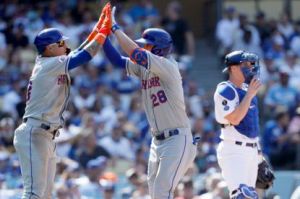
Javier Baez, J.D. Davis

The Good Javy (left, after scoring on J.D. Davis’s [center] two-run bomb in the seventh) returned from the injured list and doubled down against the Dodgers Sunday afternoon.

This time, J.D. Davis didn’t shrink. Either with one man on or with the bases loaded.

This time, too, trade deadline addition Javier Baez came off the injured list, swung like a pro, scored like a pro, and doubled down, literally. He put a small shot of rocket fuel into a team looking like the living dead too often this month.

This time, the Mets may have left eight men on but they also sent seven runs across the plate. They’ve now done that only twice since 21 July. And, this time, too, they didn’t let the Dodgers take a single lead all Sunday long.

The bad news is that Sunday’s 7-2 win to stop the Dodgers’ winning streak at nine probably won’t be enough to salvage the Mets’ 2021. They’d need a finish from here that you can describe politely as miraculous to do that. Losing eleven games in the standings this 6-15 doesn’t leave room for miracles.

But let’s worry about that later. Right now, let’s savour Baez cashing in Brandon Nimmo (leadoff full-count walk, on which he sprinted up the line to first) with one out, sending one ricocheting off the left center field fence in the top of the first, with Nimmo gunning home all the way from first.

Let’s savour Davis shooting one the other way up the right field line to send Baez home, and Jonathan Villar with two outs punching a quail into short center, Davis scoring when Cody Bellinger’s throw in brought Dodger catcher Will Smith well out in front of the plate.

Let’s savour Villar trying to take second on the throw in and Smith throwing wild enough to let Villar have third on the house, before a foul out caught by Dodger starter David Price ended the inning at three for the Mets.

Let’s savour the Dodgers getting only a pair back in the fourth, when Bellinger reached Mets starter Marcus Stroman for a two-out, two-run line single to right, making Stroman pay for walking the bases loaded ahead of Bellinger—whose season has been compromised badly by a couple of nagging leg issues and not having been able to recuperate properly from off-season shoulder surgery.

Let’s savour the Mets catching Bellinger in an inning-ending rundown out, catcher to short, Baez playing his old position in Francisco Lindor’s absence, feinting a throw toward third to keep A.J. Pollock from even thinking about a score before tagging Bellinger as he tried turning back toward second.

Let’s savour Stroman managing to keep the Dodgers at bay long enough for Baez to hustle a single into a double after two swift outs in the top of the seventh and Davis, right behind him, hitting the first pitch he saw from Dodger reliever Phil Bickford on a line over the left field fence.

Let’s savour the Mets loading the pads with one out in the top of the ninth off Dodger reclamation project Shane Greene—Nimmo’s base hit to right, Pete Alonso taking another plunk for the team, then Baez taking another plunk for the team.

And let’s savour Davis yet again, a day after he’d swung through a Max Scherzer meatball with the bases loaded for a strikeout. This time, Davis recovered promptly from falling into an immediate 0-2 hole. He wrung his way from there to a walk on four straight balls, resisting the temptation to pull the trigger on a sinker that sunk just a little too far below the strike zone floor for ball four and Nimmo trotting home.

But let’s not fool ourselves. These Mets may have a few energy reserves left, but there’s just a little too much still missing to give them much more than prayers. On paper, they’re only seven games out of first in the National League East. On the field and at the plate, Sunday’s showing is what they’ll need only every day from now on, practically, to have the prayer of even a prayer.

It may require what they may not have the rest of the way.

So just spend today thinking about Baez maybe playing his way into an extension that would keep him around the keystone with Lindor, when Lindor returns days from now.

Think about the Good Javy re-joining Lindor to turn the second base region into the swamp where base hits get sunk into ground outs. Lindor may have struggled at the plate this year but he remained a shortstop Electrolux. (Thirteen defensive runs above the league average shortstop before he was injured.)

Think about the Good Javy who turns the plate into his personal game-changing playpen, providing an energy jolt through this team that not even Con Edison could deliver, just the way he did Sunday afternoon.

Don’t think about the Bad Javy who chases pitches that deserve to escape, the one who tries a little too often to hit eight-run homers on pitches that provide the power just by the bat giving them a kiss. Not until or unless he shows up again, that is.

Think about the Good Javy outweighing the Bad Javy enough to convince Mets owner Steve Cohen it’ll be worth it to keep him around and use him as the perfect out to purge Robinson Cano, who’s due back for 2022.

Don’t say the Mets “will eat” Cano’s money for the final two years of his deal. That meal already went through the digestive tract and out the other end. They accepted him as part of the deal when they wanted relief pitcher Edwin Diaz that badly from the Mariners. Once his current suspension ends, Cano’s going to get paid whether or not he suits up for the Mets again.

Cano isn’t the defensive second baseman he used to be. He hasn’t been the hitter he once was since 2016, either. That’s something to ponder especially if wisdom finally prevails otherwise and the designated hitter finally becomes universal to stay.

The Mets may not be that inclined to have back a 38-year-old millstone drydocked an entire season over actual/alleged performance-enhancing substances, his second such suspension in four years. The Good Javy showed up in time Sunday to start helping make that decision so simple for the Mets that even Joe Biden could make it without screwing the proverbial pooch into a blood bath.