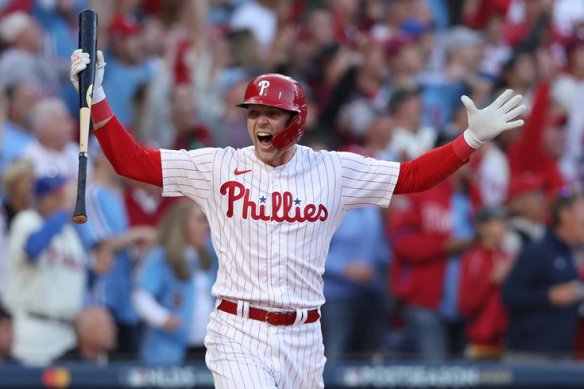
How to soil a phlying Phillies homecoming

Rhys Hoskins

There are those who seem to think Rhys Hoskins’s epic bat spike as he began running his third-inning three-run homer out is more offensive than Citizens Bank Park fans doing the infamous tomahawk chop-and-chant, even to mock the Braves. 

“Baseball is quintessentially American,” A. Bartlett Giamatti once wrote, “in the way that it tells you that, long as you travel and far as you go, out to the green frontier, the purpose is to get home.” Professor, if you watched National League division series Game Three from your seat in the Elysian Fields Friday, you saw ironclad evidence for the continuing truth of your sage soliloquy.

The Phillies came home having played fourteen straight games on the road, including their National League wild card series sweep out of the Cardinals. They’d split a tough pair against the Braves in Atlanta to open this set. Now the set came to Philadelphia, a sports city about which the most polite observations include that to err is human but to forgive is not fan policy.

That, and a six-run lead in the game’s first third leaves Phillie fan anything but comfortable. They’ve felt burned enough that they believe as firmly as few other fans that Berra’s Law is incontrovertible and impervious to alternative interpretation. They weren’t comfortable, most likely, until the 9-1 Phillies win was a finished transaction.

The first two and a third innings were quiet enough that you could almost hear a hair drop. Almost. Then came the bottom of the third against Braves starter Spencer Strider, the lad who broke out this year with a 1.83 fielding-independent pitching rate, a 4.49 strikeout-to-walk rate, a 1.00 walks/hits per inning pitched, and a 2.67 earned run average. A lad against whom the Phillies hit a measly .97 cents on the year.

This time, defying even the usual normal cliche about the postseason being far enough the proverbial kettle of fish above the regular season, the Phillies broke Strider in half in the bottom of the third. By the time the six-run inning was over, Phillie fan would have forgiven almost (underline that) anything.

Strider and his Phillies starting counterpart Aaron Nola looked almost unreachable through the first two and a half, with Strider having the slightly better end of things thanks to a pair of one-two-three innings. But Strider didn’t exactly plan to open the bottom of the third by walking Phillies center fielder Brandon Marsh on four straight pitches. Nor did he plan for his pickoff attempt to bound wild and past his first baseman Matt Olson.

Nor did he plan for Olson, hustling into foul ground to get the ball, to throw a strike that would have been perfect except for the short hop to third baseman Austin Riley two feet down the line in front of the pad, enabling Marsh to dive in with real estate to spare.

The Braves righthander certainly didn’t plan on Phillies shortstop Bryson Stott wringing him to a ninth pitch on 2-2 before lining a one-out RBI double to the rear corner of the right field grass. He and the Braves may have had double play plans by way of handing Kyle Schwarber a free pass, but as John Lennon might have sung if a baseball fan, life like baseball is what happens when you’re busy making other plans.

Rhys Hoskins enunciated Lennon’s truth rather harshly when Strider threw him a first-pitch fastball so fat it might as well have been a beach ball, and he sent it promptly into the left field seats. Strider didn’t exactly feed Phillies catcher J.T. Realmuto following up a meatball slider, but Realmuto caught enough hold of it to shoot the ball into left for a single and Strider out of the game.

Enter Dylan Lee, a somewhat late-blooming lefthanded relief pitcher with a Strider-like WHIP on the season and an excellent 2.66 FIP who kept lefthanded batters to a .158/.169/.224 slash line this year. Checking in at the plate was Bryce Harper. And Lee, too, failed to remember what happens when you make your first pitch so glandular Stevie Wonder himself could see and hit it.

Harper was only too happy to remind him with a launch that traveled two-thirds of the way to the back of the lower right field seats. It made Harper the only man ever to hit two bombs and collect seven hits in his first five postseason games in the Phillies’ fatigues. And it yanked the Philles to a 6-0 lead.

Lee shook off Nick Castellanos’s immediate follow-up base hit to left with a pop out to second (Alec Bohm) and a pop out to shortstop (Marsh, whose walk started the carnage in the first place) to end the frame before the Phillies could get ornery again.

But the Braves were up against Aaron Nola, the Phillies ace who had a splendid regular season and kept batters 0-for-17 with runners in scoring position through the top of the sixth Friday. Then Nola ran into a little hot spot in that frame, surrendering a leadoff double to Braves shortstop Dansby Swanson before walking Olson. But he struck Riley out on a high riding fastball before luring catcher Travis d’Arnaud into dialing Area Code 6-4-3.

Until he hadn’t, thanks to the throw on to first baseman Hoskins hitting the heel of the mitt and thudded to the dirt. And Braves center fielder Michael Harris II spanked a high hopper to right for a base hit to sent Swanson home with the first Atlanta run.

Harris stole second with Braves designated hitter Marcel Ozuna at the plate. You could almost hear every heart in Citizens Bank Park become an elevator snapping its cables and plunging to the floor, until Nola threw something Ozuna could whack into an inning-ending ground out alone.

Nola’s outing ended with a leadoff single by Braves pinch hitter Orlando Arcia opening the top of the seventh. Jose Alvarado entered and pounded strikeouts upon William Contreras and Ronald Acuña, Jr., before he got Swanson to line out right to Schwarber playing him somewhat deep in left field.

So what the hell was up with that little chorus of the infamous Tomahawk Chop and Chant around the Bank in the bottom of the seventh—before the Schwarbinator broke his plate drought with a base hit and Hoskins drew a walk, before Realmuto forced Hoskins at second while setting first and third up, prodding Braves reliever Jake Odorizzi out and Jesse Chavez in?

The crowd might have been trying to mock Braves fans in the yard with the game getting closer to the bank for the Phillies. Might. The Chop and Chant are dubious enough in Truist Park, but Philadelphia isn’t exactly lacking for its own history of racial tensions, either. Not clever. Not funny.

Better to let Braves fan have it the way Harper did, once Chavez went to work. Harper sent a 2-2 cutter to the left center field wall, Harris running it down, leaping to one-hand it, and hitting the wall to knock the ball loose to the track as fast as it hit the glove in the first place, sending Schwarber’s pinch runner Matt Vierling home and Realmuto to third. Better, too, to do it the way Castellanos did to follow immediately, with a two-run single to right center to send two more home.

But no. The crowd cranked the Chop and Chant up again in the top of the ninth, clutching red rally towels, as Connor Brogdon went to work erasing the Braves in order. There are those more offended by the driving bat spike Hoskins committed starting up the first base line to run his home run out than by the Chop and Chant.

Not brilliant. The Phillies’s kind of homecoming deserved better.

Bruce Sutter, RIP: Like skipping a rock

Hall of Fame relief pitcher Bruce Sutter with the Cardinals en route their 1982 World Series winner.

“It’s unhittable,” said Hall of Fame manager Dick Williams about Hall of Fame relief pitcher Bruce Sutter’s split-finger fastball, “unless he hangs it, and he never does. It’s worse than trying to hit a knuckleball.” Another Hall of Fame manager, Whitey Herzog, has said that Sutter would never have become injured if he’d remained a Cardinal.

Sutter, who died of cancer Thursday at 69, became a Cardinal in the first place, in 1980, because the Cubs with whom he’d arisen to become a groundbreaking relief pitcher in the first place got caught flatfoot, when the combination of salary arbitration and free agency smashed into a grave if unintended error by longtime owner Phil Wrigley.

The elder Wrigley’s mistake, according to Peter Golenbock in Wrigleyville: A Magical History Tour of the Chicago Cubs, was leaving half his estate to his wife, Helen, whose own death meant the Wrigley estate being taxed heavily twice and leaving son William III, who’d inherited the Cubs, strapped for running the team until or unless he could sell it.

In due course, Bill Wrigley’s financial picture would wreak havoc enough on the Cubs. Sutter himself would remember (to Golenbock) the Cubs having a good team or two followed by a disgruntled team full of veterans who came over from established winners and not liking the Cubs’ post-’79 decline.

About 1979, too, the husky righthander remembered, “That was the year . . . we lost a game to the [Phillies], 23-22. You’re going to ask who gave up the last run, aren’t you? It was a Mike Schmidt home run—off me.” Hitting his second bomb of the day, the Hall of Fame third baseman conked one off Sutter and up the left center field bleachers with two out in the top of the ninth. The Cubs—whose own bombardier Dave Kingman hit three out (one onto a Waveland Avenue porch while he was at it)—went down in order in the bottom against former Big Red Machine relief star Rawly Eastwick.

Sutter learned the split-finger fastball from a minor league coach named Fred Martin and rode it to a 2.33 fielding-independent pitching rate, a 3.42 strikeout-to-walk rate, and a 1.05 walks/hits per inning pitched rate as a Cub. He won the National League’s Cy Young Award for 1979 while he was at it. Then he won a $700,000 salary for 1980 in arbitration.

The only relief pitcher never to have started a major league game when inducted into the Hall of Fame in 2006, Sutter found himself one of the 1980 Cubs’ few leading lights, with a 2.64 ERA and a league-leading 28 saves. He also found himself a Cardinal after that season, after the Cubs under Wrigley’s financial distresses couldn’t pull the trigger on a longer-term deal with deferrable money.

Enter Herzog, who’d only coveted Sutter for half the time Sutter pitched for the Cubs. Only too acutely aware of what happens to even great teams without shutdown relief—he’d been purged as the Royals’ manager after front office disputes trying to get them better relief pitching, before All-Star reliever Dan Quisenberry came into his own—the White Rat, doubling as general manager, brought Sutter to St. Louis for Leon Durham and Ken Reitz plus a spare part named Ty Waller.

Sutter delivered in St. Louis—he nailed down Game Seven of the Cardinals’ 1982 World Series triumph— in large part because Herzog and his then-pitching coach Mike Roarke knew even more than the Cubs how to manage a pitcher whose money pitch just so happened to put arms and shoulders in danger if not handled properly. “[N]obody knew [Sutter’s] motion better than Mike Roarke,”  Herzog wrote in You’re Missin’ a Great Game:

I knew Bruce had to come back behind his ear, then straight over the top, with his delivery. He threw that nasty split-finger pitch, which made the ball look like a rock skipping on water—tough to pick up, let alone hit—but it puts a violent torque on the arm. When you think of the guys who live by that pitch . . . how many had a couple of great years, then dropped off the map?

. . . Well . . . Roarke and I were watching Sutter throw in [spring training] and I saw he was coming kind of three-quarters, bringing the ball out to the side and across. I said, “Holy moly, Mike, he’s all out of whack!” We got right on his ass about it, and he straightened it out. No harm, No foul. Bruce saved a lot of games for us; we saved him more damage than anybody knows.

You know what? If he’d stayed with the Cardinals, Bruce would never have gotten hurt.

Sutter left the Cardinals as a free agent after the 1984 season. Owner Gussie Busch decided to share the top decision making with two Anheuser-Busch leaders, Fred Kuhlmann and Lou Sussman, and they weren’t exactly as amenable to Herzog as Busch himself was, according to Golenbock’s The Spirit of St. Louis.

Herzog swore the pair “jerked” Sutter around over a no-trade clause; second baseman Tommy Herr swore Sussman angered Sutter during their talks. “Bruce wanted to stay in St. Louis,” remembered Herr.

I don’t think the money was that big of a deal. It became more of a personality conflict. Lou Sussman was handling the negotiations for the Cardinals. At some point, Lou rubbed Bruce the wrong way, and Bruce just said, “The heck with it. I’m going somewhere else.” Bruce did it just to spite Lou. And that was unfortunate, because we felt Bruce was just such a weapon for us.

Bruce Sutter

Before the beard: a portrait of the artist as a young Cub . . .

Braves owner Ted Turner showed Sutter a pile of money.` (Six years, $10 million, guaranteed contract.) But Turner couldn’t show Sutter a staff that knew how to manage his workload and keep him from letting his delivery and his bullpen warmups (he was warmed up far less judiciously in Atlanta than in St. Louis) wreck his shoulder at last.

He suffered inflammation in the final third of August 1985 plus a pinched nerve, the injury that almost kept him buried in the minors in the beginning, before Martin taught him the splitter. He would never be the same pitcher again. Had he not fallen under the Braves’ then-dubious care, Sutter’s percentage of inherited runs to score would have ended below 30 percent, splendid work for any relief pitcher.

He may have seen his career collapse in Atlanta, but the Pennsylvania native found Georgia life agreeable enough to stay there with his wife, Jayme, and their three sons. He was the only player inducted into the Hall of Fame in 2006 by way of the writers’ vote, an appropriate position considering how he’d helped to change his baseball craft.

His Hall of Fame teammate Ozzie Smith and Hall of Fame Reds catcher Johnny Bench needled him wearing fake, long gray beards as they escorted him to the podium. Sutter made hitters fear the beard from the bullpen long before anyone heard of one-time Giants bullpen stopper Brian Wilson, but he struggled to stay composed addressing and thanking his wife during his acceptance speech.

We were together through the minor leagues, through the major leagues, and now the Hall of Fame. I love you very much, I appreciate everything you have done and continue to do. I wouldn’t be here without you. I know we have some challenges to face in our future, but we’ll do ’em as we always have, together.

Their marriage was a love that endured almost as long as his love for baseball. So did several friendships Sutter made during his career, such as now-Hall of Fame teammate Jim Kaat, who ended his career as a Cardinal while Sutter anchored their bullpen.

“I feel like a brother passed away,” Kaat told a reporter. “I knew Bruce deeper than just about any other teammate. We spent a lot of time together, and as happens when your careers end, you go your separate ways. But we stayed in touch and considered each other great friends.”

The particular challenge didn’t scare Sutter. Whether throwing that rock-skipping splitter past fellow Hall of Famers out of the bullpen (let the record show that except for two homers each, Mike Schmidt and Willie Stargell, to name two, couldn’t hit him with a warehouse door), or making a half-century marriage raising three sons and becoming beloved grandparents to six in an often self-immolating world, there was no challenge to which Sutter seemed  allergic.

“Heaven needed a big time save,” tweeted longtime baseball analyst Dinn Mann. “Marvelous pitcher, even better person,” tweeted USA Today columnist Bob Nightengale. Baseball will miss him on earth only slightly less than his family will.

Two over the shoulder help tie an NLDS

Dansby Swanson, Austin Riley

Over the shoulders Wednesday night—Dansby Swanson hits the short left field turf to rob a bloop base hit from J.T. Realmuto; Austin Riley one-hands Bryson Stott’s foul over the tarp roll on which he might have turned his ribs to bone meal.

Well, I can’t decide, either. Atop a well-pitched National League division series Game Two, between the Braves and the Phillies, who put on the better defensive show between Braves shortstop Dansby Swanson and third baseman Austin Riley?

Don’t ask either one.

“I give him the credit,” Riley said, after the Braves banked the 3-0, series-tying win. “Just because running straight out, over the head is pretty tough.”

“I didn’t have to dodge a tarp,” Swanson said. “The guy, once again, a very under-appreciated defender, a lot more athletic than people give him credit for. The guy’s a gamer.”

That was like trying to choose between Lux Guardian and Lux Legacy vacuum cleaners. But come on, gentlemen. Quit being coy.

We might hand Swanson the slight advantage, though. With two out in the top of the sixth, Swanson ran out from shortstop into shallow left field chasing J.T. Realmuto’s bloop with center fielder Michael Harris II and left fielder Eddie Rosario pouring in from their positions. One false step or one body bump might have meant a base hit to a club that  isn’t terrible at turning two outs into a run-scoring chance.

Swanson took a small diving leap to nail it just before his glove hit the grass followed by the rest of him. “Play of the game, so far,” my game notes say. But if you press him on it, he’ll tell you he had a slightly unfair advantage going in.

“I should get my parents in here,” he said, “because they threw me a gajillion balls just like that all the time growing up over my head. I was the epitome of the kid that would throw a tennis ball off a wall and ricochet it and run, try to catch it over my shoulder. Probably threw a lot of tennis balls onto the field, too, to disrupt my brother’s baseball games. But I feel like I’ve been doing that since I was five.”

Two innings later, the Phillies had one out and Jean Segura aboard after a long drive to the left field wall that might have been a double was turned into a long single—thanks to Rosario playing the carom as if according to a script. He’s not the best defensive left fielder overall, but he has a powerful enough throwing arm that that kind of carom play keeps the other guy’s slugging percentage from creeping upward.

Then Phillies shortstop Bryson Stott popped a 1-2 service from Atlanta reliever Raisel Iglesias to the left side, beyond third base. Riley kicked his horse, ran it down, and reached to snap the ball into his glove above the Truist Park tarp roll—about a nanosecond before he would have hit that roll with a rib cage-cracking clank allowing Stott a reprieve.

“Couple of crazy catches,” said Braves first baseman Matt Olson. “Dansby going back, I think Rosario was going to have the play at it first. Rosario was pretty deep.”

“For me, that’s my best friend, is a good defense,” said Braves starter Kyle Wright, who kept the Phillies to a pair of hits and a walk while striking out six and turning his breaking balls loose enough to keep them out of balance. His only serious threat came when Bryce Harper, still in the Phillies’ designated hitter role, led off the second with an opposite-field double to left, took third when Nick Castellanos lined out to third, but was stranded by an unassisted ground out to first and a swinging strikeout.

“I try to get guys to put it on the ground. When they make catches like that, that’s good, too. That’s been one of my biggest weapons this year, I believe, is the defense.”

Phillies starter Zack Wheeler was almost as effective until he had two outs in the bottom of the sixth and perhaps got himself a little taken out of his game after his first pitch to Ronald Acuña, Jr. ran in hit the Braves’ right fielder on the inside part of his right elbow. Wheeler looked ashen on the mound as Braves trainers tended Acuña, who shook it off enough after about seven minutes to stay in the game and take first.

Swanson then worked out a full count walk to provide the Braves’ first man in scoring position all night to that point. Then Olson grounded one that took a tweener hop through Phillies first baseman Rhys Hoskins and sent Acuña home. With both starting pitchers working so stingily to that point, a single run must have felt like a three-run homer to the Braves.

Riley batted next. He hit a slow, small bouncer to the third base side of the mound, slow enough that Wheeler running to his right had no play to make when he speared the ball, but Swanson had a second Braves run to score on it. Then Travis d’Arnaud—the Braves catcher who’d caught Wheeler on days enough when the pair were Mets teammates—shot one sharply up the pipe for the single that sent Olson home with run number three.

A.J. Minter, Iglesias (with a little help from Riley), and Kenley Jansen kept the Phillies quiet to finish off. Andrew Bellotti and another former Met, Noah Syndergaard, kept the Braves quiet likewise to finish off. But their shoulders weren’t quite as burdened as those of the two Braves infielders who had to go over theirs to make plays that could have sent either one to the infirmary.

“[Swanson] had to readjust, get back on it and make an over the shoulder catch,” Olson said. “And then Riley going up against the tarp. Weird angle. Couple of great catches, and that’s the kind of game it was tonight.”

Game Three is set for Citizens Bank Park Friday. The Phillies had just played fourteen straight games on the road including the wild card set in which they swept the Cardinals to one side and future Hall of Famer Albert Pujols, plus ancient catcher Yadier Molina, into retirement well short of a shot at one more World Series ring.

“To leave here with a split,” said Phillies manager Rob Thomson, who had the interim tag removed well before the postseason began, “and go back home in front of a packed house of passionate people . . . I think will give our guys a little shot in the arm.”

Unless the Braves keep up the stingy pitching and luminous leather, of course. Then, that Philadelphia house packed with “passionate people” might want to give the Phillies a little shot in the head.

Nuke box music

Yordan Alvarez home run

Artist’s rendition of the nuke Yordan Alvarez dropped—covering Texas, half of Oklahoma, and a third of the Gulf of Mexico; and, enabling the Astros to take ALDS Game One. (Kidding . . . kind of . . .)

The one man in Astros silks nobody wants to face in the bottom of the ninth with men on base stepped in with two out in the bottom of the ninth in Minute Maid Park Tuesday afternoon. This lefthanded swinger had first and second and one out. He had a lefthanded pitcher to face on the mound.

It didn’t matter to Yordan Alvarez. But it came to matter phenomenally to the Mariners, who came into the half inning having seen an early 7-3 lead cut down to 7-5. And it came to matter even more to Robbie Ray, the defending Cy Young Award winner who usually starts but was brought in now for the lefty-lefty gambit.

First, Alvarez fouled off a sinker that arrived a little outside and just under the middle of the plate. Then, Ray threw him a second sinker, just under the middle of the plate but a little inside. In other words, right into one of Alvarez’s wheelhouse spots.

The two-out mushroom cloud from the warhead that won American League division series Game One for the Astros spread its umbrella over all Texas, half of Oklahoma, and maybe a third of the Gulf of Mexico. The Mariners might have sung a sailor’s lament, but the Astros probably thought it was the sweetest nuke box music this side of heaven.

We fear no team, the Mariners all but said entering this set, after a regular season surprise of finishing second to the Astros in the American League West, then sweeping the  Blue Jays out in a wild card series. They may fear no team, but they wouldn’t be the only ones to determine a little fear of Alvarez might be gentler upon their health. Short and long term.

Mariners manager Scott Servais had no reason to fear Ray faltering against a lefthanded hitter, since he kept them to a .212/.260/.347 slash line and a .647 OPS on the regular season. When his ninth-inning man Paul Sewald got a quick ground out to open but plunked rookie pinch-hitter David Hensley on a full count, then struck Jose Altuve out before Jeremy Peña singled, Servais went to the percentages.

He wasn’t going to let his righthander who’d already been bopped for the two-run homer by Alex Bregman that pulled the Astros back to within a pair an inning earlier stick around to incur further disaster. But as the mushroom cloud dissipated, the skipper was left to shake it off, remind himself it’s a best-of-five, and wait till Game Two for vengeance.

Servais may have forgotten the percentage that might have reminded him Alvarez is almost as deadly against lefthanded pitching as he is against righthanded pitching. He might have hit 17 more home runs against the starboard side, but his OPS against the port side is a deadly enough .947, and his on-base percentage is eight points higher.

Not to mention his Real Batting Average (total bases + walks + intentional walks + sacrifice flies + hit by pitches, divided by total plate appearances) against the port side (.651) is only 62 points lower than against the starboard—and would be a career year for a lot of batters no matter what side.

The data tells you what’s been. It only suggests what might be. But Alvarez’s data suggestion should have alerted Servais that, as tenacious a competitor as Ray is—and this was only the seventh relief appearance of Ray’s major league career—there was at least a 50-50 chance that Ray confronting Alvarez might not end well for his team.

Alvarez also started the Houston scoring with a two-run double in the third, cutting the early 4-0 Seattle lead exactly in half. Only nobody’s going to remember that cruise missile as vividly as they’re going to remember that ninth-inning hydrogen bomb.

Yordan Alvarez

Very well, this is the real look of Alvarez bombing the Mariners away Tuesday . . .

He didn’t just nuke the Mariners at Game One’s eleventh hour. He bombed his way into the history books. He’s only the second man in postseason history—after Kirk Gibson (Game One, 1988 World Series)—to walk it off with a home run when his team was down to their final out of the game. It was also the first postseason game-ending bomb hit with the bombardier’s team in a multiple-run deficit.

Alvarez also reminded the Mariners it’s not wise to assume that getting the early drop on a future Hall of Famer means it’s going to finish in their favour. The Mariners thumped Justin Verlander—who’d pitched a comeback season that has him in the Cy Young Award conversation—for six runs on ten hits in the first four innings, including a two-run double by Julio Rodríguez in the second and a solo blast by J.P. Crawford in the fourth.

Verlander’s final four batters faced, in fact, hit for the reverse cycle: Crawford’s homer plus Rodríguez’s immediate triple, Ty France’s immediate RBI double, and Eugenio Suárez’s single—that might have been an RBI job itself but for France being thrown out at the plate.

Yuli Gurriel cut another Mariners lead in half with his fourth inning solo launch, leaving the score 6-3, before Eugenio Suárez made it 7-3 with his own solo but Bregman—with Alvarez aboard on a one-out single— took hold of a Sewald sinker that didn’t sink quite far enough down and sent it over the left center field fence in the bottom of the eighth.

One inning later, Alvarez trained his bomb sight, pushed the button, and put a finish to one of the Astros’ more dubious streaks: until Tuesday, they’d been 0-48 in postseason play when they entered the ninth trailling by two runs or more.

It didn’t necessarily have to take the most monstrous home run hit in Minute Maid Park since now-retired, Hall of Famer-in-waiting Albert Pujols’s ICBM in the 2005 National League Championship Series. (The ancient days, before the Astros were the team to be named later in the deal making a National League franchise out of the Brewers.)

But it didn’t exactly hurt, unless you wore a Mariners uniform. And in that moment the number on Alvarez’s Astros uniform looked huge considering a little piece of baseball history involving that number. 44.

Two relief tales from . . .

Two relief pitchers will miss postseason time thanks to circumstances unrelated to play on the field. One will miss the rest of his team’s postseason, however long it lasts, thanks to a self-inflicted injury. The other will miss his team’s postseason and say goodbye to that team. Neither man’s postseason had to end this way.

Astros reliever Phil Maton broke a bone in his right pinkie after his appearance in the team’s final regular season game. He’d surrendered two hits plus the only two runs the Phillies scored in that finale, and he was unamused, understandably. What wasn’t so understandable was Maton punching his locker in frustration.

Lockers aren’t any more forgiving that outfield walls or pitchers’ mounds when it comes to human flesh and bone piledriving into them. It doesn’t matter whether the flesh and bone combination is 20, 22, or 29 years old, the latter being Maton’s age. Those stiff, hard, stationary structures can do more damage to their attackers than Muhammad Ali did to his when answering a right cross.

Yankees reliever Aroldis Chapman had annoyed his team already with an injury from a tattoo he acquired, costing him almost a month’s worth of time over August and September, never mind that prudence and his team overseers probably couldn’t convince him to wait until winter vacation to think about another work of body art.

But Chapman’s decline this season prompted his replacement as the Yankees’ closer and, apparently, didn’t sit well with the howitzer, either. Thus did he fume about his demotion until Friday last, when the Yankees conducted a team workout preparing for the division series with what proved to be the Guardians. (Their first place finish rewarded the Yankees with a wild card series bye under the new, dubious postseason system.)

Chapman had told the team he’d be there. Until he wasn’t. To put things kindly, Yankee general manager Brian Cashman was far less amused than was Maton to have handed the Phillies a pair of hits and runs:

It was surprising at first, a little shocking, but after the shock wore off, when you add everything up, it’s not surprising. There’s some questions about whether he’s been in all-in or not for a little while. He’s maintained verbally that he’s in, but at times, actions don’t match those words.

Maton knew at once he’d been a damn fool. “It was a short-sighted move,” he told the press after that game, “and, ultimately, it was selfish. It’s one of those things that I hope doesn’t affect our team moving forward.”

He may be fortunate that the Astros have someone to step in. The Astros may be more fortunate. Bryan Abreu’s fielding-independent pitching rate for 2022 is 2.12, against Maton’s 4.33 FIP. It won’t parole Maton from the Dumbass Zone just because his absence may actually have done the Astros a small favour.

Cashman merely fined Chapman for his absence. He left the roster decision up to manager Aaron Boone. Boone wasted very little time in removing Chapman, despite the Yankee bullpen overall being in questionable enough shape as it was before it lost stretch-drive comer Scott Effross to forthcoming Tommy John surgery.

“I think he questioned whether or not he was going to be on the roster or not,” the manager told a reporter. “But he needed to be here . . . I think there’s a chance he absolutely could have been [on the roster]. We’re still actually getting ready to start those conversations now. He may have been. It’s a moot point now.”

The Yankees told Chapman—whose once-vaunted fastball still had the speed of light but wasn’t exactly invulnerable any longer, not with his 2022 marks of a 4.46 ERA and a 4.57 FIP—to go home to Florida for the division series.

That’s the official word. Unofficially, the word comes forth that, in effect, they’ve told him they’re not terribly inclined to think about bringing him back after he hits free agency this winter. Not with Clay Holmes having emerged as an All-Star reliever and the Yankees’ number one closing option.

It may be lucky for Maton that the Astros may not be injured (oops) by his absence as their postseason gets underway. (The AL West ogres, too, earned a round-one bye under the new system and will tangle with the pleasantly surprising Mariners in their division series.) They can absorb his D.Z. moment and hope he’s learned or re-learned something about self-control.

It’s anything but lucky for Chapman that the Yankees would have needed him to stay all in and step up as big as he could with most of the Yankee pen now in shambles. Holmes (shoulder strain) and Wandy Peralta (a back issues) are back for the division series, but Zack Britton (arm fatigue), Chad Green (Tommy John surgery), Michael King (elbow fracture), and Ron Marinaccio (shin injury) aren’t.

Chapman isn’t any D.Z. non-entity, of course. Not with his domestic violence history that caused enough people to question why the Yankees traded for him (from the Reds), traded him away (to the Cubs, for key contributor Gleyber Torres), then re-signed him in the first place, all within the same year.

When a howitzer that can fire 100+ mph shells gets a pass from domestic violence but finally runs around over an injury from an elective act and, then, shenks a team workout atop a questionable attitude as they prepare for a postseason, something seems badly imbalanced there. It might begin with a 34-year-old who still displays often enough the mind of a four-year-old.