Postseason power teams better off?

Kyle Schwarber

The Schwarbinator’s sixth inning bomb in NLCS Game One dropped Bryce Harper’s jaw and every jaw in Petco Park Tuesday night.

Reality check time. The Guardians’ overall small-ball offense abandoned them in Game Five of the American League division series they squandered to the Yankees. (I’ll mention the squander further in due course.) And the Yankees won the best-of-five in five because their slugging superiority won out in the end.

Sure, enough stellar pitching helped big enough. Guards manager Terry Francona’s reluctance to start ace Shane Bieber in Game Five probably did almost much as his batters’ inability to solve Cortes or a pair of early Yankee bombs to cost them the season.

Now, take a look very carefully.

For the peck-and-poke Guards, 5 percent of their ALDS plate appearances ended with extra base hits and 2 percent ended with home runs. For the bump-and-thump Yankees, 6 percent of their ALDS plate appearances ended with extra base hits and five percent ended with home runs.

On the regular season, six percent of Guardian plate appearances ended with extra base hits and two percent ended with home runs. Eight percent of Yankee plate appearances ended with extra base hits and four percent ended with home runs. (Aaron Judge’s AL record-setting 62 accounted for one percent of the latter.)

Neither team relied upon or got the long ball that much in the division series, but getting just a little bit more of it made as big a difference for the Yankees as getting top of the line pitching from Gerrit Cole in Game Four and Nestor Cortes in Game Give. Getting just a little bit less of it left the Guardians vulnerable whether facing Cole, Cortes, or a sore-armed snowball thrower.

Even as the ALDS was ending the National League Championship Series between the Phillies and the Padres opened with a 2-0 Phillies win. Zack Wheeler outdueled Yu Darvish on the mound by a hair, and Darvish surrendered both Phillie runs—on solo home runs by Bryce Harper (in the top of the fourth) and Kyle Schwarber (a mammoth 488-foot blast leading off the top of the sixth)—while the teams’ pitching otherwise kept each other to four measly hits, three for the Phillies and one for the Padres.

Much as they struggled through an early-season slump, injuries, and a mid-season remake, the Phillies ended eight percent of their regular-season plate appearances with extra base hits and ten percent of their National League division series-winning plate appearances with them. They also ended three percent of those NLDS plate appearances in homers and three percent of their regular-season plate appearances likewise.

The Padres—likewise riddled by injuries and a mid-season remake, not to mention losing Fernando Tatis, Jr. to injury and then a suspension for actual/alleged performance-enhancing substances—ended seven percent of their regular-season plate appearances with extra base hits and two percent with home runs. Six percent of their NLDS-winning plate appearances against the Dodgers ended in extra base hits; two percent in home runs. The Dodgers? Ten percent of their NLDS plate appearances ended with extra base hits but two percent likewise ended with home runs.

I was led to look at those percentages after reading a splendid Baseball Reference analysis by Russell A. Carleton, “Too Reliant on the Long Ball?” Examining 1995-2021, Carleton determined that the postseason team with the higher home run percentage won 54 percent of their games and the one with the higher home runs-to-runs scored ratio won 51 percent of the time. “It doesn’t appear that power teams are in any danger in the playoffs,” he writes, “and might even be a little better off.”

In other words, Carleton would like one and all to know or to re-learn, seemingly, we can one and all knock it the hell off with our home run hypocrisies. You know: we hate the presumption of home run prevalence except when our teams detonate them, just as we hate the presumption of strikeout prevalence except when our teams’ pitchers strike the hell out of the other guys.

The moral of the story is that home runs are a perfectly reasonable way to power an offense. They are no better or worse than any other approach at winning playoff games. I’m sure there’s some element of “feast or famine,” but usually when people say that, they forget about the fact that while there will be famine, there will also be feast.

By the way, during the regular season eight percent of the Astros’ plate appearances ended with extra base hits and three percent ended with home runs. Seven percent of their plate appearances while sweeping the Mariners out of their ALDS ended with extra base hits and four percent ended in home runs. That’s slightly less than the Yankee percentages when all is totaled out. But only slightly.

Meanwhile, you might care to note that a measly seven percent of all major league plate appearances on the regular season ended with extra base hits and three percent ended with home runs. Care to know what the Show average was? Seven percent, extra base hits; three percent, home runs. Too.

“So once again,” Carleton writes, “if you hear someone trying to scare you because a team doesn’t play small ball in the playoffs, and that they are too reliant on home runs for their offense, you can tell them with confidence that it doesn’t actually make a difference. There’s nothing wrong with hitting home runs. It’s generally a good thing.”

It certainly was for the Yankees making way to the ALCS at last. It certainly was for the Phillies drawing first blood in their NLCS. Play all the small ball you want, I’m all for it, except for those out-wasting, scoring-probability-wasting sacrifice bunts. You can win small. Just not every time out.

Don’t fool yourselves that small ball-heavy teams don’t need slugging percentage personnel to, you know, get more of the runs home than a small ball-alone team in the long run. Or, the postseason short run. The Yankees had three (Judge, Giancarlo Stanton, Anthony Rizzo) with 30+ bombs on the season and prevailed. The Guardians only two who hit even 20+ bombs on the season and lost. Hardly the sole reasons, of course. But the difference helped make a difference.

Unless they’ve got Coles, Corteses, Wheelers, Darvishes, Nolas, Snells, Verlanders, Dominguezes, Haders, and Holmeses on the mound, the small ball-alone or small ball-mostly teams play with at least single hands tied behind their backs.
The Yankees rock and troll

Yankee Stadium

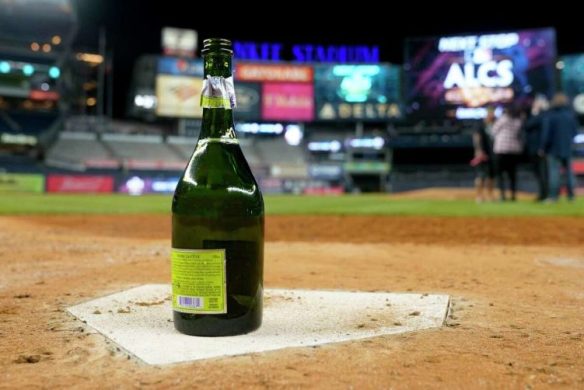
A spent champagne bottle placed on home plate after the Yankees won a trip to the ALCS Tuesday night. The Yankees had to celebrate their win in a hurry—they open against the Astros Wednesday night.

The good news is, Year One of Comissioner Rube Golberg’s triple-wild-cards postseason experiment isn’t going to have an all also-ran World Series, after all. It still yielded a pair of division-winning teams getting to tangle in the American League Championship Series.

The bad news is, those two division winners are still the Yankees and the Astros, after the Yankees sent the AL Central-winning Guardians home for the winter with a 5-1 win Tuesday that wasn’t exactly an overwhelming smothering.

What it was, though, was the game for which the Guardians shot themselves in the proverbial foot. Specifically, two Guardians, one of whom is old enough to know better and the other of whom needs a definitive attitude adjustment.

Guardians manager Terry Francona has more World Series rings this century (two) than Yankees manager Aaron Boone (none). Francona is considered by most observers to be one of the game’s smartest managers who’s made extremely few mistakes and learned from one and all; Boone is one of those skippers about whom second-guessing is close enough to a daily sport in its own right.

But when push came to absolute shove for rain-postponed AL division series Game Five, Boone proved willing to roll the dice Francona finally wasn’t.

After Gerrit Cole held the Guards off with a magnificent Game Four performance Sunday but the rain pushed Game Five from Monday to Tuesday, Boone was more than willing to throw his original Game Five plan aside—Jameson Tallion starting and going far as he could to spell the beleaguered Yankee bullpen—and let Nestor Cortes pitch on three days’ rest for the first time in his major league life.

Francona wouldn’t even think about changing his original Game Five plan, opening with his number-four starter Aaron Civale, who hadn’t even seen any action this postseason until Tuesday, then reaching for his bullpen at the first sign of real trouble. He wasn’t willing to let his ace Shane Bieber go on three days’ rest for the first time in his major league life.

Mother Nature actually handed Francona one of the biggest breaks of his life when she pushed Game Five back a day. Either he missed the call or forgot to check his voicemail. “I’ve never done it,” said Bieber postgame Tuesday, about going on three days rest. “But could I have? Sure.”

“It’s not because he can’t pitch,” said Francona after Game Five. “It’s just he’s been through a lot. You know, he had [a shoulder injury in 2021] and he’s had a remarkable year, but it’s not been probably as easy as he’s made it look.”

It might have been a lot easier on the Guardians if Francona handed his ace the chance to try it, with reinforcements ready to ride in after maybe three, four innings. Even year-old-plus shoulder injuries deserve appropriate consideration, of course. But Bieber surrendered a mere two runs in five-and-two-thirds Game Two innings. Francona’s hesitation when handed the chance helped cost him a shot at another AL pennant.

Civale didn’t have it from the outset. He had as much control as a fish on the line jerking into death out of the water. Giancarlo Stanton slammed an exclamation point upon it when he slammed a hanging cutter the other way into the right field seats with two aboard and one out.

The Guards’ pen did surrender two more runs in the game, including Aaron Judge’s opposite field launch the next inning. But they spread those runs over eight and two-thirds innings’ relief while otherwise keeping the Yankees reasonably behaved. They gave the Guards every possible foot of room to come back and win it.

That was more than anyone could say for Josh Naylor. The Guards’ designated hitter had already raised temperatures among enough Yankees and around a little more than half of social media, when his Game Four home run off Cole resulted in him running the bases with his arms in a rock-the-baby position and motion.

Naylor intends the gesture to mean that if he hits you for a long ball he considers you his “son” in that moment. It wasn’t anything new for him or for those pitchers surrendering the 20 bombs he hit on the regular season. And Sunday’s blast was the third time Naylor has taken Cole into the seats in his major league life. He was entitled to a few bragging rights.

Cole himself thought the bit was “cute” and “a little funny.” He wasn’t half as offended as that half-plus of social media demanding Naylor’s head meet a well-placed fastball as soon as possible. Yesterday, if possible. The Yankees found the far better way to get even in Game Five than turning Naylor’s brains into tapioca pudding.

“We got our revenge,” Yankee shortstop Gleyber Torres all but crowed postgame. Torres even did a little rocking of the baby himself in the top of the ninth, after he stepped on second to secure the game-ending force out. “We’re happy to beat those guys,” he continued. “Now they can watch on TV the next series for us. It’s nothing personal. Just a little thing about revenge.”

Naylor was also serenaded mercilessly by the Yankee Stadium crowd chanting “Who’s your daddy?” louder with each plate appearance. Every time he returned to the Guards’ dugout fans in the seats behind the dugout trolled him with their own rock-the-baby moves. And his most immediate postgame thought Tuesday was how wonderful it was that he’d gotten that far into their heads.

Some say it was Naylor being a good sport about it. Others might think he was consumed more with getting into the crowd’s heads than he was in getting back into the Yankees’ heads. The evidence: He went 0-for-4 including once with a man in scoring position Tuesday.

Oh, well. “That was awesome,” he said postgame of the Yankee Stadium chanting. “That was so sick. That was honestly like a dream come true as a kid—playing in an environment like this where they’ve got diehard fans, it’s cool. The fact I got that going through the whole stadium, that was sick.”

Josh Naylor

Rock and troll: Yankee fans letting Josh Naylor have it on an 0-for-4 ALDS Game Five night.

Did it cross his mind once that his team being bumped home for the winter a little early was a little more sick, as in ill, as in not exactly the way they planned it? If it did, you wouldn’t have known it by the way he continued his exegesis. “If anything, it kind of motivates me,” he began.

It’s fun to kind of play under pressure. It’s fun to play when everyone’s against you and when the world’s against you. It’s extremely fun.

That’s why you play this game at the highest level or try to get to the highest level: to play against opponents like the Yankees or against the Astros or whoever the case is. They all have great fanbases and they all want their home team to win, and it’s cool to kind of play in that type of spotlight and in that pressure.

Wouldn’t it have been extremely more fun if the Guardians had won? Did Naylor clown himself out of being able to play up in that spotlight and its pressure this time? Those are questions for which Cleveland would love proper answers.

So is the question of how and why the Guards didn’t ask for a fourth-inning review that might have helped get Cortes out of their hair sooner than later, after a third inning that exemplified the Guards’ hunt-peck-pester-prod limits.

They went from first and second and one out in the top of the third—one of the hits hitting the grass when Yankee shortstop Oswaldo Cabrera collided with left fielder Aaron Hicks, resulting in a knee injury taking Hicks out of the rest of the postseason—to the bases loaded and one out after Guards shortstop Amed Rosario wrung Cortes for a four-pitch walk. They got their only run of the game when Jose Ramírez lofted a deep sacrifice fly to center.

Now, with two outs in the top of the fourth, Andres Giménez whacked a high bouncer up to Yankee first baseman Anthony Rizzo, who had to dive to the pad to make any play. The call was out, but several television replays showed Giménez safe by a couple of hairs. Perhaps too mindful of having lost three prior challenges in the set, the Guardians’ replay review crew didn’t move a pinkie. Francona seemingly didn’t urge them to do so.

Never mind that it would have extended the inning and given the Guards a chance to turn their batting order around sooner, get Cortes out of the game sooner, and get into that still-vulnerable Yankee pen sooner. Francona’s been one of the game’s most tactically adept skippers for a long enough time, but not nudging his replay people to go for this one helped further to cost him an ALCS trip.

These Yankees don’t look proverbial gift horses in the proverbial mouths. An inning later, with Torres on first with a leadoff walk and James Karinchak relieving Trevor Stephan following a Judge swinging strikeout during which Torres stole second, Rizzo lined a single to right to send Torres home. That was all the insurance the Yankees ended up needing.

Especially when these so-called Guardiac Kids, the youth movement whose penchant for small ball and for driving bullpens to drink with late rallies, forcing the other guys into fielding lapses, winning a franchise-record number of games at the last minute, had nothing to say against three Yankee relievers who kept them scoreless over a final four solid shutout innings.

Especially when they actually out-hit the Yankees 44-28 and still came up with early winter. The trouble was, the Guards also went 3-for-30 with men in scoring position over Games One, Two, Four, and Five, and had nobody landing big run-delivering blows when needed the most. Their ability to surprise expired.

Now the Yankees have a chance for revenge against the Astros who’ve met them in two previous ALCSes and beaten them both times. They had to hurry their postgame celebration up considerably—the ALCS opens Wednesday night.

The Guardians could take their sweet time going home for the winter and pondering the season that traveled so engagingly but ended so ignominiously.

“Winning the division was the first part,” Hedges said postgame. “Wild-card round. Put ourselves in position to beat the Yankees. And we wanted to win the World Series, but that’s a good Yankees team. The cool thing is, now we have a bunch of dudes with a ton of playoff experience in the most hostile environment you can imagine.”

The Guards were bloody fun to watch for most of it. Then Cole, Stanton and Judge rang their bells in Games Four and Five, and they had nothing much to say in return. The Guardiac Kids were the babies who got rocked. There was nothing much fun about that.

The valiant but vanquished Mariners

Jeremy Peña

The Mariners fought the Astros off long and luminously in their ALDS Game Three, but Astros rookie Jeremy Peña brought the fight near to the end with his eighteen-inning, scoreless tie-breaking bomb that proved the end of the Mariners’ season.

Maybe nobody really expected the Mariners to get to their first postseason since the wake of the 9/11 atrocities in the first place. Maybe nobody really expected them to stay there when they up and bumped the Blue Jays to one side in a wild card series.

But they did.

Maybe nobody expected them to survive against the American League West ogres from Houston. Even if they made a reasonable enough-all-things-considered 7-12 showing against them on the regular season. Even if they’d beaten the Astros two out of three in two first-half sets.

They didn’t.

But a three-game sweep out of their division series still stings, no matter how valiant the Mariners effort was. Even if the series was as close as a closed clothespin, the Mariners compelling the Astros to win the first two games by comeback.

Mariners fans and just about everyone else couldn’t possibly have been surprised that Yordan Alvarez was the bombardier who flattened the Mariners in Games One and Two, first with that jolting three-run homer to turn a 7-5 lead into an 8-7 Game One win in the bottom of the ninth, then with a just-as-jolting two-run homer in the Game Two bottom of the sixth.

But going long distance two games’ worth in Game Three to see it end via Astro rookie Jeremy Peña’s leadoff bomb off Penn Murfee, after Luis (Rock-a-Bye) Garcia held them at bay over four relief innings with only one measurable threat against him, had to sting soul deep.

After a marathon exhibition of run prevention—the 42 combined strikeouts (20 by Astro batters, 22 by Mariners batters) set a postseason record; the Astros going 11-for-63 and the Mariners going 7-for-60 all night, it couldn’t feel otherwise.

“It’s kind of what we’re accustomed to, playing those tight games and finding a way,” said Mariners manager Scott Servais postgame Saturday night. “I mean, that is a big league game, with the pitching and defense that was fired out there. We just weren’t able to put anything together.”

“This at-bat,” Pena said, after his homer broke the foot-thick ice at last, “was not going to be possible if our pitching staff didn’t keep us in the ballgame. They dominated all game. Their pitching staff dominated all game.”

Sometimes you had to think what was wrong with these Astros—if they were going to prevail anyway against the Seattle upstarts, how the hell could they not have just done it in the regulation nine? Didn’t they want to avoid wheeling Justin Verlander to the mound in a Game Four if they could help it?

Now, of course, Verlander and Framber Valdez can have a little extra rest/rejuvenate time before opening the Astros’ unprecedented-in-the-divisional-play-era sixth consecutive American League Championship Series. They won’t know their opponent until things are settled between the Guardians and the Yankees in New York Monday night.

But how could these Astros, whose stocks in trade include becoming the biggest pains in the ass in the AL West with runners in scoring position, do worse with RISP (0-for-11) than the Mariners (0-for-8) did all night long?

How could Kyle Tucker and Jose Altuve hitting back-to-back one-out singles and pulling off a double-steal in the top of the second end with Mariners starting pitcher George Kirby striking Chas McCormick out to strand them?

How could Kirby plunk two Astros in the top of the third—Alvarez leading off, Trey Mancini to set up ducks on the pond—and escape with his life after McCormick’s deep fly to center was run down and hauled down by Julio Rodríguez?

How could the Astros plant first and second on Kirby with one out in the top of the seventh—and strand them by way of Christian Vazquez flying out to center and Altuve striking out?

How did Mariners reliever (and erstwhile Rays bullpen bull) Diego Castillo slither out of second and third and one out in the top of the ninth by striking Vazquez and Altuve out back-to-back swinging?

How did six Mariners out of the bullpen keep the Astros hitless from the tenth through the fifteenth, with their only baserunner of the span coming when Paul Sewald plunked McCormick to open the the top of the twelfth?

And how did Murfee save Matthew Boyd’s bones midway through the top of the sixteenth, after Boyd surrendered a base hit (Alex Bregman) and a walk (Kyle Tucker) following a leadoff fly out? Murfee got Yuli Gurriel to line out to fairly deep right center and Aledmys Diaz to pop out beyond first base in foul ground.

The longer this one went, the more improbably it continued to look. And not one muscle in T-Mobile Park dared obey any Mariner fans’ thoughts of making for the exits.

The Mariners proved just as good at leaving runners for dead as the Astros until the eighteenth. They stranded Cal Raleigh on third in the second, Ty France on first in the third, J.P. Crawford on first in the fifth, Rodríguez on second (a two-out double) in the eighth, Eugenio Suarez (leadoff single) and Mitch Haniger (one-out plunk) in the ninth, France (two-out walk, then stealing second) on second in the thirteenth, Haniger on first in the fourteenth, and Carlos Santana (two-out single; to second on a wild pitch) on second in the seventeenth.

This game threatened to end as a classic case of long-term, non-constructive abandonment against both side. (For the first time in his major league life Altuve took an 0-for-8 collar, big enough to fit Secretariat.) It only began with Astros starter Lance McCullers, Jr. pitching two-hit, six-inning shutout ball, and Mariners rook Kirby plus his defense keeping the Astros at bay for seven innings despite six hits and five walks.

Raleigh, the Mariners catcher, played all eighteen innings with a thumb fracture and a torn ligament or two that he’s dealth with for over a month. Some call it toughness. Others might call it foolishness.

He had a Clete Boyer kind of regular season at the plate: 27 home runs (leading all Show catchers) plus 20 doubles but a .284 on-base percentage. He clinched the Mariners’ postseason trip in the first place with a game-winning home run; he scored what proved the game-winning run that pushed the Blue Jays out of the postseason.

The league-average Mariners backstop who handled his pitchers well enough to help them deliver a collective 3.30 ERA on the season struck out three times in six plate appearances Saturday night, batted only once with a man in scoring position, in the bottom of the ninth, and hit into a force out.

At last Raleigh will be able to visit a hand specialist and get that paw repaired. Who knows what further damage catching two games’ worth without a break might have done? The spirit may be willing but more often than not all or part of the body can be defiant. Which reminds me that Rodríguez’s late-season back injury needs to be pondered more thoroughly, too—did he feel lingering after-effects the rest of the way?

But Peña turned on Murfee’s full-count fastball almost down the central pipe and sent it over the left center field fence and turned all eyes upon him. Peña, the rookie who slotted in at shortstop for the departed Carlos Correa. And, earned no less than his manager Dusty Baker’s lasting respect.

“You could tell by his brightness in his eyes and his alertness on the field,” Baker said postgame, “that he wasn’t scared and he wasn’t fazed by this. Boy, he’s been a godsend to us, especially since we lost Carlos, because this could have been a disastrous situation had he not performed the way he has.”

It proved a disastrous situation for the Mariners in the end. They’re likely to remain competitive with a few patches to sew and gaps to fill during their off-season. But nobody can accuse them of going down without one of the grandest and longest fights in postseason history, either. Be proud, Seattle. There was honour to spare in this defeat.

Little brothers are watching you

San Diego Padres

This Friars roast only roasted the Dodgers out of the postseason and the Padres to a pennant showdown with the likewise underdog Phillies.

“If you don’t win the World Series,” said Freddie Freeman, who won one with the Braves last year before signing with the Dodgers as a free agent following the owners’ lockout, “it’s just disappointment right now.” But you have to get to the Series for a shot at winning it.

The Dodgers won’t get there this time. Hours after the likewise-underdog Phillies shoved the Braves home for the winter to finish National League upset number one, baseball’s winningest regular season team couldn’t get past a National League division series against a band of upstart Padres that finished the furthest back in their division of any of this year’s postseason entrants.

Go ahead and blame manager Dave Roberts, if you must, for failing to do what plain sense instructed but, apparently, his Book instructed not to even think about it just yet. That was his best reliever, Evan Phillips, still sitting in the pen all seventh inning long, instead of being on the mound in the bottom of the seventh when he was needed most.

The Dodgers managed to eke out a 3-0 lead entering the inning, thanks to Freeman’s two-run double in the top of the third and Will Smith’s bases-loaded sacrifice fly in the top of the seventh. When the Padres answered with a leadoff walk, a base hit, and an RBI single without Tommy Kahnle recording a single out, Roberts needed a stopper with the Dodgers’ season squarely on the line.

And, with the Padres hell bent on not letting the set go to a Game Five in which they’d face a Dodgers’ starter, Julio Urias, who held them to three runs in Game One while the Dodgers bushwhacked their starter Mike Clevinger.

Roberts had that stopper in the pen. When Cardiac Craig Kimbrel spun out in the season’s final third and off the postseason roster entirely, Phillips became the Dodger pen committee’s number one arm. He posted the 1.94 fielding-independent pitching rate (FIP), the 1.13 ERA, the 11 strikeouts-per-nine rate, and the 5.54 strikeout-to-walk ratio to prove it.

He was the invisible man in the fateful bottom of the seventh. Roberts lifted Kahnle for Yency Almonte, whose 1.02 ERA and 0.97 walks/hits per inning pitched rate on the season were belied by a 3.17 FIP. Ha-Seong Kim slipped an RBI double past Max Muncy at third and Juan Soto dumped an RBI single into right immediately following. Game tied. Whoops.

Almonte got rid of Manny Machado on a strikeout and Brandon Drury on a foul out. Roberts lifted him for a barely-warm Alex Vesia, and Jake Cronenworth greeted Vesia with a two-run single on 2-2. When Vesia ended the inning a walk later by striking Jurickson Profar out, the Dodgers were sunk.

“I feel like that’s been my lane the last couple days in the series,” Almonte said postgame. “I made the pitches I wanted to make, but they hit the ball and did what they had to do. They get paid as well. I get paid to make pitches, and they went their way.”

Even if they didn’t know it just yet. Even if they’d go down in order against Padres reliever Robert Suarez in the top of the eighth. Then Phillips got the call, for the bottom of the eighth. He struck the side out in order. Normally that might have sent a cross-country sigh of relief forth.

“Tommy, Yency, and Ves, they’ve all been out there,” Phillips said postgame, “and they’ve all competed their butts off this year and gotten big outs for us at times. The game of baseball doesn’t always go your way. Was I anticipating pitching in some sort of situation like that? Sure. But I still consider the three outs I got as just as important. Unfortunately, it didn’t go our way.”

But these Dodgers hit only .227 in this division series. They experienced insult added to injury when Josh Hader, well-revived in San Diego after faltering in Milwaukee at last, struck the side out in order likewise to nail the Padres’ trip to the National League Championship Series.

“I know the job’s not done,” said the Padres’ Game Four starter, Joe Musgrove. “We’ve got a lot of baseball ahead of us still, but this is something that needs to be celebrated. Those guys handed it to us all year long, and when it came down to it and we needed to win ballgames, we found ways to do it.”

Thus did Tyler Anderson’s five scoreless innings in the biggest start of his life, after he’d signed an $8 million 2022 deal with no rotation guarantee attached, go to waste. Thus did a 111-win season go to waste. Thus did the Dodgers become one of three 100+ winning teams to leave this postseason early. Thus do the Padres give San Diego above-and-beyond excitement and further hope.

“They played better than us,” said future Hall of Famer Clayton Kershaw, whose Game Two misery only began when Machado sent a 2-1, two-out pitch over the left field fence in the top of the first. “It’s hard to admit sometimes, but that’s the truth of it. They just beat us.”

The Dodgers helped beat themselves, too. Kershaw might not have had his best night in Game Two, but the Dodgers’ bats, concurrently, went to the plate with men in scoring position eight times and went hitless. They might really have begun beating themselves when Walker Buehler went down to Tommy John surgery and the Dodgers couldn’t find another established starter to fortify the rotation.

We’ll never know for dead last certain. We do know that a crowd of Padres moves that began with signing Machado to that $300 million plus deal, and climaxed with bringing Soto aboard from the remaking/remodeling Nationals at this year’s trade deadline, turned the Padres from the downstate kid brothers into the ones who showed their big brothers how little size matters if and when push comes to shove.

Roberts has taken his lumps from Dodger fans who seem to question every inning, never mind game, in which they fall short and any given move or non-move can be scrutinised to death. It comes with the job. He can say proudly that he’s managed the Dodgers to six NL West titles (including five straight) in seven seasons. Very few skippers can hang that on their shingles.

Now Roberts presides over a group who won more regular season games than any group in the Dodgers’ long and storied history from Brooklyn to Los Angeles. The problem is that he has only one pandamnic-short-season, surrealistically-scheduled World Series title to show for it.

He also got out-generaled and out-played with particular pronouncement by this band of Padres who survived no few lumps of their own to get here at all. Then he picked the wrong time to forget the import of getting your absolute best relief option out there to keep the upstarts from getting particularly frisky when you have them on the brink of forcing one more game, one more chance to send them home for the winter.

It’s not quite as grave as that 2014 night then-Cardinals manager Mike Matheny left his best bullpen option in the pen waiting while sticking with a still-rusty pitcher and watching the pennant fly onto Levi’s Landing aboard Travis Ishikawa’s three-run homer in the bottom of the ninth, of course. But it’s close enough. And the pain of the sting is almost as profound.

Don’t blame Roberts entirely. The man who guaranteed a Dodger World Series in back in May couldn’t have predicted that they wouldn’t be able to hit in this division series almost at all, never mind when it mattered the most, if they weren’t named Freeman and Trea Turner, and Turner did it through a lingering finger issue.

“It’s whoever gets the big hits, and they got the big hits,” said Justin Turner (division series OPS: .466) after the Padres sealed the proverbial deal against himself and his mates. “You can point your fingers to whatever you want, but the bottom line is we didn’t get the job done. We got beat.”

As the Padres now prepare for a pennant showdown with the Phillies, their message for now should be loud enough and clear enough: Little brothers are watching you.

The phlinging, phlying, phlogging Phillies

Brandon Marsh

The Ides of Marsh—the Phillies’ center fielder launching the three-run homer that launched the Phillies toward burying the Braves and going to the NLCS Saturday afternoon.

“You’ve got to beat the champs to be the champs,” said Bryce Harper just minutes after the game ended. The Phillies aren’t exactly the champs just yet. But the way they dispatched the Braves once their National League division series shifted to Citizens Banks Park, it won’t be simple to bet against them now.

These are not the uncohesive, porous Phillies who were down 22-29 and threw out the first manager as June got underway. Since executing Joe Girardi and installing his bench coach Rob Thomson on the bridge, the Phillies were the third-winningest team in the National League, behind the Braves they just vanquished and the Mets who became 101 game-winning also-rans last weekend.

They ground their way to the postseason despite a key element or two missing significant injury time, a just-enough pitching reshuffle, and prognosticators who assumed the almighty Braves—who had to grind their own way back to snatch the National League East in the first place—would do to them what they just finished doing.

They flattened the Braves 8-3 Saturday afternoon. It’s rather amazing what a team who’d spent seventeen straight days for fourteen straight games on the road can do once they get to come home at last. By the time Phillies relief ace Seranthony Domínguez blew Travis d’Arnaud away with a wind-generating swinging strikeout to end the game, they’d outscored the Braves 17-4 in division series Games Three and Four.

The defending world champions who were second in the league in runs scored on the regular season couldn’t rent, buy, embezzle, or forge runs once they left their own playpen in this set. Their starting pitching, usually considered one of their deepest contingencies this year, had only Kyle Wright’s magnificent Game Two performance to show for it.

Once they got to playing Saturday afternoon, almost everything a Brave threw was found by a Phillie bat when it hurt the most, sometimes for measured-doses mischief and sometimes for long-distance landings. And, unless the Braves were hitting solo home runs, whatever they hit when not striking out to the tune of fifteen batters found a Phillie  glove.

This wasn’t exactly what the Braves planned to happen once they managed to overthrow the Mets and steal a division over half the world thought the Mets had in the safe deposit box.

“[T]he goal when we leave spring training is to win the division,” said manager Brian Snitker. “Until you win the division, you don’t have a chance to do anything special because you never know what’s going to happen, you don’t know what team’s going to get hot, what things have to go right for you to go deep into the postseason.”

The new postseason format may be the competition-diluting or compromising mishmash it happens to be, but one of the key reasons is that someone who doesn’t win the division—say, 25 or 6 someones in red or blue-on-red hats with big script Ps on the crowns—can do more than a few special things after they slip in through the second wild card door.

“They’re hitting on all cylinders at the right time,” said Snitker. “It’s a good club. They’ve got really good players, and they’re getting it going at the right time.”

Where to begin delineating the Braves’ engine seizure?

Maybe with poor Charlie Morton, who entered the game with a sub-one ERA in postseason elimination games but exited early with an elbow injury. But not before he was informed rudely that squirming out of one self-inflicted inning-opening jam is a reprieve, but squirming out of a second to follow immediately is not Phillies policy.

Bottom of the first—The wizened old righthander allowed the first two Phillies to reach base, Kyle Schwarber on an unintentional walk and Game Three hero Rhys Hoskins on a base hit, and escaped with his life and no score. Bottom of the second—Alec Bohm’s leadoff liner bounded off Morton’s forearm, then Morton struck Bryson Stott out before Jean Segura shot one past a diving Dansby Swanson at shortstop. First and third again.

No escape this time. Brandon Marsh, the Phillies center fielder whose long enough beard qualifies him well enough to audition for ZZ Top, saw a 2-2 curve ball arrive at the perfect level to send into the right field seats. One day after Hoskins hit a bat-spiking three-run homer to start the Phillie phun, Marsh equaled him for early drama if not for a celebratory gesture.

In the interim, Phillies starter Noah Syndergaard, last seen in postseason action throwing seven shutout innings at the Giants, in the 2016 NL wild card game the Mets ended up losing, didn’t let Orlando Arcia’s solo homer spoil his night. He sliced and diced the Braves  otherwise with a very un-Thor like array of breakers and three innings of shutout, three-strikeout ball.

As if to reward the remade/remodeled Syndergaard, who became a Phillie near the regular season trade deadline after a first half as a struggling free-agent Angel, his catcher J.T. Realmuto let Morton’s relief Collin McHugh—entering after Braves manager Brian Snitker saw Morton just uncomfortable enough warming back up to hook him—feel it where it really hurt.

Realmuto had a little help, admittedly, from Ronald Acuña, Jr. who either didn’t look in that big a hurry or misread the play. Acuña moved almost no muscle when Realmuto’s deep fly eluded Braves center fielder Michael Harris II, taking a carom off the lower portion of the State Farm sign on the center field fence and rolling almost halfway to the right field track.

It let Realmuto—maybe the fastest-running catcher in a game not known for swift-afoot backstops—run himself into an inside-the-park homer and a 4-1 Phillies lead. He also ran himself into becoming the eighteenth player and first catcher to deliver an inside-the-parker in postseason play.

He couldn’t contain himself when he dove home and sprang up whooping it up. “I’m not usually a guy that shows a lot of emotion,” he told reporters postgame. “When I slid into home, I couldn’t help myself. I was so excited. Excited for this city. Excited for this team. It was one of those moments I’ll definitely remember forever.” Him and everyone else including the concessionaires in the Bank.

Matt Olson made a small stand for the Braves in the top of the next inning, when he jerked the first pitch he saw from Phillies reliever Andrew Bellatti over the right field fence with one out, but Bellatti shook it off as if it were just a mildly annoying mosquito, striking both d’Arnaud and Austin Riley out swinging with remarkable aplomb.

The bullpens kept things quiet enough on the field, if not among the Bank crowd itching to see the Phillies take it the distance to the National League Championship Series, until the bottom of the sixth. With A.J Minter—whose fifth inning work was as lights-out as he’d been most of last year’s run to the Braves’ World Series title—taking on a second inning’s work. Uh-oh.

Segura rapped a single to center with one out and stole second almost too handily with Marsh at the plate. Minter caught Marsh looking at a third strike, but then his 2-2 changeup caught the Schwarbinator on the fingers around the bat and, after a review challenge, took his base.

Exit Minter, enter Raisel Igelsias. And enter the Phillies showing they could peck away at you with just as much ease and pleasure as they could detonate the nukes against you.

Hoskins fought one off to dump it into shallow right that fell for a base hit. When Acuña lost track of the ball after it bounded off his glove, Segura came home with the fifth Philadelphia run. Realmuto then bounced one slowly up the third base line, slow enough that Riley playing it in front of the base dirt on the grass couldn’t get a throw to first in time,   while Schwarber scored run number six and Hoskins held at second.

Then Bryce Harper—carrying a 1.674 series OPS to the plate with him—broke his bat while sneaking a base hit the other way left to send Hoskins home. Castellanos walked to load them up for Bohm but for the second time in the game the Phillies stranded the ducks on the pond. Not that it mattered. A 7-2 lead after a three-run pick-and-peck sixth was nothing to complain about.

D’Arnaud opened the Atlanta seventh with a first-pitch drive over the center field fence off Phillies reliever José Alvarado, starting a second inning’s work after a 32-minute rest during that bottom of the sixth. He then got two ground outs before yielding to Zack Eflin for the inning-ending swinging strikeout of William Contreras.

Eflin worked a one-two-three top of the eighth. Harper soon faced Kenley Jansen in an unusual-looking, from-far-enough-behind appearance, and had a that’s-what-you-think answer to d’Arnaud’s blast. He sliced Jansen’s fadeaway cutter the other way into the left field seats. Then it was time for Sir Anthony to ride in, dispatch the Braves by striking out the side, and let Philadelphia know the Phillies reached the next plateau.

“This is step two in what we’ve been through,” said Harper, whose regular season absence with a shoulder issue limiting him to the designated hitter role and then a thumb fracture could have deflated the Phillies but didn’t. “Step one being the wild card. This being step two and we’ve got two more (steps).”

Step three: either the Padres or the Dodgers in the NLCS. Step four: You have to ask? Taking things one step at a time works big for these Phillies hanging with the big boys. So far.