Unknown's avatar

About Jeff Kallman

Member, Internet Baseball Writers Association of America and the Society for American Baseball Research.

2023 BBWAA Hall ballot: The ballad of Billy the Kid, plus two

Today we look at three Hall of Fame candidates returning on the Baseball Writers Association of America ballot, all three of whom have real Hall of Fame cases.* We’ll begin with the relief pitcher who has a bona-fide Hall case even if you thought it only snuck up upon you.
Billy Wagner

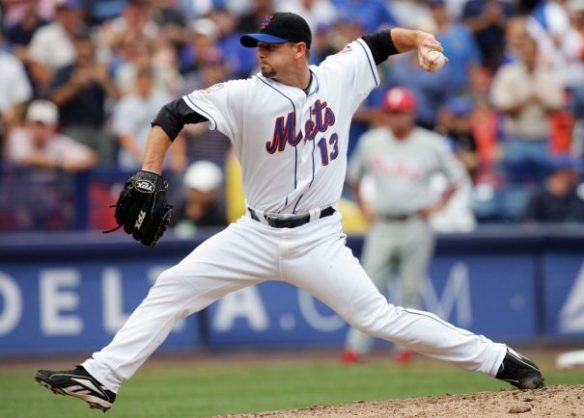
Billy Wagner—he was way better out of the bullpen than a lot of people might remember . . . enough to earn him a spot in the Hall of Fame.

The Ballad of Billy the Kid

Billy Wagner—Maybe the most underrated relief pitcher of his and just about any time. He was as lights out as relief pitchers got and then some, even allowing that nobody yet has really figured out a final objective and definitive way to rate relief pitchers of any era.

Wagner yanked himself to a pinnacle following a childhood about which “hard scrabble” might be an understatement. (Too-frequent home changes; poverty so profound that peanut butter on a cracker equaled dinner often enough.) He was a small man who made himself into a lefthanded assassin. (Two right arm fractures during his impoverished childhood compelled him to go portside.)

Billy the Kid finished his fifteen-year career with a 0.99 walks/hits per inning pitched rate; and, when it comes to win probability added, Wagner has only five relievers ahead of him, Hall of Famers all: in ascending order, Trevor Hoffman, Goose Gossage, Hoyt Wilhelm, Dennis Eckersley, and The Mariano. He was also on his own planet when it came to missing bats. In fifteen full major league seasons (he had a cup of coffee with the 1995 Astros), his strikeouts-per-nine innings rate fell below 10.0 only once; he retired with a lifetime 11.9 rate.

Nobody could hit this guy too often: the lifetime batting average against him is .187. Here’s how the hitters did against the other Hall of Fame relievers:

Lee Smith—.235.
Rollie Fingers—.232.
Bruce Sutter—.230.
Goose Gossage—.228.
Dennis Eckersley—.225.
Hoyt Wilhelm—.213.
Trevor Hoffman—.211.
Mariano Rivera—.211.

Would you like to be reminded whom among those men pitched in the most hitter-friendly times? That would be Smith (in the final third of his career), Hoffman, The Mariano, and Billy the Kid. It’s to wonder how much more stupefying the record might be if Wagner could have avoided assorted injuries including late-career Tommy John surgery.

Maybe his only flaw was a Sheffield-like tendency to nuke bridges once he left town, though for far different reasons. Wagner waged war against those he thought didn’t share his competitiveness and determination. But he finally admitted in his memoir, A Way Out, “I learned a lot about criticism and how not to be a leader when I was traded.”

When he walked away after 2010, he decided his family was a lot more important to him than whatever else he could accomplish as a pitcher. “There’s nothing left for me to do in baseball,” Wagner admitted after leaving the park one last time. “I’m not going to change anyone’s mind about whether I’m a Hall of Famer. People are either going to like me or hate me, and I can’t change their minds. Besides, life is about a lot more than this game.”

If you must, call Wagner the Bert Blyleven of relief pitchers, with a Hall case that kinda sorta sneaks up on you upon deeper analysis. But he does deserve the honour.

Last Time Around

Jeff Kent—Yes, Kent is the best-hitting second baseman of the expansion era so far. But despite his late settling-in (traded three times before he found a home with the Giants at 29), Kent was also product enough of a high-scoring era. For middle infielders, defense looms large enough, and Kent wasn’t a particularly great-fielding second baseman despite his deftness on the double play: -42 defensive runs below league average doesn’t bode well.

He was his own worst enemy with a personality often described as “prickly,” and he was caught in a few dubious incidents. The ones remembered most: 1) The notorious lie about falling while washing his truck, which turned out to be him trying to pop wheelies on his motorcycle; and, 2) the accusation that mercurial Milton Bradley dogged it on the bases as Kent swatted a double, before it came forth Bradley played through a balky knee—that turned into season-ending surgery after a hard slide into base.

A lot of Kent’s issues also came down to his own health. He incurred enough injuries later in his career that, married to his early-career mishandlings before reaching San Francisco, plus his below-average run prevention at second base, it puts him just outside the top twenty second basemen of all time. Still, his 351 home runs as a second baseman are the most for anyone playing that position. He has a fine postseason record overall, too.

The question becomes whether Kent’s once-notorious attitude problems remain enough to keep the writers from putting him in no matter the ballot crowd, and this time the lone big controversy is liable to be around Carlos Beltrán’s candidacy. Though Kent accommodated the baseball press during his playing days, he turned out to be one of those players who fit the longtime cliche about learning to say hello when it was time to say goodbye.

“I’ve learned to love and appreciate the fans, and I’ve learned to love and appreciate the Jeff Kent haters out there, too,” he said at a rather emotional retirement announcement.

I’m thankful for those people even more than the fans who gave me a hug every day, because those people motivate you . . . I leave this game proud that I have treated it with the utmost respect . . . I have tried to carry on a legacy of winning wherever I have gone. Any integrity that I have had in this game is something that I’m very, very proud of. I believe I played this game right, and I believe I’m leaving this game right.

I wasn’t exactly Kent’s biggest admirer myself for long enough, but he does deserve Hall election. If he doesn’t survive on this final BBWAA ballot, a future Contemporary Baseball Era Committee may give him a second and deeper look and elect him. May.

The Toddfather 

Todd Helton—Unlike Hall of Famer Larry Walker, the Toddfather never got the chance to show what he could do with a park other than Coors Field as his home park. Even with the width of his home/road splits, though, Helton hit respectably enough on the road that you’d have a hard time convincing anyone that he wasn’t as Hall of Fame as a first baseman gets.

Helton also crosses the average Hall of Famer’s batting threshold according to Bill James’s Monitor and Standards measures, and his peak value is a few points above the average Hall of Fame first baseman. He was a rare bird who walked more than he struck out, was an on-base machine (.414. lifetime on-base percentage), and he was actually deadlier at the plate with men in scoring position than he was with the bases empty.

His Hall case rests upon that peak value. At the plate, his 1998-2005 peak shows a 149 OPS+ and a .435 on-base percentage. His Real Batting Average (RBA) for that peak is a whopping .696. If you want to compare Helton to another Hall of Famer with a home/road split about as wide as his, be advised that Jim Rice’s peak RBA is .583.

He wasn’t the second coming of Keith Hernandez at first base, but he was a well above-average defender. But wait a minute: Maybe Helton wasn’t the obvious infield general Hernandez was—and believe me when I tell you Hernandez deserves a plaque in Cooperstown, too—but Helton was worth +107 defensive runs above his league average . . . second only to Hernandez (+120) himself.

Helton’s decline phase was accelerated by back and hip issues, but he was respected enough in the Rockies organisation to become the first player whose uniform number (17) was retired by the team. (Neat, that: Keith Hernandez also wore 17, with the Mets, who retired that number in his honour in 2022.)

“The mentality, the character, the work ethic of this team,” his one-time manager Jim Tracy once said of him, while he missed two months with an injury in a season, “it’s easy to have all that when the best player in the history of the franchise is the hardest worker on the team. It’s absolutely tearing him to pieces not to be involved with us, to not be the player we’ve known him to be.”

Helton’s complete package sounds like a Hall of Famer to me.

————————————————————-

* Some of the foregoing has been published previously.

2023 HOF BBWAA ballot: Two problematic newcomers . . .

Carlos Beltrán

Beltrán got to retire a World Series winner, returning to the Astros for 2017 . . . but he turned out a co-mastermind of Astrogate. Will that damage his Hall of Fame chances?

This is the dilemna: The one genuine, should-be Hall of Fame lock among the newcomers on the Baseball Writers Association of America’s 2023 ballot is also the first major figure from the Astrogate cheating scandal to arrive upon a such a ballot.

With Barry Bonds (actual or alleged performance-enhancing substances), Roger Clemens (see Bonds), and Curt Schilling (vile public commentaries since his retirement, despite his overwhelming Hall case) out of their BBWAA eligibility and now in the hands of the Contemporary Era Committee, it didn’t mean controversy left the BBWAA voters with those three. This new candidate by himself makes up for the loss, unfortunately.

There’s another new candidate among many on the ballot. This one might have had a Hall of Fame career if not for a series of injuries on the field that made him a very unfair pariah. His name is Jacoby Ellsbury. We’ll discuss him in due course, after first addressing . . .

The Newcomers: Carlos Beltrán

Before the exposure of the Astro Intelligence Agency’s illegal, off-field-based, electronic sign-stealing operation of 2017-18, Carlos Beltrán figured to have ended his playing career (as the Astros’ 2017 designated hitter) looking forward to accepting a plaque in Cooperstown. That and managing in the major leagues.

The number-nine center fielder of all time (according to Baseball-Reference via Jay Jaffe) who’d been respected as a student of the game and managerial material in the making found himself having to yield the bridge of the Mets (for whom he’d once starred as a player)—before he had the chance even to manage a spring training exhibition.

Though Commissioner Rob Manfred handed all 2017-18 Astro players immunity from discipline in return for spilling AIA deets, Beltrán was the only player Manfred singled out by name in his Astrogate report. It was Beltrán who suggested the Astros needed to “upgrade” from mere replay room reconnaissance, prompting then-bench coach Alex Cora to arrange the long-infamous real-time camera feed to an extra clubhouse monitor for sign deciphering and the long-infamous trash can transmissions.

That was despite Manfred’s September 2017 warning against using replay room reconnaissance and other such off-field chicanery, after the Red Sox (eventually using their own Rogue Sox Replay Room Reconnaissance in 2018 regardless) and the Yankees were caught trying a few tricks from the dugouts.

Beltrán landed the Mets’ managing job twelve days before Ken Rosenthal and Evan Drellich (in The Athletic) dropped the first full Astrogate revelation in November 2019. Within 72 hours of Manfred’s January 2020 report, all three incumbent managers named in the Rosenthal-Drellich exposure—Beltrán, Cora (who managed the 2018 Red Sox to a World Series championship), and the Astros’ A.J. Hinch (who acted feebly at best when catching onto his AIA cheaters)—were out.

Hinch was fired by Astros owner Jim Crane in hand with general manager Jeff Luhnow, but after sitting out his Manfred-imposed season’s suspension and some very contrite interviews, he found new life on the Tigers’ bridge. Cora sat out his Manfred-imposed season’s suspension, gave a few interviews in which he expressed genuine remorse for his Astrogate role, and was brought back to manage the Red Sox.

Beltrán said little about his Astrogate culpability until he returned to baseball as an analyst for the Yankees’ YES cable television network in April. There, he owned up in an interview with YES colleague Michael Kay:

Looking back now—yes, we did cross the line. I made my statement about what happened in 2017, and I apologized . . . This happened in such an organic way for ourselves. We all did what we did. Looking back today, we were wrong. I wish I would have asked more questions about what we were doing, I wish the organization would have said to us, “What you guys are doing, we need to stop this.” Nobody really said anything—we’re winning.

Obviously, Beltrán either didn’t know or chose not to know that “the organisation” as headed by Luhnow was in it up to its kishkes, having deployed the Codebreaker sign-stealing algorithim despite its creator’s warning that it was legal to use only before or after games but not during.

Had Astrogate never happened, Beltrán would have been a very likely first-ballot Hall of Famer. He played twenty seasons, and his peak with the Royals, the Astros (the first time, helping them reach a postseason with his second-half term there), the Mets (helping them to the 2006 postseason), and the Cardinals (two postseasons) was All-Star caliber or better. (He was actually a nine-time All-Star.)

He earned 67.6 wins above replacement-level (WAR) from his first full Kansas City season through the second of two with the Cardinals. That was despite missing significant time due to injuries in his final Met seasons. And his value wasn’t strictly in his bat, though my Real Batting Average metric (total bases + walks + intentional walks + sacrifice flies + hit by pitches, divided by total plate appearances) shows him not far off the middle of the Hall of Fame center field pack that played in the post-World War II/post-integration/night-ball era:

HOF CF PA TB BB IBB SF HBP RBA
Mickey Mantle 9907 4511 1733 148 47 13 .651
Willie Mays 12496 6066 1464 214 91 44 .631
Ken Griffey, Jr. 11304 5271 1312 246 102 81 .620
Duke Snider 8237 3865 971 154 54* 21 .615
Larry Doby 6299 2621 871 60 39* 38 .576
Carlos Beltrán 11031 4751 1084 104 110 51 .553
Andre Dawson 10769 4787 589 143 118 111 .534
Kirby Puckett 7831 3453 450 85 58 56 .524
Richie Ashburn 9736 3196 1198 40 30* 43 .463
HOF AVG .574

Now, however, marry it to Beltrán’s defensive prowess. He’s the number seven center fielder all-time for run prevention above his league average with +104. He was rangy, smart on the fielding lanes, and was a top of the line reader of batted balls from his position before Father Time finally began to exact a penalty.

Until Astrogate, of course, Beltrán had only one genuine black mark against him, especially so far as Met fans were concerned: frozen solid by an Adam Wainwright curve ball for strike three called—with the bases loaded, the Mets down two runs, and the pennant on the line in the bottom of the ninth, in Game Seven of the 2006 National League Championship Series.

You know something? It happens. Even to Hall of Famers. Beltrán wasn’t the first superstar to get himself tied up at the last minute of that critical a postseason set, and he won’t be the last. That’s not enough to damage a man’s Hall case. No eleventh-hour shortfall should have been. Not even for Babe Ruth.

You want to continue condeming Beltrán for that? How about The Big Fella getting himself caught stealing on a likely busted run-and-hit play to end the 1926 World Series in the Cardinals’ favour—with Bob Meusel at the plate and Hall of Famer Lou Gehrig on deck?

How about Willie McCovey—with second and third, two out, and the Giants down only 1-0—hitting a howitzer shot speared by Bobby Richardson to end the 1962 Series in the Yankees’ favour instead of sending the tying and maybe winning runs home?

How about Carl Yastrzemski fouling out with two out and the Red Sox down a single run to end the 1975 Series in the Reds’ favour?

How about Mariano Rivera surrendering a Series-losing base hit to Luis Gonzalez in 2001 or—after Dave Roberts stole second off a leadoff walk—an RBI single to Bill Mueller to tie the game at four when the Yankees were only three outs from a 2004 ALCS sweep?

None of those fatalities kept Ruth, McCovey, Yastrzemski, or The Mariano out of Cooperstown when their time eventually came. Getting frozen solid by a great pitch shouldn’t keep Beltrán out, either.

But it’s entirely realistic to suggest that, had Beltrán not gotten himself into the thick of the 21st Century’s worst major league cheating scandal, in his final season as a player, he’d probably be looking at unvarnished, uncontroversial first-ballot Hall of Fame election. Right now, we don’t know how many Hall-voting BBWAA writers will hold it against him enough to make him wait a ballot or three. Or more.

The Newcomers: The Saddest of them All

The rest of the newcomers had their moments but didn’t turn them into Cooperstown cases. A lot of them looked like potential Hall of Famers at first, too. Maybe the saddest of them all is . . .

Jacoby Ellsbury (CF)—Was there any 2010s sight sadder than Ellsbury—whose 2007 cup of coffee turned into shining in that Red Sox-winning World Series—taken down piece by piece by injuries? There was, in fact. It was the sight and sound of Yankee fans battering him mercilessly and witlessly over yet another injury doing nothing worse than playing the game.

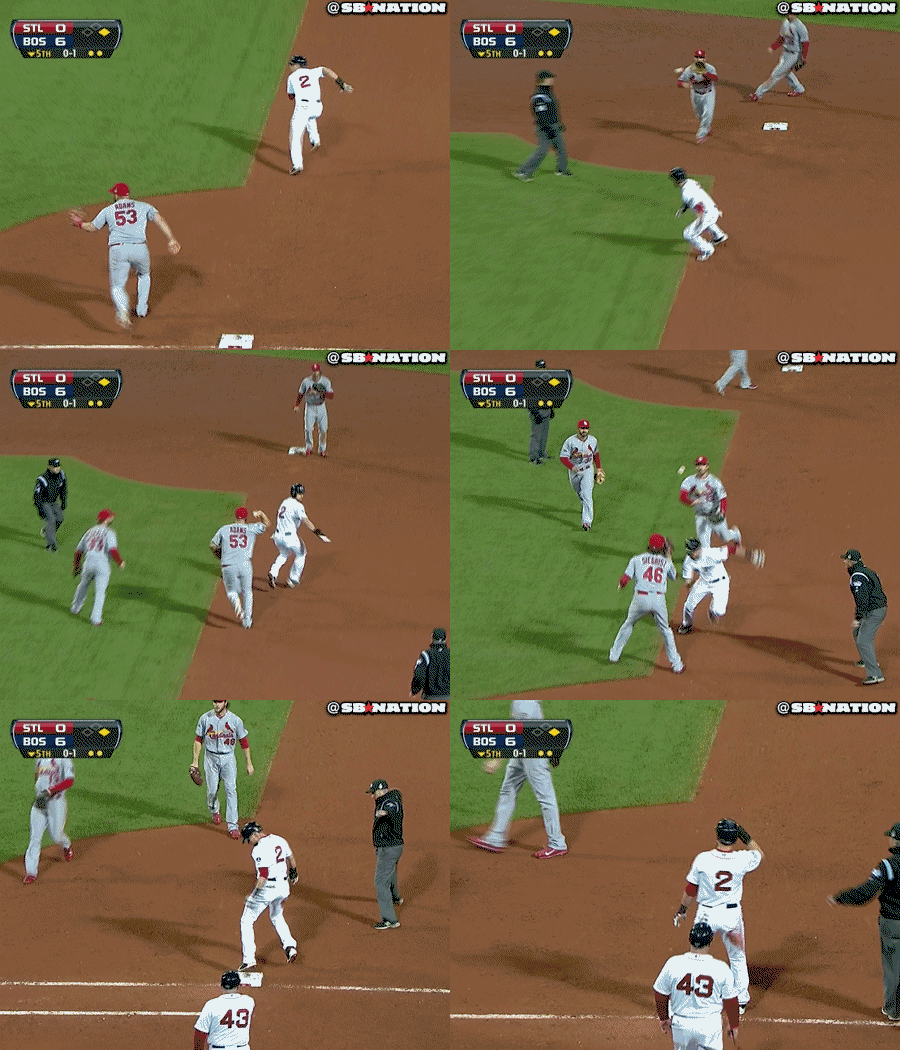
The injuries compromised him in Boston and made him an unfair pariah in the Bronx. He had Hall of Fame talent: some power, above-average center field defense, and a knack for turning baserunning into guerrila warfare. Especially the day he scored on a wild pitch—from second base. Especially in Game Six of the 2013 World Series.

Jacoby Ellsbury

Jacoby Ellsbury toying with the Cardinals as he thwarts a rundown in Game Six of the 2013 World Series. He made them resemble a quartet of wolves outsmarted by a flea.

The first of Navajo descent (his mother) to play major league baseball, Ellsbury was treated unfairly by fans and perhaps a teammate or three on the grounds that his injuries, and his sensible enough need to recover fully before playing again, equaled a character flaw. They derided him unfairly as a fragile goldbrick. They tried to make him feel as though injuries incurred in honest competitioin equaled weakness.

It got bad enough that, when one of Ellsbury’s four children was born on the Fourth of July 2019, and the proud father announced it on Instagram, he was attacked mercilessly by the worst of the Twitter twits and other social media mongrels. The guy who helped the Red Sox win a pair of World Series rings before leaving as a free agent could have been in traction and the worst Yankee fans would have accused him of staging it.

Once upon a time, Ellsbury broke the Red Sox’s consecutive-game errorless streak record. He hit four doubles and stole a base in the ’07 Series and looked on the way to becoming one of the all-time Red Sox greats.

Then, in April 2010, he crashed into a human earth mover named Adrián Beltré (himself a future Hall of Famer) at third base. He suffered four hairline rib fractures on the play, came back too soon, saw a thoracic specialist who recommended more rest and rehab, rejoined the Red Sox that August . . . and re-injured the ribs on another play against the Rangers later the same month.

More injuries followed often enough. Then Ellsbury, fed up with whisperings that he took “too long” to recover from them, elected to walk as a free agent without so much as a quick glance back at the Red Sox. In Year One as a Yankee, he played the way Jacoby Ellsbury at his healthiest could play. (He led the American League with a 22.7 power-speed number.)

From an essay I wrote when the Yankees finally released him in 2019 (for using a rehab facility outside the organisation—without their permission, as if a man injured so often didn’t know himself what might be best for him) . . .

2015—Right knee sprain on 20 May; out two months, rest of the season nothing to brag about, unfortunately. 

2016—Uninjured but production falling further, including his lowest total stolen bases to that point during a healthy season.

2017—Smashed his head against the center field wall while making a highlight-reel catch. Concussion. Missed 29 games and lost his center field job to Aaron Hicks, but somehow managed to break Pete Rose’s career record for reaching base on catcher’s interference, doing it for the thirtieth time on 11 September, which also happened to be his 34th birthday.

2018—Strained his right oblique at spring training’s beginning. Turned up in April’s beginning with a torn hip labrum. Missed the entire season (and underwent surgery in August) because of it.

2019—Started the season on the injured list with a foot injury; also turned up with plantar fasciitis in the foot (the same injury plus knee issues that reduced Albert Pujols as an Angel to a barely replacement-level designated hitter) and another shoulder injury. Took until September for the Yankees to admit Ellsbury was lost for the year.

I repeat further what I wrote then: Not one of those injuries was caused by anything other than playing the game or performing other baseball-related activity. Remember that before you continue condemning Ellsbury the man or the Yankees as a team over him. 

“Some people give their bodies to science. I gave mine to baseball,” said long-ago Met (and Giant, Expo, and Cardinal) Ron Hunt. Ellsbury did likewise. It cheated him out of a Hall of Fame case, and it made too many fans believe he was no better than a gunsmith running weapons to Russia against Ukraine.

Ellsbury didn’t become a Yankee because he believed his previous injuries really began draining the talent that was once as electric as a generator. He didn’t wear the pinstripes believing he’d become an orthopedic experiment. He isn’t owed a plaque in Cooperstown,  either. But he’s certainly owed more than a handful of apologies.


* The sacrifice fly wasn’t made an official statistic until the 1954 season. Several of the Hall of Famers listed in the RBA table played a third or more of their seasons prior to the rule coming on line. How to overcome that hole?

I tinkered with a few ideas until I tripped over a best-case scenario. I took those players’ numbers of recorded sacrifice flies and divided them by the number of seasons they played under the rule. Then, I took that result and multiplied it by the number of Show seasons they actually played.

The formula is sacrifice flies (SF) divided by sacrifice fly-rule seasons (SRS), multiplied by total MLB seasons. It shows an estimate of the sacrifice flies they might have been expected to hit if the rule was in place their entire careers.

2023 BBWAA Hall ballot: Jones, Rolen return and belong

Anticipating the arrival of my 2023 Hall of Fame ballot from the Internet Baseball Writers Association of America (yes, it’s merely ceremonial, but still), the Baseball Writers Association Hall ballot has been released. There are two players returning on the ballot who belong in Cooperstown absolutely, no further questions asked.

Tomorrow: the newcomers. Wednesday: the rest of the returning class. Now, the two returning guys who deserve their plaques post haste, especially the center fielder who killed the most runs of all.

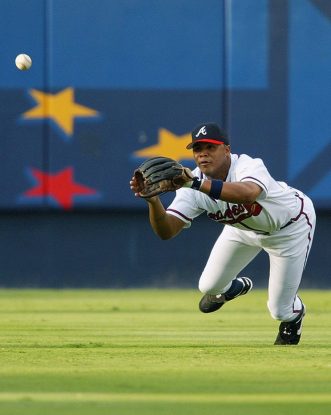
Andruw Jones

Andruw Jones

This is the single most run-preventive center fielder who ever played major league baseball. His name is Andruw Jones. His uniform front should have read Electrolux. He belongs in Cooperstown.

I’m pretty sure people still have a near-impossible time reconciling Jones’s too-staggering decline phase to his peak through age 29. It started with his final, injury-marred Atlanta season, and continued so profoundly in Los Angeles that he became indifferent enough to be a sad punch line before he was finally bought out of his deal.

But that peak should still be enough to make Jones a Hall of Famer.

He wasn’t just a Hall-level hitter before those later-career health issues. But he was way off the proverbial charts as a run-preventive center fielder. He had a great throwing arm, a genius for finding sure routes to balls despite his habitual shallow positioning, and both elevated him where it mattered the most—not just in the highlight reels, either, though he had more than enough of those.

Jones retired with the second-most defensive runs saved above his league average for any player at any position—only Hall of Fame third baseman Brooks Robinson’s +293 out-rank Jones’s +253. Jones is also +80 ahead of Hall of Famer Willie Mays among center  fielders, incidentally. Don’t be silly. I’m not calling Jones a better player than Mays, or even Hall of Famer Ken Griffey, Jr. They were just too much better all-around to kid yourself. (Baseball-Reference [via Jay Jaffe] ranks Jones number 11 among major league center fielders.)

I am saying, however, that taken strictly for his defense Jones was the most run-preventive defensive center fielder who ever played major league baseball. But Jones all-around at his peak was remarkable enough. For his twelve Atlanta seasons, my Real Batting Average metric (RBA: total bases + walks + intentional walks + sacrifice flies + hit by pitches, divided by total plate appearances) shows Jones’s peak value as more than worthy of a plaque:

Peak RBA PA TB BB IBB SF HBP RBA
Andruw Jones 7276 3185 717 65 62 83 .565

His career value at the plate wasn’t damaged quite as much as you remember by that terrible post-Atlanta decline phase, either. In fact, his career RBA is a) only nine points lower than his peak; and, b) higher than three other Hall center fielders who played in the post-World War II/post-integration/night-ball era:

HOF CF PA TB BB IBB SF HBP RBA
Mickey Mantle 9907 4511 1733 148 47 13 .651
Willie Mays 12496 6066 1464 214 91 44 .631
Ken Griffey, Jr. 11304 5271 1312 246 102 81 .620
Duke Snider 8237 3865 971 154 54* 21 .615
Larry Doby 6299 2621 871 60 39* 38 .576
Andruw Jones 8664 3690 891 69 71 97 .556
Andre Dawson 10769 4787 589 143 118 111 .534
Kirby Puckett 7831 3453 450 85 58 56 .524
Richie Ashburn 9736 3196 1198 40 30* 43 .463
HOF AVERAGE .574

Measure him by wins above replacement-level player (WAR), and Jones’s seven-year peak WAR is above that of the average Hall of Fame center fielder. There are plenty of mostly or solely peak-value Hall of Famers in Cooperstown; they only begin with Dizzy Dean and Sandy Koufax. 

Jones’s Hall of Fame teammate, Chipper Jones, wasn’t just blowing smoke when he said upon his own induction that if you wanted to beat the 1996-2007 Braves “you had to go through the Jones boys, too.” That’s the way Hall of Famers play the game. And if the Hall now gives more value to defense than in the past, Jones assuredly deserves the honour even more.

Scott Rolen

Scott Rolen

This is a Hall of Fame third baseman. His name is Scott Rolen. He shouldn’t have to wait for an Era Committee to enshrine him.

Once more, with ten times the feeling: It wasn’t Rolen’s fault that he was villified and sullied during his early seasons in Philadelphia. He just wasn’t the kind of guy the Phillies’ front office of the time loved, influenced heavily enough by the like of Loud Larry Bowa and Drill Sgt. Dallas Green.

Rolen was soft spoken, he let his prep and his play do his talking, and he didn’t blow up the nearest inanimate objects when a swing missed or a play faltered or a game was lost. You hear a lot of lip service to let’s just get ’em tomorrow. Rolen lived it. If he’d been a fighter pilot, Rolen would have earned a rep as the classic maintain-an-even-strain type. The Right Stuff.

That front office misread Rolen as indifferent, if not unrealistic. (Rolen went into his walk year in 2002 unsatisfied that the Phillies then were committed to building a consistently-winning team and spurned a $140 million offer because he wasn’t convinced of it.) Even if every teammate he had knew better. He hustled himself into injuries and that only added to the sullying, in Philadelphia and in St. Louis, where he ran afoul of Tony La Russa despite playing his usual kind of hard and delivering performances that helped the Cardinals to a few postseasons and a World Series ring.

Rolen fumed over La Russa souring on him for being injured in honest competition. If only he could have then-Brewers manager Ned Yost for a skipper. Yost called him “the perfect baseball player. It’s his tenacity, his preparation, the way he plays. He tries to do everything fundamentally sound. And he puts the team first—there’s no fanfare with him.”

Then-Cardinals GM John Mozeliak came publicly to regret trading Rolen to the Blue Jays. Former Cardinals GM Walt Jocketty caught wind that Rolen wanted to play closer to home   and pried him out of the Jays for the Reds. Rolen helped the Reds to a couple of postseasons, too.

Rolen wasn’t the hitter Hall of Fame third baseman Chipper Jones was, but Jones wasn’t the defender Rolen was, either. Not by about ten country miles. Rolen won eight Gold Gloves and they weren’t by reputation alone. Only Robinson and Hall of Famer Mike Schmidt have more such awards at third base.

Rolen had eleven seasons averaging ten or more runs saved at third and three in which he averaged twenty or more. His 140 defensive runs above league average are tied for sixth among third basemen all time. Preferring to leave it on the field and at the plate without starving for publicity or acting like the star he did his best not to present himself being may have been Rolen’s number one career problem.

But would you believe that Rolen is ahead of five postwar/post-integration/night-ball Hall of Fame third basemen at the plate, according to RBA? That those he passes include George Brett? See for yourself:

HOF 3B PA TB BB IBB SF HBP RBA
Mike Schmidt 10062 4404 1507 201 108 79 .626
Chipper Jones 10614 4755 1512 177 97 18 .618
Eddie Mathews 10100 4349 1444 142 58 26 .596
Scott Rolen 8518 3628 899 57 93 127 .564
George Brett 11625 5044 1096 229 120 33 .561
Ron Santo 9397 3779 1108 94 94 38 .544
Wade Boggs 10740 4064 1412 180 96 23 .538
Paul Molitor 12167 4854 1094 100 109 47 .510
Brooks Robinson 11782 4270 860 120 114 53 .458
HOF AVG .557

Baseball-Reference (via Jay Jaffe) rates Rolen the number ten third baseman ever. His Hall candidacy gets more traction year by year. (He shot through the 60 percent line last year, in fact.) He deserves a plaque in Cooperstown, and he shouldn’t have to wait for an Era Committee to get it.

Note: Some of the foregoing has been published previously.
Sal de mi césped?

Carlos Castro, Asdrúbal Cabrera

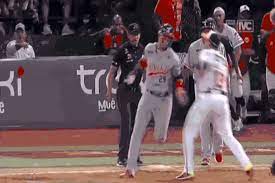
Asdrúbal Cabrera (right) telling Carlos Castro (left) that a shot in the head trumps a bat-flipping home run Saturday.

Asdrúbal Cabrera never played for the Braves during fifteen major league seasons. But on Saturday he found a way to behave as though he’d taken lessons in self-appointed Fun Policing from longtime Braves catcher Brian McCann. With a critical piece missing.

Cabrera was playing first base for Caribes de Anzoategui against Tiburones de la Guaira in the Venezuelan Winter League. It just so happened to be a game in which Tiburones’s Carlos Castro saw fit to hit three hefty home runs.

The third proved the money shot, for reasons having nothing to do with distance or the score. It proved that a 37-year-old major league veteran can display the mind of a seven-year-old who’s forgotten the meaning of fun when believing, apparently, that he and his team have been dissed.

Against lefthanded Caribes pitcher José Torres, Castro blasted one the other way to right field and clear over the fence. He strided up the first base line, bat still in hand, watching the ball fly out. On his tenth step up the line, Castro flipped his bat to begin his home run trot.

He seemed to glance toward the Caribes dugout as he approached first, but I couldn’t tell whether his face showed anything grave or provocative. The New York Post (Cabrera is a two-season former Met) described the glance as “glaring” into the dugout and Torres as “clearly upset with the antics . . . jawing at Castro as he headed to first, but it got much worse after that.”

As he rounded first, Cabrera approached from his apparent play-to-pull positioning. Castro wasn’t two steps past the pad when Cabrera swung his left arm hard to the right side of Castro’s face.

Being unprepared for such a sucker punch, Castro went down in a heap, onto his el culo, as his batting helmet took a dive toward the line under the influence of Cabrera’s flying forearm. When both benches poured out of their dugouts almost at once, Cabrera himself ended up on the ground sprawling.

Cabrera’s said to have turned an offer in free agency down last winter before sitting the 2022 season out. Considering his 2021 performance papers, he may have been fortunate to get that single offer at all. If he’s looking for one more turn in the Show for 2023, he may yet discover that a clothesline swing won’t get you half the attention a few zinging line drives to left might get.

Unless, of course, there’s a team out there that anxious to find an ancient infielder who can’t hit baseballs as often as he once did, has as much remaining defensive range as a toy dump truck with a flat inner-rear tire, but might hit a bat flipper or two blindside as a fresh new precinct commander for their self-appointed Fun Police Department. Cheap shots a specialty,

Castro rounding first looked as though he saw Cabrera coming his way but didn’t quite see the prospect of a would-be left hook until it met his face flush on. Maybe Cabrera didn’t learn what I thought from McCann, after all.

Back in late September 2013, Milwaukee outfielder Carlos Gomez tripped the Braves’ triggers when he blasted one out against Paul Maholm, a pitcher against whom he had better than respectable performance papers, enough so that Maholm had hit him with a pitch or three in the recent past, enough so to leave Gomez with a sour taste at minimum.

Now, in the top of the first in Turner Field (the Braves hadn’t yet dumped the still-not-so-old yard for Truist Park), Gomez sent Maholm’s one-out, 0-1 service over the left center field fence. He didn’t celebrate the blast so much as he pronounced it payback for a plunk too many, and he let Maholm know it. Uh-oh.

As he rounded first, then-Braves first baseman Freddie Freeman barked at him. As he rounded third, he was slightly surprised to see McCann ambling up the line, out from behind the plate, hell bent on arresting him with a choice, howling lecture accompanying the handcuffs.

Well, not so much handcuffs, but Gomez never got to hit the plate as McCann obstructed him in anger and the benches emptied. “Gomez believes Maholm drilled him intentionally two months ago, and this was his payback,” wrote ESPN’s Tim Keown at the time. “‘You hit me. I hit you,’ were apparently the words that rocked the Braves’ world. Is that a worse offense than intentionally hitting someone?”

At least McCann never went further than stopping someone to bawl him out. Sucker punching wasn’t part of his Fun Police gear.

Who knows what among the Caribes players flipped their switches when Castro looked into their dugout? Who knows what Castro had in mind when he looked? Had there been words between them over his two previous bombs in the game?

“This is not representative of baseball in Latin America,” tweeted my friend (and former Call to the Pen editor) Manuel Gómez. “Latinos are known for bringing sazón to the game. Clearly, there is some animosity between these particular teams and it was expressed in violence on the field. We are better than this!”

Tiburones went on to finish what they started, a 6-4 win. But no matter who said what to whom, Cabrera came away resembling a bit of a hypocrite. We take you back to 22 September 2016, in Citi Field, the Mets down two, when Cabrera walked it off against the Phillies with a three-run blast into the bullpen behind the right field fence.

He flipped his bat toward the Mets dugout and looked there as he started running it out. OK, he looked into his own dugout and not the opposition’s. But still. Apparently, Cabrera was fine with a flip if it came off a game-winner. But in his older baseball age he’s none too fine with a flip if it’s flipped off a blast hit before the game actually ends.

Cabrera’s not too likely to find a Show suitor for 2023. The last thing needed by a Show still coming to terms with letting the kids play is an old fart whose uniform might have sal de mi césped! as a p.s. beneath his name.

Keep José Altuve off the Astrogate hook

Jose Altuve

It’s been said before Peter Gammons revived it Friday: José Altuve wanted no part of illegally-stolen signs when he was at the plate. Stop hammering him with the “chea-ter! chea-ter!” chants once and for all.

When the World Series shifted to Philadelphia, after the Phillies and the Astros split the first two games in Houston, the Citizens Bank Park crowd wasn’t shy about letting the Astros have it over You-know-what-gate. The good news was that they saved the chea-ter! chea-ter! chants for the only three position players left on the roster from the forever-tainted 2017-18 team.

The bad news was that one of the three actually spurned taking the illegally stolen signs in the batter’s box. That was second baseman and Astros franchise face José Altuve. It didn’t matter to the chanting Phillies fans. But it should have.

When SNY’s Andy Martino published Cheated: The Inside Story of the Astros Scandal and a Colorful History of Sign Stealing in June 2021, the chapter called “The Scheme Begins” included a revelation that should have jolted anyone hammering the Astros rightfully enough over their Astro Intelligence Agency plot:

Altuve was the most reluctant of the Astros stars. When the option to have a teammate bang the trash can [to relay the signs stolen by way of an illegal off-field-based real-time camera to an illegal additional clubhouse monitor—JK] first arose, he declined.

When Altuve was batting, and there would be a bang, he would glare into the dugout.

“He doesn’t want it,” teammates would say frantically. On more than one occasion, Altuve returned to the dugout after his at-bat and yelled at the others to knock it off.

It jolted me, too. Especially since I’d actually missed the first such revelation, in February 2020, from then-Astros shortstop Carlos Correa, usually the face of the team when it came to defending the 2017 World Series title before he signed with the Twins last winter. (Correa is now a free agent again.) I missed it, and I shouldn’t have.

Commissioner Rob Manfred handed down his Astrogate verdict in January 2020—suspensions for 2017-18 general manager Jeff Luhnow, manager A.J. Hinch, and bench coach Alex Cora (subsequently a World Series-winning manager for the 2018 Red Sox . . . who had their own Rogue Sox replay room reconnaissance ring operating that season and possibly beyond); heavy fine for owner Jim Crane; key draft picks stripped.

The Astros faced the press when spring training opened the next month. Depending upon how you saw and hear, they seemed either unapologetically apologetic or apologetically unapologetic. “Yes, there’s no better way to show good old-fashioned genuine remorse than by refusing to speak the misdeed you committed,” wrote since-retired Thomas Boswell, the longtime Washington Post baseball eminence.

Crane and his team used their showcase to insist they keep their phony title and that Major League Baseball was correct not to fine or suspend any Astros players. Also, we should just trust that they stopped cheating in 2018. Why? No reason at all. Just felt like stopping, even though they, you know, won the previous World Series doing it.

. . .Maybe, with time, some Astros will be more forthcoming with authentic feelings, not practiced phrases, that will show their human dilemma—most of them not $100 million stars or future Hall of Famers, just normal ballplayers caught on a runaway train with, realistically, no emergency brake available for them to pull.

But even Boswell might have missed that Altuve didn’t want any part of the AIA. Before the original coronavirus pan-damn-ic compelled that spring training’s shutdown, Correa talked to The Athletic‘s Ken Rosenthal, one of the two reporters (with Evan Drellich) who first exposed the true depth of scheme. (Former Astros pitcher Mike Fiers had finally agreed to go on the public record in November 2019, following long, futile efforts to get someone/anyone to investigate.)

They talked aboard MLB Network a couple of days after the presser that did the Astros more harm than good. Correa steamed over Dodger outfielder/first baseman Cody Bellinger’s fuming that Altuve cheated Yankee rookie star Aaron Judge out of the 2017 Most Valuable Player award he might have won if not for Altuve’s career year in Houston. “Cody,” Correa began, “you don’t know the facts.”

Nobody wants to talk about this, but I’m going to talk about this. José Altuve was the one guy that didn’t use the trash can.

The few times that the trash can was banged was without his consent, and he would go inside the clubhouse and inside the dugout to whoever was banging the trash can and he would get pissed. He would get mad. He would say, “I don’t want this. I can’t hit like this. Don’t you do that to me.” He played the game clean.

. . . When you look at Altuve’s numbers on the road, he hit .400 on the road (.381, actually, compared to .311 at home). He didn’t cheat nobody of the MVP. He earned that MVP. He’s a six-time All-Star, three-time batting champion, MVP, five-time Silver Slugger. He’s been doing this for a long time.

For [Bellinger] to go out there and defame José Altuve’s name like that, it doesn’t sit right with me. The man plays the game clean. That’s easy to find out. Mike Fiers broke the story. You can go out and ask Mike Fiers: “Did José Altuve use the trash can? Did José Altuve cheat to win the MVP?” Mike Fiers is going to tell you, straight up, he didn’t use it. He was the one player that didn’t use it. (Emphasis added.—JK.)

The foregoing arises again because another Athletic writer, Peter Gammons, the longtime Boston Globe scribe/analyst who’s a Spink Award Hall of Famer, wrote of the Astros’ post-Astrogate manager Dusty Baker and winning team cultures in a piece published Friday—and returned to that 2020 spring training opening. Including the impossible position into which Altuve was pushed.

There he was, sitting at the table, looking as though he’d rather undergo root canal work without an anesthetic. Now we should ask just what the hell Crane was thinking when, seemingly, he insisted Altuve sit at the head table for that 2020 spring presser. The owner with a reputation for rejecting direct accountability forced “the one player that didn’t use” the AIA’s espionage to take it like a man.

Gammons talked to assorted Astros near the end of the opening workout later in the day. “They were subdued, clearly remorseful,” Gammons wrote, “but when I told Altuve that players, coaches and a number of people in the organization had told me that he did not participate in the sign stealing, he politely declined to discuss it, and asked that I didn’t talk about it on television, or write about it. ‘It would be a betrayal of my teammates’.”

Two years later, he still did not want to be singled out. But while he and [third baseman Alex] Bregman were asked by management to speak to the scandal for all the players and he received the most obscene treatment from beered up louts in Boston and New York, he never pointed to 2017 home/road splits that showed a 200-point OPS difference in favor of the road, where there was nary a banging trash can to be heard.

“He is,” Baker said, “the ultimate teammate.” That from a man who played with Henry Aaron and Reggie Smith.

Altuve’s 2017 OPS (on-base percentage plus slugging percentage) was 248 points higher on the road—where the AIA couldn’t operate—than it was at Minute Maid Park. He also hit six more home runs out of town than in Houston. With only four more plate appearances on the road than at home in ’17, his Real Batting Average (my metric: total bases + walks + intentional walks + sacrifice flies + hit by pitches, divided by total plate appearances) was .529 at home . . . but .679 on the road.

The Gammons story seems to have jolted for the Altuve “revelation.” In its email newsletter Morning Bark, offering links to stories based on its choice of a day’s top ten sports stories, Yardbarker linked to it with this teaser, which also headlined a brief news item about the piece: “Insider reveals interesting detail regarding José Altuve and Astros’ cheating scandal.”

It’s only a “revelation” if you missed either Rosenthal’s original or Martino’s book. I missed the former upon its original arrival, but I pounced on the latter when it was published. SNY, after all, stands for the Sports New York regional cable network. And the Yankees, whom Martino’s normal coverage includes, had their own skin in the sign-stealing world.

Theirs wasn’t quite as extensive as the 2017-18 Astros, of course. Neither was anything by any other teams who might have done as the Red Sox did, using their MLB-provided replay rooms for such sign-stealing reconnaissance. (MLB has since tightened up on guarding the replay rooms.) The 2017-18 Astros went far above and far beyond just boys-will-be-boys replay room roguery.

But Martino taking Astrogate book depth had no reason to want Altuve whitewashed. Especially considering Altuve—when Yankee manager Aaron Boone elected to let his faltering closer Aroldis Chapman pitch on to him, with two out in the bottom of the ninth, instead of putting him on at 2-1 with a spaghetti bat on deck—hit the monstrous two-run homer on an up-and-away slider that won the 2019 Astros the pennant.

In fact, Cheated‘s footnotes included the original Correa/Rosenthal revelation. Martino had me convinced before the footnotes section. Reading the Correa/Rosenthal revelation both recently and once again after the Gammons piece Friday, I’m convinced even more.

Saying Astrogate won’t disappear until the last member of the 2017-18 team no longer wears an Astro uniform is one thing. So is saying the 2017-18 cheaters stained baseball almost as deeply as the 1919 Black Sox. But it’s something else to keep including José Altuve among the tainted when he doesn’t deserve to be among them.

The further evidence should be even more clear by now. Altuve wanted no part of the original Astrogate scheming and bawled teammates out when they didn’t respect his wishes. He played the game straight, no chaser, then and now. He’s taken it across the chops unfairly since.