Unknown's avatar

About Jeff Kallman

Member, Internet Baseball Writers Association of America and the Society for American Baseball Research.

Sal Bando, RIP: One grave mistake

Sal Bando

Sal Bando, a solid third baseman and peacemaker/keeper for the Swinging’ A’s, but the eventual American League player representative helping change the player pension plan in 1980 with a grave error.

“Sal Bando,” said Hall of Famer Reggie Jackson about the third baseman for the 1970s Athletics, “was the godfather. Capo di capo, boss of all bosses on the Oakland A’s. We all had our roles, we all contributed, but Sal was the leader and everyone knew it.” In more ways than one.

When then-commissioner Bowie Kuhn decided to put the brakes on A’s manager Dick Williams’s seemingly endless mound conferences in a World Series, Williams chose Bando as his end-run around Kuhn’s edict. This enabled Bando to visit Hall of Famer Catfish Hunter as often as he wanted or needed to settle Hunter down.

“Take him away,” said the Mustache Gang’s 1973 traveling secretary Jim Bank of Bando, who died of cancer Friday at 78, “and that team was nothing.”

That team was also saved a few moments when mere testiness might have turned grave. The early-to-mid-1970s A’s were known as the Swinging’ As, partially for beating everyone else on the field and partially for swinging on each other almost at will, or the drop of a single brickbat. Bando himself had to thwart a few such swings including one that involved more than a flying fist.

After the A’s beat the upstart Mets in the 1973 World Series—and it took seven games to do it—shortstop Bert Campaneris, fuming over Jackson being named the Series MVP despite Campaneris having an arguable better Series, grabbed a table knife during the team’s closed victory dinner and headed for Jackson.

Bando headed Campaneris off at the pass. After enough Series hoopla, including the unconscionable bid by owner Charlie Finley to scapegoat hapless second baseman Mike Andrews over a pair of errors in the Game Two twelfth, the last thing Bando needed was one teammate trying to shish kebab another.

“Because no media was there to document it,” wrote Jason Turbow in Dynastic, Bombastic, Fantastic: Reggie, Rollie, Catfish, and Charlie Finley’s Swingin’ A’s, “the incident was quickly lost amidst the annals of team drama. What really could be said? This, apparently, was how the A’s relaxed.“

“[T]hey didn’t have many rules,” wrote the late Jim Bouton in I Managed Good But, Boy, Did They Play Bad. “Oh, maybe they weren’t allowed to punch each other in public. No punching a teammate, I suppose, in a nightclub. Fighting only allowed in the clubhouse. No screaming at each other when the wives are around. And don’t embarrass the manager to more than two wire services during any homestand.” (Ancient evenings, of course. Today, Bouton would write, “Don’t embarrass the manager to more than two social media sites.”)

A rock-solid third baseman who was too often underrated for his sterling defense (he retired with 8.5 defensive wins above replacement-level among his 61.5 total WAR, and with +35 defensive runs above his league average), Bando couldn’t resist when manager Dick Williams made good on his threat to step down over Finley’s abuses after the ’73 Series and Alvin Dark—a former A’s manager canned after he refused to go along with ginning up an incident and fine against pitcher Lew Krausse—was hired to succeed him.

“When you have a championship club, you don’t make many changes,” Bando told a reporter after Dark’s formal reintroduction. “I hope he doesn’t have too many strict rules, because we haven’t had many the past two years and we don.” As Bouton went on to continue, “[It] doesn’t mean the A’s won the championship just because they had long hair, or their manager had long hair, or their manager was permissive and let them do things their own way.”

That was maybe ten or fifteen percent of the reason. The other 85 percent was because they had a lot of good baseball players. Williams could have tried his long hair, his mustache, and his lack of rules with the Cleveland Indians, for instance, and he would have gotten a lot of long-haired .220 hitters. In fact, there would have been a lot of people blaming his permissive ways for why the Indians didn’t do so good.

Bando, Willliams would remember in his own memoir, No More Mr. Nice Guy, was “the only player I ever socialised with. I’d invite him to my hotel suite after games or during an offday, and we’d just talk baseball. The rest of the [A’s] saw this and figured I must be all right.” Small wonder they didn’t exactly plan a celebration when the fed-up-with-Finley Williams wanted out.

Bando also criticised Finley unapolgetically for his notorious meddling in their off-field lives and for his weaknesses in delivering television contracts to broadcast the team on their own home turf. “In another town, someplace back East,” Bando told The Sporting News in May 1973, “we might be heroes. Here we’re not even something special.”

The Messersmith ruling ended the reserve era near 1975’s end. Bando was one of seven A’s refusing to sign 1976 contracts, electing to play their lawful options out to become free agents at the end of that season. When Finley’s subsequent bid to fire-sale Hall of Fame reliever Rollie Fingers plus pitcher Vida Blue and outfielder Joe Rudi was blocked by Kuhn, and Finley ordered manager Chuck Tanner not to play the three, Bando intervened, threatening a team strike until Finley caved.

The third baseman signed as a free agent with the Brewers, then still in the American League. A player-coach in due course, he finished his playing career in Milwaukee as the team’s and then the American League’s player representative. Which is where Bando made perhaps his worst mistake, even ahead of eventually letting Hall of Famer Paul Molitor escape as a free agent in 1991 when Bando was the Brewers’ general manager.

When the Major League Baseball Players Association joined with the owners to revamp the player pension plan in 1980, the result was 43 days major league service time to qualify for a pension and one day’s major league service time to qualify for health benefits. But it excluded players with major league careers shy of the previous four-year vesting requirement even if they had 43 days or more major league time.

Their redress since has been a 2011 deal between then-MLBPA director Michael Weiner and then-commissioner Bud Selig, giving them $625 per quartet for every 43 days’ worth of MLB time, up to four years’ worth. And, a fifteen percent hike in that stipend as a result of last winter’s lockout settlement. The kickers: It’s still not a full pension, and the players can’t pass the money to their families upon their deaths.

Today, there are 514 pre-1980, short-career players without full baseball pensions. The most recent such affected player to pass was Bill Davis, a first baseman/pinch hitter who played in part of two 1960s seasons with the Indians and one with the expansion Padres.

Bando and his National League player rep counterpart, Montreal Expos pitcher Steve Rogers, voted in favour of the 1980 change and the exclusion. Various surviving affected players even now suspect the reasons included perceptions that they were mere September callups. But a majority of the affected players actually made teams out of spring training, or came up to play in the Show in months prior to September in various seasons.

The solid third baseman who didn’t suffer Charlie Finley’s act gladly suffered a momentary lapse of reason that left several hundred players with short careers but long vision in supporting their union on the undeserved short end of a big economic stick.

A man smart with his own money during his playing days, working off-seasons in banking before the free agency era, then creating a successful investment firm after his playing days ended, should have been smart enough to know better.
Frank Thomas, RIP: The needling and the damage done

Frank Thomas

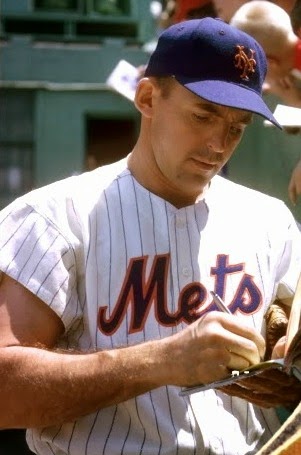
Frank Thomas, signing autographs in the Polo Grounds as an Original Met. As a Phillie, his 1965 fight with Dick Allen accelerated Allen’s undeserved war with Philadelphia racists.

Baseball’s best known Frank Thomas who isn’t the Hall of Fame bombardier died Monday at 93. The good news: That Thomas had a colourful history as one of the Original Mets, for whom he played from their 1962 birth through August 1964. The bad news is that he had a terrible history involving a teammate of colour on the 1965 Phillies.

It soiled a respectable major league career as a power-hitting outfielder/corner infielder, a three-time All-Star with the 1950s Pirates, and an Original Met who was grateful to have been remembered when the Mets reinstituted Old Timers Day last year and he fought through a neck injury to appear.

Thomas survived nasty contract battles with Branch Rickey, then running the Pirates, whose genius as a baseball thinker and courage as baseball’s colour line breaker in signing Jackie Robinson to the Dodgers was countered by his often devious and insulting penury when it came time to pay his players reasonably.

He also prospered somewhat with and survived the Original Mets, that expansion troupe remembered best as baseball’s version of . . . well, they really did have Abbott pitching to Costello with Who the Hell’s on first, What the Hell’s on second, You Didn’t Want to Know’s on third, and You Didn’t Even Want To Think About It at shortstop.

Thomas became the Mets’ first home run king, hitting 34 in 1962, a team record that stood until Dave Kingman smashed it by two in 1975. He also factored in one of the most typical of the inadvertent sketches that, perversely enough, endeared his Mets to a generation of New Yorkers bereft of the Dodgers’ and Giants’ moves west and drowning in a couple of generations of Yankee dominance and hubris.

Center fielder Richie Ashburn, eventually a Hall of Famer based on his long career with the Phillies, despaired of collisions between himself and shortstop Elio Chacón on pop flies to short left center and despaired of how to call Chacón off. Teammate Joe Christopher knew enough Spanish to tell Ashburn to holler Yo la tengo! (I got it!) Sure enough, the next such short pop to short left center had Chacón steaming out from short and Ashburn rumbling in from center.

Yo la tengo! Yo la tengo! Ashburn hollered. Chacón caught the drift at once and stopped dead. Ashburn was saved for about five seconds. Thomas had also come steaming in from left. He crashed into Ashburn and the ball fell safe. Someone forgot to hand Thomas the yo la tengo! memo.

(The pull-hitting Thomas also spent so much time trying to hit the “o” on a Howard Clothes sign on the Polo Grounds’s left field wall—because the New York clothier promised a luxury boat to the Met who hit it the most at season’s end—that manager Casey Stengel finally hollered at him, “If you want to be a sailor, go join the Navy!”)

That season proved Thomas’s final truly solid year at the plate. After a somewhat down 1963 and a 1964 that saw him in and out of the lineup with a few nagging injuries, the Mets traded Thomas to the pennant-contending Phillies that August. He hit respectably enough until he fractured his thumb on a hard slide into second base, ending his season just before the infamous collapse that cost the Phillies a pennant with which they seemed to be running away.

But now age 36, Thomas started too slowly in 1965 before the 3 July pre-game incident that ended his Phillie days in ignominy. Should-be Hall of Famer Dick Allen, the Phillies’ superstar in the making and the National League’s 1964 Rookie of the Year, was taking grounders at third while Thomas was in the batting cage and Phillies center fielder Johnny Callison came out to third to chat with Allen.

According to Phillies historian (and eventual Allen biographer) William C. Kashatus, in September Swoon, Callison suggested to Allen they give Thomas the business over a strikeout following three failed bunt attempts during a plate appearance the night before. In the batting cage now, Thomas took a big swing and miss. “Hey, Donkey!” Callison hollered. (Thomas’s nickname was the Big Donkey; he was also known as Lurch.) “Why don’t you try bunting?”

“Instead of responding to Callision,” Kashatus wrote, “Thomas glared down the third base line at Allen and shouted, ‘What are you trying to be, another Muhammad Clay, always running your mouth off?'”

Insulted by the comparison with Cassius Clay, the colourful but controversial heavyweight boxer who had recently changed his name to Muhammad Ali, Allen charged the cage, and the two players went at each other. Allen hit Thomas with a left hook to the jaw, sending him to the ground. When he got to his feet, Thomas was wielding a bat and connected with Allen’s left shoulder. By now the rest of the team was at home plate trying to restrain the two players.

In his memoir, Crash, Allen remembered Thomas knowing it was Callison who’d taunted him but aiming his return fire at Allen, wrongly.

The Muhammad Clay remark was meant to say a lot. It reminded me of how Frank would pretend to offer his hand in a soul shake to a young black player on the team. When the player would offer his hand in return, Thomas would grab his thumb and bend it back. To him, it was a big joke. But I saw too many brothers on the team with swollen thumbs to get any laughs. So I popped him. I just wanted to teach him a lesson. But after he hit me with the bat, I wanted to kill him.

Callison said hard feelings between Thomas and Allen were building well before the “Muhammad Clay” remark. One of the brothers to whom Allen referred was young outfielder Johnny Briggs, whom Kashatus quoted as saying Thomas “often made racially inflammatory comments.” But Kashatus also quoted Briggs as saying of Thomas, “Thomas agitated everybody on the team. He was just as abusive to the white guys. But the press turned that fight into a racial issue and refused to let up.”

The game that followed the ugly brawl included Allen slashing a three-run triple and Thomas hitting a pinch home run in the next inning. The Phillies lost 10-8 to the Reds . . . and Thomas was put on release waivers afterward. This, Kashatus noted, was despite Allen intervening on behalf of not letting Thomas go, pleading with manager Gene Mauch not to let it happen out of regard for Thomas’s wife and eight children. (Dolores Thomas died in 2012; one of his children, his daughter Sharon, also died before her father.)

Mauch’s fatal mistake otherwise was ordering one and all involved in the Thomas-Allen fight to keep their mouths shut or face fines: $1,000 each, except for $2,000 for Allen. That only enabled that capricious Philadelphia sports press of the time to help make life as a Phillie more miserable for Allen than the city’s racists already began making it, until he finally got the trade he’d been trying to force for long enough.

With Thomas’s release, Kashatus wrote, the veteran wasn’t bound by Mauch’s edict, and appeared on a Philadelphia radio show that often had him as a guest. “I’ve always tried to help him,” Thomas insisted. “I guess certain guys can dish it out, but can’t take it.” Said Tony Taylor, the Phillies’s talented Latino second baseman, “Since Dick was black and Thomas was white, [the Philadelphia writers] made it into a racial thing and gave Dick the label of trouble-maker. It wasn’t fair.”

“Thomas was going to go anyway,” Mauch eventually admitted about his further-fading veteran. “I should have shipped him sooner. Instead, the press came down on [Allen’s] head. If he did one little thing wrong, they would see it as so much worse because, in their heads, he was a bad guy.”

The Phillies dealt Thomas to the Astros, where he was further unhappy from knowing his baseball aging wasn’t going to reverse itself. (He’d move to the Braves and then the Cubs from there but retire in 1966.) “I would not say I enjoyed my time there,” he told an interviewer in 2017, “but not because of the city or the players.”

I was just in a bad place personally. I was an old fogey. When you reach your thirties in baseball, you’re an old man. Expendable. But I loved the guys in Houston. Joe Morgan, Rusty Staub, and my favorite Jimmy Wynn. I once got Wynn with the hidden ball trick. He was so angry with me. But what I remember most is that I hit two home runs and then they traded me! My last at-bat in Philadelphia was also a home run. I guess I just needed to stop hitting them!

Let the record show that Thomas spoke affectionately there of two black players, Hall of Famer Morgan and Wynn. Let it show further that, when the black Frank Thomas was inducted into the Hall of Fame, the first, white Frank Thomas—once one of four consecutive Braves to hit home runs in an inning, along with Hall of Famers Hank Aaron and Eddie Mathews, plus slugging first baseman Joe Adcock—was invited to join in the fun and accepted happily.

“I was the original, but he was better,” Thomas once said of his namesake. “We hold the record for most home runs hit by two players with the same name.” (Thomas is right: the two Frank Thomases actually combined for 25 more home runs than Ken Griffey, Sr. and Hall of Famer Jr. did.)

“I was told that his father was a fan of mine and named him after me,” he continued. “I have met him several times and I love him. I told him that I used to be The Big Hurt, but after meeting him I know that I was just The Little Hurt.”

Between those, and more than a few stories I’ve seen saying Thomas and Allen eventually buried the hatchet together, my better angel wants to believe that that 1965 fight and its immediate aftermath jolted the Big Donkey into a permanent awakening about human relations.

Robby the Umpbot steps closer to the Show

Ángel Hernández

Ángel Hernández, Exhibit A on behalf of Robby the Umpbot’s eventual major league advent.

Almost two years ago, when the automated strike zone was on the threshold of its tryout in the low-A level Southeast League, you could hear the so-called traditionalists waver between tears of sorrow and tears of rage. Wait until they hear Robby the Umpbot is going to get a tryout behind the plate at the AAA level this year—in all thirty parks across the Pacific Coast League and the International league.

If they haven’t already, they’re liable to palpitate, have kittens, scream themselves into strokes, or plot to storm the baseball commissioner’s office. There are plenty of reasons to wish Rob Manfred’s ouster. This isn’t one of them.

First, let’s look at how it’s going to operate in the AAA leagues. Half will be full Robbies to call every pitch with earpieces relaying the calls to the plate umpire. Half will operate similar to tennis’s challenge system: each team receives three pitch call challenges a game—the batter, the pitcher, or the catcher can call for them—and, if Robby upholds the challenge, the challenging team won’t lose the rest of its game challenges.

And to think Robby will now be one step up from the Show itself.

When Robby prepared for his Southeast League premiere, the trad thunderings went along the line of one I quoted from an online baseball forum: “The game is played by humans . . . why take away one of the most human elements of the game???” That’s what makes it beautiful.”

Well, now. The beautiful human element (a phrase once uttered by Hall of Fame manager Joe Torre, when he was the commissioner’s top cop, and that was only uttered about replay) leaves too little room for getting it right, particularly when postseason advance or maybe even a World Series championship is on the line squarely enough.

There were bugs to work out of the technology during that Southeast League tryout. There may yet be bugs to work out during its Triple-A tryout this year. But work them out baseball must, because that beautiful human element is still only too human, too prone to error, and too little held properly accountable. Including baseball’s government, which seems to believe the human element’s accountability and competence are consummations devoutly to be avoided.

It’s not impossible to think that the Manfred regime glommed onto Robby the Umpbot not because he might tend to get the calls right but because the regime has a lazy side powerful enough to reject holding umpires as accountable as any other baseball employee as . . . what? Too intrusive? Too troublesome? Too likely to launch a war with a Major League Baseball Umpires Association that was born of such a war in the first place?

The regime had no trouble launching a war against the players with last winter’s lockout. Does the regime think the umpires are as gods? Does it remember nobody comes to the ballpark to see the umpires? Does it pine for the so-called good old days when skirmishes between even Hall of Fame managers behaving like toddlers over umpires behaving like judicial tyrants were must-see television?

(That little [expletive] called me names that would get a man killed in other places, and that was on days I didn’t throw him out.—Steve Palermo, a mild-mannered and respected umpire, to say nothing of courageous, about Earl Weaver, Hall of Fame manager who was as mild-mannered as a saltwater crocodile. There was even a time when a Baltimore-area Oldsmobile dealership used a Weaver tirade as a television commercial. Charming.)

That beautiful human element still insists, too much of the time, that the strike zone is whatever the umpire says it is, Rule 2.0 be damned. At least, they do until they see the latest mischief Ángel Hernández, Laz Diaz, and Doug Eddings commit. There’s perverse pleasure in abusing the Hernándezes, Diazes, Eddingses, and their like for their errors. “Kill the ump!” has yet to become an unpopular chant.

The worst umpiring jobs are done behind the plate. Last season, the median major league umpire averaged 95 percent correct pitch calls. While you may think that a sterling record, keep in mind that a 95 average might get you a medical school scholarship but a five percent error rate in the operating theater might get you a malpractise suit.

Within that blown five percent might be and has been, often enough and too often for comfort, the blown call that turned a key pennant race game, a postseason series, or the World Series, all the wrong way around. Very few umpires, still, own up when they blow it. Chad Fairchild, now-retired Jim Joyce, Jerry Meals, and long-retired Tim Welke are only four such exceptions.

EV Analytics, a statistical company whose work includes rating and ranking sports officiating, says Hernández and Diaz are considered “neutral” umpires, not disposed excessively toward either pitchers or batters: they’re equal opportunity butchers. EVA also considers Eddings among pitchers’ best friends for butchery behind the plate.

Sam Fels, a Deadspin baseball writer who is on board with Robby the Umpbot’s advent, has one concern, that about whether “cantankerous umps” such as Hernández or Eddings respond when challenged during any game: “No chance they’ll hold a grudge, right? Or start their own argument with a batter or catcher after having their authority and precision questioned?” It might be mad fun to see whether the Replay Command Center  sends them to the showers.

What a long, strange trip it’s been . . .

Carlos Correa

Correa took a medicals-inspired, coast-to-coast trip back to the Twins in the end.

This much we should understand about today’s typical Met fan, and it’s not the first time this lifelong (theirs) Met fan has said so: Today’s typical Met fan is ready to push the plunger on a season over one bad inning—in April. The least shocking thing when Carlos Correa didn’t go from likely signing to donning a Met jersey at an introductory press conference was any Met fan surrendering 2023.

From the moment the Twins with whom Correa played last year came back into play for the shortstop, when the Mets proved as alarmed over Correa’s long-term health as the Giants had previously, many Met fans did. Social media was as crowded with them as a major subway transfer station is crowded during a New York rush hour. But there were voices of reason to be heard if you knew where to listen.

And what those voices said, from the top down, possibly including the fellow lifelong Met fan who owns the team now, was, If this guy’s rebuilt lower leg betrays him when the deal is halfway finished or less, he’s going to become a fan target and we are going to resemble the village idiots for signing him. At least, at the full thirteen and $350 million originally planned.

Now the Twins—who weren’t exactly circumspect about wanting to have Correa back longer term—have brought him back for six years and $200 million. ESPN’s Jeff Passan broke that news aboard Twitter Tuesday. The deal is now official with the physical passed.  Even if it took Correa two long stops aboard what sometimes resembled the crazy train to get there.

Remember: The Giants had landed him—until they didn’t. They quaked over something in Correa’s medical profile, enough to let him walk right into the Mets’ open arms on the day they expected to present him at a presser climbing into a Giants jersey. First it was thought to be Correa’s back. Then, as the Mets were ready to wrap him up for Christmas, the discourse turned to that now-notorious rebuilt ankle.

The Mets had Correa ready to place under New York’s Christmas tree—until they didn’t. They, too, quaked over something in the medical profile. Unlike the Giants, the Mets were willing to adjust. We know now they worked up an adjusted deal for six years and $157.5 million (were willing to go six assured at $175.5 million (roughly $27 million annually), with additional years up to six to follow based upon annual physical examinations.

The Giants’ prudence (if that’s what it was) about Correa in the end still leaves them with more holes to fill. The Mets’ such prudence doesn’t leave them with more than maybe a dent or two to fix. Remember: the Mets won 101 games last season before they collapsed in postseason round one. They’re not exactly in terrible 2023 shape, either.

But it looks as though Steve Cohen isn’t going to be the wild free-spender the rest of baseball world believed and maybe feared. It also looks as though he’s not willing to be as risky as people thought when it comes to players with injury histories no fault of their own but profound enough. Even players he says publicly, as he did about Correa, might be necessary pieces for a full-distance championship team.

Remember: Cohen once let a shiny draft pick (pitcher Kumar Rocker) walk rather than sign him over concerns about shoulder issues. He’s the owner who let Jacob deGrom, the arguable best pitcher in baseball when healthy (underline those two words), walk. (To the Rangers, for five years and $185 million.) If he was willing to let the game’s best pitcher when healthy (underline those words) walk, he wasn’t going to fear letting one of its best left-side infielders walk over similar alarms.

Is it unrealistic to think that the Astros, who raised Correa in the first place and saw him shine with them for seven seasons, let him walk into free agency in the first place because they, too, had long-term concerns about his long-term health?

Cohen may be willing to open the vault wider than any other major league owner, but it doesn’t mean he’s going to be that drunk a sailor. Remember: He had a plan and executed it regarding deGrom, signing seemingly ageless future Hall of Famer Justin Verlander for two years.

He also locked down late-game relief ace Edwin Diáz and outfield mainstay Brandon Nimmo. Extending first base anchor Pete Alonso isn’t unrealistic, either, especially after letting talented but too-firmly blocked Dominic Smith walk into the Nationals’ arms. The plan for Correa was moving him to third to play aside uber-shortstop incumbent Francisco Lindor. Without Correa? They have a pair of talented third basemen, veteran Eduardo Escobar and sprout Brett Baty.

The Mets aren’t hurting without Correa. The Twins are risking that they won’t be hurting if and when Correa begins hurting. As it was, Correa on his 2022 deal—three years, $105.3 million, and three opt-outs, the first of which Correa exercised to play the market in the first place this winter—proved a second half godsend, when the Twins became injury riddled enough but Correa managed to stay the distance.

The Twins also liked Correa’s clubhouse leadership and prodding teammates to improve. “The vision he has,” assistant pitching coach Luis Ramirez told The Athletic, “the awareness, the anticipation about what is going to come next. When he needs to talk to a teammate about an adjustment that needs to be made, or just, to like, picking up a teammate, or paying attention to small details in the game that others don’t see—he makes us better in everything, in the field, everywhere.”

They’re also banking on Correa maturing further and further away from his Astrogate past. Correa was once the staunchest public defender of the Astros’ 2017 World Series title. Yet he said not so fast, more or less, at that notorious February 2020 word salad-bar presser; their illegal, off-field-based, electronic sign-stealing Astro Intelligence Agency was “an advantage. I’m not going to lie to you.”

If you know what’s coming, you get a slight edge. And that’s why [then-general manager Jeff Luhnow and then-manager A.J. Hinch] got suspended and people got fired because it’s not right. It’s not right to do that. It was an advantage. But . . . it’s not going to happen moving forward.

Correa also took the Astros’ superstar second baseman José Altuve off the Astrogate hook, insisting—and the evidence since brought forth backs it up—that Altuve not only declined to work with stolen signs transmitted to him but actively objected to the infamous trash can banging of the pilfered intelligence while he was at the plate.

“The man plays the game clean,” Correa insisted, after then-Dodger Cody Bellinger fumed that Altuve should return his 2017 American League MVP award. “That’s easy to find out. [Astrogate whistleblower] Mike Fiers broke the story. You can go out and ask Mike Fiers: ‘Did José Altuve use the trash can? Did José Altuve cheat to win the MVP?’ Mike Fiers is going to tell you, straight up, he didn’t use it. He was the one player that didn’t use it.”

That’s what SNY’s Andy Martino said, too, in his Astrogate book, Cheated. It’s what Evan Drellich—one of the two Athletic reporters (with Ken Rosenthal) to whom Fiers blew the Astrogate whistle—is liable to reiterate in his forthcoming (next month) Winning Fixes Everything: How Baseball’s Brightest Minds Created Sports’ Biggest Mess. It’s what too many fans continue to ignore.

Without Correa, and placing their shortstop present and future into Gold Glove-winning rookie Jeremy Peña, last year’s Astros were down to only four or five remaining from the notorious 2017-18 Astrogate roster, including Altuve. The facts didn’t stop fans from hammering Altuve along with the others with chea-ter! chea-ter! chants—all the way into the World Series they won straight, no chaser at last.

The Twins bring Correa back with a front-loaded deal that includes no opt-outs and a full no-trade clause. They’re still taking a big risk on his health even for six years. God help Correa if his ankle or anything else breaks down and reduces him to journeyman status if he can play at all. Fans never let facts get in the way of fuming rants against what they think are fragile goldbrickers. Ask any Yankee fan when it comes to Jacoby Ellsbury.

But would a cynic suggest that, maybe, just maybe, in his heart of hearts, Correa was happy enough in Minnesota to let this weird coast-to-coast, medicals-scripted swing bring him back there in the first place, for a few more dollars than the Mets were willing to go on the same six guaranteed years? Maybe a cynic would. Maybe enough Met fans would. Did I just repeat myself?

The realist knows that, as fine as he’s still going to be, Correa’s ancient ankle repair did cost him in the long run. That, and not his controversial uber-agent Scott Boras, wrote this costly script. Costly for Correa. As The Athletic also points out, he lost seven years and $150 million compared to the original Giants offer, ended up with a lower offer from the Mets (half that $315 million over half the time), and signed with the Twins for four years and $85 million less than the ten/$285 million they first offered.

But realism isn’t half as much fun as ranting your head off about a season blown because of a signing blown, is it? Such is one of the major headaches of being a Met fan since the day they were born.

The Dodgers purge Bauer at last

Trevor Bauer

Bauer’s a former Dodger at last. Would another team chance surviving his baggage and its justifiable blowback?

Almost the full two weeks from his suspension’s lifting were needed for the Dodgers to declare Trevor Bauer persona non grata in their colours. Notwithstanding a wi-fi disruption and power outage in Dodger Stadium causing its further delay Friday, the team announced they designated Bauer for assignment. Even those who believe the Dodgers did the right if delayed thing at last can’t and shouldn’t claim to be happy about this entire business.

There’s nothing happy about what one woman testifying under oath said was his bruising her after she fell unconscious and thus unable to extend any further consent. There’s nothing happy about two other women saying he’d taken rough sex too far and into plain assault upon them, too. There’s nothing happy about Bauer jeopardising if not ending a major league pitching career because his sport determined he violated its domestic violence policy.

In that order.

Arbitrator Martin Scheinman cut Bauer’s original suspension from 324 to 194 games. Even at 194 games, it remains the longest suspension yet under baseball’s seven-year-old-plus policy, and Bauer remains the only player disciplined under the policy to appeal his suspension. Baseball’s government investigated as thoroughly as conceivable before imposing the original suspension.

The Dodgers, we thought, had time enough during the suspension to decide it was time to mop the egg off their faces and let Bauer go whenever the suspension might end. We know by way of USA Today‘s Bob Nightengale that, after Scheinman reduced the suspension late last month, the Dodgers tried to find a trading partner willing to take Bauer off their hands first.

Assuming there is a team immune enough to outrage to take Bauer on willingly, such a team would likely prefer waiting for Bauer to clear waivers (it takes seven more days), then sign him to the major league minimum salary. Leaving the Dodgers still required to pay the rest of Bauer’s salary, minus the fifty games worth Scheinman docked him when lifting the suspension.

The Dodgers won’t “eat” what they still owe him. They swallowed and digested that dinner when they signed Bauer in the first place. (His original contract, like all MLB contracts, was guaranteed unless he exercised either of two opt-outs, chances his suspension denied him.) Paying him seven figures to beat it is child’s play compared to all the other head and heartaches Bauer inflicted.

Well before he was suspended by MLB, the Dodgers resembled due diligence failures for signing him despite a too-well-evidenced image as a misogynistic man no matter how good he was as a pitcher. We hark back to Dodger president of baseball operations Andrew Friendman, speaking after the Dodgers signed Bauer after the pan-damn-ically shortened 2020 season, during the press conference introducing Bauer as a Dodger. “[W]e’re all gonna make mistakes,” he said.

What’s important for me … is how we internalize it, and what our thoughts are about it going forward. From our standpoint, it was important to have that conversation. And we came away from it feeling good about it. Now, obviously, time will tell. But I feel like he is going to be a tremendous add, not just on the field but in the clubhouse, in the community, and that’s obviously why we’re sitting here.

Time, alas, told an awful lot more than Friedman or the team imagined. They chose to believe Bauer learned from prior, mere misbehaviours. He made them resemble fools. Not quite as profoundly as NFL quarterback Deshaun Watson makes the Cleveland Browns look, with 24 sexual misconduct suits against him, twenty of which were settled confidentially. But horrifying enough.

ESPN’s Alden Gonzalez cited one unnamed player agent saying “nobody’s touching” Bauer now but another unnamed player agent saying, discomfitingly, “I think there will be teams that will at least be interested.” Gonzalez also notes an unnamed team executive saying the challenge of taking Bauer on would be “unique.”

As he described, it isn’t just the stain on an organization’s reputation or the backlash from its fans or the general negativity that would surround it — it’s that Bauer hasn’t shown an ounce of contrition throughout this process. In fact, he has taken the opposite approach, fighting every allegation vehemently.

“If you sign someone with that type of baggage,” one agent noted, “you have to walk him through the reclamation tour. And I don’t think he’s coachable for that.”

Bauer himself released a statement after the Dodgers announced his DFA, posted first by the Los Angeles Times‘s Bill Shaikin:

While we were unable to communicate throughout the administrative leave and arbitration process, my representatives spoke to Dodgers leadership immediately following the arbitration decision.

Following two weeks of conversations around my return to the organization, I sat down with Dodgers leadership in Arizona yesterday who told me they wanted me to return and pitch for the team this year.

While I am disappointed by the organization’s decision today, I appreciate the wealth of support I’ve received from the Dodgers clubhouse. I wish the players all the best and look forward to competing elsewhere.

“There is zero chance whatsoever,” Craig Calcaterra of Cup of Coffee tweeted in response, “that anyone with actual decision-making authority with the Dodgers told Trevor Bauer, yesterday, that they wanted him back.” Indeed. “Dodger officials declined to go into details of their conversation,” Nightengale has written since, “but privately revealed that they didn’t hear any remorse, apologies or anything in the slightest from Bauer to change their mind.”

Gonzalez cited another unnamed team executive saying, “Some teams will just take the arm, and they’ll deal with the blowback later.” Too many have done that, in baseball and other sports. They forget playing professional sports is a privilege they can revoke for moral as well as performance cause. They forget athletes’ rights (indeed, responsibilities) to rehabilitate and redeem themselves don’t carry automatic rights to do it under their umbrellas.

They forget what Gonzalez and his ESPN colleague Jeff Passan observed when Bauer was hit with the original 324-game suspension in the first place: “The standards in criminal and civil cases differ from those of a private business. The judge dissolving the temporary restraining order and declining to issue a permanent one does not absolve Bauer of liability within the [domestic violence] policy. Neither does a prosecutor passing on pressing charges.”

They get their tails waxed in the public mind, in the press, and aboard the social media scrawl for forgetting the common good of their games doesn’t end on the scoreboard or at the bank.

Those are the parts the Nationals must have understood, without having to say so, during the 2021 season, when faced with veteran infielder Starlin Castro’s suspension for violating baseball’s domestic abuse policy. They said they’d cut Castro loose when his suspension concluded. They did just that. Castro’s full suspension was fifteen percent of what Bauer ultimately served. The Nats looked as decisive as the Dodgers didn’t look.

What time told Friedman and the Dodgers also, and especially, includes just the first known of Bauer’s victims, testifying during hearings to decide a restraining order against him. And, as Calcaterra observed, reiterating—without one word spoken by Bauer’s legal team trying to refute or discredit it—her number one charge: I did not consent to bruises all over my body that sent me to the hospital and having that done to me while I was unconscious.

That, and the scars upon her psyche, are the parts no formal discipline can undo.