Unknown's avatar

About Jeff Kallman

Member, Internet Baseball Writers Association of America and the Society for American Baseball Research.

ALCS Game One: Miller time for the Mariners

Bryce Miller, George Springer

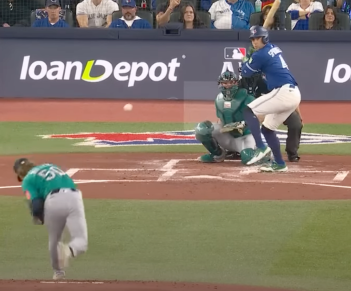
George Springer is about to demolish Bryce Miller’s first pitch of ALCS Game One. It was the only score Miller would allow over six otherwise spotless innings on short enough rest. (Fox Sports television capture.)

At the split second George Springer’s bat connected with Bryce Miller’s first pitch of this year’s American League Championship Series, you could be forgiven if you heard Mariners fans groaning. When the ball banged the Canada Dry sign above the right center field bullpen, you might have heard the groaning turn to moaning.

One pitch, one swing, the 21st postseason bomb of Springer’s career, and only the third leadoff bomb in League Championship Series history since pitch counting began in 1988, according to The Athletic‘s Jayson Stark. Just like that, the Blue Jays took a lead.

And Springer’s opposite-field smash on a fastball away, sending him past Hall of Famer Derek Jeter for fifth place on the all-time postseason bomb list, wasn’t the only reason Mariners fans groaned and moaned.

In the top of that first inning, they groaned, moaned, and fumed when the Mariners didn’t call for a review of that play at the plate on which Cal Raleigh (one-out hit, advancing to third on followup hit) was tagged out when it appeared he’d managed to get his foot on the plate through the legs of Jays catcher Alejandro Kirk. But television replays showed Raleigh’s foot landed a second or two after Kirk tagged his torso.

Were the Mariners unduly alarmed after Springer sprang?

Not after Miller wriggled out of further trouble in the form of a pair of walks courtesy of inducing a pair of line drive outs and a short fly out.

Not after Miller matched Jays starter Kevin Gausman point for point, dollar for dollar, from that point forward, until Raleigh atoned for missing the first inning score by squaring Gausman up, with two out in the top of the sixth, and driving a 2-2 service a little further than Springer’s traveled, about five rows up into the bleachers above that bullpen.

Not after Jays manager John Schneider decided that a followup walk to Julio Rodriguez should be he end of Gausman’s evening before he might incur jn any further damage. That came soon enough when Gausman’s relief Brendon Little wild-pitched Rodriguez to second and surrendered Jorge Polanco’s sharp opposite-field line RBI single to left to crack the one-all tie.

Not after Randy Arozarena wrung a leadoff walk out of Jays reliever Seranthony Dominguez in the top of the eighth, stole second and third while Raleigh suffered a called strikeout, then—after another walk to Rodriguez—came home on another Polanco steak, this time a spanker bouncing three times through the infield and a few more into right.

“I just choked up and wasn’t trying to do too much,” said Raleigh postgame about his bullpen-clearing blast. “I was just trying to get bat on ball and really put something in play, maybe find a hole. I didn’t want to punch out again.” He didn’t seem to mind putting that ball out of reach, out of play, and out of sight, either.

Kevin Gausman, Cal Raleigh

Raleigh is about to smoke Gausman’s splitter for a trip above the right field bullpen . . .

Aside from all that, it was Miller time. For a guy pitching on three days’ rest for the first time in his major league life. For six inning of one-run, two-hit baseball that including getting rid of seventeen of his final nineteen batters. He needed a little comfort from Raleigh at the mound while navigating his way out of that first-inning fire, but that was enough.

Miller went two innings longer than Mariners manager Dan Wilson expected him to go on short rest, only nobody told Miller until he was done for the night.

“They didn’t tell me anything, any plan,” said the lad who threw 27 pitches in the first inning and 49 the rest of his outing. “So I was going out there just letting it rip until they came out and got me.”

“That was incredible from him,” said Mariners reliever Matt Brash (now, there’s a classic name for a relief pitcher), who was one of three Mariners bullpen bulls along with Gabe Speier and Andres Munoz to pitch perfect innings once Miller’s time expired for the evening. Thus the 3-1 Mariners win Sunday night.

“I knew this was the biggest start of my career so far,” said Miller, whom one report revealed stood in Rogers Centre’s center field’s farthest location from the plate staring that direction to help focus, “and I just wanted to get out there and mentally kind of get in a zone and visualize having success on the mound.”

Miller’s season wasn’t always so simple. After a 2.94 ERA in 2004, he ran into elbow inflammation twice and an inflated ERA. He didn’t find himself on his horse fully until some time in August. Then he gave hints of his postseason potential in ALDS Game Four, pitching 4.1 shutout innings against the Tigers.

Remember: These Blue Jays are the ones who demolished the Yankees 34 runs worth in their American League division series and made the Bronx Bombers resemble the Bronx Broken. The Mariners got rid of 23 of the final 24 Jays hitters while they were at it. All of a sudden the Joltin’ Jays didn’t look all that intimidating despite Springer’s first-pitch flog.

Remember, too: These Mariners played fifteen innings Saturday to come out of their ALDS alive and reasonably well and leaving the Tigers for dead. They had to fly cross country and into Canada and endure a four-hour departure delay when mechanical issues forced their airline to get another plane up to Seattle from Los Angeles. They didn’t even have time for a Rogers Centre workout before ALCS Game One.

I’m not sure I’d recommend this as a continuous practise, but it seems as though now and then a team that should have been suffering exhaustion can turn one of the league’s howitzer corps to one side for one night. Now we’ll get to see if the Mariners can manhandle the Jays on a proper night’s sleep and with a proper pre-game workout.

We may even get to see Miller on the mound in a game that would mean the pennant for the Mariners if they win. The lad’s already proving that unthinkable isn’t necessarily impossible.

Who has the next-to-last-laugh now?

Kyle Tucker

Kyle Tucker’s seventh-inning strikeout seemed to take what remained of the Cubs’ wind away Saturday night. (TBS television capture.)

“It’s really the only inning you could talk about,” lamented Cubs manager Craig Counsell about the top of the sixth, after National League division series Game Five. “We just didn’t do much.

“We had six base runners. You’re going to have to hit homers to have any runs scoring in scenarios like that,” Counsell continued. “They pitched very well. I mean, they pitched super well and we didn’t.”

“They” were the Brewers, whom Counsell used to manage, until he reached managerial free agency and the Cubs decided to dump David Ross for no reason better than that Counsell became available. Cubs president of baseball operations Jed Hoyer admitted as much earlier this month.

Two second-place National League Central finishes and one division series loss later, Cub fans could be forgiven if they think it’s been karma for the manner in which Ross was vaporised. The Brewers won Game Five, 3-1, with 90 percent pitching depth, five percent unusual slugging, and maybe five percent karma-the-bitch.

Until, that is, they review the seventh inning in American Family Field Saturday night. First and second, nobody out, and Kyle Tucker—the man for whom the Cubs traded three to the Astros last December, in perhaps the signature moment that explains why they made that trade—coming to the plate.

He faced Aaron Ashby, the nephew of former major league pitcher Andy Ashby, and possibly the best relief pitcher on the Brewers staff. (Regular season: 2.16 ERA; 2.70 fielding-independent pitching rate.) His Cubs were down only 2-1. He got ahead of Ashby three balls, no strikes. Michael Busch (leadoff single) and Nico Hoerner (hit by a pitch) leaned away from second and first itching for a reason to take off.

The odds were in favour of them getting that reason momentarily. Tucker had spent the first three games of the division series as a singles hitter, but in Game Four he finally unloaded, blasting a leadoff home run in the bottom of the seventh. Maybe, despite an early strikeout and a subsequent ground out Saturday night, Tucker’s power strokes were back from the fixit shop.

Big maybe. Ashby pumped a pair of bullets Nolan Ryan himself might have applauded. Tucker swung through both of them.

Then Brewers manager Pat Murphy brought rookie righthander Chad Patrick into the game. Patrick, a righthander with seven minor league seasons behind him and not one Show appearance until the Brewers called him up from AAA Nashville for this year. He got Seiya Suzuki—who’d tied the game at one in the top of the second, when he answered William Contreras’s first-inning solo home run with a bomb of his own against Jacob Misiorowski—to drive one to left that found Jackson Chourio’s glove. He dropped strike three called in on Ian Happ.

Not one Cub came home in that inning or the rest of the way. The Brewers added one more in the seventh, when Brice Turang took Cub reliever Andrew Kitteredge over the right center field fence.

“I was looking up at the heavens to Bob Uecker,” said Brewers general manager Matt Arnold, referencing the beloved late Hall of Fame broadcaster and wit, who’d become as much a face of the Brewers as any player in their history until his passing last January. “Like, during the game, I’m like, ‘Bob, we need you’.”

“I must be in the front row,” Uecker must have said from his roost in the Elysian Fields.

He must have. This team had baseball’s best regular season record this year but entered the division series with a string of failure to get past their first postseason stages for five out of the previous six seasons. They were still recovering from their former closer Devin Williams, now a reliever and frequent hate object (by their own fans) for the Yankees, serving a pitch Mets first baseman Pete Alonso demolished like a munitions expert in the deciding wild card series game last year.

This time, they had to recover from the Cubs, their next-door-state rivals, coming back from a 2-0 game deficit.

This time, they made it. So far.

They have a National League Championship Series date with the Dodgers. They secured the date doing what enough people thought they couldn’t do if it meant paying the ransoms for their kidnapped families: slug. Contreras and Turang were joined by Andrew Vaughn in the fourth, blasting a full-count service from Collin Rea into the left field seats.

They even did it with men who weren’t even topics on last year’s team. Vaughn and Patrick were joined in that club by Misiorowski, who relieved Game Five’s opening closer Trevor Megill, surrendered only Suzuki’s second-inning smash, but otherwise worked spotlessly for his four innings. In what turned out a bullpen battle, the Brewers pen was just that much more efficient than the Cubs pen, which also deployed one starter (Rea) among a group of bulls.

Andrew Vaughn

Vaughn running out his fourth-inning bomb. (TBS television capture.)

And, boy, is the deal that brought Vaughn from the pathetic White Sox to the Brewers looking better every hour. It happened when the Brewers elected to move Aaron Civale from the starting rotation to the bullpen, and Civale responded with a spoken desire to play somewhere else if that was the case. Be careful what you wish for, was the answer . . . and Civale went from a contender to a basement dweller just like that, in early June, with Vaughn—once a first-round draft pick, demoted to the farm a month earlier—coming aboard.

Therein lies a distinction between these Brewers and the Cubs they just turned aside. The Brewers don’t have Cub money, but they don’t let that stop them from constant upgrade searching when necessary. The Cubs have Cub money.  But they’d rather undergo root canal without anesthetic than spend it. And they lack the Brewers’s bargain basement ingenuity. They haven’t yet figured out that you don’t have to shop at the Magnificent Mile all the time. You can find amazing upgrades at Lots 4 Less.

How will these Brewers be perceived going into an NLCS against those Dodgers? Contradictorily, of course. The Brewers swept the Dodgers in their regular-season series, 6-0. But there’ll be more than enough who think the Dodgers will still be the overdogs. Even if the Dodgers’ NLCS ticket was stamped by a horror of a throwing error by Phillies relief pitcher Orion Kerkering in Game Four of their division series.

But how will these Cubs be perceived going into winter vacation? Not too favourably, after all, one fears. The top of their lineup acquitted themselves well enough, particularly Busch with three of his four division series hits clearing the fences and Nico Hoerner with his hits in each game and his team-leading .476 postseason on-base percentage. But the bottom of the lineup disappeared. The collective slash line of the Cubs’ bottom five? .120/.215/.205.

And they’re likely enough to move forward without Tucker, who becomes a free agent and who’s perceived widely enough as thinking about moving on. Even if this usually un-expressive fellow who prefers to let his game do his talking calls it “an honour” to play with this group of Cubs.

That group of Cubs needs a small, not major bullpen remake, and they need to romance and re-sign Tucker, whom they could and should have extended during the second half of the season. But maybe the Cubs need a front-office overhaul, too. The kind that brings in persuaders who can convince the Ricketts family that it’s time to open the purse strings but think about trying Lots 4 Less after that one Magnificent Mile splurge.

Finishing with their best regular-season record since 2018 shouldn’t be enough. Three straight second-place NL Central finishes shouldn’t be enough. But maybe watching the Brewers go forth and tangle honourably with the ogres of the National League West will give these Cubs—and their ownership that’s as endowed as Mercedes-Benz but prefers to drive indiscriminately off the Chicago Auto Warehouse lot—more than a little pause.

The Brewers couldn’t care less for now. They’re enjoying their first postseason series clincher since 2018, the year they shoved the Rockies aside in a division series sweep. And if they wanted any further incentive, they got it from cynics and Cub fans alike who snarked that they hadn’t won a postseason series yet as they took the Cubs on. As if their round-one bye meant squat.

So who has the next-to-last laugh now?

Once upon a time, the early rock and roll era included a novelty hit, “Beep Beep,” in which a little Nash Rambler (I always presumed it to be the anti-classic, two-seat Metropolitan) went tire-to-tire with a Cadillac in a daring little race. The Brewers are the Nash Rambler about to go tire-to-tire with the Dodgers’ Cadillacs.

And, unlike “Beep Beep’s” challenger, they know how to get themselves out of second gear.

The unsinkable Mariners

Jorge Polanco

Jorge Polanco shooting the game and ALDS-winning base hit for the Mariners in the bottom of the fifteenth . . .

“Life is what happens when you’re busy making other plans,” sang John Lennon on the last album he released in his lifetime. Instead of singing it in the middle of a sweet lullaby he wrote for his then five-year-old son, the former Beatle could have been singing about baseball.

He could have been singing, too, about such contests as the just-concluded American League division series between the Tigers and the Mariners. The one that came to a fifth game that came down to a fifteenth inning and, possibly, both teams wondering just whom was going to commit a fatal flub, flop, or faux pas, Phillies-like or otherwise.

“It felt the whole game,” said Tigers shortstop Javier Baez post-mortem, “like whoever made a mistake was going to lose.”

Well, nobody in either Tiger or Mariner uniforms made any truly grave mistakes Friday night. The Mariners punched their ticket to the American League Championship Series the old-fashioned way, a hair-raiser of a ball game they finished when Jorge Polanco slashed a single with two out and the bases loaded in the bottom of the fifteenth.

Until that half-inning, the Tigers and the Mariners threw everything at each other except the proverbial kitchen sink. The sink showed up in the bottom of the fifteenth. When Tommy Kahnle relieved a gutsy Jack Flaherty for the Tigers, and J.P. Crawford opened the proceedings with a base hit, the third Mariners leadoff runner in four innings.

But Kahnle followed that by plunking Randy Arozarena on the first pitch, before Cal Raleigh lined out but left Arozarena safe at second thanks to Tigers center fielder Parker Meadows’s errant throw. Then the Tigers ordered Julio Rodriguez walked on the house. In situations leaving first base open with a season on the line, it was the smart move after dodging a Raleigh artillery shell.

Now came Polanco. He and Kahnle fought to a full count with no place to put him. Then Kahnle threw a fastball Polanco shot on a line through the right side and into right field, Crawford racing home and jumping onto the plate and into the arms of teammates who might have been forgiven if they’d just been wondering how much longer this epic could play.

“The back half of that game is like a game in itself,” said Tigers manager A.J. Hinch post-mortem. “We dodged a few bullets, and so did they . . . I didn’t want it to end, certainly,  the way that it did, but I wanted to just keep giving ourselves a puncher’s chance, and they outlasted us.”

Until the bottom of the fifteenth, it was fair to say the Tigers and the Mariners outlasted each other.

From the brilliance of starting pitchers Tarik Skubal and George Kirby to the magnificence of both bullpens plus a pair of starting pitchers pressed into all-hands-on-deck relief service, this game made you wonder whether anyone from the big bats to the supporting cast really knew how to hit anymore.

Skubal in particular pitched like the Cy Young Award winner he seems destined to become this year. He surrendered one run but set a new postseason record with seven straight strikeouts, then set another one with thirteen total strikeouts in a postseason elimination game. He pitched six virtuoso innings and left with his tank below empty.

How could he have known at that moment that things would end up with him making grand, Hall of Famer-like showings in his two ALDS starts but his team ending up on the losing side?

Kirby was almost as brilliant as Skubal. In fact, the only run charged against him scored when he’d left the game in the bottom of the sixth, after surrendering Baez’s leadoff double. Gabe Speier took over and Tigers right fielder Kerry Carpenter hit a 1-0 service into the right center field seats.

That gave the Tigers a 2-1 lead lasting long enough for the Mariners in the bottom of the seventh to tie it up with a little shuck-and-shuffling on the part of skipper Dan Wilson.

He sent Dominic Canzone to pinch hit for Mitch Garver, whose second-inning sacrifice fly opened the scoring in the first place. Hinch promptly brought Tyler Holton in to relieve Skubal’s relief Kyle Finnegan. Wilson countered by sending Leo Rivas up to pinch hit for Canzone.

In the first postseason plate appearance of his major league career, measuring Holton for the cutters and changeups he was most likely to throw, Rivas took a strike, then lined a changeup for a base hit to left to send Polanco home with the tying run.

From that point forward, the bullpens, with or without starters pressed into emergency all-hands-on-deck duty, were brilliant, even when they were slithering, sneaking, or bludgeoning their ways out of jams you could charge were some of their own making.

“It was like (we) got them on the ropes, and then they wiggle out of it. They got us on the ropes, and we wiggle out of it,” said Finnegan postgame. “It was an absolute roller-coaster of a game. That’s the beauty of this sport.”

“A heartbreaker of a finish,” said Tigers first baseman Spencer Torkelson, who’d gone hitless in six Game Five plate appearances, “but an unbelievable baseball game to be part of.”

“My experience feels like the ground was shaking every inning,” said Rivas. He wasn’t exactly wrong. Especially over the extra innings, when it seemed nobody in T-Mobile Park dared to sit back down.

“We knew this was not going to be a football score, that it was going to be a tight pitchers’ duel,” said Mariners president of baseball ops Jerry Dipoto, himself a former major league pitcher, “and our general take was: keep it close until Skubal’s out of there and we’ve got a chance to win this game.”

Even if it took nine innings from Skubal’s exit to do it. But once Speier yielded to Matt Brash, what came out of the Mariners’ bullpen—including and especially starters who hadn’t relieved in either eons or since early minor league days, whichever came first—was magnificent.

Brash himself got six outs for the first time since 2003. Andrés Muñoz, the Mariners’ usual designated closer, walked a pair but escaped and then pitched a spotless ninth. Logan Gilbert, a starter, pitched a pair of scoreless innings. Eduard Bazardo landed eight outs, something he’d never done in his career until Friday night. Luis Castillo, who hadn’t relieved in almost a decade, got rid of all four batters he faced.

The problem was the group of people rooting and cheering even louder than the ballpark crowd: the Blue Jays. Broadcast announcers noted it until even they got sick of saying it, but as the extra innings accumulated the Blue Jays had to have been roaring with delight knowing that, whichever team would meet them in the ALCS, that team’s pitching might be depleted temporarily.

That’s not what you want to throw at the Blue Jays and their own howitzer offense in their own playpen to open. The ALCS may come down to first and second game survival for the Mariners before they can bring the set back to T-Mobile Park. But when they do, the Mariners have at least one comfort upon which to lean: the Blue Jays were a game below .500 on the road while playing .667 ball at Rogers Centre.

And both teams want to end pennant droughts expeditiously as possible.

The Blue Jays haven’t hit the World Series since they won their second of two straight in 1993. The Mariners haven’t hit the World Series at all in their 48 years of existence. The last time they showed up in an ALCS, they’d won 116 games on the regular season, had the 2001 Rookie of the Year in future Hall of Famer Ichiro Suzuki, another Hall of Famer in Edgar Martinez, and lost to the Yankees.

The Tigers haven’t reached a World Series since 2006 or won one since 1984. They wouldn’t mind ending a drought, either. But on a night when Carpenter went four-for-five while the rest of the Tigers managed only four hits, Carpenter becoming the first since Babe Ruth to reach base five times and homer in a winner-take-all postseason game probably made Tiger fans wish they could have run nine of him to the plate Friday night.

It’s hard to think, “What a year,” when thinking of the Tigers. Sure, they’re talented, likeable, and their own kind of resilient. But these are the same Tigers who became this year’s first to win thirty, then forty, then fifty, then sixty games . . . before the worst September win percentage of any postseason baseball team ever. They played September as if on crutches.

The Mariners won their division handily enough, playing September with controlled fury and rolling their best month’s record of the season, 17-8/.680, while earning a round-one bye in the postseason. They proved unbreakable when the Tigers took them to the bitter end Friday night.

And the game proved unbreakable without Manfred Man, the free cookie on second base to begin each half inning. Manfred Man’s extinction should not be restricted to the postseason alone. No mistake.

Kerkering Agonistes

Orion Kerkering

Kerkering’s mistake throw home sailing wide left of Phillies catcher J.T. Realmuto as Hyeseong Kim hits the plate with the Dodgers’ NLCS ticket punch. (ESPN broadcast capture.)

In Greek mythology, Orion is the mighty hunter who was felled by either the bow of the goddess of the hunt Artemis or by the sting of a giant scorpion. In National League division series Game Five, Orion was Kerkering, the Phillies relief pitcher stung in the bottom of the eleventh by the gravest mistake of any 21st century Phillie, ever.

If Kerkering wanted immediately to scream for help, you wouldn’t have blamed him. If the next place he really wanted to be was a Himalayan cave at altitude high enough to stop anyone from finding him, you wouldn’t have blamed him for that, either.

Baseball players and other professional athletes are human enough to make grave mistakes on the field. Many of them play for teams whose fans run the gamut from entitled to fatalistic to . . .

Well, put it this way. Again. Those playing in Phillies uniforms represent a city about which it’s said, often enough, that a typical wedding finishes with the clergyman pronouncing the happy couple husband and wife before telling the gathering, “You may now boo the bride.”

So let’s say a prayer, or three, or ten, for Kerkering. Let’s pray that, no matter how the rest of his baseball career goes, he has the heart and soul to stand up, count himself a man, acknowledge that he blew it bigtime enough, and stare the infamous Philadelphia boo birds down without giving in to the temptation to hunt them down for Thanksgiving dinner.

With the bases loaded and two outs Thursday evening, Kerkering served Dodgers center fielder Andy Pages a sinker that didn’t fall from the middle of the strike zone. Pages whacked a two-hop tapper back to the box. Kerkering sprang forward and knocked the ball down, then reached to retrieve it with his bare hand.

Phillies catcher J.T. Realmuto stood fully erect and pointed to first base, with Pages about halfway up the line and Dodgers pinch runner Hyeseong Kim hurtling down the third base line. In a single instant, Kerkering went for what he thought would be the quickest out, as opposed to what every soul in Dodger Stadium expected to be the sure, guaranteed-not-to-tarnish, twelfth-inning-securing out.

He threw home, where he had no shot at bagging Kim, instead of to first baseman Bryce Harper, where he still had a clean shot at bagging Pages. The throw went wide left of Realmuto at the moment Kim hit the plate with the Dodgers’ National League Championship Series ticket punched by his spikes.

Thus ended a game during which neither the Phillies nor the Dodgers flashed anything resembling their usually powerful offenses, while both teams fought a magnificent pitching duel. Whether the 2-1 final was the Phillies losing or the Dodgers winning, take your pick.

Kerkering didn’t duck, either, once he arose from his haunches in front of the mound while the Dodgers celebrated and then let a teammate urge him out of the dugout into the clubhouse for comfort. Then, facing reporters, Kerkering owned up without hesitation.

“I wouldn’t say the pressure got to me. I just thought it was a faster throw to J.T., a little quicker throw than trying to cross-body it to Bryce,” he said. “It was just a horse [manure]  throw . . . This really [fornicating] sucks right now.”

Until Kerkering’s mishap, the Dodgers’ sole score was a bases-loades walk Mookie Betts wrung out of Phillies reliever Jhoan Duran in the bottom of the seventh. And the Phillies’s sole score came in the top of that inning, when Nick Castellanos sent Realmuto home with a double down the left field line.

Other than that, neither side had any real solutions to the other guys’ effective starting pitchers, Tyler Glasnow for the Dodgers and Cristopher Sanchez for the Phillies. These lineups, full of MVPs and big boppers and rippers and slashers, never landed the big bop or rip or slash.

Until Pages swung at Kerkering’s second service of the plate appearance, the story of the game figured far more to be the Dodgers’s Roki Sasaki, the starter who ran into shoulder trouble early in the season, returned to finish the season as a reliever, and now found himself the jewel of a Dodger bullpen about which “suspect” was the most polite adjective deployed.

Sasaki merely spent the set appearing in three games, allowing not one Phillie run, and keeping his defense gainfully employed. The record says he pitched 4.1 innings in the series. He pitched three of them Thursday, the eighth, ninth, and tenth. Whatever he threw at them, not one Phillie reached base. Two struck out; four flied, lined, or popped out; three grounded out. If the Dodgers could have won it in the tenth, Sasaki had a case as a division series MVP candidate.

The Phillies’s usual closer, Jhoan Duran, found himself deployed earlier than usual, relieving Sanchez in the seventh. After Betts’s RBI walk, Duran settled, ended the seventh, and pitched a shutout eighth. Matt Strahm succeeded him for a shutout ninth, and Jesús Luzardo—who was supposed to have been the Phillie starter if the set got to a fifth game—worked a shutout tenth.

Alex Vesia took over for the Dodgers in the top of the eleventh. He walked Harper, then wild-pitched him to second with two outs. Then he fought Harrison Bader—usually the Phillies center fielder but reduced to pinch hitting thanks to a bothersome groin injury—to a full count and a tenth pitch before he pulled Bader into a swinging strikeout.

Luzardo went back out for the eleventh. The tone of the game still suggested it wasn’t going to end too soon. Then Tommy Edman rapped a one-out single down the left field line, with Dodger manager Dave Roberts sending Kim out to run for him. Will Smith lined out deep enough to center field, but Max Muncy grounded a base hit past the left side of second base, pushing Kim to third.

Phillies manager Rob Thomson lifted Luzardo in favour of Kirkering, the 24-year-old righthander who’d become one of their more important bullpen bulls as the postseason arrived. He’d gone from untrusted to unimportant to invaluable in one year.

Now the Phillies needed him to push this game to a twelfth inning in which both teams were all but guaranteed to throw what little they had left at each other until one of them cracked. First, he had to tangle with Enrique Hernández. While Muncy helped himself to second on fielding indifference, Hernández worked out a six-pitch walk.

Up stepped Pages. Into the night went the Phillie season.

J.T. Realmuto, Orion Kerkering

Realmuto was just one Phillies teammate trying to make sure Kerkering could shake it off and not do as Kyle Schwarber advised, let one bad moment define his career and life. (ESPN broadcast capture.)

Kerkering sank in front of the mound as the Dodgers poured out to celebrate around and behind. Nothing mattered to him or to the Phillies now. Not even the unlikely fact that the Phillies had kept Shohei Ohtani, the Dodgers’ best hitter and the best hitter in the game who isn’t named Aaron Judge this year, toothless, fangless, and clawless throughout the set, 1-for-18 with a single RBI hit and nine strikeouts.

The Dodgers weren’t sure what to think, either. “That,” Vesia said postgame, “was a badass baseball game.” Through ten and a half innings, yes. What to call the bottom of the eleventh would probably take time. Even “disaster” seemed like a disguise.

But Thomson and the rest of his players had no intention of throwing Kerkering under the proverbial bus. Realmuto made sure to be the first to embrace and try to comfort him. Castellanos, who’s endured his own share of trials and tribulations, sprinted in to get to Kerkering with brotherly comforts.

“I understand what he’s feeling,” said the Phillies right fielder. “I mean, not the exact emotions. But I can see that. I didn’t even have to think twice about it. That’s where I needed to run to.”

The same mind set overtook Schwarber, who’d done more than enough to push the Phillies toward Game Four after losing the first two in Philadelphia, especially his space launch of a home run in the fourth to tie the game and start the Phillies toward the 8-2 win. (He helped the piling-on with a second bomb, too.) “One play shouldn’t define somebody’s career,” said the Schwarbinator in the clubhouse. “I’ve had tons of failures in my life.”

Just how that team will be defined going forward is up in the air for now. Realmuto, Schwarber, and pitcher Ranger Suárez can become free agents come November. But the Phillies are expected to push to entice Schwarber to re-up, and Realmuto is still too valuable behind the plate for the team to let walk without trying to keep him, too, especially since the organisation is considered very lacking in catching depth.

“I’m thinking about losing a baseball game. That’s what it feels like right now,” said Realmuto after Game Four. “The last thing I’m thinking about is next year.”

Schwarber, too, preferred to stay in most of the moment. “This is a premier organization,” said the designated hitter who sent 56 home runs into orbit during the regular season.  “And a lot of people should feel very lucky that you’re playing for a team that is trying to win every single year, and you have a fan base that cares and ownership that cares and coaches that care. You have everyone in the room that cares. We’re all about winning, and it’s a great thing. That’s why it hurts as much as any other year.”

These Phillies lost the 2022 World Series in six games, the 2023 NLCS in seven, a division series last year in four, and a division series this year in four. What’s up in the air right now just might turn to finding where and making changes enough. Especially since the average age of their regulars this year was 31. (The two youngest regulars, Brandon Marsh and Bryson Stott, are 27.)

Right now, they’re entitled to lie down and bleed. None more so than one young reliever who may not find comfort in knowing that he wasn’t the sole reason the Phillies fell short yet again. He may not find comfort yet in knowing that his teammates outscored the Dodgers by two runs across the entire division series but still couldn’t cash more than one scoring chance in in Game Four to make a difference.

“I feel for him,” Thomson told the postgame press conference about Kerkering, “because he’s putting it all on his shoulders. But we win as a team and we lose as a team.”

His sole comfort for now might be his teammates having his back. “Just keep your head up,” he said was their collective message to him. “It’s an honest mistake. It’s baseball. S— happens. Just keep your head up, you’ll be good for a long time to come. Stuff like it’s not my fault—had opportunities to score. Just keep your head up.”

The question is whether the more notorious side of Philadelphia fandom will try to knock his head off while he tries keeping it up. Maybe—as happened so notoriously to Mitch (Wild Thing) Williams after he surrendered a 1993 World Series-losing home run to Joe Carter—Kerkering’s refusal to hide and willingness to own up should help.

Or not, unfortunately. Even if Kerkering didn’t throw a World Series-losing pitch but committed only a division series-losing error.

If not, it’ll come to whether the worst sides of Philadelphia fandom compel the Phillies  brain trusts to decide, however good his pitching future might be, that it’s not safe for him to see it in a Phillies uniform.

Maybe someone should find ways to ask those sides pre-emptively whether they would have had half the fortitude to own up to a grave on-the-job mistake made in front of 50,000+ fans in a ballpark, and a few million more watching on television, or streaming online, or listening to the radio.

As with too many others who hammered those I call Merkle’s Children—Fred Merkle himself, plus Williams, Ralph Branca, Bill Buckner, John McNamara, Donnie Moore, Don Denkinger, Tom Niedenfeuer, Gene Mauch, Johnny Pesky, Mickey Owen, Ernie Lombardi, Fred Snodgrass, maybe every St. Louis Brown ever—you might be lucky to find a very few who’d answer, “Yes.”

ALDS Game Four: The Yankees, running on empty

Toronto Blue Jays

Yankee Stadium became Blue Jay Way Wednesday night, as the Jays turned the Yankees aside to advance to the American League Championship Series.

So much for the Monument Park ghosts Aaron Judge cited when the Yankees won their American League division series Game Three. They come out to play only once per postseason series. Or, the Yankees fall asleep at the switch at the plate, on the mound, or in the field, the ghosts return to the Elysian Fields feeling somewhere between dismayed and betrayed.

Once upon a time, in a different Yankee Stadium, fans taunted a World Series opponent with “Mystique and Aura, Appearing Nightly,” after one of the opponent’s pitchers suggested the Yankee couple didn’t show up in their home ballpark. Now, Mystique and Aura haven’t been seen in that or the current Yankee Stadium in a very long time. In fact, that couple may just be so 20th Century.

Wednesday night, Yankee Stadium became Blue Jay Way. The Jays finished what they started, a 5-2 Game Four win that sent the Yankees from the American League division series to season’s oblivion.

Time was when the Yankees knew they were dynastic and knew accordingly how to finish what they started, whether it was the pre-divisional win-or-be-gone pennant race and World Series (most of the time) or the divisional era pennant and World Series, for a little while, anyway. That was then. This has been since 1978: The Yankees are good for occasional World Series wins.

But you have to get there, first. And even that’s no guarantee. The Yankees didn’t collapse as spectacularly in this division series as they did in last year’s World Series. Well, wait a minute. Getting out-scored by the American League East-winning Blue Jays 34-19? You can call it a collapse, even if the Yankees did manage to win Game Three by three runs.

These Blue Jays were a lot more formidable than this year’s Red Sox, whom the Yankees vanquished in the wild card set after losing the first game. These Blue Jays, who took the AL East by winning their season series against the Yankees, were no pushovers. Maybe the Yankees weren’t quite prepared to handle the onslaught the Blue Jays laid upon them.

Maybe nobody was. Not even the Jays themselves.

But any further thoughts about Yankee domination ought to be set aside for now and, perhaps, the foreseeable future. This is their 21st Century legacy to date: They’ll make noises in the pennant races, they’ll reach their postseasons, but other than 2009 they’re not going the distance without serious changes.

So Judge led all the Yankee regulars with his 1.618 division series OPS? Vladimir Guerrero, Jr. nearly equaled it with his 1.609. As Jayson Stark (The Athletic) reminds us, the Jays batted in 34 innings in this set and scored those 34 runs. That’s a run per inning average, folks. And would you like to know the only other time any Yankee team got yanked out of a postseason by an AL East team? Two words: 2004 Red Sox.

Whatever the Yankees sent to the mound, the Jays had answers when it counted. Stark is congenitally unable to miss the ironies or the humours, so he couldn’t resist adding that the Jays as a team in this ALDS had the same slash line, practically, as Miguel Cabrera when he won the 2012 AL Triple Crown: The ALDS Jays—.338/.373/.601. Cabrera 2012—.330/.393/.609.

The Jays didn’t exactly smother the Yankees in Game Four the way they did in Games One and Two; they won by a mere 5-2. But you couldn’t blame Guerrero for trolling the Yankees with the famous victory whoop by their now-retired longtime voice John Sterling, and with Hall of Famer-turned-broadcaster David Ortiz right by his side: DAAAAAA YANKEES LOSE! 

They do when they forget they can’t run nine Aaron Judges out to bat.

The Jays as a team slashed .338/.373/.601 (OPS: .974) for the set. That was without Bo Bichette (injury) in the lineup. The Yankees as a team slashed .250/.327/.404 (OPS: .731). That was with Judge in the lineup. In Game Four the Yankee bats slept and the Yankee defense had a hole in it.

Once again, as observers have hammered most of the year, the Yankees simply couldn’t find more than one or two ways to push runs across the plate without hitting for distance.

They had the grand opportunity of Game Four with the Blue Jays going to a bullpen game, the better to save Kevin Gausman to start a Game Five that proved anything but on deck. The Jays pen helped send the Jays forward. The Yankee bullpen, one of their most suspect parts, couldn’t quite contain the Jays’s more balanced hitters.

Now the Jays will have Gausman to pitch one of the first two American League Championship Series games. The series the Yankees won’t see except on television or with ballpark tickets.

Jazz Chisholm, Jr., who can play like either a superstar or a scrub and sometimes both in the same game, watched a likely double play ball bound off his glove and behind second base, into center field, in the top of the seventh. It set up first and third for the Jays and ended the evening of Yankee starting pitcher Cam Schlittler, whose ballsy performance against the Red Sox saved the Yankee season and who’d only surrendered a pair of earned runs to that point.

Oops. A stolen base (Andrés Giménez) before a strikeout (George Springer) later, Nathan Lukes lined a two-run single to left center to leave the Jays up 4-1. An inning later, Myles Straw made it 5-1 with an RBI single. The Yankees’ only answer to that was Jasson Dominguez’s leadoff double in the bottom of the ninth and Judge singling him home.

So it turned out Blue Jays broadcaster Buck Martinez wasn’t just smack-talking when he said before the postseason the Yankees weren’t that good a team. In Game Four the Yankees made him resemble a prophet. Mystique and Aura don’t live in the Bronx  anymore.

Now I’m going to make an ask of what’s possibly the least forgiving fan base in baseball this side of the Mets, the Cubs, the Red Sox, and the Phillies: Give the Yankees a little time before you start demanding summary executions.

Too-long-time general manager Brian Cashman’s time should be done. Long-enough-time manager Aaron Boone is a good, not necessarily great manager, but he’s never had a losing season since he took the Yankee bridge in 2018. If there are miracles in the Yankee firmament, they’re probably Boone landing eight straight winning seasons almost in spite of Cashman’s makings and unmakings.

Getting smothered by the Jays this time around isn’t quite the equivalent of the manner in which the Yankees smothered themselves ending last year’s World Series. Or the manner in which they got overthrown by the Red Sox in 2004. So give them a break. Maybe a month-long break.

That doesn’t mean anyone’s trying to take your fun away, Yankee fan. Forget for one month that to err is human but to forgive must never become Yankee policy. Forget that maybe this edition of the Yankees simply had nothing left in the tank for Game Four.

Then you’ll have plenty of time for the yelling, the screaming, and the demanding of executions on 161st Street. We promise.