The continuing ballad of Billy the Kid

Billy Wagner

Billy Wagner stood 5’10” . . . but to the hitters facing him, he must have looked and felt 10’5″.

When Billy Wagner called it a career after a short tour with the Braves, he spoke like a man who wasn’t worried about whether he’d make or endure on a Hall of Fame ballot. “I’m not going to change anyone’s mind about whether I’m a Hall of Famer,” the longtime relief pitcher said. “People are either going to like me or hate me, and I can’t change their minds. Besides, life is about a lot more than this game.”

That was fifteen years ago. Tomorrow should reveal that enough voting members of the Baseball Writers Association of America have changed their minds. Wagner’s first Hall ballot showed him with 10.5 percent of the vote. At this writing, his final appearance on the BBWAA ballot should usher him into Cooperstown with at least 85 percent of the vote, well above the minimum needed.

Thus would Billy the Kid stand on the induction stage with outfielder Ichiro Suzuki (bank on it: he’ll become the first unanimous election among position players on their first Hall ballot), CC Sabathia (another first ballot lock, though a hair over seven points less than Ichiro), and Carlos Beltrán. (80.3 percent.*)

Almost a week ago, Wagner wasn’t sounding as sanguine as he did upon his retirement from the mound. “You’re sitting here and you can’t control [the outcome],” he told The Athletic‘s Tyler Kepner by phone. “It’s tough. I hate it. It’s just not been a very fun experience, especially when it comes down to your tenth and final ballot. It’s not going to be pleasant. It’s a grind, but in a couple of days, this will be over—one way or the other, good or bad.”

That wouldn’t necessarily be true. Wagner could and likely would make an appearance on a future ballot of the Hall’s Contemporary Baseball Era (Players) Committee, perhaps as soon as next December. But it looks as though nobody has to worry about that anymore. Wagner, especially.

Last week you’d have had to go the extra hundred miles to convince him. Last year, he waited and waited only to fall short by five votes. When Kepner asked Wagner if that compared to being spurned for a prom date with his buddies watching live and millions more watching on television, he couldn’t resist laughing. Then, he calmed down again and answered soberly.

“My gosh. You’ve got thirty kids looking at you,” he began.

I’m emotional, I don’t want to be emotional, so I’m fighting it back like, “Well, you know, it’s great.” You’re saying all the things you need to say, but it was awful. So the ballot comes out, they take all their stuff and leave—and you’re still going through practice. There’s no, “Hey guys, we’re going to take a five-minute break here.” You couldn’t do anything. That was rough. I was so embarrassed.

If the current indicators hold, and I’m not sure how you can tumble from 85 percent of the vote to falling beneath the 73 percent line without some very suspect eleventh-hour activity, the man who stood 5’10” as a human being but about 10’5″ to the batters he faced pitching for the Astros, the Phillies, the Mets, the Red Sox, and the Braves, is about to become anything but embarrassed.

Which is more than you can say for those batters over the sixteen-year career that ended in 2010. You might wish to become the proverbial fly on the wall if those batters could round up for a seminar called, “How Not to Hit Billy Wagner—Because You Can’t.” The beginning of Wagner’s Hall of Fame case, and possibly the end, too, is this: Opposing hitters could only hit .187 against him.

.187.

Not even The Mariano himself kept hitters that sharply out of luck. Wagner’s .187 batting average against him will become the lowest BAA of any Hall of Fame relief pitcher. Lower than Rivera and Trevor Hoffman (.211 each), lower than Hoyt Wilhelm (.213), lower than Dennis Eckersley (.225), lower than Goose Gossage (.228), lower than Bruce Sutter (.230), lower than Rollie Fingers (.232), lower than Lee Smith (.235).

Among that group, too, are a mere four who pitched in the most hitter friendly of times: Smith (in the final third of his career), Hoffman, Rivera, and Billy the Kid. That, I’ve written before and don’t mind repeating, should make you wonder what the record would have been if Wagner could have avoided assorted injuries including a late-career Tommy John surgery.

And before you take up carping yet again over his comparatively small number of innings pitched, try to keep these in mind: 1) It wasn’t his idea to finish with 903 innings pitched. 2)  His lifetime walks/hits per inning pitchd (WHIP) rate, as Kepner pointed out, is lower than any pitcher with 900+ innings in the century between the final game of Hall of Famer Addie Joss and Hall of Famer-to-be Wagner. Including The Mariano and Trevor Time.

If it’s numbers you still wish, how about these: The best strikeouts per nine rate (11.92) in baseball history. The best ERA (2.31) by any lefthander in the live ball era (1920 forward). The lowest opposition OPS (.558) in that same century between Joss’s and Wagner’s final games.

All of which are rather surrrealistic for a fellow whose hardscrabble childhood (and “hardscrabble” is phrasing things politely about a kid for whom peanut butter on a cracker was dinner often enough when he was growing up) including driving himself to throw lefthanded because two right elbow fractures made throwing his natural righthanded impossible.

That’s about as close to a self-made Hall of Famer as you can get.

“You’re not supposed to get too high or too low,” Wagner told Kepner about The Wait, “but you just sit with a big pit in your stomach right now, wondering where this thing’s going to go. You’re constantly fighting the buildup to that moment.” Finally, it looks as though Billy the Kid’s going to win his final fight.

——————————————————-

* Seemingly, Beltrán is about to be told about his Astrogate co-masterminding, “All is forgiven.” As if the writers didn’t hear, didn’t see, or chose to ignore, how Astrogate co-exposer Evan Drellich (in Winning Fixes Everything) zinged Beltrán for his post-suspension apology, the one in which he said he wished he’d asked more questions about what the 2017 Astro Intelligence Agency was doing.

Beltrán was as powerful a clubhouse presence as there was on the 2017 Astros, begging the question, what was stopping him from asking those questions? (Emphasis added.)

—————————————————–

This essay was first published at Sports Central.

Bob Uecker, RIP: Always join them laughing

Bob Uecker

‘We’d like to inject you with hepatitis. We need to bring an infielder up.”—The words Bob Uecker put into 1964 Cardinals general manager Bing Devine’s mouth, during Uecker’s Hall of Fame speech.

The man who went from making people laugh with the way he played baseball to making them laugh with the ways he talked about the game and himself has gone home to the Elysian Fields. Their gains in laughter and inverted wisdom are our losses on this island earth.

“I’d set records that will never be equaled,” Bob Uecker told the Cooperstown gathering, as he was inducted into the Hall of Fame’s broadcasters’ wing, “ninety percent I hope are never printed: .200 lifetime batting average in the major leagues which tied me with another sports great averaging 200 or better for a ten-year period—Don Carter, one of our top bowlers.”

There was far, far more to the jovial former catcher than the “jussssssssssst a bit outside” call in Major League. Most of it came forth over decades of broadcasting the Milwaukee Brewers and more than a few evenings in the guest chair with Johnny Carson. A lot of it came forth when he spoke in Cooperstown that day.

Those who think just anyone can be funny could never say they’d left half a stage of Hall of Famers in tears from laughter, led by Willie Mays himself. For now I’m going to borrow some immortal words from Vin Scully: You really ought to hear and/or read it for yourself, so I’m just going to keep my pen to myself . . .

I signed a very modest $3,000 bonus with the Braves in Milwaukee, which I’m sure a lot of you know. And my old man didn’t have that kind of money to put out. But the Braves took it. I remember sitting around our kitchen table counting all this money, coins out of jars, and I’m telling my dad, ‘Forget this, I don’t want to play.’ He said, ‘No, you are going to play baseball. We are going to have you make some money, and we’re going to live real good.’ My dad had an accent, I want to be real authentic when I’m doing this thing.

So I signed. The signing took place at a very popular restaurant in Milwaukee. And I remember driving, and my dad’s all fired up and nervous, and I said, ‘Look, it will be over in a couple of minutes. Don’t be uptight.’ We pull in the parking lot, pull next to the Braves automobile, and my dad screwed up right away. He doesn’t have the window rolled up far enough and our tray falls off and all the food is on the floor. And from there on it was baseball.

Starting with the Braves in Milwaukee, St. Louis, where I won the World’s Championship for them in 1964, to the Philadelphia Phillies and back to the Braves in Atlanta, where I became Phil Niekro’s personal chaser. But during every player’s career there comes a time when you know that your services are no longer required, that you might be moving on. Traded, sold, released, whatever it may be. And having been with four clubs, I picked up a few of these tips.

I remember Gene Mauch doing things to me at Philadelphia. I’d be sitting there and he’d say, ‘Grab a bat and stop this rally.’ Send me up there without a bat and tell me to try for a walk. Look down at the first base coach for a sign and have him turn his back on you. But you know what? Things like that never bothered me. I’d set records that will never be equaled, ninety percent I hope are never printed: .200 lifetime batting average in the major leagues which tied me with another sports great averaging 200 or better for a ten-year period, Don Carter, one of our top bowlers.

In 1967 I set a major league record for passed balls, and I did that without playing every game. There was a game, as a matter of fact, during that year when [knuckleball specialist/Hall of Famer] Phil Niekro’s brother Joe and he were pitching against each other in Atlanta. Their parents were sitting right behind home plate. I saw their folks that day more than they did the whole weekend. But with people like Niekro, and this was another thing, I found the easy way out to catch a knuckleball. It was to wait until it stopped rolling and then pick it up.

There were a lot of things that aggravated me, too. My family is here today. My boys, my girls. My kids used to do things that aggravate me, too. I’d take them to the game and they’d want to come home with a different player. I remember one of my friends came to Atlanta to see me once. He came to the door, he says, ‘Does Bob Uecker live here?’ He says, ‘Yeah, bring him in.’ But my two boys are just like me. In their championship little league game, one of them struck out three times and the other one had an error that allowed the winning run to score. They lost the championship, and I couldn’t have been more proud. I remember the people as we walked through the parking lot throwing eggs and rotten stuff at our car. What a beautiful day.

You know, everybody remembers their first game in the major leagues. For me it was in Milwaukee. My hometown, born and raised there, and I can remember walking out on the field and Birdie Tebbetts was our manager at that time. And my family was there: my mother and dad, and all my relatives. And as I’m standing on the field, everybody’s pointing at me and waving and laughing, and I’m pointing back. And Birdie Tebbetts came up and asked me if I was nervous or uptight about the game. And I said, ‘I’m not. I’ve been waiting five years to get here. I’m ready to go.’

He said, ‘Well, we’re gonna start you today. I didn’t want to tell you earlier. I didn’t want you to get too fired up.’

I said, ‘Look, I’m ready to go.’

He said, ‘Well, great, you’re in there. And oh, by the by, the rest of us up here wear that supporter on the inside.’ That was the first game my folks walked out on, too.

But you know, of all of the things that I’ve done, this has always been number one, baseball. The commercials, the films, the television series, I could never wait for everything to get over to get back to baseball. I still, and this is not sour grapes by any means, still think I should have gone [into the Hall of Fame] as a player. Thank you very much. The proof is in the pudding.

No, this conglomeration of greats that are here today, a lot of them were teammates, but they won’t admit it. But they were. And a lot of them were players that worked in games that I called. They are wonderful friends, and always will be.

And, the 1964 World’s Championship team. The great Lou Brock. And I remember as we got down near World Series time, Bing Devine, who was the Cardinals’ general manager at that time, asked me if I would do him and the Cardinals, in general, a favor. And I said I would. And he said, ‘We’d like to inject you with hepatitis. We need to bring an infielder up.’ I said, ‘Would I be able to sit on the bench.’ He said, ‘Yes, we’ll build a plastic cubicle for you because it is an infectious disease.’ And I’ve got to tell you this. I have a photo at home, I turned a beautiful color yellow and with that Cardinal white uniform. I was knocked out. It was beautiful, wasn’t it, Lou? It was great.

Of course, any championship involves a World Series. The ring, the ceremony, the following season in St. Louis at old Busch Stadium. We were standing along the sideline. I was in the bullpen warming up the pitcher. And when they called my name for the ring, it’s something that you never ever forget. And when they threw it out into left field. I found it in the fifth inning, I think it was, Lou, wasn’t it? And once I spotted it in the grass man, I was on it. It was unbelievable.

But as these players have bats, gloves . . . I had a great shoe contract and glove contract with a company who paid me a lot of money never to be seen using their stuff. Bat orders . . . I would order a dozen bats and there were times they’d come back with handles at each end. You know, people have asked me a lot of times, because I didn’t hit a lot, we all know that, how long a dozen bats would last me? Depending on the weight and the model that I was using at that particular time I would say eight to ten cookouts.

I once ordered a dozen flame-treated bats, and they sent me a box of ashes, so I knew at that time things were moving on. But there are tips that you pick up when the Braves were going to release me. It is a tough time for a manager, for your family, for the player to be told that you’re never going to play the game again. And I can remember walking in the clubhouse that day, and Luman Harris, who was the Braves’ manager, came up to me and said there were no visitors allowed. So again, I knew I might be moving on.

Paul Richards was the general manager and told me the Braves wanted to make me a coach for the following season. And that I would be coaching second base. So again, gone. But that’s when the baseball career started as a broadcaster. I remember working first with Milo Hamilton and Ernie Johnson. And I was all fired up about that, too, until I found out that my portion of the broadcast was being used to jam Radio Free Europe . . .

Keep them laughing in the Elysian Fields, Mr. Ueck.

Uh, no. These guys aren’t everything fans should be.

Mookie Betts

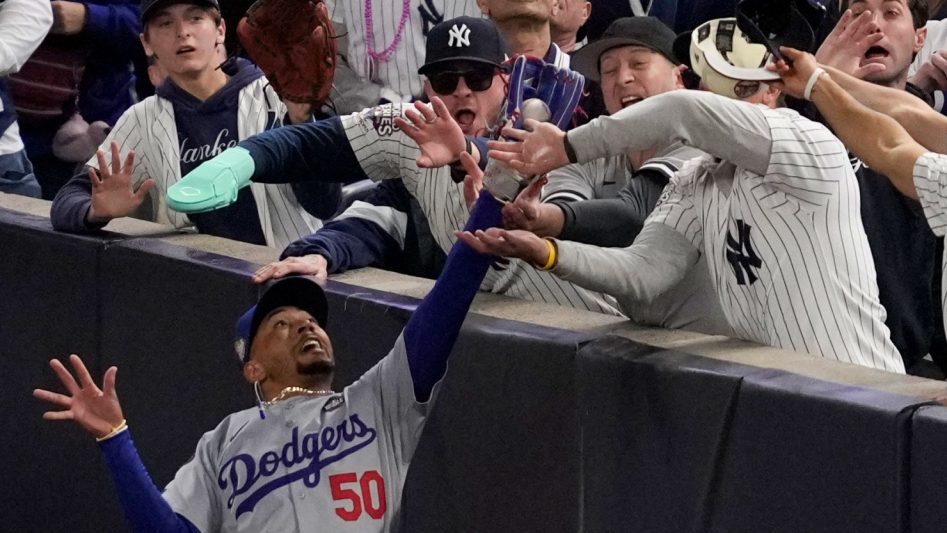
Interfering with Mookie Betts’s bid to haul Gleyber Torres’s Game Four-leadoff foul to the right side for out number one got two Yankee fans thrown out of Yankee Stadium on the spot, and now banned “indefinitely” from everything MLB.

It goes like this: If you have a problem with a pair of Yankee Stadium jerks getting banned indefinitely for interfering flagrantly with a player in the World Series, I have a problem with you. And I don’t care if the player with whom you interfered was Mookie Betts or Moe Baloney.

Austin Capobianco and John P. Hansen were banned indefinitely last week “from major league stadiums, offices, and other facilities.” MLB sent the pair a letter banning them concurrently “from attending any events sponsored by or associated with MLB. Please be advised that if you are discovered at any MLB property or event, you will be removed from the premises and subject to arrest for trespass.”

The play in question happened in the bottom of the first, Game Four, last October’s World Series. Betts ran Yankee leadoff hitter Gleyber Torres’s drive to the wall and took a flying leap, his glove hand stretched upward, trying for the ball. He had the ball in his glove squarely enough. That’s when Capobianco and Hansen reached out, one grabbing Betts’s wrist and the other trying to grab the ball out of Betts’s glove.

Outfielders are taught to steal home runs back from over fences. They’re also taught to turn foul flies into fly outs if they can get gloves on them and yank them back. I’m not sure if they’re taught how to defend themselves against overzealous fans who think they have the right to obstruct players from making plays at or over the fences by hook, crook, or anything else short of mutilation they can think of.

Which wasn’t exactly the sentiment Capobianco expressed after they were ejected from Yankee Stadium. As he told ESPN, “I patrol that wall and they know that.” That sounded as though someone in the Yankee organisation died and left Capobianco to play fence field in the will.

But the pair changed their stance when interviewed subsequently by Barstool Sports. Capobianco acknowledged they’d “crossed the line” taking hold of Betts’s wrist. Betts may have waved the play away postgame himself, but come December he wasn’t having it.

“I get them trying to get the ball. Cool,” the Mookie Monster told  2024 Back That Year Up with Kevin Hart and Kenan Thompson on the Peacock network. But, like, you tried to grab my s–t. I was in the moment. So I thought about throwing a ball at them. And then I realized, ‘Mook, you ain’t gonna do s–t. Go back to right field’.”

When the incident actually happened, Barstool Sports writer Tommy Smokes didn’t exactly feel all that sympathetic to Betts or all that outraged by Capobianco and Hansen, Capobianco in particular. “This guy is everything that a Yankee should fan be,” Smokes wrote. “A loud, passionate, Italian greaseball who will do anything it takes to help the team win.”

We just did a full interview with him linked above that’ll be out everywhere else soon and as he told us, ‘I wasn’t trying to get the ball or to hurt him, I was just trying to extend the at-bat.’ And if you can’t respect that, then I don’t respect you.”

If you can’t look at that video and objectively find it hilarious, then I know everything I need to know about you as a person. I know what you stand for . . . It’s such a clear divide between people who laugh at that and people who want this guy thrown in prison. Even Mookie Betts after the game last night seemed to not care. People are acting like they decapitated him. He acknowledged to us that the friend probably shouldn’t have grabbed his hand, and that’s true, but let’s not pretend like he tried to [fornicating] decapitate him. All the main fan was trying to do was the get the ball out of the glove and extend the at-bat. The Yankees were down 3-0 in the World Series and you do whatever it takes to extend the at-bat for your guy at the plate.

Who is “you?”

Fans in the stands are permitted to “do whatever it takes” to extend the home player’s plate appearance? Betts is to blame because Torres swung late on a 1-0 pitch and sent it foul to the right side? Fans in the stand wearing the home team’s jerseys are thus auxiliary players entitled to make or break plays? Thank God and His servant Col. Ruppert that most fans, even most Yankee fans, would answer all the above with a resounding “You’re kiddin’, Spike.”

“This is just a classic baseball moment that had no real consequences other than bringing the Yankee crowd alive and keeping their season alive,” Smokes wrote further. “Anthony Volpe[‘s grand slam in the third] helped too. But if the Yankees come back and win the series, then this man deserves a parade float and a spot in Monument Park.” Let me guess. Smokes would have been ready to hand Jeffrey Maier the keys to the city and maybe his own private New York subway car.

I’m reasonably certain that there were and are others who think classic baseball moments such as that provoke not monuments but karma.

Just ask every Yankee fan who in the ballpark for Game Five. You know—the game after the Yankees won Game Four, 11-4. The game following the only Yankee win of a set in which they just did out-hit, out-run, out-slug, and out-pitchd the Dodgers. The game they thought the Yankees had in the bag with Gerrit Cole on the mound and a 5-0 lead, until the Bronx Boneheads ordered up an on-field sando* in the top of the fifth.

The game the Yankees lost after reclaiming the lead briefly enough with Giancarlo Stanton’s sixth-inning sac fly, a lead lasting only long enough for the Dodgers to overthrow it with a pair of eighth inning sac flies the Dodger bullpen made stick.

Capobianco and Hansen were probably lucky that being ejected from Game Four, and now banned indefinitely from anything MLB from the ballpark to the back lot of spring training to possibly the team stores, too, are all they’ve received.

Yankee fans who believe karma the bitch as which she’s so often advertised would probably like to give them a parade, all right. Preferably, onto and off the Triborough Bridge and into the East River.

—————————————————————————————————

* “Sando”—Slang for “s–t sandwich,” created and popularised online (and, on lots of merchandise) by Las Vegas slot machine YouTube star Vegas Matt.

————————————————————————————————–

* This essay published originally at Sports Central.