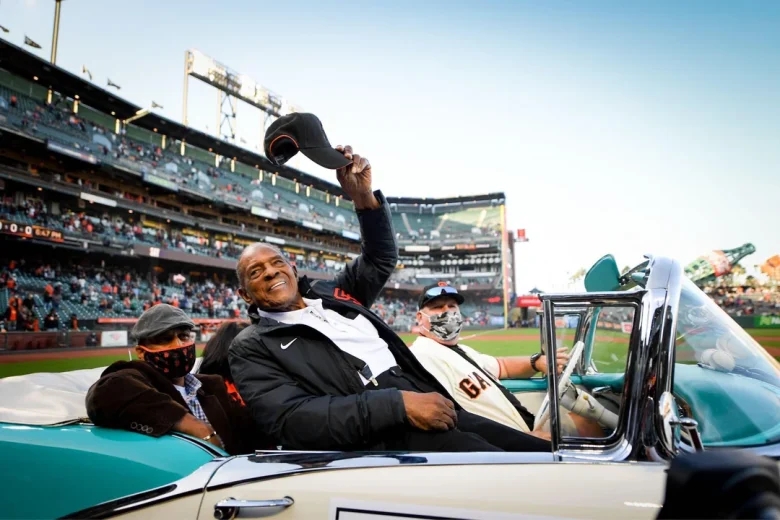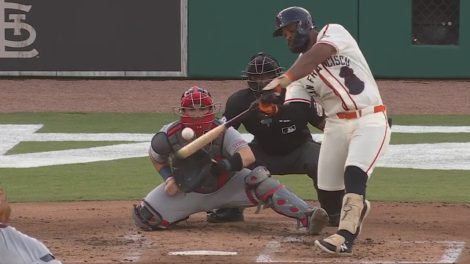
“Let him hear you, he’s listening.”

Heliot Ramos

Willie Mays played with Gary Mathews.. Who played with Edgar Martinez.. Who played with Ichiro.. Who played with Tim Beckham.. Who played with Blake Snell.. Who played with Heliot Ramos.. Who homered tonight while playing CF for the Giants… In Willie Mays’ first pro ballpark. Baseball!—Jayson Stark, Hall of Fame baseball writer.

In the first professional baseball park where the late Hall of Famer Willie Mays played as a Birmingham Black Baron, it was illegal until 1963 for white and non-white players to play on the same field. On Thursday, white and non-white players converged for the San Francisco Giants and the St. Louis Cardinals to play an official major league game.

None but the blind or the bigoted pretends racism is eliminated from American life entirely. But the Giants and the Cardinals, playing a game umpired by the Show’s first all-black umpiring crew, managed to keep it outside the gates of a ballpark where Hall of Famer Reggie Jackson played on the first interracial team Rickwood Field hosted.

That was then: Jackson’s parent club, the then-Kansas City Athletics, moved its AA-level minor league team into Birmingham at the insistence of its owner, Charles Finley, a Birmingham native who could be flagrantly wrong about many things but stood on the side of the angels when it came to racism. Jackson remembers only too well.

“I walked into restaurants and they would point at me and say, ‘The n—–s can’t eat here’,” Jackson said aboard the Fox Sports pre-game broadcast.

I would go to a hotel and they’d say, “the n—–s can’t stay here.” We went to Charlie Finley’s country club for a welcome home dinner and they pointed me out with the N-word, “he can’t come in here.” Finley marched the whole team out . . . Finally, they let me in there and he said, ‘We’re going to go eat hamburgers. We’ll go where we’re wanted.’

Coming back here is not easy. The racism when I played here, the difficulty of going through different places where we traveled—fortunately, I had a manager and I had players on the team that helped me through it—but I wouldn’t wish it on anybody.

This is now: The Negro Leagues are recognised formally (and appropriately) as having been major leagues. This year, the known statistics of Negro Leagues players and managers (surely there will be more to exhume, however long it might take) began becoming integrated into major league statistics at last.
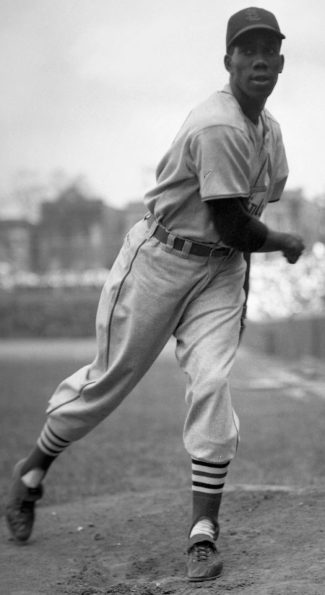
Bill Greason

The Rev. Bill Greason, former Birmingham Black Baron who got to pitch very briefly for the Cardinals in 1954.

Thursday evening, the oldest former Negro Leagues player, pitcher turned minister Bill Greason (99), was escorted to halfway between the mound and the plate by Cardinals coach and former player (and the National League’s 1985 Most Valuable Player) Willie McGee to throw a ceremonial first pitch. To Ron Teasley, Jr., whose father is the second-oldest living former Negro Leaguer.

Greason was six years Willie Mays’s senior when they were Black Barons teammates. “He was a determined young man,” the former pitcher told Ken Rosenthal. “He had the gifts, the talent, and he was sensitive to listening to those who were older than he was. It was a tremendous blessing, and we turned out to be real close. Like brothers.” Just the way Mays would look toward former Newark Eagles star Monte Irvin when Irvin was a third-year Giant and Mays a nervous Giants rookie.

Mays’s number 24 was painted in large white numerals behind the plate. A Giants uniform with his number hung in the Giants’ dugout. The Giants and the Cardinals—wearing the uniforms of, respectively, the San Francisco Sea Lions (West Coast Negro Baseball League, 1946) and the St. Louis Stars (Negro National League, 1920-1931)—wore circular patches on their jerseys with Mays’s surname and number.

Mays’s son, Michael, urged the Rickwood crowd to make some noise for his father before the game. “Birmingham, I’ve been telling y’all,” the younger Mays said, “if there was any way on Earth my father could be here, he would. Well, he’s found another way . . . Let him hear you, he’s listening. Make all the noise you can.” The Wil-lie! Wil-lie! chant just about drowned every other sound out.

Mays had issued a statement Monday saying his health would keep him from attending the game. The following day, he died at 93. America couldn’t decide whether to grieve over yielding Mays to the Elysian Fields or be grateful that he remained among us as long as he did.

“In a sense, Mays was too good for his own good,” wrote George F. Will in tribute.

His athleticism and ebullience—e.g., playing stickball with children in Harlem streets–encouraged the perception of him as man-child effortlessly matched against grown men. He was called a “natural.” Oh? Extraordinary hand-eye coordination is a gift. There is, however, nothing natural about consistently making solid contact with a round bat on a round ball that is moving vertically, and horizontally, and 95 mph. Because Mays made the extraordinary seem routine, his craftsmanship and intelligence were underrated.
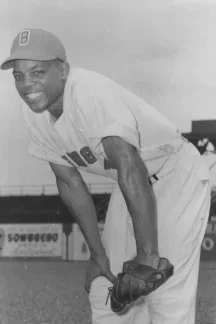
The late Willie Mays, as a young Birmingham Black Baron. (Photo: Birmingham Public Library.)

The arguable greatest position player ever to play major league baseball may have been watching and listening from his Elysian Fields roost on Thursday, but he surely lamented his Giants losing by one run to the Cardinals. Not for lack of trying.

The Athletic‘s irrepressible Hall of Fame writer Jayson Stark couldn’t resist pointing out: “Willie Mays played with Gary Mathews.. Who played with Edgar Martinez.. Who played with Ichiro.. Who played with Tim Beckham.. Who played with Blake Snell.. Who played with Heliot Ramos.. Who homered tonight while playing CF for the Giants… In Willie Mays’ first pro ballpark. Baseball!”

That would be Ramos tying the game at three-all when he took hold of a two-on, one-out, one-strike service from Cardinals starting pitcher Andre Pallante and launched it the other way, over the painted Budweiser ad on the right field fence.

The Cardinals kind of snuck back into the lead an inning later on a sacrifice fly (Nolan Gorman) and a run-scoring (Alec Burleson) wild pitch (from Giants reliever Randy Rodriguez), and padded it to 6-3 in the bottom of the fifth when Brendan Donovan sent home his third run of the game, singling up the pipe to score Burleson. The Giants got two back in the top of the sixth on an RBI single (Wilmer Flores) and a sacrifice fly (Nick Ahmed), but that was the end of the game’s scoring.

The all-black umpiring crew even managed to behave, from Alan Porter behind the plate onward. Perhaps wisely, they confined the otherwise dubious C.B. Bucknor to second base, where he couldn’t possibly commit half the mischief he normally does when he’s assigned to call balls and strikes.

For one evening Rickwood Field became the Show’s oldest park in which to play a game; built originally in 1910, it’s two years older than Fenway Park and four older than Wrigley Field. It also became the place where racism’s ghosts were made unwelcome, even as few, perhaps, beyond the assembled former Negro Leaguers, might have guessed whom its most troublesome ghost might have been.

The once all-white minor league Birmingham Barons, to whose games Mays listened as a youth, had a radio play-by-play announcer from 1932-1936 named Bull Connor, who just so happened to be Birmingham’s commissioner of public safety at the same time. “Pretty good announcer, too,” Mays once remembered of him, “although I think he used to get excited.”

That pretty good announcer eventually ordered fire hoses and attack dogs turned upon student civil rights demonstrators, in 1963, the horror of which helped speed the writing, passage, and acceptance of the 1964 Civil Rights Act. Connor is long gone. So is the legal framework by which Jim Crow wreaked his infamy. But only that.

There remain miles to go yet before racism’s cancer is eradicated entirely from too many hearts and minds, still, who might have remained oblivious Thursday night to what its absence can achieve, even on a baseball team. Thursday was one more round of chemo, but an instructive and endearing one.
Willie Mays, RIP: Loss, but Gratitude

Willie Mays

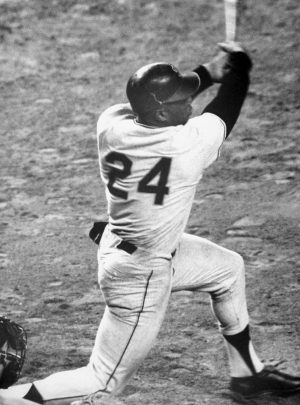
Mays hitting his 500th career home run, in 1965. “He has gone past me,” Ted Williams would say at his own Hall of Fame induction, after Mays hit number 522, “and he’s pushing, and I say to him, ‘Go get ’em, Willie’.”

Seeing Willie Mays in my boyhood when he was a Giant still in his prime was as transcendent as seeing him in his baseball dotage, as a late-career Met, was heartbreaking. Having Mays at all back in the city where he really made his baseball bones was as much a belated blessing as having him too much less than his best was sorrow. But . . .

“What do you love most about baseball?” asked Joe Posnanski, in The Baseball 100. (He ranked Mays number one.) Then, he answered. “Mays did that. To watch him play, to read the stories about how he played, to look at his glorious statistics, to hear what people say about him is to be reminded why we love this odd and ancient game in the first place.

“Yes, Willie Mays has always made kids feel like grown-ups and grown-ups feel like kids. In the end, isn’t that the whole point of baseball?”

But having Mays say farewell the way he did in Shea Stadium on 25 September 1973, with the Mets still yanking themselves back to take a none-too-strong National League East, brought tears not just of loss but of gratitude. If so few of the greats retire before the game retires them, fewer than that retire with Mays’s soul depth:

I hope that with my farewell tonight, you will understand what I’m going through right now. Something that—I never feel that I would ever quit baseball. But as you know, there always comes a time for someone to get out. And I look at the kids over here [pointing toward his Mets teammates], the way they are playing, and the way they are fighting for themselves, tells me one thing: Willie, say goodbye to America.

America never really said goodbye. Now America must say a reluctant au revoir. Mays left this island earth at 93 Tuesday. “I want to thank you all from the bottom of my broken heart for the unwavering love you have shown him over the years,” said his son, Michael, in a statement. “You have been his life’s blood.”

We’ve been his life’s blood? The younger Mays had it backward. His father was the lifeblood of every objective and appreciative baseball fan of his time. He didn’t have to wear the uniform of the team for which I rooted since their birth (not right away, anyway) to be that for me, in hand with Sandy Koufax, and believe me when I tell you that watching Koufax going mano a mano against Mays was something precious to behold.

(For the record, Mays faced Koufax 122 times and nailed 27 hits. Five were home runs, eight were doubles, one was a triple, for 33 percent extra bases off the Hall of Fame lefthander. Mays also wrung 25 walks out of him while striking out 20 times.)

Before Mays’s Giants and Koufax’s Dodgers high tailed it out of Manhattan and Brooklyn for the west coast, the most bristling debates in New York involved not politics, finance, or rush-hour traffic, but baseball. As in, whom among the three Hall of Fame center fielders patrolling the territory for each team was The Best of the Breed.

I was born in the Bronx and raised there and on Long Island; I heard the debates for years to follow after the Dodgers and the Giants went west. I had skin enough in that game long before Terry Cashman wrote and recorded his charming hit, “Willie, Mickey, and the Duke (Talkin’ Baseball).” Well, now. Let’s look at the trio during their New York baseball lives two ways, for all the seasons they played in New York together. (Snider was a four-year major league veteran by the time Mays and Mantle arrived in 1951.)

First, according to my Real Batting Average metric (total bases + walks + intentional walks + sacrifice flies + hit by pitches, divided by total plate appearances):

Together In New York PA TB BB IBB SF HBP RBA
Mickey Mantle 3493 1648 524 34 11 5 .636
Willie Mays 3299 1718 362 70 23 11 .662
Duke Snider 2629 1305 283 42 6 7 .625

Mays has a 26-point RBA advantage over Mantle and that’s with Mays losing over a season and a half to military service. (Mantle’s osteomyelitic legs kept him out of military service; Snider served in the Navy before his major league days began.) Mays also landed 70 more total bases and was handed 36 more intentional walks.

Mantle may have been a powerful switch hitter, but just from one side of the plate Mays outperformed him while they shared New York even with precious lost major league time between ages 21-23. Mantle also had a .756 stolen base percentage to Mays’s .738, but a) Mantle’s already compromised legs kept him from trying more often; and, b) Mays led his league in thefts twice during the period under review. (Snider? Even a hobbled Mantle left him behind: for their shared New York years, his stolen base percentage was .586.)

Sometimes Mantle gets the props as the best of the trio purely because his Yankees were far better teams than the others’. Actually, Snider’s Dodgers were almost as good as Mantle’s Yankees. It was no more Snider’s fault that his Dodgers couldn’t get over those Yankee humps until 1955 than it was Mantle’s sole doing that his Yankees won seven pennants and five World Series (three consecutively) while they shared the Big Apple.

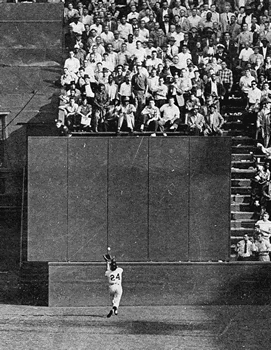
And it was hardly Mays’s fault that his Giants won a mere two pennants in the same shared span, even if Mays’s Giants got squashed by the Yankees in five in the 1951 Series but swept the far better Indians in the 1954 Series. You may have heard of a little play known as The Catch from Game One of that Series, happening when it seemed the Indians had a shot at taking the opener. (Mays would play on two more pennant winners, too, the 1962 Giants—who beat the Dodgers in another memorable pennant playoff—and the 1973 Mets.)

Willie Mays

“The Catch,” of course—460+ feet from home plate in the ancient Polo Grounds.

“That really wasn’t that great of a catch,” harrumphed curmudgeonly Indians pitcher Bob Feller, nearing the end of his own Hall of Fame career. What made him think not? “As soon as it was hit, everyone on our bench knew that he was going to catch it . . . because he is Willie Mays.” (But did they know Mays would also keep Hall of Famer Larry Doby from scoring with an equally staggering throw in to the infield off The Catch?)

Which brings me to the titanic triumvirate in center field. We’re going to look at them according to total zone runs, the number of runs their play in center field turned out above or below their leagues’ averages. Baseball-Reference begins measuring total zone runs with the 1953 season, so we’ll have five solid Big Apple seasons to review for each of the trio:

Willie Mays: +45.
Mickey Mantle: +22.
Duke Snider: +25.

Once again you see where Mantle’s physical health issues got in his way despite his supernatural talent and skill. But it might not have mattered. Mays and Mantle both played in unconscionably deep home center fields before the Giants and the Dodgers left the Apple for 1958. You can fantasise all you like how many runs Mantle might have prevented on good legs, but if you guess that he might have proven just about even you’re making a solid guess.

“Willie Mays going after a fly ball was cotton candy and a carousel and fireworks and a big band playing all at once,” Posnanski wrote. “His athletic genius was in how every movement expressed sheer delight.”

When Mays got to San Francisco, he and Mantle continued their top of the line play. When he got to Los Angeles, Snider had two decent seasons followed by a decline phase that actually took him back to New York for a round with the early Mets before finishing his career in 1964 as . . . a Giant, of all things.

Mantle managed to remain Mantle through the end of 1964. Mays managed to remain Mays through at least 1971. Even if his home run power had dissipated somewhat in the previous four seasons, he spent 1971—at age 40—leading the National League in walks and on-base percentage. Mantle’s body took him out at last at age 36; Mays’s, at age 42; Snider’s, at age 37.

And here is how the trio finished career-wise. First, how they sit among the Hall of Fame center fielders whose careers covered the post-World War II/post-integration/night-ball era, according to RBA:

Center Field PA TB BB IBB SF HBP RBA
Mickey Mantle 9907 4511 1733 148 47 13 .651
Willie Mays 12496 6066 1464 214 91 44 .631
Ken Griffey, Jr. 11304 5271 1312 246 102 81 .620
Duke Snider 8237 3865 971 154 54 21 .615
Larry Doby 6299 2621 871 60 39 38 .576
Andre Dawson 10769 4787 589 143 118 111 .534
Kirby Puckett 7831 3453 450 85 58 56 .524
Richie Ashburn 9736 3196 1198 40 30 43 .463
HOF CF AVG .588

But now, how they sit among center fielders for run prevention above their league averages, showing the top ten:

Andruw Jones +230
Willie Mays +176
Paul Blair +171
Jimmy Piersall +128
Kenny Lofton +117
Devon White +112
Carlos Beltrán +104
Willie Davis +103
Curt Flood +99
Garry Maddox +98

Thanks to his leg and hip issues, Mantle finished his career at -10. Snider finished his at -7; his late career was compromised by knee, back, and arm injuries. (Richie Ashburn, their great Hall of Fame contemporary, finished his career +39.) Two such talented center fielderss who’d had excellent throwing arms and range deserved far better than such physical betrayals.

Mays stood alone as the complete, long-enough uncompromised, all-around package. He was blessed with a body that wasn’t in a big hurry to betray him, but no blessing means a thing if you don’t take it forward. Good luck stopping Mays from doing so. Should-be Hall of Famer Dick Allen once advised Hall of Famer Mike Schmidt to play the game as though he were still the kid who’d gladly skip supper to play ball. Mays played the game precisely that way until age began to say “not so fast,” after all.

“The greats don’t always go gently into that good gray night when they can no longer play the games that made their names,” I wrote when Mays turned 90.

This son of an Alabama industrial league ballplayer fought a small war in his soul when his age insisted he was no longer able to play the game he loved so dearly at the level on which he’d played it for so many years. Some said he’d become sullen, moody, dismissive in the clubhouse. Some resented him, others felt for him, still others mourned.

. . . When he smiled as a Met, you still saw him in his youth, you didn’t see the manchild who was yanked rudely into manhood by a San Francisco that shocked him with skepticism as a New York import rather than a hero of their own. By a San Francisco that also shocked him, for all its reputation otherwise, when his bid to buy a home with his first wife was obstructed long enough by the sting of neighbourhood racism.

Willie Mays

Mays taken for a drive around PacBell Park in a 1956 Oldsmobile to celebrate his 90th birthday. San Francisco came to love him as New York did, but not without growing pains.

After his first marriage ended in divorce and in his son living across country with his mother, Mays dated Mae Louise Allen for about a decade before marrying her after the 1971 season. His happiness there was compromised by her premature Alzheimer’s diagnosis; his caring for her until her death in 2013 is the stuff of true love stories.

A welcome presence at the Hall of Fame’s induction ceremonies following his own in 1979 and at various Giants events (and numerous home games) in the years that followed, Mays wouldn’t be able to attend this year’s Field of Dreams game at Birmingham’s Rickwood Field, the field where he first played with the Birmingham Black Barons of the old Negro American League.

“I’d like to be there, but I don’t move as well as I used to,” he said in a statement on Monday. “So I’m going to watch from my home. But it will be good to see that. I’m glad that the Giants, Cardinals and MLB are doing this, letting everyone get to see pro ball at Rickwood Field. Good to remind people of all the great ball that has been played there, and all the players. All these years and it is still here. So am I. How about that?” A day later, sadly, he was gone.

Mays never apologised for making the game look fun with his fabled basket catches in front of his belt, his winging turns running the bases as his deliberately oversized hat flew off, his high-pitched voice sounding like a kid getting to play yet another inning.

“That’s what his idea was,” said one-time Giants relief pitcher Stu Miller, “to please the crowd.”

“I’m not sure what the hell charisma is,” said Ted Kluszewski, the musclebound Reds first baseman of the 1950s, “but I get the feeling it’s Willie Mays.”

“The only thing Willie Mays could not do on a baseball diamond,” Posnanski wrote, “was stay young forever.”

May his entry into the Elysian Fields, where it’s Willie, Mickey, and the Duke once again,  and especially his reunion with his beloved Mae, have been as joyous for him as the way he played the game was joyous to us for as long as we were honoured to see him play.

“It was a wacky war”

Yogi Berra

A colourised version of perhaps the most familiar image of Yogi Berra in his Navy uniform.

Note: Today is the eightieth anniversary of history’s largest amphibious war invasion—officially named Operation Overlord; colloquially known as D-Day from then until now, and beginning the liberation of France and in due course all western Europe from the grip of the Third Reich.

Among those of the U.S. Navy playing an active role in the invasion was a Yankee prospect who’d survive the war to become a Hall of Fame catcher against whom all to follow would be measured. I republish this essay in his honour and as a tribute to those who served with him but didn’t make it home.

Yogi Berra once gave a half-puckish beginning explanation as to how he became part of D-Day, World War II’s major Allied invasion of Europe from the Normandy beaches, as an eighteen-year-old Navy seaman. He made it sound like relief from boredom. As he so often did with his fabled Yogiisms, he had a knack for good humoured understatement.

Something still seems to be missing from America since Berra’s death almost nine years ago, which was also more than a year and a half after his beloved wife, Carmen, preceded him. And there may be worse reasons to think about the Hall of Fame catcher and personality than remembering how he got himself aboard a Navy rocket boat in time to be part of D-Day.

Berra was a Yankee prospect playing for their Norfolk, Virginia farm in 1943. Norfolk also just so happened to be the headquarters of the Fifth Naval District. Which meant it was also the governing center of the Navy’s Atlantic Fleet. Which also meant Norfolk and nearby Newport News overrun with sailors and civilian defense workers, an estimated 750,000 of them in a pair of towns whose populations combined weren’t quite as large as that of the Bronx.

His biographer Allen Barra, in Yogi Berra: Eternal Yankee, has written that the lad’s first real problems in Norfolk were long lines at the movie houses he loved and trying to stretch his $90-a-month minor league salary. “I never got too hooked on cigarettes, because I couldn’t afford them,” he once said. “Maybe starvation kept me from getting cancer.”

Once, knowing his team’s two other catchers were ailing, Yogi launched a unique version of a strike, telling his manager he wasn’t well for lack of food and the ploy worked toward getting him a $5 a month raise. His mother, Paulina, helped by slipping him a few extra dollars in the mail with instructions not to tell his father. And Berra became popular enough on the Tars that one ardent fan, a lady, provided him a full hero sandwich of salami and provolone every Sunday game.

That sandwich, Barra wrote, “was for Yogi what spinach was for Popeye.” After he received the first such gift, he smashed twelve hits and drove in 23 runs in two games against Roanoke. (This was the doubleheader that prompted Carmen Berra to remember, “When I heard about the 23 RBI day, I figured he had a future.”) He played well enough to be able to think an equal or better 1944 would get him a Yankee call-up. “Yogi was looking forward to an explosive 1944,” Barra wrote. That’s a polite way to describe the one he got.

Berra knew only two things: 1) He’d be in military service soon. 2) He had no idea where. Told his draft papers were drawn back home in St. Louis, he asked for and got them sent to Norfolk. After the Tars played an exhibition game with the Norfolk Air Station (some of the Norfolk players included such Show men as pitchers Fred Hutchinson and Hugh Casey, outfielder Dom DiMaggio, and Yogi’s future Yankee teammate/fellow Hall of Famer Phil Rizzuto), he talked to a warrant officer at Norfolk’s Navy training station and took the man’s suggestion to enlist in the Navy.

When his boot camp in Maryland ended, his mother underwent surgery; he was allowed to be with her until she could return home. After that, Yogi went to Little Creek to train for the amphibious service. The routine otherwise was so hurry-up-and-wait that the kid relieved his boredom at the base movie theater and with the comic books he fell in love with. Then one night he was watching Boomtown, the Clark Gable-Spencer Tracy film, when the film suddenly stopped and the theater lights suddenly came back up.

Berra and all the other sailors in the theater were ordered to line up. Officers asked for volunteers—for rocket boat duty. None of the young swabbies had a clue about rocket boats but when someone called them rocket ships, Yogi perked up. The idea that volunteering in military service was tantamount to being very careful what you wish for hadn’t yet been programmed into his mental data base.

The boats, as Barra noted, “turned out to be small landing craft, LCSSs (Landing Craft Support Small), whose purpose was to spray rockets on the beach before troop landings. There were duller things to train for. Some of the men got the hint that they might be participating in a major troop landing, perhaps the invasion of Hitler’s Fortress Europe that the papers were always writing about.”

The sailors called the rocket boats big bathtubs. If you played with toy boats in the bath when you were a small child, try now to imagine having a bath with 48 rockets, one twin .50-caliber machine gun and two .30-caliber machine guns. The boats affirmed the aforementioned hints: their purpose in life was to hammer the Normandy beaches and clear the way for the troops’ landing crafts. Yogi and his fellows had a name for them: “The landing craft suicide squad.”

The rocket boatmen first went to Plymouth, England. Once again it seemed to be hurry up and wait. Three weeks after they arrived, though, Berra’s LCSS was attached to what was thought to be the smallest transport ship in the Coast Guard fleet, the USS Bayfield. It made for Normandy early on 4 June. The Bayfield carried six LCSSs. “Just before dawn, on the morning of June 6, 1944,” Barra wrote, “their rocket boat was lifted on the davits and lowered over the side and, in Yogi’s words, ‘expendable as hell, we headed in for Omaha Beach’.”

The LCSSs were the tiniest boats on the waters heading into firing position.

“It was scary,” Yogi would remember, “but really something to see. I was only eighteen, and I didn’t think anything could kill me. I didn’t know enough to be scared. I had my head up over the side of the boat all the time, looking around like it was the Fourth of July in Forest Park and after the fireworks we were going to go over and get some hot dogs and Cokes.”

Bless his innocent soul, Yogi probably had no idea how vulnerable the LCSSs were. The sides of those boats weren’t exactly thick. One errant enemy shell, especially one hitting any of the boats’ rockets, would have made not the Fourth of July hot dogs but them into duck soup. Berra’s peekings over the edges to see the show ended when his lieutenant advised him to put his head down if he had plans to keep it.

The LCSSs waited for their lead boat to fire a test and see if it reached the beach. If it did, the other boats would move in close. It did. And inimitably, Yogi described the boats moving in “closer than the hitter is to the left field [wall] at Fenway Park.” One and all of them began firing. “I couldn’t see all the bloodshed that they showed in the movie [Saving] Private Ryan,” he remembered years later, “but I did see a lot of guys drown.”

Berra’s and all the LCSSs did what they were sent to do. Well enough that by D-Day’s afternoon they could actually relax, though they were under orders to remain through 9 June for cover fire in the event the Nazis had ideas about the counterattack that never came.

They had more trouble from an anticipated storm smashing in on 8 June, battering the boats and even flipping Yogi’s over. Before that they had trouble through no fault of their own—a friendly fire incident. Three fighter planes appeared above and the LCSSs were under orders to shoot down anything flying below cloud level. The LCSSs fired and hit one plane. The pilot bailed and parachuted before the plane hit the drink. Yogi ordered his boatmates to keep him covered, expecting to hear a stream of German.

What he heard was a stream of English language swearing. The crew had shot down an American plane whose markings they couldn’t see in the murk of the storm. When the storm worsened, Berra’s boat flipped over. Try to resist the temptation to say that only Yogi Berra and his boat crew could survive D-Day just to get thatclose to drowning after the artillery stopped.

They hung on until they were rescued and returned to the Bayfield. A Nazi bomb fell near the ship but no serious damage occurred, according to Barra and others. Berra said later he was too tired to be scared. Years later, when he met D-Day’s mastermind, Gen. Dwight D. Eisenhower, he couldn’t bring himself to ask Eisenhower about the invasion. “I never talked about D-Day,” Yogi remembered. “It didn’t seem right, but now I wish I had.”

With good reason. Numerous sailors believed Eisenhower was aboard one of their ships on D-Day. This was because of his soon-to-be-immortal radio message (You are about to embark on a great crusade) that was actually recorded at the 101st Airborne’s headquarters while watching the first Allied aircraft reach for the skies on that day. Even today, it sounds so clear that when you play it it sounds as though Ike’s telling it to you side by side as you’re about to hit the links.

Berra and his squadron got a break to rest at Portsmouth before going to Bizerte, the North African coastal town, and by 15 August 1944 he was part of the LCSS force hitting Marseilles and strafing hotels and other facilities co-opted by German forces. Berra’s boat was almost hit by mistake by a British shell that turned out to be a dud.

Berra himself got close enough to death when ships of the British Royal Navy behind the LCSSs fired at targets past the hotels and, while holding a rocket, one of his crew hollered to hit the deck. As he ducked under a gun mount, Yogi accidentally dropped the rocket. “It did not go off,” Barra wrote, “or you wouldn’t be reading this book.”

During a furious barrage, Berra got nicked by a bullet from a German machine gun before he manned his twin .50s and fired to cut down fleeing Nazis. As American troops landed, the locals swarmed the sailors with gifts and song. “It was a wacky war,” Yogi would remember. “A half hour after we were getting shot at by the Germans, the French were welcoming us.”

He rarely talked about his World War II experiences in the decades to follow. When he did so, even that provoked a little humour, as in the Los Angeles Times overhearing Berra talking to Hall of Fame pitcher Jim Palmer and Hall of Fame broadcaster Tim McCarver. Wrote the Times: “Yogi survived D-Day and George Steinbrenner, and all in forty years.”

He had to survive a more sensitive customer, though: his mother. After receiving a month’s leave for the Christmas holidays, Berra went home and showed his family his hard-earned decorations: a Distinguished Unit Citation, two battle stars, a European Theater of Operations ribbon, and a Good Conduct Medal.

Paulina Berra was already in tears as it was. Her boy also earned the Purple Heart when he was nicked by that Nazi bullet, but Yogi didn’t dare make the formal application for that medal. He figured that if Mama Berra knew what the Purple Heart really meant, she’d suffer a purple heart attack.