Ken Holtzman, RIP: The no-no-no song and other things

Ken Holtzman

Ken Holtzman, one of the prime contributors to the Athletics’ legendary (some also say notorious) three straight World Series titles in 1972-74.

Ken Holtzman was a good pitcher with two distinctions above and beyond being credited with more wins than any Jewish pitcher including Hall of Famer Sandy Koufax. He may have been the last major league player to talk to Hall of Famer Jackie Robinson before Robinson’s death. And, he’s the answer to this trivia question: “Name the only two pitchers in major league history to pitch no-hit, no-run games in which they struck nobody out.”

According to Jason Turnbow’s Dynastic, Bombastic, Fantastic, his history of the 1970s “Swingin’ A’s,” Robinson was at Riverfront Stadium for a pre-Game One World Series ceremony in 1972, commemorating 25 years since he broke the disgraceful old colour barrier. Robinson threw a ceremonial first pitch, then departed through the A’s clubhouse, where he happened upon Holtzman finishing his pre-game preparation.

“Nervous?” Robinson asked the lefthander. “Yes, sir, a little bit,” Holtzman admitted. After some small talk, Turnbow recorded, Robinson handed Holtzman an instruction: “Keep your hopes up and the ball down.” Nine days later, the A’s continued celebrating a World Series title but Robinson died of a second heart attack.

“I was probably the last major leaguer to talk to Jackie Robinson,” Holtzman would remember. Robinson’s advice probably did Holtzman a huge favour; he started Game One and, with help from Hall of Famer Rollie Fingers plus Vida Blue in relief, he and the A’s beat the Reds, 3-2.

A good pitcher who brushed against greatness often enough and became something of a rubber-armed workhorse, Holtzman—who died at 78 Sunday after a battle against heart problems—had two no-hitters on his resume from his earlier years with the Cubs. The first one, in 1969, made him that trivia answer. Four years to the day after Cincinnati’s Jim Maloney pitched a no-hitter that’s the arguable sloppiest no-hitter of all time (Maloney struck twelve out but walked ten), Holtzman joined the No-No-No Chorus.

19 August 1969, the Cubs vs. the Atlanta Braves in Wrigley Field, Holtzman vs. Hall of Famer Phil Niekro. While the Cubs got all the runs they’d need when Hall of Famer Ron Santo smashed a three-run homer off Knucksie, Holtzman performed the almost-impossible. He got fifteen air outs (including liners and popouts), thanks in large part to the notorious Wrigley winds blowing in from the outfield. (Hall of Famer Henry Aaron made three of his four outs on the day in the air.) He got twelve ground outs. And he couldn’t ring up a strikeout if he’d bribed home plate umpire Dick Stello begging for even one little break.

It joined Holtzman to Sad Sam Jones of the 1923 Yankees. Jones faced and beat the Philadelphia Athletics in Shibe Park, with both Yankee runs scoring on a two-run single by former Athletic Whitey Witt in the third inning. Jones got fourteen ground outs and thirteen air outs, living only slightly less dangerously than Holtzman did.*

Holtzman took a little more responsibility throwing his second no-hitter, against the Reds on 3 June 1971, the first no-no to be pitched in Riverfront Stadium. This time, he struck six out while walking four, getting ten ground outs and ten air outs each. Clearly he’d learned some things before his Cub days ended.

Ken Holtzman

Holtzman, as a young Cub.

He had no trouble learning off the mound, either, graduating with bachelor’s and master’s degrees from the University of Illinois and mastering French well enough to have read Proust in the language. When he moved from the Cubs to the A’s, he even found a unique way to funnel his competitive side when he didn’t have to be on the mound.

Holtzman drew a few teammates toward his passion for playing bridge, including Hall of Fame relief pitcher Rollie Fingers, infielder Dick Green, and relief pitcher Darold Knowles, according to Turnbow. In time, the Oakland Tribune‘s A’s beat writer Ron Bergman would join Holtzman and Fingers in scouting and finding bridge clubs on the road.

“We’d be the only three guys there,” Holtzman once cracked, “three major leaguers playing against 85-year-old women.”

“It was all gray-haired old ladies,” Fingers said. “We’d beat them during the afternoon, and then we’d go to the ballpark and beat a baseball team.”

On the mound, Holtzman arrived with immediate comparisons to Koufax. Being Jewish and lefthanded and arriving in Koufax’s final season made that possible, and impossible. Nobody could live up to a Koufax comparison at all, never mind by way of sharing the same pitching side and religious heritage.

Holtzman didn’t help relieve himself of those when he faced Koufax himself in Wrigley Field, the day after Yom Kippur 1966, and outlasted Koufax, 2-0, taking a no-hitter into the ninth before veterans Dick Schofield and Maury Wills singled off him. Or, when he pitched 1967 as a 21-year-old phenom with a 9-0 won-lost record around the military reserve obligations many players had in his time.

His Cub career wasn’t always apples and honey, alas. Other than the unrealistic Koufax comparisons, there were the military reserve interruptions (he pitched on weekend passes in 1967) and there was his tendency to speak his mind, which didn’t always sit well no matter how much his teammates liked him personally.

There was also dealing with Leo Durocher managing those Cubs, and especially becoming a Durocher target, burning when Durocher accused him of lack of effort. The Cubs’ Durocher-triggered self-immolation of 1969 didn’t make for better times ahead, for either Holtzman or the team. In fact, Durocher’s Cubs author David Claerbaut recorded a conversation Hall of Famer Ernie Banks had with Holtzman as the collapse approached:

Banks had a few drinks with the young southpaw after a game in Pittsburgh. “Kenny,” he said, “we have a nine-game lead, and we’re not going to win it becsuse we’ve got a manager and three or four players who are out there waiting to get beat.”

For the then 23-year-old hurler, the conversation with Banks was chilling. “He told me right to my face, I’ll never forget it. It was the most serious and sober statement I’d ever heard from Ernie Banks—and he was right.” Holtzman’s take was similar to that of Mr. Cub. “I think that team simply wasn’t ready to win. I’m telling you, there is a feeling about winning. There’s a certain amount of intimidation. It existed between the A’s and the rest of the league . . . In Oakland, when we took the field, we knew we would find a way to win. The Cubs never found that way.

After a struggling 1970 and 1971, Holtzman asked for and got a trade . . . to the Swingin’ A’s, for outfielder Rick Monday. A’s manager Dick Williams took to Holtzman at once. So did pitching coach Wes Stock: “I’ve never seen a pitcher throw as fast as he does who has his control.”

Holtzman learned soon enough how the contradictory ways of A’s owner Charlie Finley would make the A’s baseball’s greatest circus—even while they won three straight World Series in which Holtzman had prominent enough roles (and made his only two All-Star teams) and missed a fourth thanks to being swept by the Red Sox in 1975.

His first Oakland season in 1972 didn’t exclude heartache, alas. With the A’s in Chicago for a set with the White Sox, the Munich Olympic Village massacre happened. Eleven Israeli athletes and coaches were held hostage and killed by the Palestinian group Black September.

Proud but not ostentious about his Jewishness, Holtzman and Jewish teammate Mike Epstein took a long, pensive walk before electing to have the A’s clubhouse manager sew a black armband onto one of their uniform sleeves. The two players were stunned to see Hall of Famer Reggie Jackson wearing such an armband as well.

Epstein objected (he’d had previous tangles with Jackson), but Holtzman accepted. Jackson “had contact with Jewish people growing up and was not entirely unaware of Jewish cultural characteristics,” Holtzman said. “So when I saw Reggie with that armband, I felt that he was understanding what me and Mike were going through. He . . . felt it appropriate to show solidarity not only with his own teammates but with the fact that athletes were getting killed.”

In the wake of the Messersmith decision enabling free agency at last (Holtzman faced Andy Messersmith twice in the 1974 World Series and the A’s won both games), owners and players agreed to suspend arbitration while negotiating a new collective bargaining agreement. Oops. Finley offered nine A’s including Holtzman contracts with the maximum-allowed twenty percent pay cuts. What a guy.

Annoyed increasingly by Finley’s duplicities, Holtzman began 1976 as an unsigned pitcher but was traded to the Orioles on 2 April—in the same blockbuster that made Orioles out of Jackson plus minor league pitcher Bill Von Bommel and A’s out of pitchers Mike Torrez and Paul Mitchell plus outfielder Don Baylor.

Holtzman took a 2.86 ERA for the Orioles into mid-June 1976, then found himself a Yankee. He was part of the ten-player swap that made Yankees out of catcher Elrod Hendricks and pitchers Doyle Alexander, Jimmy Freeman, and Grant Jackson, while making Orioles of catcher Rick Dempsey and pitchers Tippy Martinez, Rudy May, Scott McGregor, and Dave Pagan.

As a Yankee, Holtzman landed a comfy five-year deal but picked the wrong time to begin struggling in 1977. A May outing in which he couldn’t get out of the first inning put him in manager Billy Martin’s somewhat crowded bad books. (He didn’t pitch in that postseason, just as he wasn’t called upon in 1976.) Active in the Major League Baseball Players Association as well, that side of Holtzman may have made Yankee owner George Steinbrenner less than accommodating as well.

In 1978, Holtzman again struggled to reclaim his former form and was dealt back to the Cubs. After struggling further to finish 1978 and for all 1979, Holtzman retired. He returned to his native St. Louis, worked in insurance and stock brokerage (the latter had been his off-season job for much of his pitching career), and did some baseball coaching for the St. Louis Jewish Community Center. He even managed the Petach Tivka Pioneers in the Israel Baseball League briefly, walking away when he disagreed with how the league was administered.

Holtzman might not have been the next Koufax, but the father of three and grandfather of four knew how to build unusual bridges toward triumphs on the field. May the God of Abraham, Isaac, and Jacob have brought Holtzman home to the Elysian Fields for an eternity living in peace.

* St. Louis Browns pitcher Earl Hamilton also threw a no-hit/no-strikeout game, against the Tigers in 1912 . . . but a one-out, third-inning walk preceded an infield error that enabled Hall of Famer Ty Cobb to score in a 4-1 Browns win. Hamilton did as Jones did otherwise: fourteen ground outs, thirteen air outs (including liners and popouts).
Gooden’s number retirement gives pause

Dwight Gooden

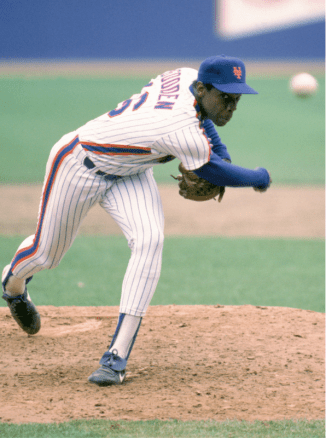
Whether throwing his multi-movement fastball or the curve ball known as “Lord Charles,” Dwight Gooden owned hitters and electrified Met fans in 1984-86.

A week ago, Stephen Strasburg finally got to make official what was determined last August and bungled almost at once: his retirement. A career worth of elbow and shoulder issues, brought to a head and then by thoracic outlet syndrome (TOS).

The former Nationals righthander leaves memories of the number-one draft pick who delivered so-often-brilliant pitching, harsh struggles, a World Series MVP in 2019, and a deadly posteason pitching resumé. (1.46 lifetime postseason ERA; 2.07 lifetime postseason fielding-independent pitching.) He’s not the only pitcher with flawed mechanics who succumbed (in his case, the inverted-W arm positioning before delivering), and he won’t be the last.

But on Sunday, the Mets did honour to a pitcher for whom the craft came naturally, with mechanics unflawed resembling an elegant young assassin on the mound, but whom the Mets decided inexplicably was the unbroken pitcher who needed to be fixed.

They retired Dwight Gooden’s uniform number 16, forty years after his staggering Rookie of the Year season. It’s the eighth team number the Mets have retired. (Jackie Robinson’s 42 is retired MLB-wide.) And, other than that of 1969 Miracle Mets manager Gil Hodges, it may contain the saddest story. Hodges’s time on the Mets’ bridge ended with a fatal heart attack in spring 1972. Gooden was ruined by his own team.

“Had New York’s [spring 1986] decision makers been present in 1506 when Leonardo da Vinci was painting the Mona Lisa,” wrote Jeff Pearlman in The Bad Guys Won, “they would have insisted on a mustache and larger ears. Here they had Gooden, called ‘the most dominant young pitcher since Walter Johnson’ by Sports Illustrated, and it wasn’t good enough.”

That spring, Gooden stood as the National League’s defending Cy Young Award winner approaching his third major league season. In his first, he pitched a Rookie of the Year season leading the entire Show with 276 strikeouts (smashing Herb Score’s rookie strikeout record in the bargain), a 1.69 fielding-independent pitching rate (FIP), a 1.07 walks/hits per inning pitched rate (WHIP), and an 11.4 strikeout-to-walk ratio. He saw and raised in his second season: he led the Show with 268 strikeouts, a 229 ERA+, and a 2.13 FIP, while being credited with a Show-leading 24 wins and 1.53 ERA.

And, over those first two seasons, Gooden became a Mets matineé idol while leaving National League batters (not to mention the American League side he struck out in the 1984 All-Star Game) wondering what became of their lumber: opposing batters hit .201 against the tapered young black man they called Dr. K.

Nobody could hit him. And he threw as though he was born to it. Every movement was both elegant and unforced, from his small windup (lifting his hands to his face) to his high-enough leg kick, his turn to hide the ball behind his right thigh, before throwing almost purely overhand and striding to the plate, in near-perfect timing, as though taking a long, unhurried step over a rain puddle.

He never looked uncomfortable. He never looked as though forcing a pitch. He threw a fastball with more movement than a dance company. He threw a curve ball with such a big trajectory that the pitch normally called Uncle Charlie was called Lord Charles when Gooden threw it. It was the third most voluptuous curve ball I have ever seen, behind only those thrown by Hall of Famers Sandy Koufax and Bert Blyleven. They were the only pitches Gooden had, the only ones Gooden needed.

“Every game,” he’d come to remember about those first two seasons but 1985 in particular, “I could put the ball where I wanted it.” Every Gooden game, you could feel Met fans thinking to themselves: Strike out twenty! Win thirty! See you in Cooperstown, Doc!

Much later than that, alas, Gooden would come to look back upon those two seasons and wonder, with no disingenuousness, how he did it at all. He knew he’d set an ionospheric bar for himself. Someone within the Mets’ brain trusts decided, inexplicably, that the evidence meant nothing. The Mona Lisa needed the ‘stache and ear job, anyway.

It might have been pitching coach Mel Stottlemyre, whom Perlman noted spent all 1985 marveling at Gooden and fantasised about what Gooden might do with another pitch or two: “That’s what he set out to do–teach the best pitcher in baseball to be better.” On the surface it sounds noble enough. But did Stottlemyre miss the memo saying you can’t improve on perfection?

“All through [spring training 1986],” Pearlman wrote, “Stottlemyre had Gooden toy with a changeup and a two-seam fastball, two pitches he did not throw. It was hard to watch. Gooden was a trouper, but the confidence he exuded on his fastball and curve ball never attached itself to the other pitches. He felt awkward and unsure.”

“I remember catching him one day in the bullpen and they were working with him on the two-seam,” said Mets backup catcher Ed Hearn. “I’m thinking, What the hell is this? He was a power pitcher with tons of movement, and they’re trying to teach him movement? What the hell for?”

“I always thought they should have left Doc alone,” said Hall of Fame catcher Gary Carter, who came to the Mets in 1985 and caught all but three of Gooden’s games. “Mel thought teaching him a third pitch would be to his advantage. But he didn’t need it. He needed someone to say, ‘Hey, you’ve been successful. Just keep going at it.’ But they didn’t’. I also think it hurt his shoulder. The pitches didn’t feel natural to Doc, and pitching was so natural to him. It just wasn’t smart.”

Emphasis added, because indeed Gooden did develop serious shoulder issues over the next several years.

The Mets’ general manager, Frank Cashen, also urged Gooden to shorten his leg kick the better to keep baserunners from taking off on him. Oh. You think a man against whom the league hits a whopping .201 has that much to worry about with baserunners? Assistant GM Joe McIlvaine went Cashen one worse: he told manager Davey Johnson, “If we can reduce Doc’s pitches, we can save his arm. He doesn’t need 200 strikeouts to succeed.”

Two hundred strikeouts is exactly what Gooden would deliver in 1986. He also delivered a 2.84 ERA but a 3.06 FIP, and the opposing on-base percentage jumped 24 points higher than in 1985. He’d pitch respectably in the 1986 National League Championship Series against the Astros; he’d get thumped twice by the Red Sox in the ’86 World Series. That year, Gooden no longer resembled the complete dominator he’d been in 1984-85.

Gooden did have an unconscionable workload for that young a pitcher: he may have thrown over 10,800 pitches in 1984-85, according to some reports, and that’s not including warmups before his starts or what he threw on his between-starts throwing days. Still. Look again at the comments of Hearn and Carter. That’s how a guy to whom pitching came that naturally, without apparent body stress other than the normal effects of pitching almost five hundred innings in the Show at ages 19-20, got compromised as badly as Gooden was.

There was one way where you could assign Gooden any blame for his reduction from off-the-charts great to merely good. He was known to be so pliant and accommodating, with his manager and coaches, and with the public (he was the no-questions-asked most popular Met on a team with several stars including Carter, Keith Hernandez, and Darryl Strawberry), that he left himself open to the wrong advice as well.

Dwight Gooden

With former teammate Mookie Wilson to his right, under an umbrella, Gooden in the rain talks to the Citi Field audience: “My health is good, my mental health is good and today I get to retire as a Met. And I want all you guys to know, you guys are part of this. Thank you so much.”

“In the pursuit of excellence,” Pearlman wrote, “Gooden made a tremendous mistake. He listened to everyone.”

Thus a young man who resembled a scientifically-sculpted model for effortless, untaxing pitching was sent from Hall of Fame-great his first two seasons to merely a good pitcher who might brush up against greatness again now and then—for the rest of his 16-year major league career. He’d lead his league in only two categories ever again (FIP, 2.44; homers per nine, 0.4; both in 1989); he’d throw a no-hitter later in his career (as a Yankee).

From 1984-86, Gooden’s FIP was 2.31 and his ERA was 2.28. For the rest of his career: 3.95 ERA, 3.69 FIP. From ’84-’86: 9.0 K/9; 3.4 K/BB. The rest of his career: 6.8 K/9; 2.1 K/BB.

Gooden’s too-well-chronicled battles with substance abuse (which got him into rehab in early 1987, delaying his season’s beginning, and got him suspended for all 1995, in between which other reputed disgraces came and went) have obscured the true reasons why he was knocked down from a perch that pointed him to the Hall of Fame. Baseball Reference ranks him the number 87 starting pitcher ever. Being inside the top hundred is remarkable enough, considering what was done to him and what he began doing to himself, of course. And in that order.

Several of Gooden’s old Mets teammates came to do him honour Sunday afternoon, including a surprising Strawberry, who’d suffered a heart attack a month earlier and may not have been expected to make it. (“I had to be here for Doc,” Strawberry told a reporter. His own Mets number 18 will be retired in June.) Hernandez and Ron Darling, now two-thirds of the Mets’ respected television broadcast team, were there. So were relief pitchers Roger McDowell and Jesse Orosco, outfielder Mookie Wilson, third baseman Howard Johnson, and outfielder/pinch hitter Lee Mazzilli, among others. So was Carter’s widow, Sandra.

Gooden walked out to the field on a blue carpet, lined with people holding up K placards such as those hanging from the old Shea Stadium railing in the deep outfield seats, the old K Korner that tracked every Gooden strikeout during every Gooden game.

He thanked Citi Field fans and Mets owner Steve Cohen Sunday afternoon, the fans for standing by him through everything great, good, and bad, and Cohen—who’s been as enthusiastic about acknowledging Mets legends as the Wilpons were reluctant, previously—for enabling him to retire officially as a Met . . . almost a quarter century after he threw his last major league pitch.

Then, he threw a ceremonial first pitch to his grandson, Kaden.

Several times, Gooden’s big smile made him look once more like the child prodigy who owned baseball for two transdimensional seasons, the one whom the younger Denzel Washington might have portrayed on film with astonishing physical accuracy. The smile must have grown exponentially when the Mets did him further honour by beating the Royals, 2-1, in the Sunday afternoon game to follow.

But it also made me remember what the very regime that took the chance on Gooden so young did to him when they decided perfection was insufficient.

This essay was published originally at Sports Central.

Fritz Peterson, RIP: The changeups

Fritz Peterson

Peterson on the mound in the original Yankee Stadium; his 2.52 ERA pitching there was the lowest by any Yankee pitcher at home in the original Stadium, including Hall of Famer Whitey Ford.

When the late Jim Bouton battled cerebral amyloid angiopathy, I wrote of Bouton’s battle and received a surprise: a note from Bouton’s Yankee teammate and fellow pitcher Fritz Peterson. The note read, simply, “If anyone can beat this, Jim can.” Bouton couldn’t in the long run, of course. And neither could Peterson beat Alzheimer’s disease in the long run.

Peterson got his diagnosis in September 2017. He died Friday at 82. Seven months after his diagnosis, the righthander who owns the lowest earned run average of any man who pitched in the original Yankee Stadium (2.52) told New York Post writer Kevin Kernan his condition “was a wacky disease.”

“It’s been happening like that for me all year,” he told Kernan. “So it’s confusing . . . It’s something so different. I don’t want to look into what comes next because I just want to enjoy every day.” Easier said than done, alas.

“I can’t go places,” Peterson continued then. “Unless something comes medically that can give me my mobility back . . . I can’t drive, so I’m depending on my wonderful wife. Whenever I get up I have to ask my wife, ‘What do we have today?’ As far as which doctors appointment. And when we do go somewhere. I have trouble walking, so I use a cane now. I feel like the old man from Scrooge.”

Fabled among fans for a sponge-like baseball memory, Peterson told Kernan his diagnosis would now keep him from attending Yankee Old-Timer’s Days, as he’d first planned to do during 2018. You can only guess the heartbreak that cause a man who loved engaging with fans on Facebook.

Peterson was a good lefthanded pitcher who grew up in the Chicago area (his favourite ballplayer was White Sox pitcher Billy Pierce) and arrived when the 1960s Yankees hit below bottom. His righthanded rotation mate Mel Stottlemyre arrived in time to help pitch those Yankees to their final pennant before the Lost Decade to come. The franchise’s first last place finish since 1912 happened in Peterson’s rookie 1966.

His roommate Bouton and Hall of Famer Whitey Ford were fading due to arm and shoulder issues. The remaining Yankee legends (Mickey Mantle, Roger Maris, Elston Howard) were reduced by age and injuries to box office appeal alone, what remained of it. Their few other good 1960s prospects proved journeyman major leaguers at best.

Peterson and Stottlemyre had a mutual admiration society, though Peterson was quick to name their pecking order.  “I always came in number two,” he cracked to Kernan. “Like Hertz and Avis, it was Stottlemyre and me.” That from a pitcher who led the American League in walks/hits per innings pitched back-to-back (1969-1970) and with the lowest walks per nine innings rate in five straight seasons (1968-72).

Prankish and fun-loving, Peterson found himself relieved of Bouton as a roommate before Bouton was plucked for the Seattle Pilots in the expansion draft for 1969. “They thought I was a bad influence on Fritz,” Bouton would write in Ball Four. “The Yankees had some funny ideas about bad influence . . . As for teaching Peterson the wrong things, the only thing I ever taught him was how to throw that changeup he uses so effectively. And he still enjoys giving me the credit.”

Peterson himself remembered best his 1 July 1966 game against the White Sox, when he took a perfect game to the eighthwith one out—and lost it when his own throwing error enabled the first White Sox baserunner before veteran White Sox catcher John Romano sent a base hit back up the middle. Peterson surrendered a run-scoring double and a sacrifice fly to follow, then made the inning-ending putout and pitched a scoreless ninth tio finish the 5-2 Yankee win.

“No immortality for me,” he’d remember in 2015.

That plus the changeup Bouton taught him were nothing compared to the changeup that came into Peterson’s wheelhouse in 1972.

Mike Kekich, Fritz Peterson

Left to right: Marilyn Peterson, Mike Kekich, Susanne Kekich, Fritz Peterson. Photographed here aboard a schooner on a summer 1972 outing, the two pitchers had already exchanged spouses, well before making it public the following spring. Fritz and Susanne eventually married and stayed that way; Mike and Marilyn proved a short-lived match, after all.

Exit Bouton, enter Mike Kekich, a lefthanded pitcher whom the Yankees acquired from the Dodgers in a December 1968 trade. Like Peterson, Kekich was fun-loving and a bit on the adventurous and flaky side. (Peterson pre-Alzheimer’s loved to remember watching Kekich dive in Florida waters chasing a giant manta ray.) They’d become linked forever publicly in a far more jaw-dropping way in spring 1973.

The two pitchers and their wives went to a July 1972 barbeque at sportswriter Maury Allen’s home and first made their plans for what Kekich called a “life swap” but both Peterson and his old pal Bouton called “a husband swap.”

According to Allen and others, Peterson had once found himself sharing transportation with Susanne Kekich, and the latter’s husband had found himself likewise with Marilyn Peterson. The partners-to-be each found common grounds they’d come to lack in their incumbent marriages. All stayed among them alone until, as Allen recalled it in his 2000 book, All Roads Lead to October, Peterson came to him in January 1973 to say he had a story for him:

Peterson unloaded the facts of the story he wanted me to write. On that evening back in July at our home, he and Kekich had made the original plans for exchanging wives. Also kids, houses, furniture, dogs, and cats. The new families had been in operation for several months, everything was still going well, and he wanted to share his wonderful news with the world. He had chosen me as the conduit.

“Are you crazy?” I asked.

“No, we’d been thinking about this for many months,” he said. “We wanted you to write it because you won’t make it sound dirty.”

Allen resisted at first because, he wrote, he thought the entire deal should have remained private. Perhaps it should have. Indeed, Allen told Peterson to hand the story to United Press sportswriter Milton Richman, instead. Peterson did. Richman wrote it straight, no chaser, no salaciousness, and it still exploded into a scandal that only began with New York Daily News columnist Dick Young tearing them apart.

“At least,” the ever-sensitive Young wrote, “they did it before the inter-family trading deadline.”

The timing for going public couldn’t have been more ticklish in hindsight: George Steinbrenner finalised his purchase of the Yankees from CBS in the same month Peterson and Kekich elected to go public with their life swap, and he’d announced Mike Burke (the CBS executive assigned to run the team for the network) would stay as the team’s president. (Temporarily, as things turned out.)

Allen ultimately wrote a long article for The Ladies Home Journal about the Peterson-Kekich swap, with full cooperation and participation of both husbands and wives. For him, perhaps the most telling comment about the entire matter came from the erstwhile Mrs. Kekich, who married Peterson and stayed that way until death did they part, and who told Allen her marriage to Kekich crumbled long before the two couples began swapping lives.

I never could seem to live up to Mike’s standards. No matter what I did, he wanted me to do it a little better. I always felt unsure about him, uncertain about myself, a little insecure. Fritz accepted me as I was.

Kekich himself told Allen he thought he was matched better with Marilyn Peterson until “things developed and we began to butt heads.” Possibly the most reluctant partner in the swap (and possibly the most stressed by it), Mrs. Peterson parted from Kekich soon enough, she to marry a doctor happily, according to Allen.

Peterson married the former Mrs. Kekich in 1974 and remained a father to his sons as well as a stepfather to his new wife’s daughters; the couple had a daughter together. Kekich, too, remained a father to his children while remarrying in due course. After several non-baseball ventures that failed, including in medicine and paramedicine, he moved to New Mexico before the turn of this century.

Kekich has been reported as comfortable out of the public eye as Peterson was in it when the occasions arrived, particularly at Yankee-related events and aboard social media, before his Alzheimer’s diagnosis.

The uproar may or may not have taken a toll on both men. Peterson pitched well below his top form in 1973, but he also came down with shoulder trouble. (Pre-1973: 3.10 fielding-independent pitching; 1974 through his retirement: 4.00.) Kekich had respected stuff but was prone to wildness before 1973; he finished his nine-season career with a 4.16 FIP and a 4.59 ERA.

Both pitchers would be traded away soon enough. Kekich was traded to the Indians during the 1973 season; Peterson was also traded there the following season, after Kekich had moved on from the team. His baseball career ended in 1976; Kekich’s, a year later. (A road accident caused Kekich his own shoulder issues.)

Bouton would remember Yankee manager Ralph Houk’s handling of the swap when compiling and editing “I Managed Good But, Boy, Did They Play Bad”, his anthology of writings about baseball managers.

As this book was going to press, Ralph Houk said one of the finest things I’ve ever heard him say . . . “The players’ lives are their own. We all have problems. You only go through this world once and everyone has a right to go through it happy.” This may indicate that Houk the manager is changing with the times, or it may be manager Houk’s way of minimizing the effect on his team while he waits to trade one of them. But it may also be a truer insight into Ralph Houk the person.

Fritz Peterson

Peterson in 2015, during an interview on New York’s WPIX-TV, two years before his Alzheimer’s diagnosis.

The Peterson-Kekich scandal proved mild sauce compared to sports scandals past and future, of course. Peterson’s trade to Cleveland proved more beneficial to the Yankees: it brought them two mainstays of their pending championship revival, first baseman Chris Chambliss and relief pitcher Dick Tidrow.

He’d work in the insurance business, as a blackjack dealer, an eschatological monograph author, and even a play-by-play announcer in minor league hockey. He wrote three books including When the Yankees Were On the Fritz: Revisiting the Horace Clarke Era. He survived bankruptcy. Eventually, Peterson and his family moved to Iowa. (“We’re still on the honeymoon and it has been a real blessing,” he said of his once-controversial remarriage, in 2013.)

“I’m hanging on for my family—that’s the most important thing,” Peterson told the Post in 2018. “If it weren’t for that I wouldn’t care. Heaven is not a bad place to be. I think we are all saved and that we all are going to end up in heaven.” May heaven prove a far less judgmental place for him than earth did once upon a time.

Shoh, it wasn’t so

Shohei Ohtani

Ohtani conks one long distance against the Giants earlier this month. His former interpreter has all but taken him off the gambling hook—and is about to plead in a federal case.

Well, now. Shohei Ohtani’s former interpreter is ready to sing. And it won’t be “An Innocent Man,” either. Ippei Mizuhara is ready to serenade the Feds with a guilty plea over stealing millions from the Dodgers star to bet on sports with an illegal bookmaker.

The New York Times said Wednesday night Mizuhara’s ready to plead guilty. The Times and several other media outlets also say the Feds have found evidence that Mizuhara tried to cover his trail by changing Ohtani’s bank account settings to deny Ohtani alerts and notifications whenever his money moved one or another way.

The Athletic reports that Mizuhara swiped more than the originally speculated $4.5. million—about $16 million plus, adding that he’s facing charges of bank fraud emanating from the Fed investigation. For which the maximum sentence is thirty years in the calaboose, though a plea deal may give him less time.

In other words, faced with riot-running speculation that he was betting on sports illegally through a California bookie, Ohtani told the plain truth when he said it wasn’t Shoh last month. That was the simple part. The hard part was acknowledging and saying his longtime friend and interpreter Mizuhara robbed him blind.

This would be the perfect moment for all appropriate social and mainstream media apologies alike for jumping Ohtani out of the gate, demanding his purge, demanding the unraveling of the obvious coverup on behalf of protecting baseball’s arguable biggest star at the moment. It would also be the perfect moment for apologies out of any and every one who said—without a shred of logic, sense, or thought—that the Ohtani case should have been Pete Rose’s get-out-of-baseball-jail-free card.

It’s not the perfect moment, yet? OK, I can wait. But not for very long. Rush to judgment? How about a warp speed to judgment. All there had to be was even one published hint that someone in Ohtani’s circle was betting on sports illegally and crowds of social media troglodytes, plus enough of a pack of mainstream reporters who are supposed to know better, couldn’t decide on the design of the noose or gallows from which Ohtani should hang.

The first such hints, which weren’t exactly hints, emerged while the Dodgers were in South Korea to play the Padres in their regular season-opening series. That’s when Ohtani first learned there was a gambling probe and that his own longtime friend and interpreter was involved.

Days later came Ohtani’s March presser. The one in which he denied flatly that he bet on baseball or any other sport in any way, shape, or form. The one in which he admitted he was now very suspicious that Mizuhara wasn’t exactly straightforward in his original statements about his ties to southern California bookie Matthew Bowyer.

“According to the [federal] complaint,” The Athletic‘s Andy McCullough writes, “Mizuhara manipulated Ohtani’s bank accounts beginning in 2021, around the time Mizuhara began wagering on sports. Mizuhara controlled an account that collected Ohtani’s baseball salary. He shielded access to the account from others in Ohtani’s orbit saying the player wanted the account to be private.

“Mizuhara also impersonated Ohtani in conversations with bank officials, the complaint read.”

Not brilliant, especially since whenever you call a bank on any matter involving an account, the bank usually records such conversations. That’s whether you want to double-check a deposit, a withdrawal, a credit card matter, your checking account, your savings account, your car or home loan, anything.

Just how Mizuhara thought he could get away with portraying Ohtani to the bank long term hasn’t been determined. Yet. If I were him, I wouldn’t think about seeking work as a professional impressionist any time soon.

Unlike Rose’s longtime lies and his sycophancy’s continuing yeah, buts, Ohtani didn’t flinch at that March presser, even if he looked and sounded as though he’d been shot in the back. He could have delivered a mealymouth self-defense, he could have thrown this or that one under the proverbial bus. But he didn’t. He didn’t take questions at the presser, but he didn’t waver from his statement or his position.

The U.S. Attorney in California’s Central District, the IRS, and the Department of Homeland Security are investigating Mizuhara and Bowyer. There was no case against Ohtani. There still isn’t. Even though everything known until now pointed far more directly to Mizuhara than to Ohtani, it didn’t stop take after take from those willing to drink of the full he-must-be-guilty-somehow nectars.

Except that Ohtani himself wasn’t named in the legal probes into Mizuhara and Bowyer. Even Bowyer through his own attorneys said Ohtani never did business with him in one or another way but that Mizuhara did plenty. And we’re probably not done learning just how deeply Mizuhara inserted his siphon into Ohtani’s lucre.

“Ohtani on March 25 said he learned of the issue on March 20–the day the reports from the Los Angeles Times and ESPN would break–after the Dodgers’ first game in South Korea, when the team held a meeting in the clubhouse,” say CNN reporters Joe Sutton and Jason Hanna.

Ohtani said the team meeting was in English and he didn’t have a ‘translator on my side’ but he got a sense that something was wrong.

He said he met one-on-one after with Mizuhara at the club’s hotel. Ohtani said up until then he didn’t know Mizuhara had a gambling problem and was in debt.

“When we talked . . . that was when I found out he had a massive debt,” Ohtani said March 25. “Ippei admitted that he was sending money from my account to the bookmaker.”

The translator had told the media and Ohtani’s representatives the player had paid off gambling debts on behalf of a friend, according to the superstar. Ohtani said he was not aware of the media inquiries.

Mizuhara was fired after the Dodgers beat the Padres in that 20 March game, of course. Another spokesman for Ohtani said the two-way star was indeed the victim of theft. Those running rampant saying there was no way that could have happened betrayed ignorance, willful and otherwise, of how often athletes, entertainers, and others of vast wealth get  fleeced by those close to them, electronically or otherwise.

Just how and why Mizhuhara got in so deep with Bowyer (who’s been reported out of the bookmaking business since last October) despite his not-so-high salary and overall monetary value remains to be seen.

Presumably, too, MLB’s investigation into this mess will wrap up soon enough. It would have to, now that we can determine beyond reasonable doubt that Ohtani was telling the truth when he said he doesn’t bet on any sports, and that Mizuhara told anything but the truth when he first tried claiming he was betting on Ohtani’s behalf. U.S. Attorney Martin Estrada is quoted as saying Mizhuara’s sports betting didn’t involve baseball, anyway.

More important would be MLB’s other teams broadening their vetting processes regarding interpreters for foreign-born players who speak little to no English or who speak the language competently enough to get by at the market or meeting fans but not comfortably enough to speak it during formal press interviews. The next Mizuhara may already be lined up among them.

That’d be the second best outcome of this mess. (The best, of course, is Ohtani’s demonstrable innocence in the matter.) That’d be more important than any social media apologies for trying to find Ohtani’s needle in a mud haystack.

Strasburg: Retirement official, and should be a hard lesson

Stephen Strasburg

Let’s hope Stephen Strasburg’s often brilliant, often injured, postseason-deadly career helps start solving pitching injuries the right way.

Allow me to begin by reaching for a magazine article. It’s one I wish would be read by those on social media or elsewhere where baseball is discussed and debated, particularly those who continue to kvetch about today’s pitchers being “babied” or “unable and unwilling to go the distance,” the way the real men did in the Good Old Days.

“[I]t’s a sad truth,” the writer began, “that, in recent years, and with increasing (and alarming) frequency, big winners have stopped winning with the abruptness of a stalled motor.”

. . . The principal reason why baseball has a sore pitching arm is that pitchers work harder today than ever before. Years ago, the baseball was a muffin, and pitchers paced themselves without fear of the big home run. Only when a runner reached second did the pitcher have to throw his best. And when he threw his best he was throwing at a larger strike zone.

Today the accent in baseball is on the score, big and quick. The ball is built for distance. Bats have the streamlined look . . . Fences are, if anything, closer. Anybody can hit a home run. No lead is safe, for five-run innings appear in box scores almost every day. So today’s pitcher must bear down all the time.

“Get out there and throw as hard as you can as long as you can,” the manager tells his starter. “If you get tired, we’ll bring in Pete from the bullpen.”

This approach to the game is murder on good pitchers, for if they last the full game, as they so often do, their arms undergo a severe strain.

“The pitching motion is a peculiar muscular activity,” said a team doctor to the writer. “It places an abnormal strain on the arm. Every time a man pitches hard, tendon fibers in his shoulder tear apart. It takes about three days for them to repair. That’s why pitchers can only work every fourth day, as a rule. When a pitcher throws too hard, or if he throws awkwardly—for instance, if he slips on the mound—the tear is apt to be bigger, causing a sore arm.”

“. . . [P]itchers are wearing out faster than ever, at a time when more pitchers than ever are being used, the search for new talent never ends,” the writer went on to say. “There are some baseball men who think that eventually pitchers will work only three innings at a time . . . In that same vein, others feel sure that the use of the relief man will be explored to such an extent that 20-game winners . . .will become extinct.”

The writer’s name was Walter Bingham. The magazine was Sports Illustrated, with the Yankees’ 1958 World Series MVP (and baseball’s third one-across-the-board Cy Young Award winner) Bob Turley on the cover. The issue was 4 May 1959. The team doctor Bingham quoted was Turley’s on the Yankees, Dr. Sidney Gaynor. 

This weekend past, the Major League Baseball Players Association and MLB swapped barbs over the current crowd of pitcher injuries. The timing couldn’t have been more grave: Stephen Strasburg, brought down by thoracic outlet syndrome, finally formalised his long-enough-known retirement after ten full seasons and shards of three to come.

The MLBPA accused MLB of shoving and shortening the pitch clock to the detriment of pitchers’ health. MLB counter-accused the MLBPA of “ignor[ing] the empirical evidence and much more significant long-term trend, over multiple decades, of velocity and spin increases that are highly correlated with arm injuries.” MLBPA chief Tony Clark put his name on their statement. No name appeared on MLB’s.

Strasburg’s TOS may have been a direct result of his longtime inverted-W arm-and-elbow positioning, both elbows above the shoulders as he cocked to throw, position which strains elbows and shoulders at once. I noted when discussing his original retirement decision, by way of longtime baseball analyst Allen Barra, that the inverted W’s arrival coincided with the little-by-little disappearance of the full windup from the pitching repertoire.

The full windup, Barra wrote in 2011, “took advantage of the momentum of [a pitcher’s] whole body to give velocity to the pitch.”

In recent decades, with pitchers more concerned about holding runners on base, the windup has largely gone the way of the two-dollar hot dog. The Inverted W is the result of a pitcher trying to add speed or finesse on a pitch by forcing the delivery—in other words, his arm working against his body instead of with it.

Sixty-five years after Bingham observed a major league pitching injury epidemic, ESPN’s Jeff Passan writes that, yes, pitchers have and will always get hurt, “but at the highest levels the causes have morphed from longer-term overuse injuries to shorter-burst, higher-intensity, muscles-and-ligaments-can’t-handle-it ones.”

Teams incentivize pitchers to throw in a way that many experts believe is the root cause of the game’s injury issues. As much as velocity correlates with injuries, it does so similarly with productivity. Throw harder, perform better. It’s a fact. It’s also bad for the health of pitchers — and the game.

At the same time, it’s not the only factor. The fact that the union wants more information on the pitch clock should matter to MLB. Even if the league did bargain for unilateral control over on-field rules changes during negotiations with the MLBPA, it can’t ignore what players continue to begrudge. This isn’t idle bellyaching. Pitchers want to understand why the extra two seconds shaved off the clock this year were so imperative. And why they aren’t entitled to one or two timeouts a game when they feel discomfort—a nerve sending a shock of pain up their arm, a muscle spasming and in need of a break. And why there still isn’t an accepted grip agent to help with balls they believe remain inconsistently manufactured. All issues of health.

If MLB wants evidence on its side, it should hark back to Bingham and toward Passan. If the MLBPA really cares about the pitching department of its membership, so should they. If both sides want to see fewer pitching injuries and longer pitching careers, they should hark especially to Keith Law, writing in The Inside Game four years ago:

Nolan Ryan is the ultimate survivor, the survivor ne plus ultra, the übersurvivor when it comes to survivorship bias . . . He is, however, an outlier, a great exception—not one that proves the rule, but one that causes many people to discard the rule. Most pitchers can’t handle the workloads that Ryan did; they would break down and suffer a major injury to their elbow or shoulder, or they would simply become less effective as a result of the heavy usage, and thus receive fewer opportunities to pitch going forward. Teams did try to give pitchers more work for decades, well into the 2000s, but you don’t know the names of those pitchers because they didn’t survive: they broke down, or pitched worse, or some combination of the above.

[The] pitching deity known as Charles “Old Hoss” Radbourn started 73 games for the Providence Grays in 1884 and threw 678.2 innings, but survived to pitch another seven years beyond that. The game itself has changed dramatically in the last few decades, with pitchers throwing harder than ever, and hitters bigger and stronger than ever, but those outliers were even outliers in their own times—and they should not distract us from what we see from looking at all pitchers, not just the ones we remember.

. . . And stop saying “Nolan Ryan” like it’s some mic drop.

I saw one social media bonehead refer to Strasburg as “an orchid.” Charitably, that could be taken to refer to his early Tommy John surgery and to both cervical neck impingement and shoulder inflammation in 2018. Then, carpal tunnel syndrome in his pitching hand in 2020 followed by TOS surgery.

Maybe we should start saying “Stephen Strasburg” like it’s some mic drop.

He retires (as it should have been, no controversy) with no reduction in the annual average value of what’s left of that mammoth contract he signed not long after his 2019 World Series triumph. That Series MVP he won crowned a career in which he was so often brilliant and in which he was downright deadly come the postseason: 1.46 lifetime postseason ERA; 2.07 lifetime postseason fielding-independent pitching.

“Although I will always wish there were more games to be pitched,” Strasburg said in his formal announcement, “I find comfort knowing I left it all out there for the only team I’ve known.” He left more out there than even he might think.

Let’s hope he enjoys his second act of life while his career, among too many ended similarly, helps more than a few people start wising up. And, for further openers, maybe being allowed or encouraged to start winding up all over again.