Two modest stars enter Cooperstown

Fred McGriff, Scott Rolen

Fred McGriff and Scott Rolen proudly displayed their Hall of Fame plaques after Sunday’s induction ceremony.

When the Yankees’ (shall we say) mercurial then-owner, George Steinbrenner, faced likely suspension over his campaign to smear his Hall of Fame right fielder Dave Winfield, George F. Will pondered whether then-commissioner Fay Vincent should marshal enough consensus to force Steinbrenner to sell the team. Will even imagined vetting a jury to empanel hearing a court case over it.

“Here is a pretty judicial pickle,” Will wrote parenthetically. “Imagine trying to assemble an impartial jury of New Yorkers to hear Steinbrenner’s case. ‘Tell the court, Mr. Prospective Juror, do you have any strong opinions about the owner who masterminded the trade of Fred McGriff from the Yankees to the Blue Jays in exchange for a couple of no-names? Stop snarling, Prospective Juror’.”

Come Sunday afternoon, that same Fred McGriff stood on the Cooperstown stage accepting his Hall of Fame plaque. Elected to the Hall by the Contemporary Baseball Era Committee, the Crime Dog didn’t exactly keep the Yankees high on his gratitude list, though the trade that might have had a prospective New York juror snarling could have been called the trade that launched him to where he now stood.

“I’d like to welcome everyone here from Atlanta to San Diego, Toronto, my hometown of Tampa Bay and everywhere in between. Thank you for showing up,” said the tall first baseman who became baseball’s first and so far only man to hit 30+ home runs in a season for five different teams. (And, the first Hall of Famer whose plaque mentions OPS.)

It is awesome to be here accepting this honor. What a blessing from the man upstairs. Beautiful weather. You can’t beat it. I’m so grateful to be going into the Baseball Hall of Fame alongside a guy like Scott Rolen who played the game the right way. A true professional. I want to thank the many living legends sitting behind me. I’m humbled and honored to be standing in front of you. And now to be part of this fraternity alongside you—just some great individuals behind me.

In one way, no player ever had a later-in-life baptism of fire to equal McGriff’s. It wasn’t enough that his career tended to be buried beneath the ramped-up batting stats of both the era of actual/alleged performance-enhancing substances (McGriff was never a suspect) and new ballparks that over-embraced hitting. No. He had to play his first game for the Braves under, shall we say, fiery conditions, after his fire-sale trade from the Padres:

I was nursing an injury when the trade happened. So I drove to Atlanta, I left Tampa at noon. I didn’t expect to play. But when I got to the ballpark, there is my name in the lineup. I was sweating. But I believe the man upstairs bought me some time when a food heat lamp caught on fire.


The start of the game was delayed two hours, long enough for me to get some more treatment. And I felt a little bit better. I started the game. And I tied it up in the sixth inning with the home run. The next day, I hit two home runs. And that Braves team caught on fire. We ended up catching the Giants after being ten games out of first place at the time to trade, and we won the division.

Two years later, McGriff and those relentless Braves teams of the 1990s won their only World Series rings. The Crime Dog did splendidly for a fellow who’d been cut from his high school baseball team once upon a time.

Both McGriff and Rolen had reason to wonder if they might ever get to Cooperstown as other than paying guests. Rolen may have thought about it just a little bit less.

“At no point in my lifetime did it ever occurred to me that I’d be standing on this stage,” the third baseman with a live bat and an Electrolux way at third said early, nodding to the Baseball Writers Association of America who elected him in January. “But I’m glad it occurred to you, because this is unbelievably special.”

(Asked whether Rolen could play shortstop, his one-time Phillies manager Terry Francona replied, referring to his broad range at third, “He’s playing it!”)

A two-sport star in his native Indiana, before beginning his baseball career, Rolen remembered learing something from his father after a particularly trying basketball mini-camp. “After day one, I told Dad that I had a minor problem . . . that I need advice with. And his answer (was), ‘OK’.”

“Well, Dad. I can’t handle the ball. I can’t shoot. I’m completely out of basketball shape. And everybody in the entire gym, including the coach, is better than me.’ And his answer?”

“OK.”

“What do you mean, ‘OK?’”

“Well, what are you going to do, Scotty?”

“Well, that’s what I’m asking you, Dad.”

“Well, how the hell do I know? You say you can’t dribble. You can’t shoot. You’re out of shape. And you’re completely overmatched. You told me what you can’t do? What can you do?”

“I guess I can rebound.”

“OK.”

“I can play defense.”

“OK.”

“I can dive for loose balls. Doesn’t appear that the guys are playing too hard up here. I could outhustle, outwork and beat everybody up and down the floor.”

“OK.”

And then here came the words of wisdom: “Well, do that then.”

It turns out that, “Well, do that then,” carried me into the minor leagues and gave me a simple mindset that I would never allow myself to be unprepared or outworked. “Well, do that then” put me onto this stage today.

The man who won a World Series ring as a key element of the 2006 Cardinals finished by doing something he’d done from the moment his parents first made the trek to see him play a major league game. He tipped his cap to them. Then, it was a Phillies cap. Sunday, it was a Hall of Fame cap. The number ten third baseman of all time never forgot.

“This is baseball’s biggest honor,” McGriff said. “This is like icing on a cake. You see, my goal was simply to make it to the big leagues. And I exceeded every expectation that I could ever imagine and then some. It is a great feeling getting recognized for your hard work.”

“I’m grateful for this grand gesture,” said Rolen, one of only four third basemen ever to hit 300+ home runs, steal 100+ bases, and hit 500+ doubles. (The others: Hall of Famers George Brett and Chipper Jones, plus Hall of Famer in waiting Adrián Beltré.) “I have an overwhelming respect and intend to represent these (Hall of Famers) behind me and this legendary Hall with the integrity on which it was built.”

McGriff and Rolen have something else in common aside from forging a new friendship. McGriff got the last laugh on a capricious Yankee owner who thought he could afford to lose the Crime Dog’s budding self. Rolen got the last laugh on a Phillies regime that allowed him to be viewed unfairly as indifferent while also letting him take unfair abuse when he challenged their willingness to build and sustain winning teams.

McGriff’s Hall plaque shows him wearing a blank cap atop his smiling, mustachoed face, and it reposes next to Negro Leagues legend/longtime Cubs coach/scout/baseball’s arguable finest ambassador, Buck O’Neil. Rolen’s plaque reposes next to Red Sox/postseason legend David Ortiz, showing him in a Cardinals cap, looking as determined as he was holding third base down almost two decades, resembling if anyone music legend Neil Young.

Both Rolen and McGriff heeded when their bodies began telling them it was time to go. Thus, one particular Young lyric stands forward, when thinking of them compared to those greats who, in Thomas Boswell’s words, “torture their teams, their fans, and themselves, playing for years past their prime, for the checks and the cheers”:

It’s better to burn out/than to fade away.

Despite McGriff’s bald pate and Rolen’s thinning one, they both look as though they could still play nine innings in a tough pennant race. But they spared us and themselves the tortuous long fade away. McGriff and Rolen finally stood on the Cooperstown podium Sunday, inspiring and accepting cheers at least as edifying as those incurred by a timely hit, a long home run, a tough play at first, an impossible play at third.
“The best job in the world” deserves better

Rob Manfred

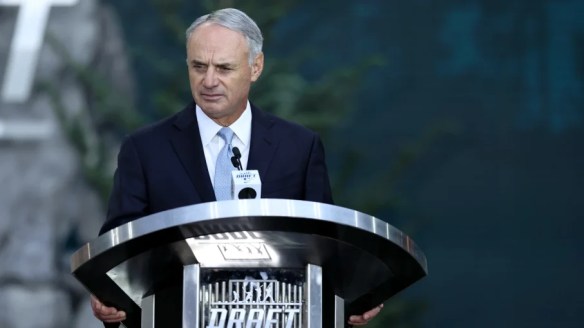
Rob Manfred at last month’s draft in Seattle—where the commissioner couldn’t quite understand why he was booed so lustily by the crowd.

I saw it first from Even Drellich, the Athletic writer whose Winning Fixes Everything proved the most in-depth exposure of Astrogate and what developed it. Commissioner Rob Manfred’s re-election for another term of office is all but a done deal when the owners vote next week. Manfred has said publicly he’d like another term in the job, which he considers “the best job in the world” to have.

A commissioner’s re-election window begins nine months prior to his term’s designated expiration date. Drellich says the owners’ vote will come smack dab at the opening of that window. If the owners have enough of a contingency among them who don’t have oatmeal for brains, Manfred should be denied. If.

He’s overseen a continuous climb in baseball’s revenues since he took the job in 2015, disrupted only by the coronavirus pan-damn-ic. That by itself may be enough to win him another five-year term. But it’s time to consider yet again an observation upon which I’ve leaned shamelessly that was first sketched by longtime New York Times writer George Vecsey: The common good of the game isn’t the same thing as making money for the owners.

The 2021-22 owners’ lockout said, guess again. When Manfred laughed during the first announcement of canceled games, assuredly he did not laugh like Figaro that he might not weep. I’ll say it again: When Manfred called it a “defensive lockout,” it sounded like Vladimir Putin pleading that he’s only defending Mother Russia from Ukraine’s “aggression.”

His handling of the Oakland/Las Vegas debacle as much as said, Oh, yes it is. He failed to school himself deeply enough on the core of that debacle, a capricious owner who tried and failed to strong-arm Oakland after reducing his team to compost, but discovered Las Vegas and its Nevada parent state didn’t have to be strong-armed to fall hook, line, and stinker into giving him a new ballpark.

The commissioner was caught pants down when he said mid-June that there was “no Oakland offer, OK? They never got to a point where they had a plan to build a stadium at any site.” Oakland mayor Sheng Thao said, that’s what you think. Last weekend she laid down the law to the commissioner in person. Oops.

Of course, John Fisher wanted Oakland to build him a big real estate development with a ballpark thrown in for good measure. Of course Oakland’s political (lack of) class finally said, not happening that way. Manfred has stood for continuing the nebulous push of municipalities building ballparks at taxpayers’ expense.

He has stood there even when it turns from a questionable proposition to a downright disaster. Atlanta’s Turner Field was only two decades old when the Braves decided the city limits were just too much and it was time to strike for the burbs. Double oops.

“[T]hey abandoned . . . Turner Field for suburban Cobb County in large measure because the county agreed to commit hundreds of millions of tax dollars to the project,” wrote CBS Sports’s Dayn Perry. “That tally is more than $350 million (and probably growing), which means Cobb taxpayers will never come close to getting that back.” Not even if the Braves own the National League East (again) for the foreseeable future.

Those are just too-obvious manifestations. Manfred has been baseball’s Professor Pepperwinkle, using the game as a lab and those who play and administer it as the experimental rats. For every one change he has ordered or shepherded that’s been good for the game, you can find several that have been worth either a laugh or a lament.

The universal designated hitter has been one of the good ones. Sorry, but I’m going to die on the hill that says however much fun it is to see the extreme outliers who can actually handle themselves at the plate, they were just that, outliers. When pitchers as a class hit a mere .162 from the end of the dead ball era through the end of the 2021 season, the universal DH was long overdue.

The ghost runner on second base to open extra half innings has been one of the terrible ones. So has the three-batter minimum for relief pitchers, especially when a manager is barred from lifting a pitcher right then and there who doesn’t have it and might be dangerously wild. So have the expanded wild cards and postseasons that dilute championship play even further.

The jury may still be out on the pitch clock. But it does present issues ranging from the sublime to the dangerous, especially concerning pitchers’ arms. Manfred’s inability thus far to commit to turning it off in the postseason’s late innings suggests he’d rather sacrifice the integrity of a championship round than one inch of his stubbornness.

We should also have noticed that the truest reason for lengthening games was never even a topic in Manfred’s mind: reducing the broadcast commercials between half innings to a single minute each. Smart negotiating could have brought that about without costing the owners money. They were no further endowed with vision on that than Manfred.

It’s also difficult to determine which has become more cringe-inspiring: the garish City Connect and All-Star Game uniforms; or, the presence of small advertising patches on uniform sleeves. It’s not impossible to say that the former are merely grotesque but the latter suggest the future baseball uniform might become the next best thing to a NASCAR jumpsuit.

Manfred has also shown far too much tendency to put his foot in his mouth and worry about the actualities after the screaming dissipates. Remember his dismissal of the World Series trophy as “a hunk of metal,” addressing questions of whether he would or could vacate the 2017 Astros’ World Series triumph once Astrogate erupted?

Fast forward to last month. Manfred now said he made a boo-boo giving 2017-18 Astros players immunity in return for spilling about the Astro Intelligence Agency. “Once we gave players immunity, it puts you in a box as to what exactly you were going to do in terms of punishment,” he told Time. “I might have gone about the investigative process without that grant of immunity and see where it takes us. Starting with, I’m not going to punish anybody, maybe not my best decision ever.”

But he did that to himself. The memo he sent down after the Red Sox and Yankee incidents of using AppleWatches and other devices in their dugouts to steal signs made clear he’d punish front offices, not players. He dropped a hammer on Astros owner Jim Crane and then-general manager Jeff Luhnow, but he let the cheaters in the dugout and on the field get away with murder.

Sort of. To this day, those 2017-18 Astros still playing major league baseball hear it from fans in the stands. Conversely, and unfairly, Astros second baseman Jose Altuve hears it despite it being shown authoritatively—and discussed in both Drellich’s book and Andy Martino’s previous Cheated: The Inside Story of the Astros Scandal and a Colorful History of Sign Stealing—that Altuve was “the one player that didn’t use” the stolen signs.

Now, back to the Oakland debacle. That fine day Nevada’s state legislature elected to spend $380 million of their citizens’ money on a Las Vegas ballpark for the A’s, A’s fans staged a “reverse boycott.” They poured into the decrepit RingCentral Coliseum to protest, among other things, Fisher’s gutting of the team while hiking ticket prices, doing squat to improve anything at the old dump, then all but saying it was all the fans’ fault.

Commissioner Pepperwinkle’s response? “It was great. It’s great to see what is this year almost an average major league baseball crowd in the facility for one night. That’s a great thing.” Ask him how a 27,759-strong crowd turned out to be a little over three times the average RingCentral Coliseum crowd for one particular event, and he was probably stuck for an answer.

Wait—no, he wasn’t. “The ballpark’s not in good shape,” he said. “The ballpark is not a major league facility. I’ve said it repeatedly.” Ask him how it was allowed to devolve in the first place. Now he might be stuck for an answer.

Someone should present these and more to the owners when they gather to vote upon whether Manfred gets another term. It may be asking them to think beyond their competence, and beyond their faith that the common good of the game is making money for them. But at least they won’t be able to plead ignorance.

Moreno won’t trade Ohtani? Let it be on his head

Shohei Ohtani

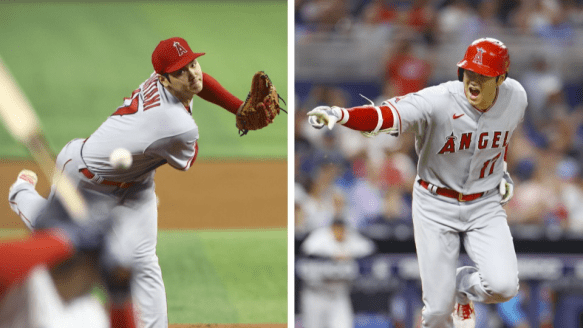
Shohei Ohtani could bring back a trade deadline haul that might push the Angels (and their trading partner, depending) into the postseason at last. But it would serve their owner right for failing to deal him and then letting him walk as a free agent bringing back . . . nothing.

Unless there is something festering in the deep background that nobody can expose, I have a contrarian thought for everyone insisting Angels owner Arte Moreno absolutely must trade Shohei Ohtani. I ask only that you save your ammunition until you read whole.

If Moreno’s that insistent upon keeping Ohtani until that very day when he becomes a free agent for the first time after the season ends, let him.

If Moreno insists upon remaining the kind of owner whose sense of marketing is more acute to the tenth power than his sense of baseball and of his team’s true competitiveness, let him.

If Moreno is that bent upon receiving nothing in return for Ohtani by letting him walk this coming winter, rather than receive the kind of value whose terms his baseball people can all but dictate, considering the prize Ohtani is, let him.

It would serve him right, even if it might serve long-enough-suffering Angel fans not so right.

Remember, this is the owner who was “exploring options” to sell the Angels almost a year ago. When that news broke, the sigh of relief from Angel fans could be felt from the Newport Beach coast to the farthest-planted lighthouse in Maine.

Moreno even let it slip that he had a pair of offers that would have eclipsed what Steve Cohen paid to buy the Mets. The problem was, Moreno let that slip this past March, when he also announced he simply couldn’t bear to part with the Angels just yet. Not while there was (ahem) “unfinished business” to tend.

“[We] feel we can make a positive impact on the future of the team and the fan experience,” he said in a formal statement when announcing his sale plans were done for who knew how long. “This offseason we committed to a franchise record player payroll and still want to accomplish our goal of bringing a World Series championship back to our fans. We are excited about this next chapter of Angels baseball.”

As of this morning, the Angels had gone from a season-opening 18-14 to a dead-even 48-48. The last time they had a four-or-more-games-over-.500 standing was when they were nine games over following a two-out-of-three winning stand against the Royals in mid-June. They’ve been 7-15 since.

The culprits have been the usual ones for this team—inconsistent pitching by one and all not named Ohtani; inconsistent hitting by one and all not named Ohtani (or Mike Trout); and, a near-consistent parade of patients for the injured list. Somehow, the Angels are four and a half games back in the American League wild card race, and nine out of first in the AL West.

That’s close enough for a major trade deadline deal to maybe make a difference, for the wild card hunt if not the division hunt. Right now, the biggest deal of deadline season could be Ohtani for whatever prime enough talent he’ll bring back, even if the acquiring team knows he might be just a rental for the rest of the way. (Even if that means a division, a pennant, maybe even a World Series ring.)

For a contending team loaded in surplus, that rental could still mean a deep postseason dive. For the Angels, it might mean surviving into the postseason, even through the back door, but just enough to give Ohtani (and Trout) a taste of postseason action neither has been granted to see since Ohtani became an Angel in the first place.

No, Ohtani won’t return a whole qualified starting rotation, a whole bullpen full of more than bull, or an entire additional lineup of Ohtanis (or Trouts). But he would return pieces solid enough to keep the Angels in this race and maybe, just maybe, a race or two to come.

“Ohtani is a once in a lifetime player, and moving off of him is akin to trading Babe Ruth,” writes Deadspin‘s Sean Beckwith. “You hold onto that kind of talent for as long as possible, and hope for the best.” And that last part, Beckwith knows, is the most problematic part:

Considering “hoping for the best” is the Angels’ entire organizational strategy — it’s why they’re in this current predicament — they will inevitably be crippled by indecision, or disillusioned by the “LA” on the hat, and stand semi-firm that Ohtani will stand by them.

This is, of course, an asinine strategy, and antithetical to the thinking of front offices, and sports media. The pleas for trade destination slideshows are being heeded everywhere you click, and all the big market teams are tallying their assets to see how much they could offer in a trade, because [general manager Perry] Minasian said he’s not going to trade Ohtani if they’re still in contention.

The thing is, contention is subjective, and four-and-a-half games back of the final wild card spot is more than enough for the Angels to grasp onto the belief that Shohei Ohtani will stay regardless of no tangible reason to do so.

It’s more than enough, too, to prevent Moreno—an owner who thought (erroneously) that his life’s success in marketing qualified him as a baseball man, when it only meant he could put (the old George Steinbrenner creed) “name guys who put fannies in the seats” on the field first and worry about rhyme, reason, cohesion, and performance (an awful lot of which his own capriciousness obstructed) second—from doing the sensible thing. Or, from letting Minasian do the sensible thing.

So let him cling to Ohtani until the two-way unicorn’s Angels deal expires this winter. Let him get less than nothing in return for the unicorn if that’s the way he wants it. Ohtani has been at least as sensational a baseball talent as Mike Trout was before the injuries became a near-annual thing for him. He (and Trout) deserve better than to be kept prisoners to merely hoping for the best.

Let Moreno explain why clinging to his unicorn to the very last was more important than letting his unicorn bring back what just might have pushed the Angels into their first postseason since they were swept out of a division series by the Royals, in the first of Mike Trout’s three Most Valuable Player Award seasons. Nine years ago, if you’re scoring at home.

That explanation should prove the funniest and saddest monologue since the Marvelous Mrs. Maisel first wandered onto the stage of a fleabag nightclub to schpritz about her husband dumping her for his secretary. Mrs. Maisel got laughs and a brilliant career out of it. It would serve Moreno right to get nothing back for the unicorn to whom he sold an illusion.

On Shoeless Joe’s birthday

Shoeless Joe Jackson

“[A]n incredible lapse of judgment, as well as a failure of character, on Jackson’s part.”

Over three years ago, I took up and wrote of whether Shoeless Joe Jackson really did play to win in the tainted 1919 World Series. I wrote it for another online publication*, prompted by the anniversary of the season that ended with Jackson and seven of his fellow Eight Men Out** suspended and the White Sox losing the pennant by two to the then-Indians.

Today is the 136th anniversary of Jackson’s birth. Today, as also happens whenever the subject of Jackson arises around social media, there are those continuing to plead on his behalf and those arguing that he and his fellow Black Sox have no behalf, so far as the World Series fix and scandal are concerned.

Often as not, today and other days, Jackson’s name arises whenever someone’s provoked to mention and re-argue the Pete Rose affair. Rose, of course, was banished for violating the rule the Black Sox and other baseball gambling scandals of that era provoked, Rule 21(d).

Jackson was clearly the best position player among the 1919 White Sox, and he just might have become a Hall of Famer had it not been for his portion of the Series fix. He didn’t instigate the fix. Unlike Black Sox ringleader Chick Gandil, Jackson wasn’t exactly a patron of the demimonde or the gambling underworld.

But he did accept an envelope with $5,000 worth of payoff money, handed him by pitcher Lefty Williams. Society for American Baseball Research writer Jacob Pomrenke probably phrased it best:

Before going home [after the 1919 Series], Jackson went to [White Sox owner Charles] Comiskey’s office in the ballpark and waited to see the Old Roman. Jackson wanted to tell Comiskey about the fix and possibly to return the money he had received. He stayed for several hours, but Comiskey holed up in his office and Jackson eventually left without talking to the White Sox owner.

In February 1920 team secretary Harry Grabiner traveled to Jackson’s home in Savannah and signed him to a substantial raise, a three-year deal for $8,000 per year. Jackson operated a successful poolroom there and a dry-cleaning business that employed more than 20 people. He and [his wife] Katie used the money he had received for fixing the World Series to pay for his ill sister Gertrude’s hospital bills.

Rather than wait until he could see Comiskey, by barging in if necessary, perhaps, he went home, signed a new deal, tended his off-season business, and used his Series fix money. He used it for a noble reason, but he still spent his share of the fix money rather than push harder to turn it over to Comiskey or anyone else in baseball who mattered.

Those who continue the push to see Jackson paroled from baseball’s Phantom Zone and eligible for Hall of Fame enshrinement often point to his surface 1919 World Series statistics: his .394 on-base percentage, his .563 slugging percentage, his .956 OPS, his .375 batting average. But what do you come up with if you burrow past the surface.

What follows is a table showing Jackson with men on in that Series. GO: ground outs. FO: fly/pop outs. ROE: reached on an error. Runs +/-: How far his team was ahead or behind when he batted with runners on. W/L: whether the White Sox won or lost the game.

Shoeless Joe Jackson with Runners On, 1919 World Series
Game PA H K BB GO FO ROE RBI Runs +/- W/L
One 1 0 0 0 1 0 0 0 -5 L
Two 2 1 1 0 0 0 0 0 0; -3 L
Three 1 0 0 0 0 1 0 0 +2 W
Four 1 0 0 0 0 0 1 0 0 L
Five 2 0 0 0 1 1 0 0 0; -5 L
Six 3 2 0 0 0 1 0 1 -3; T4 W
Seven 3 2 0 0 0 0 1 2 0; +1; +2 W
Eight 4 1 0 0 1 2 0 2 -4; -8; -5 L

Jackson batted .167 with men on base from Games One through Five, and the White Sox fell into a 4-1 Series deficit. (He also looked at strike three in one of those Game Two appearances.) Then, they played three straight elimination games, winning the first two. Over all three, he batted ten times with runners on, got five hits, and reached on an error.

But in the final chance for the White Sox to stay alive and push the Series to a ninth game***, he was 1-for-4 with runners on, driving two in with that knock . . . with the game still well beyond the White Sox reach.

Fair play: Compromised by factional dissent and compromised pitching as it was entering the Series, the White Sox faced a tougher team than they expected to face. Contrary to long standing, still stubbornly clinging myth, the 1919 Reds were no pushovers. They could very well have beaten the White Sox in a straight-no-chaser Series. The Reds were tainted unjustly twice by gambling scandals: their 1919 Series triumph, and the Rose affair seventy years later.

“[Jackson]’s participation [in the Series fix] consisted solely of trusting Gandil,” Pomrenke wrote, “a stunning amount of faith in a man whom he didn’t know very well. It was an incredible lapse of judgment, as well as a failure of character, on Jackson’s part.” Trusting Gandil, and caving to shortstop Swede Risberg, whom Gandil deputised to (shall we say) persuade Jackson to join the fix, and by whom Jackson felt well intimidated when he pondered backing out of the fix when not receiving his promised dollars at first.

That said, the deepest view of the Series says Jackson didn’t really look as though he started batting to win until the White Sox began facing elimination in Game Five, and in the third straight such elimination game Jackson and the White Sox fell too far short.

You can say for certain that Jackson wasn’t the sole reason the White Sox lost that Series. You can’t say for dead last certain that Jackson deliberately tanked in the first five games. You can’t say whether he didn’t, either. What you can say, alas, is that Jackson did accept an envelope of fix money, that he didn’t try harder than one failed day to get out from under it, and that he didn’t speak cleanly about the fix until facing the infamous grand jury before which he and pitchers Williams and Eddie Cicotte described the fix in full detail.

That one “incredible lapse of judgment [and one] failure of character” cost Jackson his major league career and his standing in “organised baseball” was a shame and a tragedy. Flawed men and women have lost far more than Jackson for even single lapses. Even Moses lapsed but once. And his punishment was far more grave than losing a potential Hall of Fame berth.

——————————

* Not long after writing that essay, I wrote and published a tribute to the late pitcher Jose Lima, for which I drew on an elegy I’d written at the time of his unexpected death. Quite inadvertently, I forgot to include a disclaimer that portions of the new piece were published previously.

The publication called me for plagiarism before I could correct the error and dropped me post haste. No appeal. Even my two editors at that publication couldn’t prevail after they, ahem, went to bat for me, but I remain grateful for their faith to this day.

I’m sure I’m not the only writer who ever got dinged and dropped for plagiarising himself, or herself. But I’ve been careful to a fanatic extent to be sure that, if ever again I use passages I’ve written before, I say at the piece’s bottom that portions were published previously. As were some portions of this essay.

** First baseman Chick Gandil, the fix’s originator, retired from major league baseball before the 1920 season after a contract dispute.

*** The 1919-1921 World Series sets were best-of-nines in a concerted attempt generate more revenue as well as hike baseball’s popularity.

The New York Times sports section, RIP

Red Smith

Red Smith’s arrival in 1971 elevated the New York Times sports section from mere literature to transcendence. Now the section dies, sadly.

Those of you who weren’t alive to see the sports section of The New York Times in its most complete glory, I feel for you. The Times disbanding its sports section this week is a blow, but in absolute truth it would have hurt a great deal more if it had happened, say, forty years ago.

The paper never really seemed to think of its sports section as something terribly important, in any time, but New York baseball fans surely did. They may have loved the more visceral approaches of the Daily News or the New York Post, but they also loved the more nuanced takes from the best of the Times.

There was Dave Anderson, a refugee from the Brooklyn Eagle and the Journal-American, who’d eventually become a Pulitzer Prize winner for distinguished commentary, in 1981. He won the prize largely for his take on George Steinbrenner’s laughably disgraceful firing of composed, cerebral, first-year, American League East-winning Yankee manager Dick Howser.

Steinbrenner tried to convince one and all present at that press conference that it was Howser’s idea to exchange a gig managing the Yankees for a shot at the Florida real estate game. “Say this for Dick Howser—instead of going along with George Steinbrenner’s party line yesterday, he declined to comment,” Anderson wrote, in a column called “The Food on the Table at the Execution.”

By not answering questions, he answered them. Anybody could see that. And anybody could see through George Steinbrenner’s scheme

‘What advice,” Dick Howser was being asked now, ”would you give Gene Michael?” ”To have a strong stomach,” Dick Howser replied, smiling thinly, ”and a nice contract.” Minutes later, the execution was over. Dick Howser got up quickly and walked out of the room without a smile. Behind his round desk, George Steinbrenner looked around.

”Nobody ate any sandwiches,” the Yankee owner said.

That from the man who once had a classic lead slaughtered by a particularly un-seeing Eagle copy editor, after a game in which critical errors cost the Milwaukee Braves against the Brooklyn Dodgers. “The Milwaukee Braves died with their boots,” Anderson began. Classic. Then, the un-seeing copy editor added, and made stick, “on.”

There was George Vecsey, whom I first met through his writing a biography or two aimed at the juvenile market. (Including The Baseball Life of Sandy Koufax, written after the Hall of Famer’s baseball retirement and awkward premiere as an NBC announcer and pre-game host.) He retired from the Times at 2011’s end, but he was a cool yet enthusiastic presence who knew emotion, not economics, was at the core of sports love.

“To its credit,” Vecsey writes on his Web journal, “this great paper continued to report and comment on the major issues in sports . . . [but i]nevitably, the excitement over the ‘local’ teams was lost. I felt the absence of emotion. Readers felt it.”

Speaking for myself, in retirement I had more time to read the paper—the print version, in a blue bag, in my driveway every morning. My friends in the Times printing plant call it ‘the daily miracle,’ and for me it is.

. . . But now the sports department is going to be disappeared, while promising new jobs for great editors, great reporters. I hope they appreciate Kurt Streeter, whose most recent Sports of the Times column savaged the pro-gambling baseball commissioner and the owner of the A’s, as they prepare for the A’s to vacate Oakland for Las Vegas.

That was the man who also wrote a sweet and sad elegy to A. Bartlett Giamatti, upon that short-lived baseball commissioner’s death (wherein Vecsey first formulated the precept that the good of the game isn’t the same as making money for the owners, a precept upon which I’ve leaned shamelessly), eight days after he pronounced Pete Rose persona non grata from organised baseball:

At the very least, the Rose affair kept Giamatti from sitting in the stands very often. He did get to see Nolan Ryan record his 5,000th strikeout last month in Texas, ticking off at least one Oakland player who thought he detected Giamatti rooting for Ryan.

Giamatti knew that baseball is about rooting, about caring. Let us envision him on the edge of his seat, a smile softening his gray beard and somber eyes, his fists itching to pump the air as Ryan blew his heater past Rickey Henderson. Let us picture him in Seattle or in Atlanta, suffering with the home fans, or back in Fenway, letting his true passions out.

As long as he was commissioner, there would have been the chance he would act and speak out of his convictions, and that these would have made him the ultimate steward of the national game.

There was also the singular Red Smith, whose death in 1982 opened the way for Vecsey to become a Sports of the Times columnist in the first place. Smith, a longtime New York Herald-Tribune fixture who was hired by the Times five years after that once-august paper collapsed into the short-lived World Journal Tribune experiment. Smith, who graduated thus from mere titan to another plane entirely, becoming the first of his breed to win the Pulitzer for distinguished commentary in 1976.

Smith, a wry observer who kept baseball foremost among the games he loved (he dismissed basketball as “whistleball” and despised hockey), a man who suffered no fools gladly. He suffered them ungladly, especially, when they tried to manipulate Hall of Famer Henry Aaron’s coming blast of Hall of Famer Babe Ruth to one side as baseball’s career home run champion for the box office above the game’s integrity:

Bill Bartholomay, the Braves’ president, meant to keep Aaron on the bench through the first three games in Cincinnati in the hope that the crowds would fill the Atlanta park to see Henry go after Ruth’s record in the eleven-game home stand that opens Monday night.

(Commissioner Bowie) Kuhn realised that in the view of most fans, leaving the team’s cleanup hitter out of the batting order would be tantamount to dumping the games in Cincinnati. He explained to Bartholomay what self-interest should have told the Braves’ owner, that it is important that every team present its strongest lineup every day in an honest effort to win, and that the customers must believe the strongest lineup is being used for that purpose.

When Bartholomay persisted in his determination to dragoon the living Aaron and the dead Ruth as shills to sell tickets in Atlanta, the commissioner laid down the law. With a man like Henry swinging for him, that’s all he had to do.

Of course, Henry swung big in the top of the first on 4 April 1974, turning the Reds’ Jack Billingham’s heater into a three-run homer to tie Ruth at 714. The “persistence” to which Smith aluded led to Braves skipper (and Hall of Fame third baseman Eddie Mathews) holding Aaron out of the second game, but playing him under orders in the third, where Aaron took an honest collar before the Braves went home and he could pass Ruth against the Dodgers.

There was Ira Berkow, who hasn’t won a Pulitzer for commentary yet but whose writings about baseball have elevated the human element into transcendence and can be had in several splendid anthologies, including Summers in the Bronx (Yankee writings), Summers at Shea (Mets writings), and It Happens Every Spring (all around the game).

There was Claire Smith, drafted from the Hartford Courant and graduated from groundbreaker (the first woman on a regular U.S. baseball beat, covering the Yankees; the late Alison Gordon did it in Canada, covering the Blue Jays for the Toronto Star) to Hall of Fame writers wing winner—joining such Timespeople as Smith and Anderson—and, in one of the sweetest turns of poetic justice, this year’s Red Smith Award winner from the Associated Press Sports Editors.

The woman whom Steve Garvey once pulled aside to give an interview, after his fellow Padres tried to block her during a postseason series, said upon hearing the news, “What I never dreamed of was being honoured with the Red Smith Award, because that’s the Mount Olympus in terms of the writers who’ve received it.”

The Times bought The Athletic, of course, and it makes sad sense that adding that online journal to its holdings should make its own sports section superfluous. Says former Times sportswriter Robert Lipsyte to New York: “[B]uying The Athletic was really about getting rid of the sports section.”

I never understood why they bought it in the first place.If you remember, The Athletic was built on the business model of stripping the sports section of all the other newspapers in the country and giving you one person to cover every single team in the world.

They are going to have to strip The Athletic back to the bone because the business model of covering everything certainly doesn’t work. The Times’s sports department, which even as denuded as it is, contains some of the smartest and most sophisticated sports reporters in the country. So, what is going to happen to them? Are they going to be integrated into other departments? Maybe. The devil is in the details, because how is The Athletic going to cover things?

The Times has also had issues aplenty, usually on the news and political sides, in which it’s compromised its veracity and its image all by its own not-so-sweet self, and for a time long enough.

But it’s hard not to feel you should attend a funeral when learning the Times sports section has died. For me, who first read the Times sports pages when Arthur Daley was still writing Sports of the Times during my boyhood, it’s like learning a favourite cousin has gone to the Elysian Fields.