Keep José Altuve off the Astrogate hook

Jose Altuve

It’s been said before Peter Gammons revived it Friday: José Altuve wanted no part of illegally-stolen signs when he was at the plate. Stop hammering him with the “chea-ter! chea-ter!” chants once and for all.

When the World Series shifted to Philadelphia, after the Phillies and the Astros split the first two games in Houston, the Citizens Bank Park crowd wasn’t shy about letting the Astros have it over You-know-what-gate. The good news was that they saved the chea-ter! chea-ter! chants for the only three position players left on the roster from the forever-tainted 2017-18 team.

The bad news was that one of the three actually spurned taking the illegally stolen signs in the batter’s box. That was second baseman and Astros franchise face José Altuve. It didn’t matter to the chanting Phillies fans. But it should have.

When SNY’s Andy Martino published Cheated: The Inside Story of the Astros Scandal and a Colorful History of Sign Stealing in June 2021, the chapter called “The Scheme Begins” included a revelation that should have jolted anyone hammering the Astros rightfully enough over their Astro Intelligence Agency plot:

Altuve was the most reluctant of the Astros stars. When the option to have a teammate bang the trash can [to relay the signs stolen by way of an illegal off-field-based real-time camera to an illegal additional clubhouse monitor—JK] first arose, he declined.

When Altuve was batting, and there would be a bang, he would glare into the dugout.

“He doesn’t want it,” teammates would say frantically. On more than one occasion, Altuve returned to the dugout after his at-bat and yelled at the others to knock it off.

It jolted me, too. Especially since I’d actually missed the first such revelation, in February 2020, from then-Astros shortstop Carlos Correa, usually the face of the team when it came to defending the 2017 World Series title before he signed with the Twins last winter. (Correa is now a free agent again.) I missed it, and I shouldn’t have.

Commissioner Rob Manfred handed down his Astrogate verdict in January 2020—suspensions for 2017-18 general manager Jeff Luhnow, manager A.J. Hinch, and bench coach Alex Cora (subsequently a World Series-winning manager for the 2018 Red Sox . . . who had their own Rogue Sox replay room reconnaissance ring operating that season and possibly beyond); heavy fine for owner Jim Crane; key draft picks stripped.

The Astros faced the press when spring training opened the next month. Depending upon how you saw and hear, they seemed either unapologetically apologetic or apologetically unapologetic. “Yes, there’s no better way to show good old-fashioned genuine remorse than by refusing to speak the misdeed you committed,” wrote since-retired Thomas Boswell, the longtime Washington Post baseball eminence.

Crane and his team used their showcase to insist they keep their phony title and that Major League Baseball was correct not to fine or suspend any Astros players. Also, we should just trust that they stopped cheating in 2018. Why? No reason at all. Just felt like stopping, even though they, you know, won the previous World Series doing it.

. . .Maybe, with time, some Astros will be more forthcoming with authentic feelings, not practiced phrases, that will show their human dilemma—most of them not $100 million stars or future Hall of Famers, just normal ballplayers caught on a runaway train with, realistically, no emergency brake available for them to pull.

But even Boswell might have missed that Altuve didn’t want any part of the AIA. Before the original coronavirus pan-damn-ic compelled that spring training’s shutdown, Correa talked to The Athletic‘s Ken Rosenthal, one of the two reporters (with Evan Drellich) who first exposed the true depth of scheme. (Former Astros pitcher Mike Fiers had finally agreed to go on the public record in November 2019, following long, futile efforts to get someone/anyone to investigate.)

They talked aboard MLB Network a couple of days after the presser that did the Astros more harm than good. Correa steamed over Dodger outfielder/first baseman Cody Bellinger’s fuming that Altuve cheated Yankee rookie star Aaron Judge out of the 2017 Most Valuable Player award he might have won if not for Altuve’s career year in Houston. “Cody,” Correa began, “you don’t know the facts.”

Nobody wants to talk about this, but I’m going to talk about this. José Altuve was the one guy that didn’t use the trash can.

The few times that the trash can was banged was without his consent, and he would go inside the clubhouse and inside the dugout to whoever was banging the trash can and he would get pissed. He would get mad. He would say, “I don’t want this. I can’t hit like this. Don’t you do that to me.” He played the game clean.

. . . When you look at Altuve’s numbers on the road, he hit .400 on the road (.381, actually, compared to .311 at home). He didn’t cheat nobody of the MVP. He earned that MVP. He’s a six-time All-Star, three-time batting champion, MVP, five-time Silver Slugger. He’s been doing this for a long time.

For [Bellinger] to go out there and defame José Altuve’s name like that, it doesn’t sit right with me. The man plays the game clean. That’s easy to find out. Mike Fiers broke the story. You can go out and ask Mike Fiers: “Did José Altuve use the trash can? Did José Altuve cheat to win the MVP?” Mike Fiers is going to tell you, straight up, he didn’t use it. He was the one player that didn’t use it. (Emphasis added.—JK.)

The foregoing arises again because another Athletic writer, Peter Gammons, the longtime Boston Globe scribe/analyst who’s a Spink Award Hall of Famer, wrote of the Astros’ post-Astrogate manager Dusty Baker and winning team cultures in a piece published Friday—and returned to that 2020 spring training opening. Including the impossible position into which Altuve was pushed.

There he was, sitting at the table, looking as though he’d rather undergo root canal work without an anesthetic. Now we should ask just what the hell Crane was thinking when, seemingly, he insisted Altuve sit at the head table for that 2020 spring presser. The owner with a reputation for rejecting direct accountability forced “the one player that didn’t use” the AIA’s espionage to take it like a man.

Gammons talked to assorted Astros near the end of the opening workout later in the day. “They were subdued, clearly remorseful,” Gammons wrote, “but when I told Altuve that players, coaches and a number of people in the organization had told me that he did not participate in the sign stealing, he politely declined to discuss it, and asked that I didn’t talk about it on television, or write about it. ‘It would be a betrayal of my teammates’.”

Two years later, he still did not want to be singled out. But while he and [third baseman Alex] Bregman were asked by management to speak to the scandal for all the players and he received the most obscene treatment from beered up louts in Boston and New York, he never pointed to 2017 home/road splits that showed a 200-point OPS difference in favor of the road, where there was nary a banging trash can to be heard.

“He is,” Baker said, “the ultimate teammate.” That from a man who played with Henry Aaron and Reggie Smith.

Altuve’s 2017 OPS (on-base percentage plus slugging percentage) was 248 points higher on the road—where the AIA couldn’t operate—than it was at Minute Maid Park. He also hit six more home runs out of town than in Houston. With only four more plate appearances on the road than at home in ’17, his Real Batting Average (my metric: total bases + walks + intentional walks + sacrifice flies + hit by pitches, divided by total plate appearances) was .529 at home . . . but .679 on the road.

The Gammons story seems to have jolted for the Altuve “revelation.” In its email newsletter Morning Bark, offering links to stories based on its choice of a day’s top ten sports stories, Yardbarker linked to it with this teaser, which also headlined a brief news item about the piece: “Insider reveals interesting detail regarding José Altuve and Astros’ cheating scandal.”

It’s only a “revelation” if you missed either Rosenthal’s original or Martino’s book. I missed the former upon its original arrival, but I pounced on the latter when it was published. SNY, after all, stands for the Sports New York regional cable network. And the Yankees, whom Martino’s normal coverage includes, had their own skin in the sign-stealing world.

Theirs wasn’t quite as extensive as the 2017-18 Astros, of course. Neither was anything by any other teams who might have done as the Red Sox did, using their MLB-provided replay rooms for such sign-stealing reconnaissance. (MLB has since tightened up on guarding the replay rooms.) The 2017-18 Astros went far above and far beyond just boys-will-be-boys replay room roguery.

But Martino taking Astrogate book depth had no reason to want Altuve whitewashed. Especially considering Altuve—when Yankee manager Aaron Boone elected to let his faltering closer Aroldis Chapman pitch on to him, with two out in the bottom of the ninth, instead of putting him on at 2-1 with a spaghetti bat on deck—hit the monstrous two-run homer on an up-and-away slider that won the 2019 Astros the pennant.

In fact, Cheated‘s footnotes included the original Correa/Rosenthal revelation. Martino had me convinced before the footnotes section. Reading the Correa/Rosenthal revelation both recently and once again after the Gammons piece Friday, I’m convinced even more.

Saying Astrogate won’t disappear until the last member of the 2017-18 team no longer wears an Astro uniform is one thing. So is saying the 2017-18 cheaters stained baseball almost as deeply as the 1919 Black Sox. But it’s something else to keep including José Altuve among the tainted when he doesn’t deserve to be among them.

The further evidence should be even more clear by now. Altuve wanted no part of the original Astrogate scheming and bawled teammates out when they didn’t respect his wishes. He played the game straight, no chaser, then and now. He’s taken it across the chops unfairly since.

Enough, already

Pete Rose

Pete Rose, shown before a Reds game in Great American Ballpark in 2018. His letter to commissioner Rob Manfred should receive a single-word answer.

Last Friday, TMZ revealed Pete Rose sent a letter to commissioner Rob Manfred four days earlier. Just how TMZ obtained the letter is open to speculation. Some might suspect someone in Manfred’s office leaked it; some might suspect Rose himself. Neither suspicion is implausible.

If you’re inclined toward charitable thought, Rose’s letter is a letter of apology, an acknowledgement of accountability, a plea for forgiveness from a man who’s been punished enough via the opprobrium he still receives as baseball’s most prominent exile.

But if you temper charity with realism, it’s yet another example of what The Athletic‘s Ken Rosenthal describes as words ringing hollow from a man who can’t get out of his own way. A man who still doesn’t get it. A man whose most stubborn remaining partisans still don’t get it, either.

“[F]or Rose,” Rosenthal writes, “untrustworthy behaviour is nothing new.

He spent the first fourteen years of his ban denying that he bet on baseball, including in his 1989 autobiography, Pete Rose: My Story. He served five months in prison in 1990 for filing false income tax returns. A secret meeting in Milwaukee with former commissioner Bud Selig in 2002, during which he admitted betting on baseball as a manager for the first time, also apparently went awry. News of the meeting leaked, and Rose promptly followed it with an appearance at a sports book in Las Vegas.

Two years later, Rose released a second autobiography, My Prison Without Bars, as the Hall of Fame prepared to induct two new members, Dennis Eckersley and Paul Molitor. Rose said the timing wasn’t his fault. Nothing is ever his fault . . .

For all Manfred knows, he could reinstate Rose and then be subjected to some other bombshell. Rose has admitted to betting on baseball only after his playing career ended. But in June 2015, ESPN obtained copies of betting records from 1986 that provided the first written corroboration Rose had gambled on games as the Reds’ player-manager. It’s always something.

In August, the proof that it’s always something reared grotesquely enough after Manfred agreed to allow Rose to take part in the Phillies’ commemoration of their 1980 World Series title. Rose made it far less about that 1980 team and far more about himself.

It took nothing more than Philadelphia Inquirer reporter Alex Coffey doing nothing worse than her job, asking Rose whether his presence—considering that only the statute of limitations kept him from facing consequences over an early-1970s extramarital affair with a teenage girl—thus sent a negative message to women. Saying he wasn’t at Citizens Bank Park to talk about that, Rose added, “It was 55 years ago, babe.”

“Put aside for one moment (and only one) the message Rose’s cavalier dismissal and term of address to Coffey,” I wrote then. “Consider that his presence Sunday sent a negative message to women and men as well as baseball. For a few grotesque moments the Phillies looked like a team that couldn’t have cared less about anything beyond a cocktail of nostalgic self-celebration and the ballpark gate.”

That’s the Rose effect. He makes it all about him. In the same moment, he can and often does make it impossible to look for what he insisted to Manfred should be sought and kept under full focus.

That’s the man who hired on as a baseball predictions analyst for online sports betting site UpickTrade last year and told a presser, “For those people who are worried about the Hall of Fame, you’ve got to remember I got suspended in 1989. That’s 32 years ago. I’m not going to live the rest of my life worried about going to baseball’s Hall of Fame.” (Suspended?)

Until he is, that is. “Despite my many mistakes,” Rose wrote to Manfred now, “I am so proud of what I accomplished as a baseball player—I am the Hit King and it is my dream to be considered for the Hall of Fame. Like all of us, I believe in accountability. I am 81 years old and know that I have been held accountable and that I hold myself accountable. I write now to ask for another chance.”

A man who hung around as a player above and beyond his actual shelf life on behalf of the self-elevating pursuit of Ty Cobb’s career hits record is only slightly more hubristic than the teams enabling him to do it regardless of his actual on-field value. The publicity factor overrode the honest competition factor often enough then and still does, often enough.

Hubris often leads to tunnel vision. It did for Rose. He couldn’t (wouldn’t?) get that he could have retired right after that 1980 Phillies world championship with a no-questions-asked Hall of Fame case even if it meant falling short of Cobb by about 632 hits. There were people (including Rose himself, sometimes) who believed he had some preternatural entitlement to pass Cobb despite his actual playing value.

Rose’s wins above replacement-level [WAR] from his rookie 1963 in Cincinnati to his 1983 World Series ring with Philadelphia: 80.4. Rose’s WAR from 1981-86, when he finally surrendered to Father Time and took himself out of the Reds lineup to stay: -0.8.*

Rose being a Hit King shouldn’t make a single bit of difference to Manfred. Not now, not ever. Rose’s pride in his playing accomplishments shouldn’t make a single bit of difference. Nor, for that matter, should any of MLB’s promotional deals with this or that online legal gambling operation. (Don’t go there, Roseophiles: Gambling isn’t the only legal activity for which your employers can discipline or fire you for indulging on the job. Just ask anyone who ever lost a job for showing up high as a kite, wired up the kazoo, or bombed out of his or her trees.)

There’s only one thing Manfred should consider. It’s called Rule 21(d). The rule against betting on baseball. The rule that makes no distinction between whether you bet on or against your team. The rule that calls for permanent, not “lifetime” banishment. The rule that prompted the Hall of Fame itself—faced with the prospect of Rose’s election despite his MLB-mandated punishment—to enact its own rule barring those on baseball’s permanently ineligible list from standing for election on any Hall ballot.

Rose “can continue pleading to Manfred, appealing to public sympathy. But Rose, to borrow a term from horse racing, one of his favorite sports, is getting left at the gate,” Rosenthal writes. “His race for Cooperstown remains permanently stalled, and it’s no one’s fault but his own.”

Accordingly, the commissioner’s sole answer to Rose now and forever should be, “No.” As for any and everyone else, the answer now and forever should be, but probably won’t be, Enough, already.

——————————————————————————————————

* By contrast, Hall of Famers Henry Aaron, Nolan Ryan, and Cal Ripken, Jr. pulled up on the positive side of the WAR ledger when they broke revered career records. Aaron, the year he broke Babe Ruth’s career home run record: 2.1. Ryan, the year he broke Hall of Famer Walter Johnson’s career strikeout record: 2.6. Ripken, the year he broke Hall of Famer Lou Gehrig’s consecutive games played streak: 3.9.

Come to think of it, when Ryan threw a bullet past Hall of Famer Rickey Henderson to record lifetime strikeout number 5,000—with then-commissioner A. Bartlett Giamatti in the ballpark itching to pump his fist celebrating the milestone—he was having an All-Star caliber 5.1 WAR season in the bargain.

Ryan, of course, was an outlier even among outliers, a point forgotten often enough and conveniently enough by the ill-informed who insist on comparing pitchers since to him and wondering why simply no one has his one-of-a-kind endurance. 

You gotta have heart plus

Don Larsen

Nothing before or after indicated Don Larsen (here delivering with second baseman Billy Martin in the background, waiting) had even a no-hitter in him, never mind the only perfect game in World Series history.

Finding foolish social media threads is as difficult as finding foolish pronouncements from the political (lack of) class. You don’t even have to hunt them for them to find you. The Twitterpater who launched one Tuesday involving Don Larsen’s 1956 World Series perfect game is a perfect example.

“Imagine,” he begins, “telling Don Larsen he’s done after 6 innings because the analytics department won’t allow him to face the top of the order for a third time.” Imagine, too, telling such a gentleman that, on that fine afternoon in Yankee Stadium, Larsen was as outlier as an outlier can become.

In the World Series era (1903-present), Larsen’s is the only one of 21 perfect games to have been pitched in a World Series, of course. He could have disappeared entirely into oblivion from there, or he could have done what he actually did posting a journeyman pitcher’s fourteen-season career, and nobody can ever take that from him.

“The unperfect man pitched a perfect game,” led Joe Trimble of the New York Daily News. “The million-to-one shot came in,” led Shirley Povich of the Washington Post. They would not have led thus if someone such as Christy Mathewson, Lefty Grove, Bob Feller, or Warren Spahn had done first what Larsen did first. Those were Hall of Fame pitchers you might have expected reasonably to do it.

Larsen himself knew it. Until the day he died at 90 over two and a half years ago, those who found Larsen’s telephone number and rang it hoping to talk a little baseball would be greeted, almost invariably, with, “You want to talk about my year with the Orioles, right?”

Nothing in Larsen’s performances before and after Game Five of the ’56 World Series indicated he might have such a jewel in him. One thread respondent replied with evidence that batters facing Larsen usually hit above .250 facing him the third time around in a game. Oops.

The thread launcher snarked back, “Larsen’s perfect game—the most iconic pitching performance in postseason history—couldn’t have happened today. The game has a heartbeat, and [Yankee manager Casey] Stengel knew it. Today’s clinical, data-as-gospel approach totally discounts that.”

Where to begin? With the counterpoint that the approach itself discounts nothing of the sort but the manner in which it’s deployed might? With the point that Stengel himself was as much about advance knowledge and matchups as he was anything else as a manager,  ages before anyone put a name to that knowledge?

“Baseball is percentage, plus execution,” Stengel loved to say to anyone who would listen.  In that order. He knew in his mind as well as his gut that without the one, the other goes in with an arm missing. (Even as late as 1963, managing the hapless embryonic Mets, Stengel lectured reporters about on-base percentage, decades before it became a sabermetrics/analytics linch pin.)

Should we then begin with the point that all the heartbeat on earth won’t always ensure a result commensurate to it? With the point that if all you needed was heart this year’s Phillies might have pushed this year’s World Series to a seventh game they might have won with it or lost in spite of it? With the point that men of the stoutest heart can and do fail as often as they succeed, if not often enough more so?

Larsen’s World Series perfecto ended in a 2-0 Yankee win. The game’s key moment has long been recognised as Hall of Famer Mickey Mantle’s running catch of now-fellow Hall of Famer Gil Hodges’s sinking fly to deep left center. If you’re looking for prior indicators that Larsen had it in him, be reminded that he started Game Two but got hooked after an inning and a third despite surrendering a single hit.

Double oops: Handed an extremely early 6-0 lead to work with, Larsen also walked four batters in that inning-and-a-third, including two in the bottom of the second, before surrendering a sacrifice fly to Hall of Famer Roy Campanella. Small wonder Stengel hooked him that soon. He wasn’t going to risk Larsen walking the Dodgers right back into the game if he could help it.

The manager had no advance knowledge, of course, that the man he brought in after a foul pop out and a bases-reloading walk, sinkerball pitcher Johnny Kucks, would surrender a two-run single (Hall of Famer Pee Wee Reese), right before his relief, Tommy Byrne, surrendered a three-run homer (Hall of Famer Duke Snider).

Larsen threw 97 pitches in the perfecto, averaging 10.7 pitches per inning. Stengel was known both for his pitching management and his willingness to go to his bullpen the moment trouble arose enough. In fact, the Ol’ Perfesser’s Game Five plan was to start Larsen . . . but have his eventual ’58 Series MVP Bob Turley ready to go at the earliest sign of serious trouble.

(In due course, Stengel would execute that plan precisely: Larsen started Game Seven of the ’58 Series, but ran into trouble with an early one-run lead, prompting Stengel to bring Turley in. Turley went the rest of the way as the Yankees won.)

Would anyone really believe that Stengel—hooking Larsen early in Game Two when his control went AWOL, now with a World Series tied at two games each—wouldn’t have hooked Larsen even sixty-plus pitches in, if the Dodgers really began hitting him hard enough during the middle innings, even if those balls were hit for hard or long outs?

(Mantle’s catch was one of two very narrow escapes Larsen had in the same inning. The next Dodger batter, Sandy Amoros, running-catch hero of Game Seven the year before, securing their only World Series win as Brooklyn Dodgers, drove one into the upper deck that missed being a home run by inches past the foul pole.)

Looking at pitching wins and perfect games over a year ago, I drew a table to show just how much the perfecto pitchers were responsible for the outcomes by themselves. (My handicap: full game logs available for only nineteen of the perfect games.) Let me now isolate Larsen’s World Series perfecto according to that table of strikeouts, ground outs, fly outs, the win factor (WF) assigned to the pitcher—based on strikeouts divided by the sum of ground and fly outs—and the pitcher’s fielding-independent pitching rate on that season:

Pitcher Score K GB FB WF FIP
Don Larsen (1956 WS Gm Five) 2-0 7 6 14 .350 4.27

Larsen’s win factor of .350 is tied for fourteenth place among perfect game pitchers, with Tom Browning (Reds, 1988). Larsen was the beneficiary of fourteen fly outs including Mantle’s staggering catch. Among the ground outs was a second-inning smash to third by Hall of Famer Jackie Robinson that caromed off third baseman Andy Carey’s glove—and, in a marvelous stroke of fortune, right to shortstop Gil McDougald, who threw Robinson out by about the width of a hair.

What of that 4.27 FIP in 1956? Larsen is sixth from the bottom among the perfecto pitchers for the seasons in which they achieved those perfectos. Only one perfect game pitcher ever had a sub-2.00 FIP in the season during which he did it. In his case, too, having pitched a no-hitter in each of his three previous seasons, it really was a case of practise makes perfect:

Pitcher Score K GB FB WF FIP
Sandy Koufax (1965) 1-0 14 3 10 1.077 1.93

One of the thread respondents made note of Larsen’s lifetime performance against batters facing him the first, second, and third times in his starts: .228 the first time, .253 the second time, .278 the third time. A second made note of the OPS against Larsen in the same scenarios: .647 the first time, .711 the second, .788 the third. From there, I elected to look at how batters fared against Larsen in low, medium, and high-leverage situations:

Batters vs. Larsen, Career BA OBP SLG OPS OPS+
Low Leverage .239 .317 .360 .677 94
Medium Leverage .252 .336 .381 .716 105
High Leverage .255 .354 .363 .717 106

The higher the leverage, the better batters generally did against Larsen, even if the distinction between his medium- and high-leverage pitching was as slim as you see. His strikeout-to-walk ratio also worsened the more batters saw him during a game over his career: 1.27 the first time around the order; 1.05 the second time; 0.79 the third time. Lifetime, too, Larsen struck out about five batters per nine innings’ work but walked 4.2 per nine.

All the heart in him couldn’t make Don Larsen a great pitcher. (Did all the heart on earth keep the Dodgers from succumbing?) It took nine Yankee hearts including his (Stengel didn’t pinch hit for anyone during the game) to do what he did in Game Five, 1956.

He had an equal zest for living; in fact, he was known as a champion drinker who reported hung over to Yankee Stadium on the fateful day. Not until he remarried happily in 1960 did he abandon the wild-enough ways that once prompted teammates to nickname him Gooney Bird.

Larsen was a power pitcher with inconsistent control who was just good enough to pitch fourteen major league seasons including on five pennant winners and two world champion teams. He never again achieved anything within a light year or five of what he did that 1956 afternoon. He never pretended otherwise. He had no less heart lacking success than having success.

He also lived longer from that day forward than any other player, coach, or manager involved in his immortal afternoon. (He was also the last living St. Louis Brown before his death.) “The last one to go was Yogi in 2015,” he told a reporter in 2018. “It’s lonesome when you get to the top.”

Larsen more than anyone else knew that what he did in the ’56 Series made him and keeps him the all-time World Series outlier, whose record in depth before and after indicated no such performance—with or without his teammates’ aid and comfort—was even imaginable, never mind possible.

The unperfect man who threw the World Series’ only perfect game ever also did his eventual grandchildren a phenomenal favour. In 2012, Larsen auctioned his Yankee uniform from the game to pay for their college educations. Enough of social media might forget to remember that that’s stronger evidence of heart equaling result than any outing he ever had as a major league pitcher.

A pitcher’s lament, a manager’s triumph

Dusty Baker

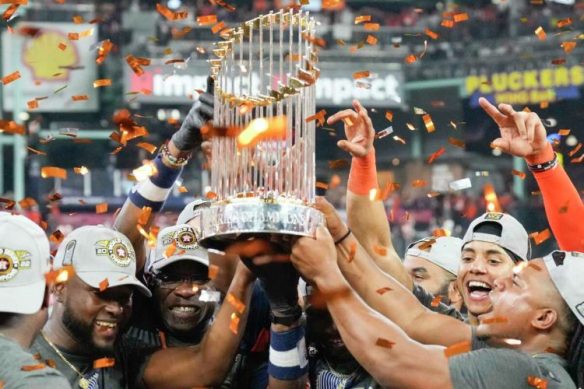
Astros manager Dusty Baker (second from left) joins his players—including Game Six starting pitcher Framber Valdez and World Series MVP Jeremy Peña (second from right), the first rookie to win that prize—hoisting the Series trophy after beating the Phillies 4-1 Saturday night.

If Jose Alvarado wants to find the nearest deep cave into which to make his residence until spring training, nobody should fault him. Not everyone can perform the impossible at will.

The Phillies’ redoubtable lefthanded reliever came into the bottom of the sixth of World Series Game Six with one key mission, take care of the Astros’ lefthanded munitions expert Yordan Alvarez with runners on the corners and one out. It might have been easier for Tom Thumb to scale the Empire State Building with a crosstown bus on his back.

This could have been construed as Phillies manager Rob Thomson believing he was still living a charmed life in his first two-thirds season on the bridge. Believing that a hard-won 1-0 Phillies lead could be kept in place or possibly enlarged the rest of the way.

Believing his righthanded starter Zack Wheeler wasn’t the right matchup for Alvarez looming with two occupied bases. Believing Alvarado would avoid the disaster into which he pitched when brought in for the same matchup in Game Five and hit Alvarez on the first pitch.

All Alvarez did now with a 2-1 pitch was send it over the farthest ledge behind center field, into some seats beneath a Blue Cross/Blue Shield advertising sign. All that did was sink the Phillies and yank the Astros to what they, and their fan base, needed in the worst way possible, a no-questions-asked, untainted World Series conquest.

Alvarado didn’t get beaten doing what he knew he wasn’t supposed to do. He didn’t get beaten serving a meatball without sauce. He got beaten throwing one of his best pitches, a nasty, shivering two-seam fastball, to a bomber who can and often does turn your best pitches into nuclear warheads no matter how they swivel up to the plate.

“Nothing moving. It didn’t move,” Alvarado said postgame. “If it moved, he had no chance. When he hit the ball, the sound says, ‘OK, that’s gone’. Because the guy is a power hitter. I watched it. But, again, sometimes you win, and sometimes you tip your cap.”

But Alvarado was wrong. The pitch moved enough. He got beaten by a hitter who moved his bat more than enough into it. Don’t condemn him. Don’t demand his post-haste measuring for a guillotine brace.

“[Y]ou’ve got Alvarado throwing 99 mph left-on-left sinkers,” Kyle Schwarber said. “And [Alvarez] ran into it and hit it out. Tip your cap. That’s a good hitter over there. I would take [Alvarado] on him any day of the week.”

Embrace Alvarado for having the guts to stare into the belly of the best a second straight World Series game and not run home to Mami at the very thought of it. A man with a regular-season 1.92 fielding-independent pitching rate earns more than a little respect.

Thomson may have some real explaining to do, though, as to why he kept Nick Castellanos—whose bat was as feeble as his glove had become a half-out-of-nowhere defensive weapon during the Series—batting behind Bryce Harper and, essentially, affording Harper as much protection as a tot with a pop gun offers a Brinks truck.

Just don’t be stupid enough to blame Alvarado for the Phillies’ inability to make Schwarber’s leadoff homer in the top of the sixth stick long enough to buy some insurance. Be better than that, this time, Phillie fan.

These upstart, self-resurrecting Phillies finally couldn’t hit what these Astro pitchers served them. They lunged at too many breakers instead of forcing them to come to their wheelhouses, they let too many fastballs elude them, and when they still had three innings left to overthrow the 4-1 Astro lead that stuck, they couldn’t and didn’t summon up enough.

Then give these Astros their due. Give them the credit they deserve for finally overcoming one World Series loss in which they won nothing at home, a second when they ran into a chain saw made in Atlanta, and the single worst cheating scandal in 21st century baseball, if not all baseball history.

Give these Astros the credit for playing untainted, un-sneaky, un-shifty (except on one or the other side of the infield here and there), unapologetically excellent baseball to beat these Phillies in six usually thrilling games.

Give them credit for making hash out of Commissioner Rube Goldberg’s more-cookies-for-everyone, three-wild-cards postseason array, not to mention defying the early-round upsets over the biggest-winning regular season teams, and living up to their 106 game-winning season where the 111 game-winning Dodgers couldn’t.

Give splended Astros rookie shortstop Jeremy Peña his props for earning both the Most Valuable Player Award of the American League Championship Series and the World Series (the first rook ever to win a Series MVP and a Gold Glove for his defense) and for damn near making Houston forget it ever had a fellow named Carlos Correa holding shortstop down.

Give center fielder Chas McCormick his props for running down what would have been J.T. Realmuto’s at-minimum eighth-inning double in Game Five and leaping to catch it before hitting the Citizens Bank Park scoreboard wall and landing in a heap on his back while leaving his imprint on the warning track and holding onto the ball like a life preserver.

Give Game Six starter Framber Valdez and the Astro bullpen their props for keeping the formerly vaunted Phillies offense—capable of turning games around in single swings until running into a no-hit wall in Game Four—from getting any ideas above and beyond The Schwarbinator’s liner into the right field seats.

And then give Astros manager Dusty Baker the biggest hug you’ve got to give for a man who’s been in this game fifty-four years as a player and manager, won a World Series ring as a player, had several postseason heartbreaks including World Series losses as a manager, and finally reached the Promised Land.

Baker really had to do this one the hard way. He took on the uphill job of managing a team riddled by the disgrace of Astrogate and their inability to speak entirely forthrightly about their 2017-18 cheating including about it being part of their 2017 Series triumph. It was comparable to Gerald Ford trying to clean up after the Nixon Administration’s Watergate mess.

But Ford lost the only presidential election for which he stood after that. Baker withstood the Astrogate heat, kept his head as the self-battered organisation turned itself and its Show roster over and away from the Astrogate stench, and brought his Israelites across the Jordan at last.

“Game Six has been my nightmare,” Baker told his team in the clubhouse after this Game Six. “I ain’t lying. I was like, damn that, man. We’re going to win today. I got Game Six off our ass, off my ass. We’ve got (Justin Verlander’s first credited World Series) win off his ass. And I’m telling you, you guys played your asses off. I didn’t have to do [poop].”

Baker and Game Sixes formerly meant disaster. 2002 World Series: he lifted starter Russ Ortiz with his Giants up 5-0 and ostentatiously handed Ortiz the “game ball.” The Angels thrashed back with three runs each in the next two innings, then ran away with Game Seven.

2003 National League Championship Series: Baker’s Cubs were five outs from going to the World Series when a double-play grounder bounded off his shortstop instead of turning two, opening the dam for a five-run Marlins rally and a Game Seven loss.

Game Six, last year’s World Series: Baker’s Astros didn’t incur anything close to those two disasters. The Braves made sure of that by shutting them out 7-0 to win the Series.

Now he couldn’t forget what his father told him after the 2002 deflation: “Man, after the way you lost that one, I don’t know if you’ll ever win another one.” Now, the son could be sanguine about the father’s fatalism.

“I was, like, I didn’t really want to get to Game Six again, but I was like, well, maybe this is how it’s supposed to be,” the son said Saturday night. “My dad didn’t mean anything negative . . . back in the old school, there was such thing as negative motivation. In the new school, negative motivation doesn’t work.”

No team had quite the negative motivation these otherwise filthy-dominant Astros have had since their 2017-18 cheating, which went above and beyond anything else devised and executed by teams past, exposing and staining them in the wake of their 2019 World Series loss.

It’s the black mark on a franchise that’s gone to six straight American League Championship Series and won four of them. A franchise that’s won two World Series titles over six years with a .622 winning percentage over those six regular seasons, something  almost never done, according to Hall of Fame writer Jayson Stark, by the greatest teams.

Not the Oakland Mustache Gang of the early 1970s. Not the Big Red Machine. Not the 1996-2002 Yankees. Not the Aughts’ Red Sox. Not the 2010s Giants. You’d have to go back to the 1953-58 Yankees—those of Hall of Famers Yogi Berra, Whitey Ford, Mickey Mantle, and manager Casey Stengel—to find one from the post-World War II era.

But guess what, ladies and gentlemen? Only three position players remained from the Astrogate teams. And they had almost nothing to do with the biggest of the big Series moments for these Astros and this manager. Air Yordan? Flying Jeremy? Tucker the Man and His Dream? Framber Valdez (is Coming)? Cristian (Soldier) Javier and his no-hit-opening oratorio? Every member of the bullpen that just rolled a Series ERA of 0.83? They didn’t show up until the Astrogate aftermath.

What the Astros needed most, said broadcast legend Bob Costas, himself a Frick Award winner thus enshrined in the Hall of Fame, was “to win outside the shadow of 2017 . . . ”

There will always be skeptics because of ’17. But they have now been a truly excellent team for a sustained period of time. I think fair-minded people already have put this in its proper context and proper proportion. So by winning again, especially with Dusty Baker as one of the faces of it, and five years removed from 2017, I think most people will have a fair sense of it.

Guess what else we can do now? We can put to bed forever all the talk over all the years about the long-suffering Baker’s “entitlement” to win a World Series at last.

It was both annoying as the day was long and absolutely unworthy of the man himself, the man who loved and encouraged all his players, from the last man on the roster to the cock of the walk, to exercise their abilities as they are, rather than as anyone else demanded, and was loved back by anyone who dealt with him over all those seasons.

Baker felt less “entitled” to anything than those who admire him and even criticise him when need be felt for him. Now he can put all that in a trunk, flashing one of his signature toothpick-punctuated grins, and lock it tight.

“After a while,” he said thoughtfully after Game Six, “I quit listening to folks telling me what I can’t do. All that does is motivate me more to do it because I know there’s a bunch of people in this country that are told the same thing, and it’s broken a lot of people. But my faith in God and my mom and dad always talking to me made me persevere even more.”

The 73-year-old man who once took too much blame for a few extraterrestrial calamities now didn’t give himself quite enough credit. There’s only so much Mom, Dad, and even God can do for a man, with a World Series or anything else.

“We’re going to play to the end”

Kyle Schwarber

Kyle Schwarber hitting his first-inning bomb off Justin Verlander in Game Five. “We’re going to play all the outs. We’re going to see where it takes us,” he says approaching Game Six. The “where,” of course, is up to Zack Wheeler and the Phillies against Framber Valdez again.

Approaching World Series Game Six, the Phillies could lean on the experience of one member who’d been there, done that, down 3-2 in a Series, then took the final two and the world championship. That was seven years ago, when he was a Cub, his season began (thanks to injury) in the World Series, and the Cubs finally did what seven-eighths of the earth thought wouldn’t happen in its lifetime.

“We’ve overcome a lot of things throughout the course of this year to be in this position,” said Phillies left fielder/bombardier/periodic base thief Kyle Schwarber as the Phillies traveled to Houston Friday. “I think when we get there, you’re going to see a really resilient club and we’re going to play until the very end and we’re going to see where it takes us.”

Funny, but that’s just about what every 2016 Cub said, too, when the then-Indians had them on the ropes with the Series returning to Cleveland for Games Six and Seven.

That was then: the Cubs pushed, shoved, pitched, and pounded their way through two arduous games. This is now: The Phillies, whose World Series drought is barely an eleventh of those Cubs’, will have to do all that plus rip, snarl, tear, slice, dice, and air fry. Just as when he was a 2016 Cub, the Schwarbinator won’t surrender, to these Astros or anyone else.

“It’s going to take everything,” said Schwarber, who did what he could to keep the Phillies from losing Game Five when he opened with a nasty home run off future Hall of Famer Justin Verlander in what proved a to-the-max 3-2 Phillies loss. “It’s going to take everyone. We’re excited. Trust me. Sure, it’s frustrating, but we’re also very excited.”

The Phillies are in a strange position this postseason. They enter Game Six with their first series deficit since they wrestled their way to the final National League wild card in the first place. Beyond that, they have reason not to fear. They’ve come back several times to get here in the first place.

Game One of the wild card set against the Cardinals? Down 2-0 in the top of the ninth. Then: bases-loaded hit batsman, two-run single, run-scoring infielder’s choice, RBI single, and a sacrifice fly, and two Cardinal runs in the bottom of the inning weren’t enough to deny the first win of a Phillie sweep.

Game Four, National League Championship Series? A four-run Padres first didn’t exactly bury them alive. Bottom of the first: Two-run homer (Rhys Hoskins), RBI double (Bryce Harper). Deficit cut to one. Bottom of the fourth: Tying RBI single. Bottom of the fifth, after Juan Soto put the Padres back up with a homer? Two-run homer (Hoskins, again), RBI double (Harper, again), RBI single, two-run Phillie lead. Bottom of the sixth: Solo bomb (Schwarber), three-run lead. Bottom of the seventh: Solo bomb (J.T. Realmuto), four-run lead, ultimately four-run win.

Game Five, NLCS? Call it the Mud and Guts Game if you must. Bottom of the third: Phillies take a 2-0 lead with another Hoskins two-run thump. Top of the fourth: Soto cuts the San Diego deficit in half with another solo smash. Top of the seventh, with the Citizens Bank Park rain turning the field into a swamp and pitching grips and strides into mush and mire? The Padres take a 3-2 lead with an RBI single and two wild pitches enabling a run. Bottom of the eighth? Harper fights and fouls his way to a dramatic opposite-field two-run homer. Two Phillies relievers make it stick for the pennant.

Game One, World Series? Kyle Tucker’s two bombs help the Astros bushwhack Aaron Nola in the first three innings. So the Phillies return the favour by ripping five out of Verlander—RBI single and immediate two-run double in the top of the fourth; two-run double in the top of the fifth. The score stays tied at five until Realmuto breaks it for keeps with a leadoff bomb in the top of the tenth, and David Robertson survives a double, a walk, a wild pitch for second and third, and gets the game and win-ending ground out.

All the Phillies need to do now is continue overcoming that nasty 0-for-20 with runners in scoring position until Jean Segura slapped an RBI single in the eighth in Game Five. They need Zack Wheeler to be his best self on the Game Six mound. They need to continue overthrowing their earlier reputation for defensive mishaps and cut the Astros off with more of the glovework and derring-do they began flashing during the Philadelphia leg of the Series.

They need, in other words, to be better than the best of their selves that pulled them into the Series and into the 2-1 Series lead the Astros wrested away from them on their own soil. Astros Game Six starter Framber Valdez, who manhandled them in Game Two, also in Houston, intends to let them do nothing of the sort.

“I think I’m just going to try to continue doing what I’ve been doing all season,” Valdez said through an interpreter after Game Five. “Just try and attack hitters early, try to breathe, try to stay calm, try to meditate. It’s something that’s really exciting. I think it’s something that really adds a lot to your career, and I’m really excited for this opportunity.”

It’ll add something to the Astros’ resume, too: their first untainted World Series rings. Not to mention handing their manager Dusty Baker—the man who steadied the Astro starship after it was strafed by the in-house phasers of Astrogate, keeping his gradually turning-over team playing through the aftermath, three seasons following its exposure, despite the organisation’s turmoil and grotesqueries—the first World Series triumph of his long and mostly distinguished managerial career.

The Astros know the Phillies won’t be simple pickings despite shutting them out back-to-back in Philadelphia, once with a combined no-hitter. It’s the Phillies’ job not to make things simple for the Astros.

“What a better storybook ending,” asked Castellanos, whose limp bat is almost forgotten when you’ve seen his defense turning into must-see television all of a sudden, “than if we can go there and win this in Game Seven?”

First things first, Schwarber would remind one and all.

“We’ve got a pretty good pitcher going for us in Game Six,” the Schwarbinator says. “We’ve got to be able to bounce back offensively. I don’t think anyone believes more in this group than we do. That’s going to be a big thing for us. We’ve just got to be able to play all the outs. We’re going to see where it takes us.”

First, it needs to take them past the Astros in Game Six. Then the Phillies can worry about who writes their storybook ending—the team of Roger Towne and Phil Dusenberry (who wrote the screenplay for The Natural); or, any given Astro, plus Jack Benny and Fred Allen, climaxing their long-running mock on-air feud while satirising the notorious weeper quiz show Queen for a Day:

Allen: An expert operating the Hoffman Pressing Machine will press your trousers
Benny: Now wait a minute! (Studio audience laughter and noise.) Now wait a minute, Allen!
Allen: Keep your shirt on, King!
Benny: You bet I’ll keep my shirt on!
Allen: All right, folks, tune in again next—
Benny: Come on, Allen, give me my pants!
Allen: Quiet, King!
Benny: Where are my pants?
Allen: Benny, for fifteen years I’ve been waiting to catch you like this.
Benny: Allen, you haven’t seen the end of me!
Allen: It won’t be long now!