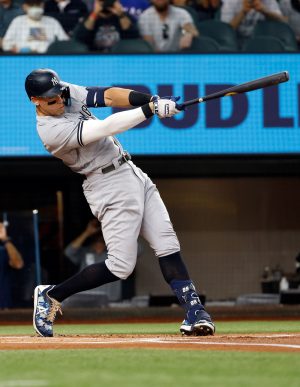
The Guards win an Óscar

Óscar González

Óscar Gonzáles about to send the Guardians to an AL division series . . . but did it have to be against a former Cleveland pitcher who’d served them long and well?

A Guardian kid leading off the longest scoreless game in the bottom of the fifteenth. Facing a former Guardian pitcher. The second pitch of the plate appearance disappearing and taking the Rays’ season with it.

One of seventeen to make major league debuts with the Guards this season, Óscar González hit eleven home runs on the way here. Now, he hit the most important one of his 24-year-old life Saturday afternoon to finish the Guardians’ shove of the Rays to one side in a two-game American League wild card sweep of opposites.

The whippersnappers upended their elders (the Rays’ average starting lineup age : 27; the Guards: 24) without caring how long it might take. If they could do it in a comparative Game One blink, sure. If they needed fifteen innings and shy of five hours to do it, neither they nor the sellout Progressive Field home crowd cared, either.

They made very short work (as in two hours and change) of the Rays in Game One. Then, they and the Rays threw the pitching kitchen sink at each other, just about, before Game Two reached the bottom of the fifteenth and Corey Kluber, former Guardian when they were still the Indians, went to work for a second inning’s relief.

It was his first relief gig in nine years. It turned out to be his last, thus far. And it wouldn’t be unfair to ponder whether Kluber might be beginning to think that someone, somewhere, placed a postseason hex upon his 36-year-old head. This was his fourth postseason tour that ended with him on the wrong side in elimination games in which he either started or appeared at all.

The last time Kluber turned up in the postseason, he wore Cleveland fatigues in 2018 and was bushwhacked by the Astros in the first of a three-game Houston division series sweep then, thanks to a fourth-inning leadoff bomb (Alex Bregman) and an RBI single, then back-to-back fifth inning-opening bombs (George Springer, Jose Altuve).

A year before that, Kluber faced the Yankees to decide another AL division series. The Yankees made shorter work of him then, with a third-inning two-run homer (Didi Gregorius) and four straight singles the final two of which plated a run each with one out in the fifth, en route the Yankees taking it in five.

A year before that, Kluber’s and the Indians’ World Series ended dramatically in that 8-7, late-rain disrupted Cubs win after a back and forth that might have tempted God Himself to proclaim a tie for the two then-longest World Series title droughts in the Show. And yet again Kluber started but was stripped of four runs that only began with Dexter Fowler sending the first-ever Game Seven-opening home run over the center field fence.

The two-time American League Cy Young Award winner has since struggled through injury-disrupted seasons in stops with the Rangers and the Yankees before spending 2022 working his way back to respectability with a respectable-enough 3.57 fielding-independent pitching rate.

But with one swing on a slightly-hanging cutter on 1-0, González sent Kluber’s newfound respectability and the end of the Rays’ fourth annual postseason trip in a row into the left field seats. He also sent Progressive Field nuclear while sending his young Guards to a division series date with the Yankees.

All season long the Guards’ rookie guard lifted heaviest carrying them to the American League Central title. The only question entering the wild card set was whether it’d be one of the kids or one of the few elders who’d get the big job done for them. Not that manager Terry Francona cared less, of courseI don’t think by that point we cared,” manager Terry Francona said.

“It could have been one of the old guys,” Francona said postgame after González’s blast. “We didn’t care. We’re not biased. I was happy that he hit it.”

“I flipped on the Guardians and game,” tweeted MLB Network researche Jessica Brand, “and first pitch Óscar González goes deep. I’m not sure I want that kind of power. Was kind of secretly relishing the goose egg farm.”

Well, somebody had to scramble those eggs sooner or later. For the longest time it looked as though neither side was necessarily that anxious to do anything other than pin the opposing lineups’ ears behind their heads and become human Electroluxes in the field.

Guardians pitching kept the Rays to six hits and Rays pitching kept the Guards to five. The Rays and the Guards used eight pitchers each, and the Guards blew a shot at smashing the scoreless tie a full game’s worth before González finally struck.

Myles Straw (who promptly stole second) and Rookie of the Year candidate Steven Kwan were handed back-to-back walks by Rays reliever Pete Fairbanks—relieving starter Tyler Glasnow—to open the bottom of the sixth. Somewhat tough on the Guards this year, Fairbanks unintentionally handed them a break when he called Rays manager Kevin Cash and a team trainer out to the mound.

“I can’t feel my hand,” Fairbanks is said to have told Cash. The team subsequently said the righthander’s index finger went numb for unknown reasons in the moment. Exit Fairbanks, enter Jason Adam, and ducks on the pond at once when Adam plunked last year’s Atlanta postseason hero Eddie Rosario on the first pitch.

Enter José Ramírez, the Guards’ All-Star third baseman. Exit Ramírez on strikes almost at once. And exit the Guards for the side when Josh Naylor grounded into a step-and-throw double play.

Ramirez more than made up for it in the twelfth, when he backhanded Manuel Margot’s hard hopper behind the pad, the momentum pulling him into foul territory, then whipped a long, low throw for which Naylor at first had to stretch to scoop, and he kept just enough of his foot on the pad to secure the out. The Rays challenged the play but lost.

Heavy sigh of relief from one end of Progressive to the other.

González might have had the most privately embarrassing moment of the night when his belt broke while sliding in the seventh. Lucky for him that first base coach Sandy Alomar, Jr. had a belt to spare. And lucky for the Guardians that González had a belt to spare opening the fifteenth inning.

But did it have to be against a Kluber who’d pitched long enough and well enough for Cleveland and its long-enough-deprived fans? A Kluber who’d given them everything he’d had, came up short, then came up injured enough to put paid to his Lake Erie days?

This is the guy who missed all 2019 after an arm fracture plus an abdomninal injury, had his 2020 option exercised by the then-Indians on Halloween 2019, then was traded to the Rangers a month and a half later in a delayed but somewhat shameful trick-or-treat. Then, Kluber returned in July 2020 as the pan-damn-ically delayed season began and lasted on inning before shoulder tightness proved a torn teres major muscle.

That sent him to the injured list and, in due course, to free agency, where he signed for a year with the Yankees for 2021, started a return to respectability including a no-hitter against the Rangers themselves, then lost another two months with another shoulder injury.

Kluber became a free agent again, signed with the Rays this year, and all seemed as right in his 36-year-old pitching world as he and anyone had a right to expect. He’s hardly the first to return to a postseason against one of his former teams, but he may be close to the top three for heartbreaks in such returns.

Those two Cy Young awards can’t help heal this one. And Cleveland cynics might amuse themselves thinking Kluber sent their team forward in their first year under a new name.

To such cynics, say only, “Don’t go there.” A franchise riddled with its own actual or alleged curses doesn’t need a Kluber Curse to throttle their exuberant and talented kid corps now. It would only destroy the magnitude of what González did Saturday afternoon, whether he did it against Corey Kluber or Clark Kent.

RBA: Judge’s a .764 batter this year.

Aaron Judge

Aaron Judge—Real Batting Average says there was a lot more to his 2022 than yanking Roger Maris to one side.

So Aaron Judge didn’t win the Triple Crown after all? Big deal. He pulled up short of passing Minnesota’s Luis Arraez for the “batting title.” When it comes to the batting number that should matter the absolute most—what I call a Real Batting Average (RBA)—the Leaning Tower of 161st Street did more than just bomb his way to the all-time American League single-season home run championship.

How does Judge being a .764 batter this year sound to you?

Judge bombed, slashed, swatted, and walked his way to an RBA 286 points higher than the Twins’ infielder did. It isn’t even close. He did likewise to the tune of 256 points higher than Jeff McNeil, the Mets’ infielder/outfielder who finished as the National League’s “batting champion.”

“Purists” seeing that and jumping up and down kicking, screaming, and throwing things, sit down and listen up.

I’ve argued this before, and I’ll die upon this hill: The so-called “batting average” is a fraud. It treats all of a player’s hits as equal, and the so-called “batting champion” needs a) a minimum number of plate appearances to qualify for the title despite b) the so-called “batting average” being calculated strictly by hits divided by official at-bats. From this point forward, any reference to it will be called hitting average.

Getting lots of hits is wonderful. Freddie Freeman led this year’s offense-challenged Show with 199. (The Show’s earned run average and fielding-independent pitching were each under four.) He also finished one point below National League hitting average-leading Jeff McNeil (Mets). You’re also going to see Real Batting Average saying Freeman was light years better than McNeil at the plate this year.

Why on earth should you give shrift to a statistic that thinks every hit you got was equal value? There’s only one reason: you think a single is as good as a double, a double’s as good as a triple, a triple’s as good as a home run. You don’t even have to pass third-grade math to see that and know it’s about as credible as a 70-dollar bill.

A few years ago, I reminded myself that total bases treats your hits the way they deserve to be treated—unequally. Let’s use Judge to explain. He had 177 hits this season and they were good for 391 total bases. He had 87 singles, 28 doubles, no triples, and 62 home runs. (Notice that almost exactly half his hits were singles, you who still dismiss him as just another all-or-nothing slugger.)

That’s 87 bases on singles, 56 on doubles, and 248 on his record-smashing home runs. Add them up. It’s 391. It’s a shame that his walks don’t count toward total bases, the way they do toward his on-base percentage (for 2022, it’s .425) because that would make his 2022 total bases 402.

The RBA formula I developed, seeking a way to explain a batter’s value simpler than weighted runs created (wRC), simple enough for a child of five or an old fart of 95 to comprehend, is as follows: Total bases + walks + intentional walks + sacrifice flies + hit by pitches, divided by total plate appearances. If you’d like to see it again in a non-intimidating mathematic formula, here it is:

TB + BB + IBB + SF + HBP
PA

The old/ancient school looked upon walks as either accidents or detriments, not stopping to ponder that a batter working out a walk if he couldn’t find something reasonable on which to swing was actually exercising a skill profound enough. Time was when observers kvetched about even the greatest hitters taking “too many” walks on too many “hittable” pitches, without asking themselves how hittable those pitches really could have been.

But why single intentional walks out, too, when calculating an RBA? Aren’t they part of the walk total for the season? Well, yes, to the latter. To the former, the answer is simple: If you’re at the plate, and the other guys would rather you take your base than their pitcher’s head off, why should you not get credit for it? There’s something they don’t want to deal with when they can deal with a lesser bat behind you to try doing the clutch hitting. To that, RBA says, basically, yay, you.

Yes, sacrifice flies are outs. But unlike sacrifice bunts, they’re not premeditated outs. You didn’t check in at the plate to make a deliberate out, which is the very definition of a sacrifice bunt. (Do I have to say it again? In four out of six “bunt situations” you have less chance of scoring the player you “sacrificed” ahead a base after the bunt than before it; in one, you have an even chance; in only one more—first and second, nobody out—do you have a slightly better chance.)

You checked in at the plate looking for a base hit. You didn’t think to yourself, “Boy, am I gonna put a thrill into those people in the stands by flying out deep.” (Well, you might, if the fly ball carries all the way to the fence.) But your fly out was deep enough to send that man on third home. You get credit for a run batted in but otherwise it’s as though you didn’t exist at the plate, because a sacrifice fly is counted no further as an at-bat than a walk. RBA says to a walk and a sacrifice fly: We know you were at the plate, that wasn’t a figment of our imagination. You’re going to get the credit you deserve for it.

Shohei Othani

Top ten in RBA; sub-3.00 ERA and FIP plus 11.9 K/9 on the mound. At $30 million for next year, Shohei Ohtani might still be underpaid . . .

We also know that, unless you’re Ron Hunt or Hall of Famer Craig Biggio, you weren’t up there looking to get hit by a pitch. But if the other guys’ pitcher is careless enough, control-less enough, or headhunting enough to plunk you, RBA’s going to give you credit for it—because you reached base. That’s another prospective run on the scoreboard. You might have preferred drilling a hole in the infield, putting a dent in the fence, or dialing the Delta Quadrant, but you became a baserunner on their dollar. Let it be to your credit and on their heads.

On the assumption that I haven’t lost you, or prompted you to send the Cuckoo’s Nest Coach to my driveway yet, what follows are this year’s top forty “batting title” qualifiers across the Show board according to Real Batting Average. Those with .300 or better hitting averages are marked with (*). (If you must throw things, please throw them through an open window facing your backyard, not with your spouse, your significant other, your children, or other family or friends in the line of fire.)

Player PA TB BB IBB SF HBP RBA
Aaron Judge (Yankees) * 696 391 111 19 5 6 .764
Starling Marte (Mets) 505 218 97 26 0 13 .701
Yordan Alvarez (Astros) * 561 288 78 9 7 6 .692
Rafael Devers (Red Sox) 555 289 50 11 3 6 .647
Paul Goldschmidt (Cardinals) * 651 324 79 1 4 5 .641
Jose Ramirez (Guardians) 685 309 69 20 9 6 .603
Pete Alonso (Mets) 685 309 67 16 9 12 .603
Shohei Ohtani (Angels) 666 304 72 14 3 5 .598
Jose Altuve (Astros) * 604 281 66 2 1 10 .596
Freddie Freeman (Dodgers) * 708 313 84 12 7 5 .595
Manny Machado (Padres) 644 307 63 10 2 1 .595
Nolan Arenado (Cardinals) 620 297 52 3 4 7 .585
Austin Riley (Braves) 693 325 57 1 4 17 .583
Julio Rodriguez (Mariners) 560 260 40 4 1 8 .559
Vladimir Gurrero, Jr. (Blue Jays) 706 306 58 6 4 6 .538
Taylor Ward (Angels) 564 234 60 0 5 4 .537
Nathaniel Lowe (Rangers) * 645 292 48 2 0 4 .536
J.T. Realmuto (Phillies) 562 241 41 1 5 12 .534
Carlos Correa (Twins) 590 244 61 2 4 3 .532
Andres Gimenez (Guardians) 557 229 34 4 3 25 .530
Xander Bogaerts (Red Sox) * 631 254 57 2 7 10 .523
Yandy Díaz (Rays) 558 200 78 2 1 6 .514
José Abreu (White Sox) * 679 268 62 2 4 12 .513
Jeff McNeil (Mets) * 589 242 40 1 5 11 .508
Justin Turner (Dodgers) 532 205 50 1 8 6 .508
Trea Turner (Dodgers) 708 304 45 1 6 3 .507
Brandon Nimmo (Mets) 673 251 71 0 3 16 .507
J.D. Martinez (Red Sox) 596 239 52 1 5 5 .507
Bo Bichette (Blue Jays) 697 306 41 0 2 2 .504
Ty France (Mariners) 613 241 35 3 5 21 .498
Alejandro Kirk (Blue Jays) 541 195 63 2 4 4 .495
Dansby Swanson (Braves) 696 286 49 0 4 3 .491
Luis Arraez (Twins) * 603 230 50 2 3 3 .478
Steven Kwan (Guardians) 638 225 62 2 4 7 .470
Andrew Benintendi (KC/Yanks) * 521 184 52 0 5 2 .466
Nico Hoerner (Cubs) 517 197 28 4 2 6 .458
Alex Verdugo (Red Sox) 644 240 42 2 6 3 .455
Alec Bohm (Phillies) 631 233 31 1 10 4 .442
Amed Rosario (Guardians) 670 257 25 0 4 4 .433
MLB RBA .456

What probably doesn’t surprise you: the top ten guys for RBA this season. What might come a little more clear to you: just how much the Mets really missed Starling Marte—the National League’s RBA champion this year—in the lineup for most of September and most of this month so far with that finger injury, especially when the Mets couldn’t muster offense enough to overthrow the Braves last weekend.

What might surprise you a little bit: Matt Olson didn’t get anywhere near the top forty for hitting average, but his .548 RBA shakes out as 47 points lower than the guy the Braves let walk as a free agent right before dealing for him. I’m not convinced yet that the Braves got the better end of letting longtime franchise face Freddie Freeman walk into the Dodgers’ arms. (The Braves also won ten fewer than the 111 game-winning Dodgers did.)

What might jolt you a little bit more: The Guardians and the Mets (four each) have more men in that RBA top forty than anyone else this season.

What might jolt you a little bit more than that: A certain unicorn finished in the top ten for RBA in the same season during which he posted an 11.9 strikeout-per-nine rate, a 4.98 strikeout-to-walk ratio, a 2.33 earned run average, and a 2.40 fielding-independent pitching rate. That helped him earn an American League-leading 9.0 total wins above a replacement-level (WAR) player for the year. Across the board, that was second only to Judge’s 10.6.

Shohei Ohtani finished eighth for RBA among the top forty hitting titles and had a pitching season that might be a Cy Young Award season in a different year. He ducked offseason arbitration by signing a one-year 2023 deal for $30 million. He might still be getting underpaid.

And, what of his future Hall of Famer teammate Mike Trout? Well, now. Trout missed a third of the season on the injured list. And he still finished the year with 6.3 WAR (an All-Star-worthy season level), 40 home runs, an OPS one point shy of 1.000 . . . and a .691 RBA. (If he’d qualified in the “batting title” race, Trout would have finished one tick behind Alvarez.)

This ought to tell you why the best news for Angel fans this year—other than Shohtime; other than Trout returning down the stretch of a race out of which the team fell eons earlier—was the news that owner Arte Moreno (who learned and showed all others the hard way that marketing genius doesn’t equal team-building savvy) intends to sell the franchise.

Depending on the eventual buyer, Angel fans may feel the way Met fans did upon the end of the Wilpon Era. It would only begin with those fans singing “Happy Days are Here Again.”

Meanwhile, the Leaning Tower of 161st Street towers over all in this year’s RBA. Judge was so much more than just Roger Maris’s conqueror, but there isn’t a jury on earth who’d rule his 62 home runs anything less than the individual story of the season. With future Hall of Famer Albert Pujols—revived by the advent of the designated hitter in the National League, managed prudently by Oliver Marmol in St. Louis, and finishing the season with 703 home runs lifetime—tied with his former Angel teammate Ohtani for an extremely close second.

If you find a panel that would rule that way, you ought to demand an investigation into jury tampering.

Summary Judgement: 62 in ’22

Aaron Judge

“I think it won’t sink in until the offseason.—Aaron Judge became the AL’s new single-season home run king at last Tuesday night in Texas.

Maybe Aaron Judge should be playing things like the stock market. Without making as grand a show of things as observers paid to be so grand (and perhaps foolish), he gambled early that he could turn his first walk year into something big when he achieves his first free agency.

He probably didn’t think he’d smash a longstanding American League home run record along the way. Certainly not in a season in which hitting across the major league board was at one of its lowest levels in the professional game’s history, and he could never be certain he’d get a miniature medicine ball or a turbocharged orb to launch.

But smash it Judge did Tuesday night. In the second game of a doubleheader in Texas. If you’re going to slam the season’s biggest exclamation point down but you can’t do it in front of the home audience, there are few places bigger than there to do it.

Batting leadoff for the 106th time at all this year, and batting first in the lineup for the 34th time, Judge squared up Rangers righthander Jesus Tinoco’s slightly hanging slider on 1-1 and drove it parabolically several rows up the lower left field seats. Even the Globe Life Field audience couldn’t contain their pleasure in seeing the Leaning Tower of 161st Street make American League history.

Almost a full week after he met Roger Maris, with the Yankees having banked the AL East title in the same week, the tall swinger from California passed the comparatively compact swatter from the Dakotas. And unlike Maris’s abusively unfair experience in 1961, Judge got there with almost universal approval from the moment it looked as though he had a serious shot at getting there.

There was nothing unfair about Judge’s achievement, unless you count that this is a young man to whom you can throw a ball of Play-Doh and he can still hit it across the county line. Tinoco had never faced Judge before and had only surrendered one home run in 19.2 innings work on the season before Judge rang his and history’s bells.

“We knew it was going to happen and nobody wants to give it up,” said Tinoco—a reliever but pitching as the Rangers’ second-game opener Tuesday night, “but it’s part of the game. I challenged him and he hit it. That’s my job. All I can say is ‘congratulations’ to him.”

“I know he has a nasty sinker and a nasty slider,” said Judge postgame. “We were kind of waiting to hear who the starter of Game Two was gonna be. When I heard it was him, I saw what he did the night before and I said, ‘This isn’t a good matchup to start the game off with a guy with high velocity like that and a good off-speed pitch.’ So going into it, I think that helped me relax: ‘Hey, this is a good pitcher. Let me go up there and let’s see what happens’.”

Maybe he pressed a little too much between home runs 61 and 62. Maybe the opposition pressed a little hard trying to pitch around him until Tinoco’s slider didn’t slide enough. Maybe, too, Judge clung just hard enough to his insistence that, sure, it’d be great to do it, but he had more important things such as postseason prep to think about.

But maybe even this still-boyish looking galoot, who softens the most when interacting with the children who like and admire him while maintaining his privacy otherwise without an ostentatious harrumph, wanted the record so badly he could taste it even up with whatever he’d had for a meal before and after his long day’s work of play Tuesday.

The Yankees won the first of the twin bill without Judge going long. They ended up losing 3-2 in the nightcap Judge opened so historically, before he was given the rest of the night off by manager Aaron Boone, following a second-inning strikeout, and a double switch of second baseman Oswaldo Cabrera to Judge’s position in right field, shortstop Oswald Peraza to second, and Isiah Kiner-Falefa out to play short.

A few hours after the second game ended, and he’d run the gamut of reporters and well-wishers, Judge reportedly found some quiet in the clubhouse until a small voice reached his ears. Asking who was there, Judge then found himself spending a little time with Yankee catcher Jose Trevino’s little son, Josiah.

The gentle giant who helped make a Toronto kid’s week, after seeing the kid in tears of joy when an adult Blue Jays fan handed him a ball Judge sent into the Rogers Centre upper deck in May, spends as much time entertaining his teammates’ kids as he does entertaining fans in the stands with blasts past the ionosphere.

It may not yet have hit him completely that he’d claimed one of the most sacred pages in the AL record book for his own. And it may take the length of the postseason, however long the Yankees prove to stay there, before it does.

“In my book,” the Leaning Tower of 161st Street said after the second doubleheader game, “it’s just another day. I wish we would have gotten the win, that would have made it a little sweeter I think. But I’m going to try to soak it in, soak in the moment with my family, and get ready for the game tomorrow. I think it won’t sink in until the offseason.”

That’s his story and he’s sticking to it. Even through his very visible effort to suppress his patented big snaggle-tooth grin as he rounded first heading for second. Even with his teammates swarming from the dugout starting about two seconds after he dropped his bat to run the bomb out. Even with his wife, Samantha Bracksieck, and his parents, Wayne and Patty Judge, leading the loud ovation.

“We just wanted it to happen so bad,” said Yankee pitcher Gerrit Cole postgame. “I don’t know if that’s pressing, or just hoping hard. We were all just hoping really hard, I think.”

Maris’s 1961 teammates pressed just as hard for him to make it once Mickey Mantle fell out of that unwarrantedly-controversial chase with a hip abscess. But they were almost alone there. Thanks to a capricious conflicted-of-interest commissioner, and a particularly nasty contingency in the baseball press of the time, Maris was denied his due for driving a baseball idol (some think sacred cow) to one side.

Judge has tried to sustain his sense of proportion throughout the entire run. Maybe come the postseason he and his wife will kick their shoes off and romp and play in wild celebration. First, he has his sixth postseason in as many seasons of being a Yankee to play.

Maris, a refugee from the then-Indians and the Kansas City Athletics, and the AL’s defending Most Valuable Player while he was at it, was en route his second consecutive World Series in a Yankee uniform. They lost a seven-game heartbreaker to the Pirates in 1960 but won a five-game laugher against the upstart Reds in 1961.

For daring to challenge and pass the Sacred Babe, Maris was battered unconscionably in ways that would be called child abuse if done by a parent to a child.

“At the plate, he heard obscene abuse from the creeps who think that a ticket to the game entitles them to horsewhip the entertainers,” wrote sportswriting legend Red Smith, then still with the New York Herald-Tribune.

Off the field he was badgered ceaselessly by fans, the press, radio-TV, press agents, promoters. Only on rare occasions did this quiet, candid young man let his temper slip, and then it was due to some especially outrageous question or repeated references to “pressure,” with the implication that he was choking up.

Some social media idiots thought and said the same about Judge as he laboured almost that full week to get from 61 to 62. For those who care about incompetent irrelevancy, let it be recorded that it took Judge two fewer plate appearances to hit 62 than it took Maris to hit 61.

Milton Gross of the New York Post, perhaps the only other writer in New York unwilling to even think about trying to beat Maris into submission or worse, had dinner with Maris and his wife plus their closest New York friends, Julie and Selma Isaacson, the evening that followed Maris’s money blast. When Isaacson toasted Maris, Gross wrote, Maris thanked him but added: “This was the greatest experience of my life. It has to be, but I wouldn’t want to go through it again for anything.”

Soon afterward, a teenage girl approached Maris politely for an autograph and asked him likewise to include the date. “What is today’s date?” Maris asked. Isaacson chimed in at once: “The date is the one you did what nobody else ever did.”

On 4 October 2022—65 years to the day after Sputnik launched the space race—the Leaning Tower of 161st Street did what nobody else in the American League ever did. You could hear Ruth and Maris together in the Elysian Fields, clinking glasses and quaffing a cold one in praise.

“I’d trade my past for his future,” the Babe must have said, knowing that Judge blasted himself toward a payday that might come close to equaling the U.S. Department of Defense’s annual budget.

“I’d trade your past for his future, too,” Maris must have cracked. “His future, and two stock splits to be named later.”

Genius playing with mental blocks?

Tony La Russa

Hall of Fame manager Tony La Russa has announced his retirement. His pacemaker put paid to his second term on the White Sox bridge. Will that term tarnish his legacy?

With Tony La Russa’s second retirement now a done deal, retrospectives of both the career that put him in the Hall of Fame and the second act that tarnished his reputation only somewhat abound. White Sox owner Jerry Reinsdorf wanted to atone for firing La Russa the first time around, in 1986, but it’s fair to say what began with intrigue devolved to sorrow despite a successful 2021 but enhanced by a 2022 disaster.

I wrote of La Russa’s earliest mishaps in his second act last year. I republish much of that essay here, with a few adjustments befitting the present occasion, and wish him well as he steps away for the second and final time. 

No baseball manager is a perfect specimen, whether he lucks into the job, performs it long enough and well enough, or gets himself elected to the Hall of Fame because of his actual or reputed job performance. Many have been the managers whose reputations for genius are out of proportion to their actual performances.

Even the certified geniuses made their mistakes. Maybe none was more truly egregious than Casey Stengel’s failure to set up his rotation so his Hall of Fame lefthander Whitey Ford could start three 1960 World Series games instead of two. Unless it was Tommy Lasorda deciding it was safe to let Tom Niedenfeuer pitch to Jack Clark, with first base open and the Dodgers one out from forcing a seventh 1985 National League Championship Series game.

Maybe it was Dick Williams, placing public perception ahead of baseball to start gassed ace Jim Lonborg instead of a better-rested arm in Game Seven, 1967 World Series. Unless it was Gene Mauch, the Little General panicking down the 1964 stretch (with the Phillies, using his two best pitchers on too-short rest and blowing a pennant he had in the bank), or in Game Five (with the Angels) when he was an out away from winning the 1986 American League Championship Series.

Regardless of his foibles since what proved his first retirement, Tony La Russa still has an outsize reputation as one of the most deft ever to hold the manager’s job. He’s been called a genius. He’s been called one of the smartest baseball men of the last half-century. They point to his Hall of Fame plaque, the 33 years he managed prior to returning to the White Sox last season, eleven division titles, six pennants, and three World Series rings.

Those plus his longtime reputation for volumnious pre- and post-game thinking and analysis (observed perhaps most deeply in a chapter of George F. Will’s Men at Work: The Craft of Baseball) still allow La Russa absolution from his most egregious errors.

He threw his early 2021 White Sox star Yermin Mercedes under the proverbial bus, and maybe even invited the Twins to retaliate the following day, after Mercedes swung on 3-0 (violating La Russa’s fealty to the Sacred Unwritten Rules) in the eighth inning of a White Sox blowout, and hit a home run . . . off a middle infielder sent to the mound.

La Russa is still considered one of the smartest of the Smart Guys whatever they think of Mercedes’s homer or La Russa’s definition of “sportsmanship.” They don’t always stop to ponder what La Russa thought of the Twins’s “sportsmanship” in giving up the ghost with two innings left to close even a fat deficit and sending a position player to the mound with real pitching still available to them.

Perhaps they haven’t read Keith Law, writing in The Inside Game in 2020: “Sometimes you do all the right things and are stymied by bad luck. Other times you do everything wrong and are subsequently rewarded for it. That’s outcome bias.” There’s a case to be made that La Russa’s reputation, and maybe even his Hall of Fame case, is a little more than half a product of such outcome bias.

It’s hard to argue against a manager with three decades plus on his resume plus those division titles, pennants, and three Series rings. But maybe it’s easy to forget or dismiss how often La Russa either outsmarted or short-sighted himself when the games meant the absolute most.

“Tony, stop thinking,” Thomas Boswell wrote, after La Russa’s Athletics were swept out of a 1990 Series they could have tied in four and gone on to win, instead of being swept by a band of Reds upstarts who didn’t know the meaning of the words “shrink under pressure.”

If the A’s had picked an usher at random to manage them in this Series, they’d have been better. The usher would have brought in [Hall of Fame reliever Dennis] Eckersley to start the eighth inning of Game Two with a 4-3 lead. The usher would have brought in Eckersley to start the eighth inning of Game Four with a 1-0 lead. And this Series would be two-all.

La Russa could write a book on why did he did what he did. But the bottom line is that every manager in the Hall of Fame would have brought in the Eck. Twice Tony didn’t and twice the A’s lost. This time, the goat’s horns stop at the top.

Outcome bias didn’t help La Russa then, a year after he’d won his first Series. But it sure helped him after a 2011 Series he won despite himself. Because smart baseball men don’t do even half of what La Russa did to make life that much tougher for his Cardinals than it should have been.

Smart baseball men don’t take the bats out of the hands of future Hall of Famers with Game One tied at zero. La Russa took it out of Hall of Famer-in-waiting Albert Pujols’s hands by ordering Jon Jay to sacrifice Rafael Furcal, guaranteeing the Rangers wouldn’t let Pujols swing even with a swimming pool noodle, walking him on the house. (The next batter got lured into dialing Area Code 5-4-3.)

Smart baseball men don’t lift better clutch hitters (especially those shaking out as Series MVPs) with late single-run leads for defensive replacements who might have to try a lot harder to do the later clutch hitting with insurance runs to be cashed in—and fail. La Russa did that lifting David Freese (after he scored a single tiebreaking run) for Daniel Descalso (grounded out with two in the eighth) in Game Two.

Smart baseball men don’t balk when their closers surrender two soft hits in the Game Two ninth with a groin-hobbled bopper due up and a double play possibility very distinct. La Russa balked. He lifted Jason Motte for Arthur Rhodes with Josh Hamilton coming up. Rhodes gave the lead away and Lance Lynn gave the game away—on back-to-back sacrifice flies.

Smart baseball men don’t look past three powerfully viable and available bullpen options with their teams down a mere 1-0 and reach for . . . a known mop-up man, with the opposition’s hottest Series bat due up. La Russa learned or re-learned the hard way in Game Four. Mike Napoli thanked him for offering Mitchell Boggs as the sacrificial lamb—Napoli hit the first pitch for a three-run homer. (Final score: Rangers 4, Cardinals 0.)

Smart baseball men don’t snooze for even a moment and forget to flash the red light when their batter (Pujols, in this case) signals their baserunner Allen Craig to try for a steal in the Game Five seventh. Craig got arrested by half a mile, inviting another free pass to the bopper and—following a base hit setting up second and third when the batter advances on the throw to third—another free pass and an inning-ending fly out.

Smart baseball men also don’t let a little (ok, a lot of) crowd noise interfere with getting the pen men up that he wants to get up in the bottom of the Game Five eighth—after ordering one relief pitcher tough on righthanded hitters to put a righthanded hitter aboard on the house, instead of getting the second out—then try sneaking a lefthanded pen man past a righthanded danger who sneaks what proves a game-winning two-run double.

They don’t try to make the Case of the Tangled Telephone out of it, either, after they end up bringing in the wrong man when nobody claimed to hear them ordering the guy they really wanted to get ready. (La Russa wanted Motte but got Lynn. Oops.)

Neither do smart baseball men drain their benches in the eighth of even a do-or-die Game Six. La Russa did. It compelled his Cardinals to perform their still-mythologised ninth and tenth inning feats of down-to-their-final-strike derring-do without a safety net beneath them. Freese took one and all off the hook with his eleventh-inning, full-count, game-winning, Richter scale-busting leadoff bomb.

The Cardinals won that Series despite their skipper. (And, because they pinned the Rangers in Game Seven, after allowing a 2-0 first-inning lead on back-to-back RBI doubles. They made it impossible for La Russa to overthink/mis-think/mal-think again after they tied in the bottom of the first and scored four more from there.) La Russa was thatclose to blowing a Series his Rangers counterpart sometimes seemed to do everything within reach to hand him.

Fairness: La Russa did plenty right and smart winning those division titles. He did plenty right and smart winning the 2006 Series in five. (It didn’t hurt that he knew what he had turning his resident pest/Series MVP David Eckstein loose.) That was two years after nobody could have stopped the Red Sox steamroller from plowing the Cardinals in four, following their self-yank back from the dead to take the last four ALCS games from the Empire Emeritus.

But the 2011 Series got La Russa compared in the long term to . . . Bob Brenly, the Diamondbacks manager who won the 2001 World Series in spite of his own mistakes, too. Batting his worst on-base percentage man leadoff; ordering bunts ahead of and thus neutralising his best power threat; overworking and misusing his tough but sensitive closer, even throwing him out a second straight night after the lad threw 61 relief pitches the night before. (You’re still surprised Scott Brosius faced a gassed Byung-Hyun Kim and tied Game Five with a home run?)

Lucky for Brenly that he had one Hall of Fame pitcher (Randy Johnson) and another should-have-been Hall of Fame pitcher (Curt Schilling, his own worst enemy) to bail him out. Brenly hasn’t managed again since the Diamondbacks fired him during a 2004 skid to the bottom of the National League West.

When La Russa retired three days after that 2011 Series ended, he didn’t announce it until after the Cardinals’ championship parade and after he called a meeting with his players. “Some grown men cried,” he said of the meeting, adding, “I kind of liked that because they made me cry a few times.”

The smartest men in baseball with even half La Russa’s experience don’t invite comparisons to comparative newcomers who trip, tumble, and pratfall their way to World Series rings. Three Series rings kept him a Hall of Fame beneficiary of the outcome bias Law described. New York City mayoral legend Fiorello H. La Guardia liked to say, “When I make a mistake, it’s a beaut.” La Russa could say the same thing, plausibly, about a fair number of his own mistakes.

That outcome bias probably kept La Russa cushioned with the White Sox for the time being, despite his early tactical mistakes. And, despite the perception the Mercedes incident left that he’d rather burn his players in the public eye than handle real or alleged issues the mature way. (Name one manager who ever invited the other guys to retaliate for a real or alleged rookie mistake.)

What made La Russa a Hall of Famer—his long-time, widely-analysed, widely-discussed ability to think ahead, to know each man on his roster and handle them as individuals without losing the team, his ability to sense and out-think his managerial opponent—was almost eroded by what ESPN’s Buster Olney calls his “own surprising decisions—including, on multiple occasions, to order intentional walks to hitters despite the fact that White Sox pitchers were ahead in the count—fuel[ing] the narrative that La Russa was the wrong manager for the team. La Russa strongly defended his choices, sometimes sounding defensive, but even some of his peers found the two-strike intentional walks indefensible.”

Last year’s White Sox scored a division title under La Russa’s hand. This year’s White Sox were done in by a slow start and rash of injuries neither of which were their skipper’s fault, but two-strike free passes were only a portion of the in-game La Russa decisions that fell under fire.

This was far, far from the years during which La Russa’s handle on matchups, on the thinkings of opposing managers, on handling a bullpen reasonably, made him a Hall of Fame skipper even with the aforesaid head-scratchers. The years that made him the third-winningest-ever major league manager and a four-time Manager of the Year winner.

Issues with his pacemaker finally took La Russa out of the game again at August’s end. But La Russa seems to know his day is done at last. (Formerly, he’d hoped to manage through the end of his contract at next season’s end.) His statement announcing his retirement isolates it:

Our team’s record this season is the final reality. It is an unacceptable disappointment. There were some pluses, but too many minuses. In the major leagues, you either do or you don’t. Explanations come across as excuses. Respect and trust demand accountability, and during my managerial career, I understood that the ultimate responsibility for each minus belongs to the manager. I was hired to provide positive, difference-making leadership and support. Our record is proof. I did not do my job.

As daring as it was for La Russa to come out of retirement for a final try, never mind that nobody in baseball but Reinsdorf clamoured for it, it’s admirable that he leaves holding himself to the very accountability he describes. We can think of times and places when it wasn’t so, of course. But maybe La Russa, too, isn’t quite too old to learn.

Here’s another nice Mess they’ve gotten themselves into

Jacob deGrom

Surrendering three solo homers despite an eleven-strikeout/no-walk outing hurt Jacob deGrom less than his Mets mustering little offense in return against the Braves Friday night.

There was supposed to be a weekend showdown in the National League East. Its two best teams, each gunning to take the division, were going to shoot it out for slightly more than the division title but for the possible final setup of the postseason picture under Commissioner Pepperwinkle’s mad-scientist changes.

The Braves and the Mets are going to the postseason. No questions asked. But after their bats came up far too short in the first two at Truist Park, Sunday is both must-see television and must-win for the Mets, if they want a shot at winning the division with a record equal to the Braves.

They let the Braves get to them twice on Friday and Saturday. They couldn’t overcome the three solo home runs torn out of an otherwise effective Jacob deGrom Friday or the two bombs and four runs torn out of Max Scherzer Saturday. They couldn’t find ways to score more than two Friday and Saturday each off a Braves pitching staff that can pitch up with anyone else and with them when needed absolutely.

Now the Mets have to hope their Starling Marte-less lineup can find more than a few ways to pry some runs out of the Braves while riding Chris Bassitt on the mound Sunday. Bassitt, a good but not great pitcher, whose 3.55 fielding-independent pitching rate is respectable but nowhere in the deGrom (2.14) or Scherzer (2.62) league. Bassitt, who’s more prone to the long ball than either of the ones who got reached so far this weekend.

The Braves don’t rely on two particular pitchers almost exclusively and have up and down the line balance. The Mets built themselves to sail aboard deGrom and Scherzer primarily. They didn’t exactly change that plan despite losing both to health issues for critical portions of the season. When that bit them in the posterior Friday and Saturday, the Braves were only too happy to exploit.

“To get the first one is huge,” said Braves third baseman Austin Riley after Friday’s game, “and just try to build as much momentum off it as possible. To come out fighting and top to bottom did a great job. Arms did great. Just a solid win.”

Riley had a big hand in it. He hit the first of a pair of back-to-back bombs against deGrom in the second, joining Matt Olson for the honours. Nobody went back-to-back long distance against deGrom since former Braves Freddie Freeman and Josh Donaldson did it in 2019.

DeGrom rehorsed almost at once and kept the Braves quiet until he struck Ronald Acuña, Jr. out to open the bottom of the sixth. Dansby Swanson then hit a first-pitch fastball over the center field wall. But Max Fried and three Atlanta bulls kept the Mets quiet other than Tomas Nido’s solo bomb off A.J. Minter in the eighth.

Kenley Jansen came on in the ninth and got himself into the kind of jam the Mets usually turn into disaster. Francisco Lindor opened by striking out but Jansen plunked Mark Canha, surrendered a base hit to Jeff McNeil for first and third, then walked Eduardo Escobar to load the pads with just one out.

But then Mets manager Buck Showalter let rookie call-up Francisco Álvarez bat instead of reaching for a more experienced bench hand. The rook struck out on three swinging pitches. Then Tyler Naquin fought Jansen to an eight-pitch, six-foul draw before Jansen finally struck him out to end it, 5-2.

Only after the game, too, did deGrom acknowledge he was pitching with a hand blister. Never using it to excuse the evening, the righthander said he and the team would monitor it closely.

Come Saturday, it was Scherzer’s turn. He was still “managing” an oblique issue that prompted the Mets to close him down for much of September. Swanson and Olson managed to go long against him, Swanson with a two-run shot in the fifth and Olson with a leadoff solo in the sixth.

“I felt like mechanically I was working east-west and me I want to work north-south,” Max the Knife said postgame. “I didn’t feel like I had good put-away pitches. I didn’t feel like my two-strike pitches tonight were as sharp as I usually have them. When I made mistakes, they made me pay and just couldn’t efficiently pitch tonight.”

Did I mention that both Friday and Saturday the Mets took early leads? Better to mention how tenacious the Braves are and can be even against the best pitching to throw against them from the other side. “Just keep going,” Swanson said postgame on Saturday. “This is no time to celebrate. There’s four games left. So much left to be had of this season.”

“We’ve just got to take the same approach,” said Olson, whose blast made for the final run of the 4-2 Braves win. “We know those guys are good that they started the last two days and we know Bassitt is a competitor as well.”

The Braves also know they were once ten games plus out of first in the division, not a happy place for defending World Series champions. But do the Mets realise they once had that ten game plus lead and looked like the ogres of any NL section not occupied by the ogres in Los Angeles?

Do they get how dangerous it was to let a rookie, even a highly-touted one, take on the job of a bases-loaded plate appearance in the ninth? Do they get just how serious are the dice they roll with their two best pitchers not quite back to full strength and their bullpen still trying to figure things out? Do they fathom that their lineup can’t let one key missing link stop them from swinging up and forth, against the Braves or otherwise?

If even one of those answers is no, never mind all four, the Mets are going to have a lot of explaining to do after Sunday night. And their notoriously self-flagellating fan base—the kind that proclaims a season over after one bad inning in May—isn’t going to want to hear it.