Call him anything, but don’t call him a thief

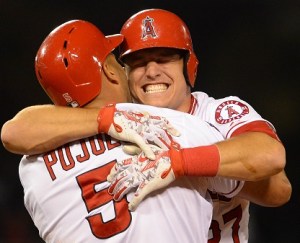
Albert Pujols, Mike Trout

This wasn’t just a celebratory hug after Pujols walked a win off with a sacrifice fly; Albert Pujols made Mike Trout a friend as well as a protege.

When the Angels decided it was time at last to let Albert Pujols go as gently as possible into that good gray baseball night, I wasn’t the only baseball observer to say it was heartbreaking. I’m sure I wasn’t the only one, either, to say his decline following his first Anaheim season was just as heartbreaking.

But I’m still astonished, if not sickened to my stomach, from seeing assorted social media denizens speaking as one such baseball group member did after the Dodgers dropped more than a few jaws by signing Pujols as a bench and very occasional role player for the rest of the season.

“Where are they going to put him? There’s [sic] no [designated hitter] in the NL, and hopefully there never will be one,” said one in particular. “He can afford a rocking chair with all the money he stole from the Angels.”

Stole?

Bad enough the gentleman writing those words clings to one of baseball’s most nebulous and negative traditions. (Pitchers overall have hit .158/.207/.199 from the end of the 1910s until the end of 2020, for a big fat .406 OPS. As of this morning, they’re hitting .102/.136/.137 in 2021, for a whopping .273 OPS.)

But “all that money he stole from the Angels?” Rest assured, this gentleman probably isn’t even close to the only fan who feels that way. He just so happened to put it into cold print,  and I just so happened to catch it in cold print.

What he and anyone else thinking like that is really saying is that a player ground down as Pujols was because of injuries is nothing but a common thief. Well, I heard and saw Yankee fans and observers say similar things about now-retired Jacoby Ellsbury, too. As if they held their teams at gunpoint for x number of seasons.

If you thought Joe and Jane Fan believe losing is practically mortal sin, there are times that seems nothing compared to what they seem to think about being injured on the job.

When the Yankees gave up the ghost and elected to pay Ellsbury the $26 million left on his contract not to play for them any longer, I wondered aloud what it might have done to a man knowing he couldn’t do his job because his body kept him from doing it no matter what his heart and mind desired—and, because it made him a hate object among the witless.

“It’s as if being injured on the job at all equals a character flaw, especially if you happen to be paid a phenomenally handsome salary,” I wrote then. “On the flip side, it’s as if being paid a phenomenally handsome salary equals some sort of immunity to earthly harm. Here’s a bulletin for you: Handing Clark Kent a nine-figure payday doesn’t make him Superman.”

Ellsbury was talented and tenacious (and a two-time World Series champion) when he could play. He wasn’t a Pujols-level talent, but he could and often did break a game open with his own skill set, too. Yet one of the reasons Ellsbury wouldn’t even think about returning to the Red Sox when he hit free agency was because, appropriately, he was fed up over incessant clubhouse whispers that he took too much of his own sweet time recovering from injuries.

“It’s hell if you do and hell if you don’t for a professional athlete,” I wrote then, too. “Return too soon from an injury and you risk re-injury; return not soon enough (in whose sound medical opinion?) and you risk being dismissed as a fragile goldbrick.”

For Joe and Jane Fan, the paradox which is borderline hypocrisy is that they put on pedestals ballplayers who play through injuries regardless of whether that might lead to further injury, as it usually does—but then Joe and Jane Fan become the first to denounce the big jerks for playing through the earlier injuries only to incur bigger and more costly ones.

Pujols’s problems in Anaheim began when he developed plantar fasciitis in one of his heels during spring training 2013. He’d had a first season with the Angels in 2012 that resembled a down season on his terms but a career year for mere mortals.

Then, in late July 2013, he suffered a tear to that bothersome area during a game against the Athletics, while running out a ninth-inning base hit off Grant Balfour. He rehabbed the foot and heel as best he could until the Angels, out of contention by then, shut him down for the rest of that season.

It never got better for him. What nobody outside the Angels clubhouse really knew was that if his feet and legs could drain him, nothing and no one could drain Pujols’s iron will.

“He could easily have shut down a couple of these years. But just the toughness is off the charts,” said Mike Trout to The Athletic‘s Fabian Ardaya in 2019. “A lot of guys would have shut it down for good. He plays banged-up, doesn’t complain. I think that’s what people don’t see.”

“I’ll remember,” said ESPN writer Alden Gonzalez, after the Angels finally designated Pujols for assignment, “that even though his lower half was shot and he wasn’t quick enough to get around on the devastating stuff pitchers throw these days, he still showed up early, still spent hours in the training room to get ready for games, still took batting practice with intent, still crouched really low on defense and still looked for any opportunity to take an extra base. He might not have been productive, but it wasn’t for lack of effort.”

Trout was right. Showing up at the ballpark early and spending hours in the training room despite the physical sappings is what Joe and Jane Fan didn’t see. Maybe they didn’t want to see. Maybe they couldn’t believe the guy who’d played as off the charts as Pujols did as a Cardinal was forced into a far steeper decline phase to his career than he should have been.

Maybe they still clung to the illusion that a nine-figure payday in and of itself could keep a man Superman despite his body turning him into Clark Kent.

In only one way did Pujols have himself to blame for the outside perception that he was just going downhill at warp speed no matter how much money he was paid. He wasn’t the type to lament continuously over his lower body’s continuing betrayals. So much so that, when he finally did speak up about it, in the same 2019 Athletic piece, Joe and Jane Fan didn’t and wouldn’t listen.

“It’s made my move here so tough,” Pujols said to Ardaya then. “I don’t wish that anyone would have had those lower-half injuries, because I know that when I’m healthy, I know what I can do. To come over here and just be pounded by injury after injury, year after year . . . This game is tough when you’re at 100 percent with no injuries. Then imagine dealing with knee, heel, elbow, everything. It’s just tough, man.”

Pujols isn’t the only baseball player who ever kept believing to his soul that all he had to do was return to reasonable health to be what he once was. He isn’t the only player who’s learning the hardest way possible that there comes a time when the badly compromised body married to your age just wouldn’t let you be that anymore.

But not all such players get paid $255 million over ten years, whether they’re future Hall of Famers or future Hall of Shamers.

Nobody held the Angels at gunpoint, either, to offer Pujols that deal in the first place when nobody else was considering it, including the Cardinals (who didn’t until Pujols was practically taking measurements for his Angels uniform), or to keep him on the field when his body was clearly and cruelly draining him faster than a proper decline phase should have done.

Writing in The Inside Game last year, Keith Law came right out and said the Angels were foolish to keep suiting Pujols up even as a designated hitter, despite that iron will, because his body compromised him too deeply.

“If you have already paid for something,” Law wrote, nodding toward the guaranteed deal, “your choice of whether to use it should be a function of whether you want or need to use it, not a function of the money that is already gone regardless of what you do.” Don’t even go there about “eating money” if that’s what the Angels had elected to do. “Major league baseball player contracts are guaranteed,” Law wrote. “[T]here is no way to un-eat that meal.”

It’s one thing to argue against guaranteed long-term baseball contracts in all but the most unique circumstances. It’s something else entirely to argue against one retroactively because the player who signed one got hit unexpectedly with one of the worst injury bugs in baseball history a year after he finished his first season under such a deal.

The clumsiness with which the Angels parted with Pujols speaks only further ill of a team whose administrative culture makes a pratfalling putz resemble Joe DiMaggio roaming center field. The Dodgers’ willingness to bring him aboard even as a part-time bench player, perhaps an occasional first base fill-in, would look a lot better if there wasn’t even the momentary sense that it was a concurrent chance to stick it to their down-freeway rival.

It won’t cost the Dodgers a dollar beyond the pro-rated minimum major league salary to give Pujols one more chance at possible postseason triumph and a possible third World Series ring that the Angels couldn’t. (The Angels’ chronic inability to build a viable pitching staff has harmed them several years; if the Pujols deal tied their hands financially, the Angels haven’t been brilliant at drafting pitching or even acquiring low-cost/high-enough-performance arms, either.)

Personally, I’d hoped Pujols would surrender to his body’s betrayals and call it a career sooner, if only because he wasn’t really Albert Pujols anymore and hadn’t really been for too long through no fault of his own. I wanted him to be as close to Hall of Famer Mike Schmidt as possible, Schmidt having retired in May 1989 because, essentially, he didn’t believe he was Mike Schmidt anymore.

Such Hall of Famers as Willie Mays and Steve Carlton couldn’t do it, either; we saw their baseball ghosts a little too long. Hall of Famer Sandy Koufax did do it when he was still ten dimensions beyond the top of his game: “I don’t regret one minute of the past twelve seasons, but I might regret the season that was one too many.” Even more so than Schmidt, Koufax left the world wanting more, not less.

Whether mere mortal or Hall of Fame immortal, not every player is as self-aware as Koufax and Schmidt. But there’s another kind of self-awareness that imposes a cruelty of its own. It’s the kind Pujols has, the kind that kept him grinding his way back in search of the trans-dimensional greatness he once evoked. The kind that guaranteed him a berth in the Hall of Fame before his body left him nothing but his will.

Knowing what we should know now of that stubborn will no matter what Mother Health and Father Time declared otherwise, we should accept that Pujols earned the chance to leave the field with whatever remains of his professional dignity intact. Maybe he has one more game- or set-changing swing left in him. Maybe he doesn’t.

But calling him the thief who stole all that money from the Angels, however, is way out of line, Joe and Jane Fan. It exposes you as the couple too witless to comprehend just what Pujols put himself through to live up to that contract no matter how often his body told his heart and mind where to shove it.

Astrogate by the coming book

Astrogate Protest

If the Astros think (erroneously) that winning will fix everything, they ain’t seen nothing yet—one of the reporters who helped Mike Fiers blow the Astrogate whistle is about to publish a book about the plot.

The Astros can talk all they wish about winning fixing everything, including and especially Astrogate. They’re finding out the hard way that it doesn’t, and it probably won’t. Not until the last Astro standing from the Astrogate team isn’t in Astro fatigues anymore.

Like it or not, Astrogate isn’t going gently into that good gray night. Especially not when one of the two Athletic writers who took Mike Fiers’s whistleblowing and went excavating deep is on the threshold of publishing an Astrogate book.

Once an Astros beat writer himself, Evan Drellich is calling his book Winning Fixes Everything: The Rise and Fall of the Houston Astros. It comes forth from Harper Books on 17 August. Both the publisher and Amazon are taking pre-orders now.

Count on it: Drellich’s book is unlikely to resolve any serious question to the Astros’ overall liking. It remains to be seen whether he convinced any of the players who escaped formal Astrogate punishment to cop to even small avail of the infamous illegal, off-field-based, electronic sign-stealing Astro Intelligence Agency.

The ones upon whom you should really take pity are today’s Astros who had nothing whatsoever to do with Astrogate because they weren’t there, including manager Dusty Baker. And, Astro fans who’ve lived for over a year with the stings, arrows, and ramifications of the team they loved as the lords of the American League West being exposed as almost unapologetic cheaters.

Drellich’s book will arrive in the stores on and off-line at approximately the seventieth anniversary of the first act in baseball’s most notorious Astrogate precursor. There’s a splendid book still in print about that one, too, Joshua Prager’s 2006 book The Echoing Green: The Untold Story of Bobby Thomson, Ralph Branca, and the Shot Heard Round the World.

It finished the job Prager began in The Wall Street Journal four years earlier. It affirmed what was mostly just whispered or spoken of back-door for decades—that the pennant race comeback against which all future arise-from-the-living-dead comebacks would be measured (the 1964 Cardinals, the 1973 Mets, the 1978 Yankees, the 1995 Mariners, the 2019 Nationals) was tainted.

For the final ten weeks of the 1951 season the New York Giants cheated their way back from thirteen games out of first place to a final-day tie with the Brooklyn Dodgers to force a three-game pennant playoff. And the Giants probably cheated their way through the playoff, right down to the moment Bobby Thomson awaited Ralph Branca’s 0-1 pitch with second and third and one out.

For decades to follow, Branca epitomised grace in defeat and Thomson modesty in triumph. The Giants went on to lose the World Series in six games to the imperial Yankees, but the two protagonists in the Shot Heard Round the World rose above the occasion. As Branca himself once put it, “I lost a ball game, but I gained a friend.”

The whispers turned to shouts and screams when Prager confirmed the decades-old speculation.

Giants manager Leo Durocher discovered his new utility infield acquisition Hank Schenz owned a hand-held Wollensak spy glass he’d acquired during his World War II military service. He also discovered Schenz wasn’t averse to using the spy glass to steal signs for the Cubs by perching himself up and inside the scoreboard behind the Wrigley Field bleachers.

So Leo the Lip, ever on the lookout for any and every edge he could find, fair, unfair, clean, dirty, or downright criminal, had an idea.

He dispatched catcher-turned-coach Herman Franks to the clubhouse high enough above and beyond the deepest Polo Grounds center field region. A buzzer would be wired from the clubhouse to the Giants’ bullpen in deep right field. Franks would see the enemy catchers’ signs through the Wollensak and signal the pen accordingly. The designated signaler in the pen, usually reserve catcher Sal Yvars, would relay the pilfered intelligence to the batters.

According to Prager, Yvars or others would do nothing if it was a fastball sign but do something, from tossing a ball to standing up or raising a hand or an arm, if the sign was breaking ball. All a Giants batter had to do was see past the opposing second baseman to see the signal or lack thereof.

Those who wanted such stolen intelligence, that is. According to Prager, Durocher asked his players who wanted it—but Hall of Famer Monte Irvin was one of those who rejected it. Prager has written that Irvin told him in 2001, when the outfielder was 81, “I told [Durocher] no. He said, ‘You mean to tell me, if a fat fastball is coming, you don’t want to know?’ ”

And if Irvin said no, so did fellow Hall of Famer Willie Mays, a rookie on the ’51 Giants. Don’t delude yourself. Irvin took to Mays as a kid brother and Mays took to Irvin as a big brother. He followed Irvin’s leads to the letter and the final syllable. No matter Mays’s actual or mythologised fealty to Mister Leo, he wasn’t that eager to let Mister Leo lead him into a life of crime.

Monte Irvin, Willie Mays

Monte Irvin (left) refused to accept stolen signs in 1951. His protege Willie Mays (right) surely followed Irvin’s lead to the letter no matter how much Mister Leo also meant to him.

The Dodgers themselves suspected Durocher was up to some sort of no good down that stretch. “In September ’51, Brooklyn coach Cookie Lavagetto took binoculars to the Dodgers’ bench to try to dope out the Giants’ system,” wrote Thomas Boswell in a column reviewing Prager’s original Journal essay. “Umpires took the binoculars away immediately. Why, it would be unfair for the victims to use binoculars to expose the telescopic cheaters!”

Branca may have learned for certain that the Giants were playing spy games when he was a short-term Detroit Tiger and heard a few whispers from pitcher Ted Gray, who was friendly with ’51 Giants reserve Hal Rapp—who told Gray about Durocher and Franks’s spy operation, enabling Gray to tell a Branca who didn’t know what to believe just yet, if at all.

When Associated Press sportswriter Joe Reichler published a 1962 story discussing the Giants’ 1951 sign-stealing, it came and went quickly enough, despite then-Commissioner Ford C. Frick’s threat to declare the Branca/Thomson game forfeit if he had absolute proof of the plot. Reichler was tipped off by utility infielder Danny O’Connell; Thomson himself called it “the most ridiculous thing I ever heard of.”

“Over the years, when interviewing Thomson and Branca,” Boswell wrote, “I’ve been struck that Thomson seemed a bit ambivalent about his Moment while Branca never seemed the least ashamed. I took it that Thomson felt apologetic because he’d caused Branca a lifetime of nagging questions . . .

“Whether Thomson took the stolen sign, Branca has been a man of honor for fifty years. He has never raised the cheating issue without proof or tarnished the game’s most replayed moment. Even now, Branca says, ‘He still had to hit the pitch’.”

Prager’s first Journal missive and then The Echoing Green put paid to all speculation once and for all and stamped “case closed” that the Giants cheated their way back from oblivion to the pennant playoff—and even to the pennant. Interviewed by a Utah newspaper in the post-game bedlam, Franks said, “Maybe we caught the sign for a fastball.”

Nobody paid attention in ’51. They did now. Once and for all time, the Miracle of Coogan’s Bluff should be known forever after as the Mugging at Coogan’s Bluff.

Thomson was cited in Prager’s book as telling New York Daily News writer Jim McCulley that Branca’s 0-1 fastball “was a pitch that [Hall of Famer Stan] Musial or any other good hitter would have taken. It was high and inside. I didn’t deserve to do a thing like that.” Prager also cited Branca telling New York Times writer Roscoe McGowen that the pitch “wasn’t a bad pitch . . .”

I didn’t think he hit it too well. It was sinking when it went into the stands. I guess we weren’t meant to win it. The ball was high and inside, not a good pitch [to hit], and it only cleared the wall by [a very few inches].

In fact, when Prager caught up to Franks shortly before the old catcher-coach-manager died in 2009, Franks described the spy glass spy—in the third person—as “tilt[ing] his scope up to the eyes of the batter.”

The spy did so to watch the batter glance toward right field, where a player in the bullpen relayed the stolen sign. The eyes of the batter also filled the scope’s field of view. And at 3:57 p.m. on October 3, 1951—with two on and one out in the bottom of the ninth inning, and the Giants down 4-2 in the third and final game of the playoff—Franks had just spied Brooklyn catcher Rube Walker call for an 0-1 fastball when he looked up at the eyes of Bobby Thomson.

“For 50 years,” wrote Boswell in 2001, “Thomson has been baseball’s ideal clutch hero and Branca the game’s most symbolic goat. Now it seems that Branca, the Dodger who gave up the homer that lost the pennant, may be a victim and Thomson less than a hero.”

Bums author Peter Golenbock cited a longtime Dodger fan leaving the Polo Grounds for pizza . . . and seeing the pizza joint displaying rolls of toilet paper marked “Dodger Crying Towels,” plus a rope tied into a noose and with the sign, “Dodger fans, hang yourself [sic] here.” You thought today’s road fans showing and banging inflatable trash cans when the Astros come to town is rough stuff?

But Golenbock also got Branca to re-tell a story once circulated well enough, Branca’s fiancee taking him to see her cousin—a Catholic priest, who told the stricken pitcher, “God chose you because He knew your faith would be strong enough to bear this cross.” Branca died in 2016, six years after Thomson. “He carried the cross of the Thomson home run,” said Vin Scully, “with dignity and grace.”

Neither the snarking Giants fans nor the stricken and suspicious Dodgers and their fans knew for dead last certain in that hour that the Giants got there in the first place with a plot as underhanded then as the Astro Intelligence Agency was in 2017-18.

The Astros weren’t baseball’s only electronic cheaters when they won the 2017 World Series, but they were the only ones known to have altered an existing camera off mandatory eight-second delay or to have installed a furtive new and illegal camera, either of which sent stolen real-time pitch signs to clubhouse monitors and a trash can banger.

The only thing left is to await Drellich’s book. (Try to imagine what Boswell snarked sadly—The Giants stole the pennant! The Giants stole the pennant!—happening in the Internet social media era.) Stay tuned. It could make the original Astrogate revelations resemble mere flickers through the spyglass darkly.

Baseball’s strategic non-command

Warren Spahn

That was then: “Hitting is timing. Pitching is destroying timing,” said Hall of Famer Warren Spahn. This is now: “Pitching is timing. Timing is supposed to make Nolan Ryan resemble a junkballer. Batter down? Oops!”

When Steve Dalkowski died a little over a year ago, the legends and myths about the nine-season minor league lefthander arose from the dead one more time. Howitzer arm? Dalkowski threw fastballs like cruise missiles.

Fans with seats behind the plate said no thanks when he was going to pitch—they didn’t want to come away with holes in their heads. He was that fast. And that wild.

Dalkowski finished his professional pitching career with 37 hit batsmen. That’s an average of four drills a year. The wildest pitching oat of his and many eras was kale compared to what’s going wild today, when as of this morning the Cubs pitching staff has hit a Show-leading thirty batters. (One batter drilled by a Cub every 44 plate appearances against them.)

At that rate, the Cubs staff is liable to do in less than two full months what Dalkowski took nine years to accomplish. The last I looked, there isn’t a Cub on staff whose fastballs inspire the kind of thing Red Sox utility infielder/pinch hitter Dalton Jones said of Dalkowski’s gas: “Hearing him warm up was like hearing a gun go off.”

Yet.

The outlier Dalkowski was in his time has become the norm in our time, and with about 200 percent more batters taking it on the chin . . . and anyplace else today’s uncontrollable fastballs can reach. As of this morning 476 major league batters have been hit by pitches—one drill every 80 plate apperances.

They’re not just free-floating knuckleballs or curve balls that break inside unexpectedly, either. These days, for whatever perverse reasons that only begin with the misuse of analytics, baseball organisations hunt and capture human howitzers who can throw lamb chops past entire packs of wolves—and practically nothing much else.

The trouble is that the newest generation of speedballers has about as much control as a politician’s mouth. The further trouble is that someone has the potential to become the next Tony Conigliaro—if not the next Ray Chapman. And the poor soul doesn’t even know it.

“Starting at the amateur level,” writes The Athletic‘s Ken Rosenthal, “the baseball industry has come to value stuff over command, velocity over artistry. According to baseballsavant.com, the average velocity of a four-seam fastball in 2008 was 91.9 mph; this season, it’s 93.6. The trend is not just a threat to the health of hitters, but to that of pitchers as well.”

Threat to their health? How about the night Cardinals reliever Genesis Cabrera opened an assignment by hitting Bryce Harper in the face-then-wrist—knocking his helmet right off his head between face and wrist, too—and Didi Grigorius in the back . . . back-to-back. Harper and Grigorius may have been lucky they weren’t beheaded back-to-back.

Cabrera wasn’t trying to relieve either man of a head or another part of their assorted anatomy. He looked and acted positively pained when Harper went down and Grigorius spun on the back drill.

Both players knew it, Harper going so far as to send Cardinals manager Mike Schildt a text message saying he knew Cabrera wasn’t trying to leave his head on the ground separately. Cabrera apologised after the game, too.

But you couldn’t ignore what Harper’s former Nationals teammate Ryan Zimmerman told the Sports Junkies podcast, either. “A couple years ago, these guys would be in Double-A or Triple-A for another year trying to learn how to pitch, but these teams just call them up to see if they can kinda hit lightning in a bottle,” Zimmerman said.

“If not, they send them back down. They don’t care if they hit four guys on the other team. What does it matter to them? The [general manager] of the other team is not in the box, so he doesn’t care. It’s a different kind of game but it is what it is and that’s where we’re at.”

This past Saturday night, Ronald Acuna, Jr. got hit in the hand by Phillies reliever Sam Coonrod, on a pitch that would have been ticketed for reckless driving and traveling 32.8 mph above the highway speed limit. After gripping his limb in obvious pain, Acuna managed somehow to return to the Braves lineup the following day and score their first run. Coonrod and everyone else in baseball were lucky Acuna’s X-rays showed nothing but a contusion on his left pinkie.

One particularly interested observer was a Hall of Fame pitcher, John Smoltz, working the Fox Sports One broadcast of the game. Not only does pitching inside have elevation now that it didn’t always have in his day or past generations, Smoltz told his viewers, matching velocity with elevation equals playing with fire if your control panel goes AWOL.

“To pitch inside waist-down, there’s nothing really bad that can happen to a (batter),” said Smoltz, who hit 57 batters himself in a 21-season career for an average three a year. “And there’s nothing really bad that can happen to a pitcher, other than you maybe leave it over the plate and it’s a homer. Now everybody through analytics is trying to get it to the letters. You throw that at 98 mph, there are not a lot of pitchers who know where that pitch is going.”

Nobody’s blaming Coonrod, either, not the Braves or anyone else. Not even knowing Acuna tied an early April game against Coonrod by reaching for a slider going away and hitting it out. All Coonrod wanted to do was pitch Acuna to the inside of the zone, which pitchers must do to stay in command. The problem was Coonrod’s lack of command.

When Angels pitcher Jack Hamilton threw the pitch that blasted Tony Conigliaro in the face, the horror of Conigliaro going down caused too many people to believe Hamilton was nothing more than a reckless headhunter. And Hamilton didn’t pitch in a time when organisations and scouts lived by velocity uber alles without a thought of anything else.

To the day Conigliaro died there remained a considerable crowd remembering Hamilton as a hard thrower who was borderline careless. To anyone who’d give him a reasonably fair shake, Hamilton would say he couldn’t have been a headhunter if he tried—he didn’t have the kind of control to make it possible.

Indeed. He pitched eight major league seasons and actually hit only thirteen batters—short of two a year lifetime. (Charlie Morton hit thirteen in 2017 alone and he’s averaged sixteen a year in his career—including leading his league three times with sixteen, thirteen, and sixteen, and the entire Show once with nineteen.) If that’s a headhunter, watch me paste this pathetic palooka with a powerful paralyzing perfect pachydoimis percussion pitch.

Carl Mays took it on the chin for just about the rest of his life after one of his submarine spitters coned Ray Chapman in 1920. Not only did it provoke baseball to make the spitter an illegal pitch, it left Mays with a slightly unfair reputation as a headhunter—he retired with 89 hit batsmen in a fifteen-season career (average: seven a year) . . . and he’s not even among the top one hundred drillers of all time.

With the relief pitchers there’s an issue a few more have started thinking about. Normally, a manager who sees his pitcher wild would have gotten him the hell out of there before he got an opposing batter clobbered or his own team facing retaliation. Then came the three-batter minimum for relief pitchers, the sole exception being if they come in during a jam and get out of it facing less than three men.

It was a foolish rule to begin with even before Cabrera’s fateful drills of Harper and Grigorius. (Harper’s wrist injury kept him from playing in seven of the Phillies’ following eight games.) That relief minimum kept Schildt from taking Cabrera out of the game until after he faced a third Phillie, on a night he had absolutely no control. How long will Commissioner Nero and his head-up-their-you-know-what bosses let this stupid rule continue before someone does get killed?

And who has to have a career compromised or destroyed a la Conigliaro before the analytics mavens in today’s front offices quit chasing speed elevation uber alles and start chasing or developing pitchers who can learn how to control what they throw and think as well as thrust on the mound?

I don’t ask that question lightly. I’m an analytics maven myself. I believe more deeply than the deepest pennant contender that statistics are what Allen Barra has called them, the life blood of baseball. I can’t and never could watch every single baseball game ever played in my lifetime, so I look at the deepest of the deep stats when I want to know who really made the difference in those games and who really was (or is) as great as his Hall of Fame plaque suggests (or will suggest).

Those deepest-of-the-deep stats can also tell me whom among non-Hall of Famers actually belongs in the Hall of Fame (Dick Allen and Tony Oliva, anyone?) and whom among the Hall of Famers had no business being there except as a visitor. (Harold Baines, anyone?) One of the things those deeper stats can also tell me within all reason is which pitcher had Dalkowski-like heat or voluptuous breaking balls but had the kind of lack of control that might have made Dalkowski resemble the mature Sandy Koufax.

If I’m running a baseball organisation, and I see a young pitcher who can throw a ball through a cement wall but has no idea where it’s going, I should be crucified if I let that kid get anywhere near a major league mound before he gets the idea. Not before someone teaches him all the speed on earth means nothing if you don’t know where the ball’s going—or the one you get within the zone in spite of yourself gets hit into the Delta Quadrant.

Because one thing will remain true no matter the era: Show me a kid who’s got a sound barrier-breaking fastball, I’ll show you a major league hitter who’ll catch up to that fastball soon enough if the kid hasn’t got much of anything else to show that batter. Assuming he lives long enough after he gets coned by one of those speedballs.

Some of the old-school should still prevail. “Hitting is timing. Pitching is destroying timing,” said Hall of Fame lefthander Warren Spahn, whose fastest fastball would resemble a Lockheed Constellation compared to today’s Dreamliners. Today, hitting is still timing but pitching seems bent on making Hall of Famer Nolan Ryan resemble a junkballer. Batter down? Oops.

Spahn also had solid breaking stuff, a screwball he developed later in his career, and the kind of control an android would envy. Want to know how many batters Spahn hit in a 21-season career? Try 42—an average two a year. He also averaged only four wild pitches a year. Today’s impatient front office would deem him unsuitable for major league competition.

His fellow Hall of Famer Koufax once tied a single-season record for wild pitches—before the flaw in his delivery got spotted at last and corrected in spring 1961. Koufax had a fastball that exploded upward as it arrived at the plate and a curve ball voluptuous enough to make Jane Russell resemble Olive Oyl.

In twelve Show seasons Koufax hit only eighteen batters—an average two per year. But he didn’t just fix the hitch in his delivery in ’61. (He’d previously reared back far and hard enough that he cut half his strike zone sight off as he threw.) He learned at last how to think while he pitched. He knew what he was doing on the mound. Today’s front office would probably write him off for thinking too much and destroying radar guns too little.

It’s taken baseball’s best pitcher today eight seasons to hit twenty batters, an average of four per year. The last time he hit one was two years ago. This season he’s been shown throwing three figure speed—at almost any time of the game while he’s on the mound.

But he has something the rest of the pack with a couple of exceptions lacks: He knows what he’s doing on the mound and he also knows there’s an awful lot of real estate to cover within the perimeter of the strike zone. He also has more than just cruise missiles to throw—he’s got a wipeout slider and a changeup that could be accused plausibly of embezzlement.

You won’t see Jacob deGrom on the mound again until 20 May or later, thanks to an issue in his side that started with a lat muscle strain. Did he get it throwing one or two pitches a little harder than even he can throw them without great physical effort? Did he get it swinging the bat and/or running the bases? (DeGrom the Outlier is 7-for-15 as a batter this year.)

If the former, rest assured deGrom knows better. If the latter, it’s yet another argument for the defense on behalf of the universal designated hitter.

It might be fun watching deGrom bop hits but there’s no fun watching him get hurt swinging the bat or running the bases. Especially when you’re not paying deGrom (a converted shortstop) to get up there and slap his mound counterpart silly with his bat. But that’s an argument for another hour.

“[W]hy are pitchers such as Jacob deGrom, Gerrit Cole and Max Scherzer at the top of the sport?” Rosenthal asks, then answers. “It’s not simply because they throw hard. It’s also because they know how to locate. More of that, please, before more players get hurt.” Letting the kids play isn’t supposed to mean letting them blow someone’s brains out.

“I’m trading me into retirement”

Claude Osteen, Thomas Boswell

In this Washington Post photo, Thomas Boswell (right) interviews former pitcher and then-Phillies pitching coach Claude Osteen during the 1980s.

If Roger Angell isn’t baseball’s Homer because Homer was ancient Greece’s Roger Angell, it’s also accurate to say something about Thomas Boswell. So I’ll say it. He isn’t baseball’s Publius; Publius was the American founding’s Thomas Boswell.

When Boswell was named a Washington Post sports columnist in 1984, together with Tony Kornheiser, then-Post editor Ben Bradlee (as Kornheiser liked to joke) said neither man alone was good enough to replace departing Dave Kindred—so he hired both to replace him.

In the years before and since, Boswell has proven that if Publius was our founding’s Boswell it took three to make one of him. Maybe you’ve heard of them: Alexander Hamilton, John Jay, and James Madison. And they weren’t half as potent a top of the order as Rickey Henderson, Mike Trout, and Willie Mays.

Therefore, The Federalist is merely the nation’s second most important book, behind the five-way dead heat known as How Life Imitates the World Series, Why Time Begins on Opening Day, The Heart of the Order, and Cracking the Show, the four known anthologies of Boswell’s baseball writings, plus Game Day which collects his writings on lesser games but also some choice baseball writings.

I spent a year working for a Washington think tank, at a time when think tanks actually thought and thought wasn’t considered either politically incorrect or an impediment to Making America Great Again. My days began with reading the two most important writers the Post had to offer—Boswell and his elder Shirley Povich in the sports section.

Only then would I make the trek in to work.

Well before that, I spent an Air Force hitch in Omaha and trekked to a particular bookstore downtown to pick up the Post on the days Povich and Boswell appeared on my way to Offutt Air Force Base. My days there were incomplete until I could spend lunch with the pair.

When I was done with each of their essays, I returned to finish my day’s work well assured that I was better informed about the things that mattered than the colleagues and superiors with whom I worked gleaning the mischief of the Soviet Empire and the vicissitudes of the Middle East as an intelligence analyst.

Povich went from this island earth to the Elysian Fields in 1998. Boswell remained. He never once failed to engage, instruct, enlighten, inspire, and entertain. He never once forgot the men behind the players or the play that needed to be made for the sake of the game itself. And I don’t mean just a fielding error or an errant double play grounder on a meatball that should have been turned into a line drive or a parabolic bomb.

Over all those years and in all those essays and books, Boswell wrote with insight and empathy about such men as his boyhood idol Roy Sievers (Boswell grew up a Senators fan), Hall of Famers such as George Brett, Gary Carter, Wade Boggs, Joe DiMaggio, Reggie Jackson, Sandy Koufax, Eddie Murray, Jim Palmer, Gaylord Perry, Brooks Robinson, Frank Robinson, Mike Schmidt, Ozzie Smith, and Carl Yastremski, to name a few.

The Sievers piece I remember wasn’t collected in one of Boswell’s books but, rather, in a book called Cult Baseball Players: The Greats, the Flakes, the Weird and the Wonderful. It also ran as a cover story for The Washington Post Magazine while I worked in that city. I kicked myself in due course for losing the copy I saved when moving back upstate New York, but I never forgot Boswell’s for-Opening-Day appreciation of the 1957 American League home run champion:

A baseball hero is a toy of childhood. Electric trains, cowboy guns and plastic soldiers are the same find. But with a baseball hero, a youngster reaches out, for one of the first times, into the world outside the family. That connection with a big, mysterious environment gives a certain sense of power; children discover they can invest their affections and actually get something special back in return. However, hero worship also brings with it the first morsels of the sort of pain and fear that we come to associate with the word “reality.” We begin to learn about adult disappointments and the profound uncontrollability of nature.

I was fortunate. I got a wonderful hero. When I was eight years old in the spring of 1956, somebody gave me my first pack of baseball cards. Pathetic as it sounds, I can still remember where I was standing when I opened them: beside a coffee table in the living room. In that pack was only one player from my hometown team, the Washington Senators. I’m convinced that, by the luck of the draw, the player on that card was destined to be my first (and, as it turned out, only) hero. It could have been Herb Plews, who made four errors in one inning, or Chuck Stobbs, who lost 13 games in a row.

But it was Roy Sievers.

Boswell republished it in the Post when Sievers died in 2017. If you think he was able to balance the sentimentalism from the substance talking about his boyhood hero, you should have read him when he wrote about the consequences of fan insanity married to human frailty equaling one grotesque, tragic denouement, Donnie Moore shooting his wife before killing himself:

You and countless others who get branded as “goats” in sports, didn’t do anything wrong. We know it, though we almost never say it. Just once, let’s put it in words: The reason we don’t forgive you is because there’s nothing to forgive in the first place. You tried your best and failed. In games, there’s a law that says somebody has to lose . . .

Numerous other athletes who’re in trouble—taking heat, answering tough questions, hearing catcalls—got themselves in hot water by doing what they knew was wrong. All Moore did was pitch despite a sore arm, throw a nice nasty knee-high forkball, and watch it sail over the left field fence . . .

The flaw in our attitude—perhaps it is even an American predisposition with Puritan roots—is to equate defeat with sin. The unspoken assumption is that those who lose must do so because of some moral flaw.

If Boswell has anything in daily newspapers resembling an equal for trying to remind Joe and Jane Fan that those who play baseball aren’t automatons squeezed out from a single algorithm and design, it might be the New York Times‘s venerable Ira Berkow. (If you don’t believe me, invest wisely in Berkow’s anthologies Pitchers Do Get Lonely and It Happens Every Spring.)

Why neither has been made a Hall of Famer via the J.G. Taylor Spink Award escapes. Maybe someone in the Baseball Writers Association of America should kick off a loud drumbeat on their behalf the way Susan Slusser of the San Francisco Chronicle did for Roger Angell. Angell needed the drumbeat because he wasn’t a daily newspaper essayist but bloody well deserved to be there as the most elegantly lyrical of baseball writers who practised their professions for weekly or other magazines.

When Pete Rose first ran into the dumpster fire of his own making, in 1989, Boswell asked, “[W]hat happens when you become larger than life? The ego needed to be great and the judgment required to be wise aren’t often found in the same package.”

When Mike Schmidt shocked the game by retiring in May 1989, while he was still among the National League’s RBI leaders though he wasn’t hitting often or hard anymore, Boswell wrote, “Most great players these days torture their teams, their fans, and themselves, playing for years past their prime, for the checks and the cheers.”

Instead, Schmidt left memories—of the player who finally dragged the Phillies to five division titles, two pennants, and their only world title . . . Even with three MVP awards and a World Series MVP behind him, he lived a slump as though he had never been in one before and might never get out of this one . . .

Schmidt . . . was not meant to comb gray hairs. From him, we only expected the sublime. He looked like some huge, graceful shortstop misplaced at third base. When he came to bat, the number 20 on his back might have stood for the number of rows he intended to hit the ball into the bleachers.

For many fans, Schmidt’s departure was a shock that left a sense of loss. Didn’t we half expect him to hit 35 more home runs this year as though the trick were done without effort? Once in awhile, however, the man himself knows best. On Memorial Day, Schmidt connected again. He did what so many great athletes have failed to do; he left us wanting more.

When the Astros were hoist by their own illegal, off-field-based, electonic sign-stealing petard, unable or unwilling to say plainly that they cheated and were sorry about it, before the coronavirus shut 2020 spring training down, there was Boswell to tell it like they weren’t: “Yes, there’s no better way to show good old-fashioned genuine remorse than by refusing to speak the misdeed you committed . . . ”

Unfortunately, getting caught is usually what does it. Then, in the Astros’ refrain of the day, [outfielder Josh] Reddick said, “If we win, we shut everybody up.”

No, you don’t. The Black Sox threw the 1919 World Series. Seventy years later, they were still in a metaphoric cornfield in “Field of Dreams,” coming out at dusk to ask whether they could just be allowed to play a game of baseball again.

Maybe, with time, some Astros will be more forthcoming with authentic feelings, not practiced phrases, that will show their human dilemma — most of them not $100 million stars or future Hall of Famers, just normal ballplayers caught on a runaway train with, realistically, no emergency brake available for them to pull.

As of 30 June, Boswell is pulling the brake on his Post career. The pan-damn-ic kept him from covering last year’s World Series up close and personal; five eye surgeries last year married to that convinced him, as he wrote 7 May, “I’ve gradually gotten the memo, sent from me to myself: ‘This is the appropriate time’.”

Branch Rickey said, “Trade a player a year too early rather than a year too late.”

I’m trading me into retirement. I’m happy about it. But I’m going to miss many aspects of the only job I’ve ever had. To my surprise, with age, it’s now clear what I will miss the most — the readers.

I’ve been one of them ever since I picked up a copy of How Life Imitates the World Series. Until then, Boswell essays published outside Washington and around New York were about as frequent as excursions to Atlantis. Boswell hasn’t published an anthology since Cracking the Show in 1994. He’s as overdue for a new one as the Cubs were for winning the World Series in 2016.

Baseball players learn the hard way that there comes time when the spirit remains willing, the brain keeps believing, the heart still beats, but the body orders them where to shove it and they can’t let themselves obey. Just ask Mickey Mantle, Willie Mays, Brooks Robinson, Steve Carlton, and Albert Pujols. The rarest are the Schmidts, the Jackie Robinsons, the Sandy Koufaxes who obey the orders before their legacies get shoved.

Writers whose pens, typewriters, word processors, computers never fail them may be more rare than than the Hall of Famer who fields like a vacuum cleaner and hits like you could put him into an old-fashioned telephone booth and he’d still hit one across the Grand Canyon.

“To avoid the column-decompression bends,” Boswell concluded, “I will be writing and chatting several more times until June 30. By then, the cicadas will leave. And so will I. They will go underground for seventeen years. I hope to go everywhere else.” The column’s headline said, “it’s time to see what I missed.”

Just please tell me it’ll be the way Alan Freed once signed off his nightly radio shows, “It isn’t goodbye, it’s just good night.” Even one Boswell exegesis a year is worth two hundred from anyone else and ten times that many from me.

Otherwise, I’ll wish Boswell and his wife, Wendy, nothing but joy in their human journey still to come. I just hope the BBWAA re-awakens enough to make bloody certain that their itinerary includes Cooperstown—and not as tourists.

Cease and desist!

Huascar Ynoa

Braves pitcher Huascar Ynoa looks like Hall of Famer Henry Aaron hitting this grand slam. But he’s not a reason to oppose the DH.

I thought I’d seen every possible absurdist argument against the designated hitter going universal to stay. (It won’t happen until after this season, if baseball’s government can quit its foot-dragging over it.) Then I read Jayson Stark in The Athletic Friday. It wasn’t Stark making such an argument but, rather, a couple of his respondents.

Stark is a Spink Award Hall of Fame writer with as much passion for mulcting “Weird and Wild” baseball moments as I have for learning about them. How could he resist White Sox pitcher Dylan Cease having a day during which he struck eleven Reds out . . . and, having to make plate appearances himself for the first time in his major league life, nailing three hits?

How could Stark resist noticing the last American League pitcher to go 3-for-3 at the plate in his first Show game (Boo Ferriss, 1945) came 76 years before Cease fired? Or, that the only National League pitcher to do that in his premiere between 1945 and now was then-Met Steven Matz (2015)?

How, too, could Stark resist making note that of those three pitchers Cease is the only one who’d never shown up at the plate to bat in his entire professional baseball life until that fine day in Great American Ballpark? And Cease’s refusal to desist happened when (Stark’s words) “a few guys who hit for a living” hadn’t had a three-hit game all season yet: Mookie Betts, D.J. LeMahieu, Charlie Blackmon, Francisco Lindor.

Then there’s Braves pitcher Huascar Ynoa, hitting a home run each in back-to-back pitching starts, with the second one—off Nationals pitcher Tanner Rainey, with the bases loaded and Ronald Acuna, Jr. on deck—going over the almost-straightaway center field fence.

It was the first time any Braves pitcher hit home runs during back-to-back starting assignments, Stark points out, since June 1961—when Lew Burdette and his running-mate in the comedy department, Hall of Famer Warren Spahn, did it in the same week, never mind the same season.

Ynoa can claim to be only the third pitcher to homer at the plate in back-to-back starts during which he also surrendered an earned run total of (wait for it!) zero. And whom might the other two be? Stark has your answer: Don Larsen, 1958; and, Rick Ankiel, 2000.

Now, repeat after me: All the foregoing are what such creatures have always been—outliers. Extreme exceptions. Non-habit forming. Hope Diamonds versus glass. Henry Aaron for one day compared to Hank Conger lifetime. Nolan Ryan pitching 27 seasons worth of major league baseball. Get the picture?

More than a few of Stark’s commenters didn’t. “Screw the DH! Let pitchers hit (at least in the National League),” read one, to which another gentle reader replied, “I don’t get why so many people want to take pitchers hitting out of the game.”

Yes watching pitchers hit is painful but getting these types of moments with Cease and Ynoa are so worth it. It’s fun! Just think about the most memorable baseball moment in the past 5 years. What is it? Bartolo’s home run. Take away pitchers hitting and we’ll never see anything like it again. Let pitchers hit!

The first sentence by the second such reader is dismissed almost too easily. Fair disclosure: I did so, posting that as of Saturday morning, the cumulative slash line for pitchers at the plate this season is .108/.136/.146, for a mighty .284 OPS. And, I wrote further, that the cumulative slash line for pitchers at the plate from the end of the 20th Century’s first decade through the end of the 21st Century’s first decade is .158/.207/.199, for a big fat .406 OPS.

I’ve said it before, but I’ll say it again the way I said to that gentle reader: Show me a position player with a slash line like that, and I’ll show you a guy who won’t get past the minors even if he’s the next Mark Belanger with the leather. Even Belanger slashed .228/.300/.280. And he only got to play major league baseball for eighteen years because he was a human Electrolux at shortstop, who finished his career worth one defensive run saved above league average less than Hall of Famer Ozzie Smith. (Belanger: +238; Smith: +239.)

Bartolo Colon’s 7 May 2016 home run in San Diego is baseball’s most memorable moment of the last five years? It was a regular riot, no question about it. But if I called it the most memorable moment in 2016-2021 baseball, it would expose me as having slept through a small truckload of moments that were far more memorable if not half as laugh-and-a-half funny. Games Seven of the 2016 and 2019 World Series come to mind at once, for openers.

Using outliers to support arguments is as fatuous as making memes out of Ryan and fellow Hall of Famer Tom Seaver, as someone did aboard Facebook last week, showing the two righthanders sharing a laugh during a Shea Stadium event, with “Pitch Counts?” above Ryan’s head, “Innings Limits?” above Seaver’s, and “#SMH” under Ryan’s and “#LOL” below Seaver’s.

The head smacks and laughs out loud should be aimed at those witless to comprehend that, for every Ryan and Seaver there are 1) probably a hundred or more hard-throwing pitchers who didn’t have a third their career longevity; and, 2) definitely not any single pitchers otherwise blessed with the exact or equivalent physiology to that pair.

Those same head smacks and laughs out loud should also be aimed at those who think Cease, Ynoa, and Colon are mic drops for keeping the National League immune to what they think is the taint, if not the virus, of the DH. By the end of the regular season—when the still-batting pitchers overall are unlikely to finish with a slash line higher than that .108/.136/.146 thus far—Cease and Ynoa will likely remain the outliers they are at the plate, assuming they do get any more base hits the rest of the way.

Hitting this season’s tough enough, seemingly, without further wasting precious outs on behalf of an anti-idea whose time really left the building long before Elvis ever did. If you’ve got a rally in the making, or you pushed a run or two across the plate with the promise of more to come before the inning’s over, do you really want to watch the enemy pitcher bury it alive by finding a way around your serviceable number eight batter to strike your pitcher out for the side? Or, to lure your pitcher into a rally-killing, inning-ending double play?

Don’t even think about countering with “sacrifice bunts—strategy!!” either. Unless you see the other guys put the old wheel play on (corner infielders down the line; middle infielders to the corner bases) so you can fake a bunt for a base hit, send four pairs of cement hands out to the infield, or present yet another defensive overshift yielding open prime real estate, bunts waste outs. (“I have yet to meet the fan who bought a ticket to a major league game,” Keith Law wrote in Smart Baseball, “because she really wanted to see guys drop some sac bunts.”)

Unless you think managers in any era made their lineups out by rolling dice, turning cards, playing eenie-meenie-mienie-moe, calling the Psychic Hotline, or tossing coins and interpreting the I Ching, here’s a scoop that shouldn’t be a scoop: most baseball strategy is plotted before the game begins.

Make the DH universal and give National League managers the options American League managers have enjoyed for decades without having to move a pitcher above the number nine slot in the order: maybe a second cleanup hitter or an extra leadoff-type in that slot.

Relieve them, too, of the brain-bending decision (and yes, I’ve seen it happen) to remove a hot starting pitcher before his gas goes AWOL because his spot in the order’s due up early enough with men on base and a chance—especially down the stretch of a pennant race or with postseason survival at stake—to tie a game or bust it open as long and wide as the Chunnel.

Of course it’s fun to see the very occasional Ceases, Ynoas, and Colons*. But I’ll Cease and desist those in half a heartbeat, on behalf of putting a permanent end to the historic and overwhelming majority of pitchers killing my rallies because the historic and overwhelming majority of the lot of them hit as though they swing swimming pool noodles at the plate.

Instead of thwarting the universal DH, how’s about we kill the free cookie on second base to open each extra half inning and the three-batter minimum for relief pitchers? (Somebody might get killed because of the latter.) Or would that cause Commissioner Nero and his mouse-like employers to think, “Nope, makes too much sense?”

————————————————————-

* It took Bartolo Colon nineteen years of major league baseball, only two and a half of which were National League seasons, and 248 previous major league plate appearances, before he finally hit James Shields’s 38th pitch of the game into the left field seats.

It didn’t even take Mark Belanger that many plate appearances to hit his first of twenty lifetime home runs—Belanger did it in his seventh plate appearance of 1967. And Belanger wasn’t a tenth as funny running his out as the portly Colon who ran like a cement truck with the rear tires deflating en route.