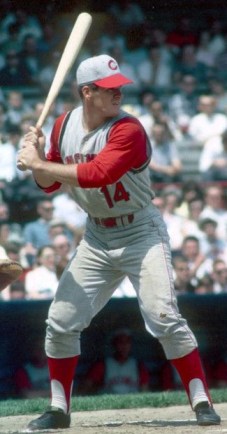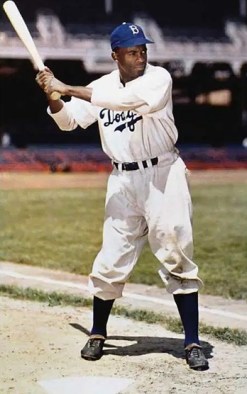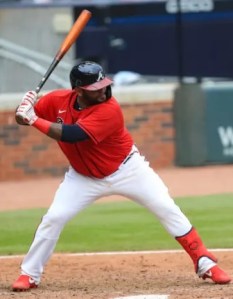
On top of old Smoky

Pablo Sandoval

Kung Fu Panda’s become Kung Fu Pincher this season . . .

Pablo Sandoval is making more noise at the plate this season than he’s made since the 2012 World Series. Some guys are lucky to hit one pinch home run? Sandoval’s hit three of them in twelve plate appearances in the role. Some guys are lucky to hit .250 in the role? He’s  hitting .333 with a 1.833 OPS in the role so far this year.

As a matter of fact, Sandoval’s lifetime slash line as a pinch hitter (he’s batted in the role 149 times) is .309/.362/.537 with an .899 OPS. Full-time players with career slash lines like that might fantasise about their Hall of Fame plaques, sooner or later.

At 34, who would have thought Kung Fu Panda—the roly-poly third baseman who hit like a Hall of Famer one minute (especially when he blasted three home runs in Game One of the 2012 World Series) but looked like a Hall of Shamer the next half hour—would find a home in both a Braves uniform and what’s normally the most thankless job in baseball?

You think relief pitchers have a stressful existence? Pinch hitters live “a baseball lifestyle that would drive a saint to drink,” Thomas Boswell wrote in an early 1980s profile of the breed, “then they expect you to play it like a straight man . . . Pinch hitting is baseball’s mission impossible.”

If you think that’s overstating the case, be advised that only one pinch hitter was ever added to an All-Star team because he was that prolific a pinch producer. “Pinch hitting was great to me,” that man told Boswell, when he was a robust 58 and claiming he might still be playing then if they’d let him use an aluminum bat. “I can sit right here in my den and look at a plaque they gave me with every one of the 145 hits and who it was off, where, and when.”

That man was Smoky Burgess. A catcher by trade, a pinch hitter by early enough co-trade, and owner of the most pinch hits in Show history when he retired after the 1967 season. Not every man who wore the pinch hitter’s fatigues could be as sanguine as he was about the job.

“If I had to do it all over again,” said Gates Brown, whose first major league plate appearance was pinch hitting for Tigers pitcher Don Mossi in the fifth inning on 19 April 1963—and hitting one into the right field seats, “I wouldn’t. Hell, nobody wants to be a pinch hitter. I had to do it to survive.”

Survival of the pinch fittest. Brown should only know. According to my Real Batting Average metric, Brown remains the number eight pinch hitter ever. The Gates of Wrath was certainly number one among pinch hitters who got the call after he’d gotten himself a couple of hot dogs, thinking he wasn’t going to get the call. Until he did.

He all but inhaled one of the hots and stuffed the other quickly into his jersey, lined what proved the winning run home, then slid into second on his belly subsequently—and felt the doggie  explode upon landing. He looked as though he’d been opened for heart surgery without being undressed and shaven first.

Some of baseball’s most famous hits were pinch hits. Two of them—Dusty Rhodes in 1954, Kirk Gibson in 1988—won World Series games by flying over fences. Most of the time, the pinch hits aren’t that dramatic even if they do prove bank for a game. Sometimes too-early success in the role marks you for life, or so you think.

“I was Old Terry Crowley before I was thirty,” said Terry Crowley to Boswell. Crowley’s mistake: a .290 hitting average as a pinch hitter in his rookie major league season; the Orioles outfielder/first baseman averaged 58 games a year in fifteen seasons. “Being known as a pinch hitter adds five years to your age.”

Many are called, few enough are chosen. Fewer than that survive at all, never mind shine in the role. Lenny Harris is the pinch-hit volume leader (212); Matt Stairs is the pinch home run leader (23). Crowley and Brown may have doomed themselves in their estimation to the wrong baseball life with their early pinch hitting success, but it could have been worse.

Smoky Burgess

Smoky Burgess, the patron saint of pinch hitters . . .

They could have been Brooks Conrad. He pinch hit a pair of game-winning grand slams in 2010. Then he committed three errors at second base in Game Three of that year’s division series against the Giants, prompting manager Bobby Cox to keep him out of the Game Four starting lineup. He was sent up to pinch hit to lead off the bottom of the ninth—and flied out for the first of the final three outs and the Atlanta series loss.

Conrad’s career lasted only three more MLB seasons and one Japanese season from there. He finished with 29 MLB pinch hits in 181 pinch appearances. He still holds the record for most pinch hit game-winning salamis in Show history. It could have been far worse.

“You pitcha the ball, I hitta the ball,” said Manny Mota, the man who broke Burgess’s lifetime pinch hits record. Harris broke Mota by 62 before he retired after 2005; Mark Sweeney got past Mota by 75 before his 2008 retirement, not even close to Harris. But remember we’re talking volume alone there.

Harris played eighteen seasons with 883 pinch hit appearances. To call him the greatest pinch hitter of all time requires an imaginative stretch. (Well, so does calling Pete Rose the greatest hitter of all time on the sole basis of 4,256 lifetime hits.) As a matter of fact, when looking at 33 players with 300+ lifetime pinch-hitting plate appearances each, then calculating their Real Batting Averages in the role (total bases + walks + intentional walks + sacrifice flies + hit by pitches, divided by total plate appearances), Harris comes out dead. last.

That was only slightly less shocking than who came out on top of the RBA heap. Relax, folks—Smoky’s still in the top five:

PINCH HITTERS (300+ PA) PA TB BB IBB SF HBP RBA
Cliff Johnson 344 138 59 11 6 2 .628
Matt Stairs 490 198 64 10 4 6 .576
Smoky Burgess 589 218 74 21 9 5 .555
George Crowe 303 134 22 5 3 1 .545
Oscar Gamble 334 105 57 10 2 6 .539
Jerry Lynch 491 187 51 17 3 2 .530
Merv Rettenmund 305 96 59 3 1 2 .528
Gates Brown 500 178 70 8 5 2 .526
Rusty Staub 418 144 49 16 10 1 .526
John Vander Wal 624 218 87 11 3 0 .511
Johnny Blanchard 408 167 34 1 5 1 .510
Jose Morales 486 189 31 17 5 3 .504
Steve Braun 482 158 70 6 4 2 .498
Kurt Bevacqua 376 118 46 10 9 0 .487
Gerald Perry 429 134 64 5 6 0 .487
Ed Kranepool 370 126 36 8 8 1 .484
Jim Dwyer 502 152 68 11 11 1 .484
Dave Hansen 703 212 104 14 4 1 .477
Mark Sweeney 799 258 99 6 10 7 .476
Denny Walling 438 159 42 4 2 0 .472
Dave Clark 413 143 42 5 5 0 .472
Matt Franco 399 116 53 12 5 0 .466
Manny Mota 594 183 63 14 12 4 .465
Del Unser 323 89 45 6 6 1 .455
Terry Crowley 494 145 63 5 7 1 .447
Mike Lum 473 150 47 4 6 4 .446
Dave Philley 337 119 26 1 3 1 .445
Dalton Jones 351 107 34 7 5 2 .442
Greg Gross 733 168 117 19 13 4 .438
Jay Johnstone 454 138 43 11 2 2 .432
Red Lucas 474 154 39 3 6 0 .426
Orlando Palmeiro 525 157 50 2 4 3 .411
Vic Davalillo 390 131 20 3 3 0 .403
Lenny Harris 883 271 63 8 5 2 .395
Cliff Johnson

Cliff Johnson—has Hammerin’ Heathcliff really surpassed Smoky and the pinch-bandits?

If Lenny Harris’s partisans think they’re shocked to see him at the bottom of the RBA heap, would it be fair to guess a bigger shock from everyone seeing Cliff Johnson at the top?

Old Mets fans can smile broadly seeing old favourites Rusty Staub (ninth) and Ed Kranepool (sixteenth) among the top twenty. I’m willing to wager that nobody thought number two would be Stairs, right smack in between Johnson and Burgess. Or that Oscar Gamble would nudge ahead of Jerry Lynch, the semi-legendary pinch hitter on the Reds’ 1961 World Series team, for fifth place by nine points.

But Cliff Johnson?

The bad news may still be that Johnson’s remembered mostly, if at all, for the incident that helped make him an ex-Yankee: his April 1979 locker-room fight with Hall of Fame relief pitcher Goose Gossage. All it took was Gossage kidding Johnson about being unable to hit righthanded pitching and Johnson to shoot back, “I sure could hit you” before giving Gossage a punch Johnson only meant to be playful.

Johnson was “a bruiser who didn’t know his own strength . . . who often, like Lenny in [John Steinbeck’s] Of Mice and Men, hurt people without meaning to,” wrote Bill Madden and Moss Klein of Johnson in Damned Yankees. The playful punch turned into a swing back, a pair of hard pushes, and the torn thumb ligament that knocked Gossage out of action for twelve weeks.

“I knew I was gone,” rued Johnson, who was indeed traded to the Indians in mid-June 1979. “After the thing with Goose, I was an outcast.”

Harris, Sweeney, Burgess, John Vander Wal, and Dave Hansen are the total bases champions among the pinchers, but RBA says Burgess gave you more heft. Longtime Phillies pincher Greg Gross is his profession’s Eddie Yost—the Walking Man—but RBA puts him sixth from the bottom.

If you believe the intentional walk equals a fear factor, then Ol’ Smoky remains the pincher most likely to strike fear into the hearts of enemy pitchers with his 21, followed by Gross (nineteen) and, in a dead heat, Lynch and Jose Morales (seventeen).

If Pablo Sandoval really is taking up a second act as a pinch hitter, he’s got time but a lot of work to do. The single-season pinch home run record (seven) belongs to Hansen and Craig Wilson. The single-season record for pinch hits (28) belongs to Vander Wal. Sandoval should hope the Braves set men on base up for him continuously if he wants to make some RBI noise: the single-season pinch rib record (25) is shared by Lynch, Staub, and Hall of Famer Joe Cronin.

And however low Harris sits on the RBA survey, he still has those record 212 pinch hits to be proud of, however long it took him to nail them. The Panda has a measly 170 to go to catch him.

Decades ago, William Conrad playing Marshal Matt Dillon on radio’s Gunsmoke described his line of work before each episode thus: It’s a chancy job, and it makes a man watchful . . . and a little lonely. Dillon should only have tried pinch hitting. One minute, you might be the man of the hour. The next, you might be handed a message to get out of Dodge—on the stage that left town five minutes ago.

Right now, Sandoval’s the man of the hour. Right now, he’s also the brightest offense on the Braves this side of Ronald Acuna, Jr. Right now, manager Brian Snitker must ponder the wherefores if he could somehow send to the plate a lineup of one Acuna and eight Pandas—when he isn’t reminding himself of the chancy side of Sandoval’s current line of work.

Kung Fu Panda’s RBA as a pinch hitter (149 lifetime appearances and counting) is .597 at this writing. He’s playing in Smoky’s league and beyond. Imagine if he keeps that up over his next 149 pinch hitting calls. He may not be quite in Johnson’s league, but he might  be numero two-o on the survey.

But Johnson held the record for lifetime pinch homers (twenty) until Stairs passed him with 23. A first baseman by original trade, whom the Astros (then in the National League) tried perhaps foolishly to turn into a catcher, Johnson was really a DH type who was more or less wasted by his five and a third early seasons in Houston. He deserves to be remembered for more than the Gossage incident.

So let us remember Johnson as one of Smoky’s Children—who went above and beyond Pop. For as long as he sits there, until Sandoval or someone else passes him, let us remember Hammerin’ Heathcliff as what Real Batting Average calls him. The Crown Prince of Pinch.

Sacred cows are worth one thing—steak

Warren Spahn, Johnny Sain

“Spahn (left) and Sain (right) and we don’t need the rain . . . really . . . “

In the too-often-factually challenged film Quiz Show, about the late-1950s scandal centered on the infamously fixed television game Twenty-One, John Turturro’s Herb Stempel is unamused when his wife, Toby, proclaims he should worship the ground upon which she walks. “You want to be worshipped,” Turturro’s Stempel snaps back, “go to Bombay, stand in the middle of the street, and moo.”

Of course, the reference is to the manner in which Hindus regard the common cow. By dictionary definition, specifically the Oxford Languages edition, the sacred cow is “an idea, custom, or institution held, especially unreasonably, to be above criticism.” And if there’s one sport whose fans continue worshipping sacred cows, it’s baseball.

Letting facts get in the way of juicy stories is as old as the game itself. You’d have almost as hard a time isolating the first such sacred cow in baseball as you’d have discovering the precise human being who invented the wheel. You can know the when and where (approximately 3,500 B.C., Mesopotamia) but as for the who only God knows, and He isn’t available for an interview as I write.

It works with juicy doggerel, too. Baseball’s loaded with it. A social media baseball group yielded one this morning when he proclaimed the Boston Braves once had a motto: “Spahn and Sain and a day of rain.” That wasn’t their motto, but it was a pleasant little doggerel dreamed up by Boston Post sports editor Gerald V. Hern in 1948:

First, we’ll use Spahn,
Then we’ll use Sain,
Then an off day,
Followed by rain.

Back will come Spahn
Followed by Sain
And followed,
We hope,
By two days of rain.

Hern dreamed it up during a 7-10 September stretch during which the Braves didn’t play because of bad weather, presumably. As Frank Jackson observed four years ago in The Hardball Times, sportswriters get awful creative when there are no games on their beats. Often as not, they’re more awful than creative.

“One suspects the Braves’ other starters were less than enthusiastic about Hern’s little ditty,” Jackson wrote. “Certainly, none came close to having the season that Johnny Sain had in 1948, and none had the career that Warren Spahn had. But that doesn’t mean they were a bunch of humpty-dumpties.”

Sain didn’t exactly do terribly for himself. After his pitching career ended he became one of the game’s most respected pitching coaches—by the pitchers he coached, if not always by the managers to whom he reported. Spahn, of course, became a Hall of Famer against whom future lefthanded pitchers would be measured, if it hadn’t been for a few to follow him named Sandy Koufax, Steve Carlton, and Randy Johnson.

But Jackson was right. The rest of the pennant-winning Braves’ 1948 starting rotation wasn’t exactly two pounds of baloney in a half-pound sack. Sain led the starters with his 2.60 earned run average and 3.41 fielding-independent pitching rate . . . but Spahn was actually last among them with his 3.71 ERA and second to Sain with his 3.64 FIP. Vern Bickford’s 3.27/3.99 and Bill Voiselle’s 3.63/4.21 would, as Jackson noted, get them both sweet contracts as free agents in today’s game.

As a matter of fact, Spahn and Sain may have inspired Hern to channel his inner Ogden Nash but Bickford started six games down that September stretch—and got credit for four wins, no losses, and one no-decision game in which he pitched well enough to beat the Phillies in the nightcap of a doubleheader—nine innings, eight scattered hits, one run surrendered, and five strikeouts (scattering four walks). But he came out after nine, the game went thirteen innings, and the Braves scored what proved the winning run on a fly out. (The sacrifice fly rule wasn’t in effect then.)

Bickford was a rookie in 1948, his arrival at 27 delayed by World War II service, yet he wasn’t exactly the kind of pitcher who’d really make you pray for rain between Spahn and Sain in 1948-50. Two years later, he’d pitch the seventh no-hitter in Braves history. He was through after 1954 (injuries provoked inconsistency after 1950, it seems); he died of cancer at 39 in 1960.

How about baseball’s most famous previous piece of doggerel? It was written by Franklin P. Adams of The New York Evening Mail in 1910. If not for that, Adams might be remembered best as one of the regular panelists on radio’s long-running brain-food quiz Information, Please. (The Boys of Summer author Roger Kahn was the son of a teacher who may actually have originated the idea behind the show.) Here was Adams in the 12 July 1910 Mail, writing doggerel he called “Baseball’s Sad Lexicon”:

These are the saddest of possible words
Tinker to Evers to Chance.
Trio of bear Cubs and fleeter than birds
Tinker to Evers to Chance.
Ruthlessly pricking our gonfalon bubble
Making a Giant hit into a double
Words that are weighty with nothing but trouble
Tinker to Evers to Chance.

Joe Tinker, Johnny Evers, Frank Chance

Those ruthless prickers of gonfalon bubbles . . .

“As the story goes,” wrote Tim Wiles in The New York Times in 1996, “Adams was told that he needed eight lines of filler for an empty spot on the sports page. Thus, the ‘Sad Lexicon.’ Never mind that some baseball historians have observed that Tinker, Evers and Chance did not dazzle as a double-play combination. After being forever linked by Adams’s poem, the three men were elected to the Hall of Fame together in 1946.”

Assessed objectively, Joe Tinker was the best defender of the trio by far, Frank Chance was the best hitter among them, and it’s entirely possible that there but for the grace of “Baseball’s Sad Lexicon” would the trio have been forgotten as a double play combination that didn’t really dazzle that often. The Old-Timers Committee elected the three to Cooperstown despite at least one double play combination—Joe Cronin (SS), Buddy Myers (2B), Joe Judge (1B)—proving far better between 1929-34.

Cronin-to-Myers-to-Judge doesn’t quite have the same rhythmic grace as Tinker-to-Evers-to-Chance. They also have something else in common with TEC: they’re not even among the top 25 double play combinations of all time. They were prime in their times, of course, but they’ve been eclipsed thoroughly by several combos that followed. Even if reciting “Tram to Whit to Evans” ain’t got that swing.

Adams’s doggerel eclipsed the previous most famous verse, about a particularly colourful and daring 1880s player who caught, played third base, and played right field, though he wasn’t more than fair-to-mediocre in the field:

Slide, Kelly, Slide!
Your running’s a disgrace!
Slide, Kelly, Slide!
Stay there, hold your base!
If some one doesn’t steal you,
And your batting doesn’t fail you,
They’ll take you to Australia!
Slide, Kelly, Slide!

Mike (King) Kelly was a terrific hitter who led his league in doubles three times, in on-base percentage twice, and in OPS+ once, while playing on eight championship teams. Kelly  was also considered baseball’s first matinee idol and known to be the first player to write an autobiography.

He was also the game’s highest-paid player at his peak and most popular off-season vaudeville performer, never mind that he died penniless of pneumonia a year after he played his final game, so profligate was he when it came to spending money.

Kelly has another distinction: he may also have been a rather profligate cheater. “He had a large effect on the game,” wrote the Society for American Baseball Research’s Peter M. Gordon in The Glorious Beaneaters of the 1890s.

It was said that half the rules in the baseball rule book were rewritten to keep Kelly from taking advantage of loopholes. He played the game with gusto and looked for every edge he could get to win, and his teams won eight championships in 16 years. We are not likely to see a player like King Kelly again.

The arguable inventor of the hook slide, Kelly also took advantage of the single-umpire presence in 19th century baseball and became infamous for cutting bases—from first to third without going near second; from second home without going near third—when the ump wasn’t looking. “This made him popular amongst fans and teammates,” wrote Sports Stories‘ Eric Nusbaum in November 2019. “It didn’t go over great among opposing players, or the embarrassed umpires.”

Kelly may also have been credited with inventing the thing that eventually became the focus of baseball’s worst cheating scandal of the 21st Century. He may (underline that) have been the first man behind the plate to use finger signals to tell a pitcher what to throw up to the plate.

Players and teams have been stealing signs since, usually on the field, though some have gotten illegally creative about it. See Philadelphia Athletics, 1910s (said to have posted a telescope viewer atop a building beyond Shibe Park’s center field); Detroit Tigers, 1940 (a player or two in the stands using pitcher Tommy Bridges’s hunting rifle scope); Cleveland Indians, 1948 (hand-held telescopers posted inside the scoreboard); New York Giants, 1951 (Leo Durocher’s infamous telescope-to-bullpen-buzzer posted in the clubhouse/ office building behind the Polo Grounds’ center field); Houston Astros, especially, 2017-18 (the infamous center field camera-to-clubhouse monitor-to-bang the can slowly).

Who would have thought that the multi-position player who showed the world how a baseball player could become a popular idol before Babe Ruth even gestated might also have been the unintended creator—thought he might well have just winked and nodded if he’d known—of that which eventually inspired Astrogate? Slide, Kelly, slide!

Babe Ruth

The Big Fella went out not with a bang but a whisper.

Of course, baseball’s most sacred cow may well remain Ruth, who made Kelly resemble a one-hit wonder as a public sports property. Speak any degree less than reverentially about the Big Fella, and you may lure about a hundred times more people than yourself out to march you on the perp walk toward the stake against which they’ll burn you.

There isn’t enough room to review in full the deets behind the point that Ruth shouldn’t be considered the greatest player who ever was. Suffice to say it’s absolutely fair to call him the greatest player of the pre-World War II/pre-integration/pre-night games era—but nothing more. (It’s not the Babe’s fault he played a segregated game, of course, but that doesn’t change the conditions in which he played.)

I’d be hard pressed to think of how many myths surrounding the Big Fella prove to be just that. But there’s one that still stands out particularly, despite its debunking: the myth of Ruth going out absolutely in a blaze of home run glory with the 1935 Boston Braves, who signed him purely as a gate attraction despite his aging, and who may well have reeled him in with a phony promise to make him their manager.

The longtime myth was that—40 years old, showing every year of it, a shell of his old self (as a player; he still looked as though he’d eaten a cow or two, sacred or otherwise)—the Mighty Bambino rose up in one final burst of pride, blasted three home runs in a game against the Pirates, then walked away forever as a player. I saw it referenced that way on a social media group about a week or so ago. If only.

Ruth’s image remains so outsized that it makes perfect sense to think he’d end his playing career with that kind of eruption. In the game in question, he hit a trio of two-run homers in the top of the first, the top of the third, and the top of the fifth. The first pair put the Braves up 4-0. The bad news: the Pirates went on to win the game, 11-7.

The worse news, for the Ruthian myth: those three bombs were the last hits of Ruth’s Hall of Fame career . . . but he played five more games with the Braves and went hitless in all five. He scored two more runs on someone else’s dimes; he got credit for one run batted in . . . on 29 May 1935, when he drew a bases-loaded walk against Phillies pitcher Euel Moore, who’d just relieved Tommy Thomas. The next Braves batter, Wally Berger, smashed a grand slam, giving the Braves a 7-0 lead. (They went on to win—8-6.)

Ruth’s slash line for those final five games: .000/.308/.000. That’s not the way you want to think of an all-time baseball idol going out, of course. They can’t all be Ted Williams on 28 September 1960, inspiring one of the most memorable essays by a Pulitzer Prize-winning author. The Big Fella wasn’t the first or last of baseball’s giants (or ex-Giants, if you remember Willie Mays’s sad final seasons) to go out not with a bang but a whisper.

But it doesn’t diminish the game, its inspirations, its pleasures, or its true legends, to acknowledge that a sacred cow is still worth what the Big Fella probably put away in over-abundance—steak.

Jack Smith, RIP: Haircut, shave, and pension throat cut

Jack Smith

Jack Smith, when he was a Dodger following seven years in their minor league system.

One of the last entries by longtime newspaper humourist Lewis Grizzard before his death in 1994 involved a haircut. Specifically, the one he received from “an old-school barber” whom he suddenly recognised as a one-time pitcher he’d seen with the 1960s Atlanta Crackers.

“THAT Jack Smith,” wrote Grizzard. “Hard to believe. There I was getting a haircut from a barber who was also a boyhood idol.”

Smith was a righthanded relief pitcher who’d bounced around the Dodgers system for seven years before he got a call-up in September 1962, when injuries sidelined reliever and former World Series MVP Larry Sherry temporarily. By his own admission, he was a hard thrower no matter what the pitch, but his number one issue was wildness.

He died at 85 on 7 April at the Westbury Health and Rehab facility in Conyers, Georgia, after a battle with Alzheimer’s disease. He was also one of the now 612 short-career major leaguers between 1949-1980 who were frozen out of baseball’s pension plan when the owners and the Major League Baseball Players Association re-aligned the plan in 1980.

That re-alignment changed pension vesting to 43 days major league time and health care vesting to a single day—excluding Smith and other short-career players during the time frame noted above. Their sole redress came by way of the 2011 deal between then-commissioner Bud Selig and then-players union director Michael Weiner: $625 per quarter for every 43 days major league time up to four years worth.

Weiner’s death in 2013 took further chances to get better redress for those players off the table, where the issue still remains, and where today’s players union director Tony Clark seems too little interested in revisiting it.

Once again, I find it unconscionable and morally repugnant that [the MLBPA] is turning its back on older men and their families,” said A Bitter Cup of Coffee author Douglas J. Gladstone, whose book first exposed the pension freezeout. “I’d love to know if Frances Clark and her three kids, Kiara, Jazzin and Aeneas, know how badly Tony is treating the men who ushered in free agency?”

A year after he won the Southern Association (AA) earned run average title with the Crackers, Smith appeared headed for another such title with Omaha (AAA) when the Dodgers called him up after Sherry’s injury. He appeared in eight games, finished two, saved one, and posted a 2.42 fielding-independent pitching rate that belied his 4.50 ERA.

The lone save was part of the Dodgers’ effort to stay in the pennant race and, in due course, force a playoff with the Giants. Smith relieved Hall of Famer Don Drysdale for the ninth. After walking Cubs second baseman Ken Hubbs and giving up a single to Hall of Famer Ernie Banks, he retired Hall of Famer Billy Williams on a fly out, surrendered a run on pinch hitter Nelson Mathews’s ground force out to shortstop, and shook off a second walk to get George Altman out on a pop foul near third base.

The effort sealed Drysdale’s 24th credited win of 1962, en route his only Cy Young Award, which kicked off a streak of five straight Cy Young Awards (then strictly a major league award) awarded to Los Angeles pitchers: Drysdale, fellow Hall of Famer Sandy Koufax thrice (1963, 1965-66) and Angels righthander Dean Chance (1964).

Smith appeared in the first two of the three 1962 pennant playoff games. In the first game, he got the sixth inning-ending double play after Sherry surrendered back-to-back home runs by Hall of Famers Willie Mays and Orlando Cepeda and pitched a shutout seventh, in a game the Dodgers lost 8-0. (Still struggling for a rhythm after a long layoff due to a finger circulation issue, Koufax himself got hit for a two-run homer by Mays in the first and a solo by Jim Davenport in the second.)

But Smith wasn’t quite so successful in the second game despite the Dodgers’ win. With the Dodgers up 7-5, he took over for Ron Perranoski after back-to-back singles (Davenport and Mays) opened the Giants’ eighth. He surrendered an RBI single to Ed Bailey and lost Cepeda when Frank Howard playing right field misplayed Cepeda’s fly.

Smith yielded to Stan Williams, who walked Felipe Alou and surrendered a sacrifice fly to John Orsino with the run charged to Smith, before getting Jose Pagan to ground out to third and getting the Giants out in order in the ninth. Ron Fairly won the game with a sacrifice fly. (The Giants won the third game and the pennant, 6-4.)

Jack Smith

Smith as a Brave; when they sent him down to the Atlanta Crackers, he decided to trade pitching for barbering after a final baseball season in 1965.

He made the Dodgers out of spring training 1963 and posted his arguable best major league effort on 28 April, against the Cardinals, with 4.1 innings of shutout ball, after the Cardinals jumped Johnny Podres for two in the first and reliever Ken Rowe for five in the second. The Dodgers managed to close the deficit to 7-4 while Smith was in the game; the Cardinals went on to win, 9-5.

After he relieved Pete Richert for the sixth, with the Dodgers in the hole 8-0 to the Pirates, the Pirates tore four runs out of him before he got the side out, a sacrifice fly by Smoky Burgess and a three-run homer by Bob Bailey. It was the last inning Smith pitched in a Dodger uniform; he was sent back to the minors, where the Milwaukee Braves claimed him in the subsequent Rule V draft.

He had a decent 1964 with the Braves, making 22 appearances, finishing nine games, and posting a 3.77 ERA and 3.70 FIP, but the Braves sent him down to the Denver (AAA) in the Pacific Coast League. In 1965, the Braves moved him to the Crackers, who’d moved to the AAA International League and become a Braves affiliate since he’d pitched for them last.

Smith had a solid 1965 in Atlanta (the Braves themselves, of course, moved there for 1966), but he decided he was tired at last of flying around the country playing baseball. He’d gone to barber college in the off-seasons and even brought some of his gear to the Braves clubhouse.

Smith opened an Atlanta barber shop, Smitty’s Bullpen, in a Marriott hotel while with the Crackers his second time. The place was so successful (then-Braves manager Bobby Bragan was a semi-regular customer) he decided to stay with it full time, retiring from baseball after the 1965 season, and finally retiring as a barber in 2016.

Some of those who follow the short-career player pension issue believe one reason they were frozen out was that they were viewed as little more than September call-ups. Smith was one in 1962, but he was on Opening Day rosters with the Dodgers in 1963 and the Braves in 1964.

His major league life didn’t last long enough to be part of the players union’s emergence as a serious force in the game. His career ended before a committee led by Hall of Fame pitchers Robin Roberts and Jim Bunning, plus veteran pitcher Bob Friend and outfielder Harvey Kuenn, led to Marvin Miller’s hiring as their first independent executive director.

Smith wasn’t there to be part of the Players Association pushes and actions that led in due course to Curt Flood’s courageous but failed reserve clause challenge; the bidding war that followed Catfish Hunter’s free agency after Charlie Finley reneged on a contracted-for insurance payment; and, Andy Messersmith’s pitching without signing a 1975 contract, then taking it to arbitration and winning the end of the reserve era, finishing what Flood started.

But Smith and his fellow 1949-80 short-career players weren’t allowed to pass the monies provided by the Selig-Weiner deal of 2011 on to their survivors after their passings. Smith is survived by his wife, Susan, three children, two stepchildren, six grandchildren, and four great-grandchildren. He may not have received grand dollars from the Selig-Weiner deal but they were something, after all. If any remained yet to come, they stopped with his death.

“It’s worth contemplating a reassessment of this,” wrote New York Post columnist Ken Davidoff, in an early February profile of a Smith contemporary, former Yankee reserve outfielder Jack Reed, “because these guys are part of the game’s tapestry and history that make it so special.”

When Hall of Fame manager Casey Stengel skippered the calamitous Original Mets, he once told his barber, “Haircut, shave, and don’t cut my throat, I may want to do that myself.” Smith’s post-baseball success as a barber doesn’t change the fact that he and his fellow short-career pre-1980 players had their throats cut.

Pete Rose, without the other stuff

Pete Rose

Pete Rose, fresh young Red . . . without Rule 21(d) and the Cobb-chase circus, how was he really as a player?

Is it strange to think of Pete Rose at eighty years old? Of course it is, especially for those old enough to have seen half or better of his playing career. But eighty he is, as of Wednesday past, and he is also freshly employed by UpickTrade—to sell baseball predictions to subscribers for $89 a month.

“Picks provided for MLB, NBA, NHL, NFL, Tennis, Golf and major Horse Races. Grow your sports bankroll with the Hit King.” Thus Upick ballyhoos Rose’s prognostications. During a media conference on his birthday Wednesday, Rose insisted he wouldn’t be betting, merely picking based on his baseball experience and knowledge.

Baseball’s most notorious gambling exile this side of the Black Sox, tying himself to a Website picking events for bettors to bet, giving himself one more dubious look in a life full of them, is purely coincidental. Right? Rose wouldn’t exactly agree.

“For those people who are worried about the Hall of Fame,” he told that Wednesday presser, “you’ve got to remember I got suspended in 1989.”

That’s 32 years ago. I’m not going to live the rest of my life worried about going to baseball’s Hall of Fame.

If I’m ever bestowed that honor, I’ll be the happiest guy in the world. I don’t think me picking games—not betting on games, I have to keep saying that—picking games for customers will not in any way, shape or form hurt my opportunity to get to the Hall of Fame someday. I’m not the only guy that’s ever made a bet in the world of baseball. I probably bet today less than any of them.

“Suspended?” Have it your way, Pete.

I’m not going to re-argue the Rose “suspension” now. The mountain range of evidence, the long and pitiful record of the lies Rose told for decades, and especially the plain language of Rule 21(d) should have put paid to that argument long ago. So should the Hall of Fame itself deciding, quite appropriately, that those ineligible for standing in organised professional baseball had no business appearing on ballots through which they might be conferred baseball’s highest honour.

(To those who insist baseball’s recent agreements with certain legal gambling enterprises mean Rose should be un-banned, remember that just because it’s legal doesn’t mean your employer lacks the right to ban you from doing it when it involves your job.)

But I would like to do one thing. For argument’s sake, I’d like to make as though Rose’s violations of Rule 21(d) never happened, that he was never banished from the game for which he continues professing his deepest love, then ask and answer the following question: How absolutely great was Pete Rose as a player?

The eternal image of Rose the player is that of a junkyard dog clawing his way to whatever he gained on the field, at the plate, on the bases. His lifetime partisans hoist the near-constant image of headfirst slides and praise him irrevocably as evoking all that was once right and proper about the game. But his .375 on-base percentage ranks 215th all-time. And his percentage of extra bases taken on followup hits was yanked down to 49 percent thanks to his six-year decline while still chasing Ty Cobb’s hits record.

Speaking of which, let’s put the Hit King business to bed. Allen Barra tried, in his 2002 book Clearing the Bases: The Greatest Baseball Debates of the Last Century. Rose in his view was “an arrogant, shallow, self-centered jerk who hung around years after he had any value on the field simply to eclipse [Ty] Cobb’s [career hits] record. You’re a fan, you want to pay money to watch that kind of circus junk, then you pay your money. I stopped caring about the so-called record two years before Rose surpassed it.”

Was Barra out of line? From his Rookie of the Year season 1963 through the end of his first regular season with the Phillies, his first eighteen seasons, Rose collected 3,557 hits. He could have retired right then and there, after playing on the 1980 Phillies’ World Series winner, and had himself a very Hall of Fame worthy career, plus a hit total a lot of Hall of Famers might have envied still.

Rose’s most emphatic partisans will find ten 200-hit seasons among those eighteen years and insist that that plus eventually breaking Cobb’s career hit record make him the Hit King indeed. Barra didn’t have the stomach for that, and neither do I. Perhaps audaciously, he asked whom you think is baseball’s greatest hitter, ever, and lo! many of the answers to that turn up . . . well . . .

Many say Ted Williams, but Teddy Ballgame never had one 200+ hit season. Many say Mickey Mantle, and he never had one, either. Many say Willie Mays, and he had only one. Many say Henry Aaron, but he has something else in common with Babe Ruth: only three 200+ hit seasons. (And don’t many still say the Babe?) Many say Stan Musial; he had a measly six. Many say that Mike Trout is in their league—and he is—but the most hits he’s collected in a single season thus far is 190.

Those players one and all were (are, in Trout’s case) better batters than Pete Rose was. Says who? Says my Real Batting Average (RBA) metric: total bases + walks + intentional walks + sacrifice flies + hit by pitches, divided by total plate appearances, says who:

Player PA TB BB IBB SF HBP RBA
Ted Williams 9788 4884 2021 243 57* 39 .740
Mike Trout 5514 2642 838 104 52 84 .675
Mickey Mantle 9907 4511 1733 148 47 13 .651
Stan Musial 12718 6134 1599 298 110* 53 .644
Willie Mays 12496 6066 1464 214 91 44 .631
Henry Aaron 13941 6856 1402 293 121 32 .624
Pete Rose 15890 5752 1566 167 79 107 .483

If you believe a lifetime .483 batter was better than a lifetime .740 batter, be my guest. But you say that doesn’t really prove anything? Well, now. How about the extra base hit percentages for each of these fellows? Be forewarned: Rose is going to come up smelling like a thorn.

Player H 2B 3B HR XBH XBH%
Mike Trout 1,396 264 48 306 618 .44
Ted Williams 2,654 525 71 521 1,117 .42
Mickey Mantle 2,415 344 72 536 952 .39
Henry Aaron 3,771 624 98 755 1.477 .39
Stan Musial 3,630 725 177 475 1,377 .38
Willie Mays 3,283 523 140 660 1,323 .35
Pete Rose 4,256 746 135 160 1,041 .24

By the way, since he spent so much of his late baseball life obsessed with catching and passing Ty Cobb, be advised that Cobb’s extra base hit percentage is three points higher than Rose’s.

Rose also doesn’t look like such a Hit King when compared to two more of his own contemporaries who both belong in the Hall of Fame and may well get there the next time the Golden Era Committee meets later this year:

Player H 2B 3B HR XBH XBH%
Dick Allen 1,848 320 79 351 750 .41
Tony Oliva 1,917 329 48 220 597 .31
Pete Rose 4,256 746 135 160 1,041 .24

There’s a guy whose career overlapped Rose’s by a few years before Rose retired as a player—a guy who’s a match for Rose’s skill set: an early-in-the-order batter with a little power and a near-surrealistic ability to reach base. (Barra once pointed out that, in each player’s fifteen best seasons, this guy reached base more often than Rose and used fewer outs to do it.)

Player H 2B 3B HR XBH XBH%
Tim Raines 2,605 430 113 170 713 .27
Pete Rose 4,256 746 135 160 1,041 .24

Now, let’s look at Allen, Oliva, Raines, and Rose according to RBA. (You may also find yourself breaking the grip longevity alone might have on you, since you’re going to see a very wide difference between Rose’s career longevity and career value.)

Player PA TB BB IBB SF HBP RBA
Dick Allen 7315 3379 894 138 53 16 .612
Tony Oliva 6880 3002 448 131 57 59 .537
Tim Raines 10359 3771 1330 148 76 42 .518
Pete Rose 15890 5752 1566 167 79 107 .483

Remove, too, that business about Rose playing in “more winning games than any player, ever.” Saying it almost implies that his teams absolutely wouldn’t have won without him. His actual offensive winning percentage is 67 percent as a Red through 1978 and 55 percent for the rest of his career. Frank Robinson’s OWP as a Red is 74 percent; Joe Morgan’s as a Red is 76 percent.

Which leads to a point I can’t remember people talking much about: whether Rose was the absolute best player on his teams during his absolute prime, the first eighteen seasons of his playing career during which he played on three World Series winners and several division winners and reasonably high in other pennant races.

I ran down Rose’s wins above replacement-level player (WAR) in each of those seasons, from his Rookie of the Year 1963 through 1980, when he ended the Phillies’ World Series win with that staggering foul catch. Except for two of those seasons, Rose was one of his teams’ top ten players and thirteen times one of his teams’ top five. But my guess is that you’ll have one of two reactions to the deets, disbelief or an overwhelming desire to shoot the messenger:

Year Pete Rose WAR/Rank Team Leader/WAR Team Finish
1963 2.4 (8) Vada Pinson (6.4) 5th
1964 1.3 (15) Frank Robinson (7.9) 2nd
1965 5.6 (2) Jim Maloney (9.0) 4th
1966 4.1 (2) Jim Maloney (7.4) 7th
1967 4.8 (4) Gary Nolan (6.0) 4th
1968 5.5 (2) Tony Perez (5.9) 4th
1969 6.6 (1) 3rd
1970 4.8 (4) Johnny Bench (7.4) 1st
1971 5.1 (2) Lee May (5.4) 4th
1972 6.1 (3) Joe Morgan (9.3) 1st
1973 8.3 (2) Joe Morgan (9.3) 1st
1974 5.9 (4) Joe Morgan (8.6) 2nd
1975 4.1 (5) Joe Morgan (11.0) 1st **
1976 7.0 (2) Joe Morgan (9.6) 1st **
1977 2.9 (7) George Foster (8.4) 2nd
1978 3.4 (6) George Foster (4.9) 2nd
1979 3.1 (5) Mike Schmidt (7.9) 4th
1980 -0.3 (20) Steve Carlton (10.2) 1st **

Once. Only once did Pete Rose lead his team in WAR for a season, only once was he the absolute best player on his team, and that was a season in which the Reds stood on the threshold of becoming the Big Red Machine despite their third-place finish.

Twice Rose was the best position player on a team where WAR determined the team’s best player period was a pitcher, and those teams finished in fourth and seventh place. And, in five straight seasons of the Big Red Machine’s heyday, Rose finished second twice, third once, fourth once, and fifth once to Joe Morgan, the overwhelming best player the Machine had.

Rose was a well-established, well-seasoned veteran when Morgan came to the Reds, but it’s absolutely arguable that those Reds would not have won without Morgan. Remember that Morgan’s offensive winning percentage as a Red is 76 percent. For the same seven seasons they were Reds teammates, Rose’s OWP is 68 percent. The Big Red Machine had better chances of winning races because of Morgan than because of Rose.

Which reminds me: what was Rose doing winning the 1973 National League’s Most Valuable Player award (the only MVP of his career) when Morgan was that much better? Easy: Rose led the league in “batting average” while playing on a division winner. So help me, if they’d known about and measured according to RBA they’d have seen the pair a lot differently:

Player, 1973 PA TB BB IBB SF HBP RBA
Joe Morgan 698 284 111 3 4 6 .585
Pete Rose 752 297 65 6 0 6 .497

I saw Rose play often enough during his entire career. I saw the headfirst sliding, the running to first base on walks, the hard-nosed style that so often crosses lines to bull headed (or beyond reasonable bounds, as in blasting Ray Fosse at the plate in the 1970 All-Star Game without even thinking of a mere takeout slide) and wasn’t exactly something on which Rose held the franchise.

He was very lucky that playing the game that way didn’t shorten his career by about ten seasons and maybe more. Baseball is littered with similar players who played their bodies right out of the game long before Rose finally did, playing themselves out of providing too much further real value to their teams before their bodies or their brains finally told them to retire or else.

If you remove the issues that sent Rose to organised baseball’s Phantom Zone, and compelled the Hall of Fame to enact a rule denying that men considered persona non grata should be considered for the game’s highest honour, this is how I see him:

Pete Rose would have been a Hall of Famer even if he hadn’t clung to and consummated the pursuit of Ty Cobb’s career hits record, though I also think his 44-game hitting streak in 1978 really kick-started the final discussions about his true or reputed status as a legend. (So did making good on his once oft-stated oath to become baseball’s first million-dollar singles hitter.)

There’s no shame in Rose being a 76 percent singles hitter; so was Tony Gwynn. But I’m going to tell you Tony Gwynn was more valuable at the plate than Pete Rose was. (It isn’t Gwynn’s fault that he lacked the caliber of teammates in his career that Rose enjoyed in his.) Says who? You guessed it: RBA, says who:

PA TB BB IBB SF HBP RBA
Mr. Padre 10232 4259 790 203 85 24 .524
Charlie Hustle 15890 5752 1566 167 79 107 .483

Rose wasn’t close to being the greatest all-around player of his or any era. Yes, he was a multi-position player who played 500+ games each at five different positions. Except for the 673 games he played in left field, he was double-digits below average for run prevention while being worth 52 runs saved above his league average in left field. For nineteen percent of all the games he played.

He was foolish for behaving practically as though he was entitled to take a shot at breaking Cobb’s record despite the fact that, for his final six seasons as a player, his real value to his teams was below that of a replacement-level player. Whether you’re in your prime or a veteran looking to boost your legacy, there’s no such thing as being “entitled” to break a record, revered or otherwise.

Cal Ripken, Jr. put up with a large load of crap pursuing Lou Gehrig’s consecutive games played streak. Yet Ripken didn’t behave as though it was his entitlement, unless you think saying often enough that it was part of his profession to show up and play every day equals entitlement. Ripken also had far more value to his teams while chasing and passing Gehrig than Rose did while chasing and passing Cobb.

Injuries reduced Albert Pujols to barely replacement-level player after his first year as an Angel. It’s been sad to see for anyone who remembers when he was a Cardinal. But Pujols doesn’t seem to behave as though he was entitled to achieve certain milestones,  the last of which was passing Willie Mays on the all-time home run list.

The circus surrounding Rose’s pursuit of and passing Cobb did exactly as Allen Barra described: it “overwhelm[ed] discussion of Rose’s other qualities and deficiencies as a ballplayer.” He’s the Hit King by accumulation alone. He wasn’t close to being the greatest hitter of the post World War II-post integration-night ball era; he wasn’t the best player on his teams in his prime with one exception.

Should I go one step beyond? OK, you talked me into it, and please remember we’re still discussing as though violating Rule 21(d) hadn’t banished Rose to the Phantom Zone. With a  circus-less look at his record as it was, Rose might (underline that, ladies and gentlemen) have had to wait one or even two tries before getting his plaque. He wouldn’t have been either the first or the last of the genuine, Hall of Fame greats to enter as a slightly overrated player.

Remember, too, that slightly beats the living daylights out of being very overrated, or being in Cooperstown despite having little to no business being there in the first place. Just ask Harold Baines, Clark Griffith, Chick Hafey, Waite Hoyt, Travis Jackson, George Kelly, Freddie Lindstrom, Tommy McCarthy, and Phil Rizzuto. (The Scooter does belong in Cooperstown—as a broadcaster. Really.) Among others.

It would have been mad fun to have that discussion involving Pete Rose. Absolutely. I’d imagine the passions on all sides of that argument would have been brought to as much of a boil as those on all sides of the argument about, you know, that other stuff.

Unfortunately, only one man was and remains responsible for that other stuff.

————————————————————————————————–

* Recall if you will from a previous essay: The sacrifice fly wasn’t made an official statistic until the 1954 season. Several Hall of Famers including Ted Williams and Stan Musial played a third or more of their seasons prior to the rule coming on line. I took Williams’s and Musial’s (and the others’) recorded sac flies, divided them by the number of seasons they played after the rule took force, then took that result and multiplied it by the number of Show seasons they actually played.

In simple math, the formula is SF/SRS [sac fly rule seasons] x MLB seasons. It was the best I could develop for getting the total sac flies you could have expected Williams and Musial (and the others) to hit all career long.

** World Series winners.

Stop wearing 42 ubiqitously on Jackie Robinson Day

Jackie Robinson

Only one Show team really has the call to wear 42 on Jackie Robinson Day. But he can still be honoured by the rest of the Show on his day . . .

Before he was anything else once he broke baseball’s disgraceful colour line, Jackie Robinson was a Dodger. A Brooklyn Dodger. A Dodger as the first major league Rookie of the Year (the award became one for each league in 1949), a Dodger when the Boys of Summer finally made this year next year (the 1955 World Series), and a Dodger when he retired at 37.

My friend Howard Cole, a splendid baseball writer who created the Internet Baseball Writers Association of America (and very kindly lured me into life membership), tried to remind people of that point around Jackie Robinson Day 2013.

“Truth be told,” he wrote for L.A. Weekly then, “while I understand the reasoning behind it, I’m a little jealous of the teams that get to share in the holiday. They didn’t do anything in particular, and some made things as difficult for Jack as can possibly be.” Not to mention that not every team other than the Cleveland Indians (with Larry Doby) and a third Show team got the near-immediate hint.

“I’d kind of like to see just the Dodger players wearing the number 42 on their jerseys,” Cole continued, “with the rest of teams bowing in reverence.”

Retiring Robinson’s uniform number baseball-wide is one thing, but my friend Cole is right. On Jackie Robinson Day—whether everyone’s playing on the actual day or whether, as this week, it covers two days since several teams were off Thursday—only one team has the proper call to wear 42 on their backs.

That team is Robinson’s team.

It’s not that the entire Dodger team necessarily welcomed him with open arms and hugs when he first arrived in 1947. There were teammates who did so. There were others who didn’t. There were those among the latter who petitioned to push the Dodgers not to bring Robinson up from the Montreal Royals, where he’d won the International League batting title and helped lead them to the league championship.

Robinson had to change hearts and minds the hard way. In a Dodger uniform. He had to change hearts and minds on both his own team and the rest of the league. It was easier to convince a barracuda to think about a strictly vegetation diet. Maybe the toughest mind he had to change was the man said to have petitioned the Dodgers to block Robinson’s advent in the first place.

But there the Dodgers were clinching the 1947 pennant. And there in The Sporting News was a remarkable quote: No other ballplayer on this club, with the possible exception of Bruce Edwards, has done more to put the Dodgers up in the race as Robinson has. He is everything Branch Rickey said he was when he came up from Montreal.

That was Dixie Walker talking. The same Dixie Walker who’d once said he’d sooner stay home and paint his house than play with a black man on his team. The same Dixie Walker who eventually made a reputation as a coach for helping young black players adjust and improve their swings at the plate. Though he’d be one-upped by a southern white teammate named Bobby Bragan.

When Branch Rickey called his southern Dodgers to ask about the Walker petition and their real feelings, Bragan said right out he’d been raised to segregation. Rickey agreed to trade Bragan but never made the deal. Bragan’s heart and mind could be changed by only one man. Robinson.

Rickey asked Bragan if he’d play his best with Robinson on the team. The reluctant Bragan said yes, he would. Then, little by little, piece by piece, Bragan found himself drawn to Robinson. They’d talk baseball, on the team train and in the dugout, maybe sharing a joke or two. Before long, as a remarkable profile by Joe Posnanski said, Bragan found himself dissenting from his own family’s dismissal of Robinson. “Wait a minute,” he told his family, “you don’t know him.”

“Bragan and Robinson became friends, real friends, the sort who would go to each other’s houses for dinner occasionally, the sort who would happily embrace whenever they came across each other,” Posnanski wrote. “And Robinson was always proud that Bragan became known as a man who would treat people fairly, honestly, no matter the color of their skin.”

Bragan went further. He became a manager in the minors and the majors and developed a bigger reputation for helping young minority ballplayers—including turning a frustrated kid in the Dodger system into a switch hitter and shepherding his path to the Show, a kid named Maury Wills.

“I think it’s just a matter of becoming acclimated to the thing by association,” Bragan ended up writing in his memoir, Baseball Has Done It. “I was exposed to integration daily under the shower, in the next locker, on the bus, in the hotel and many conversations . . . All this adds up to a tolerant attitude, a little more understanding of the situation than if we’d never left Alabama.”

If only today’s Bragans in and out of baseball were that open. And not just when it comes to black players, black people. When the Indians’ Yu Chang—a middle infielder by trade placed at first base, and a Taiwan native—made an unfortunate ninth-inning throwing error (instead of stepping on the pad for the second out, his throw to second trying for a double play hit Yasmani Grandal in the helmet, allowing the White Sox to score the winning run), he was hit with particularly racist Twitter messages.

“Maybe fix those slanty eyes and you can throw the ball straight jerk off,” said the nastiest of the messages and probably the one above all that hit Chang between his eyes. “Exercise your freedom of speech in a right way,” he tweeted, “I accept all comments, positive or negative but DEFINITELY NOT RACIST ONES. Thank you all and love you all. #StopAsianHate.”

I hope I wasn’t the only one who noticed that that happened to a member of the team that followed the Dodgers’ lead almost immediately, when the Indians’ then-owner Bill Veeck bought Larry Doby from the Newark Eagles of the Negro National League and Doby broke the American League colour line in July 1947.

Hank Thompson

Hank Thompson—the St. Louis Browns became baseball’s third integrating team when picking Thompson and Willard Brown in 1947.

Would you like to know or be reminded how baseball’s re-breaking of the colour line (there’d been black and Latino players in the pre-20th Century game, however scattered or short lived before the colour line was imposed in earnest) actually progressed? Here you go:

After Robinson in Brooklyn and Doby in Cleveland, the next team to admit black players in 1947 was the St. Louis Browns, with infielder Hank Thompson and outfielder Willard Brown. Brown at 32 played one season with the Browns but became a Hall of Famer by way of the eventual Negro Leagues Committee in 2006; he’d been a solid slugging player for the legendary Kansas City Monarchs.

Also 1947—the Dodgers brought up pitcher Dan Bankhead, whose Show career didn’t amount to much. From there, here are the first black/minority players with each major league team of the time:

1949—Hall of Famer Monte Irvin, the outfielder who broke the New York Giants’ colour barrier.

1950—Sam Jethroe, outfielder, Boston Braves. Anyone who says Boston just wouldn’t have accepted black or minority players in those years should be called a liar. The Braves welcomed black players as liberally as the Tom Yawkey Red Sox wouldn’t.

1953—Ernie Banks (shortstop, Chicago Cubs), Bob Trice (pitcher, Philadelphia Athletics), Carlos Bernier (outfielder, Pittsburgh Pirates). Bernier was a black Puerto Rican; a year later, the Pirates welcomed African-American second baseman Curt Roberts. Inexplicably, Show historians tend to consider Roberts and not Bernier the first black Pirate.

1954—Tom Alston (first baseman, St. Louis Cardinals), Nino Escalera and Chuck Harmon (outfielder, infielder-outfielder, respectively, Cincinnati Reds—both players debuted in the same game), Carlos Paula (outfielder, Washington Senators).

1955—Elston Howard (catcher, Yankees).

1956—Ozzie Virgil (catcher/infielder, Tigers).

1957—John Kennedy (infielder, Phillies).

1959—Pumpsie Green (infielder, Red Sox.)

If you want to be absolutely technical about it, only three teams in today’s Show really have any business thinking about wearing 42 on Jackie Robinson day: the Dodgers, the Indians, and the Orioles, who’d moved from St. Louis in the first place after 1953 but who thought nothing of bringing two black players to the major league team in the same year as Robinson premiered.

What should the other teams do on Jackie Robinson Day if they have no call in certain ways to wear 42? I have an idea: Let the teams in both leagues who were there before expansion wear the numbers of their first black players.

Let the Braves wear Sam Jethroe’s number 5. Let the Red Sox wear Green’s number 12. Let the Cubs wear Ernie Banks’s 14 and the White Sox wear Minnie Minoso’s 9. Let the Tigers wear Ozzie Virgil’s 22. Let the Giants wear Monte Irvin’s 20. (He debuted with 7 but changed his number in 1950.) Let the Yankees wear Elston Howard’s 33. Let the Athletics wear Bob Trice’s 23, let the Phillies wear John Kennedy’s 8. Let the Cardinals wear Tom Alston’s 10, let the Twins (the original Senators) wear Carlos Paula’s 31. (Paula wore 31 for two of his three Washington seasons.)

Let the subsequent expansion teams wear the numbers of significant black players who played contiguous to their areas unless we know whom their first chosen black players might have been:

Los Angeles Angels—Julio Becquer, 19. The first black player the Angels picked in the 1960 expansion draft that created the team.

Texas Rangers—Since they were born as the second Washington Senators, maybe they could wear Homestead Grays legend Buck Leonard’s 32.

New York Mets—Martin Dihigo, Hall of Fame pitcher for the New York Cubans, 17.

Houston Astros—This is a stretch: the Newark Eagles moved to Houston in 1948, by which time the team’s most notable players were either going to the Show or gone. Maybe Ray Dandridge, the Hall of Famer who wore 38 as an Eagle.

Kansas City Royals—This one’s a no-brainer: Satchel Paige, who wore 25 as a Kansas City Monarch.

Milwaukee Brewers—The erstwhile Seattle Pilots have a kind of choice: they could wear Luke Easter’s 9, since Easter once played for the Seattle Steelheads; or, they could wear Henry Aaron’s 44, since Aaron was the first black player signed by the Braves after they moved to Milwaukee and played his final MLB season with the Brewers.

Julio Becquer

Julio Becquer, the first black player to be selected by the Angels in the expansion draft creating the team.

San Diego Padres—John Ritchey, the first black player in the Pacific Coast League, who played as it happened for the Padres of that old venerable PCL. Uniform number: 1, I think.

Washington Nationals—Born as the Montreal Expos, well, nobody could top Jackie Robinson who’d been a Montreal Royal. But since they’re ensconced in Washington and won their franchise-first World Series as the Nats, they could go for a Homestead Grays immortal since the Grays played most of their games in Washington: Hall of Famer Josh Gibson, 20.

Seattle Mariners—Artie Wilson, who integrated the ancient Seattle Rainers of the ancient PCL and was the last Negro Leagues player known to hit .400. I haven’t been able to unearth his Rainers uniform number, but when he made it briefly to the New York Giants he wore 15.

Toronto Blue Jays—Charlie White, relief pitcher, Hall of Famer as a Negro Leaguer, and one of the first two black players signed to the longtime minor league Toronto Maple Leafs after Jack Kent Cooke bought the team in 1951. I can’t find his Negro Leagues uniform numbers, but he did wear 24 as a brief mid-1950s Milwaukee Brave.

Colorado Rockies—Middle infielder Bubbles Anderson. The only Negro Leaguer known to have been born in Colorado. Played for the Negro minor league Denver White Elephants, whose schedule often included games against white Colorodan minor league teams. Later played for the Monarchs and the Birmingham Black Barons. Number: 22.

Florida Marlins—Herbert Barnhill, a catcher for the Jacksonville Red Caps, Florida’s only-ever entry in the Negro American League. The Red Caps lured Barnhill from the Atlanta Black Crackers. Number: Possibly 18.

Arizona Diamondbacks—Ford Smith, pitcher and the only native of Arizona ever to play in the Negro Leagues, with four seasons as a Monarch before the New York Giants signed him to play in their organisation. Smith never made the Giants. I can’t unearth his uniform number, either, so since he was the first from Arizona let the D’Backs wear 1 with his name on the back.

Tampa Bay Rays—Walter Lee Gibbons, pitcher, who played for the Tampa Rockets of the Florida State Negro League before joining the legendary Indianapolis Clowns of the Negro American League. Number: 19.

If the foregoing has been a bit of a sprawl, I apologise. But it just doesn’t seem right that every Show team should wear 42 on Jackie Robinson Day. Not when only one team in the Show has the true right to claim Robinson as their own pioneering Hall of Famer, not when only two other teams took the same-season hint.

That team is the Dodgers. Everyone else, please ponder the foregoing and do your best to make it so. But don’t stop there, either. It would make everything Robinson stood for and believed meaningless if baseball can’t convince more of today’s generations of young black and other American minority people to embrace and feel at home playing Robinson’s game as their game, too.