Freese’s pieces, revisited

2020-07-12 DavidFreeseSeriesMVP

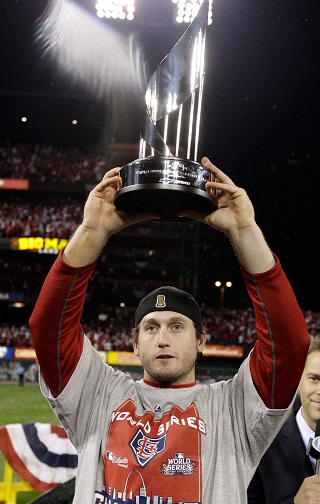
David Freese hoists the 2011 World Series MVP trophy. He’d also won that National League Championship Series MVP.

Notoriously enough at the time, Hall of Famer Reggie Jackson pre-Yankee mused aloud, “If I played in New York, they’d name a candy bar after me.” When fellow Hall of Famer Brooks Robinson was given a day at Baltimore’s old Memorial Stadium, on the threshold of his retirement, the host of the event told the cheering crowd, “Around here they don’t name candy bars after Brooks—they name their children after him.”

When David Freese made the St. Louis Cardinals’ difference in the 2011 National League Championship Series, I noted—after recalling he first thought his trade from the San Diego Padres to the team for whom he grew up rooting madly, the Cardinals, was a joke—“(E)veryone except citizens of Milwaukee might be laughing with the National League Championship Series’ most valuable player.”

In St. Louis, of course, they may be ready to name a candy bar after him. Freese’s Pieces, anyone? It isn’t everyone who comes up from oblivion to out-slug Albert Pujols when Pujols is having the best postseason set of his career, or drives home a ferocious exclamation point on it Sunday night with a first-inning blast that merely starts the Cardinals en route a secured trip to the World Series.

Who knew after Game Six of that NLCS that Freese’s series would prove a mere dress rehearsal for the big event to come? Not even Freese himself, about whom Joe Posnanski—amidst a series in The Athletic remembering sixty transcendent baseball moments—writes with loving eloquence that he was one kid who got to live every baseball kid’s backyard or schoolyard dream, suiting up for the home team he grew up loving, and hitting the blasts that either send the team to the Promised Land or yank them back to the threshold.

Most such kids would sell their souls to get a chance to do it for the home team even once. Freese did it twice, also in Game Six, but this time during the 2011 World Series. He tied it with a two-run triple in the bottom of the ninth and won it with a leadoff home run in the bottom of the eleventh. Telling the Texas Rangers, “Not so fast,” he sent the set to the seventh game his first-inning, game-tying two-run double would help the Cardinals win.

Think about the roll of Cardinals World Series heroes and from whence they came in the first place. Grover Cleveland Alexander (pitching and winning Game Six to send the 1926 Series to a seventh game his team would also win)—Elba, Nebraska. Pepper Martin (hitting .500 in a seven-game 1931 Series)—Temple, Oklahoma. The Dean brothers (Dizzy: two wins; Paul, two wins, including Dizzy’s Game Seven shutout, 1934 Series)—Lucas, Arkansas. Enos Slaughter (the Mad Dash, Game Seven, 1946 Series)—Roxboro, North Carolina. Bob Gibson (MVP of the 1964 and 1967 Series)—Omaha, Nebraska. Darrell Porter (MVP of both the 1982 National League Championship Series and World Series)—Joplin, Missouri. David Eckstein (resident pest and MVP, 2006 World Series)—Sanford, Florida.

Did somebody mention Sandy Koufax? He got to be a World Series hero twice for his hometown Dodgers, the MVP of the 1963 and 1965 Series—but that came after the Dodgers left Brooklyn for Los Angeles, and after a serious hitch in Koufax’s delivery was caught at last and fixed in spring training 1961, turning him from an untamed talent into an off-the-charts Hall of Famer.

Think a little bit, too, of how many players were Hall of Famers who came up too short in postseasons if they got there at all. Of how many—like Freese—who weren’t Hall of Famers on the best days of their regular season lives, but played like Hall of Famers when they did get to the big postseason dance. Of how the Freeses of the game live the truth of Gene Hackman’s valedictory in (of all things) the football film, The Replacements: “Greatness, no matter how brief, stays with a man.”

(Eckstein? Al Gionfriddo? Dusty Rhodes? Sandy Amoros? Don Larsen? Moe Drabowsky? Al Weis? Donn Clendenon? Gene Tenace? Brian Doyle? B.F. Dent? Dave Henderson? Mickey Hatcher? Sid Bream? Tony Womack? Edgar Renteria? Luis Sojo? Scott Spiezio? Scott Podsednik? Carlos Ruiz? Pablo Sandoval? Steve Pearce? Call your offices.)

Porter came the closest to being a homegrown Series hero, Joplin being a measly four-hour, 284-mile drive to St. Louis. Freese was born in Corpus Christi, Texas, but raised in St. Louis’s Wildwood suburb. He’d set Wildwood’s Lafayette High School’s single-season record of 23 home runs and a .533 batting average in his senior year, but felt burned out enough by baseball to spurn a baseball scholarship at the University of Missouri to try studying computer science instead.

So much for that idea. After visiting Lafayette during a summer while working in his school district’s maintenance department, Freese gave baseball another shot at two other schools and—the year Eckstein made himself the cockroach the Detroit Tigers couldn’t exterminate in the 2006 Series—made himself the Sun Belt Conference’s player of the year. The Padres drafted him in 2006’s ninth round.
2020-07-12 DavidFreese

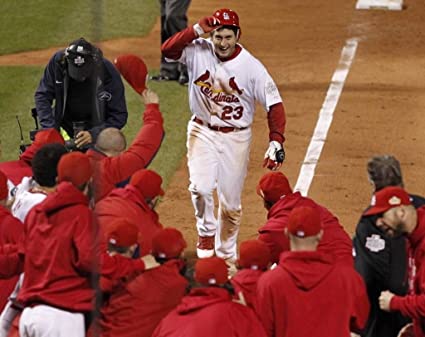
Freese about to hit the plate in a swarm of teammates, Game Six, 2011 World Series. “I just got beat up by thirty guys,” he laughed to reporters afterward. It was nothing compared to how depression was beating him up inside.

The Cardinals sent a spent Jim Edmonds to San Diego to get Freese in 2008 because they needed a solid minor league third baseman. Then, with former Angels World Series MVP Troy Glaus injured, the Cardinals needed Freese—until they didn’t. He didn’t turn up in the Cardinals’ fatigues again until 2010, where a hot start turned unfortunately into a season-ending ankle injury that June.

His 2011 threatened to be injury compromised, too, a hand fracture when hit by a pitch costing him 51 games. After his return, he finished the regular season with a flourish of eight hits in the final nine games. Then came the NLCS. Then came the World Series. Then came first and second with two outs for Freese in the Game Six bottom of the ninth, against Rangers closer Neftali Feliz. Then came Freese on 1-2 down to his and the Cardinals’ final strike—of game, set, and season.

Then came Freese swinging at a fastball on the outer half of the plate. “The beauty of it,” Posnanski wrote at the time, “was that in the instant after the ball was hit, it had a chance to be anything.”

He had obviously hit it well — the ball cracked off the bat — but there was no telling how well. It had a chance to be a home run. It had a chance to be an out. I have written before that there is nothing in sports like the successful Hail Mary pass in football, and the main reason is that no two Hail Mary passes are alike. Sometimes they deflect from one receiver to another. Sometimes they bounce off the defenders’ hands and back to a waiting receiver. Sometimes the pass just drops into a pile and sticks in a receiver’s hands. Really, there are countless geometrical possibilities. Baseball doesn’t usually have that kind of geometry. Home runs are home runs. Singles are singles. Pop-outs are pop-outs . . . But Freese’s fly was something like a Hail Mary. There was just no telling how it would turn out while the ball was in the air.

Rangers right fielder Nelson Cruz misjudged where the wall was, playing in the Rangers’ no-doubles defensive alignment, and the ball sailed over his head and into the wall. It sent the game to extra innings, where Josh Hamilton restored the Rangers’ two-run lead with a home run in the top of the tenth but a pair of singles, a run-scoring ground out, and Lance Berkman’s two-out RBI single—with the Cardinals again down to their final strike—tied things up again, this time at nine each.

Then Jake Westbrook kept the Rangers to a mere base hit in the top of the eleventh and Freese led off the bottom against Mark Lowe. Remember, now, that this was also the Series in which Pujols channeled his inner Reggie Jackson in Game Three, hitting three home runs—from the sixth inning forward, nourishing a 16-7 blowout. Who could possibly top that?

For that matter, who could possibly top Freese’s Game Six-tyer? The one that turned eight innings of somewhat sloppy baseball into three innings to come of surrealistic baseball? The answer turned out to be Freese himself. On a full count. On what looked like a changeup hanging into the middle of the plate. Over the center field fence, onto the green lawn beneath the Busch Stadium batter’s eye. With Hall of Famer Nolan Ryan, then the Rangers’ president, watching from the field level seats in abject disbelief.

Trotting around the bases as the Rangers left the field, Freese slammed his batting emphatically onto the third base line, down between his briefly leaping legs, a few feet before he hit the plate to be buried by a swarm of celebrating teammates. “I’m just about out of breath,” Freese told reporters in an on-field post-game interview. “I just got beat up by thirty guys.”

His Hall of Fame manager Tony La Russa—whose Game Five bullpen communication breakdown got close to vaporising his image as a tactical master and big-picture strategist, and who should have blown his team to world-tour vacations for pulling his kishkes back out of the incinerator—could only say, “You had to see it to believe it.”

This was a player who battled clinical depression his entire life, fell into alcoholism while battling it and suffered a small number of accidents and incidents before he became a Cardinal, then took the battle public eight months after he married and while in the Busch Stadium visitors’ clubhouse as a Pirate. “I’ve had moments like that since high school, to be honest,’’ he told USA Today‘s Bob Nightengale in 2017.

It’s been 15-plus years of, “I can’t believe I’m still here.” You win the World Series in your hometown, and you become this guy in a city that loves Cardinal baseball, and sometimes it’s the last guy you want to be. So you start building this façade, trying to be something I was not. And the whole time, I was scared to death what was going to happen to me after baseball.

. . . Who knows where I was headed, but as long as I was here, I had so many friends here, I wasn’t good at just saying no. I wanted to please people, make everyone happy, and that became impossible.

What happened was the Cardinals trading Freese to the Los Angeles Angels in November 2013, the Cardinals knowing Freese needed to leave in the worst way possible to blow the pressures away. That was part two of what began resolving his inner turmoil. He met part one at his friend’s media studio a week before the deal, an intern named Mairin O’Leary—who became Mairin Freese in the simplest ceremony possible, in a Pittsburgh coffee shop in September 2016. Over a crepes breakfast.

Freese had one more chance at postseason glory as a 2018 Dodger. He did his part, hitting leadoff home runs in Game Six of the NLCS and Game Five of the World Series, but the Dodgers fell to the Boston Rogue Sox who may or may not have deployed their now-infamous replay room reconnaissance ring sign-stealing plot during that postseason.

When he retired after last season, Freese no longer saw his stupefying 2011 postseason as a cross to bear from behind the wall of depression. He looked forward to taking his almost three-year-old son to a live Cardinals game in due course. Not to mention showing the little boy what Daddy delivered in Game Six. And all that postseason, including a still-record fifty total bases and 21 runs batted in.

“It’s going to be cool when Kai understands and I show it to him,” Daddy told the St. Louis Post-Dispatch as he retired, “and he says, ‘Is that really you on the TV?’ He understands it’s me now if he’s watching and there’s a closeup of me hitting or something. It is going to be cool (showing him the World Series ring). Look at that damn squirrel. He might not care, which might even be cooler.”

Kai Freese will have to wait, unfortunately, until the coronavirus world tour dissipates enough to let the games bring the fans back to the stands. His father has probably told him, “Trust me, it’ll be worth the wait.”

“There are 270 players in the Baseball Hall of Fame. There is only one player who grew up in St. Louis and got to live the dream again and again for the team he grew up loving,” Posnanski writes, observing the contrast between Hall of Famers who lacked for truly signature moments and ordinary men who have one that transcends the game itself. “I suspect David Freese is pretty happy with how it turned out.”

The guy who made St. Louis baseball the happiest place on earth in 2011 fought hard enough to get to happiness with how his baseball legacy turned out in the first place.
Rank desertion? Don’t even go there.

2020-07-11 BusterPosey

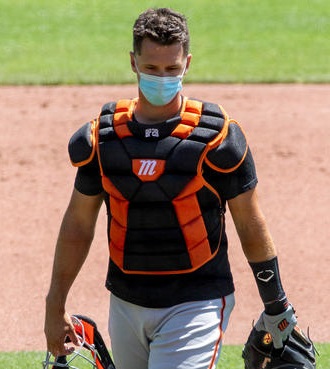
San Francisco Giants catcher Buster Posey has opted out of playing this year for the sake of his children—an incumbent pair of twins and a pair of twin newborns freshly adopted. Some dare call it desertion—erroneously.

Whatever else you think about those major league players who have opted out of playing in 2020, or who think about doing so, here’s something that shouldn’t come into play: someone snarking about such players committing “rank desertion.” (So help me, that’s how someone phrased it in one online baseball forum.) Ignore them. Let them rant their heads off, but you’re under no obligation to listen.

That’s one of the beauties of free speech, what’s left of it. You can rant your head off any old time and place it strikes you to rant. You also bear no known mandatory obligation to listen to any particular ranter for any particular reason.

Militarily, of course, “rank desertion” equals one soldier, sailor, marine, or airman, or a group of them, walking away from their units or posts without call, usually but not exclusively in wartime. In civilian terms, “rank desertion” implies someone or a group of someones walking off the job where there’s no known option aside from a labour strike or formal resignation to do it.

The players were given the opt-out option after all those weeks of haggling between the owners trying to game them out of agreed-upon-in-March pay protocols before they finally agreed to give what remained of a 2020 season a try. Handed that option, those players exercising it cannot be accused credibly of rank desertion.

There’s a coronavirus still on world tour, to various extents, and baseball players play and sojourn in places that still present exposure risks they’re not entirely anxious to bring home. Especially when they have loved ones considered in the high-risk category.

San Francisco Giants catcher Buster Posey may be the highest-profile player to opt out of the season to date. There but for the curse of injuries might he be in the Hall of Fame conversation; maybe two or even three more injury-free seasons on his jacket might keep him there. He could still get those seasons beginning next year.

As was his right under the current protocols, Posey thought more than twice about the twin babies he and his wife, Kristin, are adopting. They were born prematurely last week and at this writing remain in neonatal intensive care. The San Francisco Chronicle says the little girls are doing well enough in the circumstance.

Already the father of incumbent twin children, Posey weighed the risk and pondered the opt-out option that has yet to be rescinded. Then, he made his decision for the sake of his children’s health. The same decision Los Angeles Angels demigod Mike Trout continues weighing as the birth of his first child with his wife, Jessica, looms next month.

Trout isn’t exactly on poverty row so far as major league baseball players are concerned. Neither is Posey, even if Trout is above and beyond his and any other player’s pay grade. Atlanta Braves outfielder Nick Markakis has a family to consider as well, and he’s not exactly going to be among the poor by opting out of 2020, either, as he did during the week now past.

Two factors moved Markakis to opt out, the risk to his family and the very real COVID-19 infection incurred by his franchise co-face face teammate Freddie Freeman. (Braves fans have a case to make that Freeman now shares the distinction with Markakis’s fellow outfielder Ronald Acuna, Jr. Markakis also admits playing with no audience at first doesn’t exactly pose a thrill.)

Markakis spoke to Freeman by phone and learned fast enough. “Just hearing him, the way he sounded on the phone, it was tough,” he told reporters last Monday. “It was kind of eye-opening. With everything that’s going on, not just with baseball but all over the world, it makes you open your eyes.”

Felix Hernandez, the longtime Seattle pitching bellwether now trying to resuscitate his career with the Braves, has also opted out of 2020. So has Michael Kopech, the Chicago White Sox pitcher who’d otherwise hoped to begin his return from his 2018 Tommy John surgery. So has Colorado Rockies outfielder Ian Desmond, whose teammate Charlie Blackmon was hit with COVID-19 and who has alarms about equal to health alarms for doing so.

On health terms, Desmond and his wife, Chelsey, are already parents of four young children and Mrs. Desmond is pregnant with their fifth. That’s the immediate reason Desmond exercised his opt-out option. But it provided him a chance to speak publicly enough on social and even spiritual terms.

Desmond—who is bi-racial—laments what the George Floyd murder at police hands in Minneapolis re-exposes of society in general and, from his perspective, the game he loves otherwise. “Think about it: right now in baseball we’ve got a labor war,” Desmond began in a round of jolting but thought-provoking Instagram posts.

We’ve got rampant individualism on the field. In clubhouses we’ve got racist, sexist, homophobic jokes or flat-out problems. We’ve got cheating. We’ve got a minority issue from the top down. One African American GM. Two African American managers. Less than 8% Black players. No Black majority team owners.

Perhaps most disheartening of all is a puzzling lack of focus on understanding how to change those numbers. A lack of focus on making baseball accessible and possible for all kids, not just those who are privileged enough to afford it.

If baseball is America’s pastime, maybe it’s never been a more fitting one than now . . .

Other opt-outs, also for familial health concerns, include Los Angeles Dodgers pitcher David Price (who has yet to throw a pitch in regular-season competition for them), and three Washington Nationals: first baseman and elder statesman Ryan Zimmerman, relief pitcher Joe Ross, and catcher Welington Castillo.

Baseball’s coronavirus testings have not exactly proven the epitome of consistency or coordination. Teams like the Giants, the Nationals, the Houston Astros, the St. Louis Cardinals have postponed several “summer camp” workouts over them. Astros third baseman Alex Bregman skipped a subsequent Astros workout when his test didn’t arrive back on time. That had a few of his teammates more than a little shaky.

“We want to know how these test results are going to work out for us,” said outfielder Michael Brantley. “Not having Alex here today was just another day he didn’t get to prepare. As I read around the league, a lot of players are voicing their opinions that we need our test results back faster.”

You can say anything you wish about those players opting out and others yet to come who opt out of 2020 for their health’s sake first. If baseball’s testings continue being that inconsistently performed and handled, would you really be shocked to see more players deciding their health and their families’ health just can’t be entrusted to that? Regardless of their salaries?

You can also say as you wish about Desmond’s not-to-be-dismissed-out-of-hand thoughts regarding the first American team sport to end segregation officially while still having issues 73 years later accepting and assimilating non-white personnel on and off the playing field. You don’t need to demand a quota system to say baseball can, should, and must do a better job of it.

Much as we’ve missed a major league season thus far, we seem to need reminders more often than comfortable that certain things cut both ways. Things like the “human element,” for example. The traditionalists screamed blue murder over technological advances they thought (erroneously) would erode the “human element.” But it isn’t just traditionalists dismissing the opting-out as rank deserters.

That dismissal is a plain, no-further-discussion-necessary false dismissal of, what do you know, the human element. The element that says baseball players are not invincible androids who can’t be felled by or transmit disease but mere human men, prone to all manner of incurring and transmitting affliction, particularly during a pandemic that’s become as much a political football as a challenge to medicine.

The rank desertion accusers should be asked how swiftly they’d step in and take the risk for the sake of playing a game much beloved but not without risk. When they answer, “five minutes ago,” they should be asked just as promptly whether they’d like to bring an infection back to their loved ones.

The crickets should be heard playing the entirety of a classic jazz album—In a Silent Way.

Landis sided with the angels, once

LandisAverillHOFPlaques

When Earl Averill demanded a piece of his sale price from the PCL to the Indians, Landis—wrong without integrity about much—actually sided rightfully with the Hall of Fame outfielder.

The current discussions about whether to replace Kenesaw Mountain Landis’s name from the Show’s Most Valuable Player awards aren’t out of place. (My view is: yes, replace it.) History deems baseball’s first commissioner a tyrannical autocrat who behaved purely for the owners’ good and enforced baseball segregation.

But Landis stood squarely on the side of the angels at least twice during his reign, and those should not be forgotten, either.

Everyone knows he administered justice, sometimes more rough than just, when it came to baseball’s criminal gambling elements. What everyone doesn’t remember or know is that Landis once displayed remarkable insight and foresight when it came to selling players. Insight and foresight which, if heeded, might have made baseball’s future economics very, very different.

A kid from Snohomish, Washington named Earl Averill made the Pacific Coast League a personal playpen from 1926-28. The San Francisco Seals outfielder hit for a .342 traditional batting average and a .538 slugging percentage, with 79 home runs including 36 in 1928.

That caught the eyes of the Cleveland Indians, and the Tribe opened the checkbook and bought Averill from the Seals for $50,000, agreeing that Averill didn’t have to report to them until after the PCL pennant race ended. Averill was normally a quiet type whose passions included flowers and animals. But the future Hall of Famer was savvy enough to flinch when he read about the sale in a newspaper.

Until I read The New Bill James Historical Baseball Abstract I had no knowledge that Averill actually asked how much of that sale price he could expect to receive. James didn’t say whether or not either the Seals or the Indians laughed their fool heads off over that question.

What he did say was Averill’s answer: translating loosely, wanna bet? The outfielder decided he wasn’t going anywhere no matter how ardently the Seals and the Tribe determined to convince him otherwise. The debate reached Landis’s eyes and ears, and Landis must have surprised anyone privy to his thinking with his response.

The commissioner agreed with Averill. He actually believed Averill wasn’t out of line demanding a piece of that $50,000 sale price. Landis suggested, as James paraphrased, “that baseball should adopt some sort of legislation by which, whenever a player was sold, the player himself would get a cut of the proceeds.” Say what?

Perhaps needless to say, the suggestion went the way of the cylinder phonograph. You could only imagine the major league owners of the time demanding Landis reveal what was in his tea in that moment because they wanted to get swacked, too.

The impasse between Averill and the Indians ended when the Tribe paid him a $5,000 bonus and signed him to a salary somewhat higher than the standard major league rookie salary of the time. He went to Cleveland and launched the Hall of Fame career compromised when a back injury in a 1937 game wrecked his formidable swing.

Bad enough, perhaps, that Landis’s suggestion went nowhere fast enough, but worse was that it never entered the mind of his successor four times removed. Bowie Kuhn so despised Oakland Athletics owner Charlie Finley that he let it get in the way of sound judgment and put a needless virus into baseball’s economic system.

Quaking over the Messersmith-McNally ruling that ended reserve clause abuse and ushered in free agency, Finley fumed when three of his top players—pitchers Vida Blue and Hall of Famer Rollie Fingers, plus outfield star Joe Rudi—refused to sign 1976 contracts lacking no-trade/no-cut clauses, the issue that prompted Andy Messersmith to pitch 1975 without a signed Los Angeles Dodgers contract in the first place.

When Finley brought those three plus third baseman Sal Bando to his sale floor in June 1976, it provoked a bristling crowd of buyers. When the word reached Kuhn at Comiskey Park, where he was watching the Chicago White Sox host the Baltimore Orioles, Kuhn said, wanna bet? He voided the sales, claiming they’d be “devastating” to baseball’s “reputation for integrity.”*

Players too well accustomed to front-office duplicity probably laughed themselves into headaches. Especially when Kuhn continued, “If such transactions now and in the future were permitted, the door would be opened wide to the buying success of the more affluent clubs, public suspicion would be aroused, traditional and sound methods of player development and acquisition would be undermined, and our efforts to preserve the competitive balance would be gravely impaired.”

To James, Kuhn closing Finley’s version of Toys ‘R’ Us “was an ignorant, bone-headed, destructive policy which had no foundation in anything except that Kuhn hated Charlie Finley and saw that he could drive Finley out of the game by denying him the right to sell his [star] players.”

What Kuhn should have done, if he had been thinking about the best interests of the game, is adopt the Landis policy: rule that players could be sold for whatever they would bring, but 30% of the money had to go to the players. Had he done that, the effect would have been to allow the rich teams to acquire more of the best players, as they do now. But this policy would have allowed the rich teams to strengthen themselves without inflating the salary structure, and would have allowed the weaker teams, the Montreal-type teams, to remain financially competitive by profiting from developing young players.

If Kuhn adopted the Landis idea, it would have put $300,000 into Rudi’s, Fingers’s, and Blue’s pockets immediately. Finley would have screamed blue murder over getting a measly $2.1 million for only as long as it took him to put it in the bank. His three toys would have earned more before playing a single 1976 inning than either of the three did in 1975.

Now we’ll never know how much less the salary structure might have inflated in due course, if Kuhn hadn’t voided the Rudi-Fingers-Blue sales while imposing a concurrent cap of $400,000 on straight cash deals, meaning teams in need couldn’t sell their stars for big money while keeping their bargains on the sales floor for comparative pocket change.

When Averill was elected to the Hall of Fame in 1975, the Earl of Snohomish looked foolish for criticising the Hall in his acceptance speech because of how long it took him to get there. He still looked less foolish than Kuhn did because sticking it to Finley overrode the good of the game.

Somewhere, wherever he was in the great beyond, Landis—who was absolutely on the right side, for once in his baseball life—must have shaken his head in dismay while calling for as stiff a drink as possible.


Some portions of this essay have been published previously.—JK.


* Among other things, Dodgers owner Walter O’Malley pressed Kuhn against the Rudi-Fingers-Blue sales. This makes a travesty of the integrity of baseball. Pennants are not to be bought! read notes historian John Helyar ascribed to O’Malley in the moment.

So said the owner who bought longtime Dodger nemesis Sal Maglie from the Indians in May 1956—a deal that helped make the final Brooklyn pennant possible. Apparently, buying pennants in June was dangerous, but buying one in May was something else entirely.

By the way, the law firm that represented the National League at the time of the Maglie purchase included a young lawyer named (wait for it!) Bowie Kuhn.

Rename the MVP for a player, instead?

2020-07-05 FrankRobinson

The late Hall of Famer Frank Robinson proudly displays his two Most Valuable Player Awards—bearing then as still now the name and head image of the commissioner who enforced baseball’s colour line until his death led to the line’s official breakage.

On June’s final day, knowing of a movement afoot to re-name the Show’s Most Valuable Player Awards, I suggested re-naming them in honour of the commissioner who ended “organised baseball’s” disgraceful colour line. That by itself would rebuke the commissioner whose mealy-mouthed segregation enforcement stained and distorted the game.

Kenesaw Mountain Landis may have brought the criminal gambling elements in baseball to heel with and following the Black Sox scandal, but he absolutely refused to sanction a game open to anyone except white men.

So long as he ran the game with the absolute authority he’d accrued during his term, nobody—not even Branch Rickey, who’d long wanted to break the colour line but knew Landis wouldn’t let him—could even think about it without getting the Landis treatment. The treatment saying verbally that nothing in the rules stopped it, but factually that nobody was going to allow it, either.

It took Landis’s death of heart failure in 1944 to end both his tyrannical reign over the game and the colour line, which didn’t quite end right away. Incoming commissioner Albert Benjamin (Happy) Chandler, elected in April 1945, wasted no time answering when asked by Pittsburgh Courier writers Wendell Smith and Rick Roberts, “I’m for the Four Freedoms, and if a black boy can make it at Okinawa and go to Guadalcanal, he can make it in baseball.”

Rickey now had his chance. Recall that Chandler refused to take office formally until World War II ended but, a week before he did, Rickey signed Kansas City Monarchs (Negro American League) shortstop Jackie Robinson to the Brooklyn Dodgers’ organisation. Having the power to void any contract, Chandler didn’t even think about voiding Robinson’s.

Robinson went to Montreal to get his feet wet. Rickey concurrently signed another pair of Negro Leaguers, pitcher Don Newcombe and Hall of Fame catcher Roy Campanella. When Rickey brought Robinson up to the Dodgers for 1947, Chandler refused to stop him, promising to fight with him instead. The Show’s colour line was broken formally.

In actual fact, 73 years after Robinson suited up for the Dodgers, baseball’s integration remains an up-and-down thing, in the dugouts and on the coaching lines, and particularly in the game’s front offices up and down the organisations. That, I repeat, isn’t Chandler’s fault.

It’d still be a fine gesture—not to mention the final overdue rebuke to Landis—to remove Landis’s name from the Most Valuable Player Awards and replace it with Chandler’s. But there’ve been numerous comments in the press and around social media suggesting that, well, if we’re going to remove Landis’s name from the MVPs, why not replace it that of a player?

That’s not an unsound thought. But Jackie Robinson’s name went on the Show’s Rookie of the Year Awards in 1987. Appropriately enough, since the Hall of Famer and colour line breaker won the first ROY in 1947—when it was a major league, not an each-league award.

Hall of Famer Willie Mays’s name is on the World Series MVP award. The Roberto Clemente Award honours each year’s most charitably inclined player in memory of the Hall of Famer killed in a plane crash on a humanitarian mission. Hall of Famer Henry Aaron’s name goes on the award handed to each season’s best hitter. Hall of Famer Ted Williams’s name is on the award handed to the All-Star Game’s most valuable player. And the pitchers are covered nicely by an award named after a Hall of Famer named Cy Young.

Any one of those players’ names would have graced each league’s regular-season MVP. Since they’re covered on very significant awards already, however, there’s a candidate untouched as yet and still too often under-appreciated for just how great he was—despite being a Hall of Famer and the only man in baseball history still to have won MVPs in each major league.

The Frank Robinson Most Valuable Player Award, anyone?

Robinson died last year after a battle with bone cancer. Three years after his groundbreaking namesake spoke aloud saying he lived for the day when he’d see a black man managing a major league team, Robinson made that wish come true, when the Cleveland Indians named him their player/manager.

As a player, Robinson combined a take-no-prisoners style of play with an often underappreciated sense of humour. Underappreciated outside his clubhouses, that is. Stories abound about Robinson’s wicked wit, including the once-fabled tale of the Baltimore Orioles team bus approaching a junkyard in slow traffic and Robinson asking the driver to stop at the junkyard so less-than-sure-handed outfielder Curt Blefary (whom Robinson nicknamed Clank) could pick out a new glove.

After the Orioles downed the Minnesota Twins in the 1969 American League Championship Series, Robinson hollered in the clubhouse, “Bring on the Mets and Ron Gaspar!” Corrected by catcher Merv Rettenmund—“It’s ROD, stupid!”—Robinson didn’t miss. “Then bring on the Mets and Rod Stupid!”

When he got to manage the Orioles in due course, it came thanks to Cal Ripken, Sr.’s firing as the team’s to-be-infamous 1988-opening losing streak was at a mere six games. Told of a local disc jockey swearing to stay on the air until the Orioles won, Robinson lamented, “We’re gonna kill the poor guy.” When the streak hit twenty straight losses, he  opened his desk drawer and showed a reporter a button he’d been given: “It’s been lovely, but I have to scream now.”

The following season, Robinson managed the Orioles to second place in the American League East and himself into Manager of the Year honours. I could be wrong, but he may  also be the only man in baseball history to win two MVPs and a Manager of the Year award.

Not too shabby for a man who was also a fourteen-time All-Star, a Triple Crown winner (in 1966, his first with the Orioles), a Rookie of the Year (National League, 1956, with the Cincinnati Reds), a World Series and All-Star Game MVP, and—persuaded by the Indians’ front office that he should also play in the first game he managed—squared off against New York Yankees pitcher Doc Medich and blasted a home run his first time up.

After the Orioles started slowly in 1991, Robinson moved to the front office where he stayed until a shakeup left him open to his hiring as baseball’s vice president in charge of discipline. He got one more chance to manage, shepherding the Montreal Expos’s transition into the Washington Nationals.

Robinson often showed his humane side out of the public eye. As the founder and judge of the Orioles’ kangaroo court in the 1960s, he decreed that the fines collected for 1969 should go to Pat Corrales, a catcher on the Reds, after Corrales’s wife died while giving birth that year. When ESPN writer Buster Olney was an Orioles beat writer, he asked Robinson for advice on handling asking his prospective father-in-law for permission to marry the man’s daughter.

“He shriveled in horror,” Olney writes, “his body folding in a nearby seat as if he were ducking underneath a fastball, and Frank began to cackle, his laughter taking the form of a hiss. ‘Oh boy, you’re in trouble,’ he told me, doing everything he could to exacerbate my anxiety. ‘You’re on your own with that one’.”

Robinson also preferred to break barriers quietly. When he joined the Orioles in 1966, a clumsy reporter honest-to-God couldn’t distinguish between him and the Orioles’s well-established Hall of Fame third baseman Brooks Robinson, he cracked, “Can’t you see we wear different numbers?” Relentless though he was on the field, Robinson preferred to break barriers with wit, with a first-inning blast, or quiet reflection otherwise.

“Jackie and Floyd Patterson were brave men to go [integration marches], but I couldn’t,” he told those who wondered why he lend his baseball prestige to civil rights battles. “Not now. Not until I’m through with baseball. I don’t believe baseball should be a fight for anything except baseball.”

The Baseball Writers Association of America (which has the power to do so, since they confer the prize) may not see fit to re-name the MVPs after the commissioner who ended baseball segregation formally and officially. Perhaps they’ll see fit to re-name it for the assassin on the field and the gentleman off the field who won every conceivable MVP award baseball has to confer.

If the Albert Benjamin Chandler Most Valuable Player Award doesn’t work for you, the Frank Robinson Most Valuable Player Award should. Admirably.

A season without the Trout hitting?

2020-07-03 MikeTrout

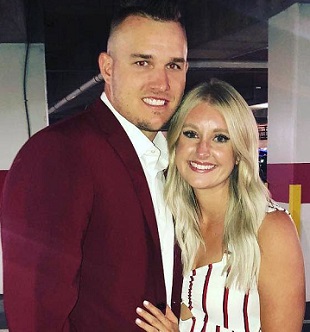
Mike Trout and his wife, Jessica, in a photo they posted to Instagram. If push comes to shove, Trout would rather sit this season than risk infecting her and their child-to-be.

Mike Trout’s virtues include that he’s as close to a hopeless romantic as a baseball player gets. This is the Angel who proposed to his wife by hiring a skywriting team to pop the question. He is also the Angels’ franchise face who’s pondering seriously whether to opt out of playing whatever the 2020 season happens to be.

Jessica Trout expects their first child next month. And her husband the romantic would like to be as certain as a young man can be that he doesn’t bring home such unwanted gifts for mother and child as the coronarivus.

As a matter of fact, the very thought of it makes Trout quake more than any pitcher has ever made the three-(should-be-four-)time American League Most Valuable Player quake. “Honestly,” Trout has told Los Angeles Times baseball writer Mike DiGiovanna, “I still don’t feel that comfortable. It’s gonna be tough. I’ve got to be really cautious these next couple weeks. I don’t want to test positive. I don’t want to bring it back to my wife. It’s a tough situation we’re in.”

Yes, it’s a difference from when Trout was among the players pleading, “When and where,” before the impasse between the owners and the players over starting a season finished. And, yes, there are millions of other people who’ve gone to work at far less lucrative jobs than Trout performs for money some small national economies rarely if ever see.

Let’s just put that into perspective, if we dare. The Wal-Mart or 7-Eleven clerk, the gas station attendant, the Starbucks barista, the cashier or floor walker at Macy*s, the servers at the Olive Garden, the local bartender, the dealers and floor walkers at the casino, are seen doing their jobs and judged on the spot by several thousand people every day.

But not at the same time. Not concurrently on national and even international television aboard which they’re watched by several million as well as the 55,000 who would be in the ballpark in normal, non-viral times. Unless they make a mistake too egregious to ignore, and it happens within range of the nearest smartphone camera trained upon them, their errors are unlikely to go past their boss and their complaining customers.

They don’t get hammered en masse aboard social media for having the occasional 0-for-4 day or night. They don’t get massively insulted for the heinous offense of not coming with 25 clones able to lift a team its best player can’t always be proud of from the ranks of the also-rans.

Whether or not you think it’s a crime, or at least a miscarriage of justice, the clerks, attendants, baristas, cashiers, floor walkers, servers, bartenders, and dealers don’t exactly bring uncounted millions into their companies through sales of their hats, uniforms, and aprons, or other bric-a-brac of their jobs. Nobody’s in half the hurry to hit the nearest Lids, Inc. or call Amazon up on their computers to buy their favourite barista’s Starbucks shirt.

Nobody loves the idea that those folks plus particular farmers, factory or warehouse labourers, repair people, waterfront workers, or airport workers can be replaced simply enough. Replacing a Mike Trout is something else entirely. It’s not his fault the Angels have been a nowhere team for his entire career to date. Good luck asking them (as some social media meatheads have) to just pay the ingrate off and find another player with even a passing resemblance.

Baseball’s paradoxes include one enunciated best by Hall of Famer Sandy Koufax, when he returned to the Los Angeles Dodgers as a pitching instructor in the late 1970s/early 1980s. “You are part of an entertainment, but you are not an entertainer,” he told Thomas Boswell, reflecting on his pitching career. (The article was re-published in Boswell’s anthology, How Life Imitates the World Series.) “But I enjoyed it, probably more than the fans enjoyed watching. I thank them for enjoying it with me.”

To this day people rub their eyes in amazement that Koufax walked away from baseball at the absolute height of his pitching career, at age thirty, because the thought of living without full use of his left arm—which is exactly what doctors told him he risked if he tried to pitch even one more season—troubled him that deeply. Koufax earned $125,000 in his final season, 1966. That salary in today’s dollars would be about $2 million short of what Trout stands to earn just pro-rated for the 2020 season.

Today there are probably people enough rubbing their eyes in amazement that Trout would even think of walking away from just that salary because the idea of becoming infected with a grave disease he might transmit to his wife and his child-to-be offends him as deeply as the idea of crippling himself for life on behalf of just one more season offended Koufax.

After almost three months worth of the owners trying to game the players out of their previously-agreed pro-rated season salaries for whenever a season might be played, the coronavirus world tour shows few if any signs of winding down. The least sensible among us accuse them of malingering while injured; the completely witless have been known to accuse them of inviting the injuries.

When Hall of Famer Ken Griffey, Jr. incurred a few too many injuries during his Cincinnati years, I had a few too many arguments with a few too many Reds fans accusing him of failing to stay in proper shape and thus leaving himself injury prone. As if the most perfectly conditioned athlete could yet avoid three season-ending injuries in four years and their impact on his swing, bat speed, and outfield range.

We see ballplayers as wealthy sport savants and forget more often than we should that they’re human men. (How often do you hear the least sensible fans accuse them of malingering while injured, simply because proper recovery time is longer than fans like?) We barely accept when they’re injured on the field; we wrestle with them now wrestling between their itch to play, our itch to watch them play, and their too real need to safeguard themselves reasonably and their families profoundly.

The most fearless player on the planet finds no reason to quake facing a 100-mph fastball, or running to haul down a fly ball only a foot between himself and disaster against a particularly unforgiving outfield wall. A virus with a particular penchant for death makes him fearful for his family and for himself. Trout knows it.

“I got to be really cautious these next few weeks,” he told an online news conference Friday morning. “I think the biggest thing is obviously I don’t want to test positive and I don’t want to bring it back to my wife. We thought hard about all this, still thinking about all this. It’s a tough time, tough situation we’re in, everyone’s in, and everybody’s got a responsibility in this clubhouse to social distance, stay inside, wear a mask, and keep everybody safe.”

ESPN’s Alden Gonzalez cites an unidentified major league infielder’s concern “how the quick ramp-up to what MLB is calling ‘Summer Camp’ might prevent teams from having the logistics in place to ensure proper social distancing at their respective facilities. He also expressed doubt that all those people making up Tiers 1 and 2 — up to 125 per team, consisting of players, coaches, trainers, front-office executives, public-relations employees and clubhouse personnel, among others — will care enough to consistently adhere to all the health-and-safety protocols.”

Later Friday, MLB and the Major League Baseball Players Association announced 38 of the first 31,185 people going through its screening process tested positive for the coronavirus, and 31 were players. Thirty-eight overall out of 31,185 is .001 percent. Thirty-one out of 38 is eight points higher than Hall of Famer Rickey (The Man of Steal) Henderson’s lifetime stolen base percentage. (.808, if you’re scoring at home.)

Previously, it became known that Colorado Rockies outfielder Charlie Blackmon and twelve members of the Philadelphia Phillies were infected. Today, the Atlanta Braves revealed first baseman Freddie Freeman tested COVID-19 positive.

The game’s government and players have developed protocols for testing and social distancing. But Gonzalez warns, “It will come down to discipline, accountability and self-policing. Positive cases are inevitable; the hope is to avoid the type of outbreaks that might postpone or even cancel the season. If one person wavers, the entire system might collapse. And even if players adhere to monklike sensibilities over the next three to four months, the realities of a pandemic that forges on might render their efforts meaningless. It’s why so many players are hesitant.”

Arizona Diamondbacks pitcher Mike Leake was the first player to exercise the opt-out option on playing this year. Following suit were two World Series-champion Washington Nationals (first baseman Ryan Zimmerman, pitcher Joe Ross), another Rockies outfielder (Ian Desmond), and free-agent pitcher Tyson Ross. There could be more to follow, with or without Trout joining their number.

A third National, relief pitcher Sean Doolittle, who’s become something of a social media star with his wife, Eireann Dolan, through their articulate tweets, has said aloud that he fears baseball won’t work this year no matter the protocols. Eireann suffers chronic lung issues leaving her prone to respiratory infections and with several hospital stays on her resume.

Doolittle would love to play this year but hates to make things worse for her. He’s popular above and beyond his team’s fan base, but he’s not exactly the final face of the Nats. Neither is Leake for the Diamondbacks; they’d take a bigger blow if they lose freshly-minted Madison Bumgarner or breakout star Ketel Marte. Blackmon’s arguably the Rockies’ face (when you can see it under his hat and behind his Bunyanesque beard), but not yet baseball’s. Freeman’s one of the Braves’s two faces. (Ronald Acuna, Jr. joins him.)

Even a truncated season without Trout would shatter not just the Angels but the game itself. Even if commissioner Rob Manfred once decided the reason Trout isn’t the face of the game above and beyond just the sport itself was . . . Trout himself, considering Trout is possibly baseball’s least self-promoting young man.

It’s almost to worry, should more players such as himself finally opt out of playing this year, that Manfred might see any coming opt-outs and decide it’s all . . . Trout’s fault, for opening his big yap, and admitting that push coming to shove would mean he’d rather take the season off than infect his wife and child-to-be.