MadBum hitches his horses to the Snakes

2019-12-16 MadisonBumgarner

Postseason legend Madison Bumgarner takes flight and gallops in Arizona now.

Picture the next time Madison Bumgarner surrenders a hefty home run in his home park and snarks over the bomber having fun with the blast. The bomber’s mates will be inspired to produce T-shirts saying not, “Get it out of the ocean” but, rather, “Get it out of the pool.”

Bumgarner has signed for five years and $85 million with the Diamondbacks, and the nearest body of water into which the opposition can hit is the pool behind Chase Field’s right field fence. Until Bumgarner gets to face the team for whom he served so well, mostly, for the first eleven years of his career, in his former playpen, that is.

A few years ago, Bumgarner’s asking price wouldn’t have been as low as $85 million for five years or more. A few injuries and, more important, a heavy workload have taken their toll, though at 30 years old Bumgarner isn’t exactly ready for Retirement Row. But yes, it does feel a little strange that you’ll see him for the next five in something other than Giants’ fatigues.

And, yes, Bumgarner really did prefer going to Arizona if the Giants weren’t going to be that interested in keeping the greatest postseason pitcher in their history. The Diamondbacks, admirably, have continued remaking/remodeling themselves without even thinking about tanking, and Bumgarner is nothing if not a competitor no matter how much his left arm doesn’t always obey his orders lately.

But The Athletic‘s Bay Area scribe, Andrew Baggarly, says it was personal as well: “Bumgarner told me in July that he and his wife, Ali, loved Arizona and he’d be interested in playing for the Diamondbacks. He gets his preferred destination from a life perspective, he’ll play for a team with way more near-term upside than the Giants, he still gets to hit (in a lively ballpark where he loves to take BP) and he still gets to stare down the Dodgers five or six times a year. What’s not to love?”

Thus does it make a little more sense that, yes, the Giants “were interested and engaged in retaining” the lefthander whose arm span as he’s about to deliver a pitch makes him resemble a Boeing Dreamliner with a bearded cockpit on takeoff; but, no, they weren’t exactly rolling the old red carpet for his landing, either.

Baggarly caught the drift at last week’s winter meetings. When he asked the Giants’ new manager, Gabe Kapler, how he was selling both himself and re-selling the Giants to their franchise World Series hero. When Kapler said he hadn’t talked to Bumgarner and (Baggarly’s words) “wanted to give him his space,” but would still reach out “if others thought it was a good idea.”

“And that was it,” Baggarly continued. “That was all I needed to know. There was no way that Bumgarner would continue his career with the Giants.” Because, of course, if the Giants wanted him to stay and thought they had a shot even at $85 million for five more years (they’re said to have offered four and $70 million), “you can bet that calls and meetings would’ve been set up. Kapler would have begun the back-channeling before he even got the job. The Giants would have tried to assuage Bumgarner’s every concern and dispel every bit of unease.”

Bumgarner isn’t the only one now shouldering into a Diamondbacks jersey who’s a bounceback candidate. The incumbent Snakes ace, Robbie Ray, is looking to make a comparable comeback from a somewhat dismal 2019, and much analysis has suggested the team hoped for enough of a comeback to make him attractive at next summer’s trade deadline. Bumgarner’s signing may have made Ray look positively glittering as a trade topic and positively assured of bringing back a haul of delicious enough prospects sooner.

MadBum is almost as renowned for the pleasures he takes in hitting as he is for that lifetime 2.11 postseason ERA, including a transdimensional 0.25 lifetime World Series ERA. He’ll fume at or bawl out enemy hitter taking a little too much pleasure in a monster mash on his dollar, but he enjoys hitting one for distance as much as the next man. Even if he admits he just can’t bring himself to let the kids play, or play with the kids, when he’s the bomb victim.

A shame, too. Two Opening Days ago I had a little mad fun with MadBum’s hitting a pair out, against the Diamondbacks of all people, one a leadoff blast against Zack Greinke in the top of the fifth, the other a one-out shot against reliever Andrew Chafin in the top of the seventh.(In between, then-Diamondback/now-Dodger A.J. Pollock hit one out off Bumgarner in the bottom of the sixth.)

I wrote a puckish column pondering the dialogue between the then Cy Ruth Award candidate and the Giants’ then-manager Bruce Bochy, leaning a little heavily off the day Bumgarner and then-Dodger Yasiel Puig tangled verbally after a ground out, with Bumgarner—who loves Puig about as much as a small child loves liver (after Puig joined the Reds and took Bumgarner deep, Bumgarner cracked, “He’s a quick study. It only took him seven years to learn how to hit that pitch”)—hollering, “Don’t look at me!”

Forgive me, MadBum, but I couldn’t resist looking at you on that Opening Day:

Bochy: Bum, it’s not that we don’t need the runs, but would you kindly remember that your job with this team is not to do your impersonation of Henry Aaron every other time up?

Bumgarner: Skip, don’t look at me!

Bochy: Bum, I know you were p.o.ed about losing the perfect game in the sixth. But you’re not getting paid the gigabucks to beat baseballs into earth orbit. You’re getting paid the gigabucks to throw them, preferably down the throats of enemy batters. Think you can remember that while you’re bucking for the Cy Ruth Award?

Bumgarner: Skip, just don’t look at me!

Bochy: Bum, you’re embarrassing our hitters. Hitting one 410 feet over the left center field fence on 1-2. You realize how many guys around here can’t hit on 1-2? You bucking to get our hitting coach fired?

Bumgarner: Skip, just don’t look at me!

Bochy: Okay, I’ll give you this one, Bum. That shot you hit in the seventh with one out. 2-0. Now, that’s a more reasonable count to swing on. And you did bust a three-all tie while you were at it. But c’mon, you don’t have to do everything yourself. Even if you’re the one who let them tie it up at three-all in the first place. Well, okay, it was A.J. Pollack, and even you can’t keep him from hitting one out now and then, you’re only human, after all.

Bumgarner: I’m only what?!?

Bochy: I knew that’d get your attention, Bum! Now, about those eleven strikeouts … that’s why you’re getting paid the gigabucks. Wait a minute — hey, Denard! Not a great way to open, getting yourself arrested for attempted grand theft second!

Bumgarner: Don’t look at him, Skip!

Bochy: Anyway, you’re getting paid to strike those emereffers out, not hit them into the Cove, buddy. There’s no Sandy Mays Award in baseball. I need you to start and when necessary close your own games, so far, depending on how much of an improvement this bullpen’s gonna be over last year’s bullpen. Christ, last year we couldn’t get save a thing if we’d had the Red Cross coming out of the pen.

Bumgarner: Rowrowrowrowwwrrrrrrrrrrrrrrrrrrrrrrr!

Bochy: What’s eating you, Bum?

Bumgarner: What’s with this Hoover? Who does he think he’s fooling with that slop? Why doesn’t he go back and make his vacuum cleaners where he belongs?

Bochy: He just struck Pence out after Hunter fought him back to 2-2.

Bumgarner: That ain’t exactly beating as you sweep as you clean, Skip.

Bochy: Where’d you learn your history?

Bumgarner: I play Trivial Pursuit just like any normal guy.

Bochy: Normal! Normal! Any normal guy who gets paid the gigabucks to pitch and strike out the other guys but who gets up to the plate and thinks he’s Mike Schmidt. You call that normal?

Bumgarner: Do I look like Mike Schmidt, Skip?

Bochy: Only when you hit.

Bumgarner: When did he ever strike out eleven guys in a game? Hey! We got first and second. Buster walked and Craw singled him to second. Who says I’m the one who has to do it all?

Bochy: Nunez just lined out to right, in case you weren’t looking.

Bumgarner: Looks like Hoover needs to change his beater bar brushes.

Bochy: Come on, Bum, give the guy a break, you had to squirm a couple of times too, you know.

Bumgarner: I twist and shout, I do not squirm.

Bochy: Have it your way, buddy. Look at him. Throws two balls to Hernandez, then strikes his ass out on three straight pitches. Looked like he took a couple of lessons from you.

Bumgarner: OK, give you that one. Poor Gork, forget the breeze, I could feel the hurricane.

Bochy: C’mon, Bum, you did more than your share today. Take the rest of the day off. Law can handle these guys.

Bumgarner: Okay, Skip, but remember who would have hit second in the ninth. For all you know I had another home run in me.

Bochy: Bum, let’s not get into that again, shall we? Can’t you settle for being the only pitcher in baseball history ever to hit two bombs on Opening Day and let it go at that?

Bumgarner: Well, look at poor Law, Skip. Two hitters, two singles, and Goldschmidt coming up. Whoa! Two straight strikes he throws on Goldschmidt. Now balls one and two.

Bochy: Gimme a break, Bum, I didn’t want Pollock to pounce on you again.

Bumgarner: You’re all heart, Skip.

Bochy: Damn! The bastard tied it up with a single.

Bumgarner: He fought the Law and won.

Bochy: Forget it. Jerry Seinfeld you ain’t. Hold on, I gotta get Law out of there.

Bumgarner: Good call, Skip. Blach got the double play. And Strickland got the strikeout. Now I know you’re gonna miss me hitting in the ninth!

Bochy: You gonna start that again?

Bumgarner: Who’s the genius who decided I could take the rest of the day off when I might have had another home run in me?

Bochy: I dunno.

Bumgarner: Well, don’t look at me, Skip!

Bochy: Hey, look who’s pitching the ninth.

Bumgarner: It’s old man Rodney! And Panik triples off him to open! C’mon, Skip, I could have gotten him home without hitting one out.

Bochy: See? Gillaspie got him home! Sacrifice fly. So it’s not like you hitting your third homer of the game, just shoot me.

Bumgarner: Don’t start with me, Skip!

Bochy: Now I got to get Melancon in there. The season isn’t even three hours old for us and already we’ve got a blown save. Thirty last year wasn’t enough, we gotta buck for forty already? Damn, how could we load up the pads on old man Rodney and not cash those guys in? How could we get Span thrown out at the plate to end that inning? Coulda had a two or more run lead.

Bumgarner: Well, Melancon isn’t getting paid the big gigabucks to go up to the plate and hit grand slams, Skip. Damn, Skip! Two outs, he gives up a double to Mathis and an RBI single to Daniel Freaking Descalso!! And Owings sends home the winning run! Why are we paying Melancon the big gigabucks? I told you you should have had me available to hit in the ninth! You ever heard of an insurance run?

Bochy: Don’t look at me, Bum!

The word is that the man who’s been a horse for the Giants even when he wasn’t pitching at his peak performance level owns horses in the Phoenix area and, with his wife, loves the horses as much as the area and as much as baseball. The man who doesn’t want you looking at him when you recover from a knockdown pitch or take him out of your shared baseball real estate isn’t averse to a little horsing around.

But wouldn’t it be something if baseball could give him dispensation for Opening Day, lets him keep a horse adjacent to the batter’s box, then—if he hits one out—lets him mount and gallop around the bases?

All the Diamondbacks have to do otherwise now remind Bumgarner the only body of water into which the other guys can hit is small, behind the fence, and features a hot tub off to one corner. And, keep him away from dirt bikes.
Yeah, we did, because they did, too

2019-12-15 DerekFisherAstrogate

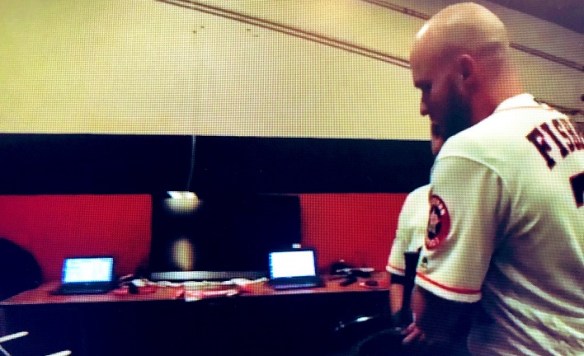
This is the purported monitor setup the Astros used to steal signs electronically, from off the field, in 2017 at least and possibly 2018 and 2019. The larger monitor isn’t engaged but you see two small video tablets on the table. Shown in front of the table is Derek Fisher, an Astros reserve outfielder from 2017 until he was traded to the Blue Jays in July 2019. The image has appeared on numerous Websites.

So the Astros asked for a Minute Maid Park camera out past center field to be taken off baseball’s officially mandated eight second transmission delay, trained live toward enemy catchers, and transmitting live to a dugout television monitor. Because, you know, they were convinced other teams, who knew just how many, were guilty of comparable espionage television networks from off the field and wanted to, you know, level the field a little bit if they could.

Thus reported Andy Martino of SNY Saturday, based upon sources who apparently asked not to be identified in print but had direct knowledge of what was said to the commmissioner’s Astrogate investigators. “They did not install a new camera for sign-stealing purposes, and the players and coaches involved did not even know which camera the feed was coming from,” Martino writes. “They wanted a monitor closer to the dugout, because their video room was too far away. They considered their actions to be in line with industry standards.”

Who were they? The original bombshell by The Athletic‘s Ken Rosenthal and Evan Dillich came from former Astros pitcher Mike Fiers and “four people who were with the Astros in 2017,” all of whom presumably asked not to be identified just yet, if at all. Martino says commissioner Rob Manfred’s bloodhounds have spoken to “nearly sixty people” thus far. An existing video capture shows a former Astros reserve outfielder, Derek Fisher, traded to the Blue Jays in July 2019, standing in front of a table between the clubhouse and the dugout on which were mounted a television monitor showing nothing but two small video tablets showing anything but. And one of the sixty witnesses, according to the aforementioned sources, and presumably unprepared to put his name to it just yet, is quoted thus: “We did ask for a game center field feed to decode signs, as many teams do. All we asked for was a live feed.”

So they broke the rules but they didn’t quite have their own Alexander Butterfield to install a new device dedicated specifically to sign-stealing. Or did they? As Martino observes, it still leaves “questions about whether the camera was installed specifically for that purpose.” And, he asked one: did someone in the Astros front office approve buying a new camera, which would create a paper trail showing the team was preparing to cheat? His answer: “Sources say the camera in question was league-approved and already in place. One source suggested it could have been a scouting camera, which would have been its league-approved purpose. That is more likely than a camera from the TV feed, which would have required the broadcast crew to participate in the scheme.”

It doesn’t acquit the Astros if the hounds turn up the evidence that, yes, there were a few other teams with high-tech espionage operations. Neither will it acquit them to say sure, we broke the rules, but, you know, we’re just the ones who got caught or exposed, and everybody or at least a few others did it, too, so we needed to get in on the fun, too, presumably to nullify the disadvantages. But the everybody-does-it/everybody’s-done-it argument simply disintegrates. Graduate the argument to, say, American political life, then ponder what the everybody-does-it/everybody’s-done-it argument implies, regardless of the partisan or ideological divide, with too many examples that candor requires the intellectually scrupulous to confront.

As far as MLB is concerned, any use of electronics to facilitate sign stealing is illegal,” Martino wrote. “Even Astros witnesses are conceding to investigators that such actions took place, because the feed was aired on a monitor behind the dugout. At this point, the question appears to be not if the Astros broke the rule, but how and to what degree they did it.” Bang-bang! You’re dead. Or, facing consquences at least as considerable, potentially, as those by which former Cardinals scouting director Chris Correa got himself and his organisation slapped after he was caught red-winged hacking into the Astros’ computer scouting database.

They may only begin with punishments administered to general manager Jeff Luhnow, who isn’t necessarily the most popular or respected administrator in the game, and manager A.J. Hinch, who looked to all the world like a schoolboy who knew his trouble only began after he came out of the principal’s office, when buttonholed by the press at the now-concluded winter meetings. It strains credulity now to believe Hinch, heretofore respected for the successful marriage between intelligence and sensitivity somewhat uncommon among major league managers in any era, was the cat caught unaware that the mice raided the refrigerator.

Astro fans aren’t the only fans bracing for revelations as to whom among their players and their coaches were really in on the fun and why, not with the credibility of three American League Wests, two pennants, and one World Series championship under suspicion. But any other team found to have built and operated their own electronic off-field intelligence television networks shouldn’t exactly be clearing space for their Emmy awards, either.


The Angels bag Tony Two Bags

2019-12-12 AnthonyRendon

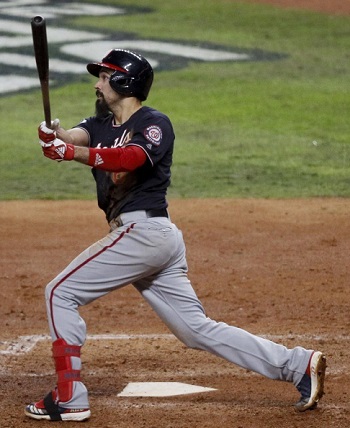
Anthony Rendon hitting the two-run homer that started yanking the Nationals toward winning World Series Game Seven. Tony Two Bags swaps his shark teeth for a halo now.

In need enough of upgrading their starting rotation, the Angels missed their chance to bring either Gerrit Cole or Stephen Strasburg back to their California roots. So they signed Strasburg’s fellow now-ex-National, third baseman Anthony Rendon, for the same time and dollars (seven years, $245 million) it took for the Nats to grant Strasburg’s real wish to stay home in Washington (he’d bought a home there quite recently) for the rest of his baseball life.

Tony Two Bags swaps his shark’s teeth for a halo. And now that they’ve turned third base from a swamp into rolling rapids, the Angels can get right back to the pitching pursuit.

They needed to upgrade at third base almost as badly as they need a pitching upgrade. A trio of third basemen produced a combined 2019 OPS (on-base plus slugging percentage) .359 lower than Rendon’s 1.010. And if nothing else Angel fans should be frothing at the mouth over the prospect of Rendon joining the game’s prize Trout in a tag team that accounted for 14.6 wins above replacement-level last season. That’s a remarkable enough difference if they could have been together then.

Fourteen wins might have meant an 86-76 instead of a 72-90 Angels season. Assuming the Angels don’t stop with Rendon on this winter’s market, free agency or trading alike, they still have room for the pitching upgrade. And to say the Angels require a pitching upgrade is to say Washington, the government and not their world champion baseball team, requires remedial constitutional training.

The entire 2019 Angel staff encouraged walking for sound mind and body; they walked 3.9 batters per nine innings while striking out 8.8 per nine. Their collective earned run average was 5.12 and their collective fielding-independent pitching was 5.04. Collectively they were stingy when it came to surrendering big flies (1.7 average per nine innings) but generous beyond belief when it came to atoning for strikeouts by letting the other guys do the stroll. (2.44 K/BB ratio.)

The bullpen was superior enough to the rotation that you wondered for a few moments why the Angels didn’t go to more bullpen games when feasible than they did. (The crown jewel, of course, was that 13-0 combined no-hitter blowout against the Marines in their first home game following the shocking death of Tyler Skaggs, their best starting pitcher.) The only Angel with an ERA and an FIP below three? Hansel Robles, relief pitcher, the former Met who succeeded where another former Met (Matt Harvey, started) had his moments but collapsed enough to be designated for assignment and released.

What to do this winter, then? At this writing Madison Bumgarner, whose postseason jacket has only Strasburg for a near-equal match, remains on the market and a solid candidate to continue the remaking/remodeling he began in 2019. Also on the market is Hyun-Jin Ryu, the National League’s 2019 ERA leader. Angels owner Arte Moreno is nothing if not a man with stupid money to spend and a reputation for several times spending stupid, but the Angels aren’t exactly hurting for resources and a Rendon signing doesn’t pull them out of the market quite yet.

Bumgarner isn’t likely to cost as much now as he might have a few years ago, and the latest reporting as I write indicate he seeks five years at $100 million, pricey in terms of the average annual value but something of a bargain over the life of the deal. He has a reputation as a Fun Policeman but isn’t otherwise sinister so long as you keep him away from dirt bikes and remember that Angel Stadium’s power alleys don’t point into the Pacific Ocean or any other body of water.

He might find himself having a blast challenging two-way Shohei Ohtani to home run contests in batting practise. And, swapping notes on postseason heroism with Rendon, who landed himself a lifetime of quaffs and steaks on the house or at cut rates with such heroics as Game Five of this year’s division series, Game Seven of the World Series, and a 1.093 OPS toward the Nats’ run to the Promised Land.

Ryu may or may not be a more elusive target, not that he’s seeking stupid money but that there are several teams training their sights upon him, including (it’s said as of this morning) the White Sox, the Twins, and the Dodgers for whom Ryu laboured six seasons. And the White Sox have a kind of incentive with Ryu’s former Dodger catcher Yasmani Grandal having signed with the White Sox for four years and $73 million and said with certainty enough that he’d love to catch Ryu once again.

The better incumbents among the Angels’ starting pitchers, Andrew Heaney and Griffin Canning, are suited better to number three and four positionings pending any adjustments they might begin making come spring. The talent is there for both pitchers but so has been the inconsistency. But the Angels have a concurrent dilemna with teams interested in prying Canning and their plus right field prospect Jo Adell away in any trades the Angels might seek for a starting pitcher. The Angels may have interest in David Price (a trade candidate) and Price might find himself having a bounceback in Angel Stadium, and the Indians’ Corey Kluber, another former Cy Young Award winner and incumbent bounceback candidate, might be another trade target, but general manager Billy Eppler’s challenge would be to bring them aboard without surrendering the family jewels or at least the holiday china.

Still, you have to hand it to the Angels for landing Rendon, the no-questions-asked best regular player on the open market this winter, who’s going to earn more per season than any third baseman in major league history. Just when it looked as though the Rangers had the most solid track to lay down for Rendon, they derailed it when they offered him six years when the third baseman sought the seven to which the Angels agreed. That, and not such silliness as ejaculated by some who think it’s the media’s fault because, you know, the media prefers the Rendons to be in New York or Boston or southern California, not Texas, is why Rendon chose to wear the halo. That and (never discount this car on a baseball player’s train of thought) the challenge of becoming a big enough part of the Angels’ return to contention and, who knows, the postseason soon enough.

Which is no less than the least the Angels could do en route reconstructing themselves into a team their and the game’s best all-around player, the one who made himself an Angel for life last spring, can be proud of. ESPN’s Alden Gonzalez isolates the point: “In short, the Angels want to win, they know there is a sizable gap to make up, and they’re willing to do what it takes to accelerate their timeline. They made a promise to Trout, who eschewed free agency to sign a 12-year, $426.5 million extension, despite barely sniffing October relevance. And the Angels made a promise to [Joe] Maddon, who chose to return to the organization, despite having his pick of managing jobs. The Angels told them they were going to do what it takes to compete. And with the Houston Astros engulfed in a sign-stealing scandal that could yield significant punishment, perhaps now is as good a time as any to take the leap.”

Nationals shortstop Trea Turner only wishes the Angels hadn’t taken the leap at their expense. He got tight enough with Rendon that they had T-shirts made proclaiming each other best friends. When Turner got the news that Rendon has become an Angel, he had shot for himself a video showing him removing his “Anthony Rendon is my favorite player” T from his drawer and kicking it against the wall. Nats reliever Sean Doolittle was a little less, shall we say, demonstrative, posting a GIF of Baby Yoda and a simple, “Goodbye, Tony.”

Maybe the Lerners could have afforded both Strasburg and Rendon. I thought so myself. But then Thomas Boswell knocked me back down to the planet in gentle but firm terms, when he wrote after the Nats re-signed Strasburg, “Before chanting, ‘The Lerners are billionaires, so just pay Rendon his money!’ look ahead just one year. After 2020, the Nats will have to replace or re-sign — in most cases at higher prices — Adam Eaton, Aníbal Sánchez, Sean Doolittle, Kendrick and Kurt Suzuki. Also, Trea Turner and Juan Soto will soon cost much more.” So maybe they couldn’t afford to keep Rendon among the sharks, too.

It makes a fellow not so proud to be an Astro

2019-12-10 AJHinch

A.J. Hinch, looking as though at minimum he’s been sent to the principal’s office.

Once upon a time a very different generation of Astros amused themselves on team buses and planes by singing a randy song to the tune of legendary musical humourist  Tom Lehrer’s “It Makes a Fella Proud to Be a Soldier.” The late Jim Bouton, an Astro from August 1969 until his aging arm plus the hoopla over Ball Four farmed him out to stay in 1970, said every new Astro received a copy almost at once. Then, he recorded the complete lyrics including this verse:

Now our pitching staff’s composed of guys who think they’re pretty cool,
with a case of Scotch, a greenie, and an old beat-up whirlpool.
We’ll make the other hitters laugh
then calmly break their bats in half,
it makes a fellow proud to be an Astro.

Those Astros hung on the fringe of the National League West race in divisional play’s first season. Today’s Astros, long since moved to the American League (they were the team to be named later in former commissioner Bud Selig’s move of his formerly owned team, the Brewers, to the National League), are three-time American League West winners in the midst of which also came two pennants and a World Series conquest.

Now the Astros have lost a pitcher who didn’t necessarily make the other hitters laugh while he broke their bats in half: Gerrit Cole, who served them better than well for two seasons and proved off-the-charts magnificent down this year’s stretch and in the first two postseason rounds. Reaching his first career free agency, Cole couldn’t resist the Yankees’ extending him a deal for nine years at $324 million, the highest ever to be paid to any major league pitcher.

Which tells you something about what can happen when a good pitcher in sound condition finally became a great pitcher in sound condition in 2019, after joining a team with deeper knowledge of the art and its array of correctives than his former team (the Pirates) ever seemed to allow. And Cole joins the team he helped defeat in this year’s American League Championship Series, the team he would have faced in Game Seven if not for Jose Altuve’s stupefying, game-set-and-pennant winning two-run homer in the bottom of the ninth in Game Six.

Everyone including myself ponders the immediacy of the winners and losers on this winter’s market after Cole’s signing. Including the Astros themselves, whose owner Jim Crane, as CBS Sports’s Dayn Perry observes, “is pointlessly worried about staying under the Competitive Balance Tax threshold. According to multiple reports, the Astros are even shopping star shortstop Carlos Correa in the name of payroll efficiency. The Astros are one hundred percent in win-now mode, and the idea of trading Correa and not bidding vigorously to retain Cole should have fans calling Crane to account.”

For that and a few other things, of course. And some of us including myself ponder, too, whether Cole will bring the Yankees such knowledge as he might have, intimate or otherwise, as regards, you know, the other stuff buffeting the Astros now. The Astrogate probe is now said looking beyond 2017, into both the seasons during which Cole suited up and pitched for the Astros, and you’d be less than human if you didn’t contemplate whether Cole would enlighten his new teammates on the Astro Intelligence Agency as did Mike Fiers when he signed with the Tigers, and subsequently joined the Athletics, after 2017.

Hours before the Cole signing detonated the world in general and the Twitterverse in particular, Astros manager A.J. Hinch discovered his presence at this week’s winter meetings in San Diego meant the press finding it impossible to resist asking him about Astrogate. It was certain that he wouldn’t answer questions about it because the commmissioner’s is an ongoing investigation. And far be it for Hinch to break the rules in this instance, one of which enjoins against speaking up or forth while such an investigation proceeds and progresses.

The cynic would chew on the continuing strain of accepting those rules you’re comfortable accepting and breaking those you’re comfortable breaking, on the assumption that Hinch was surely well aware of the AIA, since the concurrent presumption is that a baseball manager a) is responsible for the doings or undoings by those under his command and b) unlikely under most such circumstances to have disapproved above or beyond the customary “just don’t get caught, boys” admonition.

But still . . . but still . . . “If I was in your shoes, I would be on the other side of this table,” Hinch told the gathering in response to a question. “And I would want to ask questions and find answers and get some more information on the investigation and all the allegations and things like that. I know you’re probably expecting this, but I can’t comment on it. It is an ongoing investigation.”

Associated Press reporter Jake Seiner translated thus that Hinch “is eager to tell his side of the story regarding allegations Houston used electronics to steal signs en route to a 2017 World Series championship, but he is going to let Major League Baseball talk first.” The Athletic‘s Spink Award-winning Jayson Stark (presented his award in Cooperstown this past July) tweeted at about 5:34 p.m. Pacific time Tuesday, “”AJ Hinch just finished 19 uncomfortable minutes of meeting with the media. Mostly declined comment on anything related to the cheating investigation. Said he’s talked to MLB ‘a couple of times’ and now is just ‘waiting’ for a verdict. ‘Everything is in their hands’.”

If you’ve lost the track of the AIA flow chart, it’s this: Live, real-time camera operated from somewhere behind the center field playing area transmits live, real-time signs to the opposing pitcher, which transmission is seen on a large enough, duly connected monitor in the Astro clubhouse adjacent to the steps from the clubhouse to the dugout, in front of which someone, who knows whom just yet, deciphers the signs and transmits them to an Astro hitter with one or two bangs on a large plastic or vinyl trash can, dependent upon which pitch the victimised catcher called.

“I’ve committed my time and energy to cooperate with MLB,” Hinch went on to say Tuesday evening. “I’ve talked to them a couple times, and we continue to work with them as they navigate the investigation, and now we’re waiting with everything in their hands. So I know there’s still going to be questions. I hope there’s a day where I’m able to answer more questions, but I know today’s not that day. I know it will disappoint some people.”

In some other words, Hinch may be anxious to lay it down about Astrogate but any time you need Hinch—heretofore considered one of baseball’s most sensitively intelligent managers—don’t just whistle, and he won’t blow the whistle himself until he has some sort of official dispensation or pang of conscience to do so. If the rules of his profession enjoin against commenting publicly about an ongoing investigation, his immediate answer still leaves Hinch with a dubious look, though not even close to the one left to Crane when, at last month’s owners’ meetings, he, too, dismissed Astrogate questioning.

“If you want to talk about baseball, I’ll talk about baseball,” was Crane’s dismissal, as if electronic cheating from off the field, violating baseball’s specific rule against such espionage, and the likelihood that the Astros aren’t the only team operating such spy operations, had absolutely nothing to do with the game. The painfully few Astrogate comments from within the Astros’ apparatus have included hopes that the Astros don’t become the poster children for something not restricted to themselves, and that’s very much to do with baseball.

If Hinch and Crane were employed instead in the business of the government, answers like theirs might harry reporters and investigators toward exhuming a cover-up almost as ardently as they already harried to the original crime, misdemeanour, or contra-constitutional mischief. Reporters and investigators alike on the Astrogate trail are doing just that, surely. The safest assumption is that more than a handful of Astros knew about and availed themselves of the AIA that sauntered far past the accepted bounds of on-the-field gamesmanship.

Believing Hinch knew nothing of or ignored the operation particularly when the bangs! or the bang-bangs! on the can went booming forth insults our own intelligence. What could he believe they were? Teammates rooting? Between-turns batting practise by players anxious not to be more than a few hops from stepping in as a pinch swinger and thus not repairing to the underground batting cages? Practise for banging a drum slowly during a victory parade?

Commissioner Rob Manfred and his bloodhounds may discover very well that the Astros aren’t the only major league team with a taste for espionage—if they haven’t discovered that already. (Published reporting suggests that as of this writing almost sixty witnesses and over seventy thousand e-mails have been gathered with more, much more to come.) But Hinch is in a position that can’t hold very long, and he may yet experience a pang of conscience akin to that of his former pitcher Fiers, who blew the whistle on and pulled the covers off the AIA in the first place.

Hinch heretofore earned a reputation as one of baseball’s most sensitively intelligent managers, a reputation in danger of being very badly vaporised. His face Tuesday evening showed every suggestion of the schoolboy who knows his trouble has only just begun after he’s finished in the principal’s office. Like Fiers, his conscience pang wouldn’t necessarily mean naming or implying suspects. But Hinch would be to baseball as Alexander Butterfield to the Nixon White House, exposing its sophisticated in-house taping system under Senate questioning during the early Watergate peaks.

Butterfield installed the White House system and owned up. Hinch may or may not have conceived the AIA himself. If he didn’t but he was genuinely unaware, his looks could well become those of a man whose smarts were invaded by incompetence that would strike some as cruelly comic and others as tragic. It makes a fellow not so proud to be an Astro.

There’s no place like home

2019-12-10 StephenStrasburg

Stephen Strasburg makes himself a Nat for life.

The temptation is overwhelming. So for once let’s give in to temptation. Stephen Strasburg, essentially, closed his eyes, clicked the heels of his spiked shoes, and chanted the mantra, “There’s no place like home! There’s no place like home!” And made himself a Washington National for life. Which was the probable outcome, after all, when he first bought a home in the D.C. region and then finished 2019 as the world champions’ World Series MVP.

That, as no few commentators observed in the immediate wake of Monday’s news, is what happens when a pitcher learns within the earliest days of his major league baseball life that he happens to wear the uniform of a team that actually cares about him as a human as well as a pitcher in the long term and not the short range. Enough to withstand a small but incinerating storm of criticism for acting upon it.

That’s what Strasburg learned, not without a little kicking and a little whispering (he doesn’t exactly scream), between 2010 and 2012. When he first hit the old disabled list (known nowadays as the injured list) in July 2010 with a stiff shoulder, hit it again after being in too-obvious pain in the fifth inning of an August start, then underwent Tommy John surgery and missed the rest of that plus the entire 2011 season. When former pitcher-turned-broadcaster Rob Dibble, then a Nats talker, said on the air that Strasburg just needed to suck it up and not call in the cavalry to save his butt every time he felt a little ache, the uproar cost Dibble his job. And helped save Strasburg’s career.

There were none so blind as those who couldn’t and wouldn’t see that there’s no such thing as one size fitting every last pitcher who takes the mound, and that there’s no such thing concurrently as every last pitcher experiencing pain in the limb that earns his keep equaling crystal over iron. It only took baseball thought a century to grok that pitching careers lasting two decades or just beyond were aberrations and not pre-ordained actualities, that you couldn’t and shouldn’t, really, expect every highly talented arm to endure just because some were so fortunate.

Strasburg underwent a surgery named for a man who’d been a quality pitcher for twelve seasons prior to undergoing the first such procedure and twelve more to follow, but a man who wasn’t exactly renowned around the game for throwing like a human howitzer, either. When he returned for 2012, the Nationals elected not to allow their prize, a well-hyped, high-priced product of San Diego State in the first place, to overdo it despite any personal inclination, his first full season back. And once again the hoopla, this time accusing the Nats practically of tanking it on behalf of preserving the crystal, never mind that their 2012 and 2013 shortfalls had nothing to do with the Strasburg Plan.

Strasburg didn’t implode the Nats in Game Five of the 2012 division series, when they followed a 6-0 lead taken in the first two innings by trying to hit six-run homers with every other swing of the bat or by trying to throw three strikes with every pitch from the mound. It wasn’t Strasburg who told the 2013 Nats they could survive without lefthanded relief. He didn’t tell anyone that Bryce Harper could survive trying to make himself the second coming of Pistol Pete Reiser in the outfield just because today’s fences are only slightly more forgiving than the concrete wall in old Ebbets Field, or that the Nats could survive him and other key men (Jayson Werth, Wilson Ramos) on the DL with little substantial reserves on which to call in their absence. And Strasburg wasn’t the genius who told that year’s Nats the starting rotation could take the mound believing nothing better than that they had to throw shutouts just to break even.

There were none so dumb as those who spoke beyond their competence, either. The reports of the Nats’ competitive death were more than slightly exaggerated, and so were those saying their absolute World Series-winning window got slammed shut on their fingers. It took a few years, of course, but there’s something to be said for long-term planning and executing, hiccups (there were plenty enough) to one side, and today the Nats sit as world champions, in large portion because of the 31-year-old righthander who’s graduated through long, hard, smartly managed work into a near-perfect number two starter and a postseason menace.

Set that to one side, however, and listen to those in the know who knew that in his heart of hearts, however tempting might have been the offers that would lure him back to within immediate reach of his San Diego roots (the Dodgers and the Angels were thought to have eyes upon him), Strasburg didn’t want to be anywhere but in Washington. Crunching the numbers is fun and revelatory, especially when you divine as The Athletic‘s Jayson Stark has: “I have to wonder if we should be looking at the actual “value” of this deal by dividing $245 million by seven. That’s because Strasburg was already guaranteed four years, $100 million before he opted out of his last contract. So he actually got three years, $145 million out of the opt-out. That comes to $48.333 million a year. How ’bout that AAV!”

Strasburg didn’t exactly behave after the World Series like a young man eager to hit the road, Jack, as Sports Illustrated‘s Stephanie Apstein records: “The Nationals knew something else: Strasburg wanted this done. During negotiations, he asked for the team to open the ballpark every day so he could work out. So when general manager Mike Rizzo and managing principal owner Mark Lerner identified Strasburg as their top priority this offseason, they decided to act like it. They began discussing a potential deal as the 2019 season closed, and they talked in earnest after Strasburg officially opted out on Nov. 2. That urgency appealed to Strasburg, if not exactly to his agent.”

You can accuse Scott Boras of many things, plausibility be damned as it so often is when his name arises, but not caring about his clients above and beyond the commission dollars they earn him for his efforts isn’t one of those charges. (One of the most plain stupid arguments around Boras essentially denies that this is in fact what agents do, assume the heavy lifting of negotiating for their clients on a properly open job market, which in Hollywood and other entertainment worlds is thought right and proper but in professional sports is thought somehow unseemly if not criminal.)

“To establish a legacy and wear the curly W for his career was something that was very important to [Strasburg],” Boras told Apstein. “And I think it was because he knew that people in this organization cared deeply about him and always cared about his interests and the interests of his family.” Meaning that, for all those moments when Strasburg wasn’t entirely happy about the old Plan, as Apstein puts it, “[S]omewhere along the way, he began to feel grateful that his bosses took the long view. His heart was here, but so was his arm, thanks to those weeks on the bench.”

Now the hardest part will be making sure Strasburg’s long, slow arising up from the stoic presence he was for so long continues. Little by little he learned to loosen up in the dugout and finally couldn’t resist getting drawn into the revelries upon this or that moment’s triumphs. The smiles now far more frequent from his fully bearded phiz can provide backup power in the event of a Nationals Park blackout. As illustrated on Twitter—by the Nats themselves, tweeting the news of his signing not with a look at him on the mound but a look at him hitting and celebrating a mammoth three-run homer against the Braves—Stras gotta dance, too.

Boras isn’t entirely altruistic, of course, and he knows bloody well enough that Strasburg now off the market means his other high-profile pitching client Gerrit Cole stands to make out even more like the proverbial bandit, possibly this week during the winter meetings electrified Monday by the Strasburg heel click, if not by some time in early January. If nothing else Strasburg now prompts the Yankees and the Angels—both of whom are known to be all-in on Cole, both of whom are now bereft of a plausible backup in Strasburg—to remake and remodel the numbers enough that Cole lacking Strasburg’s full track record, quite (Cole’s lifetime ERA: 3.22; Strasburg: 3.17; Cole’s lifetime fielding-independent pitching: 3.06; Strasburg: 2.96), could yet make for spring training a $300 million man.

While you ponder what it all means for Anthony Rendon, in the wake of the Nats saying they could afford either Strasburg or Rendon but not quite both, it’s not yet to rule out that Rendon and the Nats might yet decide it’s worth whatever it takes either or both sides to keep him in Nationals Park, too. The Rangers appear to be in position with Rendon as the Angels and Dodgers, possibly, were with Strasburg before Monday, a homecoming option for the Houston native and a nebula for the Rangers moving into a new climate controlled ballpark and needing such a nebula to help the on-field product and the gate counts. And the Nats still have a bullpen to repair behind Daniel Hudson and Sean Doolittle, which repairs aren’t exactly prone to year-end clearance sales.

Rendon may yet remember that, a year ago, the Nats said publicly they weren’t going to break the proverbial bank for Bryce Harper because among other things they wanted to keep Rendon in the family. (We’ve learned long since that that wasn’t quite the complete story.) And Boras, his agent, too, also has one habit one wishes were known far more broadly than it is, which the Harper talks with the Phillies last winter disclosed: when his client prefers to talk to the incumbent or prospective employer himself, the agent obeys when, as Harper did talking to the Phillies, he’s told politely to keep his big trap shut.

There remains the prospect, perhaps taking his cue from Strasburg, perhaps thinking entirely without that factor, perhaps an equal division between the two, that Rendon, too, will click the heels of his spiked shoes and intone, without once referring to his native Texas, “There’s no place like home! There’s no place like home!”