Mortoned and mashed

2019-10-07 KevinKiermaier

Kevin Kiermaier trots home after his three-run homer in the second opened the can against Zack Greinke and the Astros Monday afternoon.

There’s only one problem with having three stud starting pitchers. You might have one of them going for you on too much rest. And just as too little rest is hazardous to a pitcher’s health, too much rest can get him killed to death, too. In Tropicana Field or elsewhere.

Just ask Zack Greinke, stud starter number three for the Astros. Who hadn’t pitched since 25 September. And, who got killed to death in American League division series Game Three Monday by a Rays team looking to keep their season alive in the first place.

After getting Verlandered in Game One and Coled in Game Two, the Rays flipped the script. They didn’t just Morton the Astros in Game Three, they bludgeoned Greinke for five runs before Greinke could get out of the fourth inning alive.

Charlie Morton, who was key enough to the Astros’ World Series triumph two years ago, had just enough to keep the Astros to Jose Altuve’s one-out, first-inning solo launch over the center field wall. And Greinke had little enough to resist early and often firepower, opening the gates to a 10-3 beating.

Remember with apologies to John Lennon: Baseball’s what happens when you’re busy making other plans. Put it in the bank—the Astros didn’t plan for a fourth division series game or anything else that didn’t involve opening an American League Championship Series with Justin Verlander on the mound against whomever. (Likely the Yankees at this writing, unless the Twins awaken somehow in their Game Three.)

Thanks to the Rays abusing Greinke and about half the Astro bullpen, A.J. Hinch had a decision to make, because Game Three exposed the Astros’ one wounding flaw: they, too, have a bullpen described most politely as questionable. And they’re up against baseball’s arguable best bullpen of the year.

It probably took Hinch all of about five seconds to decide. He wants the Rays to get Verlandered again in Game Four. On short rest, which fazes Verlander about as much as the sunrise fazes a rooster. On three days’ rest, which he’s done only once before in his major league life and almost a decade ago at that.

That may or may not prove a break for the Rays whose bats finally arose from the dead in Game Three. And the resurrection only began when a shaky second inning for Greinke climaxed after two hard earned outs sandwiching Avisail Garcia’s single up the pipe, when Greinke plunked Travis d’Arnaud and Kevin Kiermaier almost promptly hit one high over the left field wall

Just when Greinke looked briefly as though he’d find some reserves by bagging Austin Meadows and Tommy Pham on back-to-back swinging strikeouts in the bottom of the third, Ji-Man Choi, the Rays’ hefty and popular first baseman, unloaded on 2-2 and drove one over the right field wall.

And then the Rays really got rude after Morton—who’d been so important to the Astros’ 2017 World Series triumph, especially his Game Seven finish—shook off Altuve’s leadoff double to get an infield ground out and back-to-back strikeouts (Alex Bregman swinging, Yordan Alvarez looking) in the top of the fourth.

Brandon Lowe, the Rays’ second baseman, hit Greinke’s first service of the bottom of the fourth over the left center field wall. A line out, a strikeout, and a walk to Rays shortstop Willy Adames later, Greinke’s afternoon ended almost mercifully and Hector Rondon entered in time for Matt Duffy—who’d taken over at third in the third after Yandy Diaz experienced a sore foot—to single up the middle and send Rondon out in favour of Wade Miley.

Then Meadows sent one over Astros center fielder George Springer’s head and off the wall to send Adames and Duffy home And Pham slashed the next pitch into right for a base hit sending Meadows home. And after Choi walked but Garcia forced him at second for the side, there the Rays stood with an 8-1 lead after four.

The Astros managed two off Rays reliever Chad Roe in the top of the sixth when Bregman singled, Alvarez doubled, and Yuli Gurriel sent them both home with a turf-hop single up the pipe. But Carlos Correa lined out softly to second base and, after Brandon McKay relieved Roe, Aledmys Diaz pinch hitting for Josh Reddick flied out to right.

At the rate things were going by now it seemed almost natural for Adames to drive a 2-2 pitch over the left center field wall to make it 9-3, Rays in the bottom of the sixth. Or, for Choi to reach on an unlikely high throwing error from Bregman at third, Lowe to send Choi to third with a base hit right over Altuve’s reaching leap at second, and—after Joe Smith, the sidearmer, relieved Miley—d’Arnaud to fly deep enough to right to let Choi almost stroll home with the tenth Rays run in the bottom of the seventh.

In the interim, Oliver Drake pitched two strong innings in the seventh and eighth to further save the bigger bulls of the Rays pen for Game Four, namely Nick Anderson, Diego Castillo, and Emilio Pagan, with Colin Poche sandwiching a strikeout between a shallow pop out to center and a fly to normal right field depth to finish it.

These Astros who normally swing with authority went only 1-for-6 with men in scoring position Monday to the Rays going 3-for-7. Altuve’s first-inning launch tied him with Chase Utley for the most postseason home runs (ten) by second basemen in Show history, while Greinke continued his futility in Tampa Bay—he’s never won a game any time he’s ever pitched in the Trop.

Seven of the Rays’ runs scored with two out; seven Rays drove in runs. Not counting Diaz having to leave early with his foot issue, only d’Arnaud failed to hit safely even once otherwise.

And the Astros’ old buddy Morton showed no respect, either, striking out nine in five innings’ work and remaining perfect in postseason elimination games. Doing it Monday tied him at four such postseason elimination wins with Verlander, John Smoltz, Randy Johnson, Curt Schillling, and Clay Carroll.

Tuesday won’t give Verlander a shot at a fifth such win since the Astros still lead the set 2-1, but you can rest comfortably knowing he won’t complain. Unswept as they remain in postseason play, the Rays could still get Verlandered one more time in Game Four. They’ve never needed a running of their bulls as much as they will come Tuesday.
With the sixth you get steamrolled

2019-10-06 PatrickCorbin

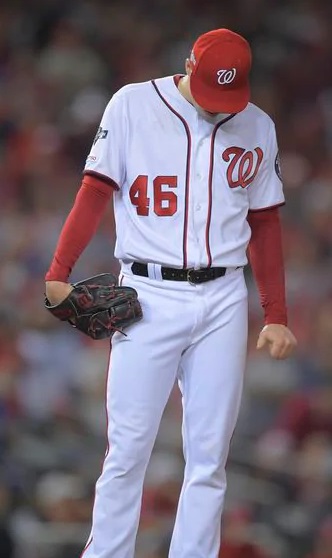
Patrick Corbin, the third man in the Nats’ starters-as-relievers plan, was the first and worst to be torched.

There is one bright side to the Nationals being bludgeoned 10-4 by the Dodgers Sunday night. It means they still have a shot in their National League division series. Because they’ll send Max Scherzer to the mound for Game Four. And all they need is Scherzer to be as close to Scherzer as possible.

If he is, the Nats have a fighting chance. And, Stephen Strasburg on regular rest for Game Five in Dodger Stadium. If he isn’t, they’ll look even more like baseball’s version of a Harold Stassen presidential campaign.

For the time being, though, they might want to can the starter-as-reliever strategy no matter how testy most of their bullpen is. They need Scherzer to pitch them as deep as possible without getting drowned. While praying manager Dave Martinez shakes Sunday off enough not to push anything resembling a panic button.

Certainly not the one he pushed Sunday afternoon, when he lifted his mostly cruising starter Anibal Sanchez after only 87 pitches, five innings, nine strikeouts (mostly on changeups, power worshippers), and a 2-1 lead, the last courtesy of Juan Soto’s monstrous two-run homer past the center field fence in the bottom of the first.

All of which followed Sanchez wriggling unscathed out of a ducks-on-the-pond first inning jam. If the only thing spoiling Sanchez’s gig was Max Muncy’s two-strike launch into the right center field bleachers with two out in the top of the fifth, surely Martinez could have kept Sanchez aboard for one more inning.

Well, maybe not. Whenever Sanchez gets a third crack at a lineup the other guys nail a .923 OPS against him. Maybe Martinez really didn’t have that much of a choice if he wanted to protect a 2-1 lead. Especially knowing his bullpen not named Daniel Hudson or Sean Doolittle were the second most self-immolating group in Washington aside from the federal government.

So Martinez reached for Corbin, the third man in his starter-as-reliever series plan. Maybe it was the right move, but there’s no maybe about how wrong the result ended up. Martinez surely thought the third verse would be the same as the first two.

Then he discovered an impostor in Corbin’s uniform.

Whoever was in Nats number 46 Sunday night, the Dodgers battered him for six runs in the top of the sixth and tied a postseason record with seven two-out runs total in the inning, keeping the Nats to only a two-runs-worth reply the rest of the way.

“Anibal was at 87 pitches. He gave us all he had,” said Martinez after the Nats were put out of their misery at last. “We were at a good spot in the lineup, where we thought Corbin could get through it. And his stuff was good . . . But he had every hitter 0-2. He just couldn’t finish.”

If the stuff was good, the command was hit by a mutiny. And then the Dodgers added insult to immolation when Russell Martin, who started the sixth-inning mischief with a two-run double bounding off the left center field fence, batted on 2-1 with David Freese on first in the top of the ninth and Hunter Strickland on the mound—and sent it into the seats above the left field bullpen.

The Nats must be wondering just what they ever did to Martin to make him treat them so disrespectfully. “You try to feast on mistakes,” Martin said after the game. “And he made a few mistakes.”

After actual or alleged Corbin knocked out two strikeouts following Cody Bellinger’s leadoff single, David Freese singled to right for first and third. And Martin on 2-2 sent a nice, low enough slider to the back of left center, leaving room to spare for Bellinger and Freese to come home. Corbin promptly walked pinch hitter Chris Taylor and the Dodgers knew this was an impostor. Enough for another pinch hitter, Enrique Hernandez, to lash a two-run double deep to left.

Feast on mistakes? To these Dodgers this Sunday night Corbin, or whoever snuck into his uniform, looked like a luau.

“That was one of those things,” Muncy said, “where once one guy started doing it, the next cat picked up on it and it just kind of rolled throughout the inning.” Steamrolled, that is.

Corbin didn’t flinch when a swarm of reporters crowded his locker after the game. “It just stinks,” he said in a voice so low, from so much pain, that you might have missed it unless you were in the front row of the swarm. “I feel like I let these guys down.”

The Nats put Muncy aboard on the house, a wise move considering he’d accounted for the first Dodger run in Sanchez’s final inning with a shot into the right center field bleachers. The wisdom lasted only long enough for Martinez to get the impostor out of there, get Wander Suero in, and and get another jolt when Justin Turner hit one into the left center field seats.

Of course, having nobody in the bullpen more reliable than Hudson and Doolittle complicates things. In a four-run hole the Nats weren’t about to burn either of those two. But bringing Strickland in to deal with the Dodgers in the ninth was almost like hiring Ma Barker to command the FBI. Martin’s launch off him was the ninth bomb Strickland’s surrendered in twelve lifetime postseason innings.

“[R]emember the crick that remains in your neck from watching the delicious meatballs Hunter Strickland has been serving up for weeks,” wrote the Washington Post‘s Barry Svrluga. “He is now a symbol of this battered bullpen and is slipping into ‘He Who Must Not Be Named’ territory.”

“We just have to keep plugging away,” Nats catcher Kurt Suzuki told reporters after the game. “You definitely feel confident. You have the lead. You still have to finish it. That is a good lineup over there. They did their job tonight.”

Suzuki and his Nats need Scherzer to do as close to his normal job as possible Monday. And if they find a ransom demand for the real Patrick Corbin, pay it.

Sunday, bloody Sunday

2019 NLDS Game 3 - Atlanta Braves v. St. Louis Cardinals

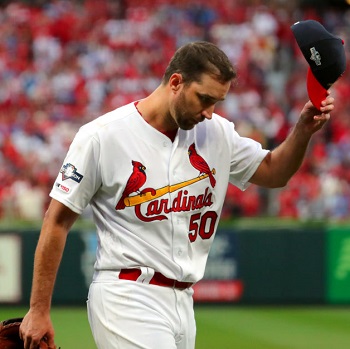
Adam Wainwright’s Sunday virtuosity ended up going for naught.

Adam Wainwright had every reason on earth to feel nothing but a powerful desire to arrange Carlos Martinez’s necktie party Sunday. So did every citizen of Cardinal Country. So did every last baseball fan who prayed for and got an impeccable pitchers’ duel, with the Braves’ Mike Soroka playing Dickey Betts to Wainwright’s Duane Allman for virtuosity.

The duel that ended with Martinez’s Spike Jones sneaking explosives into the drums and the Braves standing one win from a National League Championship Series engagement. It’s a good thing for Martinez that Wainwright is a forgiving soul. He had no intention after the staggering 3-1 Braves win in Busch Stadium of doing anything but giving Martinez a big hug.

“And Carlos will be ready tomorrow,” the 38-year-old righthander who may be approaching the end of a solid if injury-compromised career. “Let’s hope one moment doesn’t define his season, because I’d like to see him get another chance.”

Unfortunately, Wainwright and Cardinals manager Mike Schildt may be the only one with that wish. “He’ll be in that spot [Monday],” the skipper said, “and I’ll have full confidence in him.” He says that now, but . . .

Even Braves closer Mark Melancon had Martinez’s back after the game. “You’re not looking to see guys fail,” he told a reporter. “You want to do it the right way, big on big and beat somebody. We’ve all been there. I can’t say that I didn’t want to win, but Carlos is an incredible pitcher. We’ve got to come back strong tomorrow because he’s going to come back, I’m sure.”

After opening with a leadoff double but two straight strikeouts Sunday afternoon, Martinez surrendering back-to-back RBI hits that broke the Cardinals’ backs and Cardinal Country’s hearts for the bottom of the ninth means nobody’s really sure. “There were some pitches that didn’t go where they were supposed to go,” the righthander said afterward. “I didn’t have the best grip on the slider. I tried to get that pitch to do what it was supposed to do and I didn’t get to it.”

The single greatest exhibition of pressure pitching of Wainwright’s life was laid to waste right there.

With an enviable enough postseason pitching record as it is—he has a lifetime 2.79 ERA and 1.03 walks/hits per inning pitched rate in October—Wainwright for seven innings couldn’t be stopped with a subpoena, never mind a S.W.A.T. team. Especially throwing the curve ball he calls King Charles, the way Mets legend Dwight Gooden’s curve was once known as Lord Charles.

If Wainwright wasn’t quite as masterly as the Astros’ Gerrit Cole the day before, he was close enough and too much so for the Braves’ discomfort. He nailed eight strikeouts, trusted his defenders just enough, didn’t let plate umpire Sam Holbrook’s microscopic strike zone faze him any more than Soroka did, didn’t let his own club’s lack of cash-in offense bother him, and made a 1-0 lead—acquired on a Marcell Ozuna double, a Yadier Molina ground out pushing Ozuna to third, and a Matt Carpenter sacrifice fly in the second inning—feel almost like a 10-0 lead.

Then, after Brian McCann popped out to the third base side near the plate to open the top of the eighth, Wainwright’s tank ran past E. Dansby Swanson shot one through the hole at short for a single. Soroka’s pinch hitter Adam Duvall lined out to third but Ronald Acuna, Jr. worked himself to a full-count walk, Wainwright’s first of the day. And Ozzie Albies walked on 3-1 to load the pads for Freddie Freeman.

Exit Wainwright, enter Andrew Miller, who hasn’t been the same as he was with the Indians thanks to their overworking him while he was hot and a couple of injuries to follow that have sapped his once-formidable repertoire if not his heart. The Cardinals needed it to be classic Miller Time in the worst way possible now.

And after a swinging strike to open, Miller got Freeman to fly out to Dexter Fowler in center field and strand the ducks on the pond.

The problem was, the Cardinals weren’t any better after pushing Soroka’s relief Max Fried in the bottom of the eighth. Fried walked Carpenter to open, with Schildt sending swift Harrison Bader out to run for the veteran. Bader distracted Fried enough to compel a walk to Tommy Edman before Paul DeJong flied out toward the right field line. Exit Fried, enter Darren O’Day.

Also enter Jose Martinez pinch hitting in Miller’s lineup slot. O’Day faked a throw over and Bader took off, only to get hung up between second and third before O’Day threw him out at third. Then Martinez hit a sinking liner to left that Duvall on his horse could only reach and trap. You could taste the RBI that wasn’t on a plate dipped in A-1 sauce.

Bader’s arrest for attempted grand theft loomed even larger after Sean Newcomb relieved Day and got Fowler to fly out to his center field counterpart Acuna for the side. Then Schildt put Bader into center field, moved Edman from right field to third base, shifted Fowler to right field, and called on Carlos Martinez.

Josh Donaldson might have ripped a double past the diving Edman at third and down the left field line into the corner for a leadoff double, but Martinez bagged Nick Markakis and pinch hitter Adeiny Hechevarria—who’d been 4-for-6 in that role since joining the Braves—back to back on swinging strikeouts.

The bad news was Donaldson’s pinch runner Billy Hamilton, whose road running on the bases is almost his only ability that enables him to play major league baseball, getting too much into Martinez’s head. So much so that when Hechevarria swung strike three Hamilton stole third without so much as a beat cop hollering “Stop, thief!”

“At the time you want to get to third with one out, so that was a bad break,” Hamilton told reporters after the game. “But getting to third even with two outs, what if Martinez bounces one in the dirt? I could score. And maybe he has to pitch the next guy differently.”

Then, after Molina and Martinez confabbed at the mound with Molina obviously upset and Schildt joining them to settle them down and get back to business, McCann—the potential go-ahead run—was awarded first on the house and Rafael Ortega assigned to pinch run for the prodigal Braves’ catcher.

Swanson checked in at the plate 0-for-6 lifetime against Martinez. Every star aligned in Martinez’s favour. “The Cardinals start doing game management,” said McCann after the game, “and then Dansby came up clutch.”

Clutch enough to send one off the left field fence and send Hamilton home to tie it at one. “God blessed me with good hand-eye coordination,” the Braves’ shortstop said after the game. “In those situations, you just try and breathe and relax. It’s easier said than done.”

And Duvall dumped a quail into short center down for a base hit, scoring Ortega readily with Bader throwing home but well off and over the third base line, enabling Swanson to score the third run.

Only after walking Acuna did Martinez escape, getting Albies to line out to right. And after Freeman made a sensational extension to hold a wide throw from shortstop and keep his toe on first base to nail Kolten Wong opening, Paul Goldschmidt banked a double off the right field side wall off Melancon. But Ozuna looked at strike three on the inside corner and Molina flied out to center.

It gave the Braves their first postseason series lead in seventeen years and gave the Cardinals a reminder of what they might have really lost when Jordan Hicks, their originally assigned closer, having a solid season to that point, went down with Tommy John surgery in late June. Might.

Maybe a healthy Hicks keeps the Braves pinned in the ninth Sunday. Maybe he doesn’t. Two days after Martinez barely survived to keep a Cardinal win a win, he didn’t survive. And the Cardinals get to host the Braves for Game Four on the fiftieth anniversary of making the trade that helped change baseball.

It was 7 October 1969 when they traded center field mainstay Curt Flood to the Phillies. The trade Flood rejected for the reserve clause challenge that went all the way to the Supreme Court before losing—yet pushing open the door through which Hall of Famer Catfish Hunter and then Andy Messersmith would escort free agency’s advent.

Fifty years ago, too, the Miracle Mets shocked the world with their division, pennant, and World Series triumphs. Their golden anniversary team couldn’t stay the distance even toward a wild card game spot. The Cardinals have bigger stakes to play for on the Flood trade’s golden anniversary.

And a lot to make up for to Adam Wainwright, who’d love nothing more than one more postseason start at minimum. He won’t say he’ll retire after the Cardinals’ season ends; he won’t say he won’t, either.

“(I)n my mind, I’ve got two more series to pitch through, you know?” Wainwright said Sunday evening. “We got the NLCS (and) the World Series pitch through. But first we got to win (Monday). That’s where my head’s at right now. But no, I never once felt like today was it. Either we’ve got more games to win, or I’ve got more games to pitch.”

If his injuries over the years keep him from thinking about the Hall of Fame, Wainwright at least thinks the way a Hall of Famer does. Against a group of Braves who don’t know the meaning of the word surrender just yet, that attitude needs to rub off a lot more on the Cardinals now.


Masterpiece, then theater

2019-10-06 GerritCole

Gerrit Cole was the Dali of pitchers Saturday night . . .

You’d think a man who pitches like Bob Gibson in a postseason contest wouldn’t have to see his masterpiece turned into a hair raiser after he finally has to leave the game. But you can rest assured Gerrit Cole has seen a lot worse than the ninth inning Saturday night.

And you can rest assured further that he’d rather have seen his Astros survive that inning and come out one game from sweeping their way to the American League Championship Series than any known alternative.

Fifteen strikeouts. Five third strikes fastballs, five on curveballs, five on sliders. Missing by one measly walk an immaculate inning in which all three punchouts went swinging strike, foul, swinging strike. His lone walk being the one that ended his evening at last when his petrol ran empty at last.

Mentioned without apology in the same conversations as Gibson (with whom Cole shares uniform number 45), Howard Ehmke, Kevin Brown, and Gibson’s fellow Hall of Famers Sandy Koufax and Mike Mussina, among single postseason game punchout artists.

And what was Cole’s final reward for painting such a masterpiece as Dali himself would envy? Other than watching his Astros more or less sneak a run home in the seventh and eighth, to pad the lead Alex Bregman provided with a leadoff home run in the top of the fourth?

He had to watch his relief Roberto Osuna go from striking out Yandy Diaz—without whom the Rays wouldn’t even have been in the division series in the first place—on three pitches to end the eighth to stringing maybe the skinniest tightrope the Astros could possibly walk in the top of the ninth.

He had to watch Austin Meadows greet Osuna with a liner down the left field line that George Springer, moved over from center in a defensive re-alignment, couldn’t get to in time for a leadoff hit. He had to watch Tommy Pham stroke an immediate followup single right up the pipe. He had to watch Osuna walk Ji-Man Choi to load the bases once.

Then, he had to watch Bregman uncharacteristically bobble for just a moment Avisail Garcia’s bouncer to the left, settling for a force at second but no shot at a double play, and allowing Meadows to score. And, he had to watch Osuna wrestle Brandon Lowe to a full count before walking him to re-load the bases.

Exit Osuna, enter Will Harris, exit Rays catcher Travis d’Arnaud on a hard-earned swinging strikeout, exit Rays center fielder Kevin Kiermaier on a bouncer to first, and for the first time since the eighth Cole and the Astros could breathe without reaching for the oxygen tanks. And the 3-1 win put the Rays’s season on a respirator after all.

“Not the way we wanted to end it,” said Astros shortstop Carlos Correa after the game, “but we got it done and it’s a W.” Maybe the hardest-earned W of a season in which the Astros pushed 107 winning chips to the postseason table. Sometimes even the most powerful threshers in baseball don’t thank their mound lancers by finishing what he started simply.

If Rays manager Kevin Cash thought his team was Verlandered in Game One, they got even more Coled in Game Two. And the Astros’ bullpen got thatclose to throwing Game Two away. Astros manager A.J. Hinch must be feeling very fortunate that he has the kind of starters who make things like the Rays’ and others’ bullpenning a non-topic for him.

“Whether it’s about the new-age opener or pulling guys third time through, most of the people that support that haven’t had Verlander or Cole on their team,” the skipper said, and he’s speaking only the plain truth. Most teams would thank God and His servant Stengel for having just one superstud starter. He’s got three; Nationals manager Dave Martinez also has three.

“It’s hard for me to relate to having to pull guys early or wanting to pull guys early when these guys are putting up these kinds of performances,” Hinch continued. Right again, skip. “I’m going to roll with these boys while we have them.”

He may not yet have to get as creative with his boys as Martinez has had to with Stephen Strasburg relieved by Max Scherzer Friday night, but then Hinch normally doesn’t have a bullpen full of arsonists, either. Hinch has three stud relievers in Osuna, Smith, and Ryan Pressly. Make large room for all the bullpens who’d be grateful to have just one.

Pressly was a non-factor Saturday for having worked in Game One. It’s not scarifying just yet for Osuna to have one off-night, but even these finely tuned, well-oiled, near-perfectly calibrated Astros can’t afford another one too soon if at all. Because even superstud starters like Verlander and Cole have their absolute limits.

Let’s admit that for seven innings Cole didn’t know the meaning of the word “limits.” For seven innings he pitched like two Hall of Famers for the price of one, even as for six  innings the Astros pushed Rays starter Blake Snell—pitching gutsily after missing two thirds of the season on the injured list—and two Rays relievers but couldn’t quite break them except once.

Cole throttled the Rays with his mind almost more than his arm. His reputation in the game, very well earned by now, is that of a man who’ll throw a pitch in the first inning thinking it’s going to set up a pitch four or five innings later.

“He goes to areas of the strike zone whenever he needs to, whenever he wants to, whenever he sees something. That’s creative,” Hinch said after the game. “When we talk about creative, we often talk about guys that don’t have elite stuff like this. He can execute virtually any game plan for a reason . . . His mind and his ability to trust his adjustments set him apart.”

The only real breakage the Astros gave Snell opened the bottom of the fourth. Bregman worked  himself back from 0-2 with three straight solid takes on pitches low and away from him, fouled off an inside fastball, then sent the next fastball to the back of the Crawford Boxes to start what little scoring there’d be in the game.

Cash lifted Snell after he struck out Astros uber-rook Yordan Alvarez swinging right after the Bregman bomb. The Rays bullpen kept the Astros to just that run until the bottom of the seventh, while Cole looked more and more as though he’d go the entire distance without so much as a twitch of nerve or a flicker of exhaustion.

With the Rays’s usual closer Emilio Pagan opening the Houston seventh, Astros first baseman Yuli Gurriel grounded one hard to the hole at short and Willy Adames grabbed it, bobbled it, and threw in the dirt past first. Correa promptly ripped the first pitch down the left field line to the wall for second and third.

After rookie Kyle Tucker grounded out right back to the box, Astros catcher Martin Maldonado, Cole’s personal catcher who doesn’t hit well but handles pitchers like a symphonic conductor, checked in at the plate. He hit well enough this time, dumping a quail into left center enabling Gurriel to beat a throw home for a second Astros run.

It could have been worse for the Rays but somehow Pagan got George Springer to pop out to second and Jose Altuve, Game One’s co-hero, to fly out to the edge of the right field track to escape for the time being.

No such luck in the bottom of the eighth with Nick Anderson on the mound. Diaz knocked Bregman’s hard one-out grounder and threw wide of first enabling Bregman’s infield single. Alvarez then tore the first pitch into right for a base hit and first and second, and Gurriel flied deep enough to right to push Bregman tagging to third.

Then Correa slashed a 0-1 fastball into right to send Bregman home, before Colin Poche relieved Anderson and caught Tucker looking at strike three.

“We’ve got a lot more work to take care of,” said Cole after the game. “There’s a few months this winter that maybe we can sit back and have a drink about it. Right now, it’s on to the next one.”

That may come sooner than even the Astros think. And considering the results in New York—where the Yankees bludgeoned the Twins in the first two games of their division series, outscoring the Twins 18-6 over the two, with the crowning burial Didi Gregorius’s monstrous grand slam in a seven-run third Saturday—they’ve probably got the scouting reports on the Battered Bombers well enough studied.

An Astros-Yankees American League Championship Series would be a hell raiser. The league’s two most triumphant teams and their two most injury battered on the season, both of whom showed they were deeper than the Pacific Ocean when the casualties began. Gray’s Anatomy vs. House.

Says Cash: his guys know what’s at stake. Says Twins manager Rocco Baldelli: his guys know they can turn it around. Say the Astros and the Yankees, with Wade Miley (Astros) and Luis Severino (Yankees) due to start their Game Threes, and just as the man used to say on the radio: it ain’t gonna be easy, Clyde.


Martinez surprises with Max the Knife

2019-10-05 MaxScherzer

Could that someone out of the pen be Max the Knife?

Bet on it: it doesn’t happen if Matt Williams was still the Nationals’ manager. Bet a little on it: it might not even happen if Dusty Baker was still the manager. Davey Johnson, maybe. But it happened through the courtesy of incumbent Dave Martinez.

And it got him a return to Nationals Park with their National League division series against the Dodgers tied at one apiece. The Nats ain’t ready for the last dance just yet. And if they keep this up, they just might get one in the World Series in due course. Might.

Williams was too wedded to The Book, whatever he thought it was, to have even thought about bringing Max Scherzer in from the bullpen in National League division series Game Two. Compared to Williams, Baker was John Coltrane, but I’m not sure even Baker might have gone there, either.

Johnson’s the man who once inserted one relief pitcher into right field and the other on the mound (Roger McDowell and Jesse Orosco, or was it Jesse Orosco and Roger McDowell), then rotated them between the positions until his Mets won the damn game. Johnson just might have reached for Scherzer Friday night.

But Martinez did, in the eighth inning. “We weren’t expecting that,” lamented Dodgers manager Dave Roberts after the Nats finished the 4-2 win they’d started. The Dodgers and just about everyone else in the solar system.

After a long season that only began with the distinct appearance of Martinez awaiting his call to the guillotine as its victim, not its operator, who the hell did he think he was Friday night, Casey Stengel?

The good news was Scherzer striking out the side in the eighth. The bad news was, the Nats still have an honest to God bullpen, and they’re still one of the shakiest bunches this side of the old Soul Train dancers. Daniel Hudson got the ninth inning gig and got himself the bases loaded—partly because Martinez took the gamble of putting the winning run aboard with two out to set up a possible force—before swishing Corey Seager out to end it.

And before Max the Knife came in for the eighth, Sean Doolittle, usually the Nats’ closer, relieved Stephen Strasburg for the seventh and, after striking out MVP candidate Cody Bellinger to open, threw Max Muncy a dead center meatball that Muncy drove dead over the right field fence to close the Nats’ lead to a single run.

Good thing Doolittle’s pinch hitter Asdrubal Cabrera smacked Dodger reliever Dustin May’s first service into right center field with second and third for the fourth Nats’ run. Better thing that Martinez was only too willing to say screw the protocols and reach for Scherzer for the eighth. Best thing that Scherzer got Gavin Lux, pinch hitter Chris Taylor, and Joc Pederson on three straight Duke Ellingtons: It don’t mean a thing if it ain’t got that swing.

It’s one thing to go all-hands-on-deck in a win-or-be-gone play-in like a wild card game. It’s something else, seemingly, to load your bullpen with your grand starting pitchers in a division series. If you still want Scherzer to start Game Three for you in Washington, it’s entirely doable after Scherzer worked only the one inning without even thinking about asking what the hell he was doing strolling in from among the arson squad.

“All the chips are on the table,” Scherzer said after the game.

Except that Martinez hinted powerfully enough that it’d be Anibal Sanchez likely to start Game Three—with Patrick Corbin available in the bullpen. Nobody around the Nats thinks it’s such a beyond-sane idea. Certainly not Scherzer.

“I’ve been in these situations before where you’re pitching on two days’ rest in all-star games and different times in the postseason,” he told reporters after Game Two. “I know that on two days’ rest, you’ve got one inning in you. So, I said whatever the situation is, I’m ready to pitch.”

Remember: that’s the man who refused to let something so trivial as a black eye and a swollen face stop him from taking his next turn and throwing a ten punchout, four-hit gem in a doubleheader nightcap in late June. A man who’ll pitch when, never mind until he’s black and blue in the face isn’t going to flinch over coming out of a postseason bullpen for a quick round.

Oh, goody (not), the Dodgers must be thinking. Remember last year. They were undone in a World Series when the Red Sox started David Price twice and closed with him once, started Chris Sale once and closed with him once (the Series winner, as it happens), and started Eduardo Rodriguez once and drew him in from the pen twice. Hello, Yogi, wherever you are around the Elysian Fields, it’s threatening to get late early out there again.

Strasburg didn’t seem to mind that Max the Knife stole some of his thunder on a night when he needed to be a little beyond his best himself. You can afford to be sanguine when your mates pry three runs out of a Clayton Kershaw who still can’t seem to find and sustain the best of his best in postseason play, while you’re busy punching out ten in six innings, surrendering three measly hits, and one measly earned run.

And it helps even more when you now have a postseason career 0.64 ERA while allowing but one run so far this October. This keeps up, we’re going to be saying Strasburg’s name in the same postseason sentences as those of Sandy Koufax, Bob Gibson, Mickey Lolich, Orel Hershiser, Curt Schilling, Madison Bumgarner, and Justin Verlander.

You may also be saying other names to refer to the Nats before long. Ringling Brothers and Scherzer and Strasburg Circus. Brother Martinez’s Traveling Salvation Show. The Mothers of Inversion. The Dodgers could be describing them with the last of those with “of Inversion” replaced by a twelve-letter compound euphemism for “maternal fornicator” before long.