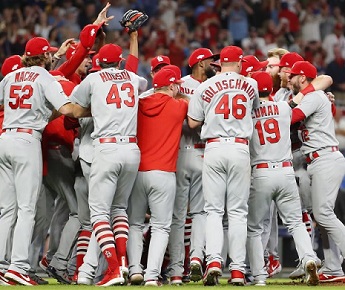
Sore winners

2019-10-10 StLouisCardinals

The Cardinals earned their coming NLCS berth . . . and their skipper earned them an image as unsportsmanlike winners with a postgame rant.

Until he was out-boxed and out-thought by Muhammad Ali in 1964, Sonny Liston was so brutal in the ring he inspired gags about knocking his opponents out before the weighing-in was finished. Forgive the Braves if they think they were stink bombed, pistol whipped, and machine-gunned before “Play ball!” finished escaping the umpire’s mouth.

In avian terms cardinals are seed-eaters by nature, not birds of prey. Don’t tell that to the Braves at any time from now until spring training. Because baseball’s Cardinals turned into glandular enough birds of prey in the top of the first Wednesday afternoon. Leaving no carrion behind.

The 13-1 final score almost didn’t matter. What the Braves incurred from the Cardinals not even Alfred Hitchcock could have conjured. Losing a tenth consecutive postseason set was bad enough. How the Braves were destroyed in Game Five of this National League division series was precedent setting.

No team in the history of division series play ever scored ten runs in a single inning until the Cardinals did it to open Game Five. They did it without one batter in Cardinals feathers hitting one into the seats. It went from small ball to medium ball. Not that the Braves cared, particularly. It hurt just as deep as if they’d been nuked.

Especially after they were four measly outs from going to the National League Championship Series themselves on Monday night. Before Yadier Molina singled home the tying run in the eighth and hit the game-ending sacrifice fly in the tenth in Game Four. Before the trip back to Atlanta. Before the early burial.

Before Cardinals center fielder Dexter Fowler, once a World Series-winning Cub whose St. Louis tenure hasn’t always been a joyful noise, got thatclose to striking out before wringing a game-opening seven-pitch walk out of Braves starter Mike Foltynewicz. Before the Cardinals sent ten runs across the plate without one single soul hitting one into the seats.

And before Cardinals manager Mike Shildt—who looks so prototypically like a nerd you’d think he knew no expletive stronger than deleted at first glance—delivered a postgame rant of the kind that usually comes when a team’s been battered, not the other way around.

Tommy Lasorda and Lee Elia, you’ve been upstaged. Meet Shildt, in one fateful moment he’d surely love to walk back now. Meet Shildt, the sorest winner on the planet.

Once upon a time another generation of Cardinals collapsed so thoroughly in Game Seven of the 1985 World Series after being jobbed by a blown call near the end of Game Six that they looked like unsportsmanlike chokers. Shildt made his 2019 Cardinals look like unsportsmanlike winners.

“They [the Braves] started some (excrement). We finished the (excrement),” Shildt growled. “And that’s how we roll. No one (fornicates) with us ever. Now, I don’t give a (feces) who we play. We’re gonna (fornicate) them up. We’re gonna take it right to them the whole (fornicating) way. We’re gonna kick their (fornicating) ass.”

Rookie Cardinals outfielder Randy Arozarena, a ninth-inning pinch hitter who finished Game Five playing right field, filmed Shildt’s rant and posted it to Instagram. That’ll teach him. He couldn’t delete the post or apologise fast enough once it hit the Internet flying. Too late. Way to soil your own achievement, boys.

Fowler may or may not have been lucky to survive long enough to wring that game-opening walk; on 1-2 he foul ticked a pitch by less than a hair. “Did I?” he cracked after the game. “That was so long ago I can’t even remember.”

Foltynewicz hadn’t walked a single soul in his Game Two start. Little did he know. And little did anyone in the joint know Cardinals second baseman Kolten Wong would even think about sacrificing Fowler to second, never mind doing it almost immediately. “After a good at-bat by Dex,” he’d say, “I told myself, ‘Just get him scoring position’.”

The Cardinals had one goal going in: take the Braves’ home audience out of the game as soon as possible. During the National Anthem if need be. They got close enough. After that, knowing they were sending Jack Flaherty to the mound, they figured a single run might be enough for the kid who pitched the National League’s ears off in the season’s second half.

“We know what kind of a pitcher Foltynewicz is and what he did to us last time and the way this series has been,” said first baseman Paul Goldschmidt, who beat out an infield hit right after Wong’s sacrifice. “We wanted to get on the board early.”

He forgot to mention the “often” part. And after left fielder Marcell Ozuna lofted a pitch that arrived around his toes into right to send Fowler home, Braves first baseman Freddie Freeman—as close to Old Reliable as the Braves have had since the retirement of Hall of Famer Chipper Jones—mishandled Yadier Molina’s hard grounder to load the bases.

Having the arguable worst week of his career as it was, en route a .200 NLDS batting average on four hits (including one homer and one double), six strikeouts, and one walk in 21 plate appearances, Freeman didn’t flinch after the massacre. “They got nine more runs,” he said. “That was pretty much the game right there.”

Matt Carpenter, penciled in to start at third base for the Cardinals, walked in a run. Tommy Edman, who’d taken Carpenter’s job during the season but was penciled in to start in the Game Five outfield, tore a two-run double down the right field line and chased Foltynewicz in favour of Max Fried. The Braves ordered a free pass to Cardinals shortstop Paul DeJong.

And Flaherty had the strange distinction of becoming the rarest breed of pitcher: one who gets to hit before he’s even thrown a single pitch. Not to mention facing his high school buddy and teammate Fried. And he walked Carpenter home.

“I’m laughing because Max is up there,” the righthanded boy wonder remembered after the game about approaching the plate. “I’m trying to keep a straight face. I looked up into the stands and saw my mom, which was great. She was smiling and all excited. I didn’t expect Max.” That’s nothing compared to what Fried didn’t expect.

He didn’t expect Fowler and Wong to hit back-to-back RBI doubles. He didn’t expect to throw a wild pitch to Ozuna for strike three enabling Wong to come home after Goldschmidt left Wong room enough to take third on a line out to right. You almost swore Molina grounded out to end the flood at last because he took pity on the Braves for one brief, shining moment.

Adam Wainwright, who pitched heroically enough in Game Three only to see it laid to waste late, could barely believe what he saw from his seat in the Cardinal dugout. “Have you seen anything like that?” he asked before answering after the game. “We just kept the pedal to the metal . . . I was just trying to stay in the moment, but after that inning I came in to the guys and said, ‘I’ve never seen anything like that’.”

The rest of the game seemed almost ceremonial even if Flaherty didn’t exactly have an untroubled outing. He shook of first and second and one out in the first, shrugged off Josh Donaldson’s solo home run in the fourth, and survived a bases-loaded jam in the fifth when he lost control momentarily and hit Ronald Acuna, Jr. with a pitch.

Considering the testiness between Acuna and the Cardinals most of the series the easiest thought to indulge was Flaherty trying to send the Braves’ youthful center field star a message. Considering everything else by that time, there was no way Flaherty would send a message pitch with what was then a twelve-run cushion that should have felt more like a hot tub, especially since Flaherty faced Acuna in the first and walked him without so much as a thought of inside and tight.

Pitching coach Mike Maddux went out to the mound at once to settle Flaherty. He didn’t want his lad making the same mistake Foltynewicz made in that first-inning flood, crossing the line between pitching with emotion and emotionally pitching. Flaherty got the message and got rid of Freeman on a ground out to second for the side.

After the flood, the Cardinals flipped from opening with offense on the brain to pure defense. They moved Edman to third and Fowler to right and sent Harrison Bader out to center field immediately after they’d finished the ten-run opening act. As if to remind his team he knew good and bloody well he had more than a glove working for him, Edman tore one off the top of the right field wall for a one-out triple in the top of the second.

Paul DeJong didn’t give Fried a moment to breathe before he ripped the next pitch off the wall for an RBI double. And after Flaherty zipped through the Braves in order in the bottom, Luke Jackson relieved Fried. He walked Wong on a full count, struck out Goldschmidt, plunked Ozuna on the first pitch, and got a sharp grounder out of Molina.

A grounder Braves shortstop Dansby Swanson picked and shoveled to second baseman Ozzie Albies, and the ball hit Albies’s bare hand leaving all hands safe. Then Bader lined one up the middle to score Wong and, after Edman struck out, DeJong hit another first pitch right through the left side to score Ozuna.

Thirteen runs in three innings. The rest of the game felt like a plain formality. The Braves bullpen from Josh Tomlin forward kept the Cardinals so quiet the rest of the way you began to feel tempted toward asking Braves manager Brian Snitker whether he’d think about trying a purely bullpen game if he could get a Game Five do-over.

“I don’t know that I’ve seen that many guys hit in the first inning that quick in my entire life,” Snitker said. “I don’t know. It wasn’t how we drew it up, I know that. I don’t know. That thing just kept rolling and we couldn’t stop it.”

“Everyone had sky high confidence going into that game and them scoring ten runs, it’s hard to swallow,” said Freeman after the game. “Everything went wrong from the get-go.”

“You don’t expect something like that to happen,” Donaldson lamented, “especially with how well we played all season.”

Any more than you expected Shildt’s post-mortem potty-mouth.

Tony La Russa’s Cardinals beat the Dodgers in a 2004 division series and, after it ended, led his players across the field for a handshake-and-hug line with the Dodgers after the 3-1 triumph. (Effervescent Jose Lima’s Game Three shutout was the only Dodgers win.) It was a grand and entirely endearing gesture. And baseball’s then-chief of discipline Bob Watson reprimanded the Cardinals for it.

La Russa may have had his flaws, but ranting like a drunken sailor over the freshly vanquished wasn’t one of them. Where’s Joe Torre, fellow Hall of Fame manager who now has Watson’s job among his other duties out of the commissioner’s office, to reprimand Shildt?

Letting the kids play is one thing. Letting them enjoy the living daylights out of the moment when they do big things without being broiled by baseball’s Fun Police for it is another thing. But letting a manager get away with a Shildt-like rant after a win at all, never mind one as lopsided as the Cardinals’ on Wednesday? That’s [fornicating] something else entirely.

This wasn’t Yankee manager Aaron Boone going on his now-famous “savages” rant in support of his players after a couple of nasty arguments with a couple of questionable umpires. This was a manager whose team had just humiliated a worthy opponent but who couldn’t resist grinding his heel on their fallen necks.

Arozarena owned up to making a rookie mistake posting his manager’s postgame potty mouth. Shildt made his team look so juvenile that most other fan bases in baseball will forget how surreal their first inning achievement was and hope the Cardinals go down hard in the National League Championship Series.

And if they do, they’ll probably find Braves fans leading the anti-charge. With no jury in the land prepared to rule them unjustified. It’s the least they can be allowed now.

The 1919 Reds, grand theft victims

This essay was first published 18 December 2018; a different version appeared in the Society for American Baseball Research’s Black Sox Scandal Research Committee Newsletter later that month, and I still thank editor Jacob Pomrenke—perhaps the most passionate reviewer of the scandal the nation has—for his kindness in accepting it. It also formed the basis of a lecture I gave to SABR’s Las Vegas chapter in January—with a replica 1919 Reds hat resting proudly on my head.

On today’s centenary of the ill-fated 1919 World Series’s final game, I republish the original, with one or two time-appropriate alterations, in the continuing if feeble hope that the 1919 Reds will receive their due at last as legitimate World Series champions despite the Black Sox shenanigans.

1919Reds

They wuz robbed: the 1919 Reds. (Hall of Famer Edd Roush stands second from left, top row.)

It’s difficult to feel sorry for a franchise whose history includes fifteen trips to the postseason, ten pennants and five World Series championships, even if they’ve spent the past six seasons in the pits of the National League Central. Difficult, but not impossible.

This season was the centenary of the Cincinnati Reds’ first National League pennant and World Series triumph, and it’s not unfair to say few outside Cincinnati might have cared. But you should. Too much commentary focused on the guys they beat in the 1919 World Series. Understandable, but patently unfair. To the Reds. The thrill of victory never smelled so much or so without warrant like the agony of defeat.

You know too much, not enough, or both about the Black Sox. You may know the mythology saying the White Sox untainted by the Eight Men Out would have just annihilated the poor little Redsies who just weren’t enough to withstand a feeding attack from the South Side sharks. That’s a lie equal to one president not having had sex with that woman and a thrice-removed successor having the largest inaugural crowd of all time.

The Reds’ golden age was the 1970s of the Big Red Machine. Five division titles, four pennants, back-to-back World Series conquests, over that decade’s first seven years. Franchises would kill for a piece of that. But the Machinists had no single season winning percentage better than the 1919 Reds. The 1919 edition’s .686 winning percentage was better than those White Sox (.629) and any team in their decade except the 1912 Boston Red Sox. (.691.)

Before anyone suspected foul play, the 1919 White Sox were 8-5 favourites to win the Series overall but 2-1 underdogs for the first two games in Redland Field. (The park would be re-named Crosley Field in 1934.) White Sox manager Kid Gleason trumpeted what he considered the greatest hitting team that yet played a World Series. Reds manager Pat Moran made a prediction that proved too chilling in due course: “If we beat [White Sox pitcher Eddie] Cicotte in the first game, we ought to win the Series.”

Cicotte, of course, hit the Reds’ second baseman Morrie Rath with the second pitch of the bottom of the first, the signal to the gamblers that the fix was on. But Cicotte would have entered that game suspect even without joining the fix. He suffered shoulder and arm miseries at the end a 306.6 inning, 29-win season. (If you’ve seen the dubious film version of Eight Men Out, you remember the scene in which Cicotte’s suspect shoulder and arm received a linament rubdown from his wife.)

The White Sox entered the Series with two great starting pitchers (Cicotte, fellow Black Sox Lefty Williams), a third (Hall of Famer Red Faber) missing in action thanks to injuries, and a rookie (Dickey Kerr, one of the Clean Sox) who looked like a comer both starting and out of the bullpen but whom observers in the moment considered a kind of wild card. The Reds entered with five solid, healthy starters: Hod Eller, Ray Fisher, Jimmy Ring, Dutch Reuther, and Slim Sallee. Gleason went into the Series on the shorter end of the pitching stick, even without Cicotte and Williams corrupted. Moran had the luxury of being able to rotate his arms—none of which was particularly overworked compared to Cicotte and Williams (297 innings)—reasonably.

Is one way to measure a team their second-half season’s performance? If so, and if  you’ll pardon the expression, you should have put your money on the Reds based on that. They went 47-19 in their second half. The White Sox went 41-26. The Reds finished nine games ahead of the second-place New York Giants; the White Sox finished three and a half ahead of the second-place Cleveland Indians.

Another measure is how they did against fellow contenders in their league. The Reds went 38-22 on the season against three other contenders (the Giants, the Chicago Cubs, the Pittsburgh Pirates); the White Sox went 35-25 against three others (the Indians, the New York Yankees, the Detroit Tigers). In September alone, the Reds faced other contenders ten times and went 8-2; the White Sox, twelve times, going 6-6.

On the regular season the White Sox out-hit the Reds but weren’t that much better at scoring. The White Sox averaged 4.8 runs per game but the Reds averaged 4.1. And the opposition averaged 2.9 runs against the Reds but 3.8 runs against the White Sox. It’s easy to figure out: The Reds out-pitched the White Sox. Entering the Series, the White Sox pitching staff had a 3.04 earned run average and a 2.88 fielding-independent pitching rate. (FIP: your ERA when defense is removed from the equation.) The Reds staff had a 2.23 ERA and a 2.81 FIP. The Reds were a little bit better at crafting their own pitching luck.

The 1919 White Sox shut the other guys out fourteen times and got shut out seven times. The bad news for the 1919 Reds: they were shut out fourteen times—but the good news is, they shut the other guys out 23 times. The closer you look, the less the White Sox look like predators and the Reds like prey.

It wasn’t just the tainted White Sox who came up short at the Series plate, Shoeless Joe Jackson to one side. Leadoff hitter Nemo Liebold hit .056 with two walks and one hit in the set. Hall of Famer Eddie Collins, another of the Clean Sox, undermined his own reputation as a money player when he hit .226 with a single run batted in. Collins’ Series average was two points above the team’s.

What of Jackson? His cumulative Series hitting line argues against him going into the tank, but his game-by-game performance looks more suspect. In his best single game at the plate all set long, Game Eight, he had two hits, three runs batted in, two runs scored including on a third inning home run, but the White Sox were blown out, 10-5, to lose the Series. The homer was Jackson’s first hit in the game, and he came to the plate with the White Sox already down, 5-0. Uh!-oh.

Even before White Sox first baseman Chick Gandil and shortstop Swede Risberg instigated the World Series fix, and found both the gamblers and the teammates to execute it, the White Sox and the Reds had a critical difference. The White Sox were riddled with dissension not all of which was provoked by frustrations real or imagined with their owner. They were wracked by clashes between more- and lesser-educated players and by spells of discomfort with new manager Gleason.

Collins played on the Philadelphia Athletics teams that ruled the earlier parts of the decade that the Red Sox didn’t, which went a long way toward fostering the presumed American League superiority. He once said those A’s “believed in teamwork and cooperation. I always thought you couldn’t win without those virtues until I joined the White Sox.”

The 1919 Reds believed as he did. Susan Dellinger, Ph.D., granddaughter of the Reds’ Hall of Fame center fielder Edd Roush, revealed in Red Legs & Black Sox: Edd Roush and the Untold Story of the 1919 World Series that those Reds liked their own new manager Moran, liked each other, played hard, and thought of team first. They mentored each other when need be, made a powerful point of making newer players feel at home, and, on the field, as Dellinger wrote, “No one cared who was on third. If he wore the Reds insignia, just get him home.”

Their morale withstood only one threat, Dellinger exhumed, when Roush finally told Moran of whisperings he’d heard that gamblers tried to get to one or two Reds pitchers. Moran called a team meeting prior to Game Eight. The scheduled starting pitcher, Hod Eller spoke up. He’d run off a gambler who tried to buy him off for the game. Then he pitched the distance in the Series-ending blowout.

“Doesn’t everybody say the dream is nonsense? Didn’t everybody say the Reds couldn’t possibly win?” wrote Damon Runyon after the Reds’ Game One win. (The article is collected in the splendid Guys, Dolls, and Curveballs: Damon Runyon on Baseball.) “Experts, ballplayers, and fans—didn’t they all laugh at Cincinnati’s fall pretensions as they have laughed every year for many years? Cincinnati will tell you that they did.”

Didn’t they tell you Pat Moran’s ball club was made up of castoffs of baseball, and that it was just a sort of baseball joke compared to the million dollar club that represents Chicago?

Cincinnati will tell you they did. Cincinnati never tires of the telling, in fact. But all the time they were telling these things about the Reds, Cincinnati was secretly dreaming a great dream that was realized at Redland Field this afternoon, with 30,000 pop-eyed breathless Cincinnati people looking on.

The castoffs of baseball proved better than the sum of their parts and the million dollar club proved worse in more ways than one.

George F. Will had it right when he once described most of the Eight Men Out as “more dumb than dishonest,” a valedictory that doesn’t apply to the ringleaders Gandil and Risberg. Or, to reserve third baseman Fred McMullin, who stumbled upon their plot in its planning and threatened to expose it unless they cut him in on the profit. (Remember, too, that if the gamblers double-crossed the Black Sox, Gandil may have double-crossed his own co-conspirators; he’s said to have kept the bulk of the money the gamblers paid them.)

Will also said of the commissioner baseball selected in the scandal’s immediate wake, Judge Kenesaw Mountain Landis, that he “delivered rough justice, perhaps more rough than just,” when it came to the game-wide malignancy that enabled the Black Sox. Landis was not faultless, including and especially the de facto perpetuation of baseball’s segregation. (He neither ruled formally nor spoke publicly but it was understood he wouldn’t sanction baseball’s integration so long as he held office.) But if he applied an overweight hand to baseball’s original gambling scandal, it was featherweight compared to the cancer the game needed to eradicate.

Jackson made two terrible mistakes, perhaps out of intimidation from the too-rough/too-tumble Risberg. (“Swede,” he told those investigating the World Series fix, “is a hard guy.”) He accepted an envelope Lefty Williams was ordered to deliver to him, containing $5,000, rather than say thanks but no thanks. And, he delayed his oft-discussed attempt to dispose of it and advise team officials what was up.

Third baseman Buck Weaver wanted no part of the fix or its payoffs. He also wanted nothing to do with being a rat against his friends, some of whom were anything but. That seemed more important than aborting the fix, which Weaver could have done by exposing what he knew. If there was a concerted cover-up of the fix, by White Sox officials at minimum, delaying its revelation and resolution by at least a year, Weaver’s silence left room for a cover-up in the first place.

Jackson’s playing record is considered Hall of Fame worthy. But the guileless outfielder (illiterate he was, but guileless doesn’t mean stupid) was never elected on the (oft-forgotten) couple of times he did appear on the Baseball Writers Association of America Hall of Fame ballots. It’s not unreasonable to say his Hall worthiness married to his banishment inspired subsequent movements to convince baseball’s government to reinstate him and enable his Hall election, whatever the details behind his Black Sox status.

Don’t think that just because the White Sox were riddled by factionalism, and that even some of the Clean Sox were rough and tumble, it means the Reds were a roster full of saints. But several Reds including Roush, Eller, and outfielder Greasy Neale believed the Series was played mostly straight at least between Games Three and Six—because, they said in various ways, the gamblers double-crossed the fixers and the fixers didn’t get all the money they were promised. It neither mitigated the Black Sox nor eroded the myth of the Reds’ comparative modesty.

Seventy years after that World Series came Pete Rose, banished from baseball for violating Rule 21(d)—the rule against betting on baseball, the rule instigated by the gambling corruptions that climaxed with the 1919 Series fix and its eventual exposure and affirmation. You can say many things about Rose, but guileless isn’t one of them. And the very real prospect of his election to the Hall of Fame despite his banished status prompted the Hall itself, an entity not actually operated or governed by Major League Baseball, to rule against baseball’s ineligible being eligible for Hall election.

A nation whose citizens empathise with victims real or imagined should hark heartily to the real victims of baseball’s two most notorious gambling scandals. The first compromised the integrity of the Reds’ first World Series winners through no fault of their own. The second cost the Reds a franchise icon and manager through all fault of his own.

(This year’s Reds didn’t get to play this year’s White Sox in interleague play. Kind of a shame, too. Try to imagine today’s baseball administration dealing with that during this particular centenary season.)

It would have been simple enough for baseball to spend 2019 giving the 1919 Reds their long, long overdue. The evidence says they could have beaten those White Sox in a straight, no chaser Series.  Baseball can’t give them a Series do-over but it can give them the championship legitimacy they deserve. Metaphysically and temporally, the 1919 Reds wuz robbed.


David and Goliath face elimination

2019-10-08 TravisDArnaudJoseAltuve

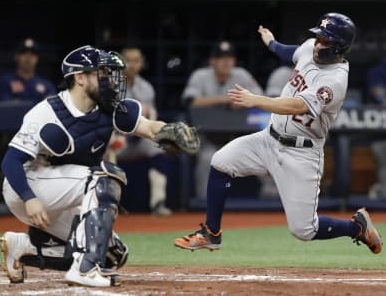
“They played beautiful defense, especially in that play right there.”—Jose Altuve, about the relay that nailed him at the plate above.

Sometimes you can’t afford to respect your elders. As in, when they’re on the mound on short rest, their less-than-well-rested arms and bodies refuse their lawful orders, and it’s still now or never until your American League division series is over.

There probably isn’t a Rays player or fan alive who doesn’t have a world of respect for Justin Verlander. There isn’t any baseball person alive lacking in such respect. Even at 36, the man has skills, the man has brains to burn, the man has no fear, the man has class, and the man has heart.

And when he says he wants the ball no matter how much rest it wouldn’t be on, nobody says no to Verlander. Not his manager. Not his front office. And sure as hell not Astroworld. Saying no to Justin Verlander with his cred is like it once was telling Evel Knievel the Snake River Canyon wasn’t going to be his new best friend.

But when even a Hall of Famer elects to take the mound in a bid to kick his team into the League Championship Series no matter how fully rested he isn’t, no matter how obedient his slider isn’t, there isn’t a Ray or anyone else alive either who’d spot him with his command gone AWOL and refuse to get the drop on him before he finds a reserve tank.

These Rays seem like nice guys. So do these Astros. But do you think the Astros would stay nice guys if they faced even a Hall of Famer with his tank down to its final fume? If you do, I have a freshly purchased Taj Mahal I’d like to sell you at cost.

Powerful teams are fun to watch when they dominate as these Astros have done all year long, and the Astros are fun to watch even on their very occasional off days. But there’s nothing like a band of upstarts that nobody else wanted pushing them to the equivalent brink of elimination as the Rays did Tuesday night.

Their 4-1 win over the Astros was as good as blowing almost anyone else out by three times that margin. That’s how tough the Astros are. And that’s how stubborn the Rays are proving to be.

Even if Gerrit Cole takes the mound Thursday back in Houston, delivers just half of what he threw at the Rays in Game Two, and sends the Astros to an American League Championship Series with the Yankees—you want to talk about E.R. vs. St. Elsewhere?—there isn’t a soul to be found who’d say the Rays didn’t prove they could hang with the big boys after it looked at first as though they’d get hanged.

So the Rays got cute sending Diego Castillo out to open, and Castillo got cute striking out the side in the first. And impressing the hell out of Astros manager A.J. Hinch. “Castillo, thank God he was an opener and not a regular starter,” he said after the game. “Having him out there for four, five, six innings would be devastating for anybody.”

The Rays got even more cute after Verlander opened the bottom of the first with a three-pitch strikeout of Austin Meadows. Tommy Pham was cute enough to work Verlander to a 2-2 count including one swing at a pitch missing the low and away corner, then send a slightly hanging changeup into the left center field seats.

A walk (to Ji-Hin Choi) and a single (to Avisail Garcia) later Travis d’Arnaud, whom the Mets thought expendable very early in the regular season, expended a base hit into left center field to send Choi home, and Joey Wendle expended a double down the right field line to send Garcia home. Verlander got rid of Kevin Kiermaier with a swinging strikeout to prevent further disaster but the Astros were in a 3-0 hole.

He’d survive first and second in the second and a man on third in the third, but he couldn’t stop Willy Adames (it almost rhymes with “Adonis”) from hitting the third pitch of the fourth over the center field fence. A strikeout, a line out, and a walk later, Hinch had to admit Verlander’d been had on a night when his spirit was willing but his arm and body demanded the rest of the night off.

For a second night running, the Astros got Rayed.

“A good approach for those guys in the first, and then honestly, I need those infield singles to be caught,” said Verlander after the game, referring to balls the Rays hit just past the Astros’ infielders. “When you don’t have it, you need the balls that are put in play to go your way, and they didn’t. Obviously, not the way you would script it. You know, it sucks.”

Thus the Astros joining up to the Rays bullpenning, which began with two out in the second and Rays manager Kevin Cash lifting Castillo for Ryan Yarborough. Whom he’d lift for Nick Anderson with Jose Altuve on second after maybe the single most important play of the game. Maybe even of the Rays’s season.

Yordan Alvarez, the Astros’ uber-rookie, sent a double to the rear of the yard. Kiermaier picked it off the wall hop and fired a perfect strike in to Adames out from short on the grass behind second, and Adames fired just as perfect a strike home to d’Arnaud at the plate spinning to tag the road-running Altuve about a split second before the Astros’ second baseman’s hand touched the plate.

And pop went the Astros’ best rally while the Rays were at it.

“That,” said Kiermaier of Adames’s strike home, “was probably the most incredible relay throw from an infielder I’ve ever seen. That was such a huge moment for us, huge momentum shift, and it just doesn’t get any better than that.”

Not even Choi turning Michael Brantley’s line drive into a single-handed double play in the sixth, bagging George Springer returning to the pillow while he was at it. That was child’s play compared to The Kiermaier-Adames Show.

And Kiermaier gets no argument from Altuve himself. “We’ve been playing aggressive all year long. I don’t see why we shouldn’t do it right now. But sometimes you have to give credit to the other team,” the Astros’ impish second baseman said after the game. “They played beautiful defense, especially in that play right there.”

“You have to tip your cap to those guys,” said Astros catcher Robinson Chirinos, whose just-passing-by solo home run off Chris Poche in the top of the eighth provided the lone Astros scoring. “The relay was perfect. It was textbook. They needed a perfect relay and they did it to throw Jose out at home plate. That was a big difference in the game tonight.”

When Jose Altuve himself gives you a five-star review, you’re being more than—what’s that overcooked word deployed about the Rays?—resilient.

Face it. On one postseason day when the Rays and the Astros had the nation’s baseball stage to themselves, the un-glamorous, un-beautiful, un-sexy, un-bankable Rays stole the show all for themselves. The Beatles themselves couldn’t have upstaged these No-Rays Tuesday night.

They were supposed to be about as deadly as babies in strollers at the plate. They were supposed to be a pitching staff full of anonymous relief pitchers with the occasional token starter and even Cy Young Award winner who couldn’t possibly keep getting away with all that bullpenning jazz.

Never mind that said Cy Young winner, Blake Snell, had Altuve on third and MVP candidate Alex Bregman on first with one out in the ninth when he went in from the pen Tuesday night, then struck Alvarez out swinging before coaxing Yuli Gurriel into the game-ending ground out right up the pipe, where Wendle just happened to be waiting to throw him out.

They have a manager named Cash for a team whose overseers seem allergic to spending any. They play their home games in a toxic waste dump that looks like a warped pressure cooker on the outside and an abandoned landfill on the inside, playing baseball on the last of the sliding-boxed zippered-billiards table surfaces.

And they are resilient, these No-Rays, even if the word “resilient” may turn into something less than a compliment before too long. “We’re good. Everybody uses the word resilient and that’s great but we’re also very good,” Cash told a reporter. “You can use that word resilient over and over and in a way it’s kind of knocking us. The truth is this is a very good team.”

The truth is also that the Astros are finding that out profoundly. The Rays may have finished with the American League’s fifth-best regular season record and the Show’s seventh best, but somehow, some way, the Rays have out-scored the Astros 17-13 in the division series so far. Somehow, some way, they’ve out-homered the Astros six to four. Somehow, some way, they have a better on-base percentage, a better slugging percentage, an OPS slightly over a hundred points higher, and more walks.

The Rays may not survive Game Five, after all, but they won’t leave the Astros thinking it wasn’t a battle royal even if Cole does go second-verse-same-as-the-first. Even if Cole will pitch on regular rest as opposed to Verlander asking to go on three days for the first time in his life and Zack Greinke getting nuked on eleven days’ rest.

“We have a great pitching staff, we play great defence and our bats are starting to come together,” said Pham, with all due modesty.

“People before this series started talking about David and Goliath,” Kiermaier. “I understand they are really good on paper and we might be the team that is not as appealing, but don’t ever count us out. We got guys feeling really good about themselves and we are clicking as a team all year. That is a dangerous recipe for success.”

Sounds a lot like what they once said about the Astros, doesn’t it?

After shoving the similar but slightly less obscure Athletics to one side in the wild card game to get their chance with the Astros—who have all the reputation and intimidation you could ask for in pushing 107 regular season winning chips to the middle of the division series table—the No-Rays and the Astros are equals for standing on the brink of elimination in Game Five.

Even with the Astros holding what they hope is the home field advantage trump. Not that the Astros are worried, necessarily, even if almost to a man they can’t wait to escape the Trop. (The Rays may not necessarily love the joint, either, but their 2019 season record shows ambivalence at best: they were the same on the road as they were at home, 48-33.)

The Astros opened the regular season against the Rays in the Trop and beat them once before losing three straight more. Aside from Games One and Two, they tangled in Minute Maid Park for three in late August. The Astros won the first two of that set; the Rays won the third. It’s not unheard of for the Rays to win in Minute Maid.

“We have done it years ago, when we have the home field. We win at home, then we lost on the road, then we come back home and make it happen,” Altuve said after the game. “So we’ve been here before. There’s no pressure right now.”

Altuve, one of the most intelligent as well as talented players the Astros have ever yielded up, also needs nobody to remind him there was no pressure on the original David, either.

So much for a young man’s game

2019-10-08 ZimmermanScherzer

Ryan Zimmerman (left) and Max Scherzer looked older at a postgame presser than they looked playing Game Five of the Nats’ division series against the Dodgers Monday night.

Once upon a time, a generation insisted you couldn’t trust anyone over thirty. Even that was pushing it; to hear some of them talk (I know, because it was my generation, even if the words never quite came out of my own mouth) you’d have thought trusting anyone over 25 was begging for trouble.

At times in recent years it’s seemed as though baseball’s unspoken but unbreakable mottos include not trusting anyone over thirty. Well, now. If thirty is baseball’s new forty, then baseball’s geriatric generation’s been doing a lot of heavy lifting this postseason and beyond. Without walkers, wheelchairs, canes, or portable respirators, even.

It’s hard to believe because it seems like yesterday, sometimes, that he was a hot draft, but Stephen Strasburg—in the Nationals’ original starters-as-relievers postseason scheme—got credit for the win in the National League wild card game with three spotless relief innings. At the ripe old age of 31.

Strasburg also pitched six with a single earned run against him in division series Game One against the Dodgers and takes a lifetime 0.94 postseason ERA into his Game Five start in Dodger Stadium Wednesday. The Nats aren’t exactly a mostly-young team but they’re putting their fate into thirtysomething hands.

That may be the problem. Even with the professiorial beard he wears now, Strasburg doesn’t look his age yet. He still looks like a lad on the threshold of sitting for his final exams in freshman year. He isn’t even close to being as grizzled as Max Scherzer. Few among even his fellow old Nats do.

If you believe in respecting your elders (never mind how often your elders have betrayed your respect, as often they have), things get better from there. Consider, if you will:

* Two 35-year-old Nats, Max Scherzer and Ryan Zimmerman, delivered the primary goods Monday night to push the Nats-Dodgers division series to a fifth game Wednesday. Max the Knife shook off a first-inning solo homer to go six and two-thirds scoreless including a crazy escape from a seventh-inning, ducks-on-the-pond jam, and Zimmerman jolted Nationals Park with a three-run homer into the crosswinds in the bottom of the fifth.

In those hours both Scherzer and Zimmerman looked as though they’d done it for the first time in their lives. Maybe there is such a thing as baseball’s fountain of youth.

* An ancient Cardinals catcher, Yadier Molina, tied Game Four of their division series with the Braves with an eighth-inning RBI single, then won the game with a sacrifice fly in the bottom of the tenth. And, a followup bat flip the young’uns should envy.

* Another Cardinal ancient, Adam Wainwright, pitched maybe the best exhibition of pressure baseball of his life in Game Three. It went for nothing, unfortunately, since Wainwright left the game with the Cardinals behind 1-0. But Wainwright will tell his eventual grandchildren about the noisy standing O Grandpa got as he tipped his hat to the Busch Stadium faithful.

* On the other hand, if it took a young Braves whippersnapper (Dansby Swanson) to tie the game in the ninth, it took an old fart of 31 (Adam Duvall) to pinch hit immediately after and drive home what proved the winning runs with a single up the pipe. And I didn’t notice Duvall carrying a portable oxygen tank with him.

* “We got Verlandered,” Rays manager Kevin Cash said memorably after Pops Verlander, all 36 years old of him, threw seven shutout innings their way in Game One of their division series. And if you think 29 might as well be 30 and therefore on the threshold of dismissability, be reminded the Rays got Coled the following day. As in, Gerrit Cole’s seven and two-thirds, fifteen-strikeouts shutout innings.

* Abuelo Edwin Encarnacion, like Verlander an ancient 36, tied Game One between the Yankees and the Twins with an RBI double in the bottom of the first. A 30-year-old fart named D.J. LaMahieu put the Yankees up by a pair with a bottom-of-the-sixth home run; a 35-year-old creaker named Brett Gardner hit one out one out later, and the Yankees routed the Twins in Game One and the division series sweep.

Lest you think the postseason’s been the sole triumphant province of the senior citizenry, be reminded sadly that Nelson Cruz—all 39 years old of him, who had the regular season of a player young enough to be his grandson (41 home runs, 290 total bases, 1.031 OPS, 4.3 wins above a replacement-level player), and who hit one out to make a short-lived 2-0 Twins lead in Game One—ended Game Three on the wrong side when he looked at a third strike from all 31 years old worth of Yankee closer Aroldis Chapman.

Just as there’s a rule in sports that somebody has to lose, there’s a parallel rule that says sometimes one old man has to beat another old man to win.

A prehistoric Ray, Charlie Morton, took 35 years to the mound on Monday and threw five innings of one-run, three-hit, nine-strikeout baseball at his former Astros mates to keep the Rays alive, barely. And the Rays abused likewise 35-year-old Zack Greinke—who’d pitched like anything except a nursing home denizen since joining the Astros at the new single-season trade deadline—for six runs including three home runs in three and two-thirds innings’ work.

The Yankees only looked like old men when it seemed you couldn’t visit one New York-area hospital this season without finding a group of Yankees among the emergency room patients. The Astros only looked like old men likewise regarding Houston-area clinics this year. Except to their opponents, it’s funny how they don’t look like old men when they play baseball.

Pops Verlander’s getting another crack at the Rays in Game Four. Strasburg the Elder has to tangle with a whippersnapper named Walker Buehler in Game Five. The eyes of us seniors will be upon them.

Unfortunately, there are those elders who behave occasionally like the ancient Alice Cooper lyric: “I’ve got a baby’s brain/and an old man’s heart.” Molina did after he sent the Cardinals toward Game Five. Hands around his throat in a choke gesture aimed at the Braves. In a series pitting two of baseball’s more notorious Fun Police departments, that puts a new twist on police brutality and underscores why respecting your elders is  easier said than done often enough.

Music from the Elders

2019-10-07 MaxScherzer

Not even Mother Nature could rain on Max the Knife’s parade Monday night.

Forget the starters-as-relievers plan that imploded with whatever impostor crawled into Patrick Corbin’s uniform Sunday. Come Monday, the Nationals wanted, needed, and all but demanded one thing.

On a day the Nats were one of four teams facing postseason elimination they needed Max Scherzer to be as close to Max Scherzer as possible. In the worst way possible. In the rain, even.

From the moment after Dodgers third baseman Justin Turner belted a two-out solo homer in the top of the first until he finally ran out of fuel while squirming out of a seventh-inning jam, Scherzer was a little bit more. For six and two-thirds to follow he was Max the Knife.

“It was amazing just playing behind him,” said third baseman Anthony Rendon after the Nats locked down the 6-1 Game Four win. “Max did what Max does.”

Elder Ryan Zimmerman, who wielded the heavy tenderiser in the bottom of the fifth, was a lot more succinct. “That’s the guy,” he said almost deadpan. Except that Zimmerman was also the guy. This was the night the Nats played sweet music from the elders. Above and beyond what they demanded going in.

Scherzer slew the Dodgers with what seemed like a thousand off-speed cuts mixed in with a few hundred speed slices and the Dodgers left unable to decide whether he’d dismantled them or out-thought them. Maybe both at once. Zimmerman was the third among division series teams’ oldest or longest-serving players Monday to do the major non-pitching damage keeping them alive without respirators to play another day.

An hour or so earlier, ancient Yadier Molina tied (with an eighth-inning single) and won (with a sacrifice fly) to get the Cardinals to a fifth game against the Braves. Great job, Yadi. Could the Nats top that? Zimmerman’s electrifying three-run homer answered, “Don’t make us laugh.”

All of a sudden the Dodgers’ stupefying sixth-inning assault in Game Three seemed like little more than a somewhat distant nightmare. Just as swiftly the Dodgers looked like the doddering old men on the field. Their average age is a year younger than the Nats’ but suddenly they looked in need of walkers and wheelchairs.

Scherzer and Zimmerman did their jobs so thoroughly that manager Dave Martinez didn’t even have to think about risking his or his club’s survival with a call into the Nats’ too-well-chronicled arson squad. If he had anything to say about it, the last thing he wanted was anyone not named Sean Doolittle or Daniel Hudson on call.

“I knew I needed to make a full-on start,” said Max the Knife after the game. “I know there’s times in the regular season where you’re not fresh, where you come into a game and you got to conserve where you’re at—try to almost pitch more—and today was one of those days.”

At first it seemed the Nats were trying to conserve . . . who know precisely what. Especially when it didn’t seem as thought they had that many solutions for Dodger starter Rich Hill’s effective enough breaking balls the first two innings. Or, for figuring out ways to avoid loading the bases twice, as they did on Hill and his relief Kenta Maeda in the third, and getting nothing but Rendon’s game-tying sacrifice fly to show for it.

But with that one-all tie holding into the bottom of the fifth, and Julio Urias in relief of Maeda, Trea Turner led off with a bullet single to left and Adam Eaton sacrificed him to second. Rendon singled Turner home to break the tie, Howie Kendrick lined a single to left center, and it looked like the Nats would content themselves with doing things the small ball way.

Then Dodger manager Dave Roberts lifted Urias for Pedro Baez. Zimmerman—the elder into whom enough were ready to stick a fork, though he’d said often enough he’d like to play one more year even as a role player—checked in next. Despite losing the platoon advantage. After he looked at a slider for a strike on the floor of the zone, he turned somewhat crazily on a fastball practically up in his face.

And, he sent it through the outfield crosswinds and onto the green batting eye past the center field fence.

“That’s what you play for, that’s what you work for all season and off season,” said Zimmerman, who hasn’t has as many such moments recently as he’d prefer but who’s still a much loved figure in his clubhouse and among the Nats’ audience. “Stay positive, the guys rallied around me, it’s nice to be back at all.”

2019-10-07 RyanZimmerman

Let the old men be kids again: Zimmerman after his crosswind-splitting three-run bomb.

The Nats went on to tack their sixth run of the night on when Rendon hit another sac fly, this time to the rear end of center field, this time enabling Turner to come home. Greater love hath no Nat than to sacrifice himself twice for the dance. Unless it was Scherzer graduating from his tank next to E to living on pure fumes pitching the top of the seventh.

He got Corey Seager to fly out to right but surrendered a base hit through the right side to rookie Matt Beaty. Rookie Dodger second baseman Gavin Lux wrestled his way to an eight-pitch walk, and rookie catcher Will Smith looked at one strike between four balls for ducks on the pond, but pinch hitter Chris Taylor (for reliever Ross Stripling) threatened to walk the second Dodger run home until Scherzer struck him out swinging on the eighth pitch of the segment.

Then, after scaring the Nats and the Nationals Park crowd audibly with a hard liner down the right field line and foul by about a hair (every known replay showed how close it missed), Joc Pederson grounded one to second base, where late-game fill-in Brian Dozier picked it and threw him out. Launching Scherzer into one of his own patented mania dances into the dugout in triumph.

“My arm is hanging right now,” Max the Knife said after it was all over but the flight back to Los Angeles and a Game Five showdown between Stephen Strasburg and Walker Buehler. “That pushed me all the way to the edge—and then some.” Good thing Doolittle had four outs to deliver and Hudson, two, to close Game Four out with a flourish of their own.

In a game culture so heavily youth-oriented over the past few years Scherzer and Zimmerman must seem anomalous. “We’re a bunch of viejos,” Scherzer told a postgame presser about themselves and their fourteen teammates over the age an earlier generation considered the cutoff for trust. “We’re old guys. Old guys can still do it.”

That wasn’t easy or necessarily guaranteed. Scherzer’s season was compromised by an attack of bursitis and an upper-back rhomboid muscle, forcing him to miss the last of July and most of August. When he returned, after a couple of short but effective enough starts, he almost looked older than his actual 34 years.

He still kept his ERA to 2.92 and still led the Show with a 2.45 fielding-independent pitching rate, but entering the postseason there were legitimate questions about how much he might still actually have left past this year. Like Zimmerman, Scherzer would far rather let himself decide when he’s ready for his baseball sunset.

Max the Knife proved Exhibit A in favour of Martinez’s original starter-as-reliever division series scheme, striking out the side swinging in the eighth in Game Two. And Corbin’s Game Three implosion put the S-A-R idea to bed for the rest of the series, if not the postseason.

Zimmerman is, of course, the one Nat remaining who’s worn their colours since they were reborn in 2005, after long and often painful life as the Montreal Expos. They picked him fourth overall that year; he had an impressive cup of coffee with them down that year’s stretch and stuck but good.

His hope to age gracefully in baseball terms has been thwarted too often by his body telling him where to shove it when he least wants to hear it. He refuses to go gently into that good gray night just yet; he accepts his half-time or part-time status with uncommon grace.

“I really don’t think these are his last games,” Scherzer told the reporters with Zimmerman sitting at his right. “Only you think this is his last games.”

“The last home game [of the regular season], they tried to give me a standing ovation,” Zimmerman said. “I mean, I feel good. I think we’ve got plenty to go.”

“I feel young,” Scherzer said, turning to Zimmerman, “and I’m older than you.”

Scherzer is older than Zimmerman—by two months. But they looked as though they’d told Father Time to step back a hundred paces when they pitched and swung Monday night. Only after the game did they creak like old men.

Zimmerman started only because Martinez wanted to use the platoon advantage against the lefthanded Hill, and he struck out twice. But when he came to the plate as Roberts sent him the righthanded Baez in the fifth, Martinez had a decision: let Zimmerman swing anyway or counter with lefthanded Matt Adams off the bench.

Martinez stayed with Zimmerman. And in that moment Zimmerman became Washington’s King of Swing, leaving Scherzer to settle for being Washington’s King of Sling. Enabling the Nats to live at least one more day. And the way they grunted, growled, and ground Monday night, the Dodgers may yet have a fight on their hands in Los Angeles come Wednesday.

Just don’t expect to see Scherzer out of the pen Wednesday. Even he’s not crazy enough to even think about that scenario. The next time Max the Knife wants to be on the mound it’ll be to pitch for a pennant.