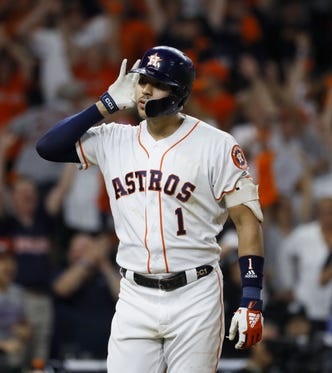
The Carlos Correa Show

2019-10-14 CarlosCorrea

Carlos Correa wants to feel and hear the noise after winning Game Two with one pitch and one swing in the bottom of the eleventh Sunday night.

Under most circumstances these days it takes something dramatic to upstage Justin Verlander even on a modestly effective night for him. And on a night the Astros needed it, in Game Two of the American League Championship Series, they got something dramatic—from a guy whose season was rudely interrupted by two trips to the injured list.

Carlos Correa wasn’t even cleared to play coming off back soreness that began in August until just about the last minute before the Astros’ arduous division series against the Rays. And earlier in the season the rib fracture he incurred undergoing a home massage made him an unfortunate butt of some rather unfortunate tacky jokes.

But they’re not joking after Correa’s Game Two performances. First, he stopped the Yankees from a third run in the top of the sixth with some shortstop acrobatics. Then, he hit a leadoff home run off reliever J.A. Happ in the bottom of the eleventh to win the game, 3-2. Thirteen times on the season the Astros won by walkoff. This one was the most important. Certainly the most satisfying.

“Going into that last inning, I thought, ‘I got this’,” Correa told a reporter after the game. “I felt like I got this. And I had the right approach against him. I’ve been successful against him going the other way. And that’s what I tried to do. I saw a good pitch down the middle, and I drove the other way.”

He had this, all right. The Carlos Correa Show was practically responsible all by itself for sending the ALCS to Yankee Stadium even up.

Don’t get me wrong, Verlander was as handy and dandy as the evening was long, even if he wasn’t the virtuoso he’d been in the first division series game. And the Astros matched the Yankees grind for grind again.

The future Hall of Famer endured five Yankee hits including a mammoth two-run homer by Aaron Judge in the top of the fourth that put the Yankees ahead briefly, while striking out seven against two walks in six and two-thirds innings’ work. It wasn’t vintage Verlander but it was enough to keep the Astros alive and split.

Even though he and they needed Correa to channel his inner Karl Wallenda two innings after Judge got the gift that usually fails to stop giving, a hanging slider that hung just enough for the Leaning Tower of the South Bronx to hang it far over the center field fence.

Yankee outfielder Brett Gardner fired a liner toward second base that took a tweener hop as Astros second baseman Jose Altuve took a stab at it. Correa from shortstop saw in a split second that Altuve had no chance on a play that tough with the ball squirting off from Altuve’s right, and with D.J. LaMahieu hitting the afterburners around third.

Correa ran over and grabbed the ball with his throwing hand and threw as perfect a strike home as you could pray to see—and Astroworld prayed hard for it. Prayers answered. LaMahieu was a dead pigeon by several feet despite his slide home. One step or inch off on either end of that play and a third Yankee run would have scored and Correa’s eleventh-hour, eleventh-inning bomb wouldn’t have happened in the first place.

The tall shortstop whose second-inning double sent Alex Bregman home with the first Astro run of the game in the first place knew only too well what that odd hop away from Altuve meant.

“As an infielder, I know how tough it is to catch a ball that’s a line drive right at you in between,” he said. “So as soon as I knew that it was going to crash in between, I was creeping over. When it hit him, and I saw the ball go my way, I just went after it. And I grabbed it, and when I looked up and I saw he was sending the runner, I thought, ‘Oh, I got this guy.’ So I threw him out. I don’t know why he sent him, but thank you.”

He’ll have Verlander’s eternal gratitude for the play. “The second I saw him come over and make a clean catch of the ball and come up and ready to throw, honestly, I thought he was out,” Verlander said after the game. “It went from ‘Crap!’ to ‘We got this guy. We got an extra out!’ It was just incredible.”

“That’s not going to get talked about,” said Astros center fielder George Springer, “but that’s an unbelievable play.”

Why did Yankee third base coach Phil Nevin send LaMahieu even knowing Correa has a shotgun arm, throwing angles be damned? Yankee manager Aaron Boone answered: “I thought it skipped off [Altuve] further . . . I was an absolute send from where I was standing. Great heads up play by Correa, to be in that position . . . I had no issue with the play at all.”

No arguing with that thinking. Boone saw the chance to re-take the lead after Springer, perhaps beginning to re-awaken from a postseason slumber, greeted Yankee reliever Adam Ottavino in fresh relief of Chad Green by hitting Ottavino’s first pitch of the gig, a hanging slider, over the left center field fence in the bottom of the fifth

Yankee third baseman Gio Urshela almost equaled Correa in the Wallenda department in the bottom of the sixth, when Yuli Gurriel ripped a leadoff liner up the third base line that had extra bases stamped on the meat of the ball. Urshela leaped like an elevator to catch it before hitting the dirt like the elevator’s cables were snapped.

“Complete grind from both teams,” Springer said in a postgame field interview. “It’s fun, but it’s a little nerve-wracking. That’s a great team over there. And they play really, really well at home. So for us to get this one after a tough game [Saturday] night was obviously big for us.”

The Yankees had to turn Game Two into a bullpen game when starting pitcher James Paxton began well but ran into command issues too early for the Yankees’ comfort. He’d shaken off a leadoff walk to Springer in the first by luring Michael Brantley into dialing Area Code 4-6-3 before Altuve lined out sharply to Yankee shortstop Didi Gregorius.

But Correa punctured him in the second and—after striking Springer out swinging to open—Brantly and Altuve singled back-to-back.

Green came in and rid himself of Bregman (line out to left) and Yordan Alvarez (pop out to shortstop) quickly enough, then zipped through a 1-2-3 fourth including striking Correa out on a slightly elevated fastball. He opened the fourth striking out pinch-hitter Kyle Tucker before Boone reached for Ottavino and Springer finally reached for the stars, or at least the rear end of the park.

From there Ottavino and six Yankee relievers—including CC Sabathia, of all people, getting Brantley to ground out to short to open the tenth before yielding to Jonathan Loaisiga—kept the Astros hitless and scoreless through five and two-thirds innings. The Astro bullpen was no slouch department, either, keeping the Yankees scoreless and limited to one measly hit and a quartet of walks that proved harmless, after all.

“Our bullpen was nasty,” Correa said. “Gave us a chance to win the game.”

“It was a struggle tonight,” said Boone. “They’re tough to score runs off, especially on a night when Verlander is out there.”

Happ saved Loaisiga’s bacon after two one-out walks in the bottom of the tenth with a swinging strikeout (Altuve) and a fly out to left (Gurriel). Then, opening the bottom of the eleventh, he threw Correa a first-pitch fastball. What Correa called down the middle actually sailed in a little up and a little away.

And just like that it sailed a lot out, about eight rows or so into the right field seats. Sending him, too, past Lance Berkman as the Astros’ all-time post-season RBI man with 27 while he was at it.

“Just back and forth—the two best ballclubs in the game,” said Judge. “I wish we could have come away with two here, but now time to regroup and get ready for Tuesday.”

Correa was 3-for-22 in the postseason until he teed off, but he said he felt confident enough before the game over feeling his swing return that he was sure he’d hit one out in Game Two. The only thing he couldn’t or wouldn’t predict was when. But his newly-returned timing couldn’t have picked better timing.

Neither could his reaction after he hit the final blast. Put this into the next “Let the Kids Play!” promo post haste. And, eat your heart out, Jose Bautista.

Correa stepped out of the box quietly. He dropped his bat almost like he was dropping a toothpick, as Yankee catcher Gary Sanchez accepted fate and began walking away just as quietly. Then Correa brought his hand to his ear, holding it there a few steps up the first base line, as though asking the crowd to let him come on and feel the noise.

And as he made his way down the third base line, he hoisted his batting helmet in his hands like a basketballer about to make the three-point shot. Except no three-point shot—not even Robert Horry’s buzzer-beater to win Game Four of the NBA’s Western Conference finals for the Los Angeles Lakers in 2002—was ever quite this emphatic.

“It’s been a tough road this year but I’m finally here,” said Correa. Astroworld probably said “Thank God!”

Millie’s song

2019-10-13 DanielHudson

Millie Hudson’s father and his team have their priorities straight.

Now I’m going to say it. Freshly minted Millie Hudson, daughter of Nationals reliever Daniel, exposed former Marlins executive David Samson as a horse’s ass.

When Daddy arrived at the delivery room for Millie’s premiere on the day of National League Championship Series Game One, Samson behaved more like the Philistines.

“Only excuse would be a problem with the birth or health of baby or mother,” Samson fumed in a Friday tweet. “If all is well, he needs to get to St. Louis. Inexcusable.”

So was Samson’s fuming. And he couldn’t wait to walk it back after Hudson bagged the final outs of the Nats’ Game Two win: “Happy to see Daniel Hudson get the save. I didn’t say he should miss the birth, & didn’t mean to judge his decision. I would have done everything possible to try to get him to St. Louis for game 1 of #NLCS, once health of baby & mom had been established. Respect his decision.”

Not so fast, Samson. You most certainly did mean to judge his decision because that’s what you did originally. “Inexcusable,” I believe was your word for it. If that’s not judging a decision, I’ve got two tickets to presidential impeachment hearings to sell you cheap.

If you want to put it in purely baseball terms, Hudson’s presence for Millie’s premiere didn’t exactly compromise the Nats against the Cardinals. Thanks in large part to Anibal Sanchez’s no-hit bid through seven and two thirds, the Nats won Game One, 2-0. And to a man the Nats had Hudson’s back.

None more emphatically than Hudson’s fellow back-end reliever Sean Doolittle. “If your reaction to someone having a baby is anything other than, ‘Congratulations, I hope everybody’s healthy’,” Doolittle snapped upon learning of Samson’s denunciation, “you’re an asshole.”

Never mind Hudson saying, “We didn’t exactly plan to have a baby in the middle of the playoffs.” Hudson knew long before the Nats even got to the postseason—you know, the one they weren’t supposed to reach in the first place after that 19-31 horror of a season beginning—that the only place he’d be when Millie debuted was by his wife Sara’s side.

“I heard somebody say one time: Baseball’s what I do, it’s not who I am,” the pitcher told the Washington Post‘s Barry Svrluga. “Once I had kids, it really resonated with me.”

The Hudsons actually thought they had it planned down to the nth detail going in. Millie Hudson wasn’t supposed to check in until 14 October. “That led Daniel and Sara Hudson to pull out their calendars and start mapping out days,” Svrluga writes. “If the Nats won the wild-card game and if the division series against the Los Angeles Dodgers was pushed to a decisive fifth game, maybe Daniel could shoot home to Phoenix, Sara could pop out the kid on command, and the Nats’ run could continue unhindered.”

Any father will tell you children have remarkable ways of changing the best laid plans in the tap of a smartphone app. They don’t do it maliciously, they do it because, well, they’re children. That’s what children do. Daniel and Sara Hudson will have time aplenty yet to teach Millie, when she’s teachable enough, that there is such a thing as perfecting the ratio between plan and execution.

But children in the womb don’t always behave according to plan or schedule. Millie is very normal that way. Her father high tailed it to Phoenix when learning she was liable to be induced the day before Game One. Hudson’s pitching repertoire includes a better than serviceable changeup. Taking her time until deciding Friday morning was her time to bow, his new daughter threw quite a changeup herself.

Nats manager Dave Martinez sounded as though he might be tempted to offer Millie a contract. “Apparently,” he cracked after Game One, “the baby didn’t want to come out until later on this morning.” After Game One, Martinez texted Hudson: “Hey, I got a name for your little girl: Anibala Sean Hudson.”

Thoroughly modern Millie will do just fine, thank you.

You’d have thought Samson took it personally when a baby girl not his own threw her changeup. Not that Millie Hudson was aware that the fate of the Nats rested so profoundly upon her exercising a woman’s perennial right to change her mind before she’d even poked her nose out from within her mother’s womb.

Neither was she aware that with one delivery she knocked Samson down and exposed as a baseball man who still seems to hold the ancient plantation mentality through which baseball executives considered their players commodities before humans.

Don’t go there about how much money Hudson earns as a pitcher. “A $90,000 slave is still a slave,” Curt Flood once said, once famously. Such baseball men as Samson today sometimes think the salient difference between players then and now is that Flood was a pauper compared to today’s slaves’ earnings.

“Samson’s [original] tweet did not seem to recognize–outside the scope of medical harm–that there was a need for any balancing test between family obligations and work obligations,” writes Forbes‘s Marc Edelman. “The analysis was entirely one dimensional as is sometimes the case with someone who spends their entire career in an executive position.”

Edelman also reminds you that Samson was still in office as the Marlins’s president when baseball agreed upon a postseason parental leave policy, instigated after Blue Jays pitcher Aaron Loup’s wife gave birth during a 2015 division series. “If Samson was really so opposed to the concept,” Edelman continues, “he could have encouraged the Marlins and other teams not to agree to the provision. Arguably, he should not be tweeting his objections years later.”

Who would have thought that one minute you’d hear people denouncing sports’ deadbeat dads, real or alleged, and the next you might find them denouncing a baseball player who thinks fatherhood is an honour?

Hudson—who signed with the Angels in February, was released in March, signed with the Blue Jays the same month, then was traded to the Nats at the new single mid-season trade deadline—certainly didn’t. “I went from not having a job on March 21 to this huge national conversation on family values going into the playoffs,” he told Svrluga. “Like, hey. Life comes at you fast, man. I don’t know how that happened and how I became the face for whatever conversation was going on.”

He became that face because a former baseball muckety-muck seemed to believe fatherhood is less important than throwing fastballs, sliders, changeups, and cutters at enemy hitters in the ninth inning. But don’t expect Samson to be a job candidate for the Nats’ front office anytime soon.

Asked about Hudson’s slightly unexpected Game One absence thanks to Millie’s dramatics, general manager Mike Rizzo said flatly, “It was a no-brainer.” Ask Nats owner Mark Lerner and he’ll tell you what he told Svrluga in support of his pitcher: ““Who could think anything else?”

“These decisions are easy,” Rizzo also said. “A happy player is a performing player. We’ve got to take care of our people. You have to treat this like a family. And the important thing is, we’ve got a new little member of the Nationals family.”

When was the last time you heard anyone around the Marlins, during or after Samson’s presidency, describe the floundering Fish as anything resembling a family?

Hudson, of course, returned to the Nats in St. Louis on Saturday, where he got to nail the final two outs in a 3-1 Game Two win that began with Max Scherzer taking a no-hit bid of his own into the seventh, where Cardinals first baseman Paul Goldschmidt ruined the no-no with a leadoff hit.

“Having a baby is the biggest blessing in the world,” the reliever said. “To come out here and get a save in a playoff game is second to that, but it’s pretty cool.”

Millie Hudson is a lucky little girl to have a father who believes fortune has to wait in the on-deck circle for family, and with colleagues and bosses who have his back without hesitation or apology. That’s one Natitude you should wish everyone else had.

“They threw the first punch”

ALCS Yankees Astros Baseball

Gleyber Torres, making Zack Greinke’s and the Astros’ Game One life miserable . . .

It was supposed to be a treat watching the Astros and the Yankees, mostly recovered from their regular season’s medical challenges. If you could say a pair of 100+ game winners were lucky to be there after they fought injury bugs as arduously as they fought field opponents, the Astros and the Yankees were just that.

Didn’t the Astros fight like six parts street gang and half a dozen parts cheetahs on speed to get their postseason home field advantage, going 12-2 to finish the season to nail down the point? Didn’t they look just that much better than the 6-8 finishing Yankees when the postseason began?

And hadn’t they survived an unexpectedly arduous division series with the upstart Rays—forcing them to open with Zack Greinke instead of Justin Verlander or Gerrit Cole—to get to the American League Championship Series in the first place? While the Yankees turned out to have it so painfully simple sweeping the suddenly somnambulent Twins to get there that you could be forgiven for suggesting the Yankees might be just a little vulnerable?

There went those ideas in Game One Saturday night.

The Yankees were good on the road this year(.568 winning percentage) but they weren’t supposed to be able to handle the Astros there. They played each other seven times on the regular season with the Astros sweeping the Yankees in three in Minute Maid Park. But somebody forgot to remind the Yankees as they opened the ALCS.

At least, somebody forgot to remind Yankee second baseman Gleyber Torres. The Yankees shut the Astros out 7-0 in Game One and Torres was practically their one-man demolition operation. The Astros’ long term survival may now depend on how well they can keep Torres from even thinking about seeing and raising from Game Two forward.

Nobody’s going to accuse the Astros of being on the ropes after a Game One loss. The Yankees won’t be foolish enough to level that charge. Not even when they punctured the Astros’s hard won, hard desired home field advantage.

“We’ve been in the situation before,” said Astros second baseman Jose Altuve after the game, referring to 2017, when the Astros were down 3-2 in that ALCS but won. “Tomorrow we have Justin, we all know how good we feel about him, so it’s just one game, it’s a seven game series, so we still have a lot of baseball to play.”

With Verlander to start Game Two and Cole to start Game Three, everyone in Astroworld should be feeling good again. No matter how good these Yankees are at finding and exploiting even the tiniest rupture in the other guys’ armour.

“They played a great game,” said Astros shortstop Carlos Correa, “a near perfect game.”

But who the hell is Gleyber Torres? Oh, yeah—he’s the guy who became a Yankee when they traded Aroldis Chapman to the Cubs in the middle of 2016. But now he’s the youngest Yankee ever to drive in five in a single postseason game. And his clutch hit reputation is beginning to fan out beyond the Bronx.

You expected trouble going in with the Aaron Judges, Giancarlo Stantons, D.J. LaMahieus, Edwin Encarnacions, and Brett Gardners. The last one from whom you expected any pinstriped lip, never mind bat, is a kid middle infielder who may have hit the most quiet 38 regular season home runs of the year.

Outside New York, Torres isn’t exactly the Yankees’ biggest star yet. But on a night when Yankee starter Masahiro Tanaka was as untouchable as he was very touchable in the regular season, and Greinke proved vulnerable enough if not quite the pinata the Rays made out of him in the division series, Torres became the last guy the Astros wanted to see at the plate. Or anywhere else, for that matter.

“Man, they’re going to be telling stories about that kid for a while,” said Judge after the game. “He’s going to be a Yankee great, I know it. He just comes to work every single day. He’s always got a smile on his face. No situation is too big. I’ll see him in the box, bases loaded, big situation and he’ll give us a little smile in the dugout like he knows he’s going to go up there and do his job.”

At first it looked as though Tanaka and Greinke would turn Game One into a pitching clinic, if not quite the ones put on by Nationals pitchers Anibal Sanchez and Max Scherzer in the first two National League Championship Series games. Tanaka looked as untouchable as he normally does against the postseason Astros, and Greinke looked nothing like the guy who’d been humiliated at the hands and tails of the Rays.

“I thought Zack did a good job giving us a chance to win,” said Astros third baseman Alex Bregman, “and we just didn’t do anything offensively.”

“When you’re facing really good pitching, it makes hitting even harder,” said mostly struggling Astros center fielder George Springer, their 2017 World Series MVP but hitting a buck twenty in this postseason to date. “Hitting’s hard. But that being said, we’re a good team, and we understand that, so we’ve got to grind and string together some at-bats and we’ll see what happens.”

As the top of the fourth began each side had one base hit apiece and they’d both been negated by inning-ending double plays. Then LaMahieu opened the Yankee fourth with a base hit and swiped second while Judge struck out swinging on one of Grienke’s nastier sliders of the night. Up stepped Torres, whom Greinke struck out swinging to end the first. And he drove one to the back of left center bounding off the fence to score LaMahieu with the game’s first run.

Torres and Greinke squared off again in the sixth after Judge led off flying out to Astros center fielder George Springer. Once again Greinke’s first service looked just too good to Torres. This one got hammered into the middle of the Crawford Boxes.

And after a six-pitch, full count, wrestling strikeout to Encarnacion, Greinke battled Giancarlo Stanton—who’d only gotten to play eighteen regular season games thanks to two trips to the injured list—and, after wriggling his way to a full count after opening 0-2, Stanton nailed a fastball just under the middle of the plate and sent it into the Astros’ bullpen behind the right center field fence.

An inning later, Torres was in the middle of it yet again. With two outs, Yankee shortstop Didi Gregorius, LaMahieu, and Judge singled back-to-back-to-back, all into right field, off Astros reliever Ryan Pressly, before Torres sent the first pair home with a bloop single to center and helped himself to second when Springer threw in futilely toward the plate.

It was the kind of night on which Torres even making an out proved productive enough. With reliever Bryan Abreu on the mound for the top of the ninth Yankee third baseman Gio Urshela hit the first pitch of the inning, a slightly hanging slider, into the right field seats. Then with one out LaMahieu walked, Judge singled him to third, and—with the Astro infield drawn in just enough—Torres whacked a grounder to an oncoming shortstop Carlos Correa.

The good news: Correa pounced on the run to throw Torres out handily enough. The bad news: LaMahieu got such an excellent jump off third he could score the seventh Yankee run without fear even with Correa all over the Torres grounder well onto the infield grass.

The Astros hurt themselves when it was still a one-run game, though. In the bottom of the fifth, Bregman, their no-questions-asked MVP candidate, worked Tanaka for a leadoff walk and Yordan Alvarez, their probable no-questions-asked Rookie of the Year, slashed a line drive to right.

As Bregman led a little too far off first, as in more than half way to second, obviously thinking of third base as his immediate destination, Judge ran to snare Alvarez’s rope. Then the tall Yankee with the toothy grin of a kid a third his age fired in to first. Bregman slipped running back to the pillow but it almost wouldn’t have mattered since he’d had a bigger lead than the law allowed in the first place.

Was Judge catching Alvarez’s liner a guarantee? Fifty-fifty at best. But he has one of the better throwing arms among American League right fielders and with Bregman that far off the pillow, slip back or no, Bregman was dead meat.

It negated the spectacular theft Bregman committed in the top of the third, when he took a spinning leap behind third with his glove arm up like the Statue of Liberty to turn Urshela’s nasty line drive, which probably would have gone further up the line for extra bases, into a nasty out.

Tanaka can’t beat the Astros in the regular season, but in the postseason he looks like an ogre against them, taking a 2.00 lifetime postseason ERA against them into Game Two. He worked the corners like a craftsman and left the usually smart hitting Astros looking half lost at the plate.

“He was throwing the ball really good today,” said Altuve. “He was hitting spots with the slider, split, and fastball. He makes it out pretty good. You have to tip your hat to that. He got a late break, normally you can see the spin, but we couldn’t see anything.”

When they got into the Yankees’ effective bullpen, they actually pried a couple of base hits out of Adam Ottavino, back-to-back singles by Michael Brantley and Altuve, but Ottavino lured Bregman into dialing an inning-ending Area Code 6-4-3.

The Astros bullpen is usually one of the league’s best, too, but Pressly didn’t look comfortable in his turn and Abreu’s inexperience was exploited a little too readily. Especially against a Yankee team who—knowing Verlander and Cole awaited them in Games Two and Three—treated Game One like a must-win contest.

“They threw the first punch in Game One,” said Astros manager A.J. Hinch. “We get to the next day. We can punch right back tomorrow. I don’t think they’re going to be too comfortable tomorrow coming to the ballpark thinking they’ve got an easy game ahead of themselves.”

Verlander gives the Astros a far above average chance to punch back in Game Two. The last thing they want is going to the south Bronx in the hole. The Yankees have ways of burying people once they’re in holes against them. One of them is a 22-year-old second baseman who prefers hitting with men on base and has the numbers to prove it so far.

“The way he’s able to get to all kinds of pitches on different planes is impressive,” said Yankee relief pitcher Zach Britton, who worked a near-spotless eighth (one walk, two punchouts) Saturday night.

“As a pitcher, you know you have to executive every single pitch throughout an at-bat or you know he’s going to beat you,” Britton continued. “That’s where the bat-to-ball skill comes in. It’s crazy. You just don’t see it in such a young player.”

You do now.

Two from first in the National League

2019-10-12 MaxScherzer

Thanks large to Max the Knife, it’s “Washington—First in war, first in peace, and two from first in the National League” . . .

Max Scherzer wanted to be a Cardinal when he grew up. That’d teach him. He got to be a Tiger for long enough. Then he got to be a very wealthy National. Earning every last dollar of his delicious contract long enough before this year’s National League Championship Series.

And thanks to himself and Anibal Sanchez making for a little deja vu all over again, the Nats are halfway to their first World Series.

Now, remember, that’s only halfway. But right now the Nats can’t be feeling anything other than that all the way won’t necessarily be the hard way, if not no way.

That was 2013: Sanchez and Scherzer were Tigers who kept the Red Sox hitless through five in back-to-back American League Championship Series games. This is 2019: they  kept the Cardinals hitless through five or more in back-to-back NLCS games. The first teammates to do it once against a single team became the first to do it twice likewise.

They just hope the net result this time isn’t what it was six years ago. In 2013 the Red Sox still went all the way to a World Series triumph. In October 2019 the Nats would prefer that the Cardinals not even think about it.

Sanchez lost his would-be no-no to a pinch hitter with two out in the Game One eighth Friday night. After dueling Cardinals starter Adam Wainwright magnificently, matching him strikeout for strikeout and keeping the Redbirds unbalanced at the plate, Scherzer lost his to Cardinal first baseman Paul Goldschmidt leading off the Game Two seventh Saturday afternoon.

And, after he rid himself of the next three Cardinals swiftly enough to end his afternoon, what was Max the Knife’s reward?

Oh, nothing much except credit for a win and a late spell of hair-raising before Daniel Hudson nailed down the 3-1 final in Busch Stadium. Everything was as succulent as the Nats could ask until reliever Sean Doolittle nailed two outs to open the bottom of the eighth and Paul DeJong rapped a clean single to right center.

Then Jose Martinez pinch hit for Cardinals reliever Andrew Miller, a day after he broke Sanchez’s no-no in the same role. After wrestling Doolittle to a tenth pitch, Martinez hit a nice, neat line drive right at Nats center fielder Michael A. Taylor. All Taylor had to do was stand still, let the ball come right to him, hold his glove up for the catch, and breathe as he threw the ball back in.

But Taylor inexplicably pushed in a few steps, then broke right back realising he’d come in too short, and by the time he was back for a flying leap the ball flew over his outstretched glove and toward the wall. DeJong whipped his horse and galloped home with the Cardinals’ first run since the fourth inning of Game Five in their division series.

Just like that Taylor threatened to negate the first-swing leadoff yank off Wainwright that he sent about six or seven rows into the left field seats in the top of the third. Just like that, it may have felt more than a little that the Nats’ splendid, mostly self-made fortune was about to get waylaid by a tax collector.

Lucky for him and the Nats that Doolittle didn’t give the Cardinals the chance for their mostly dormant bats to awaken any further. He got Dexter Fowler to fly out almost promptly to erase the side.

And then Nats skipper Dave Martinez baffled just about everyone with Natitude except anyone paying attention to the past performance papers. With a lefthander already in the game, Martinez brought in Patrick Corbin, his already-designated Game Four starting lefthander, to open the bottom of the ninth against lefthanded hitting Cardinals second baseman Kolten Wong.

Martinez remembered what the Cardinals probably wanted to forget, that Wong came to the plate having gone 0-for-5 with two strikeouts against Corbin previously. The last thing Martinez wanted was Wong reaching base somehow and turning the bases into a track meet. And, sure enough, Wong obeyed the script. On 0-1 Corbin lured him into a simple ground out to second base.

Then Martinez brought Hudson in to finish it off with Goldschmidt flying out to left and Marcell Ozuna popping out to first.

The game actually might have ended 1-0 if Cardinals manager Mike Shildt hadn’t blundered his way into a pair of Nats insurance runs in the top of the eighth. With first and second and one out, and after pitching coach Mike Maddux confabbed with Wainwright on the mound, Shildt elected to let his veteran righthander pitch to lefthanded Adam Eaton.

Eaton—who came into Game Two with a lifetime 1.169 OPS (5-for-11) against Wainwright. With the lefthanded Miller ready to go in the bullpen. Shildt paid more attention to Eaton’s so-far game-long struggle to hit in the peculiar Busch Stadium shadows than to Eaton’s history with Wainwright. And the shadows long enough progressed to the point where they weren’t quite so bothersome at the plate.

What was bothersome was Eaton ripping one right past a diving Goldschmidt at first, up the right field line, and off the sidewall, letting Matt Adams (Scherzer’s pinch hitter with a one-out double) score standing up and Trea Turner (following Adams with a shuttlecock single to right center) to follow him, Turner diving across the plate like an Olympic swimmer with the third Nats run.

That’s the way to [fornicate] up anyone getting in your Cardinals’ way, Skip.

Scherzer and Wainwright put on yet another clinic in knocking the balance to one side Saturday afternoon, each righthander leaning at least as much if not more on breaking balls just off-speed enough to keep the hard hit balls down to a minimum and keep their defenses working possible overtime. Even running several deep counts Max the Knife thrust when he absolutely had to.

“I came in and my arm didn’t feel great,” he told reporters after the game. “But around the fourth or fifth inning I felt like everything kind of loosened up in my shoulder. I was able to find my arm slot and I was driving my fastball into locations where I wanted.”

Each struck out eleven batters; each threw first-pitch strikes two-thirds of the time; it was the duel of the masters that Wainwright described before Game Two as the next best thing to an early Christmas present. It sure didn’t hurt that the odd shadows crawling across the field for a little more than half the game made things very conducive to smart, sharp pitching.

Which is exactly what both teams and their fans expect on Monday night when Game Three begins in Nationals Park. When Jack Flaherty, the Cardinals’ boy wonder who all but ruled the National League from the mound in the season’s second half, tangles with Stephen Strasburg, a former boy wonder who carries a 1.32 lifetime postseason ERA on his jacket.

And since the Nats now have three reasonably reliable bullpen bulls to call upon, it won’t be quite as simple as just hoping Flaherty knocks the bats right out of the Nats’ hands. The Nats don’t let their bats get knocked away that way for very long these days.

The Cardinals’ starting players are now 2-for-54 in the NLCS. If they don’t figure out how to recalibrate their bats and hit, and fast, Flaherty can no-hit the Nats himself including strikeouts for every out, and the Nats will still find a way to win.

“I’ve got a lot of confidence in our hitters,” Wainwright said after the game. “I think our hitters are going to do something special in Washington.” With Strasburg looming and Corbin right behind him in Game Four, they’d better.

Right now they’re saying, “Washington—First in war, first in peace, and two from first in the National League.” The Nats are too smart, too aware of their past postseason plotzes, to let this thrill knock them off task just yet.

Long suffering? Washington overqualifies.

2019-10-12 WashingtonNationals

Their host city hasn’t had a World Series title since before Calvin Coolidge earned his only elected term to the White House.

It seems a few people of my acquaintance were less than thrilled over my defense of Clayton Kershaw. Not that they disagreed with defending him but they disagreed with my assessment of Joe and Jane Dodger fan running Kershaw jerseys over in the parking lot after division series Game Five’s demolition.

As one replied to me elsewhere, those jerseys were their property and if they want to deface or damage them, that’s their right. And she was right. It’s also their and anyone else’s right to make asses of themselves if they choose. Fair is fair. But since fair is fair, not every Dodger fan made such asses of themselves Wednesday night. That, I could have made more clear.

And for not doing so, I offer Dodger fans a sincere apology. Nobody likes seeing their heroes go yet another year with nothing to show for a splendid season. The Dodgers didn’t expect to win seven straight National League Wests with nothing to show for them, and neither did their fans.

I’m not thrilled that the Mets of whom I’ve been a fan since the day they were born didn’t quite stay the season’s distance. But who the hell am I to complain?

I’ve seen the Mets win five pennants and two World Series in my lifetime. Dodger fans of my age can point to eleven pennants and five World Series conquests since I was hatched. I’d say twelve pennants and six World Series, but I was a month away from my hatching when the Boys of Summer finally made next year happen in 1955.

The Dodgers have a measly 31 years since their last World Series win. I don’t want to make Dodger fans feel any worse than they’ve felt this week, and even Dem Bums winning all those Brooklyn pennants from 1941 to 1953 only to get slapped back down by the Yankees didn’t hurt that badly.

But it probably hurt worse that it took until 1955 for the Dodgers to bring a World Series title to Brooklyn at all, the only one Brooklyn ever knew, when the Dodgers were in the National League since the presidency of Benjamin Harrison.

Nothing personal, Los Angeles Dodger fans, but you really haven’t suffered that long even if you have taken it on the chin, in the belly, and anyplace else you can think of for seven straight years. And you’ve only been barred from the Promised Land since the last year of the Reagan Administration. I can name you fans beyond the Brooklyn fans New York’s politicians forced the Dodgers to abandon who took it a lot longer.

You think the Dodgers got destroyed when Howie Kendrick hit the grand slam Wednesday night? Try the litany Peter Gammons, then of the Boston Globe, ran down after the Red Sox went from one strike away from the Promised Land to disaster in Game Six of the 1986 World Series:

[W]hen the ball went through Bill Buckner’s legs, 41 years of Red Sox baseball flashed in front of my eyes. In that one moment, Johnny Pesky held the ball, Joe McCarthy lifted Ellis Kinder in Yankee Stadium, Luis Aparicio fell down rounding third, Bill Lee delivered his Leephus pitch to Tony Perez, Darrell Johnson hit for Jim Willoughby, Don Zimmer chose Bobby Sprowl over Luis Tiant, and Bucky (Bleeping) Dent hit the home run.

And there’d be fourteen more years to come, right up to the moments Grady Little read Pedro Martinez’s heart while ignoring his tank and Aaron Boone hit the home run that had the 2003 pennant attached.

Red Sox fans, among whom I’ve also been one since the 1967 pennant race, waited longer to get back to the Promised Land than Dem Bums waited to get there in the first place. They waited 86 years between Babe Ruth’s last World Series victory with them and the 2004 Idiots; they’ve had four World Series rings to celebrate this century. Red Sox Nation has no real reason to complain again. Yet.

Cub fans waited from the Roosevelt Administration (Theodore’s) to the last days of the Obama Administration for another return to the Promised Land. And from the day I was hatched until 2016, many were the Opening Days in Wrigley Field when the first pitch of the season was accompanied by a Cub fan holding up a sign saying one of two things: “Wait ’till next year!” Or, “This Year is Next Year.” (With or without “Alas” at the end.)

Thomas Boswell reminds us that since the turn of this century the Angels, the Cubs, the Red Sox, the White Sox, the Giants, and the Astros ended World Series droughts that add up to (wait for it) 434 years. America herself isn’t even close to that old yet. And the Angels and the Astros brought themselves their first trips to the Promised Land ever. Think about that.

Think, too, about the Indians, who’ve gone 72 years without another claim on the Promised Land and got their last one around the Berlin Airlift. Not to mention how close they got in 2016. Good to the last minute, practically. Think, further, about the Rangers, who haven’t reached the Promised Land in their entire franchise existence (59 years). Or the Padres, who haven’t reached it in fifty years.

Brave fans? They had eleven straight division championships and fourteen out of fifteen. They have five pennants and one World Series ring to show for it. They’ve had three division titles, four NLDS losses, and a wild card game loss since. That ain’t easy, Clyde. (Thank you, Phil Harris.) Neither was the ten-run beating they took in the first inning of the fifth game of their just-ended division series, either.

Ten straight divisions without seeing the Promised Land trumps seven straight most of the time. Those Braves won their World Series a year before. In franchise terms, they went 43 years between the Miracle Braves’ conquerors in 1914 and the Warren Spahn-Henry Aaron Braves in Milwaukee taking the Promised Land in 1957. I’ll leave it to Brave fan and Dodger fan to slug that one out for now.

But there’s a team that just won Game One of the National League Championship Series and hasn’t gotten to the Promised Land in their entire 49-year franchise history, either. Representing since 2005 a city that hasn’t seen the Promised Land since Calvin Coolidge was a month from winning his only elected term as an American president.

Oops. Better not lean on that too hard. The Nationals got to this NLCS by breaking the Dodgers’ backs. And if they overthrow the Cardinals for a date with either the St. Elsewhere Yankees or the Gray’s Anatomy Astros in the World Series and then overthrow one or the other of those bloodied-but-unbowed behemoths . . .

C’mon. There are and have been real baseball fans in Washington for eons, and only a nano-fraction of them carry government identification. And they’ve put up with at least as much crapola as any Cub, Red Sox, Phillie, White Sox, or Brooklyn Dodger fan in creation ever had to bear.

I don’t remember any Cub, Red Sox, Phillie, White Sox, or Bum fan hearing their heroes’ owners tell the world, “The fans like home runs, and we have assembled a pitching staff that is certain to please them.” Old Senators owner Clark Griffith is said to have come up with that in the 1940s.

I can’t think of any out-of-town observer hanging the Cubs, the Red Sox, or the old Brooks with a comparable observation that became a lifetime (and not even close to always accurate) watchword: “Washington—First in war, first in peace, and last in the American League.”

Brooklyn was abandoned only once. Boston proved too much the seat of Red Sox Nation for the Braves to stay. St. Louis proved too much Cardinal Country’s capital for the decrepit Browns to even think about staying. The Mack family was too tapped to hold onto the Athletics before their successor owner moved them to Kansas City. (And, made them practically a 1950s Yankee finishing school while they were at it.)

But at least the City of Boo-therly Love (Those people would boo at a funeral—Bo Belinsky) still had the Phillies. (Who went 28 years between World Series titles, by the way, not to mention 97 years in the National League before winning their first.)

Do you remember how long Kansas City had to wait between their abandonment by the A’s and the birth of the Royals? Try two years. Do you remember how long Seattle had to wait between the Pilots’ heist to Milwaukee and the birth of the Mariners? (Who also haven’t seen, never mind won a World Series in half a century.) Seven.

Washington had it happen twice, when the original Senators moved to Minnesota for 1961 and the Second Nats’s own owner kidnapped them to Texas for 1972. Washington fans waited 33 years for the national pastime to return to the nation’s capital. Settling for rooting for the somewhat adjacent Orioles—who, by the way, haven’t seen the Promised Land since the first Reagan Administration.

Fine thing to happen to one of the American League’s charter cities.

But no Washington fan—ever—turned an outfield wall deodorant soap ad into a classic insult. That bright idea is said to have happened in Philadelphia: “The Phillies use Lifebuoy . . . and they STILL stink!

And no Washington fan ever painted an addendum on either Griffith Stadium’s or RFK Stadium’s occupancy advisory: “Occupancy by more than 35,000 unlawful. AND UNLIKELY.” A Dodger fan in Ebbets Field thought of that during the 1930s.

And no matter how they got it, no matter the shenanigans that brought the Montreal Expos to the Beltway, no matter the shenanigans of the nation’s largest organised crime family headquartered there, guess what happened when they returned.

Former Senator Joe Grzenda handed President George W. Bush a ball to throw for the ceremonial first pitch. The ball Grzenda wasn’t able to pitch to Yankee second baseman Horace Clarke at the Second Nats’ final home game ever, because heartsick fans lost it and stormed the field, forcing a forfeit.

And from there, “in that decrepit, rodent-infested RFK Stadium, the team drew 2,731,993 fans” (Boswell) in 2005. “Do you know the first year that the New York Yankees ever drew that many people? Try 1998.” It took them a mere seven years to get good. They’ve stayed that way ever since for the most part.

The Nats finished eleventh in National League attendance this season but they still drew 2,259,781 to Nationals Park. And they weren’t even close to being all or mostly bureaucrats, Congressmanpersons, or White House crawlers, either. Stephen Strasburg might have been just the most vocal Nat lamenting for more home game support, but the Nats aren’t bereft for love.

They’re just bereft of even one year’s lease for the Promised Land. Their home city’s been bereft of it for almost three times as long. And if you think Nationals Park will be devoid of a red, white, and blue racket audible from coast to coast when the NLCS moves there for Game Three, think again.

Washington’s put up with enough from its largest business. So has the country. It’s long past time that Washington and the country caught even a temporary break. Washington hasn’t seen the Promised Land in 95 years. That’s not as long as the Phillies and the Cubs were deprived. But for a baseball town, Bugs Bunny was wrong: 95 years does seem like forever.

Nothing personal, Yankees and Astros. You’ve been wonderfully deep and gutsy teams this year. You’ve earned the chance to determine which of you is going to win not just the American League championship trophy but possibly the Nobel Prize for Medicine. You’re fun to watch, you’re as admirable as the week is long, and you’re an example to us all of survival under attrition.

But you, Yankees, with your forty pennants and 27 World Series trophies. You don’t know the meaning of the word “suffering,” you and your fan base who seem to continue thinking you’re entitled to play in, never mind win, every World Series.

You, Astros? You’ve owned the American League West for a third year running and had a whale of a World Series win at the end of the first of those seasons. You’re too good and too smart to be deprived again any time soon.

Whichever one of you gets to the World Series, if the Nats get there (you, Cardinals, can just hurry up and wait, too, with your 23 pennants and eleven World Series triumphs), it will not be the end of life as you or we know it if they push, shove, nudge, bump, or bomb you to one side and themselves to the Promised Land. I promise.