Jim Bouton, RIP: The grip

2019-07-10 JimBoutonCommissionersOffice

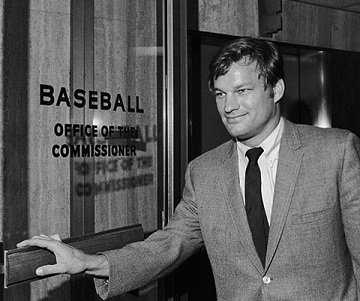
Jim Bouton steps forth from Commissioner Bowie Kuhn’s office and the meeting in which Kuhn tried to suppress Ball Four—based entirely on a magazine excerpt.

Fifty years ago Jim Bouton pitched the season he would record to write Ball Four. Once a glittering Yankee prospect reduced to relief pitching thanks to arm trouble that arose after the 1964 World Series, Bouton’s wryly candid notes, asides, and observations while pitching for the expansion Seattle Pilots and the Astros both humanised and scandalised baseball and enough of its actual or reputed guardians.

By now, of course, Ball Four is the only sports book included on the New York Public Library’s list of 20th Century Books of the Century. And Bouton died Wednesday at 80, at the Massachussetts home he shared with his second wife, Paula Kurman.

A 2012 stroke left Bouton to suffer cerebral amyloid angiopathy, a brain disease linked to dementia that compromised his ability to speak and write. Making it worse: the stroke occurred on the fifteenth anniversary of his daughter Laurie’s death in a New Jersey automobile accident.

Baseball may have gone ballistic when Ball Four hit the ground running in 1970, and Bouton could never be certain whether the Astros sent him down that year because he wasn’t pitching well or because the book was driving the front office and others out of their gourds. But he out-lived enough of his critics, most of the time the living and breathing evidence of the maxim about living well and the best revenge.

And Ball Four keeps company on the New York Public Library list with the likes of T.S. Eliot, James Joyce, William Faulkner, Virginia Woolf, Edith Wharton, Ralph Ellison, Jack Kerouac, John Dos Passos, Albert Camus, Agatha Christie, Grace Metalious, and Tom Wolfe.

Go ahead. Say if you must that Bouton didn’t exactly write The Waste Land, Light in August, Invisible Man, On the Road, or The Bonfire of the Vanities. But then T.S. Eliot, William Faulkner, Ralph Ellison, Jack Kerouac, and Tom Wolfe never had to try throwing to Harmon Killebrew, Carl Yastrzemski, Frank Robinson, Lou Brock, Frank Howard, or Willie Mays and living to tell about it, either.

To say Ball Four was received less than approvingly around baseball is to say Baltimore needed breathing treatments after the Mets flattened the Orioles four straight following a Game One loss in the 1969 World Series. “F@ck you, Shakespeare!” was Pete Rose’s review, hollered while Bouton had a rough relief outing against the Reds. All things to come considered, it was a wonder Rose knew Shakespeare wasn’t something the tavern served on tap.

Nicknamed Bulldog in his pitching days, Bouton would have been the first to say how fortunate he was to have met and married Kurman, an academic and speech therapist who holds a Columbia University doctorate in interpersonal communications, and who has worked with brain damaged children during her career. She worked with her husband carefully and helped him re-gain much of his speaking ability despite his illness.

“Together we make a whole person,” Kurman once told a Society for American Baseball Research panel, to laughter that was sad as much as approving.

But Bouton struggled concurrently with what Kurman told Tyler Kepner of the New York Times was “a pothole syndrome: Things will seem smooth, his wit and vocabulary intact, and then there will be a sudden, unforeseen gap in his reasoning, or a concept he cannot quite grasp.”

Teammates were divided mostly over Ball Four; they seemed less offended by Bouton’s vivid descriptions of the lopsided contract talks too many players experienced before the free agency era than by his candid descriptions of their clubhouse, off-field, and road off-field activities.

“The first thing I have to tell people,” said his Seattle roommate and fellow pitcher Gary Bell, with whom Bouton maintained a lifelong friendship to follow, “is that you’re not [fornicating] Adolf Hitler.” Bouton wrote in his book that being Bell’s roommate helped make him slightly more tolerable amidst teammates who weren’t exactly forward-looking or thinking. “Every year,” Bouton said of Bell, “I receive a Christmas card addressed to ‘Ass Eyes’.”

Bouton long believed fellow pitcher Fred Talbot (who died six years ago) was the teammate who was quoted anonymously as saying Bouton’s prose “would gag a maggot.” (“When I asked Fred how he was doing,” Bouton would remember in Ball Four‘s tenth anniversary edition’s postscript, “Ball Five,” after a where-is-he-now call to Talbot, “he said, ‘Well, I’m still living,’ and hung up. I didn’t even get a chance to tell him I was glad.”)

And before the Astros sent him to the minors, where he entered what proved a first retirement, unknown members of the Padres left a burned copy of Ball Four on the Astros’ dugout steps.

He got a delicious chance to write about the reaction/overreaction to Ball Four in the just-as-delightful I’m Glad You Didn’t Take It Personally, from then-commissioner Bowie Kuhn’s active attempt to suppress Ball Four to New York Daily News sportswriting legend Dick Young ripping him as a “social leper” for having written the book. When Bouton met Young in the clubhouse after that column, Young said hello and Bouton couldn’t resist replying, “Hi Dick, I didn’t know you were talking to social lepers these days.” Young replied genially, “Well, I’m glad you didn’t take it personally.” Little did Young know.

Bouton’s most famous words may well be the ones with which he ended Ball Four: “You spend a good part of your life gripping a baseball, and it turns out that it was the other way around.” But in I’m Glad You Didn’t Take It Personally, it may have been an exercise in futility for him to write, ““I think it’s possible that you can view people as heroes and at the same time understand that they are people, too, imperfect, narrow sometimes, even not very good at what they do. I didn’t smash any heroes or ruin the game for anybody. You want heroes, you can have them. Heroes exist in the mind, anyway.”

2019-07-10 JimBoutonPaulaKurman

Bouton enjoys a dance with his wife, Paula Kurman, at their Massachussetts home; the couple once competed as ballroom dance partners.

It took a very long time for baseball people to get it. Even longer than it took them to get that the late Jim Brosnan, a decade earlier, wasn’t trying to smash heroes or ruin a game when he wrote The Long Season and Pennant Race, and Brosnan didn’t go half as far as Bouton went in revealing baseball’s inner sanctum even if Brosnan incurred comparable wrath.

“I had . . . violated the idolatrous image of big leaguers who had been previously portrayed as models of modesty, loyalty and sobriety — i.e., what they were really not like,” Brosnan wrote on the 40th anniversary republication of Pennant Race. “Finally, I had actually written the book by myself, thus trampling upon the tradition that a player should hire a sportswriter to do the work. I was, on these accounts, a sneak and a snob and a scab.”

Bouton wrote and recorded Ball Four by himself, too, his editor Leonard Shecter doing nothing much more than knocking it into book-readable condition, as he would for I’m Glad You Didn’t Take It Personally. It didn’t stop Kuhn from hauling Bouton into his office and trying to jam down the pitcher’s throat a statement saying he hadn’t meant it and the whole thing was Shecter’s fault.

Both pitchers were very aware of the worlds around them, and both wrote about the periodic spells of boredom, racial tensions, off-field skirt chasings, and self-doubts endemic in their professional baseball lives. Brosnan saved them for his books and articles; Bouton was less reluctant to speak his mind about things like politics, Vietnam, and civil rights when asked or when a conversation left him the opening.

Bouton bought even less into the still-lingering press representations of athletes as heroes. Teammates didn’t always hold with that or other things, like calling them out on it when they made mistakes that cost the Yankees games he pitched.

“After two or three years of playing with guys like [Mickey] Mantle and [Roger] Maris,” he wrote in I’m Glad You Didn’t Take It Personally, “I was no longer awed. I started to look at those guys as people and I didn’t like what I saw. They were fine as baseball heroes. As men they were not quite so successful. At the same time I guess I started to rub a lot of people the wrong way. Instead of being a funny rookie, I was a veteran wise guy. I reached the point where I would argue to support my opinion and that didn’t go down too well either.”

“He stands out,” Shecter wrote of Bouton in Sport, “because he is a decent young man in a game which does not recognize decency as valuable.” Much the same thing was said of Brosnan no matter what particular writers did or didn’t think of his two books.

For decades Bouton believed Ball Four got him blackballed from the Yankees in terms of Old-Timer’s Days and other such events involving team alumni, and that Mantle was the instigator. When one of Mantle’s sons died in the mid-1990s, Bouton left a message of sympathy on Mantle’s answering machine. To Bouton’s surprise, Mantle himself called to thank Bouton and, by the way, say that it wasn’t Mantle who put Bouton in the Yankee deep freeze.

Laurie Bouton’s death prompted her oldest of two brothers, Michael, to write an astonishing op-ed piece in The New York Times calling for the Yankees to reconcile with both his father and with Hall of Famer Yogi Berra, estranged ever since George Steinbrenner fired him as manager through an intermediary in the 1980s. Michael Bouton got what he asked for. In both regards. (Yankee Stadium rocked especially with a section occupied by Laurie’s friends, holding a banner hollering LAURIE’S GIRLS!)

When Bouton retired the first time in 1970, he assembled another book, a splendid anthology of writings about baseball managers and managing called “I Managed Good But, Boy, Did They Play Bad,” then became a sportscaster for New York ABC and CBS. As his first marriage was falling apart, Bouton also tried a baseball comeback. He slogged the minors a couple of years before then-Braves owner Ted Turner abetted his September callup in 1978. After a start that prompted such comments as, “It was like facing Bozo the Clown,” as Bouton eventually recorded (in “Ball Five”), “In his next start, Bozo the Clown beat the San Francisco Giants. The pennant-contending San Francisco Giants.”

Then he tangled with Astros howitzer J.R. Richard. “The young flamethrower and the old junkballer,” Bouton described them. On the same night the towering Richard broke the National League’s single-season strikeout record for righthanded pitchers, the old junkballer fought the young flamethrower to a draw, somehow. In the interim, Bouton and a Portland Mavericks teammate named Rob Nelson cooked up the concoction that became Big League Chew gum, the kind that looked shredded like chewing tobacco, and its success made some nice dollars for Bouton and Nelson.

Bouton ended his brief baseball comeback, satisfied that he’d proven what he tried to prove, and also became a motivational speaker who also continued writing as well as joining his second wife administering a recreational 19th century-style baseball league, helping preserve an old ballpark (about which Bouton wrote Foul Ball), and becoming a competition ballroom dancing team. The Renaissance Bulldog.

Whenever one of Bouton’s former Ball Four-season teammates went to his reward, Bouton was genuinely saddened. “I think he came, over the years, to love them,” Kurman told Kepner. “As each one died, he got really teary about it. He realized how deeply they were part of him.” (The Pilots, of course, were sold and moved to Milwaukee for the 1970 season, becoming the Brewers. “The old Pilots are a ghost team,” Bouton once wrote, “doomed forever to circumnavigate the globe in the pages of a book.”)

Ball Four‘s true success, wrote Roger Angell himself (one more time: Angell isn’t baseball’s Homer; Homer was ancient Greece’s Roger Angell), “is Mr. Bouton himself, as a day-to-day observer, hard thinker, marvellous listener, comical critic, angry victim, and unabashed lover of a sport. What he has given us is a rare view of a highly complex public profession seen from the innermost side, along with an ironic and courageous mind. And, very likely, the funniest book of the year.”

Baseball didn’t collapse. The world didn’t implode. That Star Spangled Banner yet waves. Things have happened in baseball since that make any outrage over Ball Four resemble the kindergarten style debate most of the original hoopla really was. “If Mickey Mantle had written Ball Four,” Bouton once wrote, “it wouldn’t have been a big deal. A marginal relief pitcher on the Seattle Pilots had no business writing a book.” Or, implicitly, exposing the foibles and more of the reserve era’s abuses than anyone suspected existed within the Old Ball Game.

The marginal relief pitcher, once a Yankee World Series star, ended up meaning far more than that. If you want to call Bouton part of the conscience of baseball, then you must admit with more than a single tear that baseball lost something precious with his illness and, now, his death. So has his wife. So have their children and grandchildren. So has America. May the Lord and his beloved daughter welcome him home gently but happily.
The All-Star Game didn’t bomb, but . . .

2019-07-10 ShaneBieberASMVP

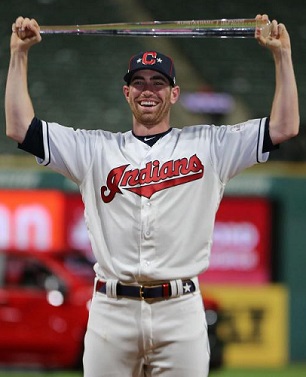
On a night the pitchers ruled the All-Star roost, Cleveland’s Shane Bieber proudly hoists his All-Star Game MVP for the home audience.

Charlie Morton walked around the American League clubhouse in Cleveland’s Progressive Field wearing a T-shirt saying, “Openers Are Human, Too.” Referencing the semi-trend his Rays took up a couple of seasons ago, of starting a game with a pitcher who’d go an inning or two before turning it over to the bullpen. Little did he know. Or did he?

This year’s All-Star Game turned out to be a game of openers even if the openers—Justin Verlander (Astros) for the American League, Hyun-Jin Ryu (Dodgers) for the National League—and most of their relief on the night are starting pitchers by profession.

What it didn’t turn out to be was a game that reflected the season to date, despite assorted prognosticators anticipating home runs flying often and all over the place.

And it launched on a Let-The-Kids-Have-Fun note of its own, when Freddie Freeman (Braves) faced Verlander with two out in the first. Freeman agreed to be miked for the Fox Sports telecast, with the world knowing he’d ask Hall of Fame pitcher John Smoltz, now a Fox analyst, to tell him what starting catcher Gary Sanchez (Yankees) put down for Verlander. Fat chance.

He and Verlander played the at-bat like a pair of pranksters, almost, even when Verlander caught him looking at a fastball on the outer edge and a naughty curve ball that landed smack dab on the floor of the zone, before Verlander followed a slider inside (Freeman admitted on the air he was looking fastball there) by catching Freeman looking at strike three, a near-cutter hitting the same spot as that naughty curve.

It was all either Freeman or Verlander could do to keep from falling apart laughing as the leagues changed sides for the bottom of the first.

American League manager Alex Cora (defending world champion Red Sox) used nine pitchers, one per inning. Verlander’s relief Masahiro Tanaka (Yankees) got the credit for the win; six pitchers—Jose Berrios (Twins), Lucas Giolito (White Sox), Shane Bieber (Indians), Liam Hendriks (Athletics), Shane Greene (Tigers), and Brad Hand (Indians)—got credit for holds; Aroldis Chapman (Yankees) got credit for a save.

National League manager Dave Roberts (defending National League champion Dodgers) also used nine pitchers, but they covered eight innings. Ryu’s relief (and Dodgers rotation mate) Clayton Kershaw was handed the official loss; Jacob deGrom (Mets), Luis Castillo (Reds), Walker Buehler (Dodgers), and Mike Soroka (Braves) worked an inning each; Brandon Woodruff (Brewers) and Will Smith (Giants) shared the seventh inning; and, Sandy Alcantara (Marlins) worked the eighth.

If this had happened on both sides of a regular season game, the purists would have reached for the whiskey bottles if not gone Elvis on the television sets. It got even crazier with the American League’s 4-3 win in a game in which thirteen total hits produced seven total runs and only two of the runs came by way of home runs.

Charlie Blackmon (Rockies) spoiled Hendriks’s sixth inning, with two outs on strikeouts (Kris Bryant [Cubs] looking; Trevor Story [Rockies] swinging), by hitting a 1-0 fastball over the right center field wall. And Joey Gallo (Rangers)— after the AL scored its third run off pinch-hitter Xander Bogaerts (Red Sox) dialing a ducks-on-the-pond Area Code 6-4-3 (with Matt Chapman [Athletics] scoring the third AL run), knocking out Woodruff and bringing in Smith—tore Smith’s first service over the right field wall in the bottom of the seventh.

Gallo teed off an inning after two of the only bright lights for the Mets so far this season took care of all three American League outs. Jeff McNeil, inserted into left field, caught a pair of fly outs sandwiching a dazzling play in which Pete Alonso, Monday night’s Home Run Derby winner, picked off a tough throw from Max Muncy (Dodgers) playing second base but stationed at the grass and moving swift to stop Daniel Vogelbach’s (Mariners) hopper from turning into a base hit.

Then Alonso in the eighth ripped a pads-padded liner up the pipe for a two-run single to bring the National League to within a single run for the second time of the night. Blackmon’s bomb took them there the first time, after the American League pried a 2-0 lead out thanks to Astro scoring Astro off Kershaw in the first (Michael Brantley—given a nice ovation from his former home audience in Cleveland—banging a double off the left center field wall to send Alex Bregman home) and Twin (Jorge Polanco, hitting a bouncer Muncy knocked down but beating the throw to first for a hit) scoring Yankee (Gary Sanchez, with a leadoff double).

The other Met bright light at the All-Star Game, deGrom, became the National League’s first pitcher of the evening to retire the side in order when he worked the third. Castillo became the second with a 1-2-3 fourth; Soroka became the third with that 1-2-3 sixth abetted by McNeil and Alonso. Alcantara did it the hard way in the eighth, striking out Merrifield after Gleyber Torres (Yankees) opened with a single, then getting Jose Abreu (White Sox) to dial his own Area Code 6-4-3 to end the inning.

If there was a real star of the show other than Verlander’s and Freeman’s first inning hijinks, it was Bieber, the Indian starter against whom the rest of the American League hits only .214 so far this season. (At least one listener of my acquaintance heard his name as “Chained Beaver.” Go figure, and don’t ask.)

He struck out the side masterfully in the top of the fifth, catching Willson Contreras (Cubs) looking at a fastball on the corner, finishing a seven-pitch battle with Ketel Marte (Diamondbacks) with a swinging strikeout on what looked like a knuckle curve taking a swan dive, and ending another seven-pitch battle by catching Ronald Acuna, Jr. (Braves) looking at a slider that landed right down the chute.

Not even Chapman striking out the side to end the game was quite as crowd pleasing as Bieber was, even allowing that Bieber worked in his own home park. It landed him the prize as the All-Star Game’s most valuable player. But he may need to work a little bit on his postgame pithiness. “Baseball,” he said, referencing the lack of bombing in the year of the bomb, “is a funny game.” Joe Garagiola, call your office.

“”It was electric out there,” said Cora after the game. “the fans got in it and it was fun. And I’m glad that [Bieber] got the MVP. He plays at this level. He’s really good.”

Bieber made the All-Star team in the first place because Rangers pitcher Mike Minor’s eligibility vaporised when he pitched on Sunday. He’s now only the third All-Star to earn the game’s MVP in his home ballpark, joining Hall of Famer Pedro Martinez (Fenway Park, 1999) and Sandy Alomar, Jr. (then-Jacobs Field, 1997).

The only thing that got close to topping the Verlander-Freeman Show in the first was a series of scoreboard blunders during the game. When not misspelling Contreras’s and David Dahl’s (Rockies) names, they spelled McNeil’s name right—but showed deGrom’s smiling mug instead. Nothing against deGrom, of course, but McNeil was less than amused.

“I didn’t really like that,” he lamented. “I wanted to see my picture up there. I know my family did, too. What are you going to do, I guess, but I don’t think that should happen.”

It’s not unusual for things to happen that shouldn’t happen even in baseball games. Think about this: None of the sixteen American League pitchers on the 2017 All-Star team made this year’s model. The National League presented the youngest starting lineup in All-Star history, its average age 26. And both sides combined presented 36 first-time All-Stars.

Both leagues also wore a patch on their uniforms with a number 45, a tribute to the late Angels pitcher Tyler Skaggs; and, American League participants Mike Trout (who started the game) and Tommy La Stella (who didn’t get to appear) switched their uniform numbers to 45 in memory of their lost teammate.

If you’re thinking all the foregoing could prevent a little pre-game controversy, think again. Remember what put these All-Star teams together in the first place: a ridiculous “primary” vote for fans that let them vote five times and produced a “Starter’s Election” more notable for worthy snubs.

More players spoke out about how broken the All-Star ballots and votes were this year than in the past. What does that tell you?

And Commissioner Rob Manfred, who’s showing more and more of an ability to trip over himself, not to mention an increasing genius for pointing the way to wisdom by standing athwart it, did it again.

Manfred denies he awarded Cleveland this year’s All-Star Game contingent on tanking longtime logo Chief Wahoo—despite meeting with the Indians in 2017, announcing then that Cleveland would get the 2019 game, and announcing concurrently that the Tribe agreed to dump the Chief.

And Manfred replied to Verlander’s accusation that this year’s ball’s been juiced by saying MLB hasn’t altered or encouraged altering the balls—just a couple of weeks after the commissioner suggested a better-centered core was behind the balls’ reduced drag in flight.

This is the same commissioner who continues to insist that if baseball’s should-be marquee players aren’t on as many marquees as they ought to be, it’s . . . the players’ faults that they game they play and love can’t figure out ways to promote them properly enough.

The same commissioner who fiddles while the Mets—reduced to a clown show that’s as funny as a tax audit by the ham-fisted, brain-challenged touch of their owner and his near-clueless chief operating son—self-immolate. Imagine if a non-sports franchise enterprise did nothing while one or another franchisee reduced his or her stores or store groups to that kind of rubble.

Say what you will about Manfred’s predecessor, but at least Bud Selig dropped the scales from his eyes if only for the moments just long enough, after Frank McCourt compromised the Dodgers by turning the team into his personal ATM machine, and forced McCourt to sell the franchise.

And while Major League Baseball Players Association director Tony Clark agrees that baseball’s asleep at the switch when it comes to promoting its stars, Clark, like Manfred, says nothing still about redressing a very real grievance—the short, even blink-of-an-eye career players from 1949-80 who were frozen out of the 1980 pension plan realignment that now vested health benefits after one day’s major league service and now provided a retirement allowance after 43 days major league time.

Eight years ago, Selig and then-Players Association director Michael Weiner realigned the realignment, sort of: the frozen-out players would get $625 per 43 days major league time, with the 43 days representing a quarter and a sixteen-quarter limit, equal to $10,000 before taxes. But when such players pass away before collecting the final such payments, the money can’t be passed to their families.

The thinking person’s sport continues to be governed by people who can’t or won’t think.

This Derby doesn’t quite fit that well

2019-07-09 PeteAlonsoHomeRunDerby

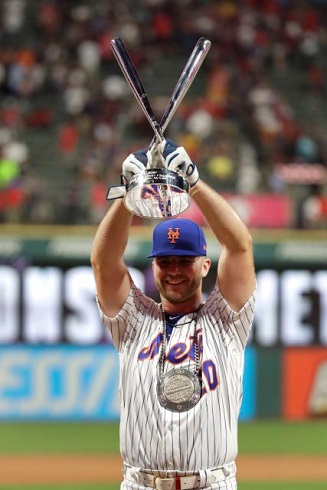
One of the 2019 Mets’ few bright lights, Pete Alonso proudly hoists his Home Run Derby winning trophy Monday night.

The remade/remodeled rules of the thing enabled Pete Alonso to win Monday night’s Home Run Derby in Cleveland’s Progressive Field. And Alonso, who’s one of the extremely few bright lights on a Mets team described charitably as a basket case, would have been the star of the show all around if it wasn’t for the kid named Vladimir Guerrero, Jr.

Gone is the longtime ten-outs window through which the Home Run Derby’s participants had to perform in the past. In is the three-minute, no-outs window through which they get to mash to their hearts’ content and their swings’ contact. Through that window did the chunky Blue Jay mash his way into becoming half of the only father-and-son tandem ever to win the Derby.

And, into the hearts of both the packed Progressive Field (commentators invariably noted the full house stayed full from late afternoon until the Derby finished) and the television audience. Hitting 91 home runs on the evening can do that for you, especially if you’re as effervescent as this son of a Hall of Famer showed himself to be.

It was great entertainment.

But it wasn’t baseball.

And there was the chance going in that this year’s Derby could be won by a guy who wasn’t even an All-Star in the first place.

As likeable as he is, as promising as his future still appears to be despite his awkward career opening after he’d turned the minors into his personal target practise, Guerrero isn’t even a member of the American League’s All-Star team. And Joc Pederson, whom Guerrero beat to set up the final showdown with Alonso, isn’t a member of the National League’s All-Stars this time. The Derby operates by a slightly different set of criteria than the All-Star Game, which has problems enough every year.

But Alonso is an All-Star. So is Alex Bregman, the Astros’ deft third baseman who often seems to be six parts Little Rascal and half a dozen parts high on laughing gas, and you’re never quite sure which side dominates at any given time. Bregman was eliminated in the Derby’s first round after a mere fourteen blasts. He may not necessarily have been complaining.

Watching the showdown between Guerrero and Pederson, who put on a big show of their own (including two swing-offs) before Guerrero yanked his way to the final showdown with Alonso, Bregman got off the arguable second best line of the night: I couldn’t imagine three rounds of that. I was gassed after two minutes of it. The arguable best line of the night? It showed up on Twitter: Joc Pederson’s going after that $1 million like he’s behind in his rent.

And, on television, Dodger pitcher and All-Star Clayton Kershaw inadvertently provided the most charming moment—his two young children, Cali and Charley, accompanied Daddy to the ballpark for the Derby. There was Cali Kershaw, pretty in pink, pumping her hands and hollering, “Let’s go, Joc! Let’s go, Joc!” The little lady’s a natural scene-stealer, just as she was during last year’s National League division series.

This year’s Derby winner added $1 million to his bankroll for his effort. In Alonso’s case, earning $1 million for one evening’s glorified batting practise all but doubles what he’s earning all season long as a Met. And, entering the Derby and the All-Star break, Alonso out-performed the guy down the freeway in Philadelphia who signed a thirteen-year, $330 million contract by the time spring training was about two-thirds finished.

Alonso also made good on his very public promise to divide ten percent of the Derby prize money equally, if he won, between the Wounded Warriors project (which aids post-9/11 military wounded) and the Stephen Siller Tunnel to Towers Foundation, named for the firefighter who lost his life on 9/11 trying to save lives in the World Trade Center.

“There’s a lot I was hitting for tonight,” the exhausted Met said after he was handed the winning medal and trophy. “I’m just happy that I can donate some money to the causes that I wanted . . . I mean, I have the utmost respect for the people that put their lives on the line every single day. And I just want to show my gratitude, because a bad day for me is a lot different than a bad day for the service men and women that serve this country.”

Whom among the Derby participants is also an All-Star? Ronald Acuna, Jr. (Braves), Josh Bell (Pirates), Matt Chapman (Athletics), and Carlos Santana (Indians). Ridiculously, one of the Derby semi-finals was between two guys who aren’t even All-Stars this year. Alonso beat his fellow All-Star Acuna to set up the showdown with Vlad the Impaler, Jr.

Even an observer who isn’t irrevocably wedded to the more stubborn of baseball’s traditions is justified in saying that the Home Run Derby is more entertainment than baseball, since it is tied explicitly to the All-Star festivities, if it invites those who didn’t make either All-Star team as well as those who did.

And one is reminded even briefly that Yankee star Aaron Judge pre-empted any participation in this year’s Derby during spring training, when the Leaning Tower of the South Bronx said he was more concerned with helping his team win games after the All-Star break than with joining and winning a Derby. Judge won the Derby in 2017. His second-half performance wasn’t quite the same as his first half, and he won the American League’s Rookie of the Year award anyway. (He also may have exacerbated a shoulder issue while swinging for his Derby win.)

I analysed Derby winners’ seasons at the time Judge declined and discovered at least half of them had lesser than equal or better second halves of the regular seasons in which they won their Derbies. Last year’s champion, Bryce Harper (now a Phillie), had a better second than first half, to name one; Guerrero’s Hall of Fame father (then an Angel) had a lesser second than first half when he won the Derby, to name one more.

It’s great entertainment.

But it isn’t baseball.

And, contrary to the naysayers, nannies, and nattering nabobs of negativism (thank you, William Safire, of blessed memory), baseball games are better entertainment than million-dollar batting practise. Even million-dollar batting practise that turned out to contribute to two extremely worthy causes.

If there’s a 50-50 chance that a Derby winner will have a lesser than better second half after winning the prize, with or without Alonso’s admirable charity intentions, it’s a little more alarming for baseball than it is engaging for Joe and Jane Fan.

And guess who’s going to be the first to complain, of course, if and when their heroes in the Derby become less at the plate and in the field, especially if and when their teams hit the stretch drive running.

Cervelli, Lucroy, and baseball’s most vulnerable beasts

2019-07-07 JonathanLucroy

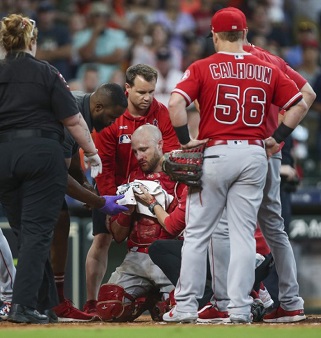
Hours after Francisco Cervelli surrendered the “tools of ignorance” Sunday, Angels catcher Jonathan Lucroy (center, kneeling) was blasted near the plate by Astros baserunner Jake Marisnick. Angels outfielders Kole Calhoun and (hidden, mostly) Mike Trout join team health personnel checking their man . . .

Baseball’s single most dangerous field position is probably behind the plate. Catchers are in on the beginning of each play, receiving the pitcher’s delivery unless its struck by the hitter. But catchers can also be men one minute made mincemeat the next, depending.

They risk being concussed into brain damage by anything from a foul tip, a violent backswing, an unforgiving wall or rail or fence while trying to catch a foul popup, or a baserunner steaming from third base and flying home in a near-perfect impression of a cruise missile. The luckier ones retire from baseball without their bodies becoming their own quislings or their minds lost in the liquefying of their brains.

Their field equipment was nicknamed “the tools of ignorance” by ancient catcher Muddy Ruel, who hoped to highlight the irony, as baseball’s very own Website points out, “that a player with the intelligence needed to be effective behind the plate would be foolish enough to play a position that required so much safety equipment.”

Ruel played generations before catchers took to wearing helmets that are the next best thing to those employed by hockey goalies. Thomas Boswell once called the catcher “half guru, half beast of burden.” It’s the latter that often means a catcher sliced, diced, and pureed, Bigfoot turned to Blue Bonnet margarine.

Baseball changed the rules a few years ago to get catchers a little further out of the line of collision than was reasonably healthy for them to remain. There were those mourning the further snowflaking of the grand old game. But maybe we ought to wonder instead how such men as Hall of Famer Yogi Berra lived as long as they did with their marbles unspilled. (Berra died at 90.)

Nothing specifically says baseball must be excessively dangerous for those who play it or those who watch and love it. Nothing suggests concurrently that even the thinking person’s sport that baseball is must be immune at all times to physical injury. But players have been known to play as though in the youthful and naive belief that they are eternally invulnerable. Until they’re not.

Hall of Fame catcher Roy Campanella once said, famously, that for a man to play baseball well a lot of him had to be a little boy. Boys will be boys, but there’s nothing written or implicit mandating that they absolutely have to destroy themselves or each other to be boys, or young men.

On baseball’s final Sunday before the All-Star break, one major league catcher decided six concussions per twelve major league seasons was quite enough, and it was time to set the so-called tools of ignorance to one side. Francisco Cervelli, Yankee turned Pirate, got number six thanks to a broken bat hitting his chin on 25 May. “That’s enough,” he told DKPittsburghSports.com’s Dejan Kovacevic. “This time is different. I can’t live like this.”

What a difference almost a month and a half makes. When first knocked down and out, Cervelli was determined to get back behind the plate as soon as feasible, which seemed to unnerve Pirates general manager Neal Huntington.

“We care about this man. We care about this person and want him to have a great post-playing career . . . You have to respect the player’s wishes,” Huntington said then. “Francisco has been adamant that he wants to continue to catch. I think he would be quite unhappy if we told him he was never going to catch for us again.”

Kovacevic says Cervelli changed his mind gradually but surely and with no instigation from the Pirates. He talks of switching to the outfield, perhaps. Barring any frequent collisions with fellow outfielders, it’s a far less dangerous place to play, assuming Cervelli can recover his batting stroke enough to justify the Pirates letting him fall in out there.

And lo! Just hours after the news of Cervelli discarding the tools of ignorance came forth, there came a play in Houston that gave his alarm too much credence.

Astros outfielder Jake Marisnick, inserted into the game against the Angels as a pinch runner for left fielder Yordan Alvarez, attempted to come home from third on a long bases-loaded fly to right by Astros center field star George Springer. Angels right fielder Kole Calhoun fired a strike home.

Marisnick came booming down the line as Angels catcher Jonathan Lucroy awaited the Calhoun throw. Mindful of the oncoming Marisnick, Lucroy moved out front and slightly left of the plate, which (read carefully) opened the lane for Marisnick to stay on a straight line, with Lucroy, a well-seasoned catcher, leaving himself concurrent room to apply a tag.

Except that Marisnick jinked left, right into Lucroy, blasting Lucroy into a heap, the impact compelling Marisnick to double back to touch the plate, before he bent over Lucroy in obvious alarm for the veteran’s health as the Angels’ training staff arrived at the plate.

The play was reviewed out of New York and Marisnick was ruled out. He would have scored the go-ahead run in a ten-all tie; the Astros ultimately won the game 11-10 in the tenth inning.

Social media seemed to bristle with Astros fans fuming over the out call, but the call was indeed correct according to the rule that’s been in place since 2014, when the Giants and most of baseball became fed up over how much playing time injuries and plate collisions cost their star catcher Buster Posey:

A runner attempting to score may not deviate from his direct pathway to the plate in order to initiate contact with the catcher (or other player covering home plate). If, in the judgment of the Umpire, a runner attempting to score initiates contact with the catcher (or other player covering home plate) in such a manner, the Umpire shall declare the runner out (even if the player covering home plate loses possession of the ball).

I watched as many replays of the play as I could. My conclusion:

1) Lucroy did indeed move to allow Marisnick a more proper lane, just before Lucroy took Calhoun’s throw to the plate on the short hop about a foot forward left of the plate. (The longtime rule was that catchers were not allowed to block the plate, a rule rarely enforced, but Lucroy acted within the letter of the current rule, too.)

2) Marisnick did indeed move left and into Lucroy’s way in a bid to move him off the play when he was indeed given a clear, straight line to the plate. If you see the play from the camera angle behind the plate, you see Marisnick look as though making a quick turn left, the pivot on his right leg, and into Lucroy.

3) Read this very carefully, too: From all appearances, Marisnick had no intention of relieving Lucroy of his limbs or his brains on the play. He wanted simply to knock Lucroy off the play and relieve him of the ball he speared seconds before impact. The ball was indeed knocked right out of Lucroy’s mitt at the moment Marisnick turned him into the high priced spread.

4) The foregoing said, Marisnick was very remorseful over Lucroy’s injury, as he tweeted subsequently: Through my eyes I thought the play was going to end up on the outside of the plate. I made a split second decision at full speed to slide head first on the inside part of the plate. That decision got another player hurt and I feel awful. I hope nothing but the best for [Lucroy].

5) Properly remorseful but momentarily blinded. Full speed or otherwise he couldn’t possibly miss Lucroy moving forward to allow him a proper lane, which, I repeat, would still give Lucroy a fair shot at tagging him out and Marisnick a fair shot at scoring.

The Angels sent Lucroy to a local hospital for a CT scan and concussion evaluation, not to mention to determine whether his nose was broken on the play. Lucroy’s week already included mourning the unexpected deaths of his Angels teammate Tyler Skaggs and his coach at Louisiana-Lafayette College, Tony Robichaux. Crowning such grief by being blown to smithereens wasn’t exactly on Lucroy’s radar.

It soiled both the Astros’ otherwise splendidly hard earned win and the afternoon on which Mike Trout, the Angels’ and baseball’s Mr. Everything, bombed his way into his team’s record book, his two launches making him the Angel with the most home runs prior to an All-Star break, ever. (The previous record, 26, was shared by Trout, future Hall of Famer Albert Pujols, and former Angels star/World Series hero Garret Anderson.)

It also spoiled such Sunday milestones as Mets rookie Pete Alonso, one of the few bright lights in a Mets season described at best as grotesque, breaking the National League’s record for runs batted in by a rookie before an All-Star break and tying the Mets’ team record for home runs before the All-Star break. (Dave Kingman set it in 1976.)

And it punctuated Francisco Cervelli’s decision with an exclamation point that might as well have been fashioned into a stake.

Baseball takes the Fourth

2019-07-04 LouGehrig

Lou Gehrig, who said farewell eighty Fourths of July ago . . .

This year is a splendid one for baseball anniversaries, not all of them pleasant. A hundred years ago the Reds were cheated out of the thrill of World Series victory by the agony of the Black Sox’s chill of self-conscious defeat; fifty years ago, the eight-year-old, crazy Mets were crazy enough to win a division, a pennant, and a World Series. Just to name two.

Today America will have its annual red, white, and blue pyrotechnic racket celebrating the declaration without which this hardy if too often self-buffeted experiment would not be alive to watch twelve major league baseball games and a few hundred more minor league games.

And the Mets, crazy this year for reasons having too little to do with the craziness of 1969, get their first Fourth of July off in a non-strike-impacted season in their entire franchise history, after splitting a pair with the Yankees Tuesday and Wednesday. No such luck for the Empire Emeritus; they have landed in Florida to open a weekend with the freshly upstart but lately teetering (they’ve won 5 of 7 but lost 9 of 16 entering today) Rays.

Twenty seasons after the shenanigans of the 1919 World Series, America’s 4 July fireworks were handed a sober contrast in the old Yankee Stadium. Two weeks after receiving his diagnostic death sentence, the insidious disease that now bears his name, Lou Gehrig accepted the honour of his teammates past and present and did what he’d rarely done on the field prior to his self-imposed removal from the Yankee lineup.

He wore his heart on his sleeve. He also spoke without a script, without premeditation, without a speechwriter. You can hunt all you like but find no actual or alleged American leader that gifted by spontaneous soul:

Fans, for the past two weeks, you have been reading about the bad break I got. But today, I consider myself the luckiest man on the face of the earth.

I have been in ballparks for seventeen years and have never received anything but kindness and encouragement from you fans.

Look at these grand men. Which of you wouldn’t consider it the highlight of his career just to associate with them for even one day? Sure, I’m lucky.

Who wouldn’t consider it an honor to have known Jacob Ruppert? Also, the builder of baseball’s greatest empire, Ed Barrow?

To have spent six years with that wonderful little fellow, Miller Huggins? Then to have spent the next nine years with that outstanding leader, that smart student of psychology, the best manager in baseball today, Joe McCarthy? Sure, I’m lucky.

When the New York Giants, a team you would give your right arm to beat, and vice versa, sends you a gift—that’s something. When everybody down to the groundskeepers and those boys in white coats remember you with trophies—that’s something.

When you have a wonderful mother-in-law who takes sides with you in squabbles with her own daughter—that’s something. When you have a father and a mother who work all their lives so you can have an education and build your body—it’s a blessing. When you have a wife who has been a tower of strength and shown more courage than you dreamed existed—that’s the finest I know.

So I close in saying that I may have had a tough break, but I have an awful lot to live for.

Leave it to Hollywood to bowdlerise such transcendence the way it did when, despite availability’s freshness, they put a completely fictionalised version of Gehrig’s “Luckiest Man” speech into Gary Cooper’s mouth, the crowning insult from a film that insults more than embraces Gehrig’s actualities. In a later generation a Hell’s Angels president lamented their press coverage by wondering, “All that bullshit, hell, ain’t the truth bad enough for ’em?” Film students and baseball fans alike have every right to ask of The Pride of the Yankees, “All that bullshit, hell, ain’t the truth good enough for ’em?”

On the same day Gehrig graduated from baseball excellence to soul transcendence, Jim Tabor, a Red Sox third baseman, hit two grand slams in a doubleheader nightcap against the Philadelphia Athletics. (One of them was an inside-the-park number.) He became one of only thirteen players to perform that feat, on a day he driving in eleven runs over the entire doubleheader.

In 1983 a Yankee pitcher, Dave Righetti, subsequently a respected pitching coach, kept the Red Sox from making their own Fourth of July fireworks. He threw a no-hitter, the first Yankee to do it since Don Larsen’s perfect game in the 1956 World Series and the first Yankee lefthander to do it since George Mogridge—in 1917, while the world war alleged to be ending all wars continued apace.

Righetti finished his no-hitter with a flourish. In 1983 Hall of Fame third baseman Wade Boggs struck out a mere 36 times. The bad news is that one of those strikeouts completed Righetti’s masterwork. Which reminds me that sixteen pitchers have struck out 3,000 or more batters and only two of them secured number 3,000 on the Fourth of July: Nolan Ryan (1980; his victim: Cesar Geronimo) and Phil Niekro. (1984; his victim: Larry Parrish.)

One year after Knucksie’s milestone the Mets and the Braves played a game that started on the Fourth of July and ended on the fifth of July. The good news for the Mets: Keith Hernandez hit for the cycle. The better news for the Braves: pitcher Rick Camp tied the game with a home run—in the bottom of the eighteenth. (“If this team needs me to tie a game, they’re in trouble,” Camp remembered later.) The best news for the Mets: They scored three in the top of the nineteenth before Ron Darling—now a Mets broadcaster, then a starting pitcher pressed into survival relief—struck out Camp himself to end the 16-13 win.

The Braves said nuts to that and went ahead with their postgame fireworks show anyway. Nothing keeps some people from their red, white, and blue racket making—not even the fifth of July and nineteen innings of baseball.

Sixty years to the day before that Fourth, two Hall of Famers—Lefty Grove (Athletics) and Herb Pennock (Yankees)—tangled in a pitching duel that went fifteen innings before Grove surrendered the game-losing RBI to Yankee catcher Steve O’Neill. The bad news: It was one of only ten RBIs O’Neill would have all season long. The worse news: it was the first game of a doubleheader.

Today, the eyes of baseball will fall most likely upon the Dodgers, who enter a home game against the Padres on a streak of five consecutive games won in the final plate appearance of the inning. The last two of the streak were won by Cody Bellinger, the Dodger outfielder doing his level best to give Dodger fans a taste this season of what Angel fans have tasted since 2012 from Mike Trout.

On Tuesday night, Bellinger received the fifth consecutive walk of the bottom of the ninth to win, 5-4. On Wednesday night, having opened the scoring with a parabola over the center field fence, and with his parents in Dodger Stadium, Bellinger stepped up in the bottom of the tenth and sent one into the right center field bleachers. Winning again, 5-4.

The two Wednesday blasts put Bellinger into the Dodgers’ record book. He knocked two Brooklyn legends—Hall of Famer Duke Snider, and eventual Miracle Mets manager Gil Hodges—to one side for the most home runs by a Dodger in any season prior to the All-Star break.

But the eyes of baseball are just as likely to fall upon the Nationals, in Washington, when they host the Marlins in the nation’s capital. The Nats have gone from basket case in the making to winners of 15 out of 17 and a resurrected National League East threat, and even their once-lamented 2019 bullpen seems to be shaking off its early season penchant for throwing kerosene balls.

An American president-to-be fired the pronouncement heard ’round the world 243 years ago. (If you’re scoring at home, that’s one year more than the total home runs a former Nationals manager hit during his own playing career.)

May [our Declaration] be to the world, what I believe it will be (to some parts sooner, to others later, but finally to all) the Signal of arousing men to burst the chains, under which monkish ignorance and superstition had persuaded to bind themselves, and to assume the blessing & security of self government.

Let today’s American political (lack of) class sully America’s birthday all it wishes, if only because the formal legal holiday allows even a single day’s relief from their suffocating mischief. Immune as almost completely they are to America as an idea as well as a country, let them stew all they choose that they can’t really impose that immunity upon still-sovereign Americans, enough of whom will re-embrace America the idea in hand with America the country today.

Descended from stock as varied in international origin as baseball players are in performance, approach, and style, still-sovereign Americans will spend a fair portion of her birthday watching the game that above all others begins with the act of a sovereign individual but scores with the act America the idea embraces in the abstract and, at her best, the actuality. Enunciated best by the Yale scholar of renaissance literature (Dante in particular) who eventually became baseball’s overseer, if for a tragically brief term:

Baseball is quintessentially American in the way it tells us that much as you travel and far as you go, out to the green frontier, the purpose is to get home, back to where the others are, the pioneer ever striving to come back to the common place. A nation of migrants always, for all their wandering, remembers what every immigrant never forgets: that you may leave home but if you forget where home is, you are truly lost and without hope.

Mr. Jefferson, meet Professor Giamatti. Preferably behind home plate, but anywhere you might see America’s best annual birthday present, that roaming to the frontier, that hope of coming home, its starting cry the one with which you, Mr. Jefferson, might have finished your declaration and America’s, had you been clairvoyant enough to see its advent: Play ball!