The Angels can’t shoulder Harvey anymore

2019-07-20 MattHarvey

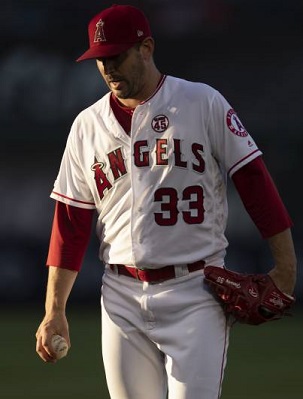
Shadows of the Knight: Matt Harvey, now designated for assignment, whose shoulder couldn’t convince his mind he’s not the Dark Knight anymore.

When you hear next of a pitcher taken out of action because of “shoulder fatigue,” your red flags should be waving as violently as if in a stiff wind. The odds are sadly good that it means thoracic outlet syndrome. For a pitcher, the odds are more sadly good that it means career badly compromised and, before very long, over.

And for a pitcher like Matt Harvey, who once looked as though he had a splendid chance of owning baseball, TOS means two seasons since in which he looked like anything but the Dark Knight he once was and still longs very badly to be. Despite his body telling him that it gave up that sword long enough ago.

At least one published report to my knowledge has cited the late Tyler Skaggs telling Harvey not to forget who he was: “You’re still the Dark Knight.” For a 30-year-old pitcher with a body trying to override his mind’s clinging to his past, it was just what Harvey wanted to hear and the last thing he needed to hear.

What Harvey needed most to hear and heed was that he might have rehabilitated his personality away from the New York demimonde to which he once gravitated like the proverbial moth to the flame, but he now had to align his remade self to pitching stuff that wasn’t a Dark Knight’s but could still get major league hitters out, if only he quit trying to pitch like 2013 because his 2019 body couldn’t do that.

And he also needed to hear and heed that his post-TOS surgery body stood a sadly excellent chance of not doing it unless he re-trained it to do it.

It’s entirely possible that either no one told Harvey, or Harvey couldn’t bear to hear, that the pitching prognosis for those undergoing TOS surgery, as he underwent in 2016, is a badly mixed one. But the pitching-challenged Angels, who need innings and lots of them from their starters, finally decided they don’t have time to see whether Harvey can continue re-training his body, his arm, and his pitching mind.

After he surrendered six runs (five earned) in six innings against the Astros during the week, the Angels surrendered, designating Harvey for assignment Friday. They took the flyer based on Harvey looking as though he had something new and developing positively during his spell with the Reds last year, but the Angels could no longer watch Harvey struggle in vain despite the occasional flash of what could be.

In human terms, it’s only too understandable that Harvey couldn’t accept he was no longer the Dark Knight. One minute, he’ll say, “Just have to kind of be smarter out there about what I can and can’t do right now.” But the next, he’ll say, “I tried to throw a 98 mph fastball on the outside corner.” That fastball hit 92 instead. And it was hit over the fence.

Joe and Jane Fan don’t always comprehend the war inside the mind of a baseball player who’d been to the mountaintop several times over—as Harvey was in 65 starts between 2012-2015, as a Met, with a 2.53 ERA over those starts—and has to learn that he may never again be anything like that dominator if he has a major league career left at all.

But if Harvey’s going to defy odds and remain any kind of major league pitcher, he’ll have to find a team in better position than the Angels to give him the chance. He may still have enough stuff to get major league hitters out, but he couldn’t stop taking the mound with the mindset that belonged to a pitcher he can’t be anymore and his command went missing and possibly kidnapped.

Coming off Tommy John surgery is one thing, and Harvey now admits he pushed himself too far, too fast after his recovery and return from that. But coming off TOS surgery—a far more invasive procedure, in which the shoulder is cut through to remove a rib—is something else.

As often as not it begins with “shoulder fatigue.” (Mets pitcher Zack Wheeler, formerly a trade candidate, was shut down with shoulder fatigue when the Mets hoped he’d start against the Twins as a likely trade-deadline showcase.) And, as often as not, it just might mean pitching career over.

If it was bad enough that Harvey pushed himself prematurely returning from Tommy John surgery, doing it in his return from TOS surgery may have been an exercise in futility. He isn’t the first pitcher to whom the condition and corrective surgery spells an end. Not even close. But he’s one of the saddest.

When Jay Jaffe (The Cooperstown Casebook) analysed TOS surgeries and aftermaths last year, after the Twins’ Phil Hughes (post-TOS surgery) was designated for assignment last year, he discovered 29 pitchers having suffered the condition and undergone the surgery with decidedly differing results.

Dodgers pitcher Bill Singer underwent the procedure in 1966 and enjoyed a long enough and solid enough career to follow. Astros pitcher J.R. Richard, a far superior talent, complained of shoulder fatigue in 1980, suffered his infamous stroke, underwent TOS surgery as part of his recovery, but never pitched major league baseball again. And boy, but didn’t he look like he was hitting the Hall of Fame track at last before he was taken down.

Among the 27 who were entered into a table examining their innings before and after the surgery, Jaffe found only five whose ERAs relative to their leagues dipped after the surgery: Aaron Cook, Matt Harrison (who underwent two TOSes, through both shoulders), Clayton Richard, Mike Foltynewicz, and Josh Beckett.

Beckett’s case may have been a little flukish: buffeted with assorted other injuries in the last few years of his career as it was, that righthander and former two-time World Series winner underwent TOS surgery in July 2013 after trying to rehab without it unsuccessfully. Returning in 2014, his velocity remained solid but his command went AWOL. Twenty 2014 starts and a hip injury later, Beckett retired.

Chris Carpenter was another top-of-the-line pitcher whose career went into the dumpster following TOS surgery. Like Beckett, he tried rehabbing without surgery. Until he couldn’t. His September 2012 return was thought miraculous, working seventeen innings that month and thirteen and two-thirds that postseason, but he looked nothing like the pitcher he formerly was. 2013: DL out of spring training, persistent discomfort in two minor league rehab starts, shut down for the season. Career over.

Kenny Rogers was one of the luckier ones. He underwent TOS surgery in 2001, at age 36 and with 2,049.1 innings on his arm. After TOS surgery: he pitched 1253.1 innings, and his ERAs relative to his league remained respectable enough. Not to mention that magnificent performance in the 2006 World Series. Jaffe says Rogers and Aaron Cook (256.1 innings pre-TOS; 1,150 innings post-TOS) are outliers: the median innings before TOS for the pitchers in question was 595 and after, 134.

Harvey before his TOS: 519.2. Harvey since: 306. He was under the median before the surgery and more than double it afterward, but that may be the end of the major league line for him. May. And, among the entire group of post-TOS pitchers Jaffe analysed last year, Harvey has the highest drop in effectiveness even accounting for the improvement he showed in Cincinnati in 2018.

And it’s wise to keep in mind how other injuries might have married to TOS when it comes to reviewing TOS pitchers’ performances pre- and post-TOS. Harvey, Carpenter, Nate Adcock, Carter Capps, Alex Cobb, Jaime Garcia, Luke Hochevar, Shaun Marcum, Vince Velasquez, and Drew VerHagen all underwent Tommy John surgery well before their TOS issues.

Only an extremely small number of the TOS pitchers experienced anything close to the highs Harvey once experienced. The rule, rather than the exception, is pitchers going from such highs to the kind of terrifying lows that now bring Harvey to the crossroads once again.

Call it a flaw in the contemporary baseball mindset if you must, but too many pitchers today still think that unless they’re blowing hitters apart it isn’t pitching. That’s what Dark Knights do. And when they’re not Dark Knights anymore, too many of them refuse to resign themselves. Even while they’re getting killed to death.

Harvey isn’t even close to the only athlete who couldn’t accept that his body went to the enemy side once too often. But is it worth putting up with the uninformed bleating, snarling, and insults from Joe and Jane Fan and a few hundred thousand talking heads to continue denying that your body demands a new way to approach your craft?

America’s called shot, fifty years later

2019-07-19 BuzzAldrinTugMcGraw

“When those astronauts landed on the moon, I knew we had a chance.”—Tug McGraw (right), Mets relief pitcher. (Left, of course, Buzz Aldrin on the moon, in the famous photograph taken by Neil Armstrong.

Writing once to commemorate Apollo 11, George F. Will couldn’t resist comparing John F. Kennedy’s kept promise to a baseball legend: It was like Babe Ruth’s ‘called shot’ in the 1932 World Series. America audaciously pointed its bat to the right field bleachers and then hit the ball to the spot.

Whether Ruth actually called the home run he blasted off Cubs pitcher Charlie Root is still open for debate. And it did take Ruth a lit-tle less time to hit the bomb than it took Neil Armstrong, Buzz Aldrin, and Michael Collins to hit Kennedy’s ball to the spot.  But let’s not get technical.

The bad news is that 20 July was the birth date of only one Hall of Famer (Heinie Manush) among 48 players to have been born on the date. The good news is at least two World Series champions (Mickey Stanley, 1968 Tigers; Bengie Molina, 2002 Angels) were. And when Armstrong took his small step for man and giant leap for mankind, it inspired the World Series champions to be the same year.

“When those astronauts landed on the moon,” said Mets relief pitcher Tug McGraw, “I knew we had a chance. Anything was possible.”

Alan B. Shepard, Jr. took America’s first suborbital space flight a year before the Mets played their maiden season. As portrayed in Tom Wolfe’s The Right Stuff, Shepard walked the line between inveterate joker and unflappable Navy commander. He was much like Original Mets manager Casey Stengel that way. Except that, by the time he launched, he didn’t have to ask NASA’s diligent calculators, physicists, aeronauticians, and biochemists any longer, “Can’t anybody here play this game?”

Wolfe portrayed with staggering accuracy and insouciant wit an American space program that began much like the Mets, the significant distinction being that the Mets might have been better off with monkeys doing men’s work even though they didn’t flub one rocket launch by blowing the top off like a champagne cork.

America’s space program required graduation from then-Senator Lyndon Johnson seriously considering professional acrobats and daredevil stunt people to pilot spacecraft to one Navy pilot (Armstrong) and one Air Force pilot (Aldrin) descending gently but firmly onto the moon, with a second Air Force pilot (Collins) piloting the command module around the moon.

Collins once admitted that in the event Armstrong and Aldrin died on the moon he’d return to earth as “a marked man for life.” He needn’t have worried. Baseball fans unfortunately treat actual or alleged game goats worse. Armstrong and Aldrin came through admirably and spared Collins any chance of becoming space travel’s Fred Merkle. He settled merely for being its Dick Stuart.

Stuart was a Pirate in 1960, a man blessed with preternatural long ball power and an equivalent talent for playing first base like a future 1962 Met, a talent that earned him the nickname Dr. Strangeglove. (Sidebar: Stuart did play for the Mets briefly during his career—in 1966, the year the Gemini space program concluded.)

Collins was preternaturally disposed against mistakes as he orbited the moon. Stuart—who’d promised to hit one out in the Series—went out on deck in the bottom of the ninth in Forbes Field in Game Seven of the 1960 World Series, with Ralph Terry on the mound for the Yankees and Bill Mazeroski leading off for the Pirates.

“I was gonna hit one,” Stuart said afterward. “Can I help it if Mazeroski got cute?”

A Met fan got cute in August 1969, when Armstrong, Aldrin, and Collins rode down New York’s Canyon of Heroes for a celebratory ticker-tape parade, hoisting the sign Collins claimed his favourite among the sea of signs: WE LOVE THE METS. BUT WE LOVE YOU MORE. SORRY, METS.

Until Apollo 11, 20 July was a kind of lukewarm date for significant history in terms of volume, anyway. St. Hormisdas was elected Pope to succeed Sympowerus (514); Henry I succeeded his father Robert II as king of the Franks (1031); Sitting Bull surrendered to federal troops (1881); Alice Mary Robertson became the first woman to preside over the House of Representatives’ floor (1921); and, the Indo-China Armistice created North and South Vietnam (1954).

Birthdays on 20 July are something else. Heinie Manush, Mickey Stanley, and Bengie Molina share a birthday with Alexander the Great, Pope Innocent IX, New York City mayor Robert Van Wyck (one of the city’s most notoriously suffocating expressways is named for him), the namesake father (and jurist during the last years of the old Russian Empire) of novelist Vladimir Nabokov, future Tigers owner Mike Ilitch, publisher and one-time Mets co-owner Nelson Doubleday, screen legend Natalie Wood, and rock star John Lodge (the Moody Blues).

On 20 July 1969, too, the late Jim Bouton was still a relief pitcher for the Seattle Pilots and still composing the diaries that would become Ball Four. His entry for 20 July, when the Pilots continued an extra-innings game suspended from the night before: Poor John Gelnar. The game was picked up today in the seventeenth inning and he promptly lost it. Then he lost the regular game, which is two in one day and not, under most circumstances, easy to do.

The Mets spent 20 July 1969 sweeping a doubleheader from the Montreal Expos. Their National League East rivals, the Cubs, swept one from the Phillies. The Astros, to whom Bouton would be traded in time to be part of their outlying spot in the NL West race, didn’t play. And it was baseball’s last round before that year’s All-Star break.

Unfortunately, the Mets were delayed at the Montreal airport for their flight back to New York. It enabled the players to watch Armstrong and Aldrin hit the moon on a television set in the airport bar. “[T]he irony wasn’t lost,” remembered outfielder Ron Swoboda. “I thought, We can’t get back from Montreal to New York, and here’s a guy stepping on the moon!

A day later, Bouton and his first wife asked the Korean orphan they adopted a year earlier if he’d like an American name, a subject they didn’t broach earlier for fear of adding to the boy’s burden adjusting to American parents in America. Knowing the boy’s friends had trouble pronouncing “Kyong Jo,” Bouton asked what about “David.”

The boy said, “Yeah.” “Okay,” said Pop, “we’ll call you David. You’ll be David Kyong Jo Bouton.” Right on cue, the lad ran out to holler to his neighbourhood buddies, “Hey, everybody, I’m David. I’m David!” Today David Bouton helps run Citigroup’s real estate financial group covering North America.

When the Beatles played their first concert at Shea Stadium, the longtime home of the Mets, before a mammoth, packed house, John Lennon is said to have commented after the evening ended, “We’ve been to the mountaintop. Where do we go from here?” Already having achieved a kind of immortality, the Beatles merely went from there to what an eventual fictitious toy astronaut described, to infinity and beyond.

When the 1969 Mets won their unlikely division, pennant, and World Series championships, they could ask, plausibly, “We’ve reached the Promised Land. Where do we go from here?” They went from there to a couple of pennant races, the death of a beloved manager, a few spells of futility and the occasional World Series appearance (including another claim on the Promised Land), and, alas, to today’s traveling circus.

When Armstrong and Aldrin landed on the moon, they, especially, could ask plausibly, “We’ve been to the moon. Where do we go from here?” Armstrong became a teacher, co-investigator of the Challenger tragedy, and a businessman; Aldrin, sadly, battled clinical depression and alcoholism before he sobered and, in due course, founded a company to develop re-usable rocket launchers. He also once settled the hash of a conspiracy theorist claiming the moon landings were faked and (with a Bible) poking him repeatedly by administering a right cross.

America sent a few more men (including Shepard himself, romping like a boy all over again with a makeshift lunar golf club) to the moon, ran eventual space shuttle missions to build the international space station among other projects, and has its eye on Mars and beyond at this writing. CBS turned out to be only half kidding when it scored a mid-1960s hit with My Favourite Martian.

Sometimes you can ponder that nothing we’ve done in space since equals Apollo 11 for the singular, permanent joy of having done what we promised to do, that was once unthinkable, and that hadn’t been done. Ever. But then nothing in baseball quite equals the singular, permanent joy of, say, the Mets conquering the game in 1969, the Phillies reaching the Promised Land for the first time ever in three long-distance tries, the Red Sox’s first return to the Promised Land since the end of World War I, the Cubs’ first return to the Promised Land since the Roosevelt Administration (Theodore’s), the Angels’ and the Astros’ first trips to the Promised Land ever.

Seven major league teams still have yet to win a World Series at all; another (the Indians) hasn’t won one since the Berlin Airlift. And two have been traded, the Astros going to the American League in exchange for the Brewers. So far, the American League has the better end of that deal.

The Dodgers haven’t won a Series since the day after the British tried to ban broadcast interviews with members of the Irish Republican Army. But right now their chances of returning to the Promised Land this year are the best they’ve been in a likely seventh consecutive season of winning the NL West.

Among the teams having yet to reach the Promised Land, one (the Nationals) plays in the nation’s capital, which once had a couple of baseball teams (both known as the Senators) that gave it a not always accurate image: “Washington: First in war, first in peace, and last in the American League.” Today, Nats fans can chant plausibly enough, “Washington: First in war, first in peace, and not yet beyond the NL East.”

Take heart, Nationals, Brewers, Indians, Mariners, Rangers, Rays, and Rockies fans. When those astronauts landed on the moon, and the 1969 Mets reached the Promised Land, they did indeed prove that anything was possible. For baseball teams, for America, and for mankind.

And it’s possible that Washington, Milwaukee, Cleveland, Seattle, Arlington, Tampa Bay, and Denver will deliver themselves to the Promised Land before America points her bat to the Martian right field bleachers. And hits the ball to the spot.

. . . but the little gulls understand

2019-07-19 AT&TParkSeagulls

A flock of seagulls over AT&T Park’s outfield, not unlike the one Pete Alonso of the Mets scattered in the sixteenth Thursday night.

A pair of National League also-rans meeting to start a four-game set in San Francisco. One managed by a three-time World Series-winning skipper, the other managed by a former pitching coach who’s caught too often unawares but still might break a record for in-season votes of confidence that make his team’s fan base anything but confident.

A pair of starting pitchers whose names appear as often in trade-deadline speculation as Harold Stassen used to run for the presidency. Backed by one bullpen that has three bulls whose names are sometimes whispered in trade talks and another backed by a group that plays with matches a little too often for its own good.

And, a marathon in which both sides’ pitching traded off otherwise lockdown work around twenty hits, ten for each side, with 32 strikeouts between them for fifteen innings, and a flock of seagulls flying above the left side of the AT&T Park outfield in circular patterns that looked taunting one minute and challenging the next.

Thus the Mets and the Giants Thursday night entering the sixteenth inning tied at one. Until Pete Alonso opened the top of the inning almost doing to a seagull with his bat what Hall of Fame pitcher Randy Johnson once actually did to a dove from the mound to break the tie at long enough last.

The Mets entered the bottom of the sixteenth with a 2-1 lead and exited with a 3-2 loss to the Giants in which Mets reliever Chris Mazza, who’d worked a spotless fifteenth, couldn’t get an out if he’d pre-ordered them on Amazon Prime Days just before the Mets hit the Bay Area.

Both teams all but emptied their bullpens, following seven strong innings from Mets starter Noah Syndergaard and nine from the Giants’ Madison Bumgarner, with the Mets’ pen of all people having a little bit of the better of things until the sixteenth. And that was after both Syndergaard and Bumgarner could swap a few jibes about how the single runs each surrendered might look almost like happy accidents in the box score.

Mets rookie Jeff McNeil scored in the top of the first—while Alonso himself dialed Area Code 6-4-3 with nobody out. Giants center fielder Kevin Pillar scored Pablo Sandoval with a sacrifice fly in the bottom of the fourth. And no matter what the Mets and the Giants threw at each other or swung against each other, nobody else came home until the sixteenth.

Bumgarner still felt his oats after the ninth, doing everything he could short of bringing Perry Mason in to plead his case to manager Bruce Bochy to go out for the tenth. “He lobbied, trust me, he did,” Bochy said after it finally ended. “In fact, I came in after the game, he’s still mad at me for not letting him go out there in the 10th.”

“I didn’t try to make it much of a conversation but he wasn’t having it,” the normally ornery Bumgarner said with a few chuckles punctuating his remarks. “Usually if I really want to I can get my way with him, but he wasn’t having it today. How many times do you get to go out for the tenth?”

He struck out six in nine to Syndergaard’s eight in seven. Then came the running of the bulls. The Mets’ pen—in order, Seth Lugo, Luis Avilan, Edwin Diaz, Jeurys Familia, Robert Gsellman (working two innings), and Justin Wilson—scattered three hits and three walks with a combined ten strikeouts (including Gsellman’s three) before manager Mickey Callaway sent Chris Mazza out for the fifteenth.

The Giants’ pen—in order, Will Smith (another trade deadline subject), Reyes Moronta, Tony Watson, Derek Holland, and Trevor Gott—was equally stingy until the sixteenth, scattering four hits and a walk while striking out a collective eight. (Including three each by Smith and Gott.)

Both the Mets and the Giants, riding concurrent hot or semi-hot streaks into Thursday night, might yet be pondering the reset buttons. But several players on both sides made themselves look a little more attractive to prospective contending suitors a fortnight before the new single trade deadline.

The men don’t know, but the little gulls understand.

Then Williams Jerez, who’d shaken off first and second in the top of the fifteenth, went to work in the top of the sixteenth. He had Alonso 0-2 with a foul. Then he hung a changeup, and Alonso hung it into the left field seats, missing one of the circling gulls by inches. Imagine the gulls as they scattered: Incoming! Hit the deck! There is no deck!

Jerez nailed a pair of back-to-back strikeouts before walking Amed Rosario, but he escaped when he picked Rosario off and got him thrown out for attempted grand theft. Then it was Mazza’s turn to work a second inning.

He got that turn because Callaway had no choice: he had nobody left in the pen, it wasn’t their fault the Mets were as futile in getting runs home until Alonso’s blast, and he didn’t want to burn a starting pitcher if he could help it. Callaway admitted after the game that if it went somehow to a seventh inning he would have sent left fielder J.D. Davis to the mound and pitcher Jacob deGrom out to play left field.

Thank God it didn’t quite come to that, except that the Giants made sure it wouldn’t get to that point off Mazza in the bottom of the sixteenth. It’s a luxury the Mets couldn’t have afforded unless they’d gotten more in their half than just Alonso’s almost-seagull shoot.

A leadoff double (Alex Dickerson), RBI double to re-tie (Brandon Crawford), a hit batsman (Austin Slater, who took over for Mike Yastrzemski in right field in the ninth), a bases-loading single (Pillar), and the Mets’ infield in to choke off the run that wouldn’t be choked off when Donovan Solano (who’d replaced Joe Panik at second in the tenth) sort of snuck a base hit into shallow right field.

“Syndergaard did a great job of pitching out of some jams early and their guys did too,” said Callaway after the game. “There were a lot of baserunners at third with less than two outs and nobody got in. It was a tough night to score runs.”

It was for fifteen innings, until the bases-loaded jam the Mets couldn’t escape the way they did in the fourth, when Pillar’s sacrifice fly began life as a potential bases-clearing hit until J.D. Davis ran it to the rear end of left field and made a leaping snatch.

But the Giants finally banked a win to be proud of and the Mets banked a loss they couldn’t really be ashamed of. Even the gulls looked as though they tried congratulating both sides when it finally ended.

Pumpsie Green, RIP: The modest pioneer

2017-07-19 PumpsieGreen

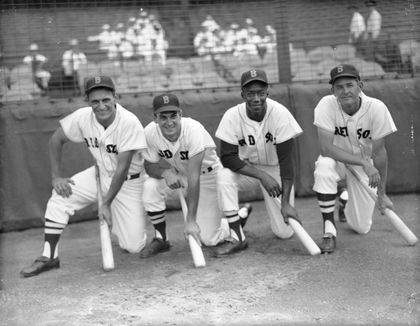
Pumpsie Green poses with three Red Sox who helped make his integrating the team that much more bearable. From left: third baseman Frank Malzone, shortstop Don Buddin, and first baseman Pete Runnels.

For those whose hobbies include forging off the wall trivia questions, here’s a beauty.  What does Pumpsie Green have in common with Jackie Robinson and Lou Brock? The answer is two parts: 1) Green, too, was the first black man to play on a particular major league baseball team. 2) He was also a teammate of the now-late Ernie Broglio, traded most notoriously for Hall of Famer Brock in 1964.

Part two is the far less problematic, of course: Green and Broglio were teammates for El Cerrito High School in California. Part one, alas, is the more so: Green was the first black man admitted to the ranks of the Red Sox, who were, alas, the final team in major league baseball to admit a black player and one of the first, alas far further, to reject Robinson, Willie Mays, and others over a decade earlier.

A catcher/first baseman in high school, Elijah Jerry Green, Jr., who died at 85 Wednesday morning, two years older and the morning after cancer claimed Broglio, became a middle infielder who wasn’t as well endowed with baseball gifts as Robinson and wasn’t built to blow the walls down. Pioneers—reluctant (a word so often used to describe Green) and otherwise—are quiet as often as they are vibrant. And Green, a handsome young man with a smile that said “Hello, my friend,” was as quiet as the season was long.

He was the son of an Oklahoma transplant who’d farmed in the Sooner State before moving his family to California. The old man became a sanitation worker and mother worked on the Oakland docks as a welder during World War II before becoming a convalescent nurse. It was Mom who gave Green his nickname, calling him Pumpsie from when he was a toddler. He had no idea what inspired it.

But loving baseball as he did, he had a fine idea what inspired him to set his sights on a possible major league life. The tough old Pacific Coast League integrated in 1948, and when the Oakland Oaks hosted a barnstorming team of all-stars led by Jackie Robinson himself, the teenage Green—who attended as many Oaks games as he could—wasn’t going to miss the game.

“I scraped up every nickel and dime together I could find,” Green told Herb Crehan for Red Sox Heroes of Yesteryear. “And I was there. I had to see that game . . . I still remember how exciting it was.” Green’s ambition then was to play for the Oaks, whose shortstop Artie Wilson was their first black player, and Green modeled his own playing style on Wilson, who once led the PCL in batting average and stolen bases.

The Oaks did sign Green but assigned him to an A-level affiliate in Washington state. By 1955, he was Red Sox property, but when they wanted to send him to their affiliate in Montgomery, Alabama, Green was only too understandably reluctant. Young black men were about as anxious to go to Alabama then as a cobra might be to go on a dinner date with a mongoose.

By spring 1957 Green impressed the Red Sox’s farm system administrators, including then-system director Johnny Murphy, the former Yankee relief pitcher and future Mets general manager. He was assigned to the Oklahoma City Indians in the AA-level Texas League, where he discovered he was good for a break whenever the Indians had to play the Shreveport (Louisiana) Sports.

“When the team went to Shreveport,” Green recalled, “I didn’t go, because they didn’t allow blacks to play in Louisiana. So I had a three- or four-day vacation.” Some vacation. But he played well enough with the Indians to earn a promotion to the Minneapolis Millers, whom the Red Sox made their AAA affiliate after the New York Giants moved to San Francisco and surrendered their rights to Minneapolis, where they first planned to move.

Every major league team except the Red Sox had integrated by the time Green became a Miller in 1958. Green didn’t play particularly well on the regular season but, in the American Association postseason, he went 5-for-12 with four runs scored and three batted into help the Millers win it.

The good news is that Green was finally invited to spring training with the Red Sox themselves in Scottsdale, Arizona, in 1959. The bad news is that spring training was the only place the Red Sox broke the colour line at first. They refused to do as some of the other integrated teams did, forcing Green to stay at a hotel seventeen miles from camp because the team’s regular spring hotel near camp refused to admit black guests.

Green finally found spring training lodging at the hotel where the Giants trained in Phoenix, the Giants having been integrated since 1949 and compelled the hotel to accept the entire team long since. And despite being considered the best rookie in camp, the Red Sox officially seemed ambivalent about him. Their manager at the time was Pinky Higgins, a former infielder known as a close buddy of owner Tom Yawkey but also known to be rather a bigot.

Even in Howard Bryant’s magnificent study of the Red Sox’s and Boston’s racial growing pains, Shut Out: A Story of Race and Baseball in Boston, it’s not entirely clear whether it was Yawkey or Higgins who declared, a decade earlier, “There’ll be no niggers on this ballclub as long as I have anything to say about it.”

Most notoriously in the mid-1940s, the Red Sox worked out Robinson, Mays, and other black players in sessions long since shown to have been shams for show after enough in the Boston press (particularly Boston Record columnist and Ted Williams nemesis Dave Egan) and the increasingly influential black press (such as the Pittsburgh Courier) pressured the team to do it.

While the rest of the Show caught on, little by little, to the good the black talent pool could do their teams, the Red Sox remained clueless. And, futile. The black talent pool didn’t suddenly make winners of all the teams, of course (we mean you, Cubs, for one example), but choosing to remain in the paleozoic era did the Red Sox no favours, either.

Higgins left room for further ambivalence when he sent Green back to Minneapolis to begin the 1959 season. “The Red Sox won no prizes this spring for the way they treated Pumpsie Green,” fumed Boston Globe baseball columnist Harold Kaese. “From a strict baseball point of view they may have been doing the wise thing when they optioned their first Negro player to the Minneapolis farm club yesterday. From every other point of view, they undoubtedly have pulled a colossal boner.”

All this blew around the head of a soft-spoken 25-year-old middle infielder who had no intention of fomenting revolution and who could never grok—even four decades after the fact—why such men as Higgins and other Boston racists had to be as they were. “Sometimes,” he told Bryant for Shut Out, “when I think of the things people like me had to go through, it just sounds so unnecessary. When you think about it, it is almost silly, how much time and energy was wasted hating.”

2017-07-19 PumpsieGreenMets

Pumpsie Green finished his major league career with the early Mets, though he missed the insanity of the original edition of the team.

“His,” Bryant wrote, “is the outsider’s story of life in a very insular city.” Today it seems somewhat difficult to remind yourself that the Jim Crow South wasn’t the only part of the country that couldn’t decide whether, as Malcolm X once phrased it, it should be, “Let’s keep the niggers in their place” or “Let’s keep the Knee-grows in their place.”

“I want to be judged like any other ballplayer,” Green said after his return to Minneapolis. “I don’t want to be a crusader. I just want to play ball.” He finally got his chance with the Red Sox after Higgins—whose alcoholism was almost as notorious around baseball as his racism—was canned in favour of Billy Jurges.

Jurges welcomed Green with open arms, as did such teammates as Hall of Famer Ted Williams plus Pete Runnels and Frank Malzone, the splendid third baseman who had Hall of Fame talent but had been buried in the minors a little too long before he finally made the Red Sox in 1955.

“I used to love to talk to Ted Williams, once of the nicest guys I ever met,” Green once told the Globe. Williams took enough of a liking to Green personally, too, that the Splinter made Green his regular for playing catch to exercise both their throwing arms during spring training and later.

As things turned out, Williams proved far more. His 1966 Hall of Fame induction speech jolted the Hall:

The other day Willie Mays hit his five hundred and twenty second home run. He has gone past me, and he’s pushing, and I say to him, ‘Go get ’em, Willie.’ Baseball gives every American boy a chance to excel. Not just to be as good as someone else, but to be better. This is the nature of man and the nature of the game. I hope that some day Satchel Paige and Josh Gibson will be voted into the Hall of Fame as symbols of the great Negro players who are not here only because they weren’t given the chance.

Pumpsie Green was the reluctant Red Sox pioneer, but his pal Williams instigated the moves that finally brought the best of the Negro Leaguers, including Paige and Gibson, into the Hall of Fame.

Green had other allies among his Red Sox teammates, including pitcher Bill Monbouquette. When coach Del Baker and then Higgins both dropped the N bomb, according to the Society for American Baseball Research, Monbouquette told coach and skipper alike he didn’t want to hear that. “[T]hen [Baker] started to give me a bunch of crap, and I said, ‘I’m going to tell you something. I’ll knock you right on your ass. I don’t care if you’re the coach or not.’ I said, ‘You don’t do things like that!’”

It would be wonderful to say that, when Green was finally brought to the Red Sox, he knocked the team’s and the leagues’ record books for the proverbial loop. He wasn’t that talented, unfortunately. He was good enough for the Show but it wasn’t going to make him a baseball star, never mind a Hall of Famer, on purely baseball grounds.

He has a respectable .357 lifetime on-base percentage and walked a little more often than he struck out, but he was used preponderantly as a pinch swinger and defensive replacement. And by his own admission he probably pressured himself far more than need be to produce in his unique circumstances.

In 1962, Green hit the headlines in one of the most peculiar ways imaginable, when he joined pitcher Gene Conley and walked off the team bus on a hot New York day, after a tough set with the Yankees, looking for refreshment. And, while moseying in and out of assorted watering holes, Conley invited Green to join in heading for Bethlehem in Israel “to be nearer to God.”

The astonished Green elected instead to return to the Red Sox immediately. Conley made his way as far as Idlewild Airport in Queens (not yet renamed for the assassinated President John F. Kennedy) before rejoining the team two days later. “We were just crying in our beer,” Green once remembered.

After that season Green was traded to the embryonic Mets, along with Tracy Stallard, the pitcher known best as the one who served Roger Maris his 61st home run at the end of the 1961 season. The Mets sent the Red Sox third baseman Felix Mantilla, once a comer with the Braves, who’d devolved into a player whose most amazing gift was for going the wrong way when batted balls came his way.

Green needed to knock himself back into shape in spring 1963. The Mets sent him to AAA Buffalo and recalled him in September. He had only 66 plate appearances as a Met but showed a very respectable .278/.409/.426 slash line, even hitting the last of his thirteen lifetime major league home runs off Philadelphia’s Ray Culp on 17 September. He began suffering hip issues, played two more seasons in Buffalo, was released in July 1965, then gave it one more try with the Syracuse Chiefs and retired.

The quiet man called Pumpsie had a fine life after his playing days. He went to college and earned a degree in physical education from San Francisco State, then ran baseball programs in the Berkeley Unified School District and coached the game for a quarter century. Some of his charges eventually made the major leagues, including Glenn Burke, Ruppert Jones, and Claudell Washington.

2019-07-18 PumpsieGreen

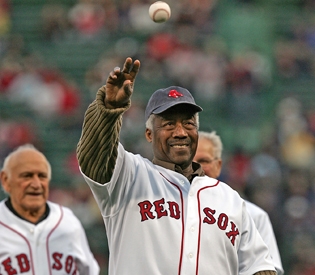
Pumpsie Green, serene and happy, throwing out a ceremonial first pitch in Fenway Park.

Green also taught mathematics and helped oversee school security while he was there. When not doing all that, he and his wife, Marie, raised two children, one of whom became a high school teacher and principal herself. And despite his quiet struggle for acceptance with the Red Sox, the years passing by made Green appreciative of just what he achieved there.

“There’s really nothing that interesting about me,” he once told Danny Peary. “I am just an everyday person happy with what I did. I take a lot of pride in having played for the Red Sox. I would like to be remembered in Red Sox history as just another ballplayer.”

One then remembers reading often enough that the Robinsons and Mayses and Larry Dobys and Frank Robinsons were one thing, but the real test would be whether and when black men could be accepted when they were as ordinary as the most ordinary white player, too. Green, however, was ordinary only as a baseball player. As a man, he wasn’t as ordinary as he liked to describe himself. Not even close.

“He laughs bitterly that the Red Sox humiliated Jackie Robinson, that it slept when it could have acquired Willie Mays, and that these twists of fate left it to unassuming Pumpsie Green to integrate the Red Sox,” Bryant wrote.

It is a fact that he is proud of, even if during those days he wanted little to do with the attention that came with being at the epicenter of a moral drama within a franchise and a city. He harbours no bitterness toward the Red Sox or the city of Boston for any reason. He wanted an opportunity to play baseball and they gave him that chance. If he does not rage at being set apart from the Red Sox in those early Scottsdale days, it is this personality that allows him not to be devoured by the past, and that makes him healthier today. It is, he says evenly, what healing is all about.

Green followed the Red Sox for the rest of his life. You may rest very assured that he was among those pumping his fists and cheering at home when the Red Sox—long past their 1950s shame, long enough removed from the Yawkey era, in which the real curse on the team was boneheaded administration, and as well integrated as the day was long—returned at last to the Promised Land, for the first of four such returns after the turn of this century.

“In 1997, they asked me to come back for opening day and throw out the first pitch,” Green told Bryant. “[Then-general manager] Lou Gorman was very friendly. They brought a limousine for me and my wife. We had a hell of a time.” A very different hell of a time than the one he had to make the Red Sox in the first place.

Ernie Broglio, RIP: Talk of the trade

2019-07-17 ErnieBroglioStanMusial

Ernie Broglio (right) enjoys some dugout levity with Hall of Famer Stan Musial. (Pitcher Larry Jackson is in the background.)

I wish I hadn’t waited. Now I can only say goodbye.

I’d found an address and contact information for Ernie Broglio, the one-time Cardinals pitcher who’d been dealt to the Cubs in the 1964 deal that made a Cardinal out of a talented kid named Lou Brock, with whom the Cubs didn’t seem to know what to do and learned the hard way that the Cardinals knew only too well.

My thought was to interview him not just about the trade that made it seem as though his real surname was BrockforBroglio. Even though I knew from much previous reading that Broglio rather enjoyed talking about it, laughing about it, and mixing in other stories from his baseball life and beyond. A genial man who didn’t take himself too seriously or curse God for any malfortune, he seemed.

“I congratulate all the Hall of Famers,” he once said, “Some I played with, and some I helped put there.” A greater self-valedictory for a pitching career that went from promise to breakdown you’d be hard pressed to find.

I wanted to ask Broglio other questions, too, including and especially about cortisone, shots of which he’d taken two years before the Brock deal. And, about the friendship he struck up with Hall of Famer Brock in the years that followed their very different careers. “I lost a ballgame but I gained a friend,” Ralph Branca once said about Bobby Thomson. Broglio could say plausibly, “I lost a team but I gained a friend.”

As my own cherished new Mets friend Bill Denehy can tell you, too many cortisone shots can portend disaster, as they did for Denehy, who’s now legally blind as a likely result. The smart medical thinking today is that any more than ten cortisone shots can create visual and other issues, but baseball and other sports still seem to rely a little too excessively on them for helping their athletes recover.

After a few delays thanks to other matters of work and life, I finally told myself I would reach out to Ernie Broglio this month. Now I won’t get the chance. He died Tuesday night of cancer at 83; his daughter announced it on social media.

“You live with it,” Broglio told a writer in 2016 about Brock-for-Broglio. “You go along with it. I mean, here you are fifty-some years later after the trade and we’re talking. And I’m thinking, ‘What trade is going to be remembered for 50-something years? I told Lou Brock, ‘I better go before you, because you’re in the Hall of Fame and well-remembered.’ I’m only remembered for the trade.”

Damn it, Broglio’s probably-half-kidding wish came true.

He was an El Cerrito, California product who was so well regarded as a promising pitcher that, in 1953, he went right from high school graduation to signing with the Oakland Oaks of the Pacific Coast League. The Reds signed him in 1954; the New York Giants bought him out of their system in 1956.

The Giants traded Broglio to the Cardinals with pitcher Marv Grissom (the winning pitcher in Game One, 1954 World Series—the game of Willie Mays’s legendary catch) for three spare parts in 1958. Broglio’s rookie 1959 wasn’t much to brag about, but in 1960 he knocked the National League over.

Armed with a curve ball Lou Brock himself once described as the best in the game at one time, perhaps until Sandy Koufax’s matured, Broglio in 1960 was credited with 21 wins to lead the entire Show; his 148 ERA+ and his 6.8 hits per nine rate were the best in Show as well.

He finished third in the Cy Young Award voting (the award was then given to one pitcher across the board) behind winner Vernon Law (Pirates) and runner-up Warren Spahn (Braves), but his ERA+ and his 7.1 wins above replacement-level (fourth of any player and tops among major league pitchers) make a case that Broglio should have won the Cy Young Award if not for Law’s team winning the pennant.

In 2016, Broglio was told of his position on 1960’s major league WAR list. Ahead of him were only Mays, Henry Aaron, and Ernie Banks. (Behind him, in descending order, were Roger Maris, Hall of Famers Eddie Mathews and Don Drysdale, his Cardinals teammate Ken Boyer, and Hall of Famers Jim Bunning and Mickey Mantle.)

“What? I’m in there? Holy cow,” he exclaimed to the San Jose Mercury News. “With all those great hitters! The Hall of Famers!”

Out of spring training in 1961 Broglio came down with shoulder tendinitis and was given eighteen cortisone shots (about one every other starting assignment) during the season. Several years later, Broglio told that to a doctor who told him, astonished, “That’s five years’ worth!”

He had a modestly successful 1962, but Broglio again came up shining again somewhat in 1963, with eighteen wins and a 2.99 ERA, but not all was well. His pitching elbow joined his shoulder in giving him trouble, perhaps from all those curve balls, which may explain the drops in his hits-per-nine rate (7.3) and his career-high 24 home runs surrendered.

The Cubs didn’t bother looking past his surfaces when they cast their lonely eyes upon him in 1964. They saw an eighteen-game winner who’d been a 21-game winner three years before that and, with an acute need for pitching, didn’t pay close attention to Broglio’s actual health.

“The Cubs didn’t know,” Broglio said a few years ago. “Nowadays, that trade never would have happened.” He was wrong. It wasn’t that the Cubs didn’t know, it was that they chose to ignore.

2019-07-17 ErnieBroglioCubs

Broglio relaxing in Wrigley Field after becoming a Cub . . .

Because about a month or so before Brock-for-Broglio, the Cubs acquired another pitcher from the Cardinals, Lew Burdette, the former longtime second banana (as a pitcher) to Spahn on the Braves. (As pranksters, Burdette and Spahn were equals.) And Burdette heard the whispers soon enough that the Cubs were itching to bring Broglio aboard and that they might have in mind sending Brock to get him.

Burdette told Bob Kennedy—then the top banana among the Cubs’ insane College of Coaches experiment—and anyone else who’d listen that Broglio had elbow trouble and was taking shots. Kennedy himself apparently tried to tell the Cubs front office to look before they leaped because the pool might prove empty.

Apparently, the Cubs thought of Brock as expendable because they simply didn’t know how to work with a center fielder who wasn’t really a power hitter but had speed to burn. (Brock’s signature power moment, unlikely as it was, was in 1962, when he became only the second major leaguer to hit a home run into the Polo Grounds bleachers 460something feet from home, against the Mets—the night before Aaron hit one to about the same spot.)

If the Cubs were willing to part with Brock, the Cardinals were only too happy to send them Broglio without saying a word about Broglio’s medical issues. They also sent the Cubs outfielder Doug Clemens and veteran pitcher Bobby Shantz and got Brock plus pitchers Jack Spring and Paul Toth.

Broglio believed the Cardinals knew exactly what they were doing in both coveting the expendable Brock and in deciding to move Broglio onward. He believed to the day he died, never mind in 2011 when he spoke to ESPN’s William Weinbaum, that the Cardinals knew they were sending the Cubs damaged goods.

“If I remember right, at one time I threw about four or five wild pitches in one ballgame,” Broglio told Weinbaum, “and Bob Uecker was catching and I kind of jokingly said, ‘How come you didn’t protect me?’ He couldn’t. He couldn’t have caught the ball or stopped the ball. They were so far in front of home plate that there was an indication that I had problems with my elbow.”

Broglio laughed while he recalled it, but the Cardinals ended up having the last laugh. They turned up the last men standing after the Phillies collapsed into a potential three-way pennant tie in 1964, and went on to win the World Series. They’ve won ten pennants and five World Series since Brock-for-Broglio. Brock went on to a Hall of Fame career breaking Ty Cobb’s lifetime stolen base record. The Cubs, with egg on their face over the deal, needed a mere five decades plus two years to return to, never mind win a World Series.

Hall of Famer Billy Williams learned of Broglio’s insistence that the Cardinals knew they were sending the Cubs a patient and not a pitcher. “That’s how the game was played then,” he told Weinbaum. “Any time a general manager felt he could put stuff on another organization, that’s what they did.”

Broglio pitched eighteen games for the 1964 Cubs looking nothing like the fellow whose ERA in 1960 was 2.74 or whose 1963 ERA was 2.98. After the season, he underwent ulnar nerve surgery and had bone chips removed from his pitching elbow. It didn’t help.

“I was back for spring training in February, which gave me a total of three months rest,” Broglio remembered. “Nowadays, for the same operation, they give you a year or more. That made my career shorter than I wanted it to be.” Indeed. His ERA for 1965 and 1966: 6.64.

2019-07-17 ErnieBroglioHome

Broglio at home, in more ways than one.

He took his wife, Barbara, and their four children home to San Jose, to the same home they’d bought in 1959, and went to work full-time and permanently in the liquor warehouse where he’d been working in the off-seasons. He also coached voluntarily at various area high schools, trying to teach young pitchers about avoiding arm trouble such as put paid to his career.

And he rooted with just about two thirds if not more of the country when the Cubs finally returned to the Promised Land in 2016.

Except for his son, Stephen’s, death at 52 in 2007, Broglio remained cheerful and friendly throughout, with a smile bright enough to walk half a city home when stricken with a power failure. He withstood the onset of type 2 diabetes. (Brock, who has enjoyed post-baseball success as a florist and the creator of a unique umbrella-shaped rain hat, has lost a leg to diabetes and survived (so far) multiple myeloma.)

And his friendship with Brock became one of the sweeter spots in his life. “Ernie is top of the charts,” the Hall of Famer told Weinbaum. “He is a good man, a man with integrity. We have a good relationship because we laugh, we talk, and people, for whatever reason, are still interested.”

Broglio cherished a 1990s Old-Timer’s Day appearance he made with Brock at Wrigley Field. “They introduced me next-to-last, and Lou was last. The Cub fans sure didn’t forget Brock-for-Broglio,” he said. “As I came out, everybody stood up and gave me a great ovation of boos. I started laughing, removed my cap, and took a bow. Then they introduced Lou, and my God, I thought Wrigley Field was going to collapse the way they cheered him.”

Broglio needed only his own good cheer to overcome and even appreciate the trade that made him infamous. That’s just one reason why I wish I hadn’t hesitated to call him. I might have made another new friend, who leaves a legacy of laughter, love, and acceptance, now gone to the Elysian Fields where I can only pray the Lord welcomed him home just as cheerfully.