Martinez fiddled after Callaway burned him

2019-05-21 NewYorkMets

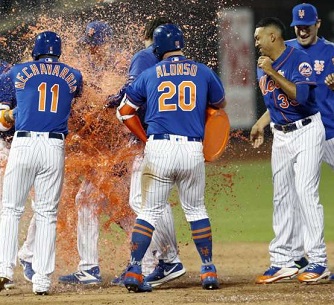
We presume it’s Amed Rosario getting the Gatorade shower from Adeiny Hechavarria (11) and Pete Alonso (20) with Edwin Diaz (39) enjoying the fun. All three figured big in the Mets’ Tuesday night win . . .

You’re not going to believe this. Even I’m not sure I believe it, and I was watching.

The Mets hosting the Nationals. Each team shepherded by a pair of managers about whom saying they’re on the proverbial hot seat is a little like saying the Titanic had a little bump on the starboard hull. Playing the second game of a set that began with Mets manager Mickey Callaway barely dodging a date with the executioner.

As if to give Callaway their own vote of confidence after the front office gave him one Monday afternoon, the Mets beat the Nats 5-3 in ten innings Monday night. And it proved to be nothing compared to how the Mets beat them 6-5 Tuesday night.

And, to how Callaway actually out-skippered Nats manager Dave Martinez when the same situation presented to each skipper. With Martinez having no further to look than across the field as well as the mound to get the hint.

Three times the Mets came from behind in the game and entered the top of the ninth tied at five. And Callaway decided to forget whatever it is his Book told him earlier in the season regarding his closer Edwin Diaz.

Actually, Callaway had decided then that Diaz wasn’t going to be in anything much other than no-questions-asked save situations, even when the Mets needed a stopper before such situations arose, if they arose.

Maybe Callaway saw the light. Maybe he felt the heat. But that was then, this was now, and there was Diaz strolling to the mound to open the top of the ninth in a five-all tie. And he zipped his way around a one-out single with two strikeouts for the side. Then it was Martinez’s turn.

Martinez’s closer Sean Doolittle was nowhere to be seen in the bottom of the ninth. “Martinez considered using Doolittle,” noted the Washington Post‘s Jesse Dougherty, “but wanted to keep him ready for a potential save situation.” Infamous last words?

If you didn’t count Mets rookie Pete Alonso hitting a 1-2 service about 25 feet above the top of the left field foul pole to tie the game at five in the first place with one out in the bottom of the eighth, Martinez liked what he saw from rookie righthander Tanner Rainey. Maybe too much so.

Martinez stayed with Rainey. And at first Martinez looked like a genius when Rainey struck out Carlos Gomez on a climbing 3-2 fastball. Then Rainey walked pinch-hitter Adeiny Hechavarria after a seven-pitch wrestle. After which Rainey walked late game insertion J.D. Davis on seven pitches.

Doolittle was still the invisible Nat, but Kyle Barraclough, one of the Nats’ more notorious arsonists, was very visible warming up most of the inning. In he came. You could hear everyone back in Washington unoccupied with the foibles and follies of government wondering aloud if the game was lost right then and there. You couldn’t blame them.

At first Barraclough looked to keep things in order enough when he got Jeff McNeil to hop one that might have been a extra innings-setting double play, until the ball hopped oddly to second baseman Brian Dozier allowing McNeil, who’d broken out of the batter’s box like a horse busting out of the gate, to make first safe and first and third, period.

And Doolittle remained the invisible Nat.

After McNeil took second on the house, the Nats not even bothering, Barraclough fell behind 3-1 to Mets shortstop Amed Rosario. Then Rosario bopped one off the plate and it two-hopped to his Nats counterpart Trea Turner playing deep enough. Rosario up the line and Hechavarria from third made McNeil resemble a flu-addled mule, Rosario beating Turner’s throw to first by a step and Hechavarria shooting home with the winning run.

To think that the Nats had taken a 3-1 lead off Mets starter Zack Wheeler in the seventh, after Callaway left Wheeler in for one pitch too many, the one-out/one-on/1-1 hanging slider Dozier hung over the left field fence.

To think that Callaway atoned for that mistake in the bottom of the inning when he shifted into all-hands-on-deck mode and got rewarded richly enough. By usually slow catcher Wilson Ramos following a leadoff single by taking second alertly on a passed ball. By Wheeler’s pinch hitter Dom Smith wringing Nats reliever Wander Suero for a four-pitch walk. By Davis catching hold of Suero’s hanging curve on 1-2 and sending it the other way off the top of the right field fence to give the Mets a 4-3 lead.

To think that Turner in the top of the eighth would hit a bizarre RBI double, the liner hitting a concrete sidewall past the left field foul line and then taking the kind of ricochet you’d see throwing a rubber ball to a stoop with the ball hitting the edge of a step, shooting past the oncoming Davis inserted into left field. And, that Juan Soto—who led off the top of the second with a hefty home run off Wheeler to open the game’s scoring—would double to right a walk and a sacrifice bunt later.

And, to think that Alonso would tie the game while breaking the Mets’ rookie record for most pre-All Star break home runs while also hitting the eleventh of his sixteen bombs on the season in or after the seventh inning.

No wonder he’s already in the Rookie of the Year conversation. So far as bullpens are concerned the bulls probably think Alonso might as well check in at the plate in a matador outfit with a big red cape for what he does to those bulls, and a sword instead of a bat.

But Callaway’s bigger test comes Wednesday, when Jacob deGrom squares off against Max Scherzer in the second meeting between National League Cy Young Award winners defending (deGrom) and past (Scherzer, twice). When he has to decide at long last, does he insist stubbornly on running Ramos out behind the plate despite the 5.33 ERA deGrom has throwing to him, or does he wake up and run Tomas Nido—throwing to whom deGrom’s ERA this year is 0.43—out to work?

Callaway showed Monday night that he can be a little on the bold side when the situation demands it. Well, Wednesday night demands it. If the Mets want a shot at sweeping the staggering Nats and maybe postponing Callaway’s execution orders far further while they’re at it, it needs to be Nido catching deGrom. There needn’t be any further debate.

Maybe the Mets need a kangaroo court

2019-02-07 FrankRobinsonKangarooCourt

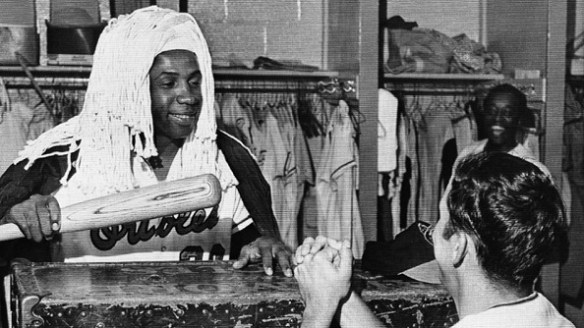
Judge Frank Robinson was the Learned Hand of baseball’s kangaroo courts. The Mets (whose future manager Davey Johnson you see pleading before Judge Robinson) ought to bring the tradition to their clubhouse. Anything would be an improvement over their current lapses . . .

When Robinson Cano loafed on a double play grounder thinking there was one more out than there actually was Friday night, Mets manager Mickey Callaway responded almost with a shrug. Actually, it was closer to the indulgent momma assuring Junior it was no crime to put his foot through the neighbour’s china closet because the china closet had no business being there.

It happened during an 8-6 loss to the Marlins, of all people, the basket case of the National League East. The six runs would be the only six the Mets scored all weekend long against the Fish. With Callaway’s job firmly on the line.

“We talked about it, and he understands that can’t happen again. You don’t just reprimand people to send a message to the rest of the team,” Callaway said after the Friday night folly. “You do things for the right reason. I think the team all understands what happened, and I know Robbie does and he has that expectation that can’t happen again.”

Except that, come Sunday, while the Mets made Marlins starter Sandy Alcantara look like Sandy Koufax, Cano—who had a long enough standing reputation for not always hustling out of the batter’s box when it wasn’t a too-obvious pop fly infield out—struck again. He dropped one in front of the plate in the fourth with J.D. Davis on first. He stood there, as if arguing the ball was foul. It wasn’t, and the Marlins executed a 1-6-3 inning-ending double play.

Junior put his foot through the neighbour’s china closet again.

“I don’t want to say it’s a bad look because, like I said, I thought it was foul, like everybody else,” Cano said after Sunday’s 2-0 loss and the attendant brain vapour. Except that everybody else knew the ball nicked off the plate and sat on the first base line before Marlins catcher Chad Wallach fielded it to start the DP. Cano never left the box other than to plead with plate umpire Jordan Baker. This time, someone’s going to fan Momma’s behind for it, since Momma won’t fan Junior’s behind for it.

There’s never a kangaroo court around when you need one. The Mets need one. Bad. If the manager isn’t going to sit on his players for mental mistakes, the players need to police themselves. Kangaroo courts used to be the perfect method for holding teammates accountable.

Sure, they’d be fun and funny, and often as not a kangaroo court’s chief judge would convict the miscreant and fine him a fair amount over something patently ridiculous. But the kangaroo courts also held players accountable for mental mistakes and deportment violations. The Mets probably aren’t the only team who could use one, but right now they may be the most obvious candidates.

The late Hall of Famer Frank Robinson—who brought the concept from Cincinnati to Baltimore after his infamous trade—was probably the Learned Hand of baseball’s kangaroo jurists. Fail or lapse on the bases and Judge Robinson, wearing a kooky contraption of an unused white string mop glued to a catcher’s helmet and wielding a bat for a gavel, would lighten you in the wallet and maybe hang his Base Running Award from the top of your locker—an old, beat-up spiked shoe. If you were too much of the proverbial red ass, the Judge would also leave you a red-painted toilet seat. If you were caught talking to girls in the seats for too long, it’d cost you a buck, as it often did outfielder Don Buford.

That recollection courtesy of The Hardball Times‘s Alfonso Tura, who wrote last month about the rise and fall of baseball’s kangaroo courts. Tura noted there were some managers who thought them threats to their own clubhouse authority while other managers actually asked certain players to open them. Hank Bauer and then Earl Weaver with the Orioles throve on Judge Robinson’s courts.

In fact, Weaver himself didn’t mind being hauled before Judge Robinson. “I was among the first — and most consistently — fined because my coaches ganged up on me,” the customarily ornery manager once told The New York Times. “In a doubleheader in Cleveland, I rested Mark Belanger in one game, then put him in for defense in late innings. Mark made two errors. In the clubhouse afterward, the kangaroo court was called to order, and Billy Hunter stood up and said: ‘Your honor, I’d like to charge Earl Weaver with misguided managing. He sent in Belanger for defense, and Mark made two errors’.”

Yogi Berra all but begged a Robinson disciple, Don Baylor, to convene one with the Yankees in 1984. “Yogi was like Earl Weaver; he didn’t see the court as a threat for his authority,” Tura wrote. “He thought the court would bring the emphasis back on execution. And he also looked to inject some levity to stop the boredom and frustration. Baylor’s first choice was to name [Hall of Fame pitcher] Phil Niekro as a one-man Supreme Court. Frank Robinson never reported to a higher authority, but Baylor assumed that Niekro’s word would outrank his. To appeal any fine he delivered, players had to consult Niekro. If they lost, the fine automatically doubled. Baylor knew that Niekro was implacable. He never changed a verdict.”

Baylor continued the practise after he left the Yankees. His fines weren’t exactly expensive, either. “If you batted with a man at first or second base and less than two outs, you either advanced the runner or it was five bucks,” Tura wrote. “Fraternization also cost five dollars. Two minutes, no more, were allowed to ask a friend on another team about the family.”

Pitchers may have faced a slightly different scale. “Pitchers were punished for allowing 0-2 base hits, with the severity of the penalty depending on the circumstance. Baylor’s fines were in the five-dollar range. When Niekro surrendered a grand slam to Ken Phelps on a 0-2 pitch, the fine was $100 — $25 for each base.” Baylor’s only other $100 fine was slapped on Red Sox reserve Steve Lyons—for being thrown out at third on what should have been an easy advance.

The custom among teams who convened kangaroo courts was that all the fines paid throughout the season would normally go to pay for a pleasant party at season’s end. Robinson made an exception in 1969: he ordered the money be given to Reds backup catcher Pat Corrales, whose wife died while giving birth to their fourth child.

Someone in the Mets clubhouse needs to convene a kangaroo court. It could be Jacob deGrom, the defending Cy Young Award winner. It could be Noah Syndergaard, who dropped Alcides Escobar with a message pitch to open Game Five of the 2015 World Series after Escobar and the Royals spent the first two Series games batting as if they’d had Barcaloungers in the batter’s box. It could be Wilson Ramos, in his first season with the team but known as a clubhouse leader wherever he goes.

Of course, if Callaway isn’t out of a job before the umpire hollers “Play ball!” Monday, the Mets’ court could probably fine him enough for infractions enough to blow the whole team to dinner at Tavern on the Green the same night.

The Nationals come to town Monday, and they wouldn’t exactly be hurt if they convene a kangaroo court, either. Though in fairness they, like the Mets, could probably haul their manager before the bench a few times. The Nats have looked fundamentally less than sound, too, this season, but then Dave Martinez has tried compensating for their injury list adventures by playing so many people out of position Frank Robinson could probably collect one day’s worth of a Max Scherzer’s salary in a week’s worth of fines.

Scherzer, Anthony Rendon, Stephen Strasburg, and Ryan Zimmerman might be the best Nats candidates to don the wig mop and wield the bat gavel. It’d be worth the price of admission to catch Judge Scherzer pounding a $100 fine on Martinez for playing anyone else out of position or on the bullpen for bringing blow torches instead of pitches to the mound.

At this point, it could almost be anyone on either team. Unless the Mets and the Nats really do have a few too many kangaroos.

Mickey dismantled?

2019-05-19 MickeyCallaway

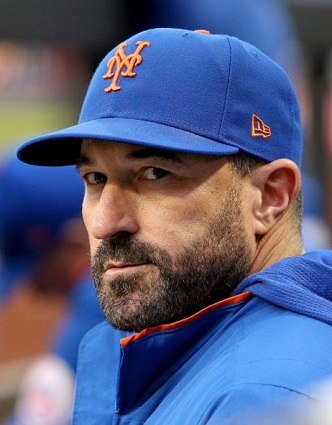
Mickey Callaway, looking here like what he might be on Monday, a man facing a firing squad . . .

If you’re a manager, look at it this way: You have a pitcher who’s top of the line enough to be the league’s defending Cy Young Award winner. You don’t have any of the catchers to whom he threw to win that award. This year, you have one catcher with whom he has a 5.33 earned run average in five starts throwing to him, and another with whom he has a 0.43 ERA in three starts.

You have the data and you’ve seen it in live action. Who do you send behind the plate to give your ace, and your team, the best possible chance to win? Should be the proverbial no-brainer, right? Especially if you were once a well respected pitching coach who should know these things.

And your number one job as a manager, other than navigating assorted clubhouse personalities and tensions, is giving your players and thus your team the best possible chance to win. So you see your ace working to a 0.43 ERA and think to yourself, that’s the catcher who ought to be working with him if you want to win. Right?

If you’re embattled Mets manager Mickey Callaway, apparently, wrong. Even if the ace in question is Jacob deGrom. Even if his ERA with Wilson Ramos behind the plate is 5.33 but his ERA with Tomas Nido behind the plate is 0.43. They’re both new to working with deGrom but Nido’s apparently doing the better job with him. This isn’t the time to double down against the idea of a personal catcher especially for a defending Cy Young Award winner.

DeGrom is too team oriented to think about it, apparently, but the manager’s job includes thinking about things his players might not ponder otherwise. But Callaway insists, and I quote, “Things aren’t going well enough for anybody to demand their own catcher.” Even though deGrom hasn’t asked for one yet.

If he’s actually aware that deGrom is doing better with Nido behind the plate, Callaway ought to reconsider while he still has his job. Which too much speculation says he won’t after this weekend. The Mets pitchers overall have a 4.37 ERA with Ramos behind the plate and a 3.20 with Nido behind the plate. Which part of that difference doesn’t register when Callaway reads the data?

It’s rare for a theoretical contending team to face a must-win series against their division’s saddest sacks, but that’s just about what the Mets faced when they opened this weekend’s set with the Marlins.

And they got swept by the Fish. It might be a little too soon to say, “Season over,” but it’s not exactly unfair to say, “Season has only two fingertips hanging onto the high wire,” either.

On Friday night, even allowing that he hasn’t got the best bullpen in the league to work with overall, Callaway inexplicably left deGrom in to take a seven-run beating in five innings that shouldn’t have gone that far. He had nobody prepared when deGrom looked early enough like he didn’t have it that night. And his catcher was Ramos.

On Saturday, Pablo Lopez and two relievers one-hit the Mets, 2-0. Steven Matz returned from a brief injured list sojourn to work three and two thirds rusty innings surrendering both Marlins runs and three Mets relievers kept the Fish shut out the rest of the way.

Come Sunday, Noah Syndergaard kept the Marlins to a pair of runs they didn’t begin to pry out of him until the sixth, but Sandy Alcantara picked the perfect day to pitch a two-hit shutout with the Mets making it only too easy for the Marlins righthander. Nido caught Syndergaard for the first time this season. Syndergaard’s previous starts saw him throwing to Ramos and posting a 4.02 ERA with him behind the dish.

Calloway had another problem on Friday night when veteran second baseman Robinson Cano jogged up the first base line on a double play grounder in the seventh. Cano admitted he thought there were two outs, partially thanks to a scoreboard error he spotted as he left the batter’s box. The manager handled it not too far removed from the indulgent mother reassuring Junior that it wasn’t his fault he put his foot through the neighbour’s china closet, the china closet had no business being there.

You don’t want Callaway to read Cano the riot act, but you didn’t necessarily expect him to hand Cano a pass, even a veteran’s pass. If anything, you’d think veterans know enough to keep their heads in the game without the scoreboard’s help. Cano was apologetic after that game but, even so, Callaway needed to take a firm enough hand. Cano didn’t face anything like a benching the rest of the weekend.

And it bit Callaway in the wrong possible spot again come Sunday. In the top of the fourth, with J.D. Davis on first, Cano whacked a dribbler in front of the plate and stood there for the most part, arguing the ball was foul (it wasn’t) while the Marlins turned a 1-6-3 inning ending double play.

None of the foregoing, of course, could put anything into the Mets’ mostly feeble bats otherwise this weekend. They scored six times Friday night and those were the only six runs they’d score on the weekend. The Marlins’ pitching took care of them effectively enough.

But why wasn’t deGrom afforded the chance to throw to the catcher with whom he and the Mets’ staff overall, while we’re at it, are getting his best results so far? Nido isn’t much of a hitter and I get that, but if you think a catcher’s number one job is handling his pitchers and calling games, you should be thinking maybe Nido gives you a better chance to help keep the other guys at bay.

At least until you find someone who can catch as well as Travis d’Arnaud did last year while being able to hit the way Ramos once did. D’Arnaud became expendable this year with Ramos’s arrival and his own futile season opening, but last year the Mets’ overall ERA with d’Arnaud behind the plate was 1.85.

And if the Mets are going to be as inconsistent as they’ve been so far at putting runs on the board, they need all the help they can get at keeping the other guys from putting runs on the board.

“If you start allowing somebody to pick their own catcher, then Ramos is not going to start four days in a row and then Nido is going to catch deGrom. That is not something that is going to be helpful to our team,” Callaway said before Sunday’s game. “It’s better to throw to whoever is catching that day and just get it done.”

Uh, no it isn’t. If Jacob deGrom’s working better with Tomas Nido behind the plate, you run Nido out there every time you give deGrom the ball until or unless Nido begins to falter on the job. You don’t have to let every pitcher on the staff pick his catcher, but you give a defending Cy Young Award winner at least some respect enough to let him pick the guy to whom he’s most comfortable throwing.

It’s not exactly unheard of. Ordinarily a team might allow a pitcher a personal catcher on behalf of giving the regular catcher a little rest, and if there’s any fielder who can use it it is the catcher. But otherwise a team might notice a pitcher doing particularly well with one catcher as opposed to others on the roster and make sure that catcher and that pitcher are hooked up regularly.

The point is to win. And if that gives you the best chance to win, go for it. Yogi Berra didn’t become a Hall of Fame catcher by hitting alone. You can look it up: in all his years as the Yankees’ number one catcher, Yankee pitchers not named Hall of Famer Whitey Ford did better with him catching than they did with any other Yankee catcher. And almost all of them pitched better as Yankees than at other times in their career thanks to having Yogi behind the plate.

Nido also can’t help the Mets with other issues. They’re last in the league in defensive runs saved; they’re fundamentally lacking; and, Callaway’s modest response to Cano’s double play misadventures simply added to any perception that he’s not the motivator, never mind tactician, the Mets need. Especially after Junior thanked Mama by putting his foot through the neighbour’s china closet for the second time in three days.

Marry that to this former pitching coach’s inability to keep a defending Cy Young Award winner in a comfort zone and put three other starters into the best conditions to work well, not to mention mal-managing a bullpen that wasn’t exactly great overall but wasn’t exactly full of rag arms, either.

It’s the formula by which a manager whose team was expected to contend this season finds himself facing a possible firing squad. And if the Mets are rounding up the firing squad, they should be pondering who’s going to succeed the fallen. Possibly as soon as Monday. When the Mets come home to open a set against the equally sputtering Nationals, who have issues aplenty of their own.

Incumbent bench coach Jim Riggleman might be a sort-of consensus interim choice despite his less-than-stellar overall record, but currently-exiled Joe Girardi and Dusty Baker may be wishing and hoping. Just don’t cast your lonely eyes upon Mike Matheny or Buck Showalter. When push comes to shove, they’re too wedded to their Books.

The Mets need to think beyond The Books if they’re going to throw the book at Callaway. And, the switch.


He almost hit .400. But . . .

2019-05-17 TonyGwynn1994

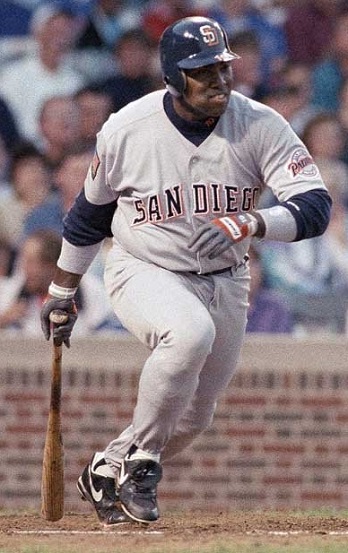
Hall of Famer Tony Gwynn hitting in Wrigley Field during 1994 . . .

Baseball fans love anniversaries as much as anything else about or around the game. This year’s a good one for those, and I’ve written about a couple of them already this year: the 1919 Reds (yes, they were a World Series winner but yes, they were robbed) centenary, and the 1969 Mets’ golden anniversary.

It’s also the 80th anniversary season of the day Lou Gehrig took himself out of the Yankee lineup to stay. And, the 30th anniversary of the season in which Pete Rose got banished for violating Rule 21(d), alas.

It’s also the quarter century of Hall of Famer Tony Gwynn’s chase to become baseball’s first .400 hitter since his old friend and fellow Hall of Famer Ted Williams. He almost made it, too. Six points short. Closer than fellow Hall of Famer George Brett got in 1980, when Brett came up short by ten.

The 1994 owners’ strike (call it what it really was: the owners pushed for and got that players’ strike no matter what you’ve read otherwise) cut Gwynn off at the pass. And it was both more and less than you thought while he was doing it.

More because you’ve got to have some kind of self discipline to hit that often, and Gwynn did lead the National League with his .394 final batting average and his .454 on-base percentage. (It was the only time he ever led the league in on-base percentage.) Less because it didn’t do as much to put or help runs onto the scoreboard as you’d think a near-.400 hitter reaching base that often will do.

The 1994 Padres were fourth in the National League West with a 47-70 record when the strike ended the season. They were outscored 531-479, a -52 run differential. Their only winning month was August, and they were 6-4 when the strike began. If you consider elementary run production as the sum of the runs you score and the runs you drive in, Gwynn produced 143 runs, which accounted for 27 percent of the Padres’ run production that season.

That he was only seven RBIs above the major league average for batters with 475 plate appearances should tell you how good that year’s Padres weren’t at reaching base ahead of him. He had a total of 306 baserunners when he batted and drove in 20 percent of those. And his extra base hit percentage (29) was only about four points above his career average (25).

If you consider my concept of real batting average—total bases + walks + intentional walks + sacrifices divided by plate appearances—this was Tony Gwynn in 1994. We’ll compare his 1994 first to George Brett’s 1980. In parentheses are their final season’s traditional batting averages, which (here we go again) should really be called hitting averages. Sorry, purists, but (here we go again again) something that treats all hits equal when all hits are not equal, and divides that number by official at-bats only, without accounting for everything a man does at the plate, is a batter’s incomplete story.

Player PA TB BB IBB Sacs RBA XBH%
Tony Gwynn (.394) 475 238 48 16 6 .648 29
George Brett (.390) 515 298 58 16 7 .736 38

Gwynn’s 1994 RBA is 122 points above his career number. And, his career number is the lowest among all nine post-World War II/post-integration/night ball era Hall of Fame right fielders and 51 points below the average RBA for those Hall of Fame right fielders. Chasing a .400 hitting average, Gwynn in 1994 batted well over his own formidable head. It’s a shame that Gwynn’s team hurt him as much as he helped them, and the 1994 Padres—talking strictly about their non-pitchers—batted .283 with a .330 on-base percentage as a team.

The 1994 metrics say the Padres would have scored ten runs a game if they could have had nine Tony Gwynns in the lineup. Gwynn created (as opposed to produced) 104 runs that season and used a sliver less than three outs a run to do it, which is splendid run creation for a high-average hitter with minimal power in an abbreviated season. He was still likely to finish well over his lifetime head if the season had played all the way: lifetime per 162 games, Gwynn created 109 runs and used 4.1 outs to do it.

Brett played a little over his own head in 1980, too. His RBA is 176 points above his career number, and he played a far more demanding field position, as he did for the majority of his career. Brett’s career RBA is just two points below the average RBA among seven Hall of Fame third basemen of the same era, and fourth behind, in ascending order, Eddie Mathews, Chipper Jones, and Mike Schmidt. The 1980 Royals (who also won the pennant that year) would have scored twelve runs a game if they could have had nine George Bretts in the lineup. Brett created 134 runs and used 2.2 outs to do it in 1980; lifetime, his 162-game average is 112 runs created using 4.1 outs to do it.

There are several post-World War II/post-integration/night ball era .300 hitters in the Hall of Fame who used more outs per run created in their careers; there are several who used fewer. Here’s a look, including their extra-base hit percentages, also including a player who would be in the Hall of Fame if not for, you know, the other stuff:

Player RC/162 Outs/162 Outs/RC (162) XBH%
Ted Williams 169 374 2.2 42
Stan Musial 137 415 3.0 38
Edgar Martinez 129 416 3.2 37
Chipper Jones 127 432 3.4 39
Willie Mays 128 436 3.4 40
Frank Thomas 140 426 3.4 42
Mike Piazza 117 430 3.7 37
Henry Aaron 123 449 3.7 39
Vladimir Guerrero 123 453 3.7 38
Wade Boggs 116 436 3.8 25
George Brett 112 459 4.1 35
Tony Gwynn 109 442 4.1 25
Kirby Puckett 109 480 4.4 29
Roberto Clemente 104 458 4.4 28
Pete Rose 101 470 4.7 24

Nice company to be in if you can get it.

But was Tony Gwynn the best man at the plate in the National League in 1994? Let’s look at the RBAs and extra-base hit percentages of the top ten hitting average finishers that season, in descending order. (Sorry, I’m staying with the program. Their hitting averages are in parentheses.)

Player PA TB BB IBB Sacs RBA XBH%
Tony Gwynn (.394) 475 238 48 16 6 .648 29
Jeff Bagwell (.368) 479 300 79 12 10 .837 50
Mike Kingery (.349) 301 160 30 2 13 .681 34
Moises Alou (.339) 471 250 42 10 5 .651 41
Hal Morris (.335) 483 214 34 8 8 .547 30
Kevin Mitchell (.326) 380 211 59 15 8 .771 49
Gregg Jefferies (.325) 447 194 45 12 4 .570 31
Larry Walker (.322) 452 230 47 5 6 .637 51
Bret Boone (.320) 424 187 24 1 11 .526 32
Bip Roberts (.320) 449 110 17 1 1 .287 18

You are now free to stop rubbing your eyes. (As I had to after calculating Bip Roberts, even running it three times to be absolutely sure I wasn’t seeing things. You’ve heard of the empty .300 average? The Sahara Desert isn’t that parched.) You’re also free to admit that you didn’t remember Mike Kingery and Hal Morris as quickly as you might have remembered Moises Alou, Kevin Mitchell, Gregg Jefferies, Larry Walker, and Bret Boone.

Gwynn’s fellow Hall of Famer Jeff Bagwell led the league in extra-base hits, slugging percentage, OPS, offensive winning percentage, win probability added, and times on base, with only four more plate appearances than Gwynn. Bagwell’s hitting average was 26 points lower than Gwynn’s chartbuster, but his RBA is a glandular 189 points higher.

Marry that to Bagwell’s having to put up with the Astrodome as his home park and I’m pretty sure that RBA is glaring enough without throwing in that his 51 percent extra-base hits is just a little more impressive than Larry Walker’s 51. (I bet you forgot the old wreck known as Olympic Stadium was a pretty fair hitter’s park, though nothing like the one Walker would get to play in in Colorado.)

Gwynn’s home park, still known then as Jack Murphy Stadium, was more neutral. He ended up tenth in slugging percentage, fourth in OPS and offensive winning percentage, sixth in win probability added, and second in times on base. That ain’t peanuts and Cracker Jack. But Bagwell also led the National League with 137 runs created and he used one fewer out to do it than Gwynn used creating 104 runs that season.

And if you want to look at the more team-dependent runs produced, adding runs scored and runs batted in, Gwynn was good for 166 . . . but Bagwell (who led the league in runs scored and the Show in runs batted in) was good for 220. You know how often writers and broadcasters love to grind away at if the season ended right now during the second half of any season? Try to imagine how far off the charts Bagwell would have been if the 1994 season went the distance after all.

MLB.com’s A.J. Cassavelli commemorates Gwynn’s cleanest shot at hitting .400 with a nicely rounded analysis suggesting he might have gone all the way there if the strike hadn’t hit. The way he was in 1994, Gwynn might well have gotten to or even a little bit past his career 162-game average of 92 runs scored and 76 runs batted in, too. And it still would have meant at least 52 runs short of Bagwell’s 1994 deliverance.

It’s not Gwynn’s fault that his team wasn’t as good as Bagwell’s. If you put Gwynn on Bagwell’s team, even in the Astrodome, Gwynn might have done a little better: he hit .357 lifetime in 107 games in the World’s Biggest Hair Dryer (thank you, Joe Pepitone), and his RBA there is only four points below his lifetime RBA. Now, change his uniform to the Astros’ fatigues. With a couple of better table setters ahead of him and a couple of more consistent run deliverers behind him.

Everyone admired Gwynn’s craftsmanship in 1994 especially, when he had a better than moderate shot at meeting his friend Ted Williams in the .400 club, just as they admired it in George Brett in 1980. Gwynn just might have joined the club, especially as torrid as he started in August before the strike began. If the only thing you saw was his traditional batting average, his hitting average, you’d have thought he was the man at the plate that year.

But when I look at him without team-dependent factors at play, I conclude that yes, he was off even his own charts as a great player in 1994, though it was actually the fifth-best season of his career. He had a no-questions-asked Hall of Fame career, but thanks to the strike we’ll never really know whether he’d have moved past the four seasons that were better than ’94 for him.

In 1994’s National League you had to like your chances a lot more with Jeff Bagwell at the plate. The Most Valuable Player Award voters certainly did. Bagwell won the 1994 award overwhelmingly, with 392 votes total and all 28 first-place votes. Come to think of it, you’d have liked your chances a lot more with Bagwell that season, too. Both men were almost equal for scoring after reaching base (Bagwell: 35 percent; Gwynn: 33 percent), but Bagwell was almost twice as likely to take the extra base on a followup hit than Gwynn. (Bagwell’s extra base taken percentage was 61 percent—for perspective, Hall of Famer Willie Mays’s lifetime percentage is 60 percent—and Gwynn’s was 35 percent.)

And I didn’t even have to think about wins above replacement-level player (WAR) until now. Keep in mind Baseball Reference‘s conjugation: 8.0 or better is MVP caliber; 5.0 or better, All-Star caliber; 2.0 or better, good enough to be a regular starter; 0.0-2.0, reserve; -0.0, replacement level, and you’re likely to be replaced. So here it is for the 1994 National League: Only Hall of Fame pitcher Greg Maddux did better than Jeff Bagwell, 8.7 (Maddux) to 8.2 (Bagwell). Only one other NL player (Barry Bonds) earned 6.0 WAR or better in ’94. Gwynn earned 4.2 WAR, closer to All-Star level than just being another guy in the starting lineup.

God rest Mr. Padre’s soul in peace. I hope he and his old homeboy/friend/teacher Teddy Ballgame keep bending everyone else’s ears off about the art and science of hitting, even if Yogi Berra sidles up to them with the bad-ball hitter’s perspective insisting you can’t think and hit at the same time.

Getting within a hair’s breadth of .400 made Tony Gwynn better than his own team and invaluable copy aside from the pending strike. But it didn’t mean he was the National League’s best or most complete hitter that year.

As I write, Cody Bellinger of the Dodgers is hitting .404. He leads the Show in on-base percentage (.481), slugging percentage (.788), OPS (1.270), total bases (123), and hits (63). His team’s quality around him also has him leading in runs scored (41) and runs batted in (42). Would you like to see how he really looks with all that?

PA TB BB IBB Sacs RBA XBH%
Cody Bellinger (.404) 185 123 25 4 3 .837 43

If he sustains it (it’s probably a very big “if”), and with no strike threatening to shorten the season, Bellinger could yet generate two things from 1994: Tony Gwynn’s copy, and Jeff Bagwell’s value. Neither would be unbecoming.

Exit under launch. Please.

2019-05-16 AaronJudge

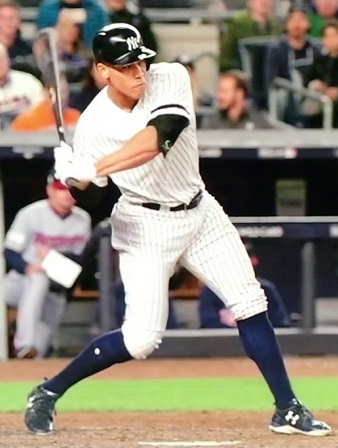
Do this man’s launch angles and exit velocities make his skyrockets any less moon drives?

You thought “runners in scoring position” fancified men on second and third? Welcome to the era of “exit velocity,” “launch angles,” and other locutions you might have thought more appropriate to a space launch than a baseball game.

Somehow it had to come to pass, unfortunately. All those years we obsessed about which pitchers hit three figure speed on the radar guns were bound to send someone off to give the hitters equal time. Continuing hangover from the Year of the Pitcher? Who knows?

So now for every Aroldis Chapman who throws a 100 mph pitch, we have to hear about an Aaron Judge (or we will, again, when he returns from the injured list) who hits one over 100 mph. That was then: the pitcher who threw the lamb chop past the wolf. This is now: The hitter who drives the lamb chop past the wolf.

One of these days the wolves are going to sue for willful starvation. It’ll happen sooner than language mavens sue to stop turning baseball into coverage of the space program, whatever’s left of it. It betrays my age but I never thought of Frank McGee as Vin Scully’s heir apparent. Though it might have been more fascinating to hear Scully report Alan Shepard’s Mercury flight than to hear McGee calling a World Series.

It’s one thing for my newly-minted friend Bill Denehy (former pitcher) to say the bomb Dick Allen hit off him in his first major league start “wasn’t a home run. That was a moon drive.” (It sailed on a rising line up toward the overhang of Connie Mack Stadium’s upper deck, stopped from landing in Delaware, as Denehy described it, only by the Coca-Cola sign on top of that overhang.) It’s something else now to hear and read baseball commentators and reporters discussing launch angles. Not to mention front office analytics departments as concerned about launch angles as astronauts were about re-entry angles.

Lots of players from the advent of the home run as a regular weapon have used uppercut swings. And we called them uppercut swings. Some of us described it a little more colourfully. “Dave Kingman’s like me,” Hall of Famer Mickey Mantle once said. “Swings from his ass.”

Kingman was a 6’6″ galoot with a long, loping uppercut swing and power equal to a nuclear weapon when he connected right and equal to a wind tunnel when he didn’t connect. Mantle himself once saw Kingman connect right and then some. “I know I never saw one like it,” he said.

He spoke of Kingman a brand-new Met facing brand-new Yankee Catfish Hunter in the first spring training 1975 exhibition between the two teams. Kingman caught hold of a Hunter slider and drove it so high and far out of the park that, according to Roger Angell in a piece collected in Five Seasons, it sailed over several palm trees before hitting the ground on the practise field behind it. Almost all the way to that field’s second base.

“A six-base blow,” Angell remarked dryly. In the same piece, he suggested the real impact of Kingman’s moon drive was to welcome Hunter—the first huge-money free agent, after he was made one thanks to Charlie Finley reneging on a contracted-for insurance payment—to his new Yankee mates: “There is nothing like a little public humiliation to make a five-million-dollar executive suddenly seem lovable.”

They didn’t talk about Kingman’s launch angle then or for any of the 442 major league home runs he hit in his career, enough of which homers traveled surrealistic distances. But they didn’t have to talk about his launch angle, either. The blast he sent clean out of Wrigley Field onto a porch three houses down on Waveland Avenue in 1979 may have been only the most obvious evidence. As also one of his nicknames, Sky King.

Today they’d analyse Kingman’s launch angles nigh unto death. Just the way they do with Cody Bellinger, Chris and Khris Davis, Joey Gallo, Aaron Judge, and Christian Yelich, to name a few. They shouldn’t be wearing baseball uniforms, they should be wearing NASA space suits. And maybe Houston should recommission the Astrodome, where once upon a time grounds crews in mock space suits manicured the Astroturf with upright vacuum cleaners.

Statcast figured out that balls hit in the air were more likely to become hits than those hit on the ground. So did enough players, with or without a little help from their analytically rounded front offices. “Ground balls are outs,” Josh Donaldson once said. “If you see me hit a ground ball, even if it’s a hit, I can tell you: It was an accident.” So why don’t we just say fly balls anymore?

Vin Scully, calling a monstrous Darryl Strawberry home run in Game Seven of the 1986 World Series: “High drive into deep right field, Evans to the track, at the wall—gone!” Now, try to imagine Scully compelled to toe the launch angle lines: “Thirty degrees into deep right field . . . ” There’d be a degree of madness in that mangle.

When showing television viewers a replay of Strawberry’s bomb, Scully began, “Here’s another look at that skyrocket, a towering drive . . .” Prose poetry. Thirty degrees into deep right field isn’t even “There once was a man from South Central . . .”

As much as I’ve accepted, embraced, and bathed happily in statistics and analytics, as profoundly as I reject the notion that statistics are the blood poisoning of a game whose very life blood is statistics, even I have my limits. Not just because it doesn’t matter how you hit your home runs as long as you hit them, period.

As I’ve written in the recent past, Roger Maris didn’t have launch angles; his homers were somewhat high line drives most of the time. And they were no less home runs than Darryl Strawberry’s skyrockets or Dick Allen’s moon drives or . . . well, who knows what to nickname Babe Ruth’s bombs? In his day transoceanic flight was done mostly by low-altitude flying boats. Or, by airships like the Graf Zeppelin and the Hindenburg, which weren’t that high and weren’t that fast. Man on the moon was science fiction.

One of those flying boats, a Boeing 314 flown by Pan American World Airways, inspired nicknaming Joe DiMaggio the Yankee Clipper. The 314 had a kind of rough beauty on the outside but inside it was a textbook model of beauty and grace. Which is how they thought of DiMaggio—likewise kind of rough looking as a youth (he became legitimately  handsome in his retirement), until he swung the bat or ran down a ball in center field.

And who cares how fast a ball sails for a base hit or over the fence? Unless you’re really that obsessed with pace-of-game, of course. The problem is that it doesn’t matter whether a home run reaches the seats faster than a speeding bullet or floats there like the Goodyear blimp. No matter how fast the ball travels, it’ll still land before the bombardier even reaches first base running it out, whether he’s pimping or running full speed.

When the opportunity arises, I argue that analytics divorced from scouting means the kids torn unnecessarily between two contentious parents. Scouting can’t tell you everything about a prospect’s potential deep value, and analytics can’t tell you whether you’re going to get a committed baseball avatar or a first class jerk. (By which I don’t mean players having, God help us, fun playing the game.)

But I know analytics can turn baseball’s lingo into something between poeticide and gobbledegook. Let me go as analytical as I please, but don’t ask me to eliminate the skyrockets, the moon drives, the bullet liners, the frozen ropes, and the seeing-eye grounders. (And don’t go there about “contact hitting” unless you can show me a batter who can breathe a base hit or home run.)

When Hall of Fame manager Casey Stengel was doing what he could with the absurdist Original Mets, one of his pitchers was future pitching guru and pennant-winning manager Roger Craig. As Hall of Famer Willie McCovey approached the plate in one game, Stengel went to the mound to talk to Craig. “How do you want to pitch him?” the Ol’ Perfesser asked. “Upper deck or lower deck?”

Stengel might be one of the arguable founding fathers of analytics (Baseball is percentage plus execution), doing the things analytics people adore decades before anyone ever heard of sabermetrics. And he created his own distinctive lingo of triple-talk. (It was known far and wide as Stengelese.) But he knew. He didn’t have to come right out and say it. Even accepting that he couldn’t just come right out and say something if he studied with Henry Higgins himself.

Launch angles and exit velocity matter a lot more for making New York to London in six hours or less than for putting runs on the scoreboard. A homer is a homer is a homer is a homer. Doesn’t matter whether it’s imitating Apollo 11 or the Yankee Clipper. It isn’t rocket science.

Let’s start the counterrevolution. How do you want to pitch Aaron Judge when he comes back from the injured list? Upper deck or lower deck?