“First in war, first in peace, and pants on fire in the American League”

0000 PantsOnFire01Senators

The nation’s capital has nothing on the home of the Continental Congress for the nation’s lowest ratio of baseball success to the American experiment’s success.

Reviewing Hardball on the Hill, James C. Roberts’s history of baseball in (and under the jaundiced eye of) Washington before the Expos moved to become the Nationals, George F. Will observed, “Once upon a time, Washington had a baseball team, and it had a reputation: ‘Washington—First in war, first in peace, and last in the American League’.”

The taunt was first fashioned by San Francisco sportswriter Charles Dryden in 1909. The Washington Senators (whose official name was the Nationals from 1906 through the mid-1950s) weren’t exactly world beaters in their first nine years of life. Or, in their final nine years before moving to Minnesota for the 1961 season.

They finished sixth in 1901-1902 and then, in order: dead last, dead last, next to last, next to last, dead last, next to last, and last. They finished sixth in 1954, dead last in 1955, next to last in 1956, dead last from 1957-59, and fifth in 1950. In between, from 1910 through 1954, the hapless Nats (“The fans enjoy home runs, and we have assembled a pitching staff that is sure to please them,” longtime owner Clark Griffith is believed to have said some time in the 1940s) finished dead last—drumroll, please—three times.

In sixty seasons before moving out of town, the Original Nats had eight dead last finishes. Or, for those who understand baseball is percentage, only thirteen percent of the time they played in Washington did they finish in the American League’s basement. They had quite a passel of first-division finishes, and even won three pennants and a memorable (1924) World Series while they were at it.

The nation’s seat of government may have hosted an awful lot of modest baseball, but they have nothing on the home of the Continental Congress. The Philadelphia Athletics had several powerhouse teams and moved to Kansas City for 1954, but they also had twenty dead-last American League finishes between 1901 and 1960. (During the years they were suspected of being the Yankees’ AAAA farm team, the Kansas City Athletics finished sixth once and seventh three times, for those scoring at home.)

About the Phillies, we’ll be charitable and leave out their fortunes from their original National League entry in 1883 and keep it to 1901-1960, while mentioning that they did win a pair of pennants, in 1915 and 1950. The Phillies, too, had twenty dead-last finishes between 1901 and 1960. And you wonder why Philadelphia baseball fans are described as “cranky” when people wish to be polite?

They, too, had a legend of futility: some time during their darkest 1930s days, a disgruntled fan was said to have taken a paintbrush to a large team deodorant soap endorsement sign mounted on Baker Bowl’s high right field wall, leaving it to read: “The Phillies use Lifebuoy . . . and they STILL stink!”

What of the ancient and hapless St. Louis Browns, you ask? From their 1901 birth as the Milwaukee Brewers—they moved to St. Louis the following season—the Browns had only ten dead-last finishes to show for their futility. They managed to win one pennant, in 1944, only to lose the World Series to the likewise World War II-depleted Cardinals. Definitely not in Philadelphia’s league.

And what of the pre-Jackie Robinson Brooklyn Dodgers, reputed to be futile enough that a frustrated fan took ink to the Ebbets Field occupancy sign in the 1930s and made it read, “Occupation by more than 35,000 unlawful . . . and unlikely”? Dem Bums finished dead last only once between 1901 and their departure for Los Angeles. They finished as low as next-to-last only six times. They won three pennants pre-Robinson and, of course, six pennants and a World Series ring with him. Cartoonist Willard Mullin’s fabled Brooklyn Bum caricature, based on circus legend Emmett Kelly’s “Weary Willie” clown hobo, merely became only a slightly deceptive icon of futility.

Very well, I surrender. The Cubs. From 1901 forward it actually took them a full quarter century to experience their first dead-last finish, during which quarter century they actually won five pennants and two World Series. Since then, they’ve had only twelve dead-last finishes, and only five of them happened in the pre-divisional play era. They’ve had double-figure next-to-last finishes, but nothing along the line of Philadelphia’s historic futilities.

Yet it still didn’t take the Phillies as long to win a World Series the first time as it took the Cubs to win their third or the Red Sox to win their sixth. The Red Sox had a calamitous 1930s but their tally of dead-last finishes from 1901 through 1960 is ten. Since expansion and divisional play, the so-long-snakebitten Red Sox have come home dead last—wait for it!—three times. The Red Sox got snakebitten by way of getting to the mountaintop, seeing the Promised Land, and then getting surrealistically kicked to the rocks along the river bank below time and again until 2004; the Cubs were longtime awful and had only a couple of such kicks before they finally got back in 2016.

Good luck with “Philadelphia—First in freedom, first in peace, and last in the American and National Leagues.” It just doesn’t have the rockin’-in-rhythm of the taunt that taunted the Senators for decades. (Duke Ellington, native Washingtonian, one-time peanut sales lad at Senators games, used “Rockin’ in Rhythm” as the title of one of his earliest classics.) The taunt that might have been true enough at the time Dryden devised it, the taunt the Senators actually rendered false. Would that be the first time anything attached to or emanating from Washington proved false?

The Senators moving to Minnesota threw the proverbial monkey wrench into the American League’s expansion plan, which originally included new teams in Minneapolis (where the Giants abandoned their territorial rights after moving to San Francisco) and Los Angeles. So the league put a new franchise of Senators in place. And, as happens so often in the nation’s capital, that good deed didn’t go unpunished.

The good news: the Second Nats finished dead last only three times in their eleven Washington seasons. The bad news: They had two sixth-place finishes, two eight-place finishes, and a ninth-place finish otherwise, before the divisional play era began. In their three Washington seasons of division play, they finished, in order: fourth, sixth, and fifth. Then they, too, high tailed it out of town, this time to Arlington, Texas.

“We tend to remember beginnings and ends, and it’s certainly true that the American League’s first Washington baseball club had a lousy beginning and a lousy end,” wrote Rob Neyer in Rob Neyer’s Big Book of Baseball Lineups. “But the middle lasted quite a lot of years, and it wasn’t so bad at all.”

The era of Washington baseball that began when the Expos were moved there to become the Nationals hasn’t exactly been a journey into Dante’s Inferno, either. Though if these Nats perfect their apparent impersonation of the 1990s-2000s Atlanta Braves (all those division titles and a measly five pennants and one World Series ring to show for them), their fans may yet begin chanting, “Washington—First in war, first in peace, and stopped  with the top of the National League East.”


This is the first of what I hope will be a continuing, periodic series of baseball mythbusting. It’s not that I’m the first guy to bust them, but even when they’ve been busted with evidence enough you can still find enough people practising one of America’s other national pastimes—refusing to let the truth get in the way of a pleasant myth. Or unpleasant myth, depending.

You’d think busting a myth was an affront to all that’s sacred in America, including baseball. But I believe you can debunk baseball bunk without eroding the joy and beauty of the game.


Does the Home Run Derby hurt players?

2019-03-17 AaronJudge2017HRDerby

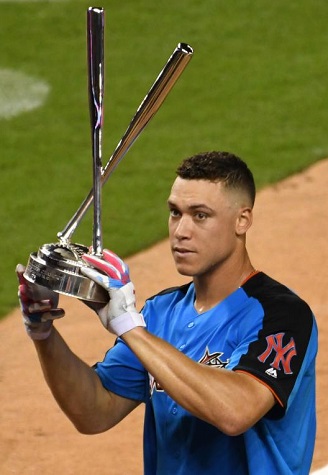
Aaron Judge, hoisting his 2017 Home Run Derby championship trophy. The Yankee bombardier would rather win baseball games than virtual batting practice hardware.

Apparently, you can’t pay Aaron Judge enough to think about entering this year’s Home Run Derby at the All-Star break. He doesn’t mind wishing and hoping for his Yankees to bust the single-season team home run record they set last year, but taking part in the annual bomb run is something else entirely.

This year’s Home Run Derby champion will receive $1 million, which happens to be $315,000 more than Judge will earn this season. And Judge would be a tempting entrant, since his home runs are customarily the kind of conversation pieces hit by the likes of Hall of Famers Mickey Mantle, Willie McCovey, and Mike Schmidt, not to mention the likes of Frank Howard, Dave Kingman, Greg Luzinski, Darryl Strawberry, Mark McGwire (pre-suspicion), and Frank Thomas.

Judge won the 2017 Home Run Derby. And that’s all, folks, as far as he’s concerned. “The money doesn’t matter,” he tweeted two days ago. “For me, I did it once. I had a blast with it. But I’m more worried about winning games. I don’t want to get hurt again doing a Derby.”

Judge did have shoulder issues in 2017, but when he underwent cartilage cleanup surgery after that season it was revealed that the injury may actually have happened near the beginning of that season. Playing in the Derby may or may not have exacerbated it. In 2017, Judge denied the shoulder was causing him a rougher second half.

But Judge may be right about one thing: going to and winning the Home Run Derby may be hazardous to a player’s second half baseball health. There have been 34 Home Run Derby champions since the event premiered in 1985, including six won by Hall of Famers if you count Ken Griffey, Jr.’s back-to-back Derby championships in 1998-99. And one shy of half those champions had lesser second than first halves of their Derby-championship seasons, marked in red:

  Before Home Run Derby After Home Run Derby
PLAYER OPS TB OPS TB
Dave Parker .891 177 .944 173
Wally Joyner .779 127 .830 144
Darryl Strawberry .769 94 .941 147
Andre Dawson* .905 188 .886 165
Eric Davis .948 117 .948 133
Ryne Sandberg* .992 203 .820 141
Cal Ripken, Jr.* 1.001 190 .881 178
Mark McGwire .966 176 .977 97
Juan Gonzalez 1.023 181 .974 158
Frank Thomas* 1.143 150 .989 149
Barry Bonds .998 184 1.191 134
Tino Martinez .989 205 .897 138
Ken Griffey, Jr.* 1.061 234 .876 153
Ken Griffey, Jr.* 1.024 206 .882 143
Sammy Sosa .962 194 1.138 189
Luis Gonzalez 1.108 203 1.125 216
Jason Giambi 1.032 189 1.035 146
Garret Anderson .943 221 .807 124
Miguel Tejada .863 174 .929 175
Bobby Abreu .955 170 .787 109
Ryan Howard .923 184 1.259 199
Vladimir Guerrero* .962 170 .935 144
Justin Morneau .903 187 .831 124
Prince Fielder 1.055 189 .967 167
David Ortiz .933 134 .867 140
Robinson Cano .863 176 .905 156
Prince Fielder .885 162 1.006 145
Yoenis Cespedes .713 129 .769 105
Yoenis Cespedes .750 128 .752 142
Todd Frazier .922 200 .664 108
Giancarlo Stanton .823 138 .800 64
Aaron Judge 1.139 208 .939 132
Bryce Harper .833 153 .972 120

* Hall of Famer.

(Codicils: 1) The 1988 Home Run Derby was cancelled due to rain. 2) Ken Griffey, Jr. won the 1994 Home Run Derby, but since the season was shortened by the strike, we don’t have a true complete second half to measure, so I didn’t include it above.)

You notice that only Sammy Sosa, Barry Bonds, Ryan Howard, and Prince Fielder went from a pre-Derby -1.000 OPS to a post-Derby +1.000 OPS in a Derby-winning season. And, that only Luis Gonzalez and Jason Giambi had pre- and post-Derby OPSs of +1.000 while increasing the second half OPS even slightly. And, that Eric Davis is the only Home Run Derby champ to have the same OPS in the first and second halves of his Derby-winning season.

Strawberry also showed the largest bump in second-half total bases of any of the Derby champs with a whopping 53. Behind him for total bases bumps in the second halves of their Derby titles are Wally Joyner (17), Eric Davis (16), Luis Gonzalez (16), Ryan Howard (15), Yoenis Cespedes (14) in his second of back-to-back Derby championships; Luis Gonzalez (13), David Ortiz (6), and Miguel Tejada (1). Cespedes, by the way, has the lowest back-to-back pre- and post-Derby championship OPSs.

(And just how good was Ryan Howard in 2006, when he led his league in home runs, runs batted in, and total bases, not to mention winning the National League’s Most Valuable Player award? His second-half OPS jumped the highest of any Derby winner in the second half, ever: an out-of-this-galaxy 336 points. Barry Bonds in 1996 has to settle for the second-highest second-half jump with a mere 193 points. Behind Bonds are Sosa [+176], Strawberry [+172], and Prince Fielder [+121].)

If Aaron Judge wanted to say the Home Run Derby injures a player physically or leaves him more injury prone in the second half, I’m not really seeing an overwhelming case for that. But if he wanted to say partaking in or winning the Derby has a measurable impact otherwise on the rest of a player’s season, the evidence adduced above suggests it’s about a 50-50 proposition so far.

And Judge is absolutely right about being more concerned with his team winning on the season and to get to the postseason than whether he or any other Yankee or any other player partakes in or wins a Home Run Derby. Joe and Jane Fan may get a big bang out of watching the Derby but who’s going to be the first to bitch when a Derby winner or the field of Derby swingers comes up lesser in the second half when their teams might be in a pennant race?

The Home Run Derby is barely more than showcased batting practise. The All-Star Game is at least a baseball game, even if it is a little bit on the stupid side for managers to make pitching changes during rallies in a bloody exhibition game.

We speak often enough of the common good of the game not being the same thing as making money for the owners or the players. Sometimes the common good of the game isn’t the same thing giving the fans a transitory kick, either.

But Joe and Jane Fan won’t hesitate, either, when you ask them which they’d really prefer: a guy winning the Home Run Derby, or a guy hitting the home run that nails his team’s advance to or in the postseason. If only Joe and Jane Fan could reconcile that to their game-compromising itch for perpetual motion and cheap thrills.

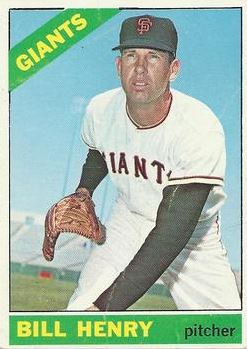
Bill Henry, patron saint


2019-03-14 BillHenryGiants

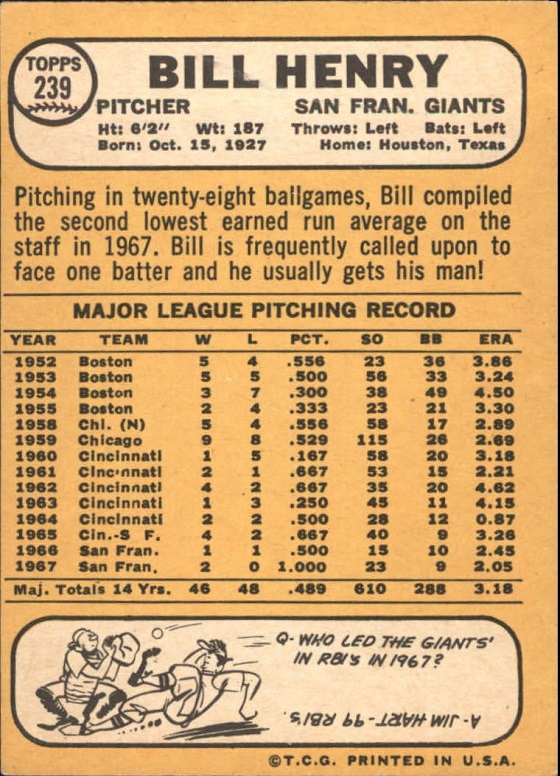
The patron saint of the single-hitter pitching specialist, on his 1966 baseball card.

Baseball isn’t necessarily broken, but between them commissioner Rob Manfred and the players’ union have agreed to a few fixes. One of them is aimed at putting an end to the supposed rash of relief pitchers assigned to get rid of a single batter, starting next season.

Never mind that, as Jayson Stark has exhumed, only one pitcher in 2018 had twenty or more assignments in which he was asked to get rid of a single hitter—now-former Mets reliever Jerry Blevins. Stark also unearthed that only five other pitchers last year (he didn’t identify them as I write) had fifteen or more single-batter assignments.

In essence, the single-batter relief pitcher doesn’t poke his nose out of his bullpen hole quite as often as you might think, lately, and as baseball’s hysterics would have you believe. Nor was it yet another creation of this supposedly wild and crazy 21st century in which the Sacred Game is rent this or that way by modernistic geek interlopers bent on keeping us up all night.

But the three-batter minimum, something I first thought seemed sound, will have its major problems. Especially if a pitcher freshly installed doesn’t have his best and finds his first two batters slapping him silly, perhaps because he was gassed going in after being warmed up in the pen injudiciously or for too long before he was brought in (and that’s before the eight warmups on the mound), perhaps after coming in with men on base and a game on the line.

Fourteen years ago, a Hardball Times writer named Steve Treder sketched out a kind of history of the lefthanded one-out guy—known popularly by the LOOGY acronym—and traced it back to 1960 and the Kansas City Athletics. First, however, Treder offered a reasonable definition:

[H]e’s brought in to face, if not a single dangerous left-handed hitter, then at least a part of the lineup containing a key lefty, or two or more lefties. Very often this is in a fairly high-leverage game circumstance, rarely before the fifth or sixth inning. Sometimes LOOGYs are deployed in the ninth, but rarely are they used in Save situations. Very rarely are they left in for much more than a single inning.

LOOGYs are selected for the role primarily on the basis of their particular effectiveness against left-handed batters — or, to be less kind, on the basis of their particular ineffectiveness against right-handed batters. They’re often long and lanky types, with snaky sidewinding deliveries.

Treder defined such a pitching season as the specialist appearing in twenty games or more (hello, Mr. Blevins), fewer than 1.1 innings per gig, and lower than a twenty percent save situation factor. He prowled the data and discovered 799 pitching seasons within those coordinates through 2004, the first of which was delivered by Leo Kiely.

Kiely was a six-year veteran of the Red Sox bullpen before he was traded to the Indians (for a spare part named Ray Webster) in January 1960 and to the A’s (for former Yankee Rookie of the Year pitcher Bob Grim) in April of that year. Kiely was a soft-tossing junkballer who appeared in twenty games, pitched twenty and two-thirds innings, pitched as much to his defense as anything else, and showed a 1.74 earned run average for his effort.

Naturally, the A’s let him go in June 1960, and Kiely never appeared in the Show again. A wisenheimer might suggest he was simply too good at his job to fit the profile of that sad-sack team. But Kiely was the unlikely prototype of his breed. Two years later, three American League pitchers were given similar job descriptions and assignments: Dean Stone (White Sox, after coming in a trade with the Colt .45s), Bob Allen (a sophomore Indian), and Jack Spring (Angels).

Angels manager Bill Rigney made Spring the first multiple-season single-batter specialist when he gave Spring the same job in 1963. The type turned up here and there the next couple of seasons, but in mid-1965 the Reds traded a tall lefthanded reliever to the Giants and gave Giants manager Herman Franks an idea.

Franks belongs in the Hall of Infamy for his role in Leo Durocher’s then-high tech sign-stealing scheme that ignited the 1951 Giants’ pennant race comeback to force the three-game playoff. (Franks was the coach wielding utility infielder Hank Schenz’s Wollensak spyglass and buzzing the stolen signs to the bullpen where they’d be transmitted to the Giants hitters who wanted them.) But he also belongs in the Hall of Unlikely Innovation for what he did with Bill Henry.

Henry was the classic tall, quiet Texan who was so reserved his teammates nicknamed him Gabby and Jim Bouton, in Ball Four, would describe Henry thus: “When you say hello to him, he’s stuck for an answer.”

He’d been a key element in the 1961 Reds’ surprise pennant, teaming with their resident journalist Jim Brosnan to form a formidable enough one-two punch out of the pen. Now he was a 37-year-old veteran, with an effective curve ball and an equally sharp sinker and a facility for throwing double play balls, and after the Giants finished out a tight 1965 pennant race against the Dodgers, to which Henry contributed four saves, Franks decided to give him a new job.

In 1966 and 1967, Henry pitched 43.2 innings in 63 games, with an ERA of 2.27 and a fielding-independent pitching rate at 3.50; Henry was better at taking care of business without his fielders in 1967. Arguably, Henry’s 1965-67 stretch with the Giants was the best three-season stretch of his long and quietly distinguished relief career. But the backside of his 1968 Topps baseball card said it all:

2019-03-14 BillHenryBaseballCard

Henry began to show his age in 1968; he ended up spending that season between the Giants and the Pirates, to whom he was sold that June and from whom he was released two months later. The Astros signed him in May 1969; in June he pitched his final pair of major league gigs in both ends of a doubleheader: 2.1 scoreless in the opening loss; two scoreless in the winning nightcap.

Even with Henry’s success in San Francisco, it still took some time before the hard-core single-hitter pitching specialist took deeper hold than in his and the earlier years of the 1960s. And, to come not from the ranks of aging veterans or marginal prospects.

Ed Vande Berg was a Mariners lefthander who set a record for rookie appearances in 1982 (78) and who was as hard core those two seasons as Henry was with the Giants with more appearances than innings pitched. Vande Berg was also very effective in the role: his ERA for those two seasons was 2.87; his FIP was 3.33. “[H]e was a prime prospect out of Arizona State who had blown through the minors in a season and a half,” Treder wrote, “and been installed as a full-time LOOGY the moment he arrived in the majors.”

Then, in 1984, the Mariners changed managers, from Rene Lachemann to Del Crandall, and Crandall made a mistake: he moved Vende Berg into the starting rotation. Vande Berg was out of his element as a starter and he was returned to the bullpen for one more LOOGY season that wasn’t as effective as his first two. He moved to the Dodgers in the deal that made a Dodger out of Steve Yeager; then, to the Indians and the Rangers, but he was never again the pitcher he was in his first two Seattle seasons.

By the time Vande Berg’s career ended, the single-batter specialist started taking further and further hold. There were 131 such seasons between 1960 and 1986, Treder noted, by once-familiar names as Paul Assenmacher, Danny Coombs, Ken Dayley, Joe Grzenda*, Al Hrabosky, Al Jackson, Jimmy Key (presumably before he became one of the American League’s premier starting pitchers), Paul Lindblad*, and John O’Donoghue.

But as Treder also noted, the hardest of the hard cores, Bill Henry’s grandchildren, began to turn up in the early 1990s, with Assenmacher, John Candelaria (once a promising starter), Jason Christiansen, Mike Holtz, Mike Myers, and Jesse Orosco (once a particularly effective closer). From 1987-2004 there were 191 single-batter pitching seasons to be seen.

Myers, who proved one of the bullpen keys to the 2004 Red Sox’s at-long-last return to the Promised Land, and who threw sidearm but looked like a telephone pole about to collapse as he threw, has the most such seasons of any of Bill Henry’s grandchildren: ten.

Henry himself finally called it a career in 1969. He stayed in the Houston area, raising his family and working as a longshoreman before retiring to a pleasant suburban life with his wife and surviving an unlikely amusement in 2007—when the paid obituary for a Bill Henry in Florida prompted a notice in the paper’s sports section the next day, which the wires picked up and spread until a Society for American Baseball Research writer got hold of the former pitcher to verify he was still alive and well . . . and dryly amused.

Henry also made a point of telephoning the man’s widow, who’d been smothered with phone calls when it was believed her husband was one and the same as the former relief pitcher. “He wasn’t really upset about it,” his daughter-in-law once told a reporter. “He kind of laughed about it.”

The quiet man did have his moments, though. Jim Brosnan, writing in Pennant Race, told a story about an 18 April 1961 game against the Giants, with the Giants’ Mike McCormick and the Reds’ Jim O’Toole having a pitcher’s duel, and the bullpen looking to amuse themselves with a few whacky bets, when spare part Hal Bevan finally challenged: “There’s too damn much noise down here. A guy can’t even think.”

He suggested himself, Brosnan, and catcher Jerry Zimmermann clam up. Brosnan takes it from there:

I was more than willing. Conversation sharpens the ache of a hangover. “First guy to say anything buys the beer after the game,” I said.

Silence reigned. Uneasily. “Gabby” Henry wouldn’t join the bet and it amazed me how loud his few comments on life and the game could sound.

Late in the game, a fly ball was hit toward us. Harvey Kuenn, playing right field for the Giants, came running for it. Apparently Kuenn was going to have to run right into the wall to get the ball, but no word of warning was sounded. The ball drifted back into the field and Kuenn, stumbling in front of our bench, caught it.

“Christ, let a guy know somethin’!” he yelled at us. No one said a word.

“That’s sickening!” said Henry, shaking his head. “You three guys’d let a man get killed just so you could win a bet!”

Three grinning faces nodded in agreement. 

Henry himself died of heart trouble seven years later after he’d had to affirm that the report of his death was somewhat exaggerated. He pitched quietly, lived quietly, seems to have been loved and respected by anyone who knew him. And he was the hard-core patron saint of the single-batter pitching specialist today’s baseball fan thinks was a 21st century plot to overthrow the great and glorious game, and today’s baseball governors think need to be retired somewhat permanently.


* Joe Grzenda and Paul Lindblad hold a curious and sad place in baseball history: Grzenda was trying to save a win for Lindblad in the final home game in Washington Senators history. He never got to finish the save.

With the Senators leading 7-5 and two outs, Grzenda never got to pitch to the Yankees’ Horace Clarke. Heartsick fans exploded onto the field to vandalise it for souvenirs and, perhaps, outrage over the team leaving for Texas. The umpires declared a forfeit to the Yankees.

Over three decades later, when the Montreal Expos moved to Washington to become the Nationals, Grzenda was invited to throw out a ceremonial first pitch—and he did it with the ball he saved from that final Senators game, the ball he would have pitched to Clarke if not for the fan riot.

Just enjoy the coming season

2019-03-13 GeorgeSpringer

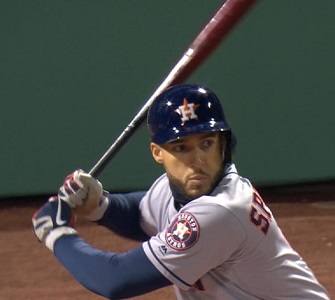
George Springer fully recovered should be big for this year’s Astros, among other things to look forward to . . .

A few almost idle comments on my podcast last weekend to the contrary, I really have no interest in predicting how baseball season to come will transpire. Other than to say that it’ll be fun to watch, and fun to analyse, on human and statistical terms alike, I am strictly obedient to Berra’s Law: It ain’t over until it’s over. Even the known tankers are liable to burp a surprise or two out.

I’m looking forward to watching the Mets’ Jacob deGrom, the defending Cy Young Award winner, tangle with the Nationals’ Max Scherzer on Opening Day. If it’s not quite the equal of a hypothetical Opening Day contest between Juan Marichal and Sandy Koufax, or Tom Seaver and Steve Carlton, or Randy Johnson and Greg Maddux, it’ll probably be as close as it gets. So, barring injury or performance relapses, will deGrom’s and Scherzer’s season to come.

I’m looking forward to seeing whether the Red Sox—defending world champions for the fourth time this century—really do have a second consecutive run to the Promised Land in them, since they didn’t do that much to reinforce themselves over the winter but have the hard core of their World Series winner intact and very much in good enough shape.

I’m looking forward to seeing whether the Dodgers take the seventh consecutive National League West title the rest of the world seems to think is theirs for the taking; and, if they do, whether they’ll get back to the World Series a third straight season but get back to the Promised Land at last. Or, whether they’ll take yet another trip to the mountaintop, get a grand panoramic view, and then take yet another nasty kick off the edge to the rocks below.

I’m looking forward to seeing just what Bryce Harper will really mean to the Phillies this season, never mind the rest of his baseball life, and what Manny Machado will really mean to the Padres this season. I’m also looking forward to seeing how the like of Patrick Corbin (Nationals), Edwin Diaz (Mets), Paul Goldschmidt (Cardinals), Sonny Gray (Reds), Matt Harvey (Angels), Adam Jones (Diamondbacks), Andrew Miller (Cardinals), Charlie Morton (Rays), Hunter Pence (Rangers), Yasiel Puig (Reds),  and Troy Tulowitzki (Yankees) do in their new homes.

I’m looking forward to seeing whether Kris Bryant (Cubs) and George Springer (Astros) have overcome their injury issues fully enough to return as the formidable threats they’ve been in the past. Baseball’s even more fun when players such as those two are at the top of their game.

I’m looking forward to seeing whether Justin Verlander’s reunion with his changeup will keep him formidable even as his Astros seem on paper to have the continuing title to the American League West. And, to seeing Alex Bregman continue to shake off last year’s catch of the season at his expense and solidify himself as Matt Chapman’s competition for the title of baseball’s current best all-around third baseman.

I’m looking forward to seeing whether Aaron Judge gets his wish and the Yankees smash their own freshly-set record for team home runs in a season. And, whether (as I examined very recently) it means concurrently that the Empire Emeritus returns to the Promised Land at last.

I’m looking forward to seeing how long the Blue Jays continue to hold out on promoting Vladimir Guerrero, Jr. to the Show, even allowing that they got the perfect excuse to start his season in the minors thanks to the oblique injury he suffered last week.

I’m looking forward to seeing whether baseball’s experiment with the independent Atlantic League trying out a few proposed new rule changes, some of them viable and some just plain cockamamie, shows the changes to be either as reasonable as some seem to be and as ridiculous as others seem. Especially, on the cockamamie side, those born of abject ignorance and willful blindness.

I’m looking forward to seeing whether this year’s imposition of a single trading deadling (31 July) and elimination of the 31 August waiver trade deadline really will force teams to assess and concentrate on their actual team and organisational depth.

I’m looking forward to a somewhat wild National League East race and a reasonably interesting National League Central race, especially with the Reds having remodeled so intriguingly in the off-season and the Cardinals hoping their reinforcements mean they might stay the distance this year. And, whether the surprisingly remodeled Twins really have what it takes to dump the Indians in the otherwise nothing-special American League Central.

I’m looking forward to seeing whether the Angels have really awakened enough to put on the field a team their best player, who happens to have been baseball’s best player from almost the absolute beginning of his major league career, can be proud of at last. And, if they do or they think they do, whether they’ll move to make him an Angel for life before he succumbs to the whispers from Harper and others about making the rest of his baseball life an hour from his native New Jersey soil.

I’m looking forward to seeing The Mariano, Edgar Martinez, Mike Mussina, the late Roy Halladay, and Lee Smith inducted into the Hall of Fame come July; and, to seeing how many more people hold their noses when Harold Baines is inducted than when Jack Morris was.

I’m looking forward to the Mets’ golden anniversary celebration of their 1969 miracle World Series winner, even with the sorrow that Hall of Famer Tom Seaver can’t be part of it except in spirit. And I still hope baseball finds a way to join the Reds commemorating their 1919 World Series winner and saying, at long enough last, “You could have and might have won that Series if it was played entirely straight, no chaser.” Well, I can dream, can’t I?

And, I’m looking forward to seeing some games in the new Las Vegas Ballpark, the new home of Las Vegas’s Triple-A minor league team, formerly the 51s and now renamed the Aviators (in honour of the one-time aviator whose corporation bought the team), and now the AAA affiliate of the Athletics.

A baseball game in Cashman Field may have been fun, but the park itself was rather like sitting in a AAA version of the Polo Grounds when the embryonic Mets played there: ramshackle, despite the pleasantry of the mist sprayers above the seats surrounding the home plate area on the brutally baking summer days that mark summertime Las Vegas equal to the washing lights of the nighttime Strip. Las Vegas Ballpark, due to be completed by Opening Day, looks to be a near-perfect place to watch a game.

I have tickets for the Aviators’ third game of the season, finishing a set against the Sacramento River Cats, whose major league parents are the Giants. The A’s may offer up another surprise American League West contention; the kindest thing you can say for this year’s Giants so far is that, well, they’ll show up, do their best with what they have, and hope for a good draft and maybe a trade deadline possibility that continues a badly needed farm replenishment. In manager Bruce Bochy’s announced final season on the bridge, those three World Series championships in that five-season span look almost as far in the rear view mirror as Pontiac.

Meanwhile, I’m also looking forward to what happens this season for one of the great nickname possibilities in baseball—young Nationals middle infielder Carter Kieboom. He’s hit three home runs this spring training, two against the wind. A season full of blasts such as those and any time someone hollers kaboom! over this or that explosion it means free publicity for him.

The Franchise could use a miracle

2019-03-07 TomSeaver02

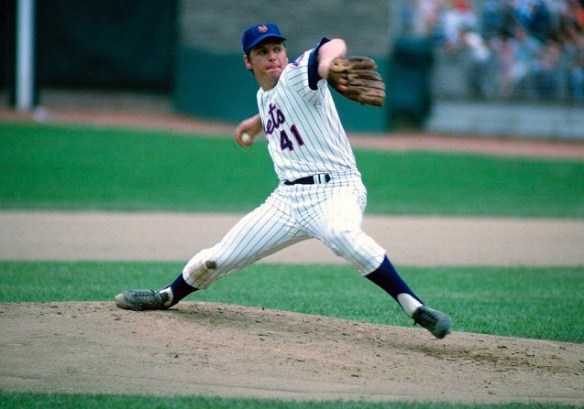
Fifty years later, Met fans still consider stricken Hall of Famer Tom Seaver “The Franchise.”

Writing for Harper‘s in 1977, A. Bartlett Giamatti—a decade before he left the presidency of Yale for that of the National League in a romantic instance of upward mobility—mourned with New York when the impasse between the Mets and Tom Seaver ended with Seaver’s exasperated demand for a trade. And, with the Mets trading him to the Reds. The Saturday Night Massacre.

Giamatti mourned not just the front office foolery that led to the Mets trading The Franchise at all, but the loss to New York of Seaver the young man, recalling a 1971 evening he and his wife got to spend with Seaver and his wife at a then-literary light’s home adjacent to Seaver’s then Connecticut home:

Seaver had . . . dignitas, all the more for never thinking for a moment that he had it at all. A dignity that manifested itself in an air of utter self-possession without any self-regard, it was a quality born of a radical equilibrium. Seaver could never be off balance because he knew what he was doing and why it was valuable . . . With consummate effortlessness, his was the talent that summed up baseball tradition; his was the respect that embodied baseball’s craving for law; his was the personality, intensely competitive, basically decent, with the artisan’s dignity, that amidst the brave but feckless Mets, in a boom time of leisure soured by division and drugs, seemed to recall a cluster of virtues no longer valued . . .

Of course Tom Seaver wanted money, and wanted money spent; he wanted it for itself, but he wanted it because, finally, Tom Seaver felt about the Mets the way the guy from Astoria felt about Seaver—he loved them for what they stood for and he wanted merit rewarded and quality improved. The irony is that Tom Seaver had in abundance precisely the quality that [then-Mets chairman] M. Donald Grant thinks he values most—institutional loyalty, the capacity to be faithful to an idea as well as to individuals . . . The anguish surrounding Seaver’s departure stemmed from the realisation that the chairman of the board and certain newspaper columnists thought money was more important than loyalty, and the fury stemmed from the realization that the chairman and certain writers thought everybody else agreed with them, or ought to agree with them.

That’s still probably as close as anyone has come to distilling both Seaver’s core, on and off the mound, and the fractured Mets’ fan’s heart as expressed by a banner hung from a Shea Stadium rail the day after the trade:

I WAS A
BELIEVER
BUT NOW WE’VE
LOST
SEAVER

2019-03-07 TomSeaverSandyKoufax

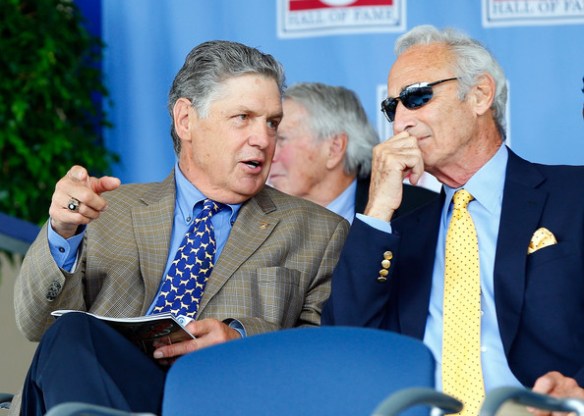
Seaver (left) with fellow Hall of Famer and oenophile Sandy Koufax at a Cooperstown induction ceremony.

Giamatti interpreted it to mean “lost faith in the Mets’ ability to understand a simple, crucial fact: that among all the men who play baseball there is, very occasionally, a man of such qualities of heart and mind and body that he transcends even the great and glorious game, and that such a man is to be cherished, not sold.”

The truly sad news is that even such a man can’t transcend nature’s cruelties.

Tom Seaver has been diagnosed with dementia. His family announced it Thursday, not long after his 1969 Mets teammate Art Shamsky disclosed his struggle with short-term memory loss, in an excerpt from Shamsky’s forthcoming After the Miracle, a chronicle hooked around the 1969 triumph and a final journey to Seaver’s California home and vineyard by Shamsky and other Miracle Mets teammates.

Shamsky already suspected, based on that visit, that Seaver wasn’t likely to be part of commemorations this year for the 1969 Mets. The formal announcement of Seaver’s condition, from his family by way of the Hall of Fame, turned suspicion into sad reality: Tom will continue to work in his beloved vineyard at his California home, but has chosen to completely retire from public life.

The arguable sixth to eighth best starting pitcher ever to play the game, and arguably in a dead heat with Randy Johnson as the best post-World War II starter, Seaver was intelligent and personable and possessed of a fine, dry wit. During the 1969 World Series, when Hall of Famer Sandy Koufax (working as an NBC baseball analyst and commentator) asked him whether God was a Met fan, Seaver said with a slight grin, “I don’t know, Sandy, but I think He’s rented an apartment in New York this week.”

Seaver’s health issues began when he was stricken with Lyme’s disease in 1991, then suffered a recurrence in 2012, leaving him with Bell’s palsy and short-term memory loss. Though he’d enjoyed visitors to his vineyard (including Koufax, himself an oenophile) and always enjoyed seeing former teammates, not to mention appearing at the annual Hall of Fame inductions, Seaver had cut his public appearances back considerably since that 2012 illness.

2019-03-07 TomSeaverAndyWarhol

Even Andy Warhol found Seaver one of a kind . . .

The 1977 contract extension rift was compounded by Seaver’s criticism of the reeling Mets’ administration for refusing to invest in both replenishing their farm system and the early free agency market. And, by Grant’s foolish public remark that the Mets had won two pennants “without superstars” and would do it again. (As the Mets continued their mid-to-late 1970s decline, the fabled Shea Stadium Sign Man, Karl Ehrhardt, pricked Grant routinely by hoisting a sign saying WELCOME TO GRANT’S TOMB, which helped the Mets alienate Ehrhardt for decades to follow.)

Then the Mets laid a second screwing upon their three-time Cy Young Award winner. Re-acquired from the Reds for 1983, Seaver was inadvertently left off the protected list, in the short-lived compensation pool allowing teams who’d lost players to free agency to claim another player from anywhere. The White Sox claimed Seaver, who won his 300th career game in their uniform—and in Yankee Stadium.

Those were no ways to treat the Franchise.

2017-03-07 TomSeaverGaryGentry

Seaver and rookie pitching star Gary Gentry (39), inspecting the carnage after celebrating Shea Stadium fans decimated the playing field following the ’69 Series triumph.

He finished his career with the 1986 Red Sox, where he was unable to partake in the World Series due to a knee injury, which probably suited New York just fine. They’d already demanded penance from the Mets’ administration for letting Seaver win number 300 in that foreign playpen in the Bronx. Letting him pitch even one inning against the Mets in a World Series would have been worth a public execution.

No genuine Met fan blamed Seaver, of course. And he thought of returning to the Mets in 1987 when they needed pitching help, but a couple of poor gigs at their then-Tidewater AAA farm convinced him to call it a career. A year later, he appeared at Shea Stadium when the Mets retired his number 41; characteristically, Seaver strode to the mound and bowed to the cheering crowd in all directions before leaving.

Seaver made such impressions practically from the beginning. Making his first All-Star team in his rookie season, 1967, Seaver felt compelled to introduce himself to his fellow future Hall of Famer Henry Aaron. “Kid, I know who you are,” Aaron replied, “and before your career is over, I guarantee you everyone in this stadium will, too.”

“Blind people come to the park just to listen to him pitch,” Hall of Famer Reggie Jackson once said. As well they might regarding one of only two pitchers with over 3,000 strikeouts and a lifetime ERA below 3.00 on their resumes. (The other? Hall of Famer Walter Johnson.)

Tug McGraw, the ’69 Mets relief pitcher, about whom Seaver said, “He’s got about forty-eight cards in his deck,” once said that when Apollo 11’s Neil Armstrong and Buzz Aldrin walked on the moon, he knew the Mets had a chance. (McGraw died of brain cancer in 2004.) Seaver saw things a little less esoterically: “There are only two places in the league—first place and no place.”

Wrote Giamatti:

Seaver held up. His character proved as durable and as strong as his arm. He was authentic; neither a goody two-shoes nor a flash-in-the-pan, he matured into the best pitcher in baseball. Character and talent on this scale equaled a unique charisma. He was a national symbol, nowhere more honoured than in New York, and in New York never more loved than the guy who seemed in every other aspect Seaver’s antithesis, the guy who would never give a sucker an even break, who knew how corrupt they all were, who knew it was who you knew that counted, who know how rotten it all really was—this guy loved Seaver because Seaver was a beautiful pitcher, a working guy who got rewarded; Seaver was someone who went by the rules and made it; Seaver carried the whole lousy team, God love ’em, on his back, and never shot his mouth off, and never gave in, and did it right. The guy loved Seaver because Seaver did not have to be street-wise.

In 1977’s Oh, God! John Denver’s earnest supermarket manager asks George Burns’s God about working miracles to send messages. After demurring on grounds of too much flash, Burns/God continues: “Oh, now and then I do one just to keep My hand in. My last miracle was the 1969 Mets. Before that, I think you have to go back to the Red Sea. Aaaaah, that was a beauty!”

It would not be unreasonable for those who love baseball to pray for Seaver to receive a miracle now.