The shifts aren’t as shifty as you think

2018-12-24 JoseBerriosChanceSisco

Chance Sicso (bunting) making Jose Berrios (pitching) and the Twins very, very angry that he exploited their foolish shift while his Orioles were seven runs down.

Hark back to April Fool’s Day, and a game between the Twins and the Orioles, in which the Orioles were in the hole 7-0 in the ninth and their catcher, Chance Sisco, came to the plate against the Twins’ Jose Berrios, who was two outs from a one-hitter. The hit belonged to Sisco himself, in fact, a third-inning double. Now, with one out, and the Twins smothering the right side of the infield while leaving the left side unoccupied, in a defensive shift, Sisco bunted the first pitch toward third base.

He was as safe at first as a baby in its mother’s arms. Berrios walked Chris Davis unintentionally to follow, and Manny Machado lined one to center for a followup hit to load the bases, but Jonathan Schoop popped out foul to catcher Mitch Garver ambling toward first base before Berrios struck Adam Jones out swinging to end the game with the 7-0 win and settle for a mere 2-hitter. And Berrios was distinctly unamused over the denouement when talking to reporters after the game.

“I don’t care if he’s bunting,” the right-hander began, before exposing that promptly as a lie. “I just know it’s not good for baseball in that situation. That’s it.”

The exact situation was the Orioles seven runs down, their catcher at the plate, facing a defensive overshift the logic behind which was obscure enough, in light of a pitcher two outs from a shutout, against a team doomed to a season of sub-mediocrity. Sisco ended up with a .288 on-base percentage for the season and a batting average for the year seven points below his playing weight. Writing elsewhere, I wondered at the time whether the Twins thought Sisco was supposed to take it as an April Fool’s Day joke and then thank the nice Twins for the laugh by hitting it right into their packed right side making his out like a good boy.

Twins second baseman Brian Dozier, subsequently traded to the Dodgers mid-season, was a little more blunt than his pitcher. “Obviously, we’re not a fan of it. He’s a young kid. I could’ve said something at second base but they have tremendous veteran leadership over there.” I thought then and still believe that it’s to wonder whether the Twins’ tremendous veteran leadership thought for a moment that overshifting with a 7-0 lead against a sub-mediocre hitter was less criminal than the kid seeing a big fat hole into which to hit and doing just that.

There are those who think that way even as they join the argument now animating against baseball’s defensive shifting trend on the grounds that it’s choking offense in a generation where nobody seems to teach anyone about hitting the opposite way. If Sisco did as the Twins ordered, instead, and hit right into that packed first base side of the field, I’d have hoped as I also wrote at the time, that the Orioles’ tremendous veteran leadership would take him aside afterward, convene a kangaroo court, convict him for not making the Twins pay for such a foolish overshift, and fine him carfare, dinner, and drinks for the entire team.

Those who think the defensive shifts threaten to put baseball on life support should be counseled that, in the big picture, the shifts really aren’t as shifty as you fear. Overall, teams put those shifts on 17 percent of the time in 2018. When they did, the hitters got a lot smarter about them than when the shifts began crawling back into the game. FanGraphs conjugated that the five teams who shifted the most averaged 11.9 shifts a game and surrendered 3.3 hits against those shifts for a .277 batting average against them. The five teams who shifted the least, FanGraphs says, averaged five shifts a game and surrendered an average hit and a half against those shifts for a .300 average against them.

But Commissioner Rob Manfred talks yet again about limiting or banning shifts, and Major League Baseball Players’ Association executive director Tony Clark talks about players having no known position (his words) one or the other way about the shifts, though they’re “willing to talk about it as part of a much broader conversation.” How about letting some facts get in the way? Baseball’s .244 batting average for 2018 had far less to do with defensive shifts and far more to do with hitters trying to hit six-run homers most trips to the plate. Or hadn’t you noticed or remembered the yammering about metastasizing strikeouts, of which there were more than there were hits last season?

Now, let’s be a little more real: a strikeout is only one out, and I don’t think you’d prefer to see hitters grounding into more double plays, but it wasn’t the shifts suppressing hitting in 2018. And there isn’t a shift on earth that can prevent walks, of which there were about three per game in 2018.

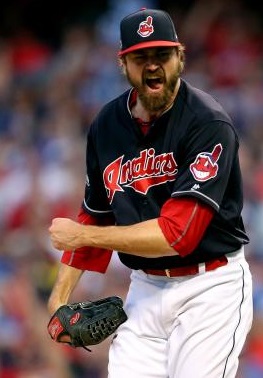
Which takes us back to another early April game, in which Cleveland’s Corey Kluber, who may yet find new employers for 2019, had a no-hitter in the making against the Angels as he opened the fifth with one out, a 2-0 lead, and Angels shortstop Andrelton Simmons coming to the plate. The Indians didn’t put a full shift on against Simmons, but third baseman Jose Ramirez played so deep in the infield there might as well have been a blue plate special sign sitting around his neck. And Simmons accepted the gift heartily, dropping a bunt right up the third base line.

All the hustle on the planet wasn’t going to get Simmons out at first. Kluber struck out Luis Valbuena to follow up, though not without a little hiccup when he wild pitched Simmons to second before nailing the strikeout. The next Angel hitter was American League Rookie of the Year-to-be Shohei Ohtani. On 1-1, Ohtani caught hold of Kluber’s up-and-away fastball and drove it over the left center field fence. The purists to whom the Sacred Unwritten Rules are as canonical as defensive shifts seem to be blasphemous screamed bloody murder, never mind that the game a) wasn’t even close to the ninth inning at the time of Simmons’s bunt and b) the game needed thirteen innings before the Angels’ Zack Cozart hit the game-ending home run.

Simmons committed no crime other than spotting a big defensive hole, something that should be second nature to him considering his own prowess playing shortstop, where he’s one of the best and the smartest in the business. If he’s at the plate with a chance to help his team get on the scoreboard in the fifth inning, neither he, nor you, should give two that the other guy may have a no-hitter in the making that isn’t as close to being consummated as it would be in the eighth or the ninth.

If Kluber’s defense made a mistake and gave Simmons a little too open a place to reach, whether it’s a complete overshift to one side or a big fat infield alley up the third base line, they should have spent less time raging against that rat bastard at the plate than getting it into their heads that — forget that good hitting beats good pitching, smart hitting beats it a little more often. With a lifetime .269 hitter at the plate, who doesn’t earn half the living with his bat that he does with his glove, but who gets what extra base hits he gets with his legs as much as his bat, Kluber should have wondered instead why Ramirez played Simmons as though that .269 lifetime average suggested the prospect of (lifetime .267-hitting) Mike Schmidt-style destruction.

Nobody but a purist or a Yankee fan feels terribly sorry for Joe DiMaggio losing so many home runs to Yankee Stadium’s cavernous left center field, when the right-handed-swinging DiMaggio rejected opposite-field hitting where he might have parked quite a lot of those lost bombs otherwise. “I could piss those over that wall,” DiMaggio huffed, when someone suggested he try going with more outside pitches. “That’s not hitting.” Tell that to Ted Williams, who finally got the a-ha! against what was then known as the Boudreau Shift.

If the shifts didn’t really suppress hitting in 2018, what on earth is the problem? Are Manfred and Clark trepidatious about encouraging organizations to teach batters how to go with the pitch again and quit just trying to pull everything whether or not it can be pulled? Are they, too, in thrall enough to the Sacred Unwritten Rules that they’re unwilling to say Sisco and Simmons showed what to do against the overshifts, so kiwtcherbeefin’ about smart hitters outsmarting smart defense?

They could also tell teams like the Twins and the Indians not to come crying when their guys lost one- or no-hitters regardless of the inning because they were fool enough to overshift with the chance of a smart hitter taking advantage of a big fat open spread. And they could throw in something about the courtesies due through the SUR rendered null and void when you leave a batter a hitting region large enough to send an earth mover unobstructed. But that would deprive Manfred and Clark of one of baseball’s older sub-professions, calling the repairman to fix what isn’t broken.

This essay was published in slightly different form by Sports Central.

A Hall of Fame voter is full of Ballouney

TheMarianoAllStarGameBill Ballou, a Worcester (MA) Telegram sportswriter whose coverage includes the Red Sox, proclaims adamantly that he refuses to vote for Mariano Rivera for the Hall of Fame. He thinks closers may well be the most overrated men in uniform during a given baseball game, this side of designated hitters, if only because when they are brought into games they have it just too simple. Unfortunately, simple is also a polite way to describe Ballou’s full argument.
Quibble if you must about the save rule. As defined now and throughout The Mariano’s career, a save situation for a relief pitcher is when he comes into the ninth inning with his team leading by three runs or less; or, he comes in with the tying run on base, at the plate, or on deck, regardless of the score; or, he pitches for three innings.

It’s one thing to object to the save qua the save, but it’s something else to suggest a man who was the best at earning saves under the incumbent rules of his long career shouldn’t have a place in the Hall of Fame. The Hall is first and foremost supposed to be about greatness above and beyond the merely excellent, within the boundaries of the rules of baseball’s play, and by that definition alone Rivera should be a no-questions-asked, first-ballot, unanimous Hall of Famer.

Even Red Sox fans acknowledge as much. Which reminds me that even the most sour citizen of Red Sox Nation who thinks Rivera was nothing more than a single-inning save machine could not have seen him pitch in Game Seven of the 2003 American League Championship Series. When he came in for the ninth and pitched through the eleventh, keeping the Red Sox from misbehaving despite a single in the ninth (Jason Varitek) and a two-out double in the tenth (David Ortiz), and with four strikeouts including two in the eleventh.

The now-manager of the Yankees rewarded The Mariano’s work that evening in the bottom of the eleventh, with a first-pitch leadoff launch into the lower left field seats for game, set, and Yankee pennant. Rivera was credited with the pitching win. And if Ortiz hit a two-out double off him, so what? That’s what Hall of Famers do even unto other Hall of Famers once in awhile.

“What is different about closers? Why do they get a hall pass when it comes to the numbers?” Ballou asks. He then answers his own question: “Because what they do is the last thing you remember about a game . . . Chris Sale lived a dream when he was on the mound for the last out of the 2018 World Series, but it’s fair to say that David Price’s seven innings as a starter had a lot more to do with Boston winning than Sale’s one.”

It’s also fair to say that Price’s one-run masterpiece and Series MVP Steve Pearce’s mayhem at the plate (a two-run homer in the top of the first; a solo bomb in the top of the eighth), not to mention the solo bombs Mookie Betts and J.D. Martinez ripped off—what do you know—future Hall of Famer Clayton Kershaw are and will be remembered far more than Sale’s spotless ninth. (For which the rules say he couldn’t be credited with a save, since he had a four-run lead to protect.) You’d think a Red Sox writer would have known that despite Sale striking out the side.

Ballou audaciously mentioned Craig Kimbrel, the Red Sox’s 2018 closer, in the same area code as Rivera. “[H]is performance in the postseason was an abomination,” Ballou begins. “When he pitched, Boston’s victories felt like defeats. In 10-2/3 innings he had an ERA of 5.90, and permitted 19 baserunners. He was also 6 for 6 converting saves — a perfect record.” Oy vey.

Argue all you wish that the save rule, if not the save concept, is overdue for an overhaul, but comparing Rivera’s work to Kimbrel’s is rather like comparing the millionaire who made his fortune from his own creation to the millionaire whose fortune came from organised crime. And if you can name a Rivera save about which it was fair to say a Yankee win felt like a defeat, well, as the old song says, mister, you’re a better man than I.

He wasn’t without his (very) occasional mishaps on the mound, of course. As often as not it required the dramatic to beat him. It took a game-set-Series-ending base hit floated over the infield into shallow center field for the Diamondbacks to beat him and the Yankees in the 2001 World Series; it took a pinch-runner’s stolen base and a prompt RBI single to tie Game Four of the 2004 American League Championship Series against him when the Red Sox refused to go gently into that good gray series-sweep night.

Game breakers and game changers like those have wrecked far lesser pitchers. Both times The Mariano merely picked himself up, dusted himself off, gave credit where due without apology or hesitation, and got right back on with his career. “The game that you’re going to play tomorrow,” he once said, “is not going to be the same game that you just played.” That’s the way a Hall of Famer thinks.

Reality reminds us that even Hall of Famers get beaten now and then by other Hall of Famers. Willie Mays hit eighteen home runs in his career off Warren Spahn, with a .305/.368/.587 slash line (batting average/on-base percentage/slugging percentage), and nobody credible would suggest that makes Spahn less a Hall of Famer. (“If I could have struck you out,” Spahn often needled Mays about surrendering Mays’s first major league home run, “we’d have been rid of you in a hurry.”) Pedro Martinez couldn’t get Craig Biggio out with a restraining order (Biggio’s slash line against him: .302/.400/.488), but the credible wouldn’t be caught dead arguing that it makes Martinez less a Hall of Famer.

Jay Jaffe, the Sports Illustrated writer who is to Hall of Fame analysis what Aleksandr Solzhenitsyn was to the Soviet Union’s totalitarianism, reminds us that Rivera was better at run prevention under his own devices and relative to his league than any other pitcher; and, that his teams missed only two postseasons while he held his job and was the last man standing on the mound four times, an unprecedented accomplishment. Jaffe also observes that The Mariano is in the conversation when it turns to signature pitches and the pitchers who threw them, his cutter in the same league as Sandy Koufax’s curve ball, Steve Carlton’s slider, Hoyt Wilhelm’s knuckleball, Bruce Sutter’s split-fingered fastball, and Martinez’s changeup.

Rivera’s lifetime ERA+ (205), the number that measures your run prevention adjusted to all the parks in which you pitched, not just your home park, is the highest in baseball history at this writing among pitchers whose careers involved their working 1,000 innings or more. “[He] allowed fewer than half the number of runs a league-average pitcher would have allowed over the same number of innings,” Jaffe says. Number two at this writing is Kershaw’s 157.

But since Ballou makes an incessant point about the single-inning closer, it’s wise to remind yourself, as Jaffe does, that Rivera’s record 652 saves include 119 in which he pitched more than a single inning, usually being brought in in the eighth with men on base to greet him. In the post-1992 expansion era, Jaffe records, Rivera’s 119 are well ahead of the two gentlemen tied for second with 55 each—Hall of Famer Trevor Hoffman, and Keith Foulke, who just so happened to be the last man standing on the mound when the Red Sox broke the actual or alleged Curse of the Bambino but wasn’t a Hall of Famer on the best day of his life otherwise. The active pitcher with the most such saves is Kenley Jansen—with thirty. Forget putting the pedal to the metal, to catch Rivera they’ll need a supersonic jet.

What about Rivera’s 42 postseason saves? you ask. Jaffe is happy to answer along with the statistics: 31 of those involved Rivera being asked to get four outs or more. The old-schoolers who like to sneer on behalf of Goose Gossage and his multiple-inning assignments, including Gossage himself, forget that Gossage’s postseason saves (eight) involved four or more outs seven times—and he’s second to Rivera. (Gossage, too, had his moment or two of postseason disaster. Kirk Gibson, pick up the house phone.)

When he pitched with runners in scoring position, The Mariano kept batters to a .214 average and a .290 on-base percentage lifetime. When he pitched with men on at all, the batters only hit .210 with a .270 on-base percentage. When he pitched with men in scoring position and two outs, lifetime, the batters only hit .211 with a .300 on-base percentage. And he did it throwing a single pitch. How many pitchers with only one solid pitch at all can you name who made serviceable careers, never mind Hall of Fame careers, and kept hitters that feeble even though they knew what was coming? (Nolan Ryan doesn’t count. Speed-of-light fastballs aren’t taught.)

If you’re inclined to measure a relief pitcher by his wins above a replacement-level player, you might care to record that Rivera’s 56.2 WAR is the most of any relief pitcher earning WAR strictly in that role. (Hall of Famer Dennis Eckersley earned more of his 63.0 WAR as a starting pitcher, including all 38.1 of his peak WAR.) Lee Smith, freshly elected to the Hall of Fame (by the Today’s Era Committee) and holder of the career saves record before Rivera obliterated him, has 29.4 WAR—eleventh among pitchers who accumulated half or more of their WAR out of the bullpen.

Remove Luis Gonzalez in the 2001 World Series and Dave Roberts (the stolen base)/Bill Mueller (the followup game-tying single) in the 2004 ALCS from the picture and, if you thought Rivera was deadly in the regular season, in the postseason he was a weapon of mass destruction. In 141 lifetime postseason innings his ERA is 0.70. No pitcher who’s pitched more than 26 postseason innings goes that low, not even Koufax or Lefty Grove. The Mariano in the postseason struck out 110 batters (a 7.0/9 innings rate), with a 1.3 BB/9 rate (he only walked 22 in those innings), and only two men ever took him over the fence in the postseason—Sandy Alomar, Jr. (Game Four, 1997 AL division series), not a Hall of Famer but not inconsequential, either; and, Jay Payton (Game Five, 2000 World Series), not a Hall of Famer and very occasionally consequential.

Payton teed off for a three-run homer with two out in the bottom of the ninth. So what did Rivera do from there? He caught Kurt Abbott looking at strike three to nail the only World Series in which the Yankees played the Mets, and that Series was actually closer than its brevity suggests. It proved that there are times in baseball when lesser assailants just don’t always know or care that they’re supposed to surrender to Hall of Famers, and that even Hall of Famers can be caught off guard by or make a mistake against the modestly endowed.

Rivera is as famous for his humility as he is for his mound deadliness. Imagine the blush across his friendly bronze face when he thinks that the number one argument over his Hall of Fame election is not whether he belongs on his first ballot but whether he should go in the way even numerous Yankee legends didn’t, not even Babe Ruth, Lou Gehrig, Joe DiMaggio, Yogi Berra, Whitey Ford, or Mickey Mantle—unanimously.

Ballou says he won’t even bother submitting a Hall of Fame ballot this time around, the better, perhaps, to avoid tainting other candidates, just because he thinks a closer, even the best who ever held such employment, has no business in Cooperstown except as a paying customer. It’s a foolish thing to reject a man simply because the rules and the prescriptions of his line of work are not to a particular judge’s liking. (Hey, did I just argue concurrently against rejecting designated hitters, too?)

Rivera didn’t create the rules of saving or closing games, and it would be craven injustice to deny his honour for doing his job under those rules and conditions better than anyone else who had the job before or while he did. Ballou’s silly position means two things, really: 1) The Mariano’s chance of becoming the Hall of Fame’s first unanimous election isn’t ruined, because Ballou’s will be an unsubmitted ballot. 2) There’s a stubborn integrity to a man who’s willing to stand without apology even if it exposes him as full of Ballouney.

The Queen City rides a Wild Horse

2018-12-22 YasielPuig

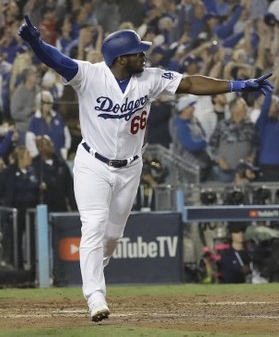
Yasiel Puig, right after hitting the three-run homer that put the Dodgers ahead temporarily in Game Four of the World Series . . .

Vin Scully called him the Wild Horse. Any time Yasiel Puig hit the field or the basepaths in Los Angeles, Dodger Stadium knew the only thing predictable about the talented but maddeningly inconsistent outfielder was how unpredictable he often was. In six seasons as a Dodger, Puig was many things. Boring wasn’t one of them.

It’s not that you can say he didn’t give advance notice. A young man who survived daily death threats from the Castro regime, escaped on what amounted to a milk carton raft, stowed aboard a coyote boat across the Gulf of Mexico, slithered through Mexico with and without the notorious cartels, and walked into Texas to finish his defection, knows a few things about how precious is life is and how exponential is the preciousness of freedom.

Love of life has been snuffed out of lesser creatures in circumstances far less grave. Landing in major league baseball, Puig was like a small boy turned loose in the toy store and told not to even think about coming out unless his wagon was loaded to overflowing. Crash Davis in Bull Durham told a meeting on the mound, “This game’s fun, OK?” Puig has played the game as if Davis’s admonishment was Article VIII of the Constitution.

He had only to learn how to distinguish between incandescent fun and immaturity without wrecking what made him unique in the first place. At one point it took an exile to the minors to deliver the point. Sometimes it really did seem as if nobody loved Puig but the people, at least those in Dodger Stadium or clinging to their televisions and radios around southern California.

But he learned enough in that exile to return as a better teammate with a reasonable harness whose doffing should be saved for particular occasions, such as helping a fun clubhouse atmosphere and dugout enthusiasm. Now the Wild Horse, who can break a game wide open one minute while occasionally letting it escape temporarily the next, has the chance to teach Cincinnati more up close and personal what it means that the game’s supposed to be fun.

On Friday, and with apologies to Whitey Herzog (who once said it of the late Joaquin Andujar, pitcher/human time bomb), the Dodgers traded their Puig-in-the-Box and a concurrent nine surprises a day—along with veteran outfielder Matt Kemp, pitcher Alex Wood, and reserve catcher Kyle Farmer—to the Reds, for struggling pitcher Homer Bailey and a pair of prospects, infielder Jeter Downs and pitcher Josiah Gray.

In one grand move the Dodgers cleared a serious enough outfield logjam and bought themselves some breathing room regarding the luxury tax (oops–competitive balance tax, ho ho ho), which translates even more simply to room for a serious run at free agent rightfielder Bryce Harper, a player who has long enough believed in making baseball fun again and has no reserve about enunciating it.

Things haven’t been all that much fun for the Reds since their last known postseason appearance. And if they weren’t even a topic when it came to the teams with the interest and the finances to hunt down Harper, getting Puig means there’s an excellent chance of things becoming a lot more lively in Great American Ballpark for at least one season.

Puig, Kemp, and Wood can become free agents after the 2019 season. Kemp restored himself as a valuable player in 2018 when he returned to the Dodgers in a deal with the Braves that many thought was supposed to mean a brief stopover before moving on promptly. But he stayed in Los Angeles, made his third All-Star team, and had a first half that looked like a reasonable facsimile of the former self that looked like a superstar in the making but didn’t quite get there.

(Here’s a pretty one for you: the so-called “untradeable contract.” As Bill Shaikin of the Los Angeles Times tweets, “Remember this the next time you hear a player has an “untradeable” contract: Matt Kemp has been traded four times on his ‘untradeable’ contract. The Dodgers alone have traded him twice on that same contract.”)

Wood has been a better than useful pitcher for the Dodgers even if his 2018 wasn’t quite the level of his 2017. In the latter he led the National League in winning percentage while having his best season overall to date. Like Puig, Wood is a six-year veteran; Kemp has thirteen seasons on his jacket and may yet find Great American Ballpark’s hitting friendliness enough to his liking to play himself into one more two- or three-year payday.

But the eyes of Cincinnati will remain on Puig, who could make for the plain most exuberant days of Reds baseball since the incendiary Rob Dibble, Norm Charlton, and Randy Myers forged the Nasty Boys bullpen who factored big in the Reds’ unlikely 1990 World Series sweep and left their own trail of mayhem in their wake before the group was broken up starting a season or two later. Maybe Puig, likewise a free agent after 2019 and looking at age 28, will bring enough fun, mayhem, and destruction of enemy pitching and baserunners (if he doesn’t throw them out, his missile launcher arm at least keeps them still enough) to convince the Reds to extend Puig a few more seasons.

“When Puig entered major league baseball,” writes Sports Illustrated‘s Gabriel Baumgaertner, “bat flips and exuberance were still frowned upon as unnecessary showmanship and disrespectful to opponents. Now, MLB runs marketing campaigns encouraging the type of emotion that was discouraged for so long. Puig is no small reason why the shift in mindset has occurred.”

His first week in major league service sure didn’t hurt. Puig had a week that players would kill to have over a full season: he caught a high drive and doubled up a runner on the same play; he hit four home runs including a grand salami; he threw out Andrelton Simmons at first base from deep right on a throw for which Roberto Clemente would have given a champagne toast.

His final days as a Dodger reversed Don Vito Corleone’s maxim about the relationship between misfortune and reward. On 14-15 September, against the Cardinals in St. Louis, Puig smashed five home runs—two the first day, three the second, overdue vengeance against the fans who’d trolled him a few years earlier, as the Dodgers fell out of the postseason early enough, with “Dodgers win? When Puigs fly!” Games like that helped send the Dodgers to this postseason. And almost helped them win the World Series.

Puig’s three-run homer off Milwaukee closer Jeremy Jeffress in the top of the sixth put Game Seven of the National League Championship Series enough out of reach to send the Dodgers to the Series in the first place. Puig flew, all right—a little bat flip here, a little crotch chop or two there as he ran the bases, having the time of his life, and not even his worst critics this side of Madison Bumgarner could really blame him.

But in Game Four of the World Series, Puig’s great reward led to unforeseen misfortune. A day after the Game Three marathon ended in Max Muncy’s leadoff homer in the bottom of the eighteenth, Puig checked in at the plate—in the bottom of the sixth—after Cody Bellinger’s infield ground out turned into the game’s first run on a throwing error. With one swing Puig made it 4-0, this three-run homer landing even farther up the left center field bleachers than his Milwaukee blast did after bounding off the yellow line.

Who knew that Red Sox pinch hitter Mitch Moreland would answer with a three-run bomb of his own in the top of the seventh? Or, that eventual Series MVP Steve Pearce would hit the game-tying bomb in the following inning, a prelude to his Game Five mayhem? Or, that the Red Sox would run the table for five in the top of the ninth, putting the Dodgers into a Series hole from which they never really saw light again?

In the moment as Puig’s drive flew over the fence Dodger Stadium was noisier than a heavy metal concert. The Wild Horse had almost as much fun running that bomb out as he’d had running out the Milwaukee mash and even the Red Sox weren’t about to think it untoward of him. Maybe they knew in their heart of hearts, “Let the kid have his fun, we have a little fun of our own to have yet.”

In the centenary of their first and worst-stained World Series championship, the Reds hope Puig does with them what he did often enough as a Dodger. The promotional possibilities are limitless, if nothing else. Imagine a Great American Ballpark audience festooned with T-shirts and placards referencing his uniform number and hailing, “Get your kicks with Puig 66!”

The Cardinals say it’s Miller Time

2016-10-15 AndrewMillerIt may be a good thing that Anheuser-Busch no longer owns the St. Louis Cardinals. They’d have one helluva promotional migraine on their hands with Cardinal fans wearing T-shirts and holding up placards saying, “Now . . . it’s Miller Time.”

The Cardinals announced via Twitter Friday morning that relief bellwether Andrew Miller has signed for two seasons with a 2021 vesting option; The Atlantic‘s Ken Rosenthal says the deal guarantees the lefthander $25 million for the two years and $12 million if the option vests.

Anyone wondering what the Cardinals were thinking in signing the 33-year-old lefthander might care to note that, even with an injury-disrupted 2018, his worst season since 2013, Miller’s 0.4 2018 wins above a replacement level player by himself were practically the same as the entire Cardinal bullpen for the season. Of course they were thinking a little more deeply when looking at Miller’s season.

From his return from the DL at August’s beginning until his final assignment of the season on 29 September, Miller pitched as close as possible to the wipeout pen man who helped the Indians get to Game Seven of the 2016 World Series before he ran out of fuel in that game. From 3 August through 28 September, Miller struck out 22 batters and walked only six while surrendering only fifteen hits and five earned runs in 16 innings for a more than solid 2.81 earned run average over the span, even if he had occasional control issues shaking off the rust and plunked two batters.

One bad inning on 29 September—a three-run homer and an RBI single—soiled his return from an early season hamstring strain and the knee inflammation that cost him two months. Clearly the Cardinals bypassed that final disaster, looked at his 3 August-28 September round, and decided that a healthy Miller meant a bullpen improved exponentially with a lefthander who can and has gone multiple innings in his turns and still owns a plus fastball and (when healthy) a slider that drives hitters into at-bat graves.

Just as clearly, the Cardinals offered Miller something other suitors couldn’t or wouldn’t, and Miller was romanced rather ardently since the World Series ended. The Mets and the Yankees had him on their dance cards and both teams asked for his most current medical reports. The Mets especially could have made room enough for Miller since they lack a solid lefthanded bullpen option at all and, if they’re that serious about contending in 2019, Miller healthy would have silenced a lot of the snickering about that stance.

Several reports indicated Miller had a phalanx of two-year offers on his plate but hoped for three. If the Cardinals were willing to give him the third year, even if it’s a vesting option, it means they have Miller through his age-36 season. If he lives up to his restored health and doesn’t let his coffin-nailing slider betray him, the Cardinals make an investment that helps send them back to the postseason post haste.

Miller gives several options for a Cardinal bullpen whose top five members posted a collective 4.50 ERA despite striking out eight or better per nine innings, perhaps because they were also walking a collective 4.16 per nine. Now look closer: the rate would have been far lower without Brett Cecil’s 6.9 walks per nine. Even closer Bud Norris undermined his own 10.9 K/9 rate with a 3.3 BB/9 rate, while converting 28 of 33 save chances.

Miller with an injury-disrupted 2016 still had a slightly better K/9 rate than the collective and individual Cardinal pen. He had a gruesome 4.2 seasonal BB/9 rate but most of that was thanks to his pre-August struggling through and with the injuries. His medicals must have looked even better to the Cardinals than they did to the Mets, the Yankees, and other teams on his trail. The Yankees may have needed to bring Miller back less, but the Mets—whose pen still needs remaking despite bagging Edwin Diaz to close—may have some splainin’ to do about not bringing Miller aboard at all.

The Cardinal pen clearly needed a shot in the arm, if not in the head. A healthy Miller gives them just that and then some, since his calling card once his gears fell into place has been middle, later, or both kinds of relief and not just single innings, either, though you have to be mindful of overworking him approaching age 33. Miller can even close when need be. (He did have such a season for the 2015 Yankees, saving 36.)

It’s going to seem strange, indeed, to see Busch Stadium with its several Budweiser signs including atop the major scoreboard serving Miller on the mound. They used to call Miller the champagne of bottled beer. They hope Miller on the mound means three rounds of champagne in the clubhouse in October.


Addison’s disease the Cubs’ nightmare

2018-12-20 MelisaReidyAidenRussell

Expanded Roster displayed this photograph of Addison Russell’s former wife/ victim, Melisa Reidy, and their son, Aiden. Russell’s abuse was worse than first believed.

To err may be human, and to forgive may be divine, but both have their limits and liabilities. Addison Russell is both, and the Chicago Cubs may have reached their limit.

Russell already faces the final 29 games of a forty-game suspension that began in September, thanks to the domestic assault his now former wife described in a September blog post. It embarrassed the Cubs no end especially after manager Joe Maddon said at first that he hadn’t read the post. But it’s gone from embarrassing to worse.

The shortstop who was a significant element in the Cubs’ 2016 World Series championship season may face worse now that the former Mrs. Russell, Melisa Reidy, has given an interview (to Expanded Roster) detailing what she suffered from him in further, harrowing detail. What began as a sweet love devolved too quickly into suspicion, infidelity, and finally violence.

The suspension notwithstanding, the Cubs tendered Russell a 2019 contract anyway. Fansided writer David Hill is hardly the only one to wonder just how much of the nightmare Reidy describes now the Cubs knew going in. “Or,” Hill continues, “how many of the details given in the interview were known to Major League Baseball when Russell was handed his 40 game suspension. Then again, how much did the Cubs, or MLB for that matter, truly want to discover?”

Chicago Sun-Times writer Gordon Wittenmyer has an answer. “The specifics were not news to either MLB or the Cubs, who reached out to Reidy and others in the aftermath of the league investigation in their own fact-finding efforts and to seek input for their decision on how to proceed internally with Russell,” he writes.

Indeed, Wittenmyer cites Cubs president Theo Epstein as suggesting Russell’s days as a Cub may be numbered according to certain factors. “Before he can play another game in a Cubs uniform,” Epstein says, “we need to know that he’s serious about self-improvement and has grown to the point where he can represent the club well.”

Russell is in an MLB-mandated program of therapy and “re-education” (Wittenmyer’s word) and has even hired a personal therapist. If his former wife’s recollections are true he’ll need more than that. A man who explodes against his wife while she holds their infant son, or tears the infant out of her arms after kicking down a door, or throws her to the floor while holding the infant and missing her head hitting a coffee table by inches, needs more than routine therapy.

And he may yet need to find another line of work. The Cubs already took a hot water bath when they added Aroldis Chapman for their 2016 championship run, but that was after Chapman served a domestic violence suspension with the Yankees (to whom he’s since returned), and in Chapman’s case prosecutors refused to take the case forward citing conflicting accounts and insufficient evidence.

When the Astros dealt for Blue Jays reliever Roberto Osuna for their run back to the postseason, Osuna was in the middle of a domestic violence suspension. The suspension ended 5 August and the case in court was withdrawn after the woman refused to travel from Mexico to testify.  The Astros were broiled in the sports press for making the trade, but as with Chapman the case was thwarted in the end.

But Russell’s former wife speaks in too harrowing detail of what she suffered, even though the couple is divorced and no known court action pends in their instance. It’s worse than what torpedoed the football career of Baltimore Ravens running back Ray Rice, who was caught on an elevator video attacking his then-fiancee and released by the Ravens when the video became too widely circulated. Rice didn’t have an infant son in the middle of that fateful rage.

Rice hit the news again this season when the Kansas City Chiefs cut running back Kareem Hunt, the NFL’s leading rusher last year, after a video surfaced of Hunt attacking a woman last February, an incident about which the Chiefs said Hunt lied to the team. Rice’s then-fiancee is now his wife. And they sat for a CBS This Morning interview together in which Rice spoke candidly about how he was purged from football and came to have no regrets about the purge.

“One of the underlying issues for me,” said Rice, who admitted to having too many personal problems—including witnessing several similar incidents in which his mother was a victim—even before he began his football career, “was—I never wanted to ask for help. Football, for me, was my counseling. It was my therapy. It was my psychologist. It was my everything.”

It was the proverbial recipe for the disaster of attacking his future wife. The acclaim Rice received in his football life, from college All-American to a Super Bowl ring, couldn’t immunise him from his self or his misdeed. He’s aware that Hunt has apologised for his crime but he knows that isn’t even close to enough, nor is merely expressing remorse for domestic violence survivors. “I’ll continue to do that,” said Rice, referring to remorse over domestic violence, “because I know now from doing the work, how gruesome it is.”

Rice was genuinely contrite as things turned out. (The NFL looked foolish for docking him a mere two games before the video emerged; commissioner Roger Goodell was compelled to apologise for such leniency.) When Rice was finally released from the Ravens, he never once thought he didn’t have it coming. He’s never tried to return to football since, other than to work as a youth coach.

“My job is to lead my family, my job is to lead my wife, my job is to lead in whatever I do,” he said with Janay at his side after his original suspension. “And if I’m not being the example, then my family crumbles.” Ask him today, as CBS This Morning did, and he’ll say of himself then, “I hate that person.” It’s very fair to say that if his contrition and his work since, on himself and on behalf of domestic violence eradication, wasn’t sincere, Mrs. Rice wouldn’t still be Mrs. Rice.

Russell issued a written statement through his attorneys in which he spoke of “a lot of work ahead for me to earn back the trust of the Cubs fans, my teammates, and the entire organization . . . work that I am 110 percent committed to doing.” He didn’t place his family (his young son with Reidy, plus a child he fathered with another woman prior to having a son with Reidy) at the top of that order. He said only that “after gaining a full understanding of the situation” did he accept the suspension and “wish[ed] my ex-wife well and hope we can live in peace for the benefit of our child.”

It was language as impersonal as Rice’s was direct and very personal, and Rice wasn’t yet a husband, never mind a father, when the crime he wishes he’d never committed  happened. The Cubs ought to keep that very much in mind as Ms. Reidy’s newest, more in depth revelations of just what she and their little son suffered at Russell’s hands take hold.

The right to work doesn’t equal the right to a particular line of work. That was one argument levied against the Astros when they traded for a still-suspended Osuna, and they’re still not entirely off the hook until or unless Osuna proves he’s a very changed man regarding his treatment of women.

It’s an argument the Cubs shouldn’t dismiss considering how very much worse Russell’s case is. The optics, as they call it, looked bad enough when they tendered him a 2019 contract despite his suspension. They look worse in the light of his former wife’s harrowing revelations since. Some call domestic violence a disease instead of a crime. If that’s true, Addison’s disease is the Cubs’ nightmare as well as his former wife’s.