“Let him hear you, he’s listening.”

Heliot Ramos

Willie Mays played with Gary Mathews.. Who played with Edgar Martinez.. Who played with Ichiro.. Who played with Tim Beckham.. Who played with Blake Snell.. Who played with Heliot Ramos.. Who homered tonight while playing CF for the Giants… In Willie Mays’ first pro ballpark. Baseball!—Jayson Stark, Hall of Fame baseball writer.

In the first professional baseball park where the late Hall of Famer Willie Mays played as a Birmingham Black Baron, it was illegal until 1963 for white and non-white players to play on the same field. On Thursday, white and non-white players converged for the San Francisco Giants and the St. Louis Cardinals to play an official major league game.

None but the blind or the bigoted pretends racism is eliminated from American life entirely. But the Giants and the Cardinals, playing a game umpired by the Show’s first all-black umpiring crew, managed to keep it outside the gates of a ballpark where Hall of Famer Reggie Jackson played on the first interracial team Rickwood Field hosted.

That was then: Jackson’s parent club, the then-Kansas City Athletics, moved its AA-level minor league team into Birmingham at the insistence of its owner, Charles Finley, a Birmingham native who could be flagrantly wrong about many things but stood on the side of the angels when it came to racism. Jackson remembers only too well.

“I walked into restaurants and they would point at me and say, ‘The n—–s can’t eat here’,” Jackson said aboard the Fox Sports pre-game broadcast.

I would go to a hotel and they’d say, “the n—–s can’t stay here.” We went to Charlie Finley’s country club for a welcome home dinner and they pointed me out with the N-word, “he can’t come in here.” Finley marched the whole team out . . . Finally, they let me in there and he said, ‘We’re going to go eat hamburgers. We’ll go where we’re wanted.’

Coming back here is not easy. The racism when I played here, the difficulty of going through different places where we traveled—fortunately, I had a manager and I had players on the team that helped me through it—but I wouldn’t wish it on anybody.

This is now: The Negro Leagues are recognised formally (and appropriately) as having been major leagues. This year, the known statistics of Negro Leagues players and managers (surely there will be more to exhume, however long it might take) began becoming integrated into major league statistics at last.
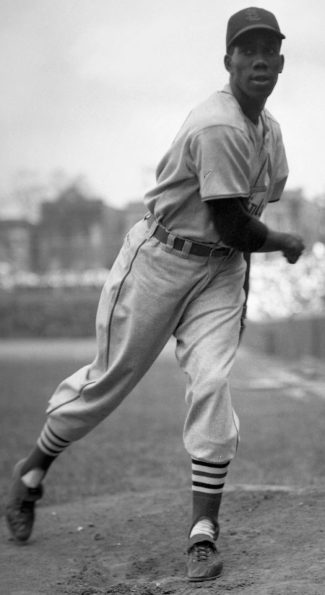
Bill Greason

The Rev. Bill Greason, former Birmingham Black Baron who got to pitch very briefly for the Cardinals in 1954.

Thursday evening, the oldest former Negro Leagues player, pitcher turned minister Bill Greason (99), was escorted to halfway between the mound and the plate by Cardinals coach and former player (and the National League’s 1985 Most Valuable Player) Willie McGee to throw a ceremonial first pitch. To Ron Teasley, Jr., whose father is the second-oldest living former Negro Leaguer.

Greason was six years Willie Mays’s senior when they were Black Barons teammates. “He was a determined young man,” the former pitcher told Ken Rosenthal. “He had the gifts, the talent, and he was sensitive to listening to those who were older than he was. It was a tremendous blessing, and we turned out to be real close. Like brothers.” Just the way Mays would look toward former Newark Eagles star Monte Irvin when Irvin was a third-year Giant and Mays a nervous Giants rookie.

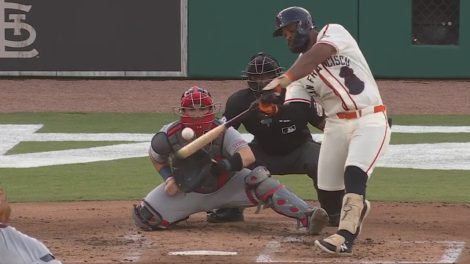
Mays’s number 24 was painted in large white numerals behind the plate. A Giants uniform with his number hung in the Giants’ dugout. The Giants and the Cardinals—wearing the uniforms of, respectively, the San Francisco Sea Lions (West Coast Negro Baseball League, 1946) and the St. Louis Stars (Negro National League, 1920-1931)—wore circular patches on their jerseys with Mays’s surname and number.

Mays’s son, Michael, urged the Rickwood crowd to make some noise for his father before the game. “Birmingham, I’ve been telling y’all,” the younger Mays said, “if there was any way on Earth my father could be here, he would. Well, he’s found another way . . . Let him hear you, he’s listening. Make all the noise you can.” The Wil-lie! Wil-lie! chant just about drowned every other sound out.

Mays had issued a statement Monday saying his health would keep him from attending the game. The following day, he died at 93. America couldn’t decide whether to grieve over yielding Mays to the Elysian Fields or be grateful that he remained among us as long as he did.

“In a sense, Mays was too good for his own good,” wrote George F. Will in tribute.

His athleticism and ebullience—e.g., playing stickball with children in Harlem streets–encouraged the perception of him as man-child effortlessly matched against grown men. He was called a “natural.” Oh? Extraordinary hand-eye coordination is a gift. There is, however, nothing natural about consistently making solid contact with a round bat on a round ball that is moving vertically, and horizontally, and 95 mph. Because Mays made the extraordinary seem routine, his craftsmanship and intelligence were underrated.
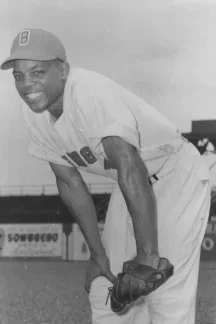
The late Willie Mays, as a young Birmingham Black Baron. (Photo: Birmingham Public Library.)

The arguable greatest position player ever to play major league baseball may have been watching and listening from his Elysian Fields roost on Thursday, but he surely lamented his Giants losing by one run to the Cardinals. Not for lack of trying.

The Athletic‘s irrepressible Hall of Fame writer Jayson Stark couldn’t resist pointing out: “Willie Mays played with Gary Mathews.. Who played with Edgar Martinez.. Who played with Ichiro.. Who played with Tim Beckham.. Who played with Blake Snell.. Who played with Heliot Ramos.. Who homered tonight while playing CF for the Giants… In Willie Mays’ first pro ballpark. Baseball!”

That would be Ramos tying the game at three-all when he took hold of a two-on, one-out, one-strike service from Cardinals starting pitcher Andre Pallante and launched it the other way, over the painted Budweiser ad on the right field fence.

The Cardinals kind of snuck back into the lead an inning later on a sacrifice fly (Nolan Gorman) and a run-scoring (Alec Burleson) wild pitch (from Giants reliever Randy Rodriguez), and padded it to 6-3 in the bottom of the fifth when Brendan Donovan sent home his third run of the game, singling up the pipe to score Burleson. The Giants got two back in the top of the sixth on an RBI single (Wilmer Flores) and a sacrifice fly (Nick Ahmed), but that was the end of the game’s scoring.

The all-black umpiring crew even managed to behave, from Alan Porter behind the plate onward. Perhaps wisely, they confined the otherwise dubious C.B. Bucknor to second base, where he couldn’t possibly commit half the mischief he normally does when he’s assigned to call balls and strikes.

For one evening Rickwood Field became the Show’s oldest park in which to play a game; built originally in 1910, it’s two years older than Fenway Park and four older than Wrigley Field. It also became the place where racism’s ghosts were made unwelcome, even as few, perhaps, beyond the assembled former Negro Leaguers, might have guessed whom its most troublesome ghost might have been.

The once all-white minor league Birmingham Barons, to whose games Mays listened as a youth, had a radio play-by-play announcer from 1932-1936 named Bull Connor, who just so happened to be Birmingham’s commissioner of public safety at the same time. “Pretty good announcer, too,” Mays once remembered of him, “although I think he used to get excited.”

That pretty good announcer eventually ordered fire hoses and attack dogs turned upon student civil rights demonstrators, in 1963, the horror of which helped speed the writing, passage, and acceptance of the 1964 Civil Rights Act. Connor is long gone. So is the legal framework by which Jim Crow wreaked his infamy. But only that.

There remain miles to go yet before racism’s cancer is eradicated entirely from too many hearts and minds, still, who might have remained oblivious Thursday night to what its absence can achieve, even on a baseball team. Thursday was one more round of chemo, but an instructive and endearing one.
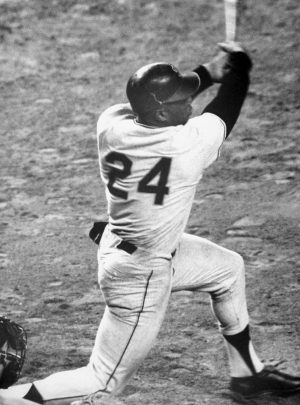
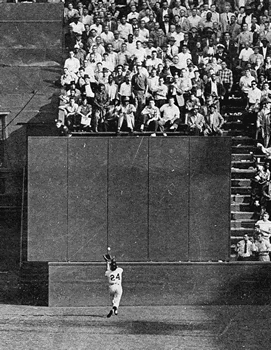
Willie Mays, RIP: Loss, but Gratitude

Willie Mays

Mays hitting his 500th career home run, in 1965. “He has gone past me,” Ted Williams would say at his own Hall of Fame induction, after Mays hit number 522, “and he’s pushing, and I say to him, ‘Go get ’em, Willie’.”

Seeing Willie Mays in my boyhood when he was a Giant still in his prime was as transcendent as seeing him in his baseball dotage, as a late-career Met, was heartbreaking. Having Mays at all back in the city where he really made his baseball bones was as much a belated blessing as having him too much less than his best was sorrow. But . . .

“What do you love most about baseball?” asked Joe Posnanski, in The Baseball 100. (He ranked Mays number one.) Then, he answered. “Mays did that. To watch him play, to read the stories about how he played, to look at his glorious statistics, to hear what people say about him is to be reminded why we love this odd and ancient game in the first place.

“Yes, Willie Mays has always made kids feel like grown-ups and grown-ups feel like kids. In the end, isn’t that the whole point of baseball?”

But having Mays say farewell the way he did in Shea Stadium on 25 September 1973, with the Mets still yanking themselves back to take a none-too-strong National League East, brought tears not just of loss but of gratitude. If so few of the greats retire before the game retires them, fewer than that retire with Mays’s soul depth:

I hope that with my farewell tonight, you will understand what I’m going through right now. Something that—I never feel that I would ever quit baseball. But as you know, there always comes a time for someone to get out. And I look at the kids over here [pointing toward his Mets teammates], the way they are playing, and the way they are fighting for themselves, tells me one thing: Willie, say goodbye to America.

America never really said goodbye. Now America must say a reluctant au revoir. Mays left this island earth at 93 Tuesday. “I want to thank you all from the bottom of my broken heart for the unwavering love you have shown him over the years,” said his son, Michael, in a statement. “You have been his life’s blood.”

We’ve been his life’s blood? The younger Mays had it backward. His father was the lifeblood of every objective and appreciative baseball fan of his time. He didn’t have to wear the uniform of the team for which I rooted since their birth (not right away, anyway) to be that for me, in hand with Sandy Koufax, and believe me when I tell you that watching Koufax going mano a mano against Mays was something precious to behold.

(For the record, Mays faced Koufax 122 times and nailed 27 hits. Five were home runs, eight were doubles, one was a triple, for 33 percent extra bases off the Hall of Fame lefthander. Mays also wrung 25 walks out of him while striking out 20 times.)

Before Mays’s Giants and Koufax’s Dodgers high tailed it out of Manhattan and Brooklyn for the west coast, the most bristling debates in New York involved not politics, finance, or rush-hour traffic, but baseball. As in, whom among the three Hall of Fame center fielders patrolling the territory for each team was The Best of the Breed.

I was born in the Bronx and raised there and on Long Island; I heard the debates for years to follow after the Dodgers and the Giants went west. I had skin enough in that game long before Terry Cashman wrote and recorded his charming hit, “Willie, Mickey, and the Duke (Talkin’ Baseball).” Well, now. Let’s look at the trio during their New York baseball lives two ways, for all the seasons they played in New York together. (Snider was a four-year major league veteran by the time Mays and Mantle arrived in 1951.)

First, according to my Real Batting Average metric (total bases + walks + intentional walks + sacrifice flies + hit by pitches, divided by total plate appearances):

Together In New York PA TB BB IBB SF HBP RBA
Mickey Mantle 3493 1648 524 34 11 5 .636
Willie Mays 3299 1718 362 70 23 11 .662
Duke Snider 2629 1305 283 42 6 7 .625

Mays has a 26-point RBA advantage over Mantle and that’s with Mays losing over a season and a half to military service. (Mantle’s osteomyelitic legs kept him out of military service; Snider served in the Navy before his major league days began.) Mays also landed 70 more total bases and was handed 36 more intentional walks.

Mantle may have been a powerful switch hitter, but just from one side of the plate Mays outperformed him while they shared New York even with precious lost major league time between ages 21-23. Mantle also had a .756 stolen base percentage to Mays’s .738, but a) Mantle’s already compromised legs kept him from trying more often; and, b) Mays led his league in thefts twice during the period under review. (Snider? Even a hobbled Mantle left him behind: for their shared New York years, his stolen base percentage was .586.)

Sometimes Mantle gets the props as the best of the trio purely because his Yankees were far better teams than the others’. Actually, Snider’s Dodgers were almost as good as Mantle’s Yankees. It was no more Snider’s fault that his Dodgers couldn’t get over those Yankee humps until 1955 than it was Mantle’s sole doing that his Yankees won seven pennants and five World Series (three consecutively) while they shared the Big Apple.

And it was hardly Mays’s fault that his Giants won a mere two pennants in the same shared span, even if Mays’s Giants got squashed by the Yankees in five in the 1951 Series but swept the far better Indians in the 1954 Series. You may have heard of a little play known as The Catch from Game One of that Series, happening when it seemed the Indians had a shot at taking the opener. (Mays would play on two more pennant winners, too, the 1962 Giants—who beat the Dodgers in another memorable pennant playoff—and the 1973 Mets.)

Willie Mays

“The Catch,” of course—460+ feet from home plate in the ancient Polo Grounds.

“That really wasn’t that great of a catch,” harrumphed curmudgeonly Indians pitcher Bob Feller, nearing the end of his own Hall of Fame career. What made him think not? “As soon as it was hit, everyone on our bench knew that he was going to catch it . . . because he is Willie Mays.” (But did they know Mays would also keep Hall of Famer Larry Doby from scoring with an equally staggering throw in to the infield off The Catch?)

Which brings me to the titanic triumvirate in center field. We’re going to look at them according to total zone runs, the number of runs their play in center field turned out above or below their leagues’ averages. Baseball-Reference begins measuring total zone runs with the 1953 season, so we’ll have five solid Big Apple seasons to review for each of the trio:

Willie Mays: +45.
Mickey Mantle: +22.
Duke Snider: +25.

Once again you see where Mantle’s physical health issues got in his way despite his supernatural talent and skill. But it might not have mattered. Mays and Mantle both played in unconscionably deep home center fields before the Giants and the Dodgers left the Apple for 1958. You can fantasise all you like how many runs Mantle might have prevented on good legs, but if you guess that he might have proven just about even you’re making a solid guess.

“Willie Mays going after a fly ball was cotton candy and a carousel and fireworks and a big band playing all at once,” Posnanski wrote. “His athletic genius was in how every movement expressed sheer delight.”

When Mays got to San Francisco, he and Mantle continued their top of the line play. When he got to Los Angeles, Snider had two decent seasons followed by a decline phase that actually took him back to New York for a round with the early Mets before finishing his career in 1964 as . . . a Giant, of all things.

Mantle managed to remain Mantle through the end of 1964. Mays managed to remain Mays through at least 1971. Even if his home run power had dissipated somewhat in the previous four seasons, he spent 1971—at age 40—leading the National League in walks and on-base percentage. Mantle’s body took him out at last at age 36; Mays’s, at age 42; Snider’s, at age 37.

And here is how the trio finished career-wise. First, how they sit among the Hall of Fame center fielders whose careers covered the post-World War II/post-integration/night-ball era, according to RBA:

Center Field PA TB BB IBB SF HBP RBA
Mickey Mantle 9907 4511 1733 148 47 13 .651
Willie Mays 12496 6066 1464 214 91 44 .631
Ken Griffey, Jr. 11304 5271 1312 246 102 81 .620
Duke Snider 8237 3865 971 154 54 21 .615
Larry Doby 6299 2621 871 60 39 38 .576
Andre Dawson 10769 4787 589 143 118 111 .534
Kirby Puckett 7831 3453 450 85 58 56 .524
Richie Ashburn 9736 3196 1198 40 30 43 .463
HOF CF AVG .588

But now, how they sit among center fielders for run prevention above their league averages, showing the top ten:

Andruw Jones +230
Willie Mays +176
Paul Blair +171
Jimmy Piersall +128
Kenny Lofton +117
Devon White +112
Carlos Beltrán +104
Willie Davis +103
Curt Flood +99
Garry Maddox +98

Thanks to his leg and hip issues, Mantle finished his career at -10. Snider finished his at -7; his late career was compromised by knee, back, and arm injuries. (Richie Ashburn, their great Hall of Fame contemporary, finished his career +39.) Two such talented center fielderss who’d had excellent throwing arms and range deserved far better than such physical betrayals.

Mays stood alone as the complete, long-enough uncompromised, all-around package. He was blessed with a body that wasn’t in a big hurry to betray him, but no blessing means a thing if you don’t take it forward. Good luck stopping Mays from doing so. Should-be Hall of Famer Dick Allen once advised Hall of Famer Mike Schmidt to play the game as though he were still the kid who’d gladly skip supper to play ball. Mays played the game precisely that way until age began to say “not so fast,” after all.

“The greats don’t always go gently into that good gray night when they can no longer play the games that made their names,” I wrote when Mays turned 90.

This son of an Alabama industrial league ballplayer fought a small war in his soul when his age insisted he was no longer able to play the game he loved so dearly at the level on which he’d played it for so many years. Some said he’d become sullen, moody, dismissive in the clubhouse. Some resented him, others felt for him, still others mourned.

. . . When he smiled as a Met, you still saw him in his youth, you didn’t see the manchild who was yanked rudely into manhood by a San Francisco that shocked him with skepticism as a New York import rather than a hero of their own. By a San Francisco that also shocked him, for all its reputation otherwise, when his bid to buy a home with his first wife was obstructed long enough by the sting of neighbourhood racism.

Willie Mays

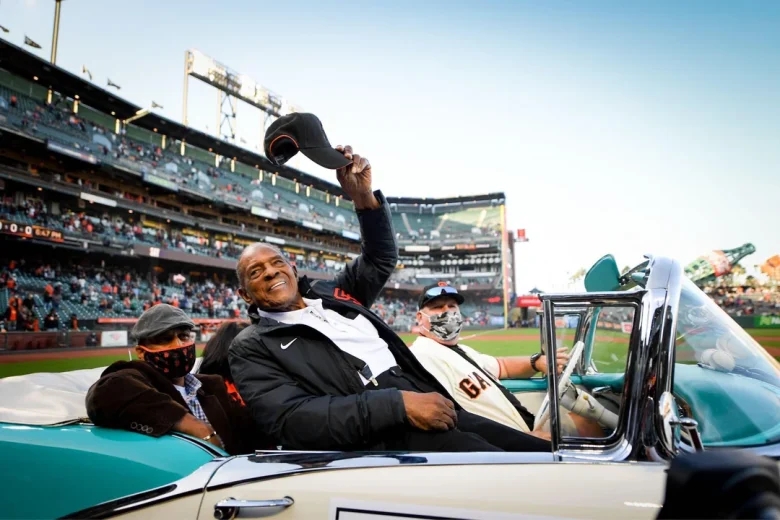
Mays taken for a drive around PacBell Park in a 1956 Oldsmobile to celebrate his 90th birthday. San Francisco came to love him as New York did, but not without growing pains.

After his first marriage ended in divorce and in his son living across country with his mother, Mays dated Mae Louise Allen for about a decade before marrying her after the 1971 season. His happiness there was compromised by her premature Alzheimer’s diagnosis; his caring for her until her death in 2013 is the stuff of true love stories.

A welcome presence at the Hall of Fame’s induction ceremonies following his own in 1979 and at various Giants events (and numerous home games) in the years that followed, Mays wouldn’t be able to attend this year’s Field of Dreams game at Birmingham’s Rickwood Field, the field where he first played with the Birmingham Black Barons of the old Negro American League.

“I’d like to be there, but I don’t move as well as I used to,” he said in a statement on Monday. “So I’m going to watch from my home. But it will be good to see that. I’m glad that the Giants, Cardinals and MLB are doing this, letting everyone get to see pro ball at Rickwood Field. Good to remind people of all the great ball that has been played there, and all the players. All these years and it is still here. So am I. How about that?” A day later, sadly, he was gone.

Mays never apologised for making the game look fun with his fabled basket catches in front of his belt, his winging turns running the bases as his deliberately oversized hat flew off, his high-pitched voice sounding like a kid getting to play yet another inning.

“That’s what his idea was,” said one-time Giants relief pitcher Stu Miller, “to please the crowd.”

“I’m not sure what the hell charisma is,” said Ted Kluszewski, the musclebound Reds first baseman of the 1950s, “but I get the feeling it’s Willie Mays.”

“The only thing Willie Mays could not do on a baseball diamond,” Posnanski wrote, “was stay young forever.”

May his entry into the Elysian Fields, where it’s Willie, Mickey, and the Duke once again,  and especially his reunion with his beloved Mae, have been as joyous for him as the way he played the game was joyous to us for as long as we were honoured to see him play.

Hobie Landrith, RIP: Of Polo Grounds and oranges

Hobie Landrith

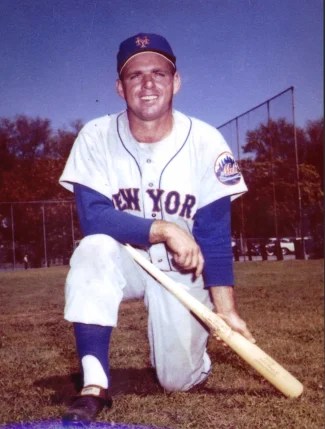
Landrith, the very first Met.

The plot was simple enough. Visiting my favourite aunt and uncle in their still somewhat new Poughkeepsie (NY) digs, a splendid colonial home that was actually the model for the development, my three cousins would awaken me promptly at seven the next morning. They wanted to see me and my twelve-year-old baseball brain win a local radio station’s “Sports Call” contest and whatever prize would come.

So there was Tommy drumming out the fabled climax of the William Tell Overture (or, the theme from The Lone Ranger, if you prefer) against the nightstand next to my bed. (And, specifically, my ear.) There was Bobby, ready to dial the “Sports Call” number with the phone to my ear. Not to mention Linda, the eldest of the trio, standing by with a grin I’d swear was caught between amusement and amazement.

And there I was, maybe a quarter awake, Bobby starting to dial the split second the host began asking the question: Who was the first player chosen in the National League’s expansion draft? (The draft creating the Montreal Expos and the San Diego Padres was yet to arrive.)

Great hitters can hit rice pudding thrown right into their wheelhouses for distance, even if they happen to be hung over. At age twelve I wasn’t exactly hung over, but I wouldn’t have said no to about two more hours sleep except for the “Sports Call” idea. (A 7 A.M. awakening when it wasn’t a school day was not my idea of paradise.) Sure enough, the other end of the line answered, the host’s voice asking the question again to me directly. Right into my wheelhouse.

I managed to croak, “Hobie Landrith, catcher, by the New York Mets.” Pay dirt. Minutes later, the station’s music finished and the host came aboard to say he’d just received the fastest correct “Sports Call” answer since he’d begun doing the feature on his morning show. A few hours later, there were Bobby, Tommy, Aunt Marge, and yours truly, in the station wagon, pulling up to . . . a pleasant stand-alone produce market, where my knowledge of Landrith’s expansion draft status landed me two large crates of freshly imported Florida oranges.

I left one of the two crates with Aunt Marge and Uncle Herb, now of blessed memory. (Their long, happy marriage ended only with their departures to the Elysian Fields a year apart in 2015-16.) Somehow, I managed to haul the other aboard the train to Marble Hill in the Bronx, where my mother met me for a night at my maternal grandparents before returning home to Long Beach. She almost collapsed when she saw me hauling the oranges with my small suitcase atop the crate.

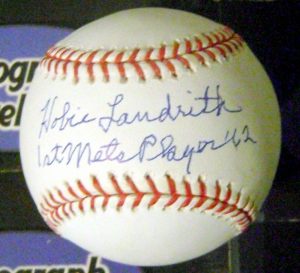
In later years, Landrith loved to sign autographs adding that he was indeed the first Met ever. 

“The first thing you have to have is a catcher,” said Original Mets manager Casey Stengel, explaining why the new team handed the first expansion draft pick chose the non-renowned veteran catcher from the Giants. “Because if you don’t have a catcher, you’re going to have a lot of passed balls and you’re going to be chasing the ball back to the screen all day.”

Stengel was probably too occupied managing and winning pennants with the 1949-60 Yankees to notice that, as a 1956 Cub, Landrith was charged with ten passed balls. But in the same season, he threw 23 would-be base larcenists out for a respectable 38 percent caught-stealing percentage. In three seasons as a Giant part-timer, before the Mets picked him, Landrith’s caught-stealing percentage was 41 percent.

“Thirty-one year old catcher who looked twenty-eight and played like forty,” wrote Leonard Shecter, in Once Upon the Polo Grounds, of Landrith, who died at 93 in California last Thursday. “Hobie always said he was 5’8″. He probably was 5’6″. It wasn’t his fault he wasn’t big enough to play this game.” (Baseball Reference actually lists Landrith as 5’10”, if you’re scoring at home.)

The Decatur, Illinois native was a perfect Original Met, until he wasn’t. On Opening Day 1962, he threw past second trying to arrest a base thief. He was charged with three passed balls in 21 games. But he spoiled the fun when the Mets swept a doubleheader from the Braves that May. He won the first game by pinch hitting a two-run homer off Hall of Famer Warren Spahn. Into the upper deck of the ancient Polo Grounds, the Original Mets’ home while awaiting Shea Stadium’s completion.

Remember: The Original Mets had Abbott pitching to Costello, with Who the Hell’s on frst, What the Hell’s on second, You Don’t Want to Know’s on third, and You Don’t Even Want to Think About It’s at shortstop. Clearly enough, Landrith didn’t really have what it took to animate the Original Met faithful. So the Mets made him do the only thing, really, that he could have done to help the anti-cause.

The next month, they sent him to the Orioles to complete a deal they made in May, a deal in which they sent cash plus a player to be named later for first baseman Marv Throneberry. Marvelous Marv himself. It may have been Landrith’s greatest contribution to the Original Mets’s unlikely grip upon New York’s heart. “The Mets were different, they were counterculture, they were fun,” Stengel biographer Robert W. Creamer would remember. “The worse they were, the more fun they were.”

The Orioles didn’t yet resemble contenders when Landrith was sent there. The Washington Senators, to whom the Orioles sold him later in 1963, weren’t exactly American League ogres, either. At least Landrith got to have a sort-of reunion before the Second Nats cut him loose after that season. His former Met teammate, Hall of Famer Gil Hodges, became their manager, after Mickey Vernon’s 14-26 ’63 start led to his execution and Eddie (The Walking Man) Yost’s running the team for one loss before Hodges came aboard.

“I was in the major leagues more because I was a good defensive catcher, and the fact that I was good at handling pitchers,” said Landrith, once upon a time, to This Great Game. The pitchers who threw to him lifetime had a respectable 3.92 ERA. His not-so-formidable bat was probably the thing that kept him from becoming a regular catcher over his early seasons with the Reds, the Cubs, and the Cardinals—even if he walked 253 times while striking out 188. (His lifetime Real Batting Average—total bases + walks + intentional walks + sacrifice flies + hit by pitches, divided by total plate appearances: .424.)

“I always thought I was a fairly decent hitter, but I realized that I wasn’t in the big leagues for my bat,” he continued in the same interview.  “I had what they called ‘warning track power.’ You know, I’d hit the ball pretty good, the fans would get up on their feet, and then they’d groan, because the ball would die at the warning track.”

Willie McCovey, Hobie Landrith, Tom Haller

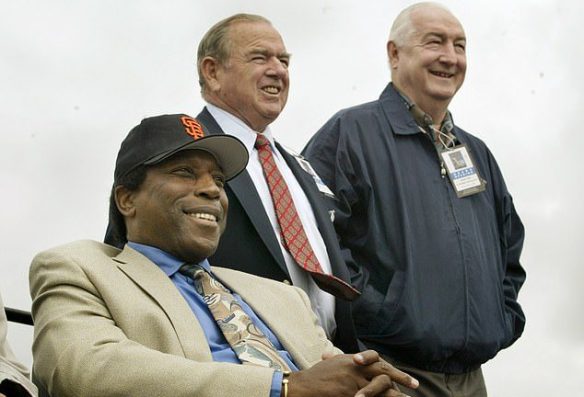
The San Francisco Chronicle captured Landrith (center), flanked by former Giants teammates Willie McCovey (left) and Tom Haller, watching a game in 2003.

As a Giant, Hall of Famer Willie Mays called Landrith “Honest John.” Landrith had no idea why. “He gave some of us strange nicknames. Folks would criticize Willie for being hard to talk to, but it wasn’t always that way. Willie got burned by the [San Francisco] press one time too many, and he got a little harder every time it happened. He was never that way with his teammates, though. I loved Willie and I had a great relationship with the man. I still do.”

Likewise Hall of Famer Willie McCovey: “People ask me all the time, what kind of a guy is Willie McCovey? And I tell them, if Willie walks into a room and smiles, everyone in that room smiles too. I was in the lineup for his first major league game when he went 4-for-4 against [Hall of Famer] Robin Roberts. I just feel fortunate that I was able to play with the man during my career. He’s just a wonderful person.”

That game, on 30 July 1959, featured three Original Mets to be (Landrith, Hall of Fame center fielder Richie Ashburn, and Phillies first baseman Ed Bouchee), plus two more eventual Mets: Mays, and Giants shortstop Ed Bressoud—who ended up becoming an Original Colt .45 (Astro) first, in the same expansion draft in which the Mets selected Landrith to kick things off.

After working as a Senators’ coach for 1964, Landrith left baseball and became a longtime public relations executive for Volkswagen. He and his wife, Peggy, had six children (three sons, three daughters), eleven grandchildren, and eleven great-grandchildren. If he just wasn’t made to be a true Original Met, he certainly was made for family and business success.

His roost in the Elysian Fields should only be that kind of serene. And I still can’t drink a glass of orange juice without remembering a certain phone call that landed me two crates of its source. Or, without remembering the catcher who helped make those crates plus Marvelous Marv possible.

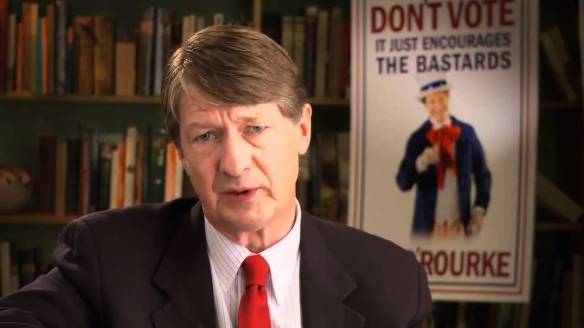
P.J. O’Rourke, RIP: He bowed to my superior mastery, once

P.J. O'Rourke

P.J. O’Rourke promoting one of his many books: “If government were a product, selling it would be illegal.”

I wasn’t even aware he was suffering. Maybe I’d simply fallen awhile out of that cheerful loop in which the spinning was tolerable because he’d been there to make you laugh, the better to prevent you from wishing to commit murder, manslaughter, mayhem, mincemeat, or My Mother, the Car.

P.J. O’Rourke, the funniest non-sportswriter in America, lost his fight against lung cancer Tuesday at 74. Back in 2008 he’d announced he was diagnosed with treatable, survivable rectal cancer. It almost figured, sadly. Fifteen years after he beat one pain in the ass—very different from the ones he beat with scolding joy sticks regularly in his writings—he couldn’t find a way not to run out of breath.

I suppose if he had any sporting passion, it was cars, if not necessarily NASCAR. (He seems to have liked shooting golf and ducks once upon a time, as well, but we’ll forgive him for now. For  the ducks. You get dinner out of that and it doesn’t cost you club memberships and green fees.) He once gathered up a passel of essays about cars into a splendid anthology. Its title alone could have been a single paragraph:

Driving Like Crazy: Thirty Years of Vehicular Hell-bending Celebrating America the Way It’s Supposed to Be—With an Oil Well in Every Backyard, a Cadillac Escalade in Every Carport, and the Chairman of the Federal Reserve Mowing Our Lawn.

Most writers would kill, maim, or demand the American return of the Smart Car in return for receiving the ability to write one actual paragraph half as springy or funny as that single book title. Though I wouldn’t go so far as to wish a Cadillac Escalade in every carport. I’d wish every carport a 1959 Mercedes-Benz fintail sedan.

Why? Because my beloved Aunt Beatsie owned one. In midnight blue. She owned and drove it for almost thirteen years, I think. She kept that car in immaculate running, looking, seating, and driving condition. Then she traded it in for a 1972 Chevrolet Impala. That was like trading Willie Mays for Willie Montañez. And America needs consistent reminders that baseball teams aren’t the only ones prone to the fart of the deal.

Actually, I take something back. O’Rourke was something of a NASCAR fan. “Oh, Jesus,” he wrote (in “NASCAR is Discovered By Me,” republished in Driving Like Crazy),

that stupendous noise, that beautiful and astounding sound—not the flatulent blasting of the drag strip or the bucket-of-puppies squeal of tiny Grand Prix engines, but a full-bore iron-block stroked-out American symphony of monster pandemonium. Exhaust notes so low they shake the lungs like rubber bell clappers in the rib cage and shrieks of valves and gears and push rods wailing in the clear ands terrifying soprano of the banshee’s wail—I could not leave my earplugs in, it was too beautiful.

Well, that didn’t make him a terrible person.

David Harsanyi, a senior writer for National Review, remembers a conversation with O’Rourke the only time the two ever met. He remembers it because he didn’t raise as a subject the time O’Rourke turned him down for a book promotional blurb in an e-mail reply to his request. “This has nothing to do with high standards of personal integrity,” O’Rourke began. “It’s just that I live in fear that I’ll lavish praise upon a work that somewhere, deep in its unread-by-me manuscript, claims that Pope John Paul II headed the conspiracy to murder Natalie Wood—or some such.”

The elegies I’ve read from those who knew him well enough touched invariably on his personal charm, kindnesses, and in-person wit that was at least equal to his written wit. In writing, of course, O’Rourke evolved from a National Lampoon semi-libertine (he edited that once-august repository of ribald ruckus once upon a time) to the kind of libertarian who suffered no fools gladly regardless of their side in the ideological zoo’s subdivisions.

He roasted left and right on behalf of the simplest political philosophy: Keep your meathooks to yourself and mind your own business. He also phrased it with a little less of the equivalent of a ball-peen hammer in an address to the libertarian Cato Institute where he served as its H.L. Mencken Research Fellow: There is only one basic human right, the right to do as you damn well please. And with it comes the only basic human duty, the duty to take the consequences.

But I had the honour of receiving a small brush of his kindness a little over three years ago, by way of American Consequences, the online journal he co-founded and edited until his death. It was my only exchange with the man, ever, and he didn’t even have to fear any claim about any actress’s murder by any pontiff or anyone else.

After the 2018 mid-term elections, in a “Letter from the Editor” he titled “Demented Politics, Lunatic Markets,” O’Rourke wrote, “If the 116th Congress were the World Series and Trump was the umpire, he’d send both teams to the showers so that he could be the pitcher and the batter and throw every strike and hit every home run. And he’d also want to be the only hot dog vendor in the stadium.”

I couldn’t resist sending him an e-mail comment about that. And, as things turned out, O’Rourke couldn’t resist publishing my comment in the journal’s next issue.

My comment: “Longtime fan, first time writing about an AC article. Reality check: If Congress were the World Series and President Tweety the umpire, the Series would have been the Baltimore Orioles against the San Diego Padres in Ebbets Field. And Tweety would have pitched, caught, homered, owned the concessions, named himself the Series MVP, and declared the Giants and the Dodgers had damn well better move back to Harlem and Flatbush and start building Edsels again. Yours cordially . . . “

Jeff,” O’Rourke replied in print, “I bow before your superior mastery of the sports metaphor!”

Well. I never drove fast on drugs while getting my wing-wang squeezed without spilling my drink. But I was handed high praise from the man who still drove fast when (his words) the drugs were mostly Lipitor, the wing-wang needed more squeezing than it used to before it got the idea, and spilling his drink was no problem since he kept the sippy cups from when his kids were toddlers and left the baby seat in the back seat so that, when he got pulled over, he looked like a perfectly innocent grandparent.

“Without sports metaphors,” O’Rourke once wrote, “American journalism would experience, as it were, sudden death.” Based on twenty-one books collecting around a thousand essays (I could be short there) that instructed while amusing and delighting, the man who bowed to my superior mastery of the sports metaphor should be recognised as American sociopolitical satire’s all-time home run champion.

Appreciating Willie, at 90 and beyond

Willie Mays

Willie Mays hits his 500th career home run in the Houston Astrodome, 1965.

I started watching baseball in earnest with the 1961 World Series, when I was pushing six, and the almighty Yankees faced the almost all-surprising Reds and beat them in five. Something about the game put a vise grip upon me that hasn’t let go in the years and over the changes good and bad since.

The Reds’ Frank Robinson was named the National League’s Most Valuable Player for 1961. Willie Mays finished sixth. As I would learn in due course, Robinson won the award as much because he had an MVP-type season as because he played on a pennant winner, but there were better MVP cases in the 1961 National League by Mays and fellow Hall of Famer Hank Aaron.

Then they finished inventing the Mets. I was no longer stuck with having to think purely about the Yankees in New York, since the National League was coming back into business there. (Assorted family members, especially my maternal grandfather, began telling me about the former exploits of the Dodgers and the Giants.)

And I’d get to see Willie Mays, even if on television alone. His Giants came to play my embryonic Mets in their former cavern, a big, horseshoe-shaped, rambling wreck of a ballpark known as the Polo Grounds. They played against each other there nine times in 1962. The Giants didn’t visit their former home until 1 June, but it certainly felt like a visit to the old neighbourhood—they swept the Mets in four.

I got to see the first of those four. Mays came exactly as advertised, playing center field as though he were part of a track meet; hitting a home run off future Giants manager Roger Craig the other way in the fifth, about 390 feet from the plate and into the right field seats; taking third from first on a seventh-inning single by another future Giants manager, Felipe Alou.

The bad news is that even a Willie Mays who leaves magnificent first impressions just warming himself up in the on deck circle can have days where someone else makes bigger impressions in the game. Fellow Hall of Famer Willie McCovey hit two bombs for the price of one Mays mash. And even McCovey didn’t steal the day’s headlines.

That theft belonged to Jim Davenport, a left-side infielder who wasn’t quite that serious a plate threat, squareing off against Mets reliever Willard Hunter two batters after Mays scored, with the bases loaded and one out. Davenport hit one not too far short of where Mays’s bomb landed in the right field seats.

It made the score 9-1, the Mets’ lone run to that point courtesy of Rod Kanehl hitting Giants starter Billy Pierce for a leadoff jack into the left field seats. The Mets managed to chase Pierce in the eighth with an RBI double (Charlie Neal) and a two-run single (Frank Thomas) back to back, before Felix (Wrong Way) Mantilla greeted Giants reliever Bobby Bolin rather rudely with a two-run homer.

That was the last of the day’s scoring. I’m reasonably certain that that was not the game during which Mets manager Casey Stengel visited Craig at the mound with McCovey due to hit and asked, “How do you want to pitch him—upper deck or lower deck?”

The Giants banked the 9-6 win. I didn’t get to watch the next three games, alas. Perhaps just as well, since the Giants outscored the Mets over those three games 22-6, including a doubleheader in which the scoring difference was 16-6, Giants.

Mays had himself a grand time playing baseball in New York for the first time since the Giants went west four years earlier. In game one of that doubleheader he opened with an RBI single and a run scored on a sacrifice fly in the first and continued with a two-run homer in the second, though somehow the Mets kept him quiet in the nightcap.

Then, he had one more homecoming message to deliver in the fourth game of the series, taking one of the Mets’ two Bob Millers (the righthanded one) into the left field seats with one out in the sixth.

The Giants met the Mets nine times in New York in 1962 and beat them seven times. Mays had himself an .851 OPS during those nine games. He was a lot more rude a house guest of the National League’s other newborn team in 1962, the Houston Colt .45s: despite Colt Stadium being a whole pitcher’s park, Mays battered the Colts for a 1.214 OPS in 1962.

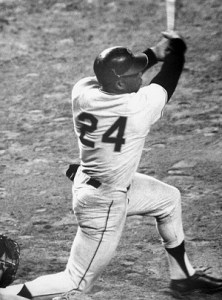
Mays was 31 years old in 1962. But he still played as though still ten years younger. He had that stance with his feet about half a foot forward and aft of home plate, the stride starting his swing where you saw his front foot step forward about another full foot plus, swinging down and across his midsection, not extending his muscular forearms until a split second before contact, the bat sweeping a little up going around.

The stride and swing that delivered 3,283 Show hits including 523 Show doubles and 660 Show home runs, and leaves open for question even now how many of his 140 Show triples came mostly from his bat or from his legs, considering how relentless a baserunner he really was.

“Willie had great instincts on the bases and he was always aggressive,” Pete Rose has said of him. “I was an aggressive baserunner also. I developed my baserunning skills watching Willie Mays play.” An interesting recollection, that—Mays took extra bases on followup hits 63 percent of the time he reached base, meaning he took more than one base on such a hit. Rose did it 49 percent of the time.

“[O]n a single, it would have been strange if he didn’t go first to third,” Rose’s teammate, Hall of Famer Johnny Bench has said. “He had one of the best turns rounding second or third you could possibly have. With his agility, he made the most perfect turns.”

Mays’s legs did as much for him playing center field as they did on the bases. He thought nothing of starting in as shallow a positioning as he could get away with before reading, hunting down, and snaring a drive. “Curt Flood was the best I’ve ever seen against the wall. He was better than Willie against the wall,” Flood’s Cardinals teammate Tim McCarver has said. “But Curt played deep. Willie didn’t play deep; he played shallow. Willie never went to the wall. Willie was the wall.”

Hall of Fame pitcher Bob Feller had a dugout seat with the rest of the Indians during the 1954 World Series, including and especially for the catch for which Mays remains remembered singularly, the run to the absolute rear of the Polo Grounds’ right center field, some 460 feet from the plate, to haul down Vic Wertz’s drive.

To everyone else in the house—including a writer named Arnold Hano, sitting in the bleachers and writing A Day in the Bleachers about that game and that play—the play seemed God’s next to last miracle. (My last miracle, said George Burns as God in a 1977 film, was the 1969 Mets.)

“That really wasn’t that great of a catch,” the curmudgeonly Feller once said. And why? “As soon as it was hit, everyone on our bench knew that he was going to catch it . . . because he is Willie Mays.”

Willie Mays Hall of Fame

Wouldn’t you love to know even now just whom the meatheads were that denied Mays first-ballot Hall enshrinement?

When Ted Williams was inducted into the Hall of Fame in 1966, he name-checked Mays respectfully. “The other day Willie Mays hit his five hundred and twenty-second home run,” said Teddy Ballgame himself. “He has gone past me, and he’s pushing, and I say to him, ‘go get ‘em Willie’.” Willie went and got 138 more of ’em before his life as a player finally ended.

For me it was baseball fortune to get to see the better of Willie Mays even in his thirties, even if he was on the road team or I had to wait for one of the Giants’ turns on the old national network Game of the Week telecasts. It was worth the wait to see him square off against such Hall of Famers as Sandy Koufax, Bob Gibson, Don Drysdale, the aging Warren Spahn, the young Tom Seaver, the young Steve Carlton.

You might care to note that Mays faced Spahn more than he faced any pitcher, Hall of Famer or otherwise, and had ownership papers on the lefthander who owned a nasty screwball and was a bit of a screwball himself. According to Stathead, Mays faced Spahn 253 times, hitting eighteen home runs among 68 hits, with a slash line pretty close to his overall career slash: .305/.368/.587, and a .955 OPS.

His first major league hit was a home run off me,” Spahn said often enough, “and I’ll never forgive myself. We might have gotten rid of Willie forever if I’d only struck him out.”

Drysdale might have told Spahn, “Why the hell didn’t you strike him out?” Mays faced Drysdale 243 times and, while he hit a measly thirteen bombs off the Dodgers righthander, the slash line is .330/.374/.604. The OPS is .978. Why the hell indeed.

Having learned more than a shard of baseball history by age 16, and having seen more than enough of Mays even as a road player to know that I was watching greatness that belonged not of this world but about five dimensions beyond it, it was easy to feel a little New York sentimentality when the Giants—entering a somewhat testy reconstruction and no longer able to afford carrying aging players, not even Hall of Famers—sold Mays to the Mets to let him finish where he began.

He only looked resplendent in the Mets’ fatigues, under the blue hat that brandished the same orange interlocked NY which once crowned Mays’s forehead on the old black Giants hat. Sunday, 14 May 1972, was my mother’s 42nd birthday; she was a year older than Mays. The date was also Mays’s first game as a Met.

The Mets took an early four-run lead thanks to Rusty Staub’s first-inning grand salami off erstwhile Indians howitzer Sudden Sam McDowell. The Giants tied the game with a four-run fifth. Leading off the bottom of the fifth came Mays, who’d been 0-1 with a walk and a strikeout when he checked in against Giants reliever Don Carrithers.

Mays hit one about 400 feet over the left field fence to bring the Shea Stadium house to a boil of delight. The fan’s heart prayed it might be an unlikely revival; the analyst’s head knew in its heart that it was only a question of when, not if we’d have to imagine baseball games played somewhere without Mays playing in one of them.

The greats don’t always go gently into that good gray night when they can no longer play the games that made their names. This son of an Alabama industrial league ballplayer  fought a small war in his soul when his age insisted he was no longer able to play the game he loved so dearly at the level on which he’d played it for so many years. Some said he’d become sullen, moody, dismissive in the clubhouse. Some resented him, others felt for him, still others mourned.

The smiles may have become rare now but when they came he still looked like the Say Hey Kid. But, yes, you can look it up: Mays never said, “Say hey!” His early habit of starting greetings to people with “Hey . . . ” inspired beat writers covering the Giants to tab him the Say Hey Kid.)

When he smiled as a Met, you still saw him in his youth, you didn’t see the manchild who was yanked rudely into manhood by a San Francisco that shocked him with skepticism as a New York import rather than a hero of their own. By a San Francisco that also shocked him, for all its reputation otherwise, when his bid to buy a home with his first wife was obstructed long enough by the sting of neighbourhood racism.

But when he accepted the now-inevitable, you cried the tears he fought to suppress when the Mets gave him a Willie Mays Night, 25 September 1973, and he addressed the Shea Stadium throng and his pennant-aspiring teammates alike, when Mets announcer Lindsey Nelson beckoned him to a microphone:

I hope that with my farewell tonight, you will understand what I’m going through right now. Something that—I never feel that I would ever quit baseball. But as you know, there always comes a time for someone to get out. And I look at the kids over here [pointing toward his Mets teammates], the way they are playing, and the way they are fighting for themselves, tells me one thing: Willie, say goodbye to America.

The game couldn’t possibly love Mays back as deeply as he loved the game, but it did its best with what it had. Today Mays celebrates his 90th birthday as the oldest living Hall of Famer, and someone like me who was there for enough of his best on the field and at the plate wishes almost as much as he must at times that we could take him back to one more day in the prime of his youth and turn him loose.

This sexagenarian and a half who saw more of him than he had a right to expect would love to shake his hand and say thank you for the honour of watching him play the game the way he played, but the fear is that “thank you” would be insufficient.

We’d love to remove the glaucoma that’s caused him to stop driving and playing golf, and take him back eyes wide open to make one more rambling catch in the depth of the Polo Grounds or in the eye of the Candlestick Park hurricane. We’d love to take him back to the day he won a second National League Most Valuable Player award eleven years after he won his first; we’d love to show him the record and get him at least two or three other MVPs he should have won.

We’d love to take him back to hit one more bomb off the Warren Spahn who only thought we’d have gotten rid of Mays if Spahn had only struck him out; to have his way with Spahn, Drysdale, fellow Hall of Famer Robin Roberts, and others; to let him have one more crack at the Bob Gibson who more or less owned him in comparison; to let him have, especially, one more chance in the single most transcendent one-on-one battle between pitcher and hitter you could ever hope to see, Willie Mays facing Sandy Koufax.

We’d also love to bring back his beloved Mae Louise, his second wife, who wept with him that farewell night at Shea Stadium, and whose eventual suffering with Alzheimer’s her loving husband didn’t allow to stop him from tending her, caring for her, loving her until she died a little over eight years ago.

But all we can do is say “Happy birthday, Willie, and here’s to many more,” we Americans who’ve never really said goodbye to the man who transcended the game we’ve loved, and who have no known inclination to do so. America without Willie Mays would feel like England without the Beatles: anything except themselves anymore.