One pitcher’s death and another’s murderous bereavement

2019-08-30 SkaggsBivens

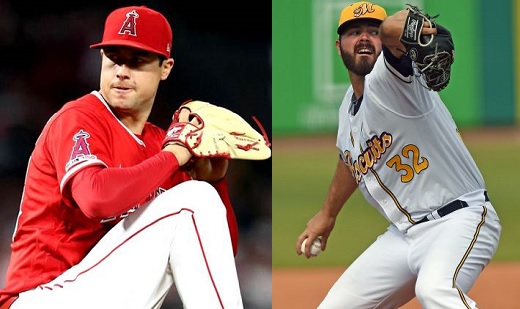
The Angels’ Tyler Skaggs’s (left) painkiller-related death raises a suspicion or three; murder robbed Rays minor league reliever Blake Bivens (right) of his wife, infant son, and mother-in-law. Bivens should be just as worthy of our sympathy and perhaps a degree or three more . . .

Fetanyl is a synthetic pain reliever usually though not exclusively administered for relief in cancer patients. Oxycodone, perhaps the most infamous among opioid pain relievers, is prescribed normally for those who need long-term, around-the-clock pain relief.

The Tarrant County (Texas) medical examiner says both plus alcohol were in Tyler Skaggs’s system the night he died unexpectedly on 1 July. “[A]lcohol, fentanyl and oxycodone intoxication with terminal aspiration of gastric contents,” the medical examiner’s report is quoted as saying.

That clinical language translates to the 27-year-old Angels’ lefthander vomiting and choking on it under the influence in his sleep.

Skaggs’s death provoked a hurricane of grief around baseball that seemed exacerbated when the Rangers, whom the Angels were in town to play, not only canceled that night’s game out of respect to the Angels but put Skaggs’s uniform number, 45, in the Angels’ uniform lettering style, behind the pitching rubber the following night, before the Angels beat them 9-4.

And when the Angels returned home from that road trip, they kicked off their first homestand since Skaggs’s death with a staggering 13-0 combined no-hitter against the Mariners that electrified its own sport and others, from Taylor Cole pitching two and Felix Pena pitching the final seven innings to Mike Trout himself accounting for about half the Angels’ destruction, his share only beginning with a two-run homer into the Angel Stadium center field rocks in the bottom of the first.

Assorted players around baseball have scratched their own little tributes to Skaggs since, including many scrawling his number 45 onto their game hats. The sole admirable sight on the otherwise execrable black (for visiting teams) and white (for home teams) Players’ Weekend uniforms—which made the games resemble contests between Mad‘s memorably “Spy vs. Spy” strips—was the circular black patch with 45 in white in the middle on every sleeve.

We’ll know soon enough, I’m very certain, as to just why Skaggs needed to take fetanyl and oxycodone. There’s already an ugly rumour that an Angels employee may have had a hand in Skaggs’s death; Los Angeles Times sports editor Bill Shaikin says MLB will investigate the claim. And Skaggs’s family has hired a Texas attorney to investigate for themselves.

Unless there was foul play of the type Tarrant County’s police couldn’t determine, or unless Skaggs suffered a medical condition about which none seems to have been aware, his is only slightly less senseless a death than what was done to the family of Rays minor league relief pitcher Blake Bivens.

Bivens’s wife, Emily; their year-old son, Cullen; and, his mother-in-law, Joan Jefferson Bernard, were shot to death Tuesday morning. Emily and Cullen Bivens were found dead inside Mrs. Bernard’s Keeling, Virginia home; Mrs. Bernard was found dead in the driveway. Bivens’s teenage brother-in-law, Matthew Bernard, is in custody charged with the crimes.

A neighbour told police Bernard came to her door and punched her in the arm before she heard subsequent gunshots at Mrs. Bernard’s home. Investigators found shell casings from a 30-30 rifle near the victims’ bodies; Bernard was arrested naked and trembling up the road after being found in a nearby wooded area. He was jogging in a circle and refused to stop at first even despite being pepper-sprayed by one officer; when he tried to choke another neighbour, police finally subdued the naked Bernard.

“My life as I knew it was destroyed,” said Bivens, a righthanded pitcher with a 4-0 won-lost record and a 3.98 earned run average but a proneness to walks for the Montgomery Biscuits (AA) this season, in an Instagram post Thursday. “The pain my family and I feel is unbearable and cannot be put into words.”

The stricken reliever tried anyway.

He called his wife the one “who made me into the man I am today and you loved me with all of my flaws.” He said of his little son, “I can’t breathe without you here. I finally understood what love was when you were born and I would have done anything for you.” And, he said of his mother-in-law, “You loved your family more than anyone I’ve ever seen. You raised the most wonderful girl in the world. I’m so glad y’all are still together.”

It says nothing against Blake Bivens that an established major league pitcher freshly married and unexpectedly dead at 27 provoked a wider, deeper choke of game-wide grief than a six-year minor league pitcher having not even a single cup of major league coffee whose wife, infant child, and mother-in-law were murdered.

But it’s impossible not to notice that Skaggs left a loving wife behind while Bivens was robbed grotesquely of his. Both are to mourn a little more deeply.

The Angels gave Skaggs a past-heaven home farewell

2019-07-12 MikeTrout

Wearing Tyler Skaggs’s name and number, Mike Trout finishes running out the two-run bomb he launched to start the Angels’ memorial massacre Friday night.

The stricken finally returned home to start the season’s second half. And the way they did it didn’t just defy belief, it drove belief almost as far out of Angel Stadium Friday night as Mike Trout’s two-run homer flew out in the bottom of the first.

The Angels paid one more tribute to the unexpectedly late Tyler Skaggs before the home audience Friday night. On the night before Skaggs would have turned 28. With a combined no-hitter and a sinking of the Mariners all the way to Davy Jones’s Locker.

It only began with a 45-second pre-game moment of silence in Skaggs’ memory, the time in honour of his uniform number. The Angels one and all wore Skaggs’ number 45 for the moment and for the game. Some dare call that tempting the baseball demigods, others dare call it divine inspiration.

After the Angels put the 13-0 no-no squarely into the bank, nobody really knew what to call it. Assuming God was available for comment, even He Himself might have been lost for words, and His words are usually the best words any side of heaven.

“Tyler’s birthday is 7/13. Tomorrow,” said Trout following the game. “They’d tell you to rewrite this script to make it more believable if you turned this in.” Which is pretty astute coming from a guy who claimed to be speechless over what he and his mates just did.

“Absolutely incredible,” tweeted Astros pitcher Justin Verlander. “Meant to be.”

The Mariners joined the Angels, showing shiploads of class, in lining up the baselines from the plate as a Skaggs jersey was placed behind the Angel Stadium pitcher’s mound in a frame.

Skaggs’ widow, Carli, his mother Debbie, his stepfather Dan, and his stepbrother Garrett, made for the mound accompanied by Angels pitcher Andrew Heaney. Then Debbie wound up and threw a ceremonial first pitch, before embracing Heaney and Mike Trout, the Angels’ all-everything center fielder suddenly emergent as the team’s no questions asked leader in the immediate aftermath of Skaggs’ unexpected death.

And those genuinely touching moments were almost nothing compared to what happened during the actual game, played in front of a likeness of Skaggs and a circular memorial displaying number 45 large on the rear end of Trout’s office, the center field fence.

How many times can you say the Angels paid their departed pitcher the most unexpectedly appropriate tribute of all—a game in which two pitchers, Taylor Cole (two innings) and Felix Pena (seven innings) combined to surrender no hits, only one walk, and see not a single Mariner reach on an error?

How often can you say Trout himself—who wept unashamedly last week in Texas, trying to express what his friend Skaggs meant to himself and to their team—accounted admirably for almost exactly half the Angels’ commemorative destruction?

Say it as often as you like even if you’re not an Angel fan. Because seldom if ever has a team rent by in-season tragedy responded like this when finally getting to play for the home audience after their lost teammate’s death on the road, showing him the love with their fans.

2019-07-12 LosAngelesAngels

First, they lined up for 45 seconds of silence in Skaggs’ memory. Then, they performed a combined no-hitter and a blowout. Who says baseball’s lost its capacity for surreality?

And even less often does it begin the way it did in the bottom of the first, after Cole retired the Mariners in order on a strikeout, a fly out, and a ground out—dropping seven on Mariners starter Mike Leake before Matt Festa struck out Justin Upton, who’d singled earlier in the inning, swinging on a 2-2 fastball.

The carnage only began when Angels leadoff man David Fletcher banged a double off the right center field wall. Trout stepped up in the number two slot and, proving it almost doesn’t matter where in the Angel lineup he hits, turned on a Leake sinker with about as much sink as a blimp and blasted it right into the rocks behind the center field fence.

Almost immediately after crossing the plate himself, Trout looked toward the Angel Stadium section where players’ wives or girl friends sit, until he caught Carli Skaggs’ eye. It looks as though he gave her a gentle affirmative nod. That one’s for your husband, Carli. And you ain’t seen nothing yet.

The inning from there went single (Shohei Ohtani), single (Justin Upton), swinging strikeout, RBI single (Andrelton Simmons scoring Ohtani), run-scoring error (Upton scoring as Mariners second baseman Dee Gordon misplayed a forceout), RBI single (Dustin Garneau), swinging strikeout, bases-loading single (Fletcher), and Trout’s two-run double.

And Trout wasn’t even close to finished for the night. The very next inning, a strikeout after Festa walked Simmons home, Festa hit Trout with a 2-0 slider to send home Justin Bour. Three innings and two more Mariners pitchers later, Trout squared off against Matt Wistler with Fletcher on second thanks to a single and a throwing error on the play and rifled a double to the back of left field, scoring Fletcher and making things 10-0.

All the while Pena continued keeping the Mariners from bringing their flippers to bear after Cole worked the first two spotless. About the only dicey moment he really faced, other than walking Mariners designated hitter Omar Narvaez in the fifth, was Mac Williamson smashing a grounder in the top of the sixth for which third baseman Matt Thaiss needed to make a diving stop and hard enough throw to nip Williamson.

Trout helped put another cherry atop the Angels’ sundae evening when he came home as Upton sent Mariners reliever Parker Markel’s 2-0 fastball over the center field fence. The Angel who patrols center field like a cop with acrobats in his family history did his evening’s work so well there wasn’t a baseball jury on earth who’d convict or sentence him for grounding out with the bases loaded to end the bottom of the eighth.

By then the only question left was whether Pena could finish the second combined no-no in Angels history. (The first was between Mark Langston and Mike Witt in 1990.) And, the first Angel no-hitter of any kind since Jered Weaver in 2012. Strangely enough, it was in 2012 that the Mariners themselves were last no-hit, courtesy of the White Sox’s Philip Humber’s perfect game.

The answer was Williamson flying out on the first pitch, Gordon grounding out on the second pitch, and Mallex Smith grounding out on the second pitch. Easy as 1, 2, 2.

“This,” tweeted Blue Jays pitcher Marcus Stroman, “is unbelievable. The baseball gods.”

Nobody’s really going to care for the smaller details of the night such as the Angels going 7-20 with runners at second base or better including Trout’s 3-for-4. Nobody’s going to care (too much) that, between them, Cole and Pena threw 63 strikes out of 103 pitches, with Cole striking out a pair and Pena punching out six.

Leave those details plus the Mariners’ seven pitchers combining to surrender eight earned runs, punching out eleven, but walking seven, to the statisticians. Because other than the surrealistic final score, and the absence of Mariners hits, nobody cared about any numbers above and beyond the 45 on the Angels’ backs Friday night.

Nobody cared about anything other than one baseball team coming home from a heartbroken road trip, seeing the massive makeshift memorial to their fallen teammate outside the home plate entrances to their ballpark, and taking a little extra incentive they hardly needed considering, to suit up and give him a sendoff he couldn’t have imagined but surely hoped wouldn’t come for decades yet to be. Decades he’ll see only from heaven.

With Skaggs’ clubhouse locker fully stocked and the team intending to keep it that way the rest of the season, the Angels had one more tribute to make after the game. They went out to the mound and covered it in Skaggs jerseys. Leaving the big 45 behind the pitching rubber exposed. There was nothing more they could possibly do.

Whether the Angels go from here to the postseason, even though they now sit in rear-view enough distance five and a half games and five teams away from a wild card slot, almost doesn’t matter. On Friday night, saying one more farewell to a pitcher they loved on the mound and even more as a young man, the Angels were bigger than baseball. And baseball didn’t seem to mind one bit.

The Angels win with overloaded hearts

2019-07-03 TrevorCahill

Angels relief pitcher Trevor Cahill gives a salute to the late Tyler Skaggs. Showing class to burn, the Rangers installed Skaggs’ uniform number—in the Angels’ uniform font—behind their pitching rubber in memorial tribute for Tuesday’s game.

A teammate dies without warning as a season comes to within sight of the halfway marker. Your scheduled road opponent is gracious enough to cancel the game scheduled that night out of respect for your loss. The grief within your clubhouse and your front office is too real to suppress. And back home your fans are laying out item after item, flower after flower, message after message in your teammate and friend’s memory.

“LTBU in heaven!” said a scrawl on one souvenir batting helmet left among the memory gifts, referring to Angel fans’ customary call (Light that baby up!) after Angels wins, to light the halo around the original stadium big A scoreboard now implanted in the back parking lot.

Angel fans get to mourn Tyler Skaggs a little longer than the Angels themselves in terms of the schedule, because the Angels still had a game to play against the Rangers in Arlington Tuesday night.

Whether you’re in the depth of a pennant race, on the race’s fringes, or headed for the repose where the also-rans will commiserate when it’s all over, you know in your heart of hearts, gut of guts, and mind of minds, that the young man you mourn would rather you suit up, shape up, and step up on the mound, at the plate, on the bases, in the field, than spend more than a single day’s grief without playing the game he loved with you.

So the Angels did what they knew their lost brother wanted. They suited up, shaped up, stepped up, with Skaggs’s uniform number (45) on a small round black patch on their jerseys’ left breasts. They carried Skaggs’s Angels jersey for a pre-game moment of silence in his honour.

“It was just kind of something unplanned. His jersey was hanging in his locker. We wanted to take him out there with us one more time,” said pitcher Andrew Heaney later. “He was definitely my best friend. There’s probably about 100 other people out there that would say he was their best friend, too, because he treated everybody like that.”

His best friends beat the Rangers, 9-4, on a night during which the Rangers showed the Angels such respect as canning the walkup music and others among the normal rackets for Ranger feats at home. The Rangers even installed a red number 45 behind the pitching rubber. In the Angels’ uniform font. To do Skaggs and his team honour.

And not a single Angel tried to hide his grief at a post-game conference.

Their all-everything center fielder, Mike Trout, spent most of the game walking three times and scoring on a base hit. Maybe the single greatest star in the Angels’ firmament, ever, Trout couldn’t get through a simple expression of what Skaggs meant to himself and their team without several chokings back of tears.

“Lost a teammate, lost a friend, a brother, we just got to get through it,” he said shakily. “He was an unbelievable person. It’s all about him. Husband of Carli, what a sweet girl, Debbie his mom, you know, a good relationship with them. You know, it’s just a tough, you know, 24 hours.

“We’re getting through it, tough playing out there today, but like Brad [Ausmus, the Angels’ manager] said earlier, Skaggs, you know, he wouldn’t want us to take another day off,” Trout continued. “The energy he brought into this clubhouse, you know, every time you saw him he’d pick you up. It’s going to be tough, you know, these next couple of days, the rest of the season, the rest of our lives, you know, to lose a friend . . . All these guys in here, you know, I see these guys more than my family. To lose somebody like him is tough.”

In Washington, Nationals pitcher Patrick Corbin, close friends with Skaggs since their Diamondbacks days, switched his uniform from 46 to Skaggs’s 45. Then he went out to pitch his regular turn, his manager Dave Martinez saying it was just about all Corbin could do. Corbin himself affirmed it after the Nats beat the Marlins, 3-2, Trea Turner walking it off with an RBI hit.

“When you have a loss, you want to keep things as normal as you can and just try to go out there and do what you have to do,” Corbin said after that game. But he never said it would be easy to pitch through the memories of their being drafted together by the Angels, traded together to the Diamondbacks, and in each other’s wedding parties this past offseason.

Corbin not only changed his uniform number to Skaggs’s but scratched the number in the dirt behind the mound before he managed to pitch seven innings despite being disrupted by a rain delay of over an hour, surrendering one run, no walks, and seven strikeouts.

Another Nat had personal ties to Skaggs. Adam Eaton played in the fall instructional leagues with Skaggs. And they were eventually traded away from the Diamondbacks in the same three-way deal that returned Skaggs to the Angels and sent Eaton to the White Sox.

“Saw his debut. Saw his first hit. Saw his first strikeout. Know his wife. My wife knows his family. It’s just . . . I’m not quite sure it’s hit me yet,” the outfielder said, shades covering his teary eyes. “My family, our hearts go out to his family. He’s kind of kicked us in the pants in his passing that we need to take every day as it’s our last and enjoy our family and love our family and what’s important in our life, and know that we’re blessed to play this game every day. That’s the gift he’s given us, even after.”

As for the Angels, they started the game with a first-inning, run-scoring ground out before a first-inning sacrifice fly, a third-inning solo homer, and a double steal including home put the Rangers up 3-1. The Angels tied it in the fifth on a base hit that turned into two runs home on an outfield throwing error; a four-run sixth—an RBI single, a runner-advancing throwing error, another RBI single, and a sacrifice fly—put them ahead to stay.

The Rangers got their final run on another sacrifice fly, and the Angels got their final two when shortstop Andrelton Simmons opened the top of the eighth with a walk and, one out later, right fielder Kole Calhoun drove a middle-high fastball parabolically over the right center field fence. The win pulled the Angels back to .500 and to within four games of the American League wild card hunt.

Those small details were probably the last things on their minds Tuesday night. They might be a little more concerned for Tommy La Stella, their breakout All-Star, who had to leave the game in the sixth after fouling a pitch off his right leg below his knee. But La Stella probably thought his injury was tiny compared to the wrench in the team’s hearts.

“It’s bigger than the game. The friendship and the love I had for him and his family, it’s more than that,” Trout said.

“Today it was just different,” said Calhoun after the game, “and there’s no playbook on how it’s supposed to go today and you’re supposed to act and react. But getting back to the game definitely is what he would have wanted. Today was a day that we leaned on each other like we really needed to do.”

The same thing happened ten years earlier, after rookie pitcher Nick Adenhart was killed by a drunk driver while out celebrating after a splendid first start of the season. The day after Adenhart’s death, the Angels beat the Red Sox, 6-3, in Angel Stadium. The win was only partial comfort then just as it was Tuesday night in Arlington.

It doesn’t always work that way.

Cardinals pitcher Darryl Kile died unexpectedly of a heart attack in June 2002, while the Cardinals were in Chicago to play the Cubs. The following day, they lost to the Cubs, 8-2, with the Cubs scoring all eight before the eighth inning including a four-run sixth, and the Cardinals able to muster only two in the eighth—on future Hall of Famer (and current Angel) Albert Pujols’s two-run homer—and one in the ninth on an RBI single.

When Yankee catcher Thurman Munson was killed in the crash of his own aircraft, the Yankees played the Orioles the day after and lost a 1-0 heartbreaker in Yankee Stadium. In a game featuring three future Hall of Famers (Eddie Murray, Reggie Jackson, and Goose Gossage) and a pitching duel between Scott McGregor of the Orioles and Luis Tiant of the Yankees, the lone run came when John Lowenstein hammered a Tiant service over the fence.

A year earlier, Angels outfielder Lyman Bostock was murdered while on a visit to Gary, Indiana, in a car, when a man fired at the car hoping to hit his estranged wife, whom he suspected having an involvement, shall we say, with another man in the car. The next day, the Angels beat the Brewers in extra innings, Carney Lansford singling home Danny Goodwin with two out in the tenth.

Death in season sometimes rallies teams and other times knocks them apart. Maybe no death in Reds’ history was as shocking as the 2 August 1940 suicide of reserve catcher Will Hershberger—whose own father had committed suicide previously. Blaming himself for a doubleheader loss, Hershberger reportedly told manager Bill McKechnie more than that troubled him but nothing to do with the team, and McKechnie never disclosed the rest.

The Reds played another doubleheader the day after Hershberger’s death. They swept the Boston Braves (then known as the Bees), then went on to win the pennant with a 23-8 September before beating the Tigers in seven in the World Series. McKechnie publicly dedicated the rest of the season and the pennant chase to Hershberger, and the Reds awarded a full winning World Series share to Hershberger’s mother while they were at it.

And when Indians shortstop Ray Chapman died after being coned by Carl Mays’s fastball in 1920, the stricken Tribe—with just a little help from the explosion of the Eight Men Out being taken out in Chicago at almost season’s end—ended up winning the pennant and the World Series.

The 1955 Red Sox were headed only to a fourth place finish but they suffered the unexpected death of promising young first baseman Harry Agganis to a pulmonary embolish on 27 June that year. The following day, the Red Sox swept the Washington Senators in a doubleheader compelled by a rainout earlier that season. The scores were 4-0 in the opener and 8-2 in the nightcap.

These Angels may or may not band up and make a surprise run to the postseason from here. But they honoured their effervescent pitching teammate now gone in the only coin all accounts suggest Skaggs would have accepted. They played ball. And they beat a team who probably didn’t really mind getting their tails kicked for just one night, because the grief felt around baseball over Skaggs’s unexpected death was just too real.

“We knew what they were dealing with on the other side,” Rangers manager Chris Woodward said after the game. “We were trying to comprehend the impact something like that would have on our ball club. I can’t even describe the feelings they were having. Obviously, it wasn’t our best game, but clearly it affected us in some way. Honestly, I don’t know how to describe that feeling. It was just kind of obvious they deserved to win.”

“We know we’ve got an angel watching over us now,” Calhoun said. “When I got to the plate, it felt right to pay some respect to him, and like I said, we know we’ve got somebody watching over us up there.” Somebody who didn’t deserve to die at 27.

Tyler Skaggs, RIP: Another heavenly Angel, damn it . . .

2019-07-01 TylerSkaggs

Tyler Skaggs—accommodating, joyful, and tragically dead at 27.

The Angels are a franchise with a sad enough history of calamity in its ranks. It’s a shame to think of things this way, but it’s been a decade since the last death among their active family, young pitcher Nick Adenhart. Just maybe the franchise’s sad history of active duty rendezvous with the Grim Reaper would get an even longer break.

Then came the news that pitcher Tyler Skaggs was found dead at 27 in the team’s Southlake, Texas hotel Monday afternoon, as the Angels were about to open a road set with the Rangers. Even the Rangers were staggered by his death. They had no issue at all with cancelling Monday’s game.

Skaggs was a Santa Monica High School standout, the son of their longtime softball coach Debbie Skaggs, a good if sometimes inconsistent pitcher in the major leagues, and with a reputation for approachability that went back to his high school days and a sense of humour that got wicked without getting nasty.

Only recently Skaggs deployed his humour on behalf of getting teammate Tommy LaStella to this year’s All-Star Game, in a hilarious video in which Skaggs interviewed Angels two-way star Shohei Ohtani—with Skaggs in English and Ohtani, playfully, in his native Japanese. It must have helped, since LaStella was voted by fellow players to the American League All-Stars “in a career year nobody saw coming,” least of all LaStella.

“I will remember the smile and spirit he always showed during his Santa Monica High days,” wrote Los Angeles Times baseball writer Eric Sondheimer almost immediately after learning of Skaggs’s death. “The beach, the ocean, the air — it helps creates a personality that people want to embrace. He’s left us but won’t be forgotten. Now’s the time to remember all the joy he brought people through his 27 years.”

Skaggs was a mid-to-back-of-the-rotation starter whose best pitch was considered his curve ball while he also owned a changeup that could be effective but wasn’t quite fully developed. He missed all 2015 and most of 2016 recovering from Tommy John surgery; he battled subsequent injuries including adductor strains; he was still freshly married to his wife, Carli, having tied the knot last December.

And he was a prodigal Angel, having been dealt to the Diamondbacks in mid-2010 in the deal that made Dan Haren an Angel, but returning in 2013 in the three-way deal that brought him back to the Angels, sent slugging but defense challenged outfielder Mark Trumbo to the Snakes, and sent Adam Eaton from the Snakes to the White Sox, with the Angels also getting swing pitcher Hector Santiago while they were at it.

He was posting a fine season marked by a little hard luck this year, his 4.29 ERA counterweighted by a fine 3.84 fielding-independent pitching rate and a mere 3.8 runs to work with from his mates during his times in the games to prove the hard luck spells.

None of which matters as heavily as the Angels having to say a permanent goodbye to a good pitcher who was an apparent joy in the clubhouse. Police say no foul play was suspected. Leaving us only to speculate sadly over just what could have taken a young guy with as much to live for as Skaggs had.

My son, Bryan, an inexhaustible Angels fan since early boyhood, called me to tell me the news, my cell phone ringing just as I was stepping into a supermarket. His first words were, “Another Angel’s going to heaven.” He’d been shattered by Adenhart’s death at the hands of a drunk driver ten years earlier.

He probably had little enough idea that the Angels have been there only too many times in their franchise life. Since 1965, when they were freshly relocated to Anaheim, and when rookie pitcher Dan Wantz surprised observers by pitching his way onto the staff with an unexpected strong spring  training, only to die of a brain tumour at 25 four months later.

There was Minervino Rojas, late blooming but seemingly inexhaustible relief pitcher. (“He’s got three pitches,” a rival said of the deceptively effective Rojas, formerly buried in the Giants’ system. “Slow, slower, and come and get it.”) A fireman’s fireman whose off-speed repertoire helped him lead the American League retroactively with 27 saves in 1967, in the era when the one-inning closer wasn’t even a topic. Arm trouble forced his retirement in spring 1969. A year later: a hit-and-run driver killed two of his three children, though his wife and infant son survived, and left Rojas a paraplegic.

There was utility infielder Chico Ruiz—once famed for the steal of home as a Red that kicked off the 1964 Phillie Phlop—dead in an offseason auto accident in 1972, a year after he’d helped poison an already-poisoned clubhouse by threatening talented but deeply troubled outfielder Alex Johnson, who loved him yet also loved to needle him incessantly, with a pistol. At 33.

There was Bruce Heinbechner, pitching his way onto the roster in spring 1974, seen as the Angels’ forthcoming lefthanded relief specialist, until the 23-year-old was killed in a pre-season auto accident. There was Mike Miley, shortstop, three years later. Seen as a prospective Rookie of the Year challenger at 23–before he, too, was killed in a pre-season road accident.

There was Lyman Bostock, outfielder, one of the Angels’ earliest big-money free agents after a promising career to date with the Twins. Like Skaggs, outgoing and popular. So enthusiastically chatty in the clubhouse that Bostock’s Angels teammates nicknamed him Kareem Abdul Jibber-Jabber. Shot to death at 27 a year after Miley’s death, while riding in a car with a relative and friends in Gary, Indiana. The shooter said he was aiming at his estranged wife; the case prompted Indiana to change its insanity defense laws.

There was Donnie Moore, relief pitcher, haunted both in his own soul and in the aftermath of surrendering the fateful home run to Boston’s Dave Henderson when the Angels were a strike away from going to the 1986 World Series—still coming to terms with the end of his career and his personal demons when he shot and injured his wife before shooting himself to death, in 1989.

And, there was Adenhart, who threw six shutout innings in his first 2009 start, scattering seven hits and striking out five, killed at 22 by a drunk driver while riding as a passenger in a mini-van. The driver, Andrew Thomas Gallo, was sentenced to 51 years-to-life behind bars.

2019-07-01 TylerCarliSkaggs

Tyler Skaggs posted this wedding photo on Instagram after marrying his wife, Carli, last December.

Skaggs took his lady to the Bahamas in November 2017, to propose to her. He looked happier with Carli Skaggs on their wedding day than at any other time in a life most accounts say was as happy as the day was long.

That only makes his death now even more heartbreaking than any game lost, any pitch that didn’t make it the way he wanted it. The Angels lose a teammate and friend but a young lady loses a husband whom she knew deeply had too much life to share and live.