NLDS Games One: The Atlanta Chop Slop, the Los Angeles funeral parlour

Truist Park

Trash talk? Have at it. Trash the field over a call going against you? What was this, Braves fan?

Neither the Dodgers nor the Phillies expected simple National League division series this time around. Not with both teams coming in with what some call patchwork pitching. But one came out looking better in their Game One while the other came out looking like the remnant of a nuclear attack.

The Phillies and their pitching managed to keep the Atlanta threshing machine from threshing Saturday afternoon, winning 3-0. Starting with a first-inning nuking of future Hall of Famer Clayton Kershaw, the Diamondbacks laid waste to the Dodgers Saturday night, 11-2. On the arms of big enough bats and a starting pitcher who was usually close enough to Dodger batting practise.

Letting starter Ranger Suárez go no more than three and two thirds, knowing they’d have a day off between Games One and Two, the Phillies went to a bullpen game, essentially. And that bullpen finished what Suárez started, shutting the Braves out over the remaining five and a third. The Braves who hit a record 307 home runs on the regular season looked as though they had paper towel tubes for bats.

None more glaring than the founding father of the 40/70 club. Ronald Acuña, Jr. went 0-for-3 with a walk, and his evening’s futility included an embarrassing called strikeout in the fifth, when—with first and third and one out—the second Phillies reliever of the evening, Seranthony Domínguez, planted a fastball right on the low inside corner.

Small wonder that Braves manager Brian Snitker could and did say, postgame, “I think it was more their pitching than our hitting.” Indeed.

Braves starter Spencer Strider pitched boldly enough, striking eight out and scattering five hits in seven innings’ work. But the Phillies still pried two runs out of him, both with Bryce Harper the big factor. First, Strider threw wild enough trying to pick Harper off first in the top of the fourth, enabling Bryson Stott to single him home with the first run. Then, Strider threw Harper enough of a meatball to disappear into the Chop House seats behind right field with one out in the top of the sixth.

“Strider, man, he’s one of the best in the game. You know he’s going to come at you and throw his best at you,” Harper said postgame. “So just trying to get a pitch over and was able to get the slider up and do some damage.”

Except for Acuña’s surprising silence, and the eighth-inning catcher’s interference call with J.T. Realmuto at the plate and the Phillies with the bases loaded, enabling the third Phillie run home, the Braves at least looked stronger in Game One defeat than the Dodgers did. Even Strider, who became the first postseason pitcher ever to lose twice against a team against whom he’s well undefeated in the regular season.

The Diamondbacks didn’t let Clayton Kershaw—all 35 years old of him, with possible lingering shoulder issues plus eight days of rest leaving him with little enough to offer—get out of the first alive. Their 35-year-old journeyman starter Merrill Kelly, who didn’t turn up in the Show until age 30 in the first place, manhandled them for six and a third after the Snakes bit Kershaw deep in the first.

For the regular season’s final two months, with a 2.23 ERA over eight starts, Kershaw seemed to tell age and his shoulder alike where to stuff it. Then Kershaw took the ball Saturday night. What’s the saying about too much rest being as hazardous to a pitcher as too little rest can be?

Ketel Marte opened with a double to the back of left center field, and Corbin Carroll began showing why he’s in the Rookie of the Year conversation with a prompte RBI single. Tommy Pham—the same Tommy Pham who called out the lack of work ethic among second-tier Mets teammates with whom he played before the trade deadline—rapped a short single to left for first and second.

Then Christian Walker, a veteran first baseman who hadn’t been anything much special before 2022, hit one so far to the back of the left field bleachers some wondered how the ball didn’t leave the ballpark structure. Just like that, Dodger Stadium resembled a funeral parlour. And, just like that, Kershaw resembled the corpse for whom the audience came to mourn.

A ground out by Lourdes Gurriel, Jr. and a walk to Alek Thomas later, Evan Longoria sent Thomas all the way home with a double to deep center field, hammering the final nails into Kershaw’s coffin.

“Embarrassing,” the lefthander said postgame. “You just feel like you let everybody down. The guys, a whole organization, that looked to you to pitch well in Game One. It’s just embarrassing, really. So I just feel like I let everybody down. It’s a tough way to start the postseason. Obviously, we still have a chance at this thing, but that wasn’t the way it should’ve started for me.”

Kershaw’s postseason history is a direct contrast to the regular-season career that guarantees him a place in Cooperstown. Until Saturday night, enough of that sad history came by way of leaving him in too long or by circumstances above and beyond his control.

Entering Game One with a 5.49 ERA against the Dodgers lifetime but a 7.03 ERA against them when pitching in Dodger Stadium, Kelly pitched six and a third shutout innings before turning it over to a bullpen that kept the Dodgers to one hit. The bad news: the hit was a two-run triple by Will Smith off Miguel Castro. The good news: The Snakes could afford such generosity by then, since it cut an 11-0 lead by a measly two runs.

Kelly’s keys included forgetting how the Dodgers treated him like a piñata in regular season play. “I’m watching our guys beat up on one of the best pitchers that we’ve ever seen in our lives and watching them do it in the first game I’ve ever pitched in the playoffs,” he said postgame. “I felt if I gave those games any attention I was going out there behind the eight-ball before I even stepped on the mound.”

This time, Kelly went out there with a six-run cushion, then saw it padded to nine by a three-run second including Carroll leading off against Dodger reliever Emmet Sheehan with a drive into the right field bleachers. Kelly was now comfortable enough that he could have pitched from a high-backed leather office chair and incurred no damage.

The only thing that should have and apparently did embarrass the Braves was the Truist Park crowd throwing drinks onto the field after catcher Sean Murphy’s mitt grazed Realmuto’s bat by a thin hair. You could hear it on replays that didn’t exactly show it too clearly, but Murphy’s lack of challenging the call affirmed it.

Trea Turner—who started a spectacular double play with Acuña (leadoff walk) on third to end the bottom of the eighth, diving left for Ozzie Albies’s ground smash and backhanding to second baseman Stott—scored on the interference. The rain of drinks into the outfield annoyed both the Braves and their manager.

“There’s no excuse for that,” Snitker snapped postgame. “It’s scary because those water bottles, when they come, they’re like grenades. It could really seriously injure one of our players.”

That’s what the miscreants don’t stop to think about. Against a team whose fan base is usually considered one of the worst in the game. (Remember the Philadelphia wedding: the clergyman pronounces the happy couple husband and wife before telling the gathering, “You may now boo the bride.”) Be better, Braves fans.

Only the silence in Dodger Stadium following the Diamondbacks’ early and often abuse of Kershaw and Sheehan kept the big National League division series headlines elsewhere from reading, “Chop Slop.”

WS Game Three: No history, just a Braves win

Ian Anderson

Ian Anderson—If you can’t do both, what’s your real choice . . . trying to make history, or trying to take a World Series advantage?

Let’s see. Yes, on a cool, mostly misty, on-and-off light rainy night in Truist Park, Ian Anderson took a no-hit bid through five innings of World Series Game Five.

He faced eighteen batters and threw eleven first pitch strikes. He also threw about as many balls as strikes; 39 strikes out of 76 pitches, meaning one more strike than ball Saturday night. While he was at it, he and his batters wrestled to seven full counts.

You still want to yell at Braves manager Brian Snitker for hooking Anderson after a measly five innings? You might actually have ended up yelling at Snitker for leaving Anderson in an inning too long if he waited until Anderson took that kind of balance into the sixth.

You might be flooding social media with demands for Snitker’s summary execution on the spot, instead of celebrating the Braves taking a 2-1 Series lead with a 2-0 combined two-hit shutout during which four innings separated the Braves’ only runs.

You might forget how much you were touched by that sweet pre-game ceremony doing the late Hall of Famer Henry Aaron honour, especially knowing that Astros manager Dusty Baker was mentored and befriended by Aaron when he first arose as a Braves outfielder over four cups of coffee before slotting in full in 1972.

You might forget what sad fun it was to hear the Truist Park audience serenading Astros second baseman Jose Altuve and third baseman Alex Bregman with chants of “cheater! cheater!” when they batted in the top of the first.

Fun because at least the crowd saved it strictly for two of the five remaining Astrogate team members. Sad because nobody’s really processed yet what Andy Martino isolated in Cheated: The Inside Story of the Astros Scandal and a Colorful History of Sign Stealing: Altuve actually spurned the illegally-stolen signs and even demanded whomever transmitted them with the trash can bangs to knock it the hell off when he was batting.

You might forget Anderson and Astros starter Luis Garcia having a fine pitching duel between them, until Braves third baseman Austin Riley—with Eddie Rosario (one-out walk) and Freddie Freeman (base hit lined over unoccupied shortstop defying a defensive overshift) aboard—ripped one inside the third base line, past a diving Bregman, and down the line further for an RBI double in the bottom of the third.

You might forget the Truist Park organist having a little cheerful troll when Garcia batted with one out in the top of the third . . . giving him “Rock-a-Bye Baby” for walkup music—a neat little salute to Garcia’s baby-rocking arms motion before he goes into that little back-and-forth salsa step to deliver to the plate. Garcia’s tiny little grin over the serenade? Priceless.

You might forget that the would-be no-no got broken up in the top of the eighth, with Tyler Matzek on the bump for the Braves, when Rosario scampering in from deep left field positioning and Braves shortstop Dansby Swanson scampering out managed to let pinch hitter Aledmys Diaz’s somewhat shallow pop fly hit the wet grass with a thunk! Most likely, because Swanson didn’t want to plow Rosario even if either one could have caught the ball clean, and Rosario didn’t want to plow Swanson thinking the shortstop couldn’t hear him call for it. Oops.

You might forget Braves catcher Travis d’Arnaud with one out in the bottom of the eighth, turning on Astro reliever Kendall Graveman’s unsinking sinker and sinking it over the center field fence.

You might also forget the Astros living up exactly to one of now-retired Thomas Boswell’s best arguments on behalf of the universal designated hitter, with the Braves at the plate with two out in the bottom of the second, and the DH still unavailable to either side in the National League ballpark.

D’Arnaud smashed Garcia’s full-count fastball high off the right field wall for a double. With Anderson on deck, the Astros handed Swanson an intentional walk and—what do you know—struck Anderson out to end the inning. Now, what was that Boswell wrote in February 2019?

It’s fun to see Max Scherzer slap a single to right field and run it out as if he thinks he’s Ty Cobb. But I’ll sacrifice that pleasure to get rid of the thousands of rallies I’ve seen killed when an inning ends with one pitcher working around a competent No. 8 hitter so he can then strike out the other pitcher. When you get in a jam in the AL, you must pitch your way out of it, not ‘pitch around’ your way out of it.

Travis d'Arnaud

Travis d’Arnaud taking Astros reliever Kendall Graveman over the center field fence in the eighth Friday night.

Swanson’s not exactly tearing it up at the plate in the Series; his .417 Series on-base percentage is the product of three walks to go with his two hits in twelve plate appearances. Would someone care to explain why the Astros pitched around a comparative spaghetti bat with four strikeouts in the Series to get to that dangerous, .054-hitting pitcher looming in the on-deck circle?

You want to yell at either Game Three manager, you might want to bark at Baker. Garcia probably had a great shot at getting rid of Swanson and assuring himself of an easy inning-opening out if Anderson and his pool-noodle bat were due to lead off the bottom of the third.

See the fun you’d have forgotten about if you’d decided putting Snitker on trial for hooking Anderson after five no-hit innings that rank as some of the sloppiest no-hit innings you might ever have seen? That’s assuming you were actually watching the game and paying close attention to the pitches instead of thinking “no-hitter!” without taking your eye and mind deep.

“He walked down and said, ‘That’s it. Heck of a job’,” Anderson said postgame about his removal. “You feel a little bit of, I had more to give, but it’s something that you understand and move forward . . . I knew he wasn’t going to budge. We’re very fortunate to have him, and the way he treats us is phenomenal. He’ll shake your hand after every outing, good or bad, and that goes a long way.”

It’s not as though Snitker made the move purely driven by those pesky (to you) analytics, either. “He was throwing a lot of pitches in the top half of that lineup,” the manager said post-game. “I thought the fourth inning he really had to work hard to get through that. He had a really good fifth inning. And then I told him because he was like, ‘Are you sure? Are you sure?’ But I was just like, ‘Ian, I’m going with my gut right here. Just my eyes, my gut’.”

Oho, but what about those upcoming bullpen games necessitated by the broken leg taking Charlie Morton down when he might have been available to start Game Four or Five without it?

“I just thought at that point in time, in a game of this magnitude and all, that [Anderson] had done his job,” Snitker said. “And we had a bullpen that all the guys we use had two days off, and they were only going to pitch an inning apiece, and that made them available for the next two games after if it went south.”

Four innings of shutout, three-strikeout, no-walk, two-hit relief by Matzek, AJ Minter and Luke Jackson preceding him, and Will Smith following with a three-lineout ninth shaking Bregman’s leadoff single to one side, kept things from going south.

So now Snitker has to crank the mental gears up a little further until he can have Max Fried back for Game Five? He’s probably had to crank them up further for more ticklish situations than this. Like his outfielder Joc Pederson, Snitker prefers to cast pearls before swine—or anyplace else he can think to cast them.

Go ahead. Rant your heads off about hooking Anderson with a freaking no-hitter going after (despite) five sloppy innings’ work. We’d all have loved to see it continue. We’d all have loved to see the Braves finish the combined no-no. Nobody would reject a clean shot at further history made—it would have been the third no-no in postseason history and the first such combined no-no at once.

Anderson made his history as it was. He was the first rook to throw five no-hit World Series innings in 99 years. He can dine out on that for the rest of his life.

But isn’t a Series advantage the better option?

The bullet bites the Dodgers

Corey Seager

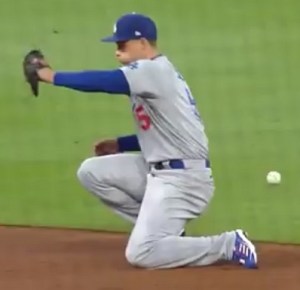
Seager couldn’t stop the unstoppable smash hit in the bottom of the ninth.

It didn’t cost anyone a World Series they were one strike away from winning. It didn’t cost anyone a pennant. It was only Game Two of the National League Championship Series, and one team has a 2-0 disadvantage that actually can be overcome and overthrown in a best-of-seven set.

Corey Seager’s inability to stop Eddie Rosario’s two-out smash up the pipe in the bottom of the ninth Sunday night, and thus stop Dansby Swanson from scoring the winning Braves run, stands to be a candidate for the worst individual moment in Dodger postseason history. Unless the Dodgers can perform that overthrow.

How many years have you mused how readily one player can go from hero to goat in the same game—if not the same inning? But how often does it happen in a game—and a set so far—in which his team seems to see men in scoring position as allergies above opportunities?

Twice on Sunday, Seager played the hero, once in the top of the first and once in the bottom of the ninth. Within minutes of the second play, he stood shriven and the Dodgers stood halfway toward the end of their season, and all he’d been asked to do in that harrowing moment, in effect, was to try what amounted to catching a speeding bullet with his teeth.

Seager opened the Dodger scoring in the top of the first with Mookie Betts aboard on a jam-shot pop single to shallow left. He turned on Braves starter Ian Anderson’s first service and hammered it over the right center field wall. In two blinks he put Anderson and the Braves into a 2-0 hole.

In a four-all tie in the bottom of the ninth, Seager hustled from defensive shift positioning well behind second base to take Dodger reliever Brusdar Graterol’s slighly offline throw to second to erase pinch-runner Cristian Pache on Swanson’s would-have-been sacrifice bunt. That’s the way to make the Braves waste a precious offensive out even worse.

After Braves center field double-switch insertion Guillermo Heredia grounded out to push Swanson to second, Dodger manager Dave Roberts lifted Graterol for Kenley Jansen, with Rosario checking in at the plate having a 3-for-4 night and counting.

A ground out pushed Swanson to second, Graterol was lifted for Kenley Jansen with Rosario coming up, having gone 3-for-4 thus far—and having scored the Braves’ third run when third base coach Ron Washington waved him home daringly on an eighth-inning Ozzie Albies base hit, diving behind the plate just eluding Dodger catcher Will Smith’s tag.

All Jansen did now was throw Rosario one nice little cutter heading for the inside part of the plate. All Rosario did was fire it right back up the pipe at a reported 105.4 miles per hour. Seager had little choice behind second but to turn down to his right to try backhanding the bullet. It blasted off his downstretched glove and into shallow center field.

Swanson shot home with the winner in a 5-4 Braves win, the second walk-off-winning run in two NLCS games for these Braves, who must be feeling as though they’re living charmed lives so far. The bullet bit Seager and the Dodgers. With 32 teeth.

But if you’re going to pound the goat horns into Seager’s forehead, or even demand Dodger manager Dave Roberts’ immediate execution over one or two of his pitching decisions, you really should consider this:

How come the team that led this year’s National League in runs scored, and had a team .806 OPS with runners in scoring position, couldn’t go better than 2-for-18 with four walks and a hit batsman in 24 chances to get runs home so far in this set?

How come the two hits each came from Chris Taylor, with one of them a Game Two bloop misplayed by Heredia into a tiebreaking two-run double in the top of the seventh? Where have all the other Dodger bats been when they manage to get somebody on second base or beyond?

Go ahead and second-guess Roberts’ pitching moves all day long if you must. Argue as you must how foolish it was to send Max Scherzer out to start when Scherzer by his own postgame admission had a dead arm going in.

When Roberts lifted Scherzer for Alex Vesia in the fifth, this time there was no objection from the gassed marksman. Max the Knife was probably lucky that the worst damage in four and a third innings was former Dodger Joc Pederson—now a Brave, by way of the Cubs’ trade deadline fire sale—hitting a two-run homer well above the Chop Shop behind Truist Park’s right field seats in the third.

Argue as you must, too, that Roberts’ real weakness handling his pitching staff isn’t so much playing it by any analytical script as it is relying far too heavily on the more highly-revered members of his pitching staff, instead of paying close attention to which arms have which hot hands regardless of star power.

This time, it was using his 20 game-winning starter Julio Urias in an oft-familiar role—moving him between postseason starting and relieving, a role he’s normally thrived in performing—only to see it backfire spectacularly enough in the Braves’ two-run, re-tying eighth.

Argue as you must that Roberts could well have Graterol for the seventh—after Joe Kelly got rid of the Braves in order in the sixth—and saved Blake Treinen and Jansen to start clean eighth and ninth innings. Or, that he could have given Graterol the night off and used  Treinen and Jansen over the final three innings to divide the last nine outs between them. Or, that he could have brought lefthanded Justin Bruihl in to handle the lefthanded Braves due to swing in the eighth.

Roberts said postgame that in weighing every option the lefthanded Urias was the best arm he had to bring in for the eighth. There’s nothing but positive when you reach for what you think is the best available arm when there’s a two-run lead to protect. That’s what a smart manager does. But even Urias is only human, not Superman.

Sometimes, even in the worst possible moment, the other guys are just a little bit better. The goat hunters too often like to forget that when they’re prowling for a head onto which to plant the horns.

Roberts is no stranger to calculated gambling. If the Urias gambit worked, he’d have resembled a Stengelian genius. When he said postgame that the postseason is the time of year when “careful” isn’t an option, he was dead right. “Careful” wasn’t exactly an option for the Braves, either, when Washington waved Rosario home and left room for Game One walkoff conqueror Austin Riley to send an RBI double to the back of center field.

Since the Braves managed to stand the Urias gambit onto its own head with a little risk taking of their own, it may force Roberts into even deeper such gambling, since Urias was originally his projected Game Four starter but now may be compromised going into that game if he’s still on the slate.

But offer succor to Seager, not sulfuric acid. The Braves didn’t walk Game Two off because Seager did what he wasn’t supposed to do or what he knew better than to do. He’d done his level best to send his team toward a win as the game opened. He’d done his level best to keep them alive and toward extra innings.

Now, Seager did his level best again to keep his team alive but failed to stop the unstoppable bullet. The Dodgers have nine Game Two goats to hold to account. Those batters who couldn’t and didn’t hit with six more Dodgers in scoring position after Seager’s homer and before Taylor’s double.

There’s a reason a smash hit is called a smash hit. Often as not, it’s just too unstoppable.

Georgia on our minds

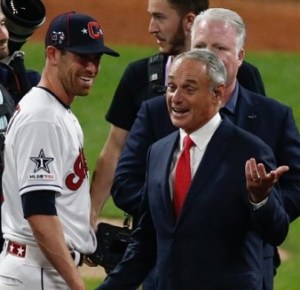
Commissioner Rob Manfred congratulating 2019 All-Star Game MVP Shane Bieber. Did he think deep or hard before moving this year’s All-Star Game out of Atlanta?

Most of us, generations be damned, grew up hearing the two most certain of life’s certainties are death and taxes. Everyone has candidates for the third certainty, including that which reminds us of one thing that crosses partisan lines even if the partisans forget the other side does it, too.

Translated to baseball terminology, that thing seems to be demanding a replay review when ball four is called in election races on what they think they threw for strike three. When such a review turns into something such as a new state election law, as in Georgia, there comes a fourth guarantee: somebody isn’t going to like it.

A lot of somebodies don’t like the law. Such somebodies as former Georgia state lawmaker Stacey Abrams and President Joseph Biden. A lot of not-so-much-somebodies don’t like the law, either, and their agitation as much as any other factors have prompted among other things major league baseball’s government moving this year’s All-Star Game and college draft out of Atlanta’s Truist Park.

Abrams had skin in the game going in. She lost Georgia’s 2018 gubernatorial race to Brian Kemp, who signed the omnibus bill into law earlier this month, by 50,000 votes, claiming then-Georgia secretary of state Kemp erased thousands from state voter rolls.

Kemp had skin in the current game going in, too. For the heinous offense of certifying that now-former president Donald Trump didn’t push the winning run across the state plate in the bottom of the twelfth, regardless that Kemp wasn’t exactly known to favour anyone other than Trump, Kemp faced Trump’s none-too-silent wish to see him thrown out of the league.

The most understandable result of Trump’s post-campaign campaign to overthrow his loss to Biden might have been Georgia and other states reviewing and tightening up their election laws. The only place where fury and back-and-forth charges of foul get more furious might be a baseball game decided (in truth or in allegation) by a close call for or against one or the other side at the final out.

Election shenanigans have been as common in American politics as yard signs, and they didn’t begin or end with such ancient players as New York’s Tammany Hall, Chicago’s Daley Machine, Kansas City’s Prendergast Machine, or Nassau County’s (Long Island) Margiotta/D’Amato Machine. Wherever you landed observing Trump vs. Biden, your least shocking revelation would have been one or another state addressing their election laws in the aftermath.

When Kemp signed the new Georgia election law, Abrams charged that it “suppresses voters, criminalizes compassion & seizes election authority from local + state officials.” That statement wasn’t half as incendiary as Biden’s prompt denunciation of the law as both un-American and as “Jim Crow on steroids.”

Georgia’s real history with Jim Crow is grotesque enough, from state poll taxes (1877) and literacy tests from which descendants from Confederate and Union soldiers were exempt (1907) to the “white primary” rule (1908) that prohibited non-white voting explicitly. Jim Crow in any southern states was (and remains) a portion of American history for which the nation can never be proud.

Now, about the new Georgia election law. Examine deeper than what you see excerpted in the press and aboard social media. Comparing it to Jim Crow is nebulous. It only begins with the fact that mandating seventeen days pre-election (two Saturdays included) for early voting—with mandatory eight-hour-minimum open times and allowance for twelve-hour (7 a.m.-7 p.m.) times—doesn’t exactly “suppress” voters.

A good number of states lack that allowance, including Biden’s home state Delaware which isn’t going to put it in place before the next Congressional election year 2022. Biden himself—with different priorities and a far less grotesque personality, he’s like Trump in showing you wisdom by standing athwart it—also said the Georgia law imposes limits on absentee voting that “effectively” (his word) deny voting to “countless” people. That’s not exactly what the law says or does.

For one thing, no-excuse absentee voting stays in place with just a couple of adjustments. I’d be hard pressed to think a voter is being “suppressed” because the absentee ballot application window is a “mere” 67 days, or because such applications you can now do online, because the state secretary of state is now required by law to offer them online. Or, because the absentee ballot must be received by election officials at least eleven days before Election Day.

Some of the new law’s critics harp about the voter identification portion, which has now shifted it from matching signatures to identification numbers from a voter’s driver’s license or free voter identification card. Lacking either, a Georgia voter can present a photocopy of a utility bill, a bank statement, a paycheck, a government check, or an official document that includes his or her name and address. All they have to do is include the last four digits of their Social Security numbers if they don’t have driver’s licenses or previous voter ID numbers.

If that’s “voter suppression,” I’m Willie Mays. And if that’s something designed to keep non-white voters from voting, I’m hard pressed to comprehend the 2016 Gallup survey that found 77 percent of non-white voters supporting photographic voter identification. You’d think (properly) that non-white voters have just as much stake in preventing real (not alleged) voter fraud as white voters have. And you’d be right.

The new Georgia election law also puts the famous drop boxes into law. They showed up in Georgia for the first time last year thanks to the pan-damn-ic, and now they’re legally mandatory with or without the coronavirus. The new law requires one drop box for every one hundred thousand registered voters or one for every advance vote location in any Georgia county, whichever number is smaller.

Abrams was right about one thing: the new law does “criminalise compassion,” sort of. Giving, offering, or helping give food and/or drinks to people within 150 feet of polling places or within 25 feet of voters in line to vote becomes a legal misdemeanor. Even, seemingly, when the benefactor isn’t discussing the election or particular favoured candidates.

The law also bars ordinary Georgians from photographing or recording their own votes. Guess who gets an exemption from that: the state secretary of state, whom the law requires to create “a pilot program for the posting of digital images of the scanned paper ballots created by the voting system,” with the images becoming “public records subject to disclosure.”

I’ve read about enough early proposals for inclusion in the law that were foolish at minimum, dangerous at most, and thrown out of the bill before it became a final product. But how the hell did that one slip in? How close do you think that one gets to the kind of thing you thought was reserved for the Third Reich, the Soviet Empire, and other authoritarian/totalitarian states who’ve used ballots when allowed at all against their citizens?

Kemp and any Georgia governor has a line-item veto power—but it affects only statewide and state executive budget items. Even he can’t be comfortable with the idea that his or any Georgia secretary of state can come that close to crossing the line from scanning paper ballots to making Georgians’ votes public.

You can bank it. Baseball commissioner Rob Manfred and his minions probably didn’t read the new Georgia law in almost any way, shape, or form. You can understand why, since the law’s volume is 68 percent (92 pages if you’re scoring at home) the length of Philip Roth’s legendary novella Goodbye, Columbus. But the mis- or mal-excerpting of the law did them no favours and puts baseball into a precarious position.

For one thing, the Atlanta Braves themselves aren’t thrilled with baseball pulling the All-Star Game out of their home playpen. Indeed, even Abrams herself has said Georgia companies shouldn’t jump all the way into boycotts but first “use the chance to publicly condemn the law, invest in voting rights expansion and support wide-ranging federal election legislation before they’re targeted with a boycott movement,” as the Atlanta Journal-Constitution puts it.

For another thing, former UN ambassador and Atlanta mayor Andrew Young demurs from any such boycott, especially involving Atlanta, whatever he thinks of the new law, telling The Athletic, “Everything doesn’t depend on sports. But if you hurt the sports, you hurt the hotels, you hurt the airport, you hurt every business in town . . . [Atlanta’s] the 44th largest economy in the world — and, you can quote me, I don’t know why anybody wants to [fornicate] with that.”

Manfred and his look more like knee-jerkers than thoughtful protesters who considered the whole thing reasonably. (They look, in other words, much the way Trump looked when thundering against Maximum Security’s 2019 Kentucky Derby qualification or on behalf of Pete Rose’s Hall of Fame entry without troubling himself with the deets on both rejections.) Lacking an immediate suggestion for an alternate All-Star Game site this year is the least of Commissioner Nero’s largely self-imposed problems.

On Wednesday night, some Republican lawmakers in Georgia’s state House of Representatives voted to cancel a tax break for Georgia-based Delta Air Lines, on the grounds that Delta objected to the new election law. “You don’t feed a dog that bites your hand,” said Georgia’s House speaker David Ralston. “You got to keep that in mind sometimes.”

Imagine the furies if Democratic officials behaved likewise. Oops . . . Lois Lerner, for openers, call your office.

Wherever you sit about the law itself, the thought of governing officials deciding a private entity needs to be punished for taking any position regarding any legislation or policy should scare the hell out of you. If they can do it to an airline, they can do it to anything, including the business of a game.

Fish fouled

Adam Duvall has just low-fives third base coach Ron Washington after helping the Braves to an eleven-run second and a 29-9 slaughter.

Not even Joe West’s umpiring crew working the game could prevent it. For all anybody knows, maybe even Country Joe himself took pity on the Miami Marlins and called the Hague–or, at least, the Georgia Department of Natural Resources—himself, to file on their behalf against the abuses they suffered in Atlanta Wednesday night.

Or, at least Marlins manager Don Mattingly might have slipped a note to Atlanta Braves manager Brian Snitker, asking only partially puckishly, “Brian, could we have the bottom of the second back? Pretty please? With tartar sauce on it?”

Call it the Fish Fricasee. But call the Braves’s 29-9 cleaning, scaling, and fileting the arguable nastiest combined attack of ground troops, close-cover strafing, aerial assault, and strategic bombing ever committed by them, their 29 runs setting a new franchise record.

Sure, the Milwaukee Brewers de-clawed the Detroit Tigers 19-0 in Comerica Park earlier in the day. Only they did it in gradual clips and snaps, a couple of runs here, a few there, a few more yonder. Who the hell needed that nonsense from rude guests when you had the hosts in Truist Park treating their oceanic guests like a shipment of cat food?

What started as a 2-0 Marlins lead got vaporised by fourteen Braves batters including four repeaters before Ender Inciarte showed the Fish mercy and cast his line for an inning-ending ground out to first base. The carnage only began with Dansby Swanson singling his way aboard against Marlins starter Pablo Lopez.

Lopez’s next two mistakes were back-to-back walks to Austin Riley and Adam Duvall. And then it began:

* Ozzie Albies returning from a month on the injured list pushed Swanson home with a ground out to first.

* Inciarte sent a sacrifice fly to the deeper region of left center field, tying the game at two.

* Duvall took third on the play and the Marlins called for a review to see whether third baseman Brian Anderson got the tag on the sliding Duvall’s leg before or after a) Duvall’s foot hit the pillow and b) Riley crossed the plate. The review said no, sir, umpire Hunter Wendelstedt making the emphatic safe sign.

* After Lopez walked Ronald Acuna, Jr., Freddie Freeman hit a line drive to right that diving Marlins right fielder Monte Harrison couldn’t grab, the ball bouncing under his blue glove, scoring Duvall and sending Acuna to third.

* Marcell Ozuna floated a pop to shallow left near the line that hit the grass before Miami left fielder Lewis Brinson could reach it, sending Acuna home. “And the Braves are first-and-thirding the Marlins to death,” crowed Braves broadcaster Chip Caray after the fourth run rang in.

* Travis d’Arnaud, the former Met, checked in with first and third yet again. He hit the first-pitch hanging changeup into the first empty row of the left field seats. The blast ended Lopez’s evening and it’s not impossible that the only thing the Marlins righthander could say when Mattingly came forth to end his misery was, “What took so long, Skip?”

Exit Lopez, enter Jordan Yamamoto for the Fish. Swanson greeted him with a base hit to left, then Riley shot one right between shortstop and third basemen trying to converge to send Swanson home. Then Duvall hit yet another first pitch into the right center field bullpen.

Yamamoto finally said too much was enough about the Braves’ first-pitch hitting and wrestled Albies to an eighth pitch. Unfortunately, it was finally ball three and a full count, forcing Yamamoto to throw a ninth pitch. And Albies drove it four rows up the empty center field seats.

A smooth-looking righthander otherwise, Yamamoto shares a surname with World War II’s Japanese Combined Fleet commander. What the U.S. Navy did to Admiral Yamamoto’s forces at Midway and beyond, the Braves did to the Marlins in the bottom of the second. They one-upped the ten-spot second under which they might have buried the Philadelphia Phillies two Sundays ago—but for the Phillies crawling back to make the Braves sweat out a 12-10 final.

Yamamoto the pitcher’s misery didn’t end when he and the Marlins finally escaped the second inning with what was left of their lives, unfortunately. He’d pitch two and two-thirds innings total and leave with twelve earned runs on his evening’s jacket. Making him only the second relief pitcher in seventy years to take twelve or more for the team, joining the sad company of Vin Mazzaro—who took fourteen from the Cleveland Indians for the Kansas City Royals in two and one third on 16 May 2011. He’d have had better survival odds if he was a World War II naval commander.

About the only thing the Braves didn’t do to the Marlins Wednesday night was drop the atomic bomb. Oops. Take that back. After a one-out single, a hit batsman, and a shallow base hit against another Marlins reliever, Josh A. Smith, Duvall—who also hit a three-run homer in the fifth—dropped the big one, slicing salami on an 0-1 meatball in the bottom of the seventh, for what proved the final four Atlanta runs.

Whoever files the report with the Hague, or with the Georgia department’s fisheries management, they’re going to have to include that. It might be the only time in history that a late atomic bomb did less damage and was less lethal than what happened earlier in the war.