We interrupt your World Series fun . . .

Yoshinobu Yamamoto

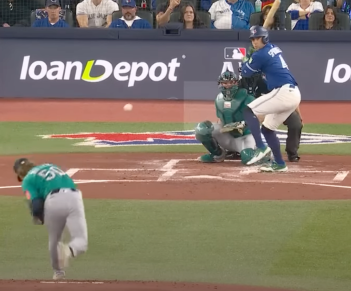
Yamamoto carving the Blue Jays in Game Two, following the Jays’ bludgeoning the Dodgers in Game One, was rudely interrupted by the commissioner putting his foot in his mouth again.

Hand it to Rob Manfred. Baseball’s commissioner certainly found a way to soil or at least cloud our World Series pleasure. The Blue Jays bludgeoned the Dodgers in Game 1; Yoshinobu Yamamoto put restraints on almost all the Blue Jays to even it up in Game 2. Nothing but fun.

That’d teach us. Baseball’s lessons include periodic reminders that Murphy’s Law includes a clause about no good deed going unpunished. We just couldn’t be allowed to love this Series without Manfred invited to spread a little fertilizer across the field.

We couldn’t be allowed to enjoy Blue Jays outfielder Addison Barger becoming history’s first pitch hitter to step up with the bases loaded and send one into the seats. We couldn’t be allowed to enjoy Barger plus Dominic Varsho and Alejandro Kirk going long in the middle of the Jays making life miserable for Dodger starter Blake Snell and a few other starters-turned-bullpen bulls, to the tune of a 11-4 Game 1 blowout.

We couldn’t be allowed enjoy Yoshinobu Yamamoto carving the Blue Jays like Thanksgiving turkeys in Game 2, going the distance for a second straight postseason start, the first Dodger to do that since Orel Hershiser in 1988 and the first anyone to do that since Curt Schilling in 2001. Not to mention the Dodgers making a nice mix of small and tall ball — an RBI single here, a pair of solo homers there, a bases-loaded wild pitch, and a run-scoring force out yonder, to beat the Jays in Game 2, 5-1.

No, that pleasure was just too much, wasn’t it? We couldn’t even enjoy the pleasure of calling out the cone-head contingency in Rogers Centre chanting, “We don’t need you! We don’t need you!” whenever Shohei Ohtani strode to the plate, Ohtani having spurned a Jays offer on behalf of staying in southern California even if it meant switching leagues.

It wasn’t quite as contemptibly disgusting as the notorious AI-generated feces flyer his apparent pal in the White House dreamed up a weekend ago. No one that I know of is rushing to strap Manfred into the cockpit of a Boeing Shitterfortress yet. But if reporters who spotted and buttonholed him before World Series Game 2 had premeditated it, they couldn’t have done a better job of getting Manfred to put his foot in his mouth. Yet again.

With a gambling scandal battering the NBA, Manfred was asked whether baseball remains vigilant in protecting the game’s integrity from gambling infestations. After all, two Guardians pitchers (Emmanuel Clase, Luis Ortiz) remain in drydock while investigations continue into whether they accommodated suspicious microbets while pitching in June.

“We didn’t ask to have legalized sports betting,” Manfred said Saturday night. “It kind of came, and that’s the environment in which we operate. Now we don’t have a lot of choice about that, and if it’s going to change — broadly change — probably the only way it would happen is the federal government.”

The federal government.

The one whose chief executive may have strong-armed Manfred into declaring, whoops, the “permanent” banishment mandated for violating Rule 21(d) didn’t mean “permanent,” after all, meaning the end of the late Pete Rose’s exile from baseball and blockage from the appropriate Hall of Fame ballot.

The one whose chief executive conducts a dog-ate-my-homework presidency with more glee than his predecessors ever showed, while threatening the long tentacles of the law upon people in and out of government, for no crime other than disagreeing that he can do as he damn well pleases, indeed, the Constitution (which says otherwise) and the law be damned. And, with more glee than his worst such predecessors ever allowed themselves.

Manfred also said he didn’t want to discuss baseball’s pending labour issues right now (“I want to get seven exciting [World Series] games. A year from now, we’ll have plenty of time to talk about labor”), but boy have we had great postseasons since the 12-team system with wild card rounds, haven’t we?

If anyone put in front of Manfred the thought that this postseason has actually seen nothing but first-place teams in both the League Championship Series and the World Series, I haven’t been able to spot it yet.

Perhaps the commissioner wishes to fix things that might actually be broken. How about negotiating a salary floor, not a salary cap, with reasonable penalties for falling short of the floor, the better to get those billionaires’ boys’ club members who refuse to invest in their teams to either invest or divest?

How about expanding to two more major league teams, one for each league? Then, how about rebuilding baseball’s leagues and divisions thus:

1) Two conferences in each league. We’ll argue over naming them later.

2) Two divisions per conference. We’ll argue over naming them later, too.

Then, we move toward restoring genuine championship play:

3) No more wild card nonsense. If you didn’t finish the regular season with your butts parked in first place, you get to wait till next year. (A properly instituted and enforced salary floor may also stop Reds, White Sox, Rockies, and Pirates fans from awakening on Opening Day thinking, “This year is next year,” but I’d rather sacrifice a great if sad saying on behalf of up-and-down league competitiveness.)

4) No more regular season interleague play. Save it for the All-Star Game. And, while we’re at it, be done at last with those fakakta All-Star and City Connect uniforms that run the gamut from ugly to disgusting and back to repulsive. Let the players wear their proper team uniforms for the All-Star Game again. (And, for the Home Run Derby, if it must continue and for those invited to swing. Which reminds me: only bona-fide All-Stars shall be considered for Home Run Derby participation.)

5) Best-of-three division series, featuring none but the regular season division winners.

6) Best-of-five League Championship Series — the way it was from the 1969 birth of divisional play through 1984.

7) The World Series shall remain a best-of-seven, and thus have its absolute primacy restored.

Last but not least: 8) The foregoing will prevent postseason saturation, while 9) still providing plenty of postseason games. At maximum, there would be (count them!) 29 games. Even if every such series ends in a sweep (remember, baseball is the sport where anything can happen — and usually does), you’d still have 20 games.

Now, back to our World Series fun. Let’s get back to determining whether ancient Max Scherzer, the Blue Jays’s planned Game 3 starter at this writing, can summon up the old Max the Knife one more time. Or, whether the Dodgers help him decide the hard way whether it’s time to think about having his glove bronzed and letting those great seasons past make his Cooperstown case.

ALCS Game One: Miller time for the Mariners

Bryce Miller, George Springer

George Springer is about to demolish Bryce Miller’s first pitch of ALCS Game One. It was the only score Miller would allow over six otherwise spotless innings on short enough rest. (Fox Sports television capture.)

At the split second George Springer’s bat connected with Bryce Miller’s first pitch of this year’s American League Championship Series, you could be forgiven if you heard Mariners fans groaning. When the ball banged the Canada Dry sign above the right center field bullpen, you might have heard the groaning turn to moaning.

One pitch, one swing, the 21st postseason bomb of Springer’s career, and only the third leadoff bomb in League Championship Series history since pitch counting began in 1988, according to The Athletic‘s Jayson Stark. Just like that, the Blue Jays took a lead.

And Springer’s opposite-field smash on a fastball away, sending him past Hall of Famer Derek Jeter for fifth place on the all-time postseason bomb list, wasn’t the only reason Mariners fans groaned and moaned.

In the top of that first inning, they groaned, moaned, and fumed when the Mariners didn’t call for a review of that play at the plate on which Cal Raleigh (one-out hit, advancing to third on followup hit) was tagged out when it appeared he’d managed to get his foot on the plate through the legs of Jays catcher Alejandro Kirk. But television replays showed Raleigh’s foot landed a second or two after Kirk tagged his torso.

Were the Mariners unduly alarmed after Springer sprang?

Not after Miller wriggled out of further trouble in the form of a pair of walks courtesy of inducing a pair of line drive outs and a short fly out.

Not after Miller matched Jays starter Kevin Gausman point for point, dollar for dollar, from that point forward, until Raleigh atoned for missing the first inning score by squaring Gausman up, with two out in the top of the sixth, and driving a 2-2 service a little further than Springer’s traveled, about five rows up into the bleachers above that bullpen.

Not after Jays manager John Schneider decided that a followup walk to Julio Rodriguez should be he end of Gausman’s evening before he might incur jn any further damage. That came soon enough when Gausman’s relief Brendon Little wild-pitched Rodriguez to second and surrendered Jorge Polanco’s sharp opposite-field line RBI single to left to crack the one-all tie.

Not after Randy Arozarena wrung a leadoff walk out of Jays reliever Seranthony Dominguez in the top of the eighth, stole second and third while Raleigh suffered a called strikeout, then—after another walk to Rodriguez—came home on another Polanco steak, this time a spanker bouncing three times through the infield and a few more into right.

“I just choked up and wasn’t trying to do too much,” said Raleigh postgame about his bullpen-clearing blast. “I was just trying to get bat on ball and really put something in play, maybe find a hole. I didn’t want to punch out again.” He didn’t seem to mind putting that ball out of reach, out of play, and out of sight, either.

Kevin Gausman, Cal Raleigh

Raleigh is about to smoke Gausman’s splitter for a trip above the right field bullpen . . .

Aside from all that, it was Miller time. For a guy pitching on three days’ rest for the first time in his major league life. For six inning of one-run, two-hit baseball that including getting rid of seventeen of his final nineteen batters. He needed a little comfort from Raleigh at the mound while navigating his way out of that first-inning fire, but that was enough.

Miller went two innings longer than Mariners manager Dan Wilson expected him to go on short rest, only nobody told Miller until he was done for the night.

“They didn’t tell me anything, any plan,” said the lad who threw 27 pitches in the first inning and 49 the rest of his outing. “So I was going out there just letting it rip until they came out and got me.”

“That was incredible from him,” said Mariners reliever Matt Brash (now, there’s a classic name for a relief pitcher), who was one of three Mariners bullpen bulls along with Gabe Speier and Andres Munoz to pitch perfect innings once Miller’s time expired for the evening. Thus the 3-1 Mariners win Sunday night.

“I knew this was the biggest start of my career so far,” said Miller, whom one report revealed stood in Rogers Centre’s center field’s farthest location from the plate staring that direction to help focus, “and I just wanted to get out there and mentally kind of get in a zone and visualize having success on the mound.”

Miller’s season wasn’t always so simple. After a 2.94 ERA in 2004, he ran into elbow inflammation twice and an inflated ERA. He didn’t find himself on his horse fully until some time in August. Then he gave hints of his postseason potential in ALDS Game Four, pitching 4.1 shutout innings against the Tigers.

Remember: These Blue Jays are the ones who demolished the Yankees 34 runs worth in their American League division series and made the Bronx Bombers resemble the Bronx Broken. The Mariners got rid of 23 of the final 24 Jays hitters while they were at it. All of a sudden the Joltin’ Jays didn’t look all that intimidating despite Springer’s first-pitch flog.

Remember, too: These Mariners played fifteen innings Saturday to come out of their ALDS alive and reasonably well and leaving the Tigers for dead. They had to fly cross country and into Canada and endure a four-hour departure delay when mechanical issues forced their airline to get another plane up to Seattle from Los Angeles. They didn’t even have time for a Rogers Centre workout before ALCS Game One.

I’m not sure I’d recommend this as a continuous practise, but it seems as though now and then a team that should have been suffering exhaustion can turn one of the league’s howitzer corps to one side for one night. Now we’ll get to see if the Mariners can manhandle the Jays on a proper night’s sleep and with a proper pre-game workout.

We may even get to see Miller on the mound in a game that would mean the pennant for the Mariners if they win. The lad’s already proving that unthinkable isn’t necessarily impossible.

ALDS Game Four: The Yankees, running on empty

Toronto Blue Jays

Yankee Stadium became Blue Jay Way Wednesday night, as the Jays turned the Yankees aside to advance to the American League Championship Series.

So much for the Monument Park ghosts Aaron Judge cited when the Yankees won their American League division series Game Three. They come out to play only once per postseason series. Or, the Yankees fall asleep at the switch at the plate, on the mound, or in the field, the ghosts return to the Elysian Fields feeling somewhere between dismayed and betrayed.

Once upon a time, in a different Yankee Stadium, fans taunted a World Series opponent with “Mystique and Aura, Appearing Nightly,” after one of the opponent’s pitchers suggested the Yankee couple didn’t show up in their home ballpark. Now, Mystique and Aura haven’t been seen in that or the current Yankee Stadium in a very long time. In fact, that couple may just be so 20th Century.

Wednesday night, Yankee Stadium became Blue Jay Way. The Jays finished what they started, a 5-2 Game Four win that sent the Yankees from the American League division series to season’s oblivion.

Time was when the Yankees knew they were dynastic and knew accordingly how to finish what they started, whether it was the pre-divisional win-or-be-gone pennant race and World Series (most of the time) or the divisional era pennant and World Series, for a little while, anyway. That was then. This has been since 1978: The Yankees are good for occasional World Series wins.

But you have to get there, first. And even that’s no guarantee. The Yankees didn’t collapse as spectacularly in this division series as they did in last year’s World Series. Well, wait a minute. Getting out-scored by the American League East-winning Blue Jays 34-19? You can call it a collapse, even if the Yankees did manage to win Game Three by three runs.

These Blue Jays were a lot more formidable than this year’s Red Sox, whom the Yankees vanquished in the wild card set after losing the first game. These Blue Jays, who took the AL East by winning their season series against the Yankees, were no pushovers. Maybe the Yankees weren’t quite prepared to handle the onslaught the Blue Jays laid upon them.

Maybe nobody was. Not even the Jays themselves.

But any further thoughts about Yankee domination ought to be set aside for now and, perhaps, the foreseeable future. This is their 21st Century legacy to date: They’ll make noises in the pennant races, they’ll reach their postseasons, but other than 2009 they’re not going the distance without serious changes.

So Judge led all the Yankee regulars with his 1.618 division series OPS? Vladimir Guerrero, Jr. nearly equaled it with his 1.609. As Jayson Stark (The Athletic) reminds us, the Jays batted in 34 innings in this set and scored those 34 runs. That’s a run per inning average, folks. And would you like to know the only other time any Yankee team got yanked out of a postseason by an AL East team? Two words: 2004 Red Sox.

Whatever the Yankees sent to the mound, the Jays had answers when it counted. Stark is congenitally unable to miss the ironies or the humours, so he couldn’t resist adding that the Jays as a team in this ALDS had the same slash line, practically, as Miguel Cabrera when he won the 2012 AL Triple Crown: The ALDS Jays—.338/.373/.601. Cabrera 2012—.330/.393/.609.

The Jays didn’t exactly smother the Yankees in Game Four the way they did in Games One and Two; they won by a mere 5-2. But you couldn’t blame Guerrero for trolling the Yankees with the famous victory whoop by their now-retired longtime voice John Sterling, and with Hall of Famer-turned-broadcaster David Ortiz right by his side: DAAAAAA YANKEES LOSE! 

They do when they forget they can’t run nine Aaron Judges out to bat.

The Jays as a team slashed .338/.373/.601 (OPS: .974) for the set. That was without Bo Bichette (injury) in the lineup. The Yankees as a team slashed .250/.327/.404 (OPS: .731). That was with Judge in the lineup. In Game Four the Yankee bats slept and the Yankee defense had a hole in it.

Once again, as observers have hammered most of the year, the Yankees simply couldn’t find more than one or two ways to push runs across the plate without hitting for distance.

They had the grand opportunity of Game Four with the Blue Jays going to a bullpen game, the better to save Kevin Gausman to start a Game Five that proved anything but on deck. The Jays pen helped send the Jays forward. The Yankee bullpen, one of their most suspect parts, couldn’t quite contain the Jays’s more balanced hitters.

Now the Jays will have Gausman to pitch one of the first two American League Championship Series games. The series the Yankees won’t see except on television or with ballpark tickets.

Jazz Chisholm, Jr., who can play like either a superstar or a scrub and sometimes both in the same game, watched a likely double play ball bound off his glove and behind second base, into center field, in the top of the seventh. It set up first and third for the Jays and ended the evening of Yankee starting pitcher Cam Schlittler, whose ballsy performance against the Red Sox saved the Yankee season and who’d only surrendered a pair of earned runs to that point.

Oops. A stolen base (Andrés Giménez) before a strikeout (George Springer) later, Nathan Lukes lined a two-run single to left center to leave the Jays up 4-1. An inning later, Myles Straw made it 5-1 with an RBI single. The Yankees’ only answer to that was Jasson Dominguez’s leadoff double in the bottom of the ninth and Judge singling him home.

So it turned out Blue Jays broadcaster Buck Martinez wasn’t just smack-talking when he said before the postseason the Yankees weren’t that good a team. In Game Four the Yankees made him resemble a prophet. Mystique and Aura don’t live in the Bronx  anymore.

Now I’m going to make an ask of what’s possibly the least forgiving fan base in baseball this side of the Mets, the Cubs, the Red Sox, and the Phillies: Give the Yankees a little time before you start demanding summary executions.

Too-long-time general manager Brian Cashman’s time should be done. Long-enough-time manager Aaron Boone is a good, not necessarily great manager, but he’s never had a losing season since he took the Yankee bridge in 2018. If there are miracles in the Yankee firmament, they’re probably Boone landing eight straight winning seasons almost in spite of Cashman’s makings and unmakings.

Getting smothered by the Jays this time around isn’t quite the equivalent of the manner in which the Yankees smothered themselves ending last year’s World Series. Or the manner in which they got overthrown by the Red Sox in 2004. So give them a break. Maybe a month-long break.

That doesn’t mean anyone’s trying to take your fun away, Yankee fan. Forget for one month that to err is human but to forgive must never become Yankee policy. Forget that maybe this edition of the Yankees simply had nothing left in the tank for Game Four.

Then you’ll have plenty of time for the yelling, the screaming, and the demanding of executions on 161st Street. We promise.

“There’s an end for all athletes”

Joey Votto

Joey Votto, shown batting in a 2019 game. 

Watching a baseball great retire at all is enough. Watching him do it during a season is more of an eye-opener and a mood killer. Hearing him say honestly that he doesn’t have it anymore could very well be baseball’s red badge of courage.

When Joey Votto realized he simply couldn’t will himself to another self-resurrection after a slow start, the way he’d done on more than one occasion during his 17-season major league career, he did the only thing that could be done by a man who said often enough that he’d leave money on the table rather than play poorly.

Realizing his comeback attempt to make it to the Blue Jays wasn’t going to happen, Votto simply retired last week. Just like that. No grand gesture, no grand and often foolish farewell tour. The greatest first baseman in the history of the Reds, bought out by his longtime home after last year, unlikely to turn a minor league contract with the Jays into seeing Jays action unless he was seated in the ballpark, decided enough was more than enough.

The day after Votto made his Instagram announcement, the Reds met the Jays at Rogers Centre and buried the Jays 11-7. Votto was delayed by car trouble and didn’t get to see the game, but he did get to the visitors clubhouse in order to say hello and goodbye to old teammates. Then, as The Athletic‘s Kaitlyn McGrath wrote, he talked to the press.

“I was not waxing and waning,” Votto began, “but I had moments where I was like, ‘Is this the right thing to do? And do I want the organization to tell me that I’m done?’ And I just decided, you’ve played long enough, you can interpret what’s going on. And I was awful. I was awful down there. And the trend was not fast enough, and I didn’t feel at any point in time like I was anywhere near major-league ready. I can say to the very last pitch I was giving my very all. But there’s an end for all athletes. Time is undefeated, as they say.”

Because he never got to suit up for the Jays in regular-season major league play (a longtime dream, since he grew up rooting for the Jays in his native Canada), Votto gets to retire as a single-team player. He also gets to retire as one of the game’s über-mensches, a guy who throve on fan interaction, liked to hang at chess clubs, and spoke out about a battle with protracted anxiety and depression in the wake of his father’s death.

Votto even made time to make it up to a young girl who adored him and the Reds but wept when he was tossed from a game in San Diego in the first inning over arguing balls and strikes. Told that little Abigail Courtney was heartbroken at not being able to see her hero play, Votto sent her a ball signed, “I am sorry I didn’t play the entire game. Joey Votto.” Then, he blew her family to tickets for the next day’s game and made a point of meeting and spending time with the girl, not to mention signing anything she handed him.

Last November, after the Reds declined his option and handed him the buyout, Abigail’s mother, Kristin, Xtweeted her immediate response: “The Reds are a bunch of PUTZES!!!” Mom assured one and all that Abigail (now 9 and playing softball in southern California) used that word only when she’s furious.

You can imagine about three-quarters of Reds Nation reacting comparably. Even if they knew in their hearts of hearts that Father Time caught up to their longtime first base fixture who was an on-base machine to what some critics thought was a fault: they blamed him for refusing to swing at unhittable pitches even with chances for “productive” outs. Please.

Your most precious commodity at the plate for an inning is outs to work with; your second most precious is baserunners. And if you have men on base ahead of you, would you rather see the man at the plate drawing the walk or swinging away for the “productive out” but  landing himself in a rally-altering or killing double play?

Let’s flip that coin and see what the other side says. Oh, yes — Votto swung at only 19 percent of the pitches he saw that didn’t hit the strike zone between 2012-2020; you can presume that, framing that period, Votto’s selectivity rarely wavered otherwise. A guy retiring with a .409 lifetime OBP, who led his league in that stat seven times and the entire Show three, doesn’t get there by swinging at practically anything. Nor does he create runs, which Votto did quite splendidly, retiring thus with a +145 wRC.

That and far more are why Votto will end up with a plaque in Cooperstown in due course. You might care to see how he sits against all post-World War II/post-integration/night-ball era Hall of Fame first basemen according to my Real Batting Average metric. (TB + BB + IBB + SF + HBP / PA.)

First Base PA TB BB IBB SF HBP RBA
Jim Thome 10313 4667 1747 173 74 69 .653
Jeff Bagwell 9431 4213 1401 155 102 128 .636
Willie McCovey 9692 4219 1345 260 70 69 .615
Joey Votto 8746 3706 1365 147 48 81 .611
Harmon Killebrew 9833 4143 1559 160 77 48 .609
Orlando Cepeda 8698 3959 588 154 74 102 .561
Gil Hodges 8104 3422 943 109 50 25 .561
Eddie Murray 12817 5397 1333 222 128 18 .554
Tony Perez 10861 4532 925 150 106 43 .526
HOF AVG .592

But Votto also joins a small roll of players who saw the end before it showed itself to them. Dearly though he wanted one final major league turn, in and for the city where he grew up, Votto didn’t want a free ride or a legacy call-up. If he didn’t earn his way, he didn’t want to be there. Out of respect for the Jays and the fans.

“This isn’t my organization, so how can I show up and make it my day, my moment?” he said. “Here’s an at-bat, here’s a game, here’s a stretch of time. To me, it’s disrespectful to the game. I also think it’s disrespectful to paying fans that want to see a high-end performance, and I would have given them an awful performance. So truly, I can say that I tried my very best and I just came up short. And I’ve had 22 years of not coming up short, so I guess I’m due.”

If that resembles an echo of another city’s baseball past, it should. Votto faced Father Time slightly over 35 years after the arguable greatest player in Phillies history called it a career — in a season’s second month, no less.

“I could ask the Phillies to keep me on to add to my statistics,” said Hall of Famer Mike Schmidt through tears at a press conference, “but my love for the game won’t let me do that.” He did, Thomas Boswell wrote, “what so many great athletes have failed to do; he left us wanting more.”

So did Joey Votto.

This essay was published in slightly different form at Sports Central.

Starting postseason life with two bangs

Royce Lewis

Sometimes things line up too perfectly to pass up on those opportunities.—Royce Lewis, here rounding third off the second of his AL wild card series-opening home runs Tuesday.

Children who grow up with dreams of baseball have numerous supporting fantasies. Rest assured, once they realise they can play the game well, they dream of making the Show. Many of them then dream of going number one in the draft, with or without the glandular signing bonus. Many of those dream of going number one, making the Show, then making the postseason for the first time and making . . .

Waves? Big splashes? Broken precedents? All the above? Ask Royce Lewis, the Twins’ infielder who slotted as the team’s designated hitter for Game One of their wild card set against the Blue Jays Tuesday. The same guy who hit grand slams in back-to-back games against the Guardians in July.

He faced formidable Blue Jays starter Kevin Gausman in the bottom of the first with one out and Edouard Julien aboard (leadoff walk). He worked the count full. Then, he turned on a pitch in the middle of the inside part of the plate, and it sailed on a high line into the left field seats. Game One wasn’t ten minutes old, and Lewis put the Twins up 2-0.

Two somewhat quiet innings later, Lewis checked in against Gausman again. This time, he opened the inning. This time, he didn’t wait for the count to get full. This time, Gausman’s 3-1 service came right down the pipe. This time, the ball took a flight the opposite way, banging off the top of the right field wall, making it 3-0, Twins, turning Target Field temporarily into the world’s largest outdoor nuthouse.

Two plate appearances. Two swings. Two bombs. There have been 58 number-one draft picks since Rick Monday went number one to the then-Kansas City Athletics in 1965. There have been a number of big boppers among them. Only three of those number-ones became Hall of Famers. (Harold Baines, Ken Griffey, Jr., Chipper Jones.) Four, if you count Hall of Famer-in-waiting Joe Mauer.

Not a one of them began any postseason life they had with even one home run, never mind two, never mind hitting the first bomb of any postseason, never mind being responsible for every run scored in their team’s postseason series-opening win, which the Twins won 3-1. The lone Toronto run: Kevin Kiermaier singling Bo Bichette home in the top of the sixth.

“That’s a God thing,” Lewis said postgame. “I’m just blessed to be part of it. It felt like I was blacked out the whole game. My heart was racing.” He keeps blacking out like that and the Twins have an excellent chance of going places other than home prematurely this postseason.

Wherever Lewis’s career goes from here, he’s got bragging rights forever on every fellow member of the Number One Club. He also has the honour of being the man most responsible for ending the Twins’ most peculiar negative achievement, stopping their postseason game losing streak at eighteen. Not to mention only the third player ever, regardless of draft position, to open his postseason life with a first-inning home run, joining Evan Longoria (Rays, 2008) and one-time Twins favourite Gary Gaetti (the eventual 1987 World Series winners).

Eighteen straight postseason games lost over nineteen years, under three different managers and with several franchise icons in the mix, from Mauer to Johan Santana to Torii Hunter to Byron Buxton. It took a guy whose first couple of seasons in the Twins’ fatigues have been disrupted rudely by injuries and who was freshly recovered from a hamstring injury to step up Tuesday and bring his demolition kit to the park with him.

“We just wanted to put an end to something that was very unfortunate to our beloved fans,” said Twins starting pitcher Pablo Lopez, who pitched five and two-thirds strong innings before Kiermaier’s steak single ended his day. “Our fans have been so great to us—they support us, they root for us no matter the situation. It felt right. The way I see it now, we have a new streak going.”

“I thought the place was going to split open and melt,” said Twins manager Rocco Baldelli—who has a pair of postseason home runs on his own resumé, including in the 2008 World Series for the Rays. “Honestly. It was out of this universe out there on the field. The fans took over the game. They helped us win today.”

The Twins’ fielders took over when the fans didn’t. There was center fielder Michael Taylor stealing a prospective game-tying double from Matt Chapman with a flying leap against the fence in the top of the second. There was, especially, Kiermaier’s chopper in the fourth, sneaking away from onrushing Twins third baseman Jorge Polanco.

Bichette on the run from second thought he had a shot at scoring. Plantaar fasciitis-addled shortstop Carlos Correa thought otherwise. He yanked himself running to his right, picked the ball barehand as Bichette headed down the third base line, threw off balance, and managed somehow to get the diving Bichette out by about the full length of a catcher.

“If you like watching the biggest players making the biggest plays in the biggest games,” Baldelli said, “then you should go watch that play. It was fantastic.”

Lewis had the fantastic franchise wrapped up in the first and the third, though.

“Some people believe in fate,” he said. “Some people believe that the things we do today drive what we do tomorrow. But sometimes things line up too perfectly to pass up on those opportunities.”

He had two pitches line up just that perfectly as ironclad evidence.