

Red Sox center fielder Jarren Duran hoists the clear bat awarded the All-Star Game’s Most Valuable Player. His tiebreaking two-run homer held up to give the AL the 5-3 win.
God help us all, everyone. The All-Star break began with a pre-Home Run Derby singing of “The Star Spangled Banner” Monday night (by country star Ingrid Andress) that made youth cringe and elders think wistful thoughts of Roseanne Barr. It ended with a tenth American League All-Star Game win in eleven seasons.
In between, of course, was much to ponder and much to dismiss as patent nonsense, which seems to be far more the norm than Chicago Tribune sports editor Arch Ward, who initiated the game in 1933, might have imagined.
Phillies third baseman Alec Bohm could be seen having to labour to keep from laughing (presumably, that he might not weep—or wish to commit manslaughter) when Andress tackled “The Star Spangled Banner” as though too well besotted. It turned out that appearance was everything: She copped the following day to being drunk and having enough issue with it to seek rehab and recovery.
Wish her well, but demand to know why nobody in baseball’s administration noticed she was drunk as she took the mike in the first place.
That was then: The Derby rules were, a participant had ten outs to hit as many homers as they could, the hitter with the most such bombs advanced, and that was that. So simple that, in fact, even Mark Belanger (human Electrolux at shortstop, but a spaghetti bat who hit three fewer homers in eighteen major league seasons than the late Hall of Famer Willie Mays hit in the first half of 1965) could have done it.
This is now: Round One—three minutes or forty batted balls, whichever came first, followed by an old-style three outs to hit as many bombs as possible. Round Two—the top four floggers moved to a bracket-like semifinal. Round Three—the two semifinal winners head to head. The net result: Teoscar Hernandez (Dodgers) defeating Bobby Witt, Jr. (Royals), who nearly forced a playoff with a ICBM-like blast stopped only by the left center field fence.
Some of us still wonder why we’re supposed to tolerate three-hour long Home Run Derbies but arise armed against two and a half hour-plus real baseball games. Or, why we had three-minute commercials aboard Fox’s All-Star Game telecast Tuesday before seeing supersonic relief pitchers blowing the side away in order in a minute and a half if that long.
Perhaps commissioner Rob Manfred might have an answer to that one. At least he has a sort-of answer to the question (posed by The Athletic‘s Tyler Kepner) of when the ever-more-hideous generic All-Star Game uniforms of the past several years will be disappeared in favour of returning the fine old tradition of All-Stars wearing their own uniforms and thus representing their teams.
“I am aware of the sentiment and I do know why people kind of like that tradition,” Commissioner Pepperwinkle told Kepner. “There will be conversations about that.” The proper two-word answer to that, of course, is, prove it. About knowing why people (more than kind of) like that tradition and holding serious conversations about it.
Well, take the proverbial pause for the proverbial cause. That very first All-Star Game featured the American League representatives wearing their own teams’ home uniforms with the National League wearing road threads, as modeled below by Hall of Fame catcher Gabby Hartnett:

Behold now this year’s threads for each league:
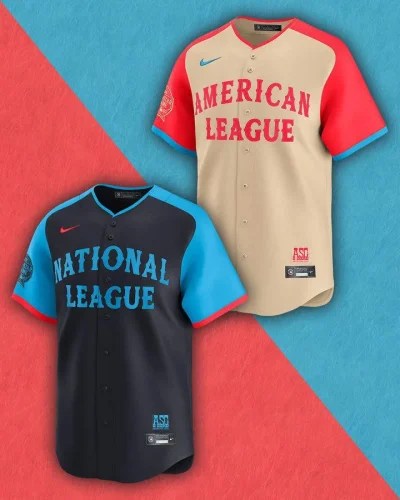
Yes, we have seen far worse for generic All-Star uniforms.
Except for each league’s colour scheme, is it really that radically different from the 1933 NL haberdashery? Now, this year’s threads would look far nicer if the American League jersey was done with red-on-white (the AL was the home team in Globe Life Field) and the National League was done with blue-on-gray (since the NL is the visiting team). And worn over either white (home) or gray (road) pants.
My normal position is to be all-in on returning to the practise of each league’s All-Stars wearing their own teams’ uniforms, representing their teams and fan bases, as their forebears did for so many decades. If Commissioner Pepperwinkle insists ultimately upon keeping generic league uniforms, this year’s style just might be the right way to go, switching the core white and gray each year depending upon which league is the All-Star host.
The wherefores of this year’s uniforms mattered less when the game got underway, and rookie NL starting pitcher Paul Skenes (Pirates) got to face Aaron Judge (Yankees) after all, thanks to Judge’s teammate Juan Soto wringing himself into a walk. The bad news: Judge forcing Soto at second with a grounder to third for the side.
AL manager Bruce Bochy (Rangers) was well aware of the marquee appeal of Skenes versus Judge while penciling Judge into his cleanup slot. But he sent three lefthanded swingers with impeccable on-base credentials up against the righthanded Pirate phenom to open, hoping precisely to get that marquee match without sacrificing his best chances to start winning the game.
Joe and Jane Fan insist, “This is just an exhibition, dammit!” Maybe they’re right. Maybe the metastasis of regular-season interleague play to a full-season thing has left the All-Star Game bereft of meaning, as opposed to such artifices as the period when postseason home field advantage went to the league who won the Game..
But maybe a Hall of Famer in waiting who’s won four World Series as a skipper knows, however the game’s been kicked around like a commissioner’s plaything for too damn long, that himself, his NL counterpart Torey Lovullo (Diamondbacks), and the players on both sides, actually do play this particular game as baseball, not show business.
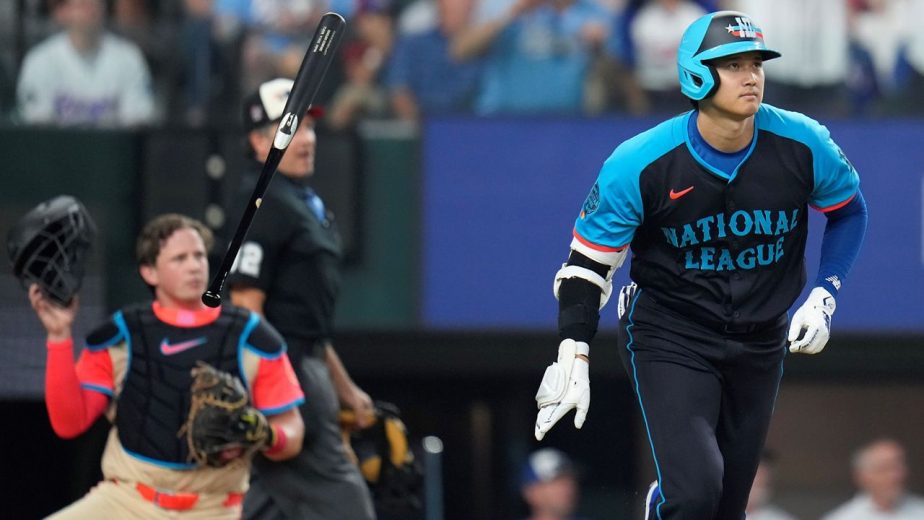
Shohei Ohtani detonating a three-run homer in the third inning. “To be able to share a dugout with him was surreal.”—Pirates pitcher Paul Skenes. Ohtani is now the only player in Show history to earn a pitching win in one All-Star Game and a home run in another All-Star Game.
So Bochy got Joe and Jane Fan their marquee matchup the old fashioned way, and Skenes came out of it on top, but Bochy’s diligence left him the only manager in major league history to win a World Series and an All-Star Game in each league. And, the first since Hall of Famer Joe McCarthy to manage an All-Star Game at home the season after he won a World Series.
Putting baseball ahead of show biz has enriching payoffs, of which Commissioner Pepperwinkle seemed as unaware as both managers were reminded soon enough en route the American League’s 5-3 win Tuesday.
Lovullo got the first such reminder when Shohei Ohtani (Dodgers) faced Tanner Houck (Red Sox) in the top of the third with nobody out, two men on, and sent a 2-0 splitter a few rows back into the right center field seats. (The last Dodger to hit one out in All-Star competition? Hall of Famer Mike Piazza, 28 years earlier.) Bochy got his in the bottom of that inning, when Soto shot a two-run double to center and David Fry (Guardians) singled him home to tie the game at three after another Judge ground out.
Two innings later, Lovullo got the reminder that ended up counting for the game, when Jarren Duran (Red Sox) batted with two out and one on, took a strike from Hunter Greene (Reds), then caught hold of a Greene splitter and sent his own message into the same region of seats where Ohtani’s blast landed.
“It won’t hit me until I try to go to sleep tonight,” Duran told The Athletic postgame. “Who knows if I’ll be able to sleep tonight.”
A guy in his fourth Show season who entered this All-Star Game leading it with ten triples and the AL with 27 doubles, then detonated what proved the winning bomb Tuesday, deserves to sleep the sleep of the just. So does the rookie whose first two months in Show have made him a name and an arm to reckon with as it was, without giving him the additional gift of being an Ohtani teammate even for just one game—thus far.
“I tried to enjoy the three hours I had on a team with him,” Skenes said postgame, “because that’s probably only going to happen once a year. It was really cool to watch him do that, really cool to watch him go about his business and get to meet him and all that. You know, he’s—I don’t know of any hitters I’ve faced that’s better than him in my career. So, to be able to share a dugout with him was surreal.”
The only thing better for either would have been an NL win, of course. Nobody had to tell Skenes it was neither his nor Ohtani’s fault the NL came up two bucks short Tuesday.


 Throneberry Fields Forever