ALCS Game Two: Rangers bent, not broken

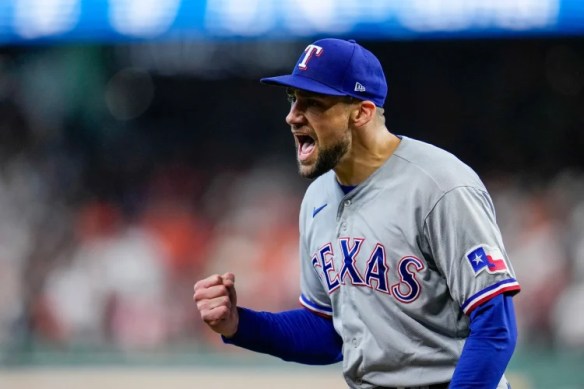
Nathan Eovaldi

Nathan Eovaldi, after wresting the Rangers out of a bases-loaded jam in ALCS Game Two. It helped the Rangers go up 2-0 despite Houston bombardier Yordan Álvarez’s two-homer day.

The War for Texas is two games in. The Rangers have won them both, in Houston. Despite being bent a lot more in American League Championship Series Game Two than they were in Game One.

That’s what a four-run first, an arduous wriggle out of a bases-loaded/nobody out fifth-inning jam, and a gutsy four-out save does for you. Even on a day when Yordan Álvarez recovers from an apparent virus and a three-strikeout Game One to hit two bombs.

Álvarez turned out trying to play Game One through an ailment that left him unable to hold food down or avoid headaches, not to mention unable to sleep very much. When it came time for Game Two, Álvarez still knew something his team didn’t until game time: he was going to play Monday no matter what, and nothing short of house arrest would stop him.

And if only the Rangers hadn’t jumped all over Astros starting pitcher Framber Valdez in a four-run first inning, Álvarez’s two-homer Game Two might, maybe, have become something beyond just another tale he can tell his eventual grandchildren.

But it still took a large effort by the Rangers to keep the Astros from overthrowing them and sweeping the first Houston leg of this ALCS. Large enough to prove that you can bend but not quite break these Rangers, who held on tight to win Game Two, 5-4.

It took ten pitches and a throwing error from Valdez to put the Rangers up 4-0 before the game’s first out was recorded. With Nathan Eovaldi starting for the Rangers, Ranger fans could have been forgiven if they thought the rest of the game might, maybe, be something of a leisurely game.

Marcus Semien and Corey Seager opened by hitting the first pitch of each plate appearance for back-to-back singles, Seager’s a shuttlecock that landed before Astros third baseman Alex Bregman running out could reach it. Then it took Valdez pouncing upon Robbie Grossman’s dead-fish tapper back but bobbling it a moment before throwing wild past first, allowing Semien to score and leaving second and third.

Then came Adolis García lining a single the other way to right to score Seager, and Mitch Garver pulling a line single to left to score Grossman. Finally, Valdez nailed an out striking Josh Heim out swinging on three pitches, but Nathaniel Lowe replied almost immediately to follow by sneaking a base hit through the left side of the infield to score García.

That wasn’t exactly in the Astros’ game plan. Valdez finally struck Josh Jung out and got a fly out by Leody Taveras to end the inning. It made Álvarez’s first homer, a yanking drive into the second deck behind right field in the bottom of the second, a crowd pleaser but a mere interruption. Eovaldi went from there to sandwich a strikeout between two ground outs to third, the first of which took a grand throw by Jung from the foul side behind third base to get Chas McCormick by a step.

Nor was it in the Astro plan for Valdez to last only two and a third innings, after Heim led off the top of the third with a blast into the Crawford Boxes for the fifth Rangers run.

“I thought the quality of my pitches were good,” the righthander said through his interpreter postgame. “I think they were good and they maybe got a little bit lucky. There were a couple of balls that they didn’t hit well that fell for base hits a couple times. I tried going as far as I could.”

Valdez has a few more things to learn about luck. These Rangers prefer to make their own luck. They might attack with aplomb at the plate but they’re going to turn your mistakes into disaster, too. You’d better not call them lucky, either, when you’re the poor soul who mishandled and then threw away a potential double play grounder that might have kept the Rangers’ first-inning damage down to a small dent.

Bregman nudged the Astros a little closer back with a leadoff bomb ringing the foul pole in the fourth. Then Eovaldi had to shove his way out of a no-out, bases-loaded jam in the fifth by striking pinch-hitter Yainer Díaz and José Altuve out back-to-back before Bregman beat one into the ground toward third—where Jung, whose over-run of Jeremy Peña’s bouncer loaded the pads in the first place, threw him out at first by three steps.

Michael Brantley pulled the Astros back to within a pair with a sixth-inning RBI double. Josh Sborz relieved Eovaldi for the seventh and got the side in order, including a called third strike on Altuve to end it. Aroldis Chapman went out to pitch the eighth and, after a Bregman fly out to center and a Tucker ground out to second, the first pitch he threw Álvarez would be his last of the day, Álvarez lining it hard and fast into the lower right field seats.

“You can never count us out,” McCormick said of his Astros post-game. “We don’t ever quit.” That was true enough to compel Rangers manager Bruce Bochy to get Chapman out of there after Alvarez’s second launch and ask Jose Leclerc for a four-out save.

Leclerc shook off back-to-back walks to get McCormick to force José Abreu at third for the side, then dispatched the Astros in order in the ninth—the hard way. Peña’s deep fly to right collapsed into an out at the track. Díaz’s grounder toward third was stopped by Jung on the slide before Jung threw him out. Altuve’s fly to center was only deep enough to land in Taveras’s glove for the side and the game.

“We’ve had some chances to win some games,” said McCormick, painfully aware the Astros had several grand Game Two chances laid waste. “Usually we do come through with some big hits. We did earlier in the year and, this time around, we haven’t come up with that big hit.”

Indeed. The Astros have been 1-for-9 with men in scoring position all ALCS so far. And, out of their 24 postseason runs thus far this time around, Álvarez is responsible for eighteen of them, either scoring them or sending them home. But even he can’t thwart the Rangers by himself. Not the way these Rangers do things. Not when they can make a two-homer game by him a sidebar.

“We’re jumping on teams early,” Jung said postgame, “and that helps us settle in. Our pitching has been outstanding. You can’t ask for anything more than what they’ve given us.”

Eovaldi has the knack of transforming from a solid regular-season pitcher to a Hall of Fame-level pitcher in the postseason. Even if he wasn’t quite at his pure best in Game Two, he still had enough to keep the Rangers well ahead of the game by the time his outing ended. He now has a 2.87 ERA and a 2.60 fielding-independent pitching rate in nine career postseason series.

“Something just clicks for him,” his catcher Heim said postgame. “I’m not sure. Same preparation. Same mentality that he has had all year. Just something about big games that he loves.”

It may yet prove to be something Ranger fans will love for eternity and beyond. The Rangers are halfway to the World Series, still unbeaten this postseason, and going home to their own inviting playpen in Arlington. They were far better at home than on the road in the regular season—but now they’ve won seven straight postseason contests with six coming on the road.

“We’ll get ’em in Texas,” Astros manager Dusty Baker vowed after Game Two. Ahem. You weren’t exactly out of Texas in Games One and Two, sir. You’ve been gotten in Texas so far.

ALCS Game One: Bad Astro looks, sharp Ranger pitching

Evan Carter

Evan Carter’s running-and-leaping catch of an Alex Bregman drive that had extra bases stamped on it otherwise ended with doubling up José Altuve in the Game One eighth—on Altuve’s own baserunning mistake.

This was not a good look for the Astros. When Justin Verlander keeps the arguable best remaining postseason offense to the weakest postseason game it’s had this time around but the Astros still don’t win, it’s not a good look.

When Jordan Montgomery scatters five hits in six and a third innings with no Astro scoring against him, before handing off to a bullpen whose regular season was an indictment for arson but has been a challenge to pry runs out of this postseason, it’s not a good Astro look.

When José Altuve, one of baseball’s smartest players, makes an eighth-inning baserunning mistake more to be expected of a raw rookie than a thirteen-year veteran with a Most Valuable Player Award in his trophy case, it’s not a good Astro look.

Astroworld should only be grateful that the Rangers didn’t even think about trolling Altuve the way a certain Brave trolled Bryce Harper on a similar but different play in the National League division series out of which the Phillies shoved the Braves.

Harper didn’t miss second scrambling back to first when Nick Castellanos’s long ninth-inning drive in Game Two was caught on the run and leap by Braves center fielder Michael Harris II, but he was thrown out at first by a hair and a half to end the game and the only Braves win of the set.

Altuve didn’t end American League Championship Series Game One Sunday night, but he did put the kibosh on the Astros’s final scoring opportunity in the 2-0 loss. He’d drawn a leadoff walk against Rangers reliever Josh Sborz, who yielded at once to Aroldis Chapman—a relief pitcher whose best fastball can still out-fly a speeding bullet, but who once surrendered a pennant-losing homer to Altuve himself and is still prone to hanging his sliders.

Then, somehow, Astros third baseman Alex Bregman sent a 2-1 slider off the middle of the zone to the rear end of Minute Maid Park, toward the chain-link fence beneath a Bank of America sign. The Rangers’ rookie left fielder Evan Carter ran it down and still had to take a flying leap to catch it one-handed just before it might have hit the fence and spoiled the Ranger shutout.

“Everybody,” said Astros catcher Martín Maldonado, who probably meant both the Astros themselves and the Minute Maid crowd, “thought that ball was going to hit the wall.”

Carter threw in to shortstop Corey Seager, who tossed right to second baseman Marcus Semien with third baseman Josh Jung pointing to the base emphatically. Semien stepped on the base just as emphatically. It took a replay review to affirm what Seager, Semien, and Jung spotted at once. Second base umpire Doug Eddings rung Altuve up. Altuve never touched second en route back to first.

Ouch!

“I didn’t think he was going to make the play he made—it was a great play,” said Altuve, a man who excels at just about everything you can ask of a veteran except baserunning, what with leading the entire Show with sixteen outs on the bases during the regular season. “You just try to come back to first base (and) that’s what I did.”

“That’s a play,” Semien said, “where I always watch to see what the runner does. Sometimes the umpires are looking at the ball, and that’s exactly what (Eddings) told me. He said he was looking at the ball. He didn’t see it. I tried to remind him. He still called it safe, but luckily that’s a play we can review. I’ve made that mistake before on the bases, so it’s one that we kinda go over in spring training, and all of a sudden in the ALCS, it showed up.”

Carter had also run down and caught leaping a Bregman drive down the left field line in the first. Then he himself accounted for the first Rangers run in the second inning, when he shot a base hit right past diving Astros first baseman José Abreu and gunned his way to second ahead of a throw that was dropped almost inexplicably at the base. Rangers catcher Jonah Heim then singled back up the pipe and Carter, reading the ball almost as a Biblical scholar parses the Beatitudes, scored.

“They always preach to us, especially the ones that can run a little bit, just, ‘Hey, it’s a double until it’s not’,” said Carter, who didn’t play his first major league game until 8 September. “So that’s kind of my mindset. I’m going to get a double until the outfielder tells me that I need to stop. I didn’t feel like I was told I needed to stop, so I just kept going.”

Three innings later, the Rangers’ number nine lineup batter, center fielder Leody Taveras, caught hold of a hanging Verlander sinker and lined it right over the right field fence. That was the second and final blemish against Verlander, the veteran who walked to the Mets as a free agent last winter but returned to the Astros in a trade deadline deal in August.

Altuve’s eighth-inning misstep was only the final among several opportunities the Astros missed all game long. They wasted Abreu’s second inning-opening single almost at once when Michael Tucker forced him at second on a followup ground out, then stranded Tucker on a pair of fly outs.

They wasted first and second with two outs in the third when Yordan Alvarez struck out for the second of three times on the night.

They pushed the bases loaded against Montgomery in the fourth, the only inning in which the Rangers’ 6’6″ tall, free agent-to-be lefthander truly struggled, and Montgomery ironed up and struck Maldonado out swinging on 1-2.

It was only when Astros utility player Mauricio Dubón, playing center field for them Sunday night, slammed a hard line out to center field opening the Houston seventh, that Rangers manager Bruce Bochy decided to reach for the bullpen. Now, the Astros had a clean shot at a bullpen that might resemble the Third Army this postseason but blew 33 out of 63 so-called save situations on the regular season.

Altuve’s baserunning mistake still left the Astros four outs to work with yet and the vulnerable Chapman hardly off the hook with Alvarez checking in at the plate: Chapman’s lifetime postseason ERA in Minute Maid Park was 7.53 entering Sunday night. He fell behind Alvarez 2-1. Then, he threw Alvarez a slider that hung up just enough to be sent into orbit, just as Altuve had done winning that 2019 ALCS.

The only place Alvarez sent this one, though, was on the ground toward first base for an inning-ending out. Then Bochy reached for Jose Leclerc to work the ninth. Leclerc landed a hard-enough earned three up, three down; he went to full counts on Abreu and Chas McCormick before getting Abreu to line out to center for the first out and McCormick to strike out swinging, sandwiching Tucker’s 2-2 ground out to second.

“We just found a way to get a couple of runs across the board,” said Bochy after the game ended. “That was the difference in the game, obviously. But our guy was really good, Monty, terrific job he did. And he got in a couple of jams there and found a way to get out of it.”

Verlander didn’t sound discouraged after Game One despite his solid effort coming up just short enough. “We’ve lost Game One of some playoff series before,” said the future Hall of Fame righthander. “And that’s the great thing about this team. Obviously nobody is sitting in the locker room right now happy. But it’s very matter of fact, okay. We just got punched, how do you answer?”

The Astros have Game Two to start answering, of course. But they might have to find a few more ways to keep Carter from running down and killing their better drives.

Approaching the League Championship Series

Houston Astros

The Astros are playing for a piece of history as well as a pennant.

Welcome back to Year Two of Commissioner Pepperwinkle’s postseason format. Brought to you by Jack. The makers of Diddley, America’s number one squat.

In the first episode, act one, three out of six regular season division winners got wild card round byes. The other three had to play wild card teams in round one. Two swept, one got swept, and one other wild card team swept the other one. Those sets played almost faster than the speed of sound, light, and the Road Runner vs. Wile E. Coyote.

Episode one, act two: Two division winners got swept, two more lost in four games. Those sets didn’t quite go beep! beep! but they were played swiftly enough when you look back upon them. And the net result was that the winning teams, collectively, went 20-2. Or, one loss fewer than former major league pitcher David Cone’s 1988 won-lost record.

We pause now for a brief commercial. A lot more brief than the ones which have been, really, the number one culprit in turning baseball games into marathon runs that tried the patience of even those lifetime romantics to whom the lack of a time clock has been one of baseball’s most endearing faculties.

This pause is brought to you by Schtick Razor Blades. No matter how you slice it, Schtick is just too sharp for comfort. Four out of five dermatologists tell you Schtick is several cuts below . . . the surface, and anything else it can reach. Remember, four out of five surveys have been doctored.

Episode two, stage right, begins Sunday night in Houston. Where the numbers one and two finishers in the American League West square off in a contest for not just the American League pennant but Texas bragging rights. Episode two, stage left, begins Monday night in Philadelphia. It’s only a contest for the National League pennant. There’s no intra-division, never mind in-state rivalry at stake there.

What we do have, however, is baseball’s sixth-best regular season team (the Astros) playing its eight-best regular season team (the Rangers) for that American League pennant and that Texas throne. We also have baseball’s seventh-best regular season team (the Phillies) playing its twelfth-best team (the Diamondbacks) for that National League pennant and, maybe, highlight film rights plus a year’s immunity from the sting of the Arizona bark scorpion.

Sunday night, the Astros open at home defiant of the conspiracy theory that the five-day layoff for the bye teams was a killer. They got the same five days off as the Dodgers and the Braves did and they beat the Twins in their division series, 3-1, outscoring the Twins 20-13. They also out-pitched the Twins, 3.25 team ERA to 4.89, with 52 pitching strikeouts to 37.

They weren’t quite as good at avoiding pitching walks as the Twins (16 for the Astros, 9 for the Twins), but they didn’t have to be in the end. The Astros hit for a team .818 OPS to the Twins’s .681. They may not find the Rangers to be ALCS pushovers, either: the Rangers led the American League regular season in hits, runs, home runs, and OPS. The Astros’s formidable pitching might have a war on its hands. But both teams were almost dead even for team fielding-independent pitching: 4.32 for the Rangers, 4.31 for the Astros.

This Texas war has the potential to make the Alamo resemble a ranch barbeque. Especially when each team’s most formidable postseason batter, Rangers shortstop Corey Seager (you know, the guy the Dodgers allowed to escape into free agency) and Astros left fielder Yordan Alvarez, checks in and starts doing damage. When this ALCS ends, Texas will be singing either “Corey, Corey Seager, king of the wild frontier” or “Yordan fit the battle of Jericho.”

The Astros—please, let’s knock it off about Astrogate at last, if only because a) second baseman José Altuve was indeed what his former teammate Carlos Correa said, “the one guy who didn’t use the trash can” and objected loudly when it was used during his plate appearances; and, b) Altuve and third baseman Alex Bregman are the only two remaining position players from the 2017-18 Astrogate teams.

But the Astros are playing for a piece of baseball history. If they turn the Rangers aside, then go on to win the World Series against either the Phillies or the Astros, they’d be the first repeat Series champions since the 1978 Yankees. If they meet and do it to the Phillies, they’d also be the first since 1978 to do it to the guys they beat the year before.

The Rangers are playing their first ALCS since winning back-to-backs in 2010-2011 . . . but losing both those World Series, especially to that staggering Cardinals overthrow in Games Six and Seven in 2011. (David Freese, call your office!) They haven’t even smelled the postseason since losing a division series to the Blue Jays in 2016, never mind gotten far enough to play for the pennant.

So the War for Texas involves one team playing for history and another time trying to augment its own on the positive side of the ledger. They can both hit. They can both pitch, even if some observers wonder just when the Rangers’ ordinarily unsteady bullpen runs out of postseason mojo. They’ll throw out future Hall of Famer Justin Verlander (Astros) against Jordan Montgomery (Rangers—and the guy who runs Yankee fan temperatures up the scales because the Yankees let him escape in 2022) for Game One.

And they’re both managed by men who know how to keep the horses running reasonably while not letting the moments overwhelm them too heavily. Bruce Bochy vs. Dusty Baker. It almost sounds like Casey Stengel (the Yankee version) vs. Joe McCarthy (also the Yankee version). Almost. Though I can’t imagine either man having any kind of flair for Casey’s Stengelese triple-talking wit and wonder.

So on with the show. Brought to you by The Company. Who remind you that sixty-seven years after its birth, it’s now . . . sixty-seven years later.

ALDS Game Three: Baltimore Agonistes

Baltimore Orioles

After their surprising and pleasing AL East conquest, the inexperienced, pitching-compromised Orioles found the AL West-winning Rangers too hot to handle.

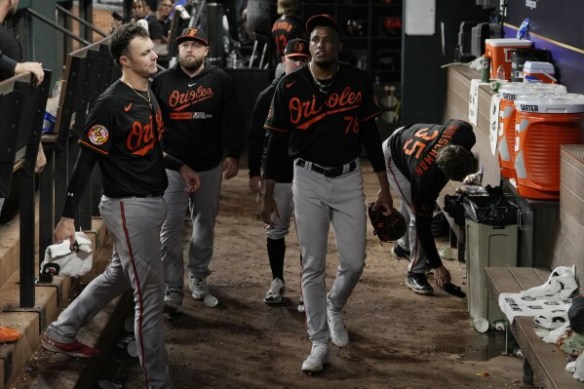
Maybe it had to be this way, an inexperienced team of Orioles upstarts getting flattened by a better-experienced collection of Rangers in three straight. It might have been the team’s first postseason appearance in seven years, but they brought a collection of men with plenty of postseason time among themselves before becoming Rangers.

Maybe the Orioles were in over their own mostly young, 101 game-winning heads. Maybe the Rangers were too well primed by their Hall of Fame-bound manager who’d skippered three Series winners in five years on the Giants’ bridge.

But as joyous as it was to see the Rangers make too-easy work of the Orioles in this American League division series, it still hurt to see these Orioles swept away like flotsam and jetsam. It was the first time they’d been swept in any series since the May emergence of Adley Rutschman as both their regular catcher and their team leader. The first, and the worst, at once.

No matter how heavily tanking played a role in getting the Orioles to the point of winning the American League East, it hurt. No matter how stupid their administration looked censoring their lead television broadcaster—over a team-generated graphic meant to show a positive portion of their progress—it hurt.

No matter how further stupid that administration looked in doing practically nothing at the trade deadline despite having an upstart group of American League East conquerors on their hands—it hurt.

And, no matter how temporarily stuck Orioles manager Brandon Hyde might have looked  having to start a heavy-hearted pitcher in his fourth major league season but on his first postseason assignment in Game Three—it hurt.

“This is a really good group of guys,” said pitcher Kyle Gibson, a pending free agent, “and I think that adds to the sting of it too, because we knew we had something special. You want to try to capitalize on that whenever you can.”

“There’s no other way to put it,” said outfielder Austin Hays. “They kicked our ass. It sucks. Just couldn’t really get anything going, couldn’t get any momentum on our side to get things going. It hurts. It really hurts.”

The real-world motto of the real-world Texas Rangers: “One riot, one Ranger.” The motto of the American League West winners now could be: “Two postseason sweeps, thirty Rangers.”

The Rangers picked up where they left off Tuesday night against a flock of Orioles lacking veteran presence and, especially, veteran pitching, beating the Orioles, 7-1, in a game that was essentially over after two innings. Manager Bruce Bochy, in the conversation for Manager of the Year as it is, looked even smarter in this AL division series than he looked winning with the Giants in 2010, 2012, and 2014—and he looked like the Yankee version of Casey Stengel then.

Even more so because, until Tuesday night, the AL West-champion Rangers had to to their heaviest labours on the road. “We had our work cut out going on the road against Tampa and Baltimore,” Bochy said after wrapping the division series Tuesday night. “Just shows the toughness with this ballclub and the deal with having to fly to Tampa.”

Now they were home and happy in Globe Life Field, and Rangers shortstop Corey Seager didn’t give Orioles starter Dean Kremer a chance to continue collecting himself after second baseman Marcus Semien fouled out to open the bottom of the first. Seager smashed a 1-1 service 445 feet over the right field fence.

An inning later, it was one-out single (Josh Jung), two-out double (Semien), and an intentional walk to Seager. Kremer and the Orioles weren’t going to give him another chance to mash with first base open if they could help it. They took their chances with Mitch Garver, whose Game Two grand slam broke them almost in half—and Garver thanked them with a two-run double.

Up stepped Adolis García, the Rangers’ right fielder. Kremer had García down 1-2. The next fastball, a little up over the middle of the zone, disappeared over the left center field fence. Just like that, the Orioles were in a 6-1 hole out of which they wouldn’t get to within sight of the earth’s surface if the Rangers could help it.

They could. Their redoubtable starter Nathan Evoaldi, who’s been there and done that in postseasons previous, pinned them for seven innings and seven strikeouts, the only blemish against him an almost excuse-me RBI single by Orioles rookie star Gunnar Henderson in the top of the fifth. As if to drive yet another exclamation point home, Rangers first baseman Nathaniel Lowe greeted Gibson, the third of five Oriole pitchers on the night, with a leadoff homer in the bottom of the sixth.

“You’re not trying to do anything different,” said Seager, whose nine walks are a record for a three-game postseason span, according to MLB analyst Sarah Langs. “You’re just more focused. That’s not the right word, but it’s just more intense. Everything matters. It’s just a different game. It really is. There’s no way around it. So you have to have a different edge, different approach.”

Kremer’s heavy heart was thanks to the atrocity Hamas inflicted upon Israel, to which his parents are native and for which they both served in the Israeli Defense Forces before emigrating to California where their son was born. But he told Hyde when asked—this was discussed often on the game broadcast—that no matter what was in the back of his mind or the front of his heart, he could go for Game Three.

He still has extended family living in Israel. (He’s also said he do as Hall of Famer Sandy Koufax and decline to pitch if an assignment happens to fall on Yom Kippur, the Jewish Day of Atonement.) Anyone who thinks Kremer still didn’t take a heavy heart to the mound with him Tuesday night may be deluding himself or herself.

Perhaps if Hyde had more choices he might have told Kremer to forget the mound for now and focus upon his family. But the Orioles standing pat at the trade deadline, other than adding Cardinals comer-turned-injury-compromised righthander Jack Flaherty, who’d pitched his way out of their rotation to become a bullpen option, came back to haunt them horribly this series.

They were forced to hold veteran ace/post-Tommy John surgery patient John Means out of the division series because of late September elbow soreness—and had no reinforcements. They lost relief ace Felíx Bautista to a torn ulnar colateral ligament that took him to Tommy John surgery on Monday—and rode their bullpen a little too hard compensating for their lack of rotation depth down the stretch and in the division series after the AL East championship bye week off.

So their survival depended upon a young man with a temporarily compromised heart. Kremer went out courageously enough and found the Rangers a little too hot to handle after all. However the Rangers might have empathised with him, that didn’t mean they were going to let him off the hook.

That survival also depended upon an offense that dissipated near season’s end. Even when they awoke well enough in Game Two, turning what began as a 9-2 blowout in the making into an 11-8 squeaker of a loss. “Offensively, we weren’t at our best the last two, three weeks of the season,” Hyde said. “That carried into the postseason where we had guys scuffling. [The Rangers] rolled in with a ton of momentum. I don’t think we rolled in with a ton of momentum offensively.”

The Rangers had to dispatch the Rays in two straight wild card series games before taking the Orioles to school. Eovaldi pitched both series winners.

“I’ve never had a curtain call or anything like that,” said the veteran righthander whose six-inning relief in that eighteen-inning World Series Game Three marathon in 2018 really put him on the baseball map, and who took such a call after his Tuesday night’s work ended. “But our fans were bringing it all night long. When I walked out at 6:30 tonight, they were chanting, the ‘Let’s go Rangers.’ I knew it was going to be a really good night for us.”

He couldn’t have known just how good. For Eovaldi and his Rangers, it’s on to take on whomever wins the Twins-Astros division series in the American League Championship Series.

For these Orioles, it’s on to reflect upon how far they got in the first place despite almost nobody imagining them here when the season began. They have a core that can win again next year. All their administration has to do is refuse to hesitate on opening the trade lines and the checkbooks a little deeper. Knowing this Oriole administration, alas, good luck with that.

ALDS Game Two: From blowout to squeaker

Mitch Garver

Mitch Garver’s third-inning grand slam proved the difference maker as the Orioles turned an  early blowout into a squeaker of a win for the Rangers Sunday.

Until this weekend, the last time the Orioles were swept in a series was in May, by the Blue Jays. During the regular season, the Orioles were a .642 team on the road. Now, they’re on the threshold of an American League division series sweep, but they’re counting on that traveling mojo to overthrow a Rangers team that won’t be overthrown without a fight.

Not after the Orioles turned a 9-2 blowout in the making into an 11-8 squeaker in Game Two Sunday. Not after the Orioles couldn’t do better than Aaron Hicks’s three-run homer with one out in the bottom of the ninth. Not after the Rangers battered them for nine runs in the first three innings, including and especially Mitch Garver’s grand slam in the third.

Not after the Oriole bullpen was so deeply deployed following a Game One loss that saw theirs ranks pressed into duty after four and two thirds. Today’s travel day from Baltimore to Arlington may not necessarily give them relief. Not facing a Rangers team that hasn’t played at home in a fortnight but hit 53 home runs more at home than on the road during the season.

“We just came up a little bit short today, but that built a lot of momentum going into the next game,” said Orioles leftfielder Austin Hays after Game Two. “Nobody laid down. We didn’t give away any at-bats. We continued to fight. We were able to get into their bullpen and work on those guys a little bit. I feel good moving forward, but we know we’ve got our work cut out for us.”

That’s a polite way to put it. They played .500 ball against the Rangers in six regular season games, but they blew their home field advantage to open this division series. A team that hasn’t seen home in a fortnight can be presumed hungry to put an end to this set as soon as possible, by any means necessary.

The Rangers proved that when they started Garver, a backup catcher who played in only half the regular season games, and sent him out for his first postseason appearance this time around. In a game the Orioles opened with a 2-0 lead after one full inning, but the Rangers slapped rookie Orioles starting pitcher Grayson Rodriguez silly with a five-run second, Garver checked in at the plate with one out followed by three straight walks.

Orioles reliever Bryan Baker left the pillows loaded for his relief, Jacob Webb. On 3-1 Webb elevated a fastball, and Garver elevated it six rows into the left field seats.

Rangers manager Bruce Bochy—who came out of retirement to shepherd the Rangers after all those years and those three World Series rings managing the Giants—said pregame that it was “just time to get [Garver] out there.” Garver may have given the boss the most expensive thank-you present of the postseason thus far.

“He’s got big power,” Bochy said postgame, “and that’s big at that point in the game. Really was the difference in the game.”

So were the eleven walks handed out by eight Orioles pitchers, including a postseason record five to Rangers shortstop Corey Seager. So were the mere three hits in thirteen Oriole plate appearances with runners in scoring position, which explains a lot about how the Orioles actually out-hit the Rangers (fourteen hits to eleven; .973 to .891 game OPS) but fell three short in the end.

Also in too-vivid contrast were the fruits of each team’s trade deadline moves. Or, in the Orioles’ case, lack thereof. The Rangers moved to bring future Hall of Famer Max Scherzer into the fold but also added starter Jordan Montgomery and reliever Chris Stratton in a deal with the Cardinals.

The Orioles moved to bring another Cardinal pitcher, Jack Flaherty, aboard at the deadline. But Flaherty, once a glittering Cardinal comer, hasn’t been the same pitcher since a 2021 oblique injury and a 2022 shoulder injury. He pitched his way out of the Oriole rotation and now looks to be the long man out of the bullpen.

He got a shot at showing what he could do in that role when it looked as though it would be just mop-up work Sunday. The good news: He surrendered only one run (on Garver’s double play grounder in the fifth) in two innings’ work. The bad news: He contributed to the Oriole walking parade with three of his own, including two in the fifth.

Some say the Orioles standing practically pat at the trade deadline instead of going for any kind of impact deal may yet come back to bite them right out of the postseason, especially after their own pitching depletion (losing top starter John Means and closer Félix Bautista especially) late in the season. Others fear the Orioles were more concerned with their usual penny pinching plus censoring a lead broadcaster over a positive graphic the team itself fashioned for a broadcast.

Montgomery handled the Orioles well following the two-run first, at least until he surrendered a pair in the fourth on an RBI single (Jorge Mateo) and a sacrifice fly (Ryan Mountcastle.) But when Orioles rookie star Gunnar Henderson greeted him with a full-count leadoff home run and Hicks followed with a base hit, Montgomery’s day ended and the ordinarily wobbly Ranger bullpen took over.

That bullpen kept the Orioles quiet until the bottom of the ninth, when Brock Burke handed Henderson a one-out walk and Hays singled him to second. Bochy reached then for José Leclerc, and Hicks—the erstwhile Yankee who never really found his best footing in the Bronx—reached for a one-strike service and drove it into the right field seats.

It was a little vindication for Hicks the day after he blew a hit-and-run sign in the Game One ninth, leaving Henderson a dead duck on the pond when he was thrown out at second, before Leclerc finished the 3-2 Rangers win. After his up-and-down Yankee life, Hicks looked like an Oriole blessing after he signed in May following his Yankee release. After Sunday, he looked like an Oriole hope once again.

An Oriole hope is just what Baltimore needs now. But Ranger hopes won’t exactly play to an empty house come Tuesday. At the end of the former, survival. At the end of the latter, a chance to play for the pennant.