Hernández Hideaway

LosAngeles Dodgers

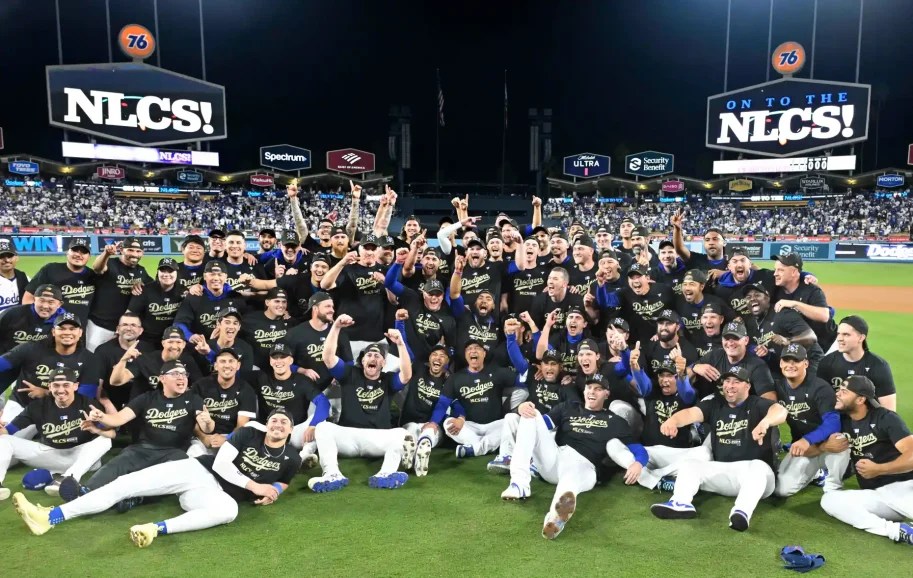
Ahead for the Dodgers: playing the Mets for the NL pennant.

They had a starting rotation most of which belonged in post-op. But the Dodgers are going to the National League Championship Series.

They had Shohei Ohtani, maybe the National League’s 2024 Most Valuable Player winner in waiting (though Francisco Lindor has a powerful claim), hitting a hefty home run in the first division series game but nothing much after. And they’re going to the NLCS.

They had Freddie Freeman, trying to play despite not giving a rolled ankle sufficient healing time, as close to plain ineffective as he’s ever been at any time in a brilliant career so far. And they’re still going to the NLCS.

Their starting picture so belonged in an orthopedic journal that they went to a Game Four bullpen game. And they’re still going to the NLCS.

They surrendered three homers to Padres superman Fernando Tatis, Jr. (two in Game Two, one in Game Three). And they’re still going to the NLCS.

They lost the sason series to the Pads and didn’t look quite as good on paper coming into the now-done division series. They’re still going to the NLCS.

They scored only two runs Friday night. But those were more than enough to send them to the NLCS.

The Dodgers did it with resilience. They did it with that eight-man bullpen game in the hostile arterials of Petco Park and the pen going lights out otherwise, to where the Dodgers were somehow able to shut the Padres out over the final 24 innings of the set.

They coaxed a magnificent Game Five start out of Yoshi Yamamoto, who turned a five-inning shutout over to that pen, where a mere four relievers were needed to finish what he started. On the first MLB postseason night featuring two Japanese-born starting pitchers, Yu Darvish was brilliant for the Padres over seven, except for two blemishes, and Yamamoto was better over five for the Dodgers.

But the Dodgers had to turn Dodger Stadium into Hernández Hideaway to get there, too, Friday night.

First, Kiké Hernández—back with the Dodgers for a second homecoming year after a detour to Boston, where he’d had a pocketful of postseason heroics for the Red Sox—punished Padres starter Yu Darvish with two outs in the bottom of the second, sending Darvish’s first service halfway up the left field bleachers.

Five innings later, Teoscar Hernández—a first-year Dodger after a tour taking him to Houston, Toronto, and Seattle, whose hefty grand slam pulled the Dodgers to within a run of the Padres in Game Three but only that—didn’t need full pillows. With one out, he hit Darvish’s 2-1 service to the same real estate his fellow Hernández reached.

Padres third baseman and slugger Manny Machado had perhaps the best post mortem from anyone in their silks: “We didn’t hit and score some runs. They did a tremendous job on the other side, on the pitching side. You have to give credit where it’s due. We just couldn’t string along hits. We had some opportunities, we couldn’t [push] through, and we fell short.”

That from a representative of the regular-season offense that threshed, of the team whose starting rotation could and often did dominate, and whose bullpen was one of baseball’s deepest of the year. The Dodgers said, essentially, in Kiké Hernández’s shameless postgame phrase, “[Fornicate] ’em all.”

“What was it,” said third baseman Max Muncy, “80 percent of the f—ing experts said we were going to lose? F— those guys. We know who we are. We’re the f—ing best team in baseball, and we’re out there to prove it.”

That won’t be as easy as they think. Awaiting the Dodgers are the Mets, who picked themselves up from the May scrap heap, rumbled their way to the postseason and through the first two rounds, have a lot more starting pitching depth (and lack of injury), a lineup with more depth than suspected going in, and (big “and”) they’re known lately for leaving bullpens wasted.

Both teams have their issues. The Mets need Pete Alonso to stay in the zone he’s rediscovered this postseason and closer Edwin Díaz to return all the way to form as he hinted in his last outing against the Phillies.

The Dodgers need length from at least two or three starters if they don’t want to tax that bullpen into letting the Mets do what they’ve done best this time around—make the final three innings their personal marquee stage. They also need Mookie Betts to continue becoming the Mookie Monster again after his slumpbusting bombs against the Padres.

This forthcoming NLCS does promise to see two teams throwing the proverbial kitchen sinks at each other as best they can with what they have. Whoever wins it stands to become a heavy World Series favourite.

ASG: As (almost) usual, show biz yields to baseball

Jarren Duran

Red Sox center fielder Jarren Duran hoists the clear bat awarded the All-Star Game’s Most Valuable Player. His tiebreaking two-run homer held up to give the AL the 5-3 win.

God help us all, everyone. The All-Star break began with a pre-Home Run Derby singing of “The Star Spangled Banner” Monday night (by country star Ingrid Andress) that made youth cringe and elders think wistful thoughts of Roseanne Barr. It ended with a tenth American League All-Star Game win in eleven seasons.

In between, of course, was much to ponder and much to dismiss as patent nonsense, which seems to be far more the norm than Chicago Tribune sports editor Arch Ward, who initiated the game in 1933, might have imagined.

Phillies third baseman Alec Bohm could be seen having to labour to keep from laughing (presumably, that he might not weep—or wish to commit manslaughter) when Andress tackled “The Star Spangled Banner” as though too well besotted. It turned out that appearance was everything: She copped the following day to being drunk and having enough issue with it to seek rehab and recovery.

Wish her well, but demand to know why nobody in baseball’s administration noticed she was drunk as she took the mike in the first place.

That was then: The Derby rules were, a participant had ten outs to hit as many homers as they could, the hitter with the most such bombs advanced, and that was that. So simple that, in fact, even Mark Belanger (human Electrolux at shortstop, but a spaghetti bat who hit three fewer homers in eighteen major league seasons than the late Hall of Famer Willie Mays hit in the first half of 1965) could have done it.

This is now: Round One—three minutes or forty batted balls, whichever came first, followed by an old-style three outs to hit as many bombs as possible. Round Two—the top four floggers moved to a bracket-like semifinal. Round Three—the two semifinal winners head to head. The net result: Teoscar Hernandez (Dodgers) defeating Bobby Witt, Jr. (Royals), who nearly forced a playoff with a ICBM-like blast stopped only by the left center field fence.

Some of us still wonder why we’re supposed to tolerate three-hour long Home Run Derbies but arise armed against two and a half hour-plus real baseball games. Or, why we had three-minute commercials aboard Fox’s All-Star Game telecast Tuesday before seeing supersonic relief pitchers blowing the side away in order in a minute and a half if that long.

Perhaps commissioner Rob Manfred might have an answer to that one. At least he has a sort-of answer to the question (posed by The Athletic‘s Tyler Kepner) of when the ever-more-hideous generic All-Star Game uniforms of the past several years will be disappeared in favour of returning the fine old tradition of All-Stars wearing their own uniforms and thus representing their teams.

“I am aware of the sentiment and I do know why people kind of like that tradition,” Commissioner Pepperwinkle told Kepner. “There will be conversations about that.” The proper two-word answer to that, of course, is, prove it. About knowing why people (more than kind of) like that tradition and holding serious conversations about it.

Well, take the proverbial pause for the proverbial cause. That very first All-Star Game featured the American League representatives wearing their own teams’ home uniforms with the National League wearing road threads, as modeled below by Hall of Fame catcher Gabby Hartnett:

Gabby Hartnett

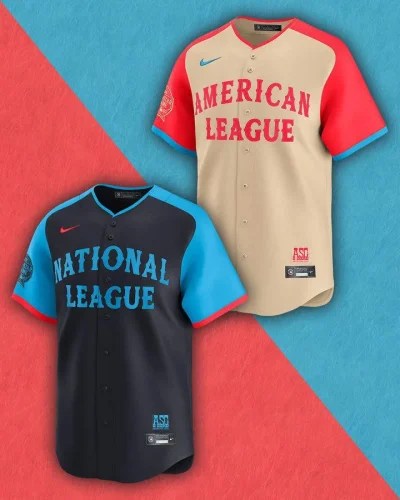
Behold now this year’s threads for each league:

Yes, we have seen far worse for generic All-Star uniforms.

Except for each league’s colour scheme, is it really that radically different from the 1933 NL haberdashery? Now, this year’s threads would look far nicer if the American League jersey was done with red-on-white (the AL was the home team in Globe Life Field) and the National League was done with blue-on-gray (since the NL is the visiting team). And worn over either white (home) or gray (road) pants.

My normal position is to be all-in on returning to the practise of each league’s All-Stars wearing their own teams’ uniforms, representing their teams and fan bases, as their forebears did for so many decades. If Commissioner Pepperwinkle insists ultimately upon keeping generic league uniforms, this year’s style just might be the right way to go, switching the core white and gray each year depending upon which league is the All-Star host.

The wherefores of this year’s uniforms mattered less when the game got underway, and rookie NL starting pitcher Paul Skenes (Pirates) got to face Aaron Judge (Yankees) after all, thanks to Judge’s teammate Juan Soto wringing himself into a walk. The bad news: Judge forcing Soto at second with a grounder to third for the side.

AL manager Bruce Bochy (Rangers) was well aware of the marquee appeal of Skenes versus Judge while penciling Judge into his cleanup slot. But he sent three lefthanded swingers with impeccable on-base credentials up against the righthanded Pirate phenom to open, hoping precisely to get that marquee match without sacrificing his best chances to start winning the game.

Joe and Jane Fan insist, “This is just an exhibition, dammit!” Maybe they’re right. Maybe the metastasis of regular-season interleague play to a full-season thing has left the All-Star Game bereft of meaning, as opposed to such artifices as the period when postseason home field advantage went to the league who won the Game..

But maybe a Hall of Famer in waiting who’s won four World Series as a skipper knows, however the game’s been kicked around like a commissioner’s plaything for too damn long, that himself, his NL counterpart Torey Lovullo (Diamondbacks), and the players on both sides, actually do play this particular game as baseball, not show business.

Shohei Ohtani

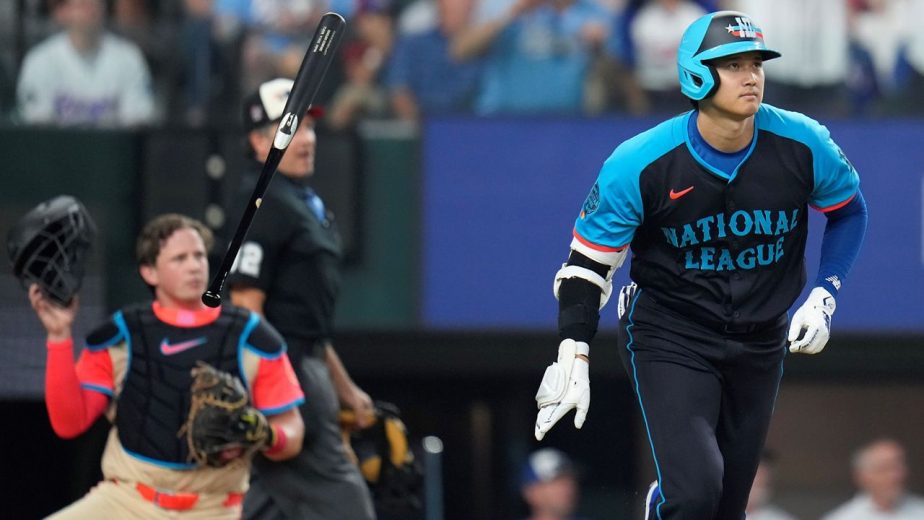
Shohei Ohtani detonating a three-run homer in the third inning. “To be able to share a dugout with him was surreal.”—Pirates pitcher Paul Skenes. Ohtani is now the only player in Show history to earn a pitching win in one All-Star Game and a home run in another All-Star Game.

So Bochy got Joe and Jane Fan their marquee matchup the old fashioned way, and Skenes came out of it on top, but Bochy’s diligence left him the only manager in major league history to win a World Series and an All-Star Game in each league. And, the first since Hall of Famer Joe McCarthy to manage an All-Star Game at home the season after he won a World Series.

Putting baseball ahead of show biz has enriching payoffs, of which Commissioner Pepperwinkle seemed as unaware as both managers were reminded soon enough en route the American League’s 5-3 win Tuesday.

Lovullo got the first such reminder when Shohei Ohtani (Dodgers) faced Tanner Houck (Red Sox) in the top of the third with nobody out, two men on, and sent a 2-0 splitter a few rows back into the right center field seats. (The last Dodger to hit one out in All-Star competition? Hall of Famer Mike Piazza, 28 years earlier.) Bochy got his in the bottom of that inning, when Soto shot a two-run double to center and David Fry (Guardians) singled him home to tie the game at three after another Judge ground out.

Two innings later, Lovullo got the reminder that ended up counting for the game, when Jarren Duran (Red Sox) batted with two out and one on, took a strike from Hunter Greene (Reds), then caught hold of a Greene splitter and sent his own message into the same region of seats where Ohtani’s blast landed.

“It won’t hit me until I try to go to sleep tonight,” Duran told The Athletic postgame. “Who knows if I’ll be able to sleep tonight.”

A guy in his fourth Show season who entered this All-Star Game leading it with ten triples and the AL with 27 doubles, then detonated what proved the winning bomb Tuesday, deserves to sleep the sleep of the just. So does the rookie whose first two months in Show have made him a name and an arm to reckon with as it was, without giving him the additional gift of being an Ohtani teammate even for just one game—thus far.

“I tried to enjoy the three hours I had on a team with him,” Skenes said postgame, “because that’s probably only going to happen once a year. It was really cool to watch him do that, really cool to watch him go about his business and get to meet him and all that. You know, he’s—I don’t know of any hitters I’ve faced that’s better than him in my career. So, to be able to share a dugout with him was surreal.”

The only thing better for either would have been an NL win, of course. Nobody had to tell Skenes it was neither his nor Ohtani’s fault the NL came up two bucks short Tuesday.

Opening Day: Snow fooling

There was nothing wrong with your television set. Do not attempt to adjust the picture. The snow took control of the transmission when Miguel Cabrera hit this Opening Day home run . . .

Just because the expected Opening Day marquee battle between Jacob deGrom (Mets) and Max Scherzer (Nationals) had to be postponed (COVID-positive Nats players and a team staffer to quarantine), that didn’t mean Wednesday was going to lack for the good, the bad, and the bizarre. This is baseball. Where anything can happen—and usually does.

Especially if Opening Day is also April Fool’s Day. The part that wasn’t a gag—fans in the stands again, at long enough last. The sound was glorious, even if reduced from most normal capacities thanks to the continuing if only slightly receding pan-damn-ic.

Comerica Park should have been playing “Winter Wonderland” Wednesday. The Tigers’ aging star Miguel Cabrera shouldn’t be blamed if he was singing “Let it Snow, Let It Snow, Let It Snow.” Especially when he more than a little hard on the Bieber, turning on the Indian ace’s rising snowball, hitting a two-run homer, and . . . sliding into second base, unable to tell through the snow that the ball flew out.

I don’t know if the Coors Field public address people had it cued up, but they could and should have sounded “Don’t Pass Me By” after Dodger first baseman Cody Bellinger hit an RBI single . . . off Rockies left fielder Raimel Tapia’s glove and over the left field fence. The problem: Justin (Who Was That Unmasked Man) Turner not seeing the ball reach the seats and retreating to first, compelling Bellinger to pass him on the basepath.

Oops. On a day the Rockies thumped Clayton Kershaw and managed to squeeze a win out after doing what Rockies usually do in the off-season—in this case, unloading their franchise player and all but reveling in front office dissembly and mission abandonment—Turner was the gift that . . . added insult to injury for the defending World Series winners.

The sleeper star in waiting in Blue Jays silks might have thought about singing an ancient  T. Rex number called “The Slider.” Gerrit Cole’s was just too juicy for Teoscar Hernandez to resist in the sixth. He sent it into earth orbit or 437 feet and into the left field bleachers at Yankee Stadium—whichever came first. Who needed Bo Bichette and Vladimir Guerrero, Jr.?

Just one thing was wrong. Hernandez needs to work on his bat flips. He didn’t have one. A blast like that was just begging for him to go Willson Contreras. Hernandez just ambled up the base line carrying his bat, then kind of nudged it away to the grass. He’s young, with plenty of time to learn, though. And his blast tied the game the Jays went on to win, 3-2.

Which is the score by which the Phillies beat the Braves in ten innings—after Bryce Harper began the inning as the free cookie on second base, took third on J.T. (Nothing Is) Realmuto’s ground out, waited patiently as Didi Gregorius was handed first on the house, then came home with the winner when Jean Segura sliced a single to left.

The game got to the tenth in the first place because Phillies manager Joe Girardi decided he wasn’t quite ready to trust the National League’s leading arsonists with taking over from certified innings-eater Aaron Nola with a 2-0 lead in the seventh. The Braves were far more ready to trust Pablo Sandoval—erstwhile Giant, one-time World Series hero, all-time poster child for Slim Slow—to pinch hit for Max Fried’s relief Tyler Matzek with a man on.

. . . and slid into second unable to tell at first whether the ball or the snow cleared the fence.

Kung Fu Panda turned out to be more than ready to hit Nola’s 0-2, slightly down and slightly in fastball into the right field seats. Girardi is many things but a crystal ball operator isn’t one of them. If he had been, he could have lifted Nola safe and sound because the Phillies’ bullpen apparently forgot to refill the gasoline cans for a change. Not even a bases-loaded jam in the eighth could keep Archie Bradley, Jose Alvarado, Hector Neris and Conner Brogdon from keeping the Braves scoreless over the final three and a third.

Does Philadelphia believe in miracles? Don’t ask too quickly, folks. Remember: this is the baseball town in which a typical wedding concludes with the minister pronouncing the newly-married couple husband and wife—then addressing the gathering with, “You may now boo the bride.” As much as I hate to drop a cliche so worn you see more holes there than in an oil field, the Phillies have 161 games left to play. Ruh-roh.

That was last year’s pan-damn-ically irregular season: Twins center fielder Byron Buxton, who sometimes evokes Willie Mays when he’s not on the injured list, walked twice all year long. This was Opening Day: Buxton should have had “Cadillac Walk” as his entrance music—he walked twice. He also blasted a two-run homer to the rear end of American Family Field in the seventh and had his arm calibrated so well that the Brewers didn’t dare to even think about running wild on him.

Buxton’s blast made it 5-3, Twins. Proving that no good deed goes unpunished, the Twins undid their own sweet selves with a badly timed error, making room for a ninth-inning, three-run, game-tying comeback that turned into a 6-5 Brewers win on—wait for it!—a chopped ground out that left just enough room for Lorenzo Cain to score the winner from third. (A transplanted Minnesotan of my acquaintance thinks, only, “That’s so Twins!”)

The Twins were saved from Opening April Fool’s Day ignominy by the Reds, alas. The Cardinals spotted Jack Flaherty a six-run lead in the first—abusing Reds starter Luis Castillo with an RBI infield hit, a bad error by Reds third baseman Eugenio Suarez playing shortstop, and Dylan Carlson ringing a three-run homer off the foul pole—before he had to throw a single competitive pitch in the game.

Flaherty didn’t quite have his A game. A C+ might be more like it. Lucky for him and the bullpen that the Cardinals felt in the mood to abuse the Reds the rest of the way: An RBI single and a run home on a wild pitch plus a two-run homer in the fifth, and it didn’t matter if the Cardinal arms let the Reds have all six of those first-inning runs back. Let the Cardinals’ song for the day be “The Eleven,” as in the 11-6 final.

The bad news for the Angels opening at home against the White Sox: the lineup struck out ten times. The good news: only four of them came in the final six innings. Meanwhile, they beat the White Sox 4-3 like pests instead of power drivers: walking here, working counts there, game-tying single here (Justin Upton), solo homer (Max Stassi) there, RBI single (Mike Trout) and RBI ground out (Albert Pujols) yonder, the bullpen keeping the White Sox quiet the final three.

Not to mention the Still Best Player in the Game ending his Opening Day with a .750 on-base percentage: that RBI single plus a pair of well-worked walks in four plate appearances. Trout could also point proudly to something not usually associated with the Angels the last couple of years: they didn’t let the game get away early, and they nailed it late with a two-run eighth and a shutdown ninth by reliever Raisel Iglesias.

Unfortunately, time will tell if a triumph like that proves an April Fool’s joke that wasn’t half as funny as Miguel Cabrera’s home run slide.

But here’s no joke: There were 222 hits on Opening Day and a mere 35 percent of them went for extra bases, including a measly thirteen percent being home runs, while fifteen percent of the day’s hits were infield hits. The games produced a .311 batting average on balls in play. There were even nineteen tries at grand theft base and 79 percent of them succeeded.

Maybe the rumours of the all-around game’s death are more than slightly exaggerated for now. When there’s a slightly higher percentage of infield hits than home runs on a day, the small ballers should take their victories where they can find them. But you wonder if Cabrera will inspire more than a few players to think it’s time to work on their home run slides.