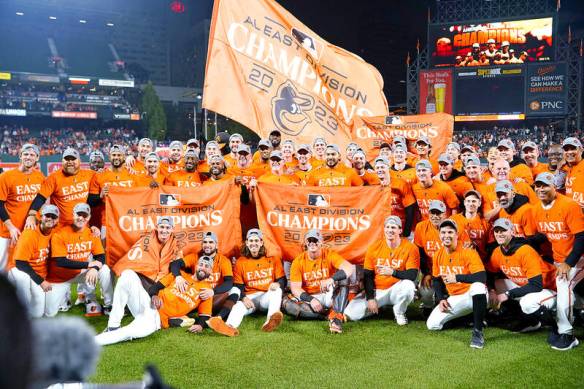
Party hearty, Baltimore, but . . .

Baltimore Orioles

Your American League East champions, who got here the hard, disgraceful way.

You hate to dump rain upon the Oriole parade just yet. But their clinch of both the American League East and home field advantage through the end of the American League Championship Series (if they get that far in the first place) isn’t exactly the early climax of a simon-pure story.

Of course it’s wonderful to see the Orioles at the top of their division heap and Baltimore going berserk in celebration. Of course it’s wonderful to see the first team in Show history ever to lose 100+ in a season flip the script and win 100 within three years.

Of course it’s wonderful that the Orioles are going to stay in Camden Yards for three more decades at least, an announcement that came in the third inning Thursday. It sent the audience almost as berserk as they’d go when Orioles third baseman Ramón Urias threw the Red Sox’s Trevor Story out off a tapper to secure the clinch.

Of course it’s wonderful that we don’t get to call them the Woe-rioles, or the Zer-Os anymore. And of course it’s going to feel like mad fun rooting for the Orioles to go deep in the postseason to come, even one that remains compromised by too many wild cards and too many fan bases thus lost in the thrills and chills of their teams fighting to the last breath to finish . . . in second place or even beyond for a nip at the October ciders.

Unfortunately, it’s not easy to forget how the Orioles got to this point in the first place. In plain language, they tanked their way here. There’s no way to sugarcoat it.

However marvelous and resilient they were all season, however much of a pleasure it’s been to see this year’s Orioles behaving like their illustrious predecessors of 1966, 1970, 1983, and numerous other division champions and pennant winners, they got here via tanking. That should never be forgotten. It should never happen again. To the Orioles or any other conscientious major league team.

It started after their 2016 season ended too dramatically. When then-manager Buck Showalter kept to his Book and his Role Assignments, declined to have his best relief pitcher Zack Britton ready and out there, because it wasn’t a quote save situation. Leaving faltering Ubaldo Jimenez on the mound to face Toronto’s Edwin Encarnación. Baltimore still won’t forget the three-run homer Encarnación parked in the second deck of Rogers Centre with the Blue Jays’ ticket to the division series attached.

They tanked from there forward, picking up from where they left off after 1988-2015. They finished dead. last. in the AL East in three of the four seasons to follow. (A fourth-place finish broke the monotony.) As of a hot August 2021 day when the Angels (of all people) bludgeoned them 14-8, including thirteen runs over three straight innings, they were 201-345—after having been the American League’s winningest regular-season team from 2012-2016.

Before the 2021-2022 owners lockout ended and spring training began, The Athletic‘s Dan Connolly came right out and said it, even though he admitted it didn’t really bother him: rebuilding the entire organisation, ground up, and giving almost all attention to the minors and the world baseball resources but so little to the parent club, “produces a tank job in the majors.”

They weren’t the only tankers in the Show by any means. Famously, or perhaps infamously, the Astros tanked their way to the 2017 World Series—which turned out to be tainted thanks to the eventual revelations that the 2017-18 Astros operated baseball’s most notorious illegal, off-field-based, electronic sign-stealing scheme.

They were preceded by the 2016 Cubs, who tanked their way to that staggering World Series conquest. Like the Astros, the Cubs came right out and said it: they were going into the tank in order to win in due course. The 2016 Cubs don’t have the 2017-18 Astros’ baggage, and their conquest was mad fun, but their fans endured a few seasons of deliberate abuse to get there.

Yes. I said it again. Just like Thomas Boswell did in July 2019. “It’s dumb enough to tear down a roster that is already rotten or old or both,” he wrote.

But it’s idiotic to rip up a team that has a chance to make the playoffs, even as a wild card, especially in the first era in MLB history when six teams already are trying to race to the bottom. With more to come? What is this, the shameless NBA, where tanking has been the dirty big lie for years?

. . . With the Orioles (on pace for 111 loses), Tigers (111), Royals (103), Blue Jays (101), Marlins (101) and Mariners (98) all in the same mud hole wrestling to get the same No. 1 draft pick next season, we’re watching a bull market in stupidity. And cupidity, too, since all those teams think they can still make a safe cynical profit, thanks to revenue sharing, no matter how bad they are . . .

. . . In the past 50 years, losing usually leads to more losing — a lot more losing. I’ve watched it up close too often in Baltimore. In 1987-88, the Birds lost 202 games. Full rebuild mode. In the 31 seasons since, the Orioles have won 90 games just three times. At one point, they had 14 straight losing seasons. Why did D.C. get a team? Because the Orioles devalued their brand so much that there was nothing for MLB’s other 29 owners to protect by keeping a team off Baltimore’s doorstep.

Baseball has seldom seen a darker hour for its core concept of maintaining the integrity of the game. Commissioner Rob Manfred is either asleep or complicit.

Too many teams are now breaking their implicit vows to the public. They’re making a profit through the back door as money gushes into the game from revenue streams, many of them generated over the Internet, which are divided 30 ways. For generations, fans have believed that they were “in it together” with their teams. Bad times made everybody miserable — fans, players and owners alike. Now, only the fans take it in the neck.

And in the back.

So this year’s Orioles, a genuinely fun and engaging team, with a lot of genuinely fun and engaging players, have won 100 games for the sixth time in their franchise history. They have the home field postseason advantage for as long as they endure through the end of the American League Championship Series. They’re liable to make things interesting for any team looking to dethrone them this postseason. Just like their former glory days.

It’s wonderful to see Camden Yards party like it’s 1969 again. Or 1970-71. Or 1979-80. Or the scattered good seasons between then and now. But it should be miserable to think of how they got here in the first place. It should be something no Oriole fan, no baseball fan, really, should wish to see again.

Tanking is fan abuse, plain and simple. It also abuses the game’s integrity. That integrity has taken more than enough shots in the head from other disgraces perpetuated by its lordships. Don’t pretend otherwise.

But now that we’ve got that out of our system, for the time being, let’s celebrate. The once-proud organisation that gave us the Brooks-and-Frank-Family Robinson era, The Oriole Way, and the era of Steady Eddie and Iron Man Cal (though beating the 1983 Philadelphia Wheeze Kids could have been called shooting fish in a barrel), is going back to the postseason at last.

And, this time, let’s pray, that when a true as opposed to a Role-or-Book “save situation” crops up in the most need-to-win postseason game, manager Brandon Hyde won’t leave his absolute best relief option in the pen—a dicey question, considering they’ve lost closer Félix Bautista (now to Tommy John surgery), even with Yennier Cano emerging to look like a grand candidate—waiting while a misplaced, faltering arm surrenders a season-ending three-run homer before their time.

Maybe these guys have what it takes to wrestle their way to a World Series showdown with that threshing machine out of Atlanta. Maybe they won’t just yet. Let’s let Baltimore and ourselves alike enjoy the Orioles’ October ride while it lasts, however long it lasts. The loveliest ballpark in the Show has baseball to match its beauty once again.

Commissioner, anyone?

Adapted from JK’s speech to the Las Vegas chapter of the Society for American Baseball Research delivered 10 June 2023.

Calling baseball commissioner Rob Manfred an inveterate tinkerer is calling Donald Trump and Joe Biden mountebanks. Calling Manfred a visionary denigrates the very definition of vision. But those who pine for the so-called good old days, while letting themselves think Manfred’s lust for rule remaking/remodeling points toward them, must first be made to answer, “Which good old days?”

Certainly not the days when the bases were large stones. Certainly not when pitchers were required to throw no way but underhanded and from a standing position strictly. Certainly not when the one-hop hit to the outfield was ruled an out if the fielder snagged the ball on that hop. Certainly not when none but white men were permitted to play the major league game. 

There are some things from the so-called Good Old Days that ought to be preserved or exhumed, of course. That’s without regard to the particular period of Good Old Days the get-off-my-lawn crowd prefers to revive. There are also things heretofore inconceivable to which today’s governors of our game, Manfred on down, should lend far more thought than they do. But it cannot be Manfred to shepherd it any longer.

Would you like to become baseball’s next commissioner? If your answer is yes, at minimum you’ll need a reasonable station from which to disembark your train. What follows is a fourteen-step platform:

1. The august office itself. Upon assuming office, the new commissioner shall convene a rules committee to explore broadening the means by which commissioners are chosen in the future. There’s no sound reason why the owners alone should choose the game’s public steward and top administrator, since it’s long been proven that under the owners alone the commissioner thinks the good of the game is little more than making money for it, and them.

The commissioner of the future should be elected by the following group of 79 people: Single representatives of the owners and the players, each; and, designated representatives from each of major league baseball’s nineteen umpiring crews.

2.Tick-tock clock. On paper, and in the imagination, the pitch clock seemed sound as a nut. In actuality, it wreaks more havoc than should be allowed. Havoc, and no few injuries ranging from the simple to the serious and back. Not to mention the imposition upon pitchers with unique or at least colourful pitching styles. Those concerned about the coming of the Clockwork Baseball Player should concern themselves about and stand athwart anything that would make that coming reality.

3. Game time. Are we supposed to applaud that, thus far, the pitch clock and its concurrent impositions upon the batter have shaved a whole . . . half an hour on average off the time of play? Are we supposed to applaud that the truest culprit of the elongated major league game—namely, the broadcast commercial blocks after each half inning and during each pitching change—remains unmolested?

The pitch clock’s elimination should be matched by all effort to make a new broadcasting agreement that includes no commercial blocks longer than one minute after half-innings and thirty seconds during pitching changes. (Yes, Virginia, it really does take less time now for a relief pitcher to get from the bullpen to the game mound than for the commercials to play.)

4. Manfred Man. The free cookie on second base to open each extra half inning shall be eliminated. Permanently. The only Manfred man that should ever be in the public mind shall be, once again, the hitmaking band of the 1964-66 British Invasion.

5. We’re on the air, anywhere. Eliminate all blackout rules for television. Allow any major league game to be broadcast in any region regardless of whether the ballpark is in the same broadcast region. Let a million television sets bloom because decades of evidence have proven that, of all the reasons for people to stay away from the ballpark, television like radio before it is the least of those reasons.

(As a relevant aside, I still remember seeing Dodger Stadium fans clutching tiny portable TV sets in the park. With the pictures turned down but the sound turned up. Why? Because they wouldn’t believe what they’d just seen from beginning to end unless they heard it from the late Vin Scully.)

6. Umpires can be impeached, too. The umpires have been laws unto themselves for long enough. It’s past time for them to be held as accountable for their malfeasance as players, managers, and team administrators. There’s no reason on earth for accuracy below 96 percent to be permissible. If you doubt that, ponder that a surgeon with a 96 percent accuracy rating wouldn’t face job security, he’d face malpractise suits.

Umpires with accuracy below 96 percent shall be placed on probation for the rest of the incumbent season or the first half of the following season. Failure to improve will result in suspensions. And, yes, the rule book strike zone shall be enforced strictly. The days of umpires deploying their own strike zones must end. That by itself should help assure accuracy of 96 percent or higher behind the plate.

7. No tank you veddy much. Team ownerships who fail repeatedly to invest properly in their major league product and their minor league support systems shall be put on notice. You have one year to decide: Will you invest properly in your teams, every year, regardless of the free spoils of revenue sharings you receive before each season begin; or, will you sell your team to a local/regional ownership willing to do what needs to be done to put an honestly competitive team on the field.

Tanking is fan abuse, plain and simple. If you can afford to buy a major league baseball team, you can afford to put forth a product that gives honest effort to compete. Rebuilding on the fly has been done for eons, before and after the free agency era.

Concurrently, past commissioner Bowie Kuhn’s ridiculous prohibition on player sales shall be rescinded. Teams shall be allowed to sell their players on an open market for whatever price other teams are willing to pay—and the players to be sold shall receive at least 25-30 percent of the sale price. This will allow the supposedly not-so-rich teams to stay minimally competitive, too.

Call it the Averill-Landis Rule, after the ancient commissioner who thought Hall of Famer Earl Averill wasn’t nuts to demand to know how much of the sale price he might receive when the Cleveland Indians bought him from the Pacific Coast League.

While we’re at it, a tanking team must never be given permission to relocate, which leads to . . .

8. If you want to build it, we will come. Under no circumstances shall any team seeking to build a new ballpark go to the local and/or state government for help. For now we mean you, Oakland Athletics. It takes colossal gall to try strongarming your incumbent locale into building you a new ballpark and, when they call your bluff, try to strongarm Las Vegas into building one for you; or, at least, paying for half if not more of it.

The willful self-destruction of a team fan base should never be sanctioned. Neither should regional taxpayers be made to foot all or most of the bill for a new playpen. The Voice in Field of Dreams assuredly did not say, If you build it, they will pay for it.

9. Interleague, schminterleague. Eliminate it from the regular season. Entirely. Save it for when it truly matters—during the All-Star Game, and during the World Series.

10. Are the All-Stars out tonight? Absent one fan, one vote, one time requirements, eliminate the fan vote. Why? Because the All-Star Game must include rosters containing none but the absolute best players on the season thus far. If this means one or more teams lack All-Star representation, tough. This isn’t T-Ball.

While we’re at it, the next commissioner must rule that the All-Star Game also needs to cease being used as a gold watch, even for future Hall of Famers. They’ll get their tributes appropriately around the circuit without a final All-Star honorarium, not to mention those so qualified getting the big one in Cooperstown in due course.

11. Competition, not compensation. This nonsense must cease. The regular season’s meaning has been compromised long enough. And the saturation of postseason games has compromised more than enhanced the game. There’s no reason on earth why any team not parked in first place at season’s end should be playing for baseball’s championship.

Expansion should be pursued to create divisions with even numbers of teams. Then, two conferences of two divisions each shall be fashioned in each league. The wild cards shall be eliminated entirely.

Then, each league’s division champions will meet in a best-of-three division series. The winners in each league will then meet in a best-of-five League Championship Series. (You want the Good Old Days restored, there’s a splendid restoration.) The World Series shall remain its best-of-seven self with its primacy thus restored. (Postseason saturation will be scaled back considerably under such a system, too.)

Thus will baseball fans no longer be subject to the thrills, spills, and chills of watching teams fighting to the last breath to finish in . . . second or even third place.

12. We want a real ball! Something’s very wrong when the Japanese leagues can develop baseballs pitchers can grip easily and are eminently fair to both sides of the ball but the American major leagues—which own a major baseball manufacturer—can’t. All effort to develop a baseball that doesn’t require that new-fashioned medicated goo for pitchers but is consistent and fair to hitters as well shall be undertaken.

A new, consistent baseball shall be developed and brought into play within one year of the new commissioner taking office. It’s long past time for the thinking person’s sport and those who support and supply it to start thinking. Hard.

13. Pensions. The new commissioner shall convene an immediate panel from among all team ownerships and the Major League Baseball Players Association. This panel, at once, shall agree that it was wrong to eliminate pre-1980 short-career major league players from the realignment of 1980. That realignment granted pensions to all players who accrued 43 days of major league service time, and health benefits to all players accruing one day of major league time.

The calculations shall be done to ensure full and proper pensions, based on their actual major league time, to all 500+ surviving short-career players who played before the 1980 realignment. The 2011 Weiner-Selig stipend—one small payment per 43 days service time, which today equals $718 per 43 days—was laudable, but insufficient.

Those players backed their players union’s actions that led to or upheld free agency, too. They do not deserve to remain frozen out.

14. As your absolute first order of business in office. Before assuming office, the new commissioner’s first official pronouncement shall be to demand . . . a recount.

Baseball’s unlocked. But . . .

“I believe that God/put sun and moon up in the sky./I don’t mind the gray skies/’cause they’re just clouds passing by.” So wrote Duke Ellington, and sang Mahalia Jackson, in his 1943 magnum opus reworked for 1958’s album  Black, Brown, and Beige. The lyric was part of a segment called “Come Sunday.”
Come Sunday, this Sunday, the gray skies yield metaphorically as spring training finally begins. And, early-series cancellations notwithstanding, there will indeed be 2,430 regular season baseball games played in a 162-game schedule this year. It might mean a tighter calendar, of course. But, given that, does it now feel as though spring has arrived properly at last?

Baseball’s owners’ lockout, which ended 26 years of labour “peace” needlessly, ended Thursday. Commissioner Rob Manfred called it a “defensive lockout.” Those who believe that might as well believe Vladmir Putin decided to defend himself against Ukranian “aggression.”

The owners could very well have elected to let baseball continue operating while they negotiated and hammered out a new collective bargaining agreement. The now-concluded 99-day lockout was and will ever be on them entirely. But they had the players right where the players wanted them. Sort of.

The players now have the owners accepting the largest hike in the so-called competitive balance tax—too long used by the owners as a de facto salary cap—since the tax was born after the 1994-95 players’ strike. They also have the owners accepting the largest jump ever in the minimum major league player’s salary, and a pre-arbitration bonus pool for young players emerging as early stars that’s worth $230 million new money just over the time span of the new CBA.

Yet the Major League Baseball Players Association’s vote for accepting the terms was a mere 26-12. The Athletic‘s Evan Drellich writes that it was “telling” for “roughly a third of the executive board [feeling] there was more to accomplish right now, in continued negotiations in 2022, not in the future.”

There’s the warning from Hall of Fame baseball writer Jayson Stark: The new competitive-balance tax threshold may not necessarily mean putting the “competitive balance” all the way into it:

You know those seven teams that came within $8 million of going over the [old] threshold last year? They’re likely to do that same thing this year—other than the Mets, who are already well north of it. But if all those teams spend another $20 million or so apiece, that’s a notch in the win column for players, except for one thing . . . teams that weren’t spending money before still have no incentive to spend now.

“All this does is just increase payroll disparity,” said one longtime club official. “Just because the Phillies go up $10 million doesn’t mean a team like the Marlins goes up $10 million.”

In other words, there’s still room enough for continuing tanking. Maybe that was why that one-third of the union’s executive board felt there was still more to get done now, if not yesterday. Remember Hall of Fame shortstop Derek Jeter took a hike from running the Marlins almost a fortnight ago, saying, essentially, that he didn’t sign up to preside over the Fish only to see their “direction” resemble a killifish and not a barracuda.

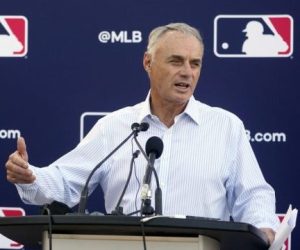
What, then, of commissioner Rob Manfred, who is probably the single worst salesman in baseball and barely sold it when he proclaimed at a Thursday press conference that he was “thrilled” the lockout was over and a new deal was done?

At least three questions presented to him inquired about future mended relationships between MLB and those who actually play baseball. Manfred actually doffed his stegasaurus-in-the-china-shop cloak to admit he hasn’t been so successful at promoting “a good relationship with our players. I’ve tried to do that. I have not been successful at that.”

Gee, what gave him the clue? Standing with almost no apology for the precept that the general good of the game is making money for the owners? Allowing the owners to go 43 days worth of silent after their lockout began? Dismissing the World Series championship trophy as “a piece of metal” while not quite holding all the Houston cheaters accountable when Astrogate tainted their 2017 World Series title and outraged as large a percentage of players as it did fans?

Saying it was Mike Trout’s fault Trout wasn’t considered baseball’s face outside the game itself? Abetting the owners trying to cheat the players out of their proper pro-rated 2020 salaries during the pan-damn-ically short season? Tinkering like Rube Goldberg with the game’s play, from the free cookie on second base to open each half inning to the three-batter minimum for relief pitchers?

Manfred did at least observe that the new deal should give the owners and the players more than a little room to move on working out such things as doing away with draft-pick compensation for players reaching free agency; and, on establishing a joint committee aimed at addressing issues involving field competition. But . . .

“The committee can implement rules changes with 45 days notice,” writes another Athletic staffer, Ken Rosenthal, “and with the league holding a majority of members, Manfred can push through any changes he desires. Will he do it, continuing the league’s chest-pounding, zero-sum style? Or will he and league officials show greater understanding that players are the product, and become better listeners?”

They’ve barely understood, if at all, that no fan has ever paid his or her way into a ballpark to see their team’s owner. “Recent history suggests that when the owners give in one area, they take from another, which again leaves the middle class of players vulnerable,” Rosenthal warns. “Don’t hold your breath waiting for the league to suddenly become more benevolent to its most valued employees, though even a mildly less aggressive approach would be helpful.”

But Rosenthal points to at least one team administrator not named Steve Cohen (the deepest-of-deep-pockets owner of the Mets whom enough owners fear for his willingness to invest in his team and its organisation) who has more than a clue. “It’s paramount,” said Twins president Dave St. Peter on a Zoom call to writers covering the team, “that we as an industry do a better job of building trust with our players.”

Coming in the wake of such petty tacks as scrubbing players from MLB’s own Website early in the lockout, St. Peter’s words may sound encouraging on the surface. But it’s wise to remember a remark once made often enough by the maverick journalism legend Sidney Zion: Trust your mother, but cut the cards.

Try not to get too hopped up over the new service-time adjustments, either, which mean rookies finishing with the Rookie of the Year or in second place for the award get a full year’s service time even if he didn’t spent the entire season in the Show. “[A]ny system based on counting days is a system that can be manipulated,” Stark warns. “So why do we suspect we could be back in this same, uncomfortable place in five years, trying to remind the powers that be again that there’s something wrong with a sport that rewards teams for not putting its best players on the field.”

For the moment, we can revel in a few things. The entire baseball family, from the teams to the fans, is watching to see the swift enough movement of the game’s remaining free agents. And we’ll be spared at long enough last the overwhelming, century-plus-old futility of pitchers at the plate wasting outs (those who can hit have always. been. outliers), now that the designated hitter will be universal instead of everywhere but the National League.

At long enough last, we should see a cutback in basepath injuries thanks to coming new bases that will be—relax, ladies and gentlemen—a mere three inches larger than the bases have been in the past, but designed with more give that may mean less leg injuries taking players out for two-thirds of a season or longer.

That twelve-team postseason format? With three wild cards per league? The good news is that the odds of a team with a losing record making the postseason under it aren’t great. Since the first wild-card game in 2013, Stark says, if this format had been in play only once might a sub-.500 team have burglarised its way into the postseason: 2017. (The Angels, the Rays, or the Royals.) And, the extra-card clubs would still average 87 wins.

“So despite this expansion,” Stark continues, “the baseball playoffs will still be the most difficult to make among the four major professional sports.” And still rather profitable for the owners, who stand to pull down $85 million postseason from ESPN with the third wild card. They may also change the trade deadline atmosphere, as Stark observes: “More buyers. Fewer sellers. Less incentive for teams hovering near contention in July to hold those depressing closeout sales.” May.

Myself, I remain in favour of something else: eliminating the wild cards entirely, adding two more major league teams to make sixteen-team leagues, and doing away with regular-season interleague play. But with or without the third of those, 1) divide each sixteen-team league into four four-team conferences; 2) best-of-three conference championships; 3) best-of-five League Championship Series (you know, the way the LCS was from 1969-85); and, 4) leaving the World Series its best-of-seven self.

Goodbye postseason saturation, welcome home genuine championship.

For now, I hope, too, that the remaining 525 pre-1980, short-career players maneuvered out of the 1980 pension realignment won’t be forgotten much longer, either. The lockout also suspended the annual stipend the late MLBPA director Michael Weiner and former commissioner Bud Selig got them—$625 per 43 days’ major league service time, up to $10,000 a year. (It would have been paid normally in February.)

Which would, of course, require what they once called the vision thing. This commissioner and his bosses tend to lack that. Today’s players have it, but they could use a lot more depth. Doing right further for those pre-1980 men whose playing careers were short, but who supported the union in its most critical early years, toward the end of reserve era abuse, and the rightful advent of free agency, would show vision even philosophers only imagine having.

Baseball’s death wish?

Rob Manfred

Rob Manfred announcing the cancellation of the 2022 regular season’s first two weeks. He has made clear his vision for the good of the game is making money for the owners and too little more.

I’ve quoted it often but it all but screams now. “We try every way we can think of to kill this game,” said Hall of Fame manager Sparky Anderson once upon a time, “but for some reason nothing nobody does never hurts it.”

That’s Anderson’s body among many now performing imitations of washing machine spin cycles in their graves, while their beings in the Elysian Fields pray today’s baseball owners haven’t pushed the game closer to its own.

“I had hoped against hope,” commissioner Rob Manfred said Tuesday evening, “I wouldn’t have to have this press conference where I am going to cancel some regular season games. I want to assure [baseball] fans that our failure to reach an agreement was not due to a lack of effort by either party.”

It was to laugh that you might not wish to commit manslaughter.

That was the man whom we are, as one Twitter denizen tweeted, “old enough to remember [saying] cancelling regular season games over his MLB #Lockout would be a disaster.” The disaster is of Manfred’s own and his bosses’s making.

That was the man whose bosses, the owners, compelled him to impose a lockout, just after midnight 1 December, when baseball’s previous collective bargaining agreement expired, rather than allow themselves and the Major League Baseball Players Association to continue operating the game under the former agreement while negotiating a new one.

That was the man who presided over 43 days’ worth of absolute dead silence from the owners’ side to follow. Dead silence, including nothing in the way of an offer from the owners to the players. Dead silence, but not oblivion.

Eyes unclouded by either cataracts or selectivity saw this was not dismissable as mere  billionaires versus millionaires. Eyes thus unclouded saw that Manfred claiming major league baseball franchises return less on what is invested to buy and run them was a shameless and shabby lie.

Eyes at full strength see that only 31.4 percent of the players’ union’s active major league membership earns more than a million dollars in a season, that 28.2 percent of that membership are minor league players on teams’ forty-man rosters who earn no more than $40,500.

“Player pay has decreased for four consecutive years, even as industry revenues grew and franchise values soared and the would-be stewards of the game pleaded to anyone who would listen that owning a baseball team isn’t a particularly profitable venture,” wrote ESPN analyst Jeff Passan on the day of Manfred’s first deadline for a deal without cancelling games.

Players’ service time has been manipulated to keep them from free agency and salary arbitration. The luxury tax, instituted to discourage runaway spending, has morphed into a de facto salary cap, and too many teams are nowhere near it anyway, instead gutting their rosters and slashing their payrolls because the game’s rules incentivize losing. The commissioner has called the World Series trophy a “piece of metal,” and the league has awarded the team that did the best job curtailing arbitration salaries a replica championship belt.

Eyes open wide saw that Manfred and his bosses are the (lack of) class attempting nothing short of its level best to push players further back toward what they were prior to 1975-76.

That was then: Curt Flood, in his courageous but failed bid to break the ancient abused reserve clause, proclaimed, “A $90,000 a year slave is still a slave.” And, Andy Messersmith, who finished what Flood started: “I was tired of players having no power and no rights.” This is now: Owners and their administrators, enough of whom originate in the corporate world, refer to baseball players as assets, commodities, elements, liabilities, pieces.

They wish you to forget that baseball is unlike the typical industry in which the worker bees make the products sold, because in baseball the worker bees are the product sold.

They also wish you to forget that a small market is in the eye and the adjusted ledger of the beholder. “There is no such thing as a ‘small market’,” tweeted Ben Verlander, an actor and the brother of future Hall of Fame pitcher Justin Verlander. “If you want a bigger market. Put more money into your team and make them competitive.” (The “small market” Pirates, believed among baseball’s premiere tankers, are worth $1.2 billion.)

Last weekend, negotiations dragged before Monday’s marathon sessions deep into the night enabled exactly what the players thought would occur, the owners refusing to budge more than milliliters if that far on any concessions the Players Association wanted to sign on the proverbial dotted line—and then propagating as Manfred ultimately did that by God they’d gone to the mattresses trying to get a deal.

This time, however, the players had an invaluable weapon in the PR wars. They weren’t shy about taking it to social media, any more than serious fans were shy about hitting the Internet running to fact-check any and just about every one of Manfred’s claims about the owners in serious binds. Finding them very wanting.

“If times are so tough for these clubs financially over the last five years,” tweeted Giants third baseman Evan Longoria Tuesday afternoon, “show us the financials. Be transparent.”

From the moment the lockout began through the moment Commissioner Nero announced the first two series of the regular season were cancelled—if not for his entire commissionership—he’s been very transparent about his view of the good of the game: making money for the owners, and precious little else.

Another future Hall of Fame pitcher, Max Scherzer, whose plainspokenness and willingness to put in sixteen-hour days at the bargaining table has impressed as much as he impresses on the mound, makes plain he’s not thinking purely of himself or the considerable dollars he’ll lose for every regular season day with an unplayed game.

“It’s about everybody else. I’m in a position to fight for those guys and sacrifice my salary to make this game better,” Max the Knife insisted to USA Today baseball columnist Bob Nightengale.

We all want to make the game better for the next generation behind us, and we’ll do whatever it takes to make that happen. The former players that fought for the game and fought for the players, I realized the benefits from that. I had an unbelievable career for all of the rights that everybody fought for, going back to Curt Flood. Now I have the opportunity to do that for the next generation.

“Scherzer and the union are fighting for pay for the young players who aren’t eligible for salary arbitration, seeking large raises in minimum salary and bonus pools,” Nightengale continued.

They are fighting to make sure that teams are actually trying to win and not to collect draft picks with a draft lottery. They are fighting to make sure that every team can freely sign free agents without a restrictive luxury tax, pointing out the absurdity of the San Diego Padres having a larger payroll than the New York Yankees. They are fighting to make sure the integrity of the regular season is not compromised, willing to accept a twelve-team playoff system, but not fourteen teams.

It would be even better if Scherzer and his fellows, and Nightengale and his fellows in the baseball press, also remembered a particular group among the former players who fought for their brethren and for the game itself and who deserve considerably more attention than either the Players Association or the owners have paid.

There remain 525 former major leaguers, playing prior to 1980 but whose careers were short for assorted reasons, frozen out of that year’s pension re-alignment, but who were gained $625 per 43 days’ major league service time in a 2011 deal between the late Players Association director Michael Weiner and then-commissioner Bud Selig, worth up to $10,000 a year for them depending on their actual major league time.

Those players—including 1969 Miracle Mets Rod Gaspar and Bobby Pfeil and former Rangers fresh-from-high-school pitching phenom turned mishandled David Clyde—didn’t receive those annual stipends as they should have in February, also thanks to the owners’ apparent baseball death wish.

“The owners . . . still they couldn’t help themselves, couldn’t resist going for the throat,” writes The Athletic‘s Ken Rosenthal. “They, too, could end up net losers, depending upon how much [baseball’s] place in the entertainment landscape is diminished. But they seemingly would rather take that risk than satisfy the players who pitch and hit and make teams so valuable.”

The day you see baseball fans walking about wearing jerseys with names on the back such as Angelos, Crane, Lerner, Liberty, Monfort, Moreno, Nutting, Guggenheim, Reinsdorf, Ricketts, or Steinbrenner, among others, is the day you should see swine in the colours of American Airlines.

“They may not break the union,” writes Rosenthal’s fellow Athletic scribe Andy McCullough of Manfred and his bosses. “But they will break something.” They already have. They’ve broken the heart of a nation starved for the sort of post pan-damn-ic normalcy that baseball alone might provide.

The lockout is on

Before you start cringing while you lament the lockout, try to keep one thing in mind: It hasn’t canceled any games, regular, postseason, or World Series. Yet. If there must be a “work stoppage” for baseball, let it happen during the off-season. Let yourselves be fooled not one moment, either, that baseball has ceased going to work entirely.

About the only work that’s been stopped is contract offerings and signings between the owners and the players. Be advised that team front offices and staffs will continue going to work and players will continue their customary off-season routines preparing for the season to come.

That slightly surreal rash of tradings and free agency signings leading up to the deadline for the lockout—right down to the Red Sox trading Hunter Renfroe to the Brewers to bring home Jackie Bradley, Jr., he of the modest bat but the immodest outfield defense—is halted. That portion of the annual winter meetings involving the Show is pre-empted.

The lockout, as The Athletic‘s Evan Drellich observes, was somewhat inevitable “for months now, even years.” It’s the first “work stoppage” Major League Baseball has seen since the 1994 players’ strike.

That strike was pushed and provoked by the owners then. This “stoppage?” “Players have grown increasingly dissatisfied with club behaviors and the CBA that enables at least some of them,” Drellich writes, “and owners have shown little interest in making the concessions the players seek.”

Talks broke off a few hours before the Wednesday/Thursday midnight deadline after the owners refused to consider any economic proposal from the players unless the players agreed “in advance” to cease certain demands. Those demands, Drellich writes, include the time it takes a player to achieve free agency and changes to the current revenue sharing system.

The players believe with plenty of good reason that the current revenue sharing ways enable too much tanking, teams refusing to rebuild on the fly in favour of just throwing in the towel, allowing the major league product to perform like the St. Louis Browns while (it is alleged) they rebuild from the ground up.

Now hear this: Only two teams are known to have tanked successfully, meaning they tanked to rebuild and ended up in the Promised Land: the Astros and the Cubs. The Cubs tanked to build their 2016 World Series champion within just a handful of seasons; the Astros tanked likewise to build their long-since tainted 2017 World Series champion.

Time was when teams tried to urge certain star players out of the lineup the better to enable them to reach particular milestones before the home audience. It’s a lovely thing to behold when a man does it at home, but when his team tries maneuvering him into it it besmirches the competitive mandate.

That kind of tank usually drew a fury of indignation against the team that put coffers ahead of the honest competition, ahead of the presumption that a team must and does put its best possible lineup forth in the best interest of winning an honest contest.

Today’s tanking teams put coffers ahead of an honestly competitive season. In perhaps one of the top five perversions of “stop us before we over-spend/mis-spend/mal-spend again,” the owners would rather see a small handful of teams abuse their fans than demand such teams do what needs to be done to ensure at least an effort to compete.

Commissioner Rob Manfred audaciously calls it “this defensive lockout,” needed because the Major League Baseball Players Association’s vision for the game “would threaten the ability of most teams to be competitive.” If you believe that, my Antarctican beach club’s sale price has just dropped another hundred grand. “It’s simply not a viable option,” Manfred’s statement continues. “From the beginning, the MLBPA has been unwilling to move from their starting position, compromise, or collaborate on solutions.”

The union says the lockout was anything but “defensive”—“It was the owners’ choice, plain and simple, specifically calculated to pressure players into relinquishing rights and benefits, and abandoning good-faith bargaining proposals that will benefit not just players, but the game and industry as a whole.”

“This drastic and unnecessary measure,” says a statement from union director and former first baseman Tony Clark, “will not affect the players’ resolve to reach a fair contract. We remain committed to negotiating a new collective bargaining agreement that enhances competition, improves the product for our fans, and advances the rights and benefits of our membership.”

Do you notice that the owners through Manfred didn’t mention the fans but the players through Clark did? Do you notice the owners didn’t mention enhancing competition but the players did? The player are also concerned, rightfully enough, with younger players getting their major league earnings due and with younger players no longer subject to arbitrary whims that include suppressing them in the minor leagues when they’ve shown themselves Show ready.

“There’s also a feeling among players that front offices have become very good at manipulating the system to their advantage,” says the union’s chief negotiator, Bruce Meyer. “We want to make changes designed to incentivize competition for players, and remove disincentives for that competition. We want to find ways to get players compensated at an earlier stage of their careers when the teams are valuing them the most. And we want to preserve the fundamental principles of a market system.”

Tanking to one side, both sides have a couple of troublesome competition proposals. The owners are said to want a fourteen-team postseason; the players are said to prefer twelve.  Both should be rejected out of hand, no further questions asked, because postseason competition needs no further dilution than has happened in the wild card era.

Not long ago, there came a proposal for four-division leagues that might require expanding the leagues to another team each. I’ll see and raise: expand each league with one additional team each (and, this time, please do make damn sure there’s a real market for major league baseball in the new locales), but return each league to two divisions.

You’d actually have something resembling baseball the way it once was, after its first expansion: eight-team divisions, two in each league. Now, eliminate the damn wild cards and make it plain enough that either you’re playing for first place or it’s wait till next year, and don’t even think about tanking any longer.

Then, you remove the number one reason why the postseason loses its audience the deeper it progresses—saturation. Today’s postseason involves a maximum forty-two games. This still isn’t as crazy as the National Basketball Association’s maximum possible 98 postseason games, but it’s insane enough. In two divisions of eight teams each, baseball could (should) re-align itself to best-of-five League Championship Series and leave the World Series its best-of-seven self.

Guess what? In that re-alignment, you’d have a maximum of seventeen games, and the postseason wouldn’t even think of sneaking into the wee small hours of the month of November.

No, I’m not angling to become baseball’s next commissioner, but I’m only too well aware that the postseason has become a plaything through which the common good of the game becomes even more equal to making money for the owners and provoking the players to demand their cuts of it, too.

“[B]oth sides, after years of discontent, could be interested to test the other’s resolve,” Drellich says of the lockout now on. “The owners, as well, might believe that the free agents who remain when the lockout concludes will feel pressure to sign quickly, and therefore, at a discount.”

Don’t believe for one nanosecond that the owners should get away with crying poverty. Not when such new deals or extentions come forth as those recently handed to a Mets trio of Mark Canha, Eduardo Escobar, and (especially) Starling Marte; plus, Sandy AlcantaraJavier Baez, Byron Buxton, Wander Franco, Avisail Garcia, Kevin Gausman, Jon Gray, Robbie Ray, Corey Seager, Marcus Semien (is it me, or did the Rangers just drop about $512 million on new signings including Seager?), and (especially) Max Scherzer.

Unfortunately, the mid-level players often get bypassed during collective bargaining issues and often bear the brunt of whatever new CBAs cost. The talks usually involve “a league minimum and free agency eligibility,” as ESPN’s Buster Olney observes. “The players’ middle class, which has seen salary diminishment as a lot of teams apply analytics and identify cheaper replacement-level players, while other teams adopt the tanking strategy and cut payroll dramatically, has mostly been left out of those conversations.”

Scherzer isn’t the only player concerned about that plus making sure the owners can’t further suppress real competition and the full free agency picture. “Unless this CBA completely addresses the competition (issues) and younger players getting paid,” Max the Knife says emphatically, speaking as a member of the union’s eight-member player subcommittee, “that’s the only way I’m going to put my name on it.”

More competition issues? How about pushing the owners to push Manfred away from that ridiculous three-batter minimum for relief pitchers? How about pushing them to make the designated hitter universal, once and for all time, and eliminate the single most automatic out in the game? And, to make it so without one insane owners’ proposal that it be tied to a six-inning minimum for starting pitchers?

How about knocking it the hell off with monkeying around with the baseball itself (yes, MLB used two different sets of balls with two different actual weights in 2021—unbeknownst to anyone), then just develop and use a viable ball that favours neither pitcher nor hitter but makes it as level a confrontation as possible?

People thought Pete Alonso (Mets first baseman) was talking through his batting helmet when he waxed last June about MLB manipulating the balls themselves on behalf of impacting free agency. An astrophysicist discovered not only the different ball weights this year, but spoke to one unnamed pitcher who suspected the possibility that MLB might send different-weighted balls to stadiums hosting certain series: say, deader balls to sets between lesser teams but livelier balls to those hosting, say, the Yankees vs. the Red Sox.

I’d say that demands a full-throttle investigation. If people could and did go slightly mad over pitchers using that new old-fashioned medicated goo, they ought to go slightly more mad over ball cheating by baseball’s administration itself. The MLBPA should bring that up—and stick it in the owners’ ears.

The best news about this lockout is that it did happen during the off-season. Assorted analyses say strikes in sports are becoming things of the past. The bad news is that unreason isn’t going to become a thing of the past any time soon. Not, at least, until baseball’s ownerships today continue to prefer manipulation over competition, and the players increase their concern that competition be diluted no more.