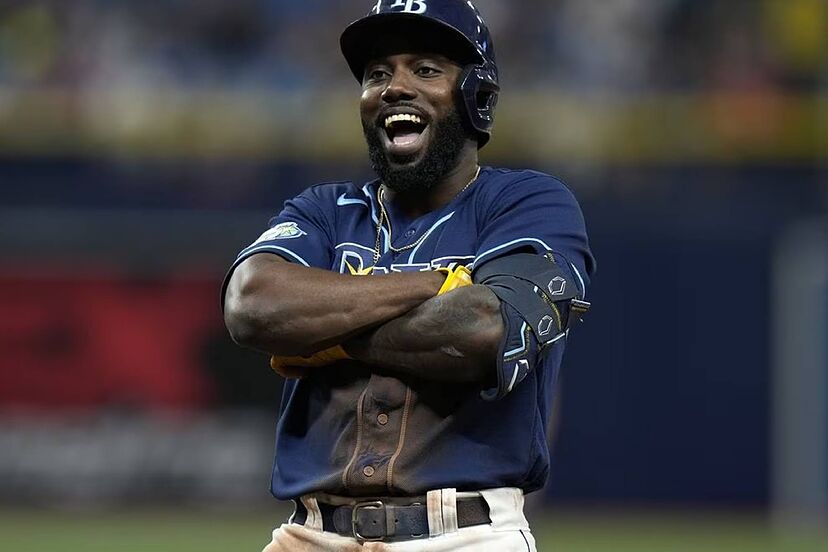
They’ll love Arozarena in Seattle . . .

Randy Arozarena

Arozarena’s smile could light up any ballpark felled by a power outage.

Nobody likes to see teams send their most heroic postseason heroes onward. Sometimes that happens when the most recent of their postseason heroics are still in full rearview mirror view. That stings the deepest.

So maybe the Rays did their fans a favour by sending Randy Arozarena to the Mariners long after the postseason postings that made his name disappeared from rearview sight. But it’s a small favour. And, depending upon the net results of the haul they got in return, it might not even prove that much of a favour.

Once up as high as ten games atop the American League West, the Mariners have since gone 11-20 as the formerly-moribund Astros reheated enough to take the division lead by a full game. Losing a ten-game lead in a 24-game stretch was unprecedented. No team before them ever blew that fat a lead that soon.

Arozarena’s season began slumping until he re-heated before the trade, but he hasn’t factored in the Mariners fortunes just yet, even if they took a pair from the White Sox after making the deal. The Mariners have the patience of Job when it comes to waiting for his full emergence in their silks.

They sent the Rays two prospects with upside enough if you consider the Rays’ ability to shape players, minor league outfielder Aidan Smith and pitcher Brody Hopkins. The Rays had better hope they can forge that pair into more than just replacement-level major leaguers. Arozarena was worth about a hundred times that much from the moment his 2020 coming-out party began.

Arozarena picked up one hit on Saturday but then went 2-for-4 with a run scored in Sunday’s 6-3 Mariners win. He beat an infield hit out in the first to score almost promptly on Cal Raleigh’s immediately-following home run, then he beat another infield hit out to load the bases with two out in the second only to be stranded there.

“He’s really loved by his teammates and fans,” said Mariners outfielder Luke Raley, himself an Arozarena teammate in Tampa Bay for two seasons, “and he’s going to be a fun addition for sure. He’s the low heart-beat kind of guy. He’s just made for the big moment. Late in the game, you need a big hit, you want Randy at the plate.”

Raley spoke after the Mariners demolished the bottom-crawling White Sox 10-0 Friday night. He even revealed Mariners president Jerry Dipoto consulted him on Arozarena before pulling the proverbial trigger on the deal. “I kind of gave him a three-, four-minute spiel about my thoughts and the things that [Arozarena] does,” Raley said. “You try to explain it, but it’s really hard—because until you see it, you don’t fully understand it. But he just is like a bright star.”

This is the effervescent who defected from Cuba in a rowboat and was first signed by the Cardinals. A year before that coming-out party, Arozarena made what some call a mistake and others call serious. When the Cardinals destroyed the Braves 13-1 in 2021 National League Division Series Game Five, manager Mike Schildt broke into a postgame rant that left himself and his team resembling sore winners:

They [the Braves] started some (excrement). We finished the (excrement. And that’s how we roll. No one (fornicates) with us ever. Now, I don’t give a (feces) who we play. We’re gonna (fornicate) them up. We’re gonna take it right to them the whole (fornicating) way. We’re gonna kick their (fornicating) ass.

Schildt’s rant went viral thanks to Arozarena capturing it on video and sending it there. Once the rejoinders went flying in earnest, he couldn’t wait to take the video offline. The only place the Cardinals went from there was to a four-game sweep out of that National League Championship Series by a team of Nationals whose manager was smart enough not to say they were going to [fornicate] the Astros up in the World Series—they simply did it, in seven thrilling games.

A cynic might suggest the Cardinals waiting to trade Arozarena to the Rays the following January was a matter of not wanting it to look as though they were teaching him a lesson about impudent videomaking. But their loss was the Rays’ gain, once baseball resumed after the long enough and weird enough pan-damn-ic shutdown. The Rays hit the expanded postseason running. Arozarena hit it exploding.

He hit ten home runs to smash Hall of Famer Derek Jeter’s record for a single postseason. He set a single-postseason record with 29 hits. He was named that American League Championship Series most valuable player. Perhaps fittingly, too, he slammed the exclamation point down upon one of the weirdest and wildest World Series game-ending walkoff hits in Game Four.

He pounded the plate nine times with his right palm to be sure he wasn’t imagining having scored the walkoff run to finish 2020 World Series Game Four’s insane finale. Compared to his grin, the Cheshire Cat was suffering depression.

Arozarena was on first in the ninth when pinch-hitter Brett Phillips singled Kevin Kiermaier home with the tying run. Except that Dodgers center fielder Chris Taylor coming in to field the ball had more eye on Kiermaier and the ball caromed off his glove to his left. Taylor scrambled to retrieve the ball and get it to his cutoff man Max Muncy.

Except that Muncy took the throw past first and wheeled to throw home, but the throw bounded off catcher Will Smith’s mitt at the split second Smith began wheeling for a tag on an oncoming Arozarena—who wasn’t within two nautical miles of the plate just yet. Arozarena tumblesaulted after tripping and stumble back toward third before righting himself when he saw Smith lacked the ball, diving home and pounding the plate with the palm of his right hand nine times.

The Rays would lose that Series, of course, but Arozarena went from there to become the 2021 American League Rookie of the Year, his rookie status unblemished by his late arrival down the 2020 stretch. He was likely the first ROY to win that award after making himself into a postseason breakout star. And few postseason breakout stars had Arozarena’s knack for making even opposing fans take to him.

He was made for the arena. A word that just so happens to be the final three syllables of his surname. But he’s also made of more endearingly human things. When he learned he’d been traded, Arozarena delivered a farewell to admire. He slipped into the stands and greeted, shook hands with, and thanked as many fans and stadium workers as he could before departing. No newspaper ad or billboard stuff for him.

Arozarena’s likely salary escalation plus the Rays’ apparent inability to make any AL East gains prompted the team to move him to Seattle and pitcher Zach Eflin to the Orioles. Closing the book on this season and looking toward next may make baseball sense for the Rays.

“Tampa Bay has been hovering on the edge of the AL playoff picture for nearly the entire season, but a late-season surge wouldn’t have been out of the question,” says FanGraphs writer Jake Mailhot. “By moving Arozarena at this point in the season, the Rays have indicated that they’re more interested in ensuring they’re set up well for the future than in hoping for a long-shot playoff run over the next few months.”

But sending a franchise icon away—in a year that cost them their $182 million shortstop to administrative leave over an underage sex scandal in the Dominican Republic—stings even more. The Rays may lead the Show in frugality, but don’t think for a nanosecond that they entered 2024 intending to change Arozarena’s home address just yet.

They’re not the first to think they had to move such an icon, of course. But depending on what’s to come the rest of this season and most of next, Rays fans may yet come to see the Arozarena trade as comparable to that of the Mets trading Hall of Famer Tom Seaver to the Reds in 1977. Breaking hearts and backs and what was left of a franchise’s spirit alike.

Why Wander Franco must go

Wander Franco

Rays shortstop Wander Franco amidst reporters as he arrived at a Dominican court Friday. (AP/WTSP Tampa Bay photo.)

Last August, when a social media post first hinted that Wander Franco dined upon forbidden fruit, he was held out of the Rays’ lineup. But he was quoted as saying, “They don’t know what they’re talking about. That’s why I prefer to be on my side and not get involved with anybody.”

Franco had the part about “they” not knowing what they were talking about kind of right.

He wasn’t just “running around” with an underage girl in his native Dominican Republic. Authorities there say he was sexually involved with her and, apparently, paying her mother about $1,700 a month for seven months in return for, as the old rhythm and blues song pleads, mama keeping her big mouth shut.

You thought Trevor Bauer turned out to be a nightmare for women and for baseball? Sexual violence with a fellow adult who wasn’t awake to continue giving her consent (which was never discredited in court even if his victim lost her restraining order bid) is demeaning and dangerous. What should we call kidnapping (for two days), seducing and schtupping a fourteen-year-old girl even once, never mind over four months?

Especially if the girl in question, fourteen years old when Franco began his relationship with her, may have been forced into this kind of rodeo before, sadly and sickeningly. She said so when interviewed by a psychologist during Dominican authorities’ investigation of the Rays shortstop.

“Since I was little,” the girl told a psychologist, according to court documents made available to The Athletic, “my mother has seen me as a way for her to benefit both from the partners she has had and from my partners. And it is something that I dislike very much.”

The shortstop who was worth sixteen defensive runs saved above the American League average in 2023 won’t be able to throw his way out of this one as readily as he can throw enemy batters out after slick and swift fielding of their batted balls. This isn’t, say, a high school sophomore having a romp with an eighth grader, as shattering as that sounds. This is a legal adult in his early 20s accused of putting it to at least one girl of eighth-grade age and possible others as well.

Like Franco, the mother is charged formally with commercial sexual exploitation. Like Franco, she could go to prison for 20-30 years if convicted in court. If her daughter told the truth to the investigating psychologist, mama may not have had to be paid to keep her big mouth shut in her daughter’s case.

For now, the Rays and baseball’s government have a more immediate problem to solve, namely what to do with a 22-year-old shortstop who’s at once a face of the Rays and a guy who was on baseball’s restricted list over this case from last August through the end of the World Series.

MLB has been investigating since. The sport’s protocols governing domestic violence, sexual assault, and child abuse allow teams and the commissioner to discipline a player for violating it regardless of a court verdict. Bauer escaped legal punishment but not baseball discipline. Franco’s case is far more grave than even Bauer’s.

It isn’t helped by a Tampa Bay Times column, written by John Romano, describing him as a ballplayer beyond his years on the field and at the plate but a comparative child off the field and without a bat in his hands.

If his baseball skills had advanced beyond his chronological age, then Franco’s social skills were more like an adolescent.

It was nothing dramatic; nothing immediately noticeable. But common courtesies seemed to elude him . . . It wasn’t that Franco was mean or rude, he just didn’t seem to consider the needs of those around him.

There was also a propensity to make impulsive choices. Franco was a father at 17. He bought a Lamborghini, a Mercedes and a Rolls Royce SUV before he was 21. He traveled with high-end bling, which the world discovered when his car was broken into at a Jacksonville hotel during a minor league rehab assignment and $659,000 worth of jewelry was stolen.

He got into an altercation with centerfielder Jose Siri near the end of spring training in 2023, and then another with Randy Arozarena during the regular season. The longer he was in Tampa Bay, the more isolated he seemed to become in the Rays clubhouse . . .

The first public sign that there might have been issues was earlier in the summer when Rays manager Kevin Cash took the unusual step of sending Franco home for two games. It wasn’t a suspension per se, more like sending an unruly child to timeout. Cash talked that day about Franco needing to control his emotions better.

Eventually it was decided to invite one of his best friends from the Dominican, Tony Pena, to join Franco in Tampa Bay. A few years older, it was hoped that Pena would be a steadying influence. And for a short time, Franco’s off-field mood and on-field performance did seem to improve. He hit eight homers in a 32-game stretch in July and August.

Then came the social media post heard ’round the sport. Then the probe. Then Franco’s arrest during 2023’s final week when he failed to appear on a court summons. Then the details thus far in the current case. And, his release under such conditions as a guaranteed two million pesos payment (roughly $35,000 U.S. dollars), and showing up every month before the Dominican Public Ministry. (He is allowed to leave the country so long as he meets those conditions.)

Can the Rays or baseball government itself send Franco—who signed the fattest contract in Rays history after the 2021 season, eleven years and $182 million—back to the Phantom Zone before he goes to trial?

Hark back to 2019. Pirates relief pitcher Felipe Vázquez, in his second All-Star season, was bagged for having sex with a Florida girl whose age he claimed not to know was thirteen years old when he first intercoursed with her. Baseball’s government wasted no time putting him on the restricted list—they did it practically the moment he was arrested.

The Pirates wasted no time, either. They disappeared Vázquez just as fast. They scrubbed his image from scoreboard videos and banners outside PNC Park, not to mention removing his name from inside-the-park monitors showing National League relief pitching leaders. “By game time, looking around,” wrote The Athletic‘s Rob Biertempfel, “it was as if Vázquez had never played for the Pirates.”*

It was the least both baseball government and the Pirates could have done out of respect to Vázquez’s victim. Returning Franco to the Phantom Zone now is the least both baseball government and the Rays can do out of respect for his victim, too.

They may wish to consider a remark from Franco himself to the girl in question, during a WhatsApp conversation cited in the court documents and disclosed by the Dominican news agency Diario Libre: “My girl, if my team realises this it could cause problems for me, it is a rule in all teams not to talk to minors, and, nevertheless, I took the risk and I loved it.”

If that quote is accurate, the Rays and baseball government have even less time to move. For the girl’s sake, and for baseball’s. And in that order.

—————————————————————

* In due course, Vázquez was convicted and sentenced to two-to-four years in state prison with a 23-month credit for time served before trial and sentencing. He lost an appeal in Pennsylvania Superior Court in 2021 and was deported back to his native Venezuela last March.

Self-awareness as a vice

George Kirby

George Kirby, a second-year pitcher who inadvertently proved a little self-knowledge might be a dangerous thing—for his image, not for his particular line of work.

Maybe the only thing that brings Joe and Jane Fan to a boil faster than a baseball player speaking honestly about an injury is a pitcher who admits he didn’t do well with being kept in a game past his sell-by date for the day. George Kirby, second-year Mariners pitcher, may be learning the hard way.

After surrendering back-to-back first-inning runs to the Rays Friday, Kirby pitched five more spotless innings. In the bottom of the seventh, he threw one pitch for an unassisted ground out to first base, a second pitch Jose Siri drilled for a double, then three pitches to René Pinto. The third was lined down the left field line and into the seats to tie the game at four.

Mariners manager Scott Servais lifted Kirby for Isaiah Campbell. Campbell walked Yandy Díaz, induced Brandon Lowe to force Díaz at second base, but then fed Harold Ramirez a pitch meaty enough to feed the left field seats. An eight-inning leadoff bomb off another Mariners reliever secured the 7-4 Rays win.

But Kirby faced the media postgame and admitted he wasn’t exactly thrilled about pitching the seventh, which he entered having thrown 93 pitches or so already. “I didn’t think I really could go any more,” the boyish-looking righthander said. “But it is what it is.”

Come Saturday, Kirby apparently couldn’t wait to walk that back, the faster the better: “Skip’s always got to pry that ball out of my hands. Just super uncharacteristic of me as a player and who I am out on that mound. I love competing. Like I said, I just screwed up.”

The social media jerk brigades turned out in force with the customary charges of gutless, backbone-challenged, you name it. So did a few former players, for that matter. There seemed little room for charity, little thought that Kirby might have spoken Friday out of frustration over surrendering a game-tying bomb, and even less thought that Kirby might actually have a little self-awareness going for him.

Kirby had already faced Pinto twice earlier in the game when they met in the bottom of the seventh. Pinto flied out in the second and lined out in the fifth. Including the close of business Friday, all batters facing Kirby for the third time around, lifetime thus far, have a meaty enough .814 OPS against him, including what are now twelve home runs in 46 such games in which they got that third chance.

The first time through a lineup, Kirby’s batters have a .684 OPS against him, but the second time through they have a .602. Their batting average against him drops from .265  the first time to .221 the second. The third time they see him? They’re two points below .300.

This is also a pitcher who kept the Astros in check in Game Three of last year’s division series. You might remember that game: the eighteen-inning marathon in which neither side could even sneak a run home, with Kirby starting for the Mariners and going seven shutout innings, scattering six hits. With Jeremy Peña hitting Mariners reliever Penn Murfee’s full-count meatball over the left center field fence for the game’s only run and the eventual world champion Astros’s trip to the American League Championship Series.

Kirby also made his first All-Star team this season, and if he didn’t quite pitch like one during his fourth-inning appearance (a leadoff double, a one-out RBI single), you could attribute that to All-Star inexperience. On this season whole, including Friday night, Kirby leads the entire Show with a 9.44 strikeout-to-walk ratio and an 0.9 walks-per-nine rate, not to mention having a very respectable 3.31 fielding-independent pitching rate that suggests his 3.48 ERA means a little hard luck pitching in the bargain.

He pitched 131 major league innings last year and, after Friday, has pitched 165.2 innings this year. The most innings he’d pitched in the minors in any full season was 111.1 in 2019.

Backpedaling his Friday comments may indicate that someone told Kirby it wasn’t such a great look to admit his true sell-by date for the game expired after six innings. The jerk brigades were only too happy to pile that message on, including dredging up the usual outliers who could and did go long and (figuratively, most of the time) threaten murder and mayhem if their managers even thought about lifting them early.

Allow me to reference a decade that ended with the average innings pitched per start being 6.4. Care to guess? The 2010s? The Aughts? The 1990s? Strike three. The decade I referenced was the 1950s. Now would you care to stop saying they were all “tougher” in the allegedly Good Old Days—the days when baseball people thought injuries were half in a player’s head if not signs of quitting?

(Further ancient history: Paul Richards, once thought a genius when it came to pitching, also thought once that the way to fix injuries—especially among his once-vaunted and unconscionably overworked “Baby Birds” Orioles kids of the late 1950s/early 1960s—was to send them for . . . tonsillectomies. True story.)

Hell if you do, hell if you don’t. But I’m not going to be one of the ones telling Kirby he should have kept his big mouth shut Friday. A little more self-awareness such as his might actually mean longer and less physically-stressing careers for a lot of young pitchers. Not to mention better chances of postseason success, considering the Mariners lead the American League’s wild card chase.

How often have pitchers who’ve insisted on “gutting it out” despite fatigue or sensing their best stuff’s expired end up murdered on the mound and thus hurting their team as a reward for their “guts?” How often have fans, hanging the no-guts/no-backbone tags on pitchers who don’t “gut it out” past their game’s sell-by date, turned around and hung the no-brains/no-sense tags on managers who left their pitchers in one inning too many?

Ponder that foolishness before you join the fools who think Kirby needs a spine transplant.

The Guards win an Óscar

Óscar González

Óscar Gonzáles about to send the Guardians to an AL division series . . . but did it have to be against a former Cleveland pitcher who’d served them long and well?

A Guardian kid leading off the longest scoreless game in the bottom of the fifteenth. Facing a former Guardian pitcher. The second pitch of the plate appearance disappearing and taking the Rays’ season with it.

One of seventeen to make major league debuts with the Guards this season, Óscar González hit eleven home runs on the way here. Now, he hit the most important one of his 24-year-old life Saturday afternoon to finish the Guardians’ shove of the Rays to one side in a two-game American League wild card sweep of opposites.

The whippersnappers upended their elders (the Rays’ average starting lineup age : 27; the Guards: 24) without caring how long it might take. If they could do it in a comparative Game One blink, sure. If they needed fifteen innings and shy of five hours to do it, neither they nor the sellout Progressive Field home crowd cared, either.

They made very short work (as in two hours and change) of the Rays in Game One. Then, they and the Rays threw the pitching kitchen sink at each other, just about, before Game Two reached the bottom of the fifteenth and Corey Kluber, former Guardian when they were still the Indians, went to work for a second inning’s relief.

It was his first relief gig in nine years. It turned out to be his last, thus far. And it wouldn’t be unfair to ponder whether Kluber might be beginning to think that someone, somewhere, placed a postseason hex upon his 36-year-old head. This was his fourth postseason tour that ended with him on the wrong side in elimination games in which he either started or appeared at all.

The last time Kluber turned up in the postseason, he wore Cleveland fatigues in 2018 and was bushwhacked by the Astros in the first of a three-game Houston division series sweep then, thanks to a fourth-inning leadoff bomb (Alex Bregman) and an RBI single, then back-to-back fifth inning-opening bombs (George Springer, Jose Altuve).

A year before that, Kluber faced the Yankees to decide another AL division series. The Yankees made shorter work of him then, with a third-inning two-run homer (Didi Gregorius) and four straight singles the final two of which plated a run each with one out in the fifth, en route the Yankees taking it in five.

A year before that, Kluber’s and the Indians’ World Series ended dramatically in that 8-7, late-rain disrupted Cubs win after a back and forth that might have tempted God Himself to proclaim a tie for the two then-longest World Series title droughts in the Show. And yet again Kluber started but was stripped of four runs that only began with Dexter Fowler sending the first-ever Game Seven-opening home run over the center field fence.

The two-time American League Cy Young Award winner has since struggled through injury-disrupted seasons in stops with the Rangers and the Yankees before spending 2022 working his way back to respectability with a respectable-enough 3.57 fielding-independent pitching rate.

But with one swing on a slightly-hanging cutter on 1-0, González sent Kluber’s newfound respectability and the end of the Rays’ fourth annual postseason trip in a row into the left field seats. He also sent Progressive Field nuclear while sending his young Guards to a division series date with the Yankees.

All season long the Guards’ rookie guard lifted heaviest carrying them to the American League Central title. The only question entering the wild card set was whether it’d be one of the kids or one of the few elders who’d get the big job done for them. Not that manager Terry Francona cared less, of courseI don’t think by that point we cared,” manager Terry Francona said.

“It could have been one of the old guys,” Francona said postgame after González’s blast. “We didn’t care. We’re not biased. I was happy that he hit it.”

“I flipped on the Guardians and game,” tweeted MLB Network researche Jessica Brand, “and first pitch Óscar González goes deep. I’m not sure I want that kind of power. Was kind of secretly relishing the goose egg farm.”

Well, somebody had to scramble those eggs sooner or later. For the longest time it looked as though neither side was necessarily that anxious to do anything other than pin the opposing lineups’ ears behind their heads and become human Electroluxes in the field.

Guardians pitching kept the Rays to six hits and Rays pitching kept the Guards to five. The Rays and the Guards used eight pitchers each, and the Guards blew a shot at smashing the scoreless tie a full game’s worth before González finally struck.

Myles Straw (who promptly stole second) and Rookie of the Year candidate Steven Kwan were handed back-to-back walks by Rays reliever Pete Fairbanks—relieving starter Tyler Glasnow—to open the bottom of the sixth. Somewhat tough on the Guards this year, Fairbanks unintentionally handed them a break when he called Rays manager Kevin Cash and a team trainer out to the mound.

“I can’t feel my hand,” Fairbanks is said to have told Cash. The team subsequently said the righthander’s index finger went numb for unknown reasons in the moment. Exit Fairbanks, enter Jason Adam, and ducks on the pond at once when Adam plunked last year’s Atlanta postseason hero Eddie Rosario on the first pitch.

Enter José Ramírez, the Guards’ All-Star third baseman. Exit Ramírez on strikes almost at once. And exit the Guards for the side when Josh Naylor grounded into a step-and-throw double play.

Ramirez more than made up for it in the twelfth, when he backhanded Manuel Margot’s hard hopper behind the pad, the momentum pulling him into foul territory, then whipped a long, low throw for which Naylor at first had to stretch to scoop, and he kept just enough of his foot on the pad to secure the out. The Rays challenged the play but lost.

Heavy sigh of relief from one end of Progressive to the other.

González might have had the most privately embarrassing moment of the night when his belt broke while sliding in the seventh. Lucky for him that first base coach Sandy Alomar, Jr. had a belt to spare. And lucky for the Guardians that González had a belt to spare opening the fifteenth inning.

But did it have to be against a Kluber who’d pitched long enough and well enough for Cleveland and its long-enough-deprived fans? A Kluber who’d given them everything he’d had, came up short, then came up injured enough to put paid to his Lake Erie days?

This is the guy who missed all 2019 after an arm fracture plus an abdomninal injury, had his 2020 option exercised by the then-Indians on Halloween 2019, then was traded to the Rangers a month and a half later in a delayed but somewhat shameful trick-or-treat. Then, Kluber returned in July 2020 as the pan-damn-ically delayed season began and lasted on inning before shoulder tightness proved a torn teres major muscle.

That sent him to the injured list and, in due course, to free agency, where he signed for a year with the Yankees for 2021, started a return to respectability including a no-hitter against the Rangers themselves, then lost another two months with another shoulder injury.

Kluber became a free agent again, signed with the Rays this year, and all seemed as right in his 36-year-old pitching world as he and anyone had a right to expect. He’s hardly the first to return to a postseason against one of his former teams, but he may be close to the top three for heartbreaks in such returns.

Those two Cy Young awards can’t help heal this one. And Cleveland cynics might amuse themselves thinking Kluber sent their team forward in their first year under a new name.

To such cynics, say only, “Don’t go there.” A franchise riddled with its own actual or alleged curses doesn’t need a Kluber Curse to throttle their exuberant and talented kid corps now. It would only destroy the magnitude of what González did Saturday afternoon, whether he did it against Corey Kluber or Clark Kent.

Sixty years separate Angel no-hit rookies

Reid Detmers

Reid Detmers pumps a fist after finishing his no-hitter Tuesday night.

Justin Verlander is a 39-year-old Hall of Famer in waiting by general consensus, but he merely flirted with a fourth career no-hitter in his 460th major league start Tuesday night. Reid Detmers is a 22-year-old rookie who landed his first and his Angels’ twelfth no-hitter later in the evening during his eleventh career major league start.

The Illinois lad who’s a product of the University of Louisville isn’t Verlander’s kind of strikeout machine. But on a night when Verlander’s flirtation featured five strikeouts but was ruined by Gio Urshela’s one-out base hit, Detmers struck out a measly two taking it all the way to Yandy Diaz’s game-ending ground out to shortstop.

Verlander got help enough from his Astro friends hanging five runs on the board against the Twins before his evening ended after eight. Detmers got almost as much help from his Angel friends against the Rays as Taylor Cole and Felix Pena got almost three years ago when they combined for a no-hitter against the Mariners.

As if a good luck charm, Angels pitcher/designated hitter Shohei Ohtani was presented his hardware from 2021 before the game (including his Most Valuable Player award), and on Shohei Ohtani Bobblehead Night in the bargain. (He pitched in at the plate with a 2-for-5 night while he was at it.)

Then, the Angels blew the Rays out 12-0 Tuesday night while Detmers put his defense to the bulk of the work keeping the Rays hitless. Before the Angels’ first home game following pitcher Tyler Skaggs’s tragic death, they commemorated Skaggs’s memory. Then Cole and Pena enjoyed working in the warm jacuzzi of a 13-0 blowout at the Mariners’ expense.

In that game, Mike Trout merely opened the proceedings with a hefty two-run homer in the bottom of the first before going forth to account for almost half the Angels’ scoring on that night. Come Tuesday night, the future Hall of Famer smashed a pair of homers in the second and the eighth, and yanked himself back into the major league slugging, OPS, OPS+, and total bases leads.

While the Rays had nothing much to say against Detmers’s array of off-speed services, the Angels scored two in the first (a run-scoring ground out, an RBI single), then three in the second. (RBI double, sacrifice fly, and Trout’s first bomb.) Their abuse of Rays starter Corey Kluber continued in the third when Chad Wallach hit a three-run bomb into the bullpens in left.

And all stayed mostly quiet except for a few defensive gems that saved Detmers along the way, until Trout checked in with one out and Andrew Velasquez aboard off a leadoff single, squared up Rays reliever Brett Phillips’s first service, and drove it well over the center field fence. Ohtani followed immediately with a double down the rear of the right field line, before Anthony Rendon—often injured, but still a force when healthy—sent a 1-0 pitch into the same neighbourhood to where Trout’s smash traveled.

Oops. Did I mention Phillips is normally a Rays outfielder—and the man whose base hit set up the insane game-winning runs on a pair of Dodger errors in Game Four of the 2020 World Series—who was sent to the mound to take one for the team in that inning?

Kluber’s evening ended after three full. Sad. Especially since he threw a no-hitter of his own almost a year ago. The Rays sent four bona-fide relievers out to keep the Angels scoreless over four more innings’ work before manager Kevin Cash decided his bullpen needed a break with only an eight-run deficit. Apparently, Cash didn’t think his hitters could stage a Metsian eight-run comeback at the eleventh hour.

So with Trout due up as the third hitter of the inning, and Ohtani and Rendon right behind him in the Angel order, Cash chose Phillips to be the sacrificial lamb. Maybe Cash figured that, on a night a rookie lefthander kept his batters befuddled enough, the better part of valour might have been to bite the bullets. It turned out to be hard swallows upon two howitzer shells.

Detmers took the third-highest career ERA into a no-hitter since they started keeping earned runs as an official statistic in 2013, according to the Elias Sports Bureau. If the lefthander’s as decent a young man as he’s been portrayed, he’ll make damn sure to let it be known that his teammates did far more to achieve the no-hitter than he actually did.

A no-hitter with only two pitching strikeouts doesn’t look that dazzling in the box scores. And as it turned out Detmers got a lot of help from his friends on both sides—eighteen hits at the plate, then fourteen fly outs and eleven ground outs including the one that some cynics are going to say was a seventh-inning gift handed the rook on a plate.

Before Phillips went to the mound to serve those eighth-inning Angel gifts, he grounded one to the right side of Angels first baseman Jared Walsh who played him back and well enough off the line. Walsh reached for the ball on the move, seemed to have it, then it fell out of his mitt. Walsh overstepped the ball still moving right before he grabbed it and, with Detmers hustling to cover the pad, saw he had no chance to get the swift Phillips.

Everyone in Angel Stadium expected the tough enough play to be ruled an infield hit. Walsh admitted post-game he prayed for the ruling otherwise. “I literally knew. Everybody knew,” he told reporters. “I was just like, ‘Hell yeah, give me that error baby’.” Which is exactly what official scorer Mel Franks did.

Detmers did keep the Rays out of their comfort zone with his repertoire of off-speed breaking balls and expecially his well-regarded changeup, which he threw a career-high 24 times Tuesday night. But he threw 25 things the Rays hit that managed to find Angel gloves. He got eleven ground outs and fourteen fly outs. Giving Detmers exactly seven percent of the direct responsibility for the Rays going hitless Tuesday night. Well.

Bo Belinsky

Bo Belinsky—sixty years and five days earlier, he was an Angel rookie pitching the franchise’s first no-hitter.

Five out of 57 no-hitters prior to Detmers included the pitcher in question striking out five or less. The last one to do it with two strikeouts was Francisco Liriano in 2011. And there’s at least one perfect game on record with the pitcher striking out only two—David Palmer (Montreal Expos) in 1984.

Detmers can say at least that he did a little to help his own no-hit cause Tuesday night. He didn’t make his teammates do all the work getting all the outs the way Earl Hamilton (1912), Sam Jones (1923), and Ken Holtzman (1969) did. And he pitched his no-no sixty years plus six days after the first no-no in Angels history, Bo Belinsky’s notorious no-no against the Orioles in 1962.

That lefthander’s game was a nine-strikeout, four-walk affair that left him with a season-opening 1.53 ERA over his first four starts—and 33 percent direct responsibility for his gem. Except for a 1964 to come in which he had a 2.86 ERA, before an overnight brawl with Los Angeles sportswriter Braven Dyer (who triggered it with a drunken verbal assault at the pitcher’s hotel room in Washington) ended his Angels days, Belinsky would never again pitch that successfully.

He was a street kid from New Jersey who’d bounced around the Oriole system several years (speedball legend Steve Dalkowski was once a teammate) before the Angels lifted him in a minor-leaguers’ draft. He proved to have too much taste for the Hollywood demimonde, too little regard for his own talent, too much vodka, and (especially after a spell in the 1965-66 Phillies’ bullpen) too many amphetamines, before three failed marriages and desperation drove him to hard-fought sobriety and Christianity later in life.

When Belinsky retired Dave Nicholson on a pop out to third to finish his rookie no-hitter, as he eventually admitted in his inimitable way, his first words to catcher Bob Rodgers were, “Hey, look at the blonde with the big tits!” The first question he faced from reporters after the game was, “When did you start thinking about a no-hitter?” Belinsky’s answer: “This morning at about five o’clock.” Wink-wink, nudge-nudge.

Detmers seems too grounded to even think about spiraling into the Belinsky style. “There are times that it hasn’t really sunk in that he’s in the major leagues,” his mother, Erin, told a reporter. “Because he’s still our son. He’s only 22. It just seems so surreal. But it’s real.”

He’s known to only look relaxed before a start while pondering his game plan for the day. “It’s just something I’ve dreamed of ever since I was a little kid,” said post-game. “I didn’t think it’d ever happen. I don’t even know. I probably won’t even remember this tomorrow.” For this Angels rookie, it won’t be for the sort of reasons his Angels rookie ancestor from 1962 might have forgotten a few details, either.