For Pujols, meeting Mays wasn’t a walk in the park

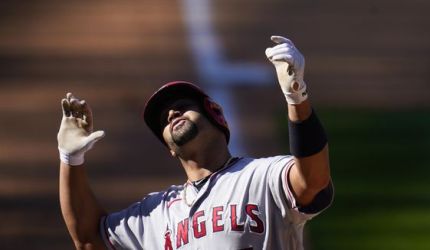
Albert Pujols just after hitting the home run tying him with Willie Mays on the career list Sunday.

A little earlier this pandemic season, Albert Pujols received a text message on his cell phone. “It’s your time now. Go get it,” the message said. The message came from Hall of Famer Willie Mays, whose 660 lifetime major league home runs Pujols has chased all season long.

With the shadows creeping in in the top of the eighth at Coors Canaveral Sunday afternoon, Pujols went and got it. With his Los Angeles Angels down 3-2 and a man on first, El Hombre turned on a meaty 1-1 fastball from Rockies reliever Carlos Estevez and drove it parabolically down the left field line and halfway up the seats.

The blast was the kind of launch for which Pujols has been fabled from the moment he first came into his own in St. Louis almost two decades ago. The kind he’s hit the last few years almost to the exclusion of anything else.

The kind that reminds you of both the greatness that will punch his Cooperstown ticket and the greatness that’s been eroded by the injuries that have sapped him since after his first season as an Angel, turning his ten-year, $255 million contract into the unfair poster child for terrible sports contracts.

When Pujols commented after Sunday night’s game, it was tough to know which affected him more, finally meeting Mays in the record book or Mays himself urging him on in the first place. “Legend,” said the agreeable Dominican who was born seven years after Mays played his last major league game. “I mean, it’s unbelievable.”

Oh, it was believable, all right. Pujols’s swing remains a work of art, even if it’s supported by legs that betrayed him almost a decade ago, a knee that underwent a surgery here and there, a heel that fought with painful plantaar fascitis costing him the final two months of 2013, feet requiring surgeries after 2015 and 2016.

“When his days are done and his legend is told,” wrote The Athletic‘s Fabian Ardaya, shortly after Pujols’s milestone blast, “they will talk about the swing — that beautiful, powerful swing — and the follow-through and the strut when you knew, everyone knew, that Albert Pujols got every piece of a baseball.”

The swing cemented Pujols as perhaps the best right-handed hitter the game has ever seen. It is slower now, a reality that happens with age, and the majestic drives don’t occur as often. But when they do, even for a split second, they take you back to when Pujols wrecked the league, ruined historic closer seasons and, quite simply, hit.

They take you back to when the only thing keeping Pujols’s three-run detonation against Brad Lidge inside Minute Maid Park in the top of the ninth, 2005 National League Championship Series, was the bracing for the park’s retractable roof. The bad news: that bomb won the Game Six battle but merely saved his Cardinals from losing the war in Game Seven.

They take you back to when Pujols ripped three in a kind of reverse cycle in Game Three of the 2011 World Series—a three-run blast, a two-run blast, a solo blast, in that order, and every one of them after the sixth inning in a 16-7 demolition of the Texas Rangers. The solo provided the sixteenth run.

They take you back to when Pujols was younger, unimpeded by his lower body health, and liable to either drop Big Boy or otherwise make life miserable for opposing pitchers and fielders, in a St. Louis run that left him as the Cardinals’ second-best all-around position player ever, behind the man on behalf of whom Pujols doesn’t always accept having been nicknamed El Hombre.

They take you to his deadly postseason record—the lifetime postseason .323/.431/.599 slash line; the .725 lifetime postseason real batting average (RBA: total bases plus walks plus intentional walks plus sacrifice flies plus hit by pitches divided by total plate appearances); the 109 runs produced. Enough Hall of Famers don’t look half that dangerous playing for all the platinum.

Two years ago Pujols tied Hall of Famer Stan Musial on the all-time runs batted in list. Five years before that, when Musial died, Pujols was almost inconsolable. He and Musial became that close personally. “I know the fans call me El Hombre, which means The Man in Spanish,” he insisted, “but for me and St. Louis there will always be only one Man.”

So insistent on the point was Pujols that, when he became an Angel and the club began hoisting billboards touting El Hombre‘s arrival, Pujols flipped. He insisted very publicly there was only one player who should ever be called The Man, and it wasn’t Albert Pujols. The billboards disappeared faster than the Angels executed their scouting staff after an international signing scandal.

When Pujols talks about his own place in baseball, he does it almost as though the idea that he’s part of it is secondary to what came before him. “I know my place in history,” he told Ardaya. “(But) it’s hard. I don’t want to — It’s almost like I take it personal, like I don’t want to disrespect this game.”

He’s even ready to hand history off to the teammate who played his first full season in an Angel uniform the same year Pujols joined the team. The teammate who’s now the Angels’ all-time franchise home run leader and has been the game’s all-everything player almost right out of the chute. The teammate who doesn’t have a team baseball’s All-Universe player can be proud of.

“We have the best player in the game,” Pujols told Ardaya of Mike Trout, “and five or six years from now, he’s going to be making history, too.” As if he hasn’t already. Pujols knows it.

You think that’s an affectation? Pujols is the same player who refused to join the ruckus in Detroit last year, when he hit one out in Comerica Park for his 2,000th career RBI and, for whatever perverse reasons, MLB and the Tigers together tried to strong-arm the Tiger fan who caught the ball by refusing to authenticate it, until or unless he turned it over, assuming before asking that he wanted to cash the ball in big.

Ely Hydes didn’t like being treated like an opportunist. “Honestly, if they were just cool about it I would’ve just given them the ball,” Hydes told a WXYT interviewer. “I don’t want money off of this, I was offered five and ten thousand dollars as I walked out of the stadium, I swear to God . . . I just couldn’t take being treated like a garbage bag for catching a baseball.”

Pujols understood. Completely. “Just let him have it, I think he can have a great piece of history with him, you know,” he said. “When he look at the ball he can remember . . . this game, and I don’t fight about it. You know, I think we play this game for the fans too and if they want to keep it, I think they have a right to. I just hope, you know, that he can enjoy it . . . He can have it . . . He can have that piece of history. It’s for the fans, you know, that we play for.”

Hydes eventually gave the ball to the Hall of Fame in memory of his little son who died at 21 months old a year before Daddy caught the Pujols milestone.

Mays finished his career both with 660 home runs and as a shell of his once-formidable self, ground down by all those seasons and no few off-field heartbreaks, unable until his body finally put him in a stranglehold to admit that the game he loved and lived to play was no longer fun when he was Willie Mays in name only.

Those were real tears that almost poured out of Mays when he faced a Shea Stadium throng on Willie Mays Day, with the Mets who brought him back to the city of his major league youth, and told them, “There always comes a time for someone to get out. And I look at these kids over there, the way they are playing, and the way they are fighting for themselves, and it tells me one thing: Willie, say goodbye to America.”

It shouldn’t shock anyone when Pujols’s time finally arrives. You can say his time is past, that his lower body ruined what should have been a simpler, kinder, gentler decline phase, leaving him prone to as much criticism under ordinary circumstances as praise when now and then the vintage edition makes a cameo as it did Sunday night.

You should also say, as Angels general manager Billy Eppler did two years ago, that few really knew, never mind understood, Pujols’s determination to play through every lower-body malady he’s incurred since trading Cardinal for Angel red.

“He plays through discomfort,” Eppler told MLB.com. “He endures a lot and doesn’t talk a lot about it. But I can tell you that he’s definitely someone that wants to play and fights through a lot of adversity to make sure he’s out there and contributing to the club.”

There’s something to be said for that as well as against that. It’s not as though Pujols needed to burnish his Hall of Fame resume. And, it’s not as though the Angels couldn’t have cashed him in for things they needed even more than they needed Pujols’s cachet—things like a pitching overhaul, mostly.

He has one more year to go on his Angels deal. The Angels as they stand now are still going nowhere and they still need a radical pitching overhaul if they have any prayer of returning to competitive greatness, with Trout committed to them for life and Pujols knowing he can tell Father Time to go to hell only so much longer, if at all.

Would the Angels even think of trading Pujols this offseason, to a contender with young pitching talent to spare, in need of a veteran mentor to whom they’d be grateful for all his counsel and whatever hits he has left, before the Angels bring him back for that ten-year personal services deal that begins when his playing days end? Who knows?

Such a team could do a lot worse than drawing counsel from the man whom Baseball-Reference lists as the number two first baseman ever to play the game. Only Hall of Famer Lou Gehrig is ahead of him. But Pujols has an arguable case as the greatest all-around first baseman of all time simply because, as devastating as he’s been a hitter, he was also a far better defensive first baseman than Gehrig before his lower body resigned its commission.

Or, maybe, Pujols himself will take stock, surrender to his body’s and Father Time’s mandate at last, leave next year’s $30 million on the table, start that personal services term, and congratulate himself as baseball should on a one-of-a-kind playing career. Maybe. Only Pujols knows for certain, and he doesn’t seem to like talking about that any more than he liked talking about what it took for him to just stroll up to the plate any more.

Maybe the combination of this year’s pandemic surreality and the current major league regime’s continuing inability to promote its best and give proper due to its milestoners kept Pujols’s Sunday night smash hit from blowing the social media universe up too much beyond about an hour’s worth of ordnance.

“To be able to have my name in the sentence with Willie Mays is unbelievable,” Pujols said Sunday night. The Angels have an off-day Monday. He hasn’t hit well this season, and Sunday’s smash was only his fourth home run in 31 games. One homer every seven games on average. He and they have twelve games left.

All Pujols needs is one more meaty pitch to drive, one more summoning up of whatever remains of that impeccable swing, and they’ll be saying his name in the same sentence as Mays once again. This time, for passing him to become sole possessor of number four on the all-time bomb squad.

Maybe then, he’ll get the twenty-one guns he deserves. Maybe.

Lou Brock, RIP: “First base is useless”

With their son Lou, Jr. in the background, Hall of Fame thief Lou Brock and his wife, Jacqueline greet well wishers on his 81st birthday in June.

Lou Brock’s philosophy on the bases was simple enough. “First base,” he once said, “is useless. And most of the time, it is useless to stay there.” On 1,245 major league occasions Brock attempted grand theft next base. On 938 occasions, he succeeded.

It knocked fellow Hall of Famer Ty Cobb out of the record book, Cobb having held yet another of those records presumed unbreakable with his 892 lifetime thefts. Yet Brock himself predicted his records for career stolen bases and single-season stolen bases (118, breaking Maury Wills who’d broken Cobb’s old mark) would fall in due course—to the very felon who did break them, fellow Hall of Famer Rickey Henderson.

A long-enough battle between 81-year-old Brock and diabetes and multiple myeloma ended Sunday afternoon. Swell timing. A week earlier, the pitcher he faced most often in his major league career, Hall of Famer Tom Seaver, died at 75 after a battle with Lewy body dementia abetted by COVID-19.

Brock was blessed with a power failure-defying smile and an equally bright if not overbearing confidence in himself and his abilities. He wasn’t a particularly great defensive outfielder, though he worked hard to improve, but the St. Louis Cardinals didn’t pay his handsome for their times salaries because he was where balls hit to left went to die.

They paid Brock to get his fanny on base somehow, any how, and turn a baseball game into six parts track meet and half a dozen parts grand larceny. If he couldn’t snatch the bases, the least he could do was invite himself to live rent free in pitchers’ and catchers’ heads.

“[T]he most important thing about base stealing is not the steal of the base, but distracting the pitcher’s concentration,” the master thief once said. “If I can do that, then the hitter will have a better pitch to swing at and I will get a better chance to steal.” If the hitter swung at that better pitch and connected, that was more than all right with Brock; 53 percent of the time he reached base he took extra bases on followup hits.

Brock was as much a gentleman off the field as he was a larcenist on it. “There was a light inside of Lou Brock that brightened every place and space he entered,” remembers longtime St. Louis Post-Dispactch writer Bernie Mikllasz. “A light that warmed every person he encountered. Grace. Dignity. Class. Joy. His generosity of spirit touched so many. I’ve never known a finer man.”

That finer man became a Cardinal in the first place because the Chicago Cubs, who raised him, had no clue what to do with an outfielder who was swift afoot but not exactly the kind of power hitter normally seen on patrol in the ballpark depths. Brock himself may have hurt as much as helped his own Cubs cause by doing the unthinkable in the Polo Grounds on 17 June 1962, in the top of the first inning. One day before Brock’s 23rd birthday.

The Cubs faced the embryonic New York Mets and their stout lefthanded pitcher Al Jackson. Don Landrum’s leadoff walk turned into a stolen base thanks to Marvelous Marv Throneberry at first for the Mets. He misplayed the throw from home on the Ken Hubbs strikeout trying to catch Landrum leaning.

Hall of Famer Billy Williams grounded Landrum to third. Fellow Hall of Famer Ernie Banks worked Jackson for a walk. Fellow Hall of Famer Ron Santo tripled Landrum and Banks home. (With Richie Ashburn playing center field for the Mets that day, the game featured five Hall of Famers.)

Up stepped Brock. He swung and drove the ball to the same spot near the bleachers on the right side of center field as Santo’s triple traveled. Except that, somehow, some way, Brock’s drive flew past where Santo’s ball was rudely interrupted. Straight into the bleachers. Four hundred and sixty-eight feet from home plate. Real estate previously claimed by only two men in baseball history, Luke Easter in a 1948 Negro Leagues game, and Joe Adcock of the Milwaukee Braves in 1953.

Only Brock had no clue. He gunned it out of the batter’s box in his usual style, that of a man on the dead run from a process server. Rookie that he was, Brock actually thought the second base umpire giving the traditional home run signal was trying to tell him that at his rate of speed he had a clean shot at an inside-the-park job.

He learned otherwise when he was mobbed back in the dugout and Santo came over to holler, “Did you see where that ball went? I needed binoculars!”

Two years later, in 1964, the Cubs thought themselves in dire need of further pitching help. They also figured Brock could bring it their way in a trade. Buck O’Neil, the Negro Leagues legend who signed Brock for the Cubs in the first place, suspected the Cubs also feared being seen as “too black” by a fan base not always comfortable with their group of black players, even the popular Banks and Williams.

But another former Cardinal pitcher, Lew Burdette, obtained earlier that season, did his level best to talk the Cubs out of the trade. The Cubs’ target was righthander Ernie Broglio. Once a pitcher with formidable promise, the Cubs saw only the pitcher who’d finished third in the 1960 Cy Young Award voting (it was a major league award then, not one for each league) and won eighteen games in 1963. Burdette tried to warn them otherwise: Broglio had an elbow issue  and was taking more than one cortisone shot.

Unfortunately for the Cubs, general manager John Holland chose to ignore the word Burdette passed via then-College of Coaches head coach Bob Kennedy. The Cubs delivered the trade and learned the hard way just how badly damaged Broglio’s goods were. (For the record, the full trade involved Brock, relief pitcher Jack Spring, and spare starting pitcher Paul Toth going to the Cardinals for Broglio, veteran pitcher Bobby Shantz, and outfielder Doug Clemens.)

Not that the Cardinals were thrilled about their new toy. Broglio may have been struggling with his elbow but he was personally popular with his teammates. “Our friendship,” catcher Tim McCarver once said, “blinded us to what kind of effect Lou would have on the team — until we saw him run.” Said Hall of Fame pitcher Bob Gibson, “We thought it was the worst trade ever.”

They thought so until they proved the last team standing after that wild final weekend on which they won the pennant at the last split second, practically, following the infamous Phillie Phlop. When they noticed Brock in 103 games for his new team stole 33 bases, scored 81 of his season-long 111 runs, rolled up a .387 on-base percentage, and threw 21 doubles, nine triples, and twelve home runs into the mix for a .527 slugging percentage as a brand-new Cardinal.

Brock only looked cheerful, bright, and happy as the day was long during a game, and it caused enough people to misunderstand his commitment. “Some in the press and in the stands considered him too casual about his job,” wrote David Halberstam in October 1964, “but that was a misperception. In fact, he was driven, not merely by a desire, but by a rage to succeed.

As a Cub, Brock was seen as too intense and self-critical for his own good. “He’d break out in a big sweat,” then-Cub pitcher Larry Jackson observed, “just putting on his uniform.” As a Cardinal, he finally turned that intensity into progress without losing his natural joy in the game. He became so devoted to his craft that he started filming pitchers to study their tendencies for his on-base advantage. (Hall of Famer Don Drysdale: “I don’t want to be in your goddam movies, Brock!”)

Brock pitched in on the Cardinals’ 1964 World Series conquest but became a first class pain in the ass to the 1967 Boston Red Sox in that Series. When it wasn’t Gibson tying the Sox into knots from the mound, it was Brock hitting .414 and stealing seven bases. A year later, the Cardinals lost to the Detroit Tigers in seven games but it wasn’t Brock’s fault—that time, he hit .464, stole another seven pillows, and broke Bobby Richardson’s record for World Series hits with thirteen.

“Ernie is top of the charts,” Brock told ESPN’s William Weinbaum about Broglio in 2011. “He is a good man, a man with integrity. We have a good relationship because we laugh, we talk, and people, for whatever reason, are still interested.” Interested enough that you’d have thought Ernie’s real surname was Brockforbroglio.

Born to Arkansas sharecroppers, Brock’s family moved to Louisiana when he was two. “Jim Crow was king,” he once said of his youth, “and I heard a game in which Jackie Robinson was playing, and I felt pride in being alive.” He also learned a few lessons about conquering fear at home—when he told his father he feared animals were running under his bed, “[Dad] solved the problem quickly—he cut the legs off the bed.”

Just the way no few enemy pitchers, catchers, and infielders probably wanted to cut the legs off Brock before he swiped their clothes for good measure with the bases. What they couldn’t do, diabetes finally did in 2015, at least to part of his left leg.

After baseball (Cardinals owner Gussie Busch forgot all the animosities of earlier players’ union actions and dropped a sumptuous yacht on Brock as a retirement present), Brock prospered as a St. Louis florist and the inventor of a unique small umbrella hat (the Brockabrella) aimed at letting fans stay by their seats instead of fleeing to the indoor concourse during rain delays.

He saw his son, Lou, Jr., play football at USC and in the National Football League as a cornerback/safety for two seasons before becoming a Sprint/Nextel executive. He and his wife, Jacqueline, also became ordained ministers of the Abundant Life Church who frequented numerous Cardinals games and special events over the years.

Two years after losing that part of his leg, Brock was also stricken with multiple myeloma, the cancer that begins in the plasma cells. He didn’t let them keep him from savouring life or welcoming socially-distancing visitors to his home with his Jacqueline on his 81st birthday this past June.

“You have a great smile,” Brock once told then-ten-year-old Jeff Kurkjian, the son of writer Tim Kurkjian, in Cooperstown. “Let everyone see it. A great smile can disarm people like nothing else. Smile as much as you can. We don’t smile enough in the world today.”

I hope that was Ernie Broglio slipping his way to the front of the line awaiting Brock at the Elysian Field’s gates and handed him a cold beer and a bear hug. Unless his longtime manager (and Hall of Famer) Red Schoendienst beat Broglio to the front with a cold one—and a mock arrest warrant signed by the Lord for grand larceny. One and all smiling.

Freese’s pieces, revisited

2020-07-12 DavidFreeseSeriesMVP

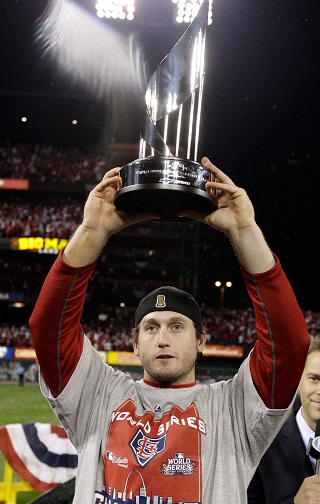
David Freese hoists the 2011 World Series MVP trophy. He’d also won that National League Championship Series MVP.

Notoriously enough at the time, Hall of Famer Reggie Jackson pre-Yankee mused aloud, “If I played in New York, they’d name a candy bar after me.” When fellow Hall of Famer Brooks Robinson was given a day at Baltimore’s old Memorial Stadium, on the threshold of his retirement, the host of the event told the cheering crowd, “Around here they don’t name candy bars after Brooks—they name their children after him.”

When David Freese made the St. Louis Cardinals’ difference in the 2011 National League Championship Series, I noted—after recalling he first thought his trade from the San Diego Padres to the team for whom he grew up rooting madly, the Cardinals, was a joke—“(E)veryone except citizens of Milwaukee might be laughing with the National League Championship Series’ most valuable player.”

In St. Louis, of course, they may be ready to name a candy bar after him. Freese’s Pieces, anyone? It isn’t everyone who comes up from oblivion to out-slug Albert Pujols when Pujols is having the best postseason set of his career, or drives home a ferocious exclamation point on it Sunday night with a first-inning blast that merely starts the Cardinals en route a secured trip to the World Series.

Who knew after Game Six of that NLCS that Freese’s series would prove a mere dress rehearsal for the big event to come? Not even Freese himself, about whom Joe Posnanski—amidst a series in The Athletic remembering sixty transcendent baseball moments—writes with loving eloquence that he was one kid who got to live every baseball kid’s backyard or schoolyard dream, suiting up for the home team he grew up loving, and hitting the blasts that either send the team to the Promised Land or yank them back to the threshold.

Most such kids would sell their souls to get a chance to do it for the home team even once. Freese did it twice, also in Game Six, but this time during the 2011 World Series. He tied it with a two-run triple in the bottom of the ninth and won it with a leadoff home run in the bottom of the eleventh. Telling the Texas Rangers, “Not so fast,” he sent the set to the seventh game his first-inning, game-tying two-run double would help the Cardinals win.

Think about the roll of Cardinals World Series heroes and from whence they came in the first place. Grover Cleveland Alexander (pitching and winning Game Six to send the 1926 Series to a seventh game his team would also win)—Elba, Nebraska. Pepper Martin (hitting .500 in a seven-game 1931 Series)—Temple, Oklahoma. The Dean brothers (Dizzy: two wins; Paul, two wins, including Dizzy’s Game Seven shutout, 1934 Series)—Lucas, Arkansas. Enos Slaughter (the Mad Dash, Game Seven, 1946 Series)—Roxboro, North Carolina. Bob Gibson (MVP of the 1964 and 1967 Series)—Omaha, Nebraska. Darrell Porter (MVP of both the 1982 National League Championship Series and World Series)—Joplin, Missouri. David Eckstein (resident pest and MVP, 2006 World Series)—Sanford, Florida.

Did somebody mention Sandy Koufax? He got to be a World Series hero twice for his hometown Dodgers, the MVP of the 1963 and 1965 Series—but that came after the Dodgers left Brooklyn for Los Angeles, and after a serious hitch in Koufax’s delivery was caught at last and fixed in spring training 1961, turning him from an untamed talent into an off-the-charts Hall of Famer.

Think a little bit, too, of how many players were Hall of Famers who came up too short in postseasons if they got there at all. Of how many—like Freese—who weren’t Hall of Famers on the best days of their regular season lives, but played like Hall of Famers when they did get to the big postseason dance. Of how the Freeses of the game live the truth of Gene Hackman’s valedictory in (of all things) the football film, The Replacements: “Greatness, no matter how brief, stays with a man.”

(Eckstein? Al Gionfriddo? Dusty Rhodes? Sandy Amoros? Don Larsen? Moe Drabowsky? Al Weis? Donn Clendenon? Gene Tenace? Brian Doyle? B.F. Dent? Dave Henderson? Mickey Hatcher? Sid Bream? Tony Womack? Edgar Renteria? Luis Sojo? Scott Spiezio? Scott Podsednik? Carlos Ruiz? Pablo Sandoval? Steve Pearce? Call your offices.)

Porter came the closest to being a homegrown Series hero, Joplin being a measly four-hour, 284-mile drive to St. Louis. Freese was born in Corpus Christi, Texas, but raised in St. Louis’s Wildwood suburb. He’d set Wildwood’s Lafayette High School’s single-season record of 23 home runs and a .533 batting average in his senior year, but felt burned out enough by baseball to spurn a baseball scholarship at the University of Missouri to try studying computer science instead.

So much for that idea. After visiting Lafayette during a summer while working in his school district’s maintenance department, Freese gave baseball another shot at two other schools and—the year Eckstein made himself the cockroach the Detroit Tigers couldn’t exterminate in the 2006 Series—made himself the Sun Belt Conference’s player of the year. The Padres drafted him in 2006’s ninth round.

2020-07-12 DavidFreese

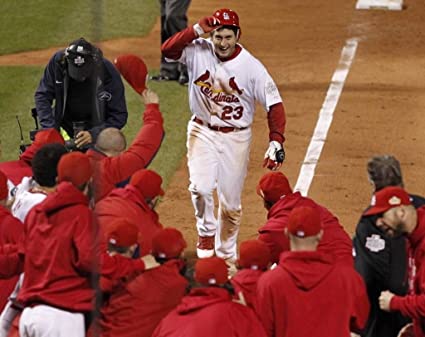
Freese about to hit the plate in a swarm of teammates, Game Six, 2011 World Series. “I just got beat up by thirty guys,” he laughed to reporters afterward. It was nothing compared to how depression was beating him up inside.

The Cardinals sent a spent Jim Edmonds to San Diego to get Freese in 2008 because they needed a solid minor league third baseman. Then, with former Angels World Series MVP Troy Glaus injured, the Cardinals needed Freese—until they didn’t. He didn’t turn up in the Cardinals’ fatigues again until 2010, where a hot start turned unfortunately into a season-ending ankle injury that June.

His 2011 threatened to be injury compromised, too, a hand fracture when hit by a pitch costing him 51 games. After his return, he finished the regular season with a flourish of eight hits in the final nine games. Then came the NLCS. Then came the World Series. Then came first and second with two outs for Freese in the Game Six bottom of the ninth, against Rangers closer Neftali Feliz. Then came Freese on 1-2 down to his and the Cardinals’ final strike—of game, set, and season.

Then came Freese swinging at a fastball on the outer half of the plate. “The beauty of it,” Posnanski wrote at the time, “was that in the instant after the ball was hit, it had a chance to be anything.”

He had obviously hit it well — the ball cracked off the bat — but there was no telling how well. It had a chance to be a home run. It had a chance to be an out. I have written before that there is nothing in sports like the successful Hail Mary pass in football, and the main reason is that no two Hail Mary passes are alike. Sometimes they deflect from one receiver to another. Sometimes they bounce off the defenders’ hands and back to a waiting receiver. Sometimes the pass just drops into a pile and sticks in a receiver’s hands. Really, there are countless geometrical possibilities. Baseball doesn’t usually have that kind of geometry. Home runs are home runs. Singles are singles. Pop-outs are pop-outs . . . But Freese’s fly was something like a Hail Mary. There was just no telling how it would turn out while the ball was in the air.

Rangers right fielder Nelson Cruz misjudged where the wall was, playing in the Rangers’ no-doubles defensive alignment, and the ball sailed over his head and into the wall. It sent the game to extra innings, where Josh Hamilton restored the Rangers’ two-run lead with a home run in the top of the tenth but a pair of singles, a run-scoring ground out, and Lance Berkman’s two-out RBI single—with the Cardinals again down to their final strike—tied things up again, this time at nine each.

Then Jake Westbrook kept the Rangers to a mere base hit in the top of the eleventh and Freese led off the bottom against Mark Lowe. Remember, now, that this was also the Series in which Pujols channeled his inner Reggie Jackson in Game Three, hitting three home runs—from the sixth inning forward, nourishing a 16-7 blowout. Who could possibly top that?

For that matter, who could possibly top Freese’s Game Six-tyer? The one that turned eight innings of somewhat sloppy baseball into three innings to come of surrealistic baseball? The answer turned out to be Freese himself. On a full count. On what looked like a changeup hanging into the middle of the plate. Over the center field fence, onto the green lawn beneath the Busch Stadium batter’s eye. With Hall of Famer Nolan Ryan, then the Rangers’ president, watching from the field level seats in abject disbelief.

Trotting around the bases as the Rangers left the field, Freese slammed his batting emphatically onto the third base line, down between his briefly leaping legs, a few feet before he hit the plate to be buried by a swarm of celebrating teammates. “I’m just about out of breath,” Freese told reporters in an on-field post-game interview. “I just got beat up by thirty guys.”

His Hall of Fame manager Tony La Russa—whose Game Five bullpen communication breakdown got close to vaporising his image as a tactical master and big-picture strategist, and who should have blown his team to world-tour vacations for pulling his kishkes back out of the incinerator—could only say, “You had to see it to believe it.”

This was a player who battled clinical depression his entire life, fell into alcoholism while battling it and suffered a small number of accidents and incidents before he became a Cardinal, then took the battle public eight months after he married and while in the Busch Stadium visitors’ clubhouse as a Pirate. “I’ve had moments like that since high school, to be honest,’’ he told USA Today‘s Bob Nightengale in 2017.

It’s been 15-plus years of, “I can’t believe I’m still here.” You win the World Series in your hometown, and you become this guy in a city that loves Cardinal baseball, and sometimes it’s the last guy you want to be. So you start building this façade, trying to be something I was not. And the whole time, I was scared to death what was going to happen to me after baseball.

. . . Who knows where I was headed, but as long as I was here, I had so many friends here, I wasn’t good at just saying no. I wanted to please people, make everyone happy, and that became impossible.

What happened was the Cardinals trading Freese to the Los Angeles Angels in November 2013, the Cardinals knowing Freese needed to leave in the worst way possible to blow the pressures away. That was part two of what began resolving his inner turmoil. He met part one at his friend’s media studio a week before the deal, an intern named Mairin O’Leary—who became Mairin Freese in the simplest ceremony possible, in a Pittsburgh coffee shop in September 2016. Over a crepes breakfast.

Freese had one more chance at postseason glory as a 2018 Dodger. He did his part, hitting leadoff home runs in Game Six of the NLCS and Game Five of the World Series, but the Dodgers fell to the Boston Rogue Sox who may or may not have deployed their now-infamous replay room reconnaissance ring sign-stealing plot during that postseason.

When he retired after last season, Freese no longer saw his stupefying 2011 postseason as a cross to bear from behind the wall of depression. He looked forward to taking his almost three-year-old son to a live Cardinals game in due course. Not to mention showing the little boy what Daddy delivered in Game Six. And all that postseason, including a still-record fifty total bases and 21 runs batted in.

“It’s going to be cool when Kai understands and I show it to him,” Daddy told the St. Louis Post-Dispatch as he retired, “and he says, ‘Is that really you on the TV?’ He understands it’s me now if he’s watching and there’s a closeup of me hitting or something. It is going to be cool (showing him the World Series ring). Look at that damn squirrel. He might not care, which might even be cooler.”

Kai Freese will have to wait, unfortunately, until the coronavirus world tour dissipates enough to let the games bring the fans back to the stands. His father has probably told him, “Trust me, it’ll be worth the wait.”

“There are 270 players in the Baseball Hall of Fame. There is only one player who grew up in St. Louis and got to live the dream again and again for the team he grew up loving,” Posnanski writes, observing the contrast between Hall of Famers who lacked for truly signature moments and ordinary men who have one that transcends the game itself. “I suspect David Freese is pretty happy with how it turned out.”

The guy who made St. Louis baseball the happiest place on earth in 2011 fought hard enough to get to happiness with how his baseball legacy turned out in the first place.

The second shot heard ’round the world

2019-12-24 CurtFlood

“Curt Flood stood up for us.”—Hall of Famer Ted Simmons.

Irony is almost as common to baseball as are the bat and the ball. Few examples remain more profound than one eight-player trade between the Phillies and the Cardinals in October 1969 that ended up changing the game for the men who played it.

The Phillies’ side of the deal included sending Hall of Fame-worthy third/first baseman Dick Allen to the Cardinals, whose package to the Phillies included seven-straight Gold Glove center fielder Curt Flood.

To Allen, whose Philadelphia experience was unconscionably brutal even by the norms of 1960s’ racial growing pains, the trade equaled the Emancipation Proclamation. To Flood, whose St. Louis experience included planting roots and owning and operating a portraiture studio in the city, the trade equaled what his eventual wife calls “like someone putting a knife in his stomach, or your mom throwing you away. It was that kind of deep hurt.”

Judy Pace was a groundbreaking black television actress (she had a prominent role in the popular television serial Peyton Place in its final season) and Flood’s girl friend for three years by the time Flood decided he wasn’t just a piece of livestock to be sold or dealt at will. They parted when Flood hied to Spain during his reserve clause battle but reconnected and married in 1986, eleven years before Flood’s death of throat cancer.

And Mrs. Pace-Flood thinks a fresh Hall of Fame election makes it more possible for her late husband to earn the honour as a baseball pioneer. “I’m so happy that Marvin [Miller] got in,” she tells William C. Rhoden, longtime New York Times sports columnist now writing for The Undefeated. “I want Curt to follow. There’s unfinished business.”

That business began fifty years ago today, when Flood—writing on the stationery of his portraiture studio—sent commissioner Bowie Kuhn a slightly early Christmas present, refusing to just report to the Phillies like a good little boy and rejecting the idea that he was mere property. “I believe,” he wrote, “that any system which produces that result violates my basic rights as a citizen and is inconsistent with the laws of the United States and of the several states.”

2019-12-24 CurtFloodLetter

The Curt Flood letter to commissioner Bowie Kuhn.

To those who believe to this day that the Flood letter was really Marvin Miller’s handiwork, Mrs. Pace-Flood has a reply: “People ask about the letter, they don’t want to believe that he wrote that letter,” she tells Rhoden. “They want to know if Marvin Miller wrote the letter or if Marvin gave him the ideas. No. Marvin did not write the letter. Curt was brilliant.”

Arguably, Flood was the National League’s best defensive center fielder who wasn’t named Willie Mays in the 1960s. He won those seven Gold Gloves consecutively from 1963-69. As would future Hall of Famer Ozzie Smith at shortstop, Flood likewise made himself into a respectably fine hitter as the years of his career went forward. And there was more to him than just a rangy-squared outfielder.

“Flood was a quiet man, a deep thinker, and an independent cuss,” wrote John Helyar in The Lords of the Realm, published three years before Flood’s death. “He told friends on the club that he’d refuse to go if the Cardinals ever traded him. He’d quit before he left St. Louis. He had strong ties to the city, after playing for the Cardinals since 1958, and had begun a photographic and art business on the side. Flood was an outstanding portrait painter, whose rendering of [Cardinals owner] Gussie Busch hung in the saloon of the owner’s yacht.”

Let it be said that, even in the era when owners tended to be paternalistic when not dismissive of their hired hands on the field, Busch was somewhat anomalous in how he treated his players. He treated them like princelings, even if you considered that it was patrician patronage.

Busch put baseball’s first million dollar payroll on the field in 1968. He footed the bills for private rooms in top hotels when the Cardinals made road trips. Their homecomings included each player getting a free case of one of his Anheuser-Busch beers. And when the jet age arrived, Busch—who’d previously attached his luxury Pullman car Adolphus to trains for Cardinals players to travel in—flew them aboard charter jets.

He also helped Hall of Famer Stan Musial get into the restaurant business, when Musial bought into the St. Louis steakhouse where among other things fellow Hall of Famer Yogi Berra (a native St. Louisian) met his future wife. He helped Flood start his portrature business. He rewarded Roger Maris for two fine seasons as a Cardinal to finish his troubled career with a particularly profitable Anheuser-Busch distributorship after Maris retired.  He’d hand Hall of Famers Lou Brock a yacht and Bob Gibson a luxurious motor home upon their retirements.

And after the players threatened a spring 1969 strike over getting a hike in the owners’ contribution to their pension plan, a hike they eventually got when they could still high tail it to the spring camps and get into game shape, Busch responded by walking into his players’ spring training clubhouse in St. Petersburg with a few brewery directors, and delivering a lecture that only sounded the essence of calm reason.

It was really an old-fashioned patrician dressing down to the plebeians. “I hope that many millions of fans will retain their loyalty to baseball,” Busch was quoted as telling them. “We are going to do everything we can to make sure they do . . . I don’t react well to ultimatums. I don’t mind negotiations—that’s how we get together—but ultimatums rub me the wrong way, and I think ultimatums rub the fans the wrong way . . . ”

When reporters also present asked for comments, not one Cardinal said a word, probably too stunned to speak. “One of the players,” Helyar wrote, “stood there in a particularly raging silence. His name was Curt Flood.” Flood himself held out on his own for a raise for 1969 and got it, but Busch’s clubhouse speech sounded to him as though he “had been telling us to behave or get out. I no longer felt like a $90,000 ballplayer but like a green recruit.”

Flood became a Cardinal in the first place thanks to a 1957 trade that sent him there from the Reds in a five-player swap, and he’d sworn he’d do what it took never to be traded again. Now, after the 1969 Cardinals finished fourth in the new National League East, as Helyar quoted him, Flood told a friend, “There ain’t no way I’m going to pack up and move twelve years of my life away from here. No way at all.”

By November 1969, Flood called Miller to say he wanted to challenge baseball’s abused reserve system, by which the owners used the actual reserve clause’s one-firm/one-option year on player contracts to bind them for life or until the owners saw fit to trade or sell them. The Players Association agreed to foot the bill for Flood’s legal expenses, but Flood wanted to try his luck with Kuhn first. Hence the letter. And, hence, Kuhn’s reply just prior to New Year’s Day, as legendary sportswriter Red Smith put it: “Run along, sonny, you bother me.”

Known officially as Flood vs. Kuhn, the case went all the way to the U.S. Supreme Court. Before it was decided, the Cardinals were hit with a 1972 contract holdout, a 21-year-old catcher who’d just established himself as the number one Cardinal behind the plate. Before the kid was finished he’d expose another rupture in the owners’ armours.

Ted Simmons wanted $30,000; the Cardinals wouldn’t go much past $20,000. Simmons played under an automatic renewal, unsigned. As his season grew more torrid, he got a shock at the All-Star break, when he was in Atlanta as the NL’s reserve All-Star catcher: the Cardinals were ready to hand him $70,000: the $30,000 he wanted for 1972 and $45,000 for 1973.

With Simmons’s new signing the Cardinals betrayed a secret: the owners would rather open the vaults and hand a kid seventy large than let him even think about a reserve clause test. Then came the bad news for Flood, whose legal team included former Supreme Court justice Arthur Goldberg: the Supreme Court ruled against him.

The good news: Flood kicked a door open just a little bit. The Court itself called the reserve clause “an anomaly” and “an aberration” but decided it should be remedied by Congress. Which was akin to sending a lunch argument between two sharks to be remedied by a barracuda. Someone among the owners who didn’t have oatmeal for brains tried to warn them. “As the champagne corks popped,” Helyar wrote, “[owners’ negotiator] John Gaherin still cautioned: Flood’s defeat hadn’t brought an end to the forces of change; it had only bought them some time.”

Hall of Fame pitcher Catfish Hunter would kick the door open further after the 1974 season. When Athletics owner Charlie Finley reneged on a contracted-for insurance payment to Hunter, he took it to arbitration—and won, with the arbitrator declaring the contract breached and Hunter a free agent. Kuhn’s failed bid to get it overturned failed when Miller threatened a lawsuit.

Thus Hunter became the target of a bidding war that brought Hunter offers of, essentially, the galaxy, safe passage through the Cardassian Empire, grazing rights on Bejor, and a fleet of luxury starships. Kidding. Sort of. Hunter ended up taking the third most valuable package among the offers, from the Yankees, because of the money distribution he wanted including an annuity for his children’s education.

Hunter taught the world what a top of the line baseball player could get on a fair and open job market in a very profitable industry, in essence. All that was left was for some player, any player, to have the moxie to chase it for reasons having nothing to do with breach of contract and everything to do, more or less, with treating the reserve clause in strict interpretation. Meaning that the contract expired legally after the player had played his mandated first year and his team-optioned second year.

After the owners continued stalling on salary arbitration, which Gaherin himself believed might have forestalled the absolute end of the reserve system, one of the National League’s best pitchers refused to sign his 1975 contract, after being enraged when Dodgers general manager Al Campanis “injected a deeply ‘personal issue'” into their talks.

From that moment Andy Messersmith refused to talk to anyone lower than Dodger president Peter O’Malley. He also refused to sign any deal that didn’t include a no-trade clause, refusing to let the Campanises determine his career path. Messersmith pitched without signing a 1975 contract no matter how much money the increasingly edgy Dodgers offered as the season went on. (It may have reached as high as $550,000 over three years.)

This was no ordinary pitcher. Messersmith led the 1975 National League in shutouts, complete games, and innings pitched, with a 2.29 earned run average, a 3.09 fielding-independent pitching rate, and the lowest hits-against-per-nine rate in the league with 6.8. Not until August 1975 did Miller present himself to Messersmith, when the pitcher was the last unsigned player to remain unsigned and finally agreed to file the grievance seeking free agency.

Arbitrator Peter Seitz tried to persuade the owners to take the case away and negotiate, even offering to be the mediator if they did. They didn’t, and Messersmith won. Ted Simmons nailed it in one simple statement: “Curt Flood stood up for us. [Catfish] Hunter showed us what was out there. Andy showed us the way.”

“I never went into this for the glory and betterment of the Players Association. At the start, it was all personal,” Messersmith said in due course. “The money was incredible, but they wouldn’t being the no-trade clause to the table . . . Now I understood the significance of what this was all about. I was tired of players having no power and no rights.”

Messersmith finished what Flood began. Today, with Miller finally elected to the Hall of Fame despite his late-life demurrals (he died in 2012), there’s a small swell hoping that Flood will receive the same honour as a baseball pioneer. Including new Yankee pitcher Gerrit Cole, who signed a deal about which Flood himself could only have fantasised, nine years and $324 million, average annual value $36 million.

When Cole was introduced formally as a Yankee, he paid tribute to Flood, Simmons, Hunter, and Messersmith. “[C]hallenging the reserve clause was one of the first stepping stones to ultimately the system we have today, which I believe brings out the genuine competitiveness that we have in baseball,” Cole told the presser. “I just think it’s so important that players know the other sacrifices that players made in order to keep the integrity of the game where it is.”

Flood wasn’t entirely alone during his challenge. Teammates supported him morally. So did Dick Allen, to whom the trade was liberation day. Trial testimony on Flood’s behalf came included from Hall of Famers Jackie Robinson (Mrs. Pace-Flood once said his testimony almost brought Flood to tears, coming from his personal baseball idol) and Hank Greenberg. ABC Sports broadcast legend Howard Cosell backed Flood publicly.

But Flood still felt as though on the threshold of a nightmare. “You couldn’t even use the word nervous,” Mrs. Pace-Flood said in a 2017 interview. “It was completely draining for Curt, mentally and physically. It was as if his whole world was going to disappear. All that he had worked for, all that he loved, all that he ever wanted to do—those things were hanging in the balance with the outcome of this case.”

2019-12-24 CurtFloodTedWilliams

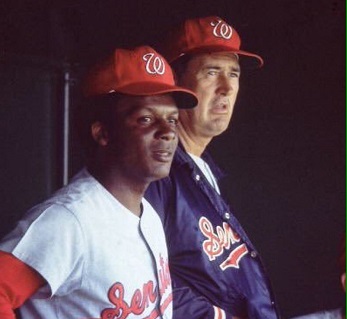
Curt Flood, in the Senators’ dugout, next to his manager—Hall of Famer Ted Williams.

After sitting 1970 out, Flood actually tried a baseball comeback—with the Washington Senators, whose otherwise capricious owner Bob Short delivered perhaps the finest gesture of his baseball life on Flood’s behalf. Short made a deal with the Phillies to get negotiating rights to Flood. Then he made Flood an offer he couldn’t refuse: He offered Flood $100,000 for 1971, agreed to pay the money no matter what, and agreed further that, if they couldn’t come to terms for 1972, he’d make Flood a free agent.

The kicker, according to Tom Deveaux’s The Washington Senators 1901-1971: Short wouldn’t put that agreement in writing, since it would violate the rules of the time. And, according to Flood himself, Short would deny those extra conditions existed if they were made public.

The worse news was that Flood no longer had it, and he knew it a little too sadly. He left the team on 27 April, leaving Short a note saying he’d tried but the long layoff proved too much, not to mention having run into financial trouble with his portraiture business. That was putting it politely. The business went bankrupt, and Flood also faced issues with the Internal Revenue Service over the home he’d bought his mother.

Flood bought a bar on Majorca to begin sorting out his shattered life, but in time he returned to America, tried broadcasting with the A’s for a spell, and reconnected with Judy Pace. He also became, of all things, the commissioner of two short-lived professional baseball leagues, the Senior Professional Baseball Association (1988-89) and the United Baseball League (mid-1990s).

“Flood seemed a strange choice to be commissioner of a league that desperately would need the assistance of the major leagues,” wrote Peter Golenbock in his book about the SPBA, The Forever Boys: The Bittersweet World of Major League Baseball as Seen Through the Eyes of the Men Who Played One More Time, published in 1991. “Later I would discover that many of the players considered themselves outcasts from baseball, so perhaps Flood’s choice as commissioner had been fitting after all.”

“Dred Scott in spikes,” George F. Will called Flood in 1993.

There was poetry and portent in the fact that Curt Flood’s career blossomed in St. Louis, the city where Dred Scott had taken his case to court. In 1966, the Cardinals moved into a new stadium that is located just a long fungo from the courthouse where Scott, a slave, argued that he had lived on free soil and therefore should be free . . . [Scott] was not the last time that the Supreme Court would blunder when asked when a man can be treated like someone’s property.

That is the question Curt Flood posed when the Cardinals tried to trade him. They said he had to go wherever they decided to send him. It had always been so, and always would be. He said, well, we’ll just see about that. He rose in rebellion against the reserve clause that denied baseball players the fundamental right to negotiate terms of employment with whomever they chose. He lost the 1970 season and lost in the Supreme Court, but he had lit a fuse.

Six years later—too late to benefit him—his cause prevailed. The national pastime is clearly better because of that. But more important, so is the nation, because it has learned one more lesson about the foolishness of fearing freedom.

Will observed wryly that what was once said of another player could have been said of Flood the center fielder—two-thirds of the earth is covered by water and the rest was covered by Flood. That was nothing compared to the flood he began when he stood on his hind legs and demanded, quietly but firmly, the rights of any working man or woman from the most obscure labourer to the most elevated chief executive officer.

Flood belongs in the Hall of Fame as the citizen who first told baseball seriously that denying a man the right to sell his services fairly and openly was, shall we say, un-American. So does the California guy who finished what Dred Scott in Spikes began, when Flood fired the second shot heard ’round the world one not-so-foggy Christmas Eve.

Marvin and Ted, a love story

2019-12-08 TedSimmonsMarvin Miller Press ConferenceWhen all was said and finally done, Marvin Miller got what he no longer wanted. He’d said it expressly and pointedly enough, citing specifically the assorted Veterans Committees he believed with certain merit were often enough stacked for certain results. “At the age of 91,” he said, “I can do without farce.”

Miller’s name turned up on the Modern Era Committee ballot now concluded, and there emerged a bristling debate as to whether Miller’s express wishes did or didn’t supercede the prospect that, at long enough last, he would attain even posthumously the honour many believed too long overdue but his family believed should be set aside according to his very own wishes.

More than most baseball men Miller knew that the Rolling Stones were right about one thing at least, namely that you can’t always get what you want, but if you try sometimes, you just might find you get what you need. What he needed from this year’s Modern Era Committee to go into the Hall of Fame was twelve votes, and he got them, one shy of the thirteen awarded to enshrine former catcher Ted Simmons.

Wherever he reposes in the Elysian Fields now, Miller didn’t get what he wanted but got what he needed, and it’s to lament that previous Veterans Committees or their 21st Century successors-by-category didn’t give it to him while he was still alive and well enough to accept and appreciate it. But there’s a nice synergy in Miller going in however posthumously with Simmons who is very much alive, well, and working as an Atlanta Braves scout today.

Even as Curt Flood’s reserve clause challenge awaited its day before the Supreme Court, Simmons himself came close enough to challenging the clause himself, entering his second year as the St. Louis Cardinals’ regular catcher, who thought establishing himself thus even at age 22 was worthy of just a little bit more than a $6,000 or thereabout pay raise.

Simmons refused to sign for 1972 for a penny less than $30,000. The Cardinals’ general manager, Bing Devine, said not so fast, son, and held in the lowest $20,000s. Simmons opened the season without a contract, the Cardinals renewed him automatically as the rules of the time allowed, and everyone in baseball cast their jeweler’s eyes upon the sophomore catcher who defied the athletic stereotype (among other things, he’d serve time on the board of a St. Louis art museum and a knowledgeable one at that) and the clause that owners abused for generations to bind their players like chattel until they damn well felt like trading, selling, or releasing them.

This wasn’t a veteran who’d seen too much and heard too much more; this was a kid whom you might have thought had everything to lose but who lived as though principle trumped even a three-run homer. He played onward and refused any Cardinals entreaty that didn’t equal a $30,000 salary, then went to Atlanta the selected All-Star choice as the National League’s backup catcher. He’d barely landed and checked in when Devine rang the phone. Would Simmons kindly accept $75,000; or, the $30,000 he asked for for 1972 and $45,000 for 1973?

Miller watched Simmons very nervously, knowing the kid pondered taking it to court if things came that way, never mind that Flood had yet to get his Supreme Court ruling. (And lost, alas.) He understood completely when Simmons accepted Devine’s new proposal, but the Simmons case handed Miller intelligence you couldn’t buy on the black market or otherwise: the owners would rather hand a lad $75,000 than let any arbitrator get to within ten nautical miles of the reserve clause.

A former United Steelworkers of America economist, Miller won skeptical players over in the first place by being just who he was, and he wasn’t the stereotypical union man with a bludgeon instead of a brain, pressing hardest on the point that no concern of theirs was out of bounds and that the doors to the Players Association’s office would remain open whenever they wanted. His mantra was, “It’s your union,” a mantra one wishes was that of numerous other American labour unions to whom the rank and file were and often still are, generally, to be seen and not heard.

Ahead of the Simmons issue still lay Hall of Fame pitcher Catfish Hunter to shine a light on what a fair, open market portended for baseball players, when Oakland Athletics owner Charlie Finley reneged on insurance payments mandated in Hunter’s contract, and an arbitrator hearing Hunter’s grievance ruled in favour of the righthander. At once, Hunter’s Hertford, North Carolina home hamlet became baseball’s hottest address, teams swooping in prepared to offer him the moon, the stars, safe passage through the Klingon Empire, and grazing rights on the planets of his choice.

Hunter merely astonished one and all by finally signing the third-richest offer in front of him, at seven figures plus for the next five seasons, and one that came at almost the eleventh minute, because the Yankees—whose representative Clyde Kluttz went back with Hunter his entire career to that point—were willing to divide the dollars according to his wishes, right down to an annuity to guarantee his children’s education. After writing the division on a napkin in a diner nook, Hunter’s first question ahead of the dollars to be done was whether the Yankees could or would do that. They could. They did.

And ahead of that, still, lay Andy Messersmith, one of the game’s best pitchers, pitching for and haggling contract with the Los Angeles Dodgers in spring 1975. When those hagglings turned a little too personal for Messersmith’s taste, thanks to general manager Al Campanis injecting personal and not baseball issues and stinging the pitcher to his soul (and to this day he refuses to discuss it), Messersmith refused to talk to any executive lower than heir apparent Peter O’Malley and demanded a no-trade clause in the contract to come.

Like Simmons, Messersmith refused to sign unless he got the clause, out of refusing now to let the Al Campanises dictate his future if he could help it. Like Simmons, Messersmith played on in 1975, pitching well enough that when fans and artery-hardened sportswriters weren’t needling him about his unsigned contract the Dodgers were trying to fatten his calf in dollar terms. They offered him princely six-figure annual salaries at three years, but they refused to capitulate on the no-trade clause.

“I never went into this for the glory and betterment of the Players Association,” Messersmith, ordinarily what John Helyar (in The Lords of the Realm) described as happy-go-lucky and a little flaky, said much later. “At the start it was all personal. Al Campanis had stirred my anger, and it became a pride issue. When I get stubborn, I get very stubborn.” Indeed not until August 1975 did Miller reach out to the still-unsigned Messersmith, the last man standing among six players who opened 1975 without signed contracts. Only then did Messersmith agree to file a grievance seeking free agency if he finished the season unsigned.

Messersmith followed through. (Retiring pitcher Dave McNally, technically unsigned but intending to stay retired, agreed to join the grievance as insurance in case the Dodgers’ dollars seduced Messersmith, who wouldn’t be seduced.) The owners refused to listen when such representatives of their own as their Player Relations Committee leader (and then-Milwaukee Brewers chairman) Ed Fitzgerald, pleaded with them to consider negotiating a revision of the reserve system. “We need to negotiate while we’re in a power position,” he pleaded. Plea denied with the very pronounced sound of a gunshot’s bullet going through the owners’ feet.

And—abetted among other evidence by a newspaper article, in which no less than Minnesota Twins owner Calvin Griffith acknowledged a proper reserve clause application would make a player a free agent after one signed season and one option season, properly applied—arbitrator Peter Seitz ruled in Messersmith’s favour. “Curt Flood stood up for us,” Simmons would say. (Helyar described him as choked up.) “[Catfish] Hunter showed us what was out there. Andy showed us the way. Andy made it happen for us all.”

Miller was smart enough not to demand immediate free agency for all, recognising as he did that teams did have certain rights in players they developed even as he knew, and insisted, that baseball players should have the same rights as any other American from the greenest labourer to the most seasoned executive to test themselves on a fair, open job market when they were no longer under contract.

It did more for the good of the game than the artery-hardened hysterics of the day would have allowed, especially in their lamentations over the coming death of competitive balance. (Pace Mark Twain, the reports of its death were extremely exaggerated, and still are: among other things, more teams have won World Series since the Messersmith ruling than won the Series before it.) But few things were more astonishing than the owners’ subsequent chicaneries, unless it was seeing the years go passing by with the idea of Miller in the Hall of Fame not as popular with many of his former clients as his work on their behalf.

Simmons, of course, went forward to enjoy a career that should have gotten him elected to Cooperstown; his peak value matches that of the average Hall of Fame catcher. He went one and done in his only year’s eligibility on the Baseball Writers’ Association of America ballot. Exactly why never seemed clear, other than perhaps residual ill will over Simmons’s late-career tangle with Whitey Herzog (who traded him to the Brewers citing defensive shortcomings, after he declined repositioning the field), but the advanced metrics show Simmons the tenth best catcher to strap it on, ever. Maybe they had a problem marrying baseball’s most honorific museum to an art museum board director.