What really kept Maris from Cooperstown?

Roger Maris

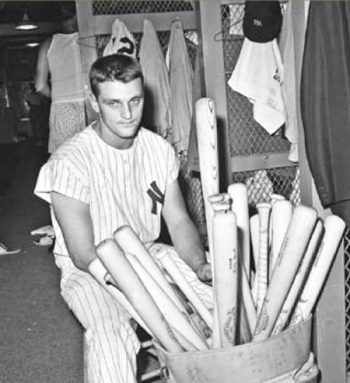
Roger Maris in the Yankee clubhouse, 30 September 1961—the day before he swung his way into history.

Bad enough when I spot those in the baseball press I don’t know personally but perpetuate mythology over factuality. But now my editor at the Internet Baseball Writers Association of America’s Here’s the Pitch newsletter, a man who’s become a friend in the bargain, does it.

Pondering Aaron Judge’s choice of number 99 on his Yankee uniform, Dan Schlossberg writes in today’s HTP, “Perhaps he knew he would become twice as good as [Roger] Maris? Certainly, Maris never chased a Triple Crown. In fact, his .260 lifetime batting average is the leading negative whenever his Hall of Fame candidacy is considered.”

Not even close, my good friend.

Mike Schmidt hit only seven points higher than Maris lifetime and that didn’t stop his election to the Hall of Fame. OK, that’s a ringer. Schmidt is the arguable greatest all-around third baseman ever to play the game. But his lifetime .267 hitting average didn’t exactly block him from Cooperstown, either.

There are lots of Hall of Fame players who hit in the .260-.269 range lifetime. Those modest hitting averages didn’t block them, either. They had other factors in their favour. And so might have Roger Maris except for one pair of problems.

Problem one: Maris was so badly seared by his pursuit and breaking of ruthsrecord in 1961 that there were times too many writers of the time believed he began to shy away from perpetuating the greatness that was his for the taking. Never permitted to enjoy truly the blessings of having cracked baseball’s single most prestigious record, Maris looked from there like a man to whom greatness was an intruder, not a companion.

Problem two: After a solid 1962 season, the injury bug began to hit Maris. Back trouble  limited him to ninety games in 1963. He had a bounceback 1964, with 26 home runs, despite missing twenty games with assorted leg injuries. Then came 1965 and the injury that should have proved scandalous for the manner in which the Yankees handled it.

First, Maris suffered a pulled hamstring that kept him out 26 games after the first three weeks of the 1965 season. Then, come 20 June, Maris jammed his hand against the plate umpire’s shin guard while sliding home. He tried playing a few after that, but the injury was severe enough to take him out of the second game of a doubleheader against the Kansas City Athletics and out of the Yankee lineup after 28 June.

Finally the hand injury was diagnosed as bone chips for which he underwent offseason surgery. It turned out to be far worse. The hand continued to bother him as he started 1966. At last he complained about the problem, and all that did was crank the New York sports press that never truly accepted him and the Yankees themselves into harrumphing that he had no business complaining.

The hand injury turned out to have been a misdiagnosed fracture. Whatever remained of his once-formidable home run power was gone. So was Maris’s desire to continue playing. He’d played through enough injuries as it was and felt unappreciated for the effort.  The Yankees aged profoundly during and after 1964, the final pennant winner of the old Yankee guard, but the Yankees needed the Maris, Mickey Mantle, and Whitey Ford box office more than they needed them properly healthy, so it seemed in retrospect.

The writers chose Maris as the primary culprit, often accusing him of loafing, as some teammates did, both of whose sides were unaware of the true severity of the hand injury. If you’re looking for evidence as to why other players become either paranoid or hypochondriacal about their physical health, Maris was key evidence on their behalf.

“For those who had refused to appreciate Maris in the early 1960s,” wrote his Society for American Baseball Research biographer Bill Pruden, “his injury-plagued performance in the middle part of the decade, coming when the Yankees as a team were faltering, only seemed to confirm their views.”

For a man who had never placed any individual accomplishment above winning, it was a difficult time. Indeed, tired of battling injuries, of trying to play, even when hurt, but never seeming to be appreciated for the effort regardless, Maris gave much thought to retirement. However, before that decision could be made, the struggling Yankees traded Maris to the St. Louis Cardinals for third baseman Charley Smith.

Maris continued to play a solid right field in St. Louis for two consecutive pennant winners and their 1967 World Series champions (he also had the best Series of his career individually), before retiring at last and accepting Cardinal owner Gussie Busch’s offer to operate a Budweiser beer distributorship in southern Florida. He throve in the business with his brother Rudy as his partner, until he succumbed to lymphoma at 51 in 1985.

Injuries, not indifference or loafing, put paid to Maris’s Hall of Fame case before he had the chance to solidify one following his Hall-caliber 1960-62 seasons. Meanwhile, my friend Schlossberg went on to write, “Maris batted just .269 [in 1961] against expansion-diluted pitching.” Halt right there, Daniel.

The fear of diluted pitching when the American League expanded for the first time was probably one of the factors animating commissioner Ford Frick’s scurrilous conflict-of-interest bid to deny anyone, Maris or otherwise, legitimacy in pursuing ruthsrecord in 1961. Well, now. Would you like to know how “diluted” the league’s pitching actually became?

I know I sure did. And I found out. Pay very close attention to the following table, showing the league’s 1960 and 1961 earned run averages, fielding-independent pitching rates, walks and hits per inning pitched, strikeouts per nine innings, and walks per nine.

AL Pitching ERA FIP WHIP K/9 BB/9
1960 3.87 4.00 1.37 4.9 3.6
1961 4.53 4.09 1.38 5.2 3.7

There was a 66 point jump in the league’s ERA for 1961, well enough shy of a full run’s difference. But look further and closer. That’s not the place you end pondering the difference in the league’s pitching from ’60 to ’61, it’s the place where you only begin.

The league’s FIP—measuring that for which pitchers alone are responsible (you can call it their ERA without their fielders’ performances factored in) remained practically the same, unless you think a mere nine-point rise is equivalent to scaling the Empire State Building.

AL pitchers also averaged a lousy single point more walks and hits per inning pitched (WHIP) in ’61 than in ’60. They struck out practically the same average per nine innings and walked almost exactly the same per nine. If that’s drastically “diluted” pitching, I’m a dead bolt.

If anything, Maris had a tougher time hitting 61 in ’61 than the Sacred Babe had in 1927. I’ve noted it before but it’s worth nothing again here: The advent of relief pitching above and beyond being the final repose of pitchers who couldn’t cut it as starters had a big say in it.

Ruth in ’27 faced 67 pitchers all season long, while Maris in ’61 faced 101. Ruth got to face pitchers a third time around in games 35 percent of the time in ’27; Maris enjoyed that privilege only 30 percent. He faced more fresh arms in games than Ruth did.

Did I mention again, too, that this year Aaron Judge faced 232 pitchers by the end of the doubleheader during which he hit his 55th home run of the year? That he faced pitchers a third time around in only seventeen percent of his games as of the end of that twin bill?

The myth of diluted AL pitching in 1961 isn’t quite as grave as the truly unconscionable myth of The Asterisk, of course. But it has in common with that disgrace that it never truly existed in the first place.

You’re welcome, Dan.

Paid in full to Club 700

Albert Pujols

Could you blame Albert Pujols for spreading his wings with the biggest grin on the planet after number 700 flew out?

It took Albert Pujols 98 home runs before he finally caught hold of one in Dodger Stadium the first time, off a sophomore Dodger import from Japan named Kaz Ishii. Ishii spent four years in the Show before returning to pitch again in the Japanese leagues until age 39. He retired as he began, the walk (almost six per nine innings) being his wounding flaw.

Pujols at age 39 had 656 major league home runs on his resume and would meet and pass Hall of Famer Willie Mays on the all-time bomb list, before his injury-laden decline as an Angel finally finished with a brief but memorable tenure in a Dodger uniform last year. He couldn’t possibly imagine then that his final major league wish, a 700th home run, might come in the Dodgers’ venerable venue.

But the designated hitter, the only slot available to enable Pujols to play major league baseball one more season, finally became universal this year. And the Cardinals, the team with whom Pujols arose, starred, and became a baseball immortal in the first place, were more than willing to bring La Máquina home to try. Not just because they respected what he did, but because they genuinely believed in whatever he had left in the tank.

He wasn’t going to win a National League home run title. There wasn’t that much left of his power stroke. But whatever he had to give, the NL Central leaders would accept gladly. It turned out he had just enough to give until Friday night. Not just some key hits and key big blows, but history. And key stretch drive wins.

Pujols had only six home runs before the All-Star break but thirteen from then until he checked in at the plate the first time Friday night. All of a sudden, it didn’t seem just a dream that he could get to within two freeway exits worth of sight of 700.

The Cardinals couldn’t have scripted this one better if they had Paddy Chayevsky, Budd Schulberg, and Ring Lardner, Jr. collaborating on it.

In the top of a scoreless third, with Tommy Edman aboard on a one-out walk, Pujols fell behind to his lefthanded former Angel teammate Andrew Heaney 1-2 before catching hold of a fastball practically down the pipe and drove it almost to the rear end of the left center field bleachers. Appreciating his effort in his brief time in their team’s silks, the Dodger Stadium crowd exploded.

When the Cardinals put first and second aboard after two quick outs in the top of the next inning, with Pujols about to check in at the plate, Dodger manager Dave Roberts decided not to let Pujols get a second shot at making Heaney’s night any more miserable. Roberts brought righthander Phil Bickford in. With La Máquina sitting one blast from history, the manager wasn’t going to let him have a lefthanded treat.

He was going to make Pujols earn it the hard way. Except that Bickford has a 4.26 fielding-independent pitching rate this year, and Pujols lifetime has been almost as solid against righthanders (.295/.372/.532) as he’s been against lefthanders (.301/.381/.574). On the other hand, Pujols against righthanders this year has looked like the old man he is in baseball terms.

Roberts had to know Pujols’s .209/.297/.384 against the starboard siders made it the safest bet on the planet to bring in a Bickford. When Bickford had Pujols even at 1-1, Roberts could be forgiven if he signed in contentment knowing history wasn’t going to be made on his dollar. Then Bickford threw a third straight slider just a shade down and a shade in.

Pujols may be a living ghost of his old self no matter how much history he chased this year, but he still knows what he’s doing at the plate. The mind and the eye remain intact even if the body might still be hurling obscenities toward him. He swung at Bickford’s gift right as it knocked on his door.

This one only cleared about four rows of the same left center field bleachers. But it didn’t matter how far it traveled, just that it traveled to the right place in the first place. He joined the 700 Club at last. And there wasn’t a teammate, opponent, or fan in the house who’d have denied him his right to spread his wings and grin all the way around the bases.

As he’d done so often during the peak of his Hall of Fame-in-waiting career, Pujols singlehandedly handed the Cardinals a lead, 5-0 if you’re scoring at home, and it turned into an 11-0 demolition of the ogres of the NL West.

The fun continued in the top of the fifth when—abetted by Juan Yepez with one out reaching second on a Max Muncy throwing error across the infield—Dylan Carlson smacked an RBI double, and Lars (Sometimes You Feel Like a) Nootbaar followed Carlson with a two-run homer a third of the way up the right field bleachers.

Yepez thanked the Dodgers for that fifth-inning present with a one-out blast of his own over the left field fence in the seventh, after which Carlson doubled again but Nootbaar had to settle for sending Carlson home with a mere single. Then, come the top of the eighth, Alec Burleson pinch-hitting for Pujols thanked La Máquina for the memories with a leadoff blast off Dodger reliever Hanser Alberto to finish the Cardinals’ demolition.

But this was still Pujols’s night. Lots of former teammates and opponents and watchers have been remembering some of his biggest blasts of the past.

Mike Trout, his longtime Angel teammate and a future Hall of Famer himself, can’t forget how Pujols joined the 600 Club. “The grand slam, when he hit 600,” says Trout.

Just the situation. I mean it was a big spot in the game, and everyone was thinking the same thing. “This is for 600. This is gonna be sick right here.” And then he hit it. He loves the moment. And that’s the thing—people kept asking me, “Hey, do you think he’s going to get it [700]?” For sure. The way Albert prepares himself—he doesn’t change his approach, doesn’t try to hit a homer. He’s just trying to put a good swing on the ball. That’s big.

Manny Machado was a year away from first wearing an Oriole uniform when he saw his signature Pujols attack: Game Three, 2011 World Series, when Pujols wrecked the Rangers with three homers—all starting in the sixth inning. “That,” the Padres’ gazillion-dollar third baseman says, “was just incredible.”

I mean, he was not missing. You could throw him whatever and he was going to hit it. You could even throw the rosin bag and he was probably going to hit it out. Just that sweet swing. Even all his homers, going back—his first home run. I just admire that swing, how smooth it is, how long it stays in the path. It’s impressive.

Just don’t ask former Astros reliever Brad Lidge. When the Astros were still in the National League and playing the Cardinals for a trip to the 2005 World Series, Lidge got the worst possible taste of Pujols. It only proved to delay the Astros’ sweep out of the Series by that year’s White Sox, but Lidge still can’t forget.

“I made a mistake,” Lidge says now of the hanging ninth-inning slider Pujols demolished so thoroughly that only the roof braces of Minute Maid Park kept the ball from landing in the streets behind the building. “And it wasn’t super-surprising that he didn’t make a mistake.”

With a little help from his Astros pitching staffmate Roy Oswalt, Lidge by then knew that Pujols had evolved into a Ph.D. student of the game and its pitchers. “All of a sudden,” he says, “t started to feel like he knew what you were going to throw before you did. You felt like you had to be perfect . . . He had so much plate coverage, whether you’re throwing a 97 mph fastball or a slider down and away, you had to be perfect.”

“My game plan for him,” says Hall of Fame pitcher Greg Maddux, who once threw Professor Pujols a repeat changeup and saw it fly onto Chicago’s Waveland Avenue, “was to give up a single or less.”

But that was then. This is now. The greats normally approach such milestones in decline as it is. Pujols’s injury-smashed decline was a shock long before he rejoined the Cardinals. His Angel tenure started well enough. Then the body regions below his hips began attacking him like fresh meat under attack from the wolves past which he once hit lamb chops almost at will.

None of that matters now. Baseball players don’t always get to make their dreams, never mind their final wishes, come true. The only thing better than the 700 Club for Pujols now would be the Cardinals going all the way to the World Series and coming out with what would be his third lifetime Series ring. Just ask La Máquina himself.

“[D]on’t get me wrong,” he begins. “I know what my place is in this game.”

But since Day One, when I made my debut, it was never about numbers, it was never about chasing numbers. It was always about winning championships and trying to get better in this game. And I had so many people that taught me the right way early in my career, and that’s how I’ve carried myself for 22 years that I’ve been in the big leagues. That’s why I really don’t focus on the numbers. I will one day, but not right now.

“He talks the talk and walks the walk with saying those things,” says his Cardinals teammate Nolan Arenado. “And I really believe him.”

On Friday night, making history with a two-bomb evening, Pujols made believers all over again as he joined the club heretofore populated only by Barry Bonds, Henry Aaron, and Babe Ruth. Even for one night, nobody could take that resurrected belief away.

“What have you gotten yourself into?”

Keith Hernandez

An on-base machine at the plate, Keith Hernandez’s real baseball genius was revolutionising first base as a command infield position.

Almost four decades ago, the Mets’ general manager Frank Cashen thought he’d laid the foundation for the Taj Mahal. The Cardinals’ transcendent but troubled first baseman, Keith Hernandez, thought the roof fell in on him.

A mainstay of a defending world champion, who’d driven Cashen to drink almost every time he played against the Mets, was about to become a Met.

From the moment a previous Met regime traded Hall of Famer Tom Seaver because he seemed a little too uppity about how the team should spend their money (a few parts upon himself as baseball’s best pitcher; a lot more parts on the free agency market and replenishing the farm), the Mets reverted to their original losing ways. And they weren’t half as funny about it.

It was one thing for the best first baseman in baseball to run afoul of his manager Whitey Herzog because a small morass of off-field issues sent him into the cocaine netherworld and, in 1983, into a few lazy baseball habits. It was something else to be sent to what was then, still, the National League’s version of the seventh circle of hell.

Herzog and Hernandez weren’t exactly Damon and Pythias. The White Rat was earthily thoughtful; Mex was cerebral. Where Herzog preferred the George Brett prototype right down to the pinch of Skoal in that Hall of Famer’s cheek, Hernandez smoked cigarettes and engaged Civil War period fiction and the New York Times crossword puzzle, for openers.

The thinking person’s sport had an actual thinking person in its ranks, who just so happened to be an on-base machine and a first base revolutionary. Herzog forgot the thinking side of himself and also listened to the whispers about Hernandez’s cocaine dalliance. (At the 1985 Pittsburgh drug trials, Hernandez would call cocaine “the devil on earth.”)

Herzog asked Cashen if he’d be willing to deal talented reliever Neil Allen. “[Allen’s] well-known drinking problem,” Jeff Pearlman noted in The Bad Guys Won, “didn’t seem to bother Herzog.” When Cashen said he hadn’t thought about it, Herzog replied, “If you think about Neil Allen and another pitcher, we’ll give you Keith Hernandez.”

To St. Louis, which roasted the Cardinals for years to follow over the trade, it was rather like Capitol Records sending Frank Sinatra to Dot Records in exchange for two spare session musicians and a tape operator. (“He came right into our kitchen and rattled our pans for about four years,” Herzog has written, “burned the Cardinals with a lot of big hits.)

Only Hernandez was probably less amused than the Chairman of the Board would have been. The first call he made when told he was about to become a Met was to his agent, Jack Childers. Hernandez wanted to know if he could afford to retire and live off his deferred income. Childers counseled his client not to even think about it. Hernandez resigned himself. Oops.

His Met tenure began with a classic, almost Metsian screwup. According to Pearlman, he caught a flight to Montreal, where the Mets were playing the Expos. The Mets’ media relations man, Jay Horwitz, sent a limousine to meet Hernandez. The limo went to the wrong gate, compelling Hernandez to catch a cab.

“When he first got there, I remember looking across the clubhouse at him,” says Ed Lynch, a pitcher on the 1983 Mets. “He was unpacking his bags, I think we’re in Montreal, and I’m thinking, ‘Boy, you poor son of a bitch. What have you gotten yourself into?’”

It took a little romancing and a lot of tour guidance from popular veteran Mets pinch hitter Rusty Staub to convince Hernandez he hadn’t exactly been sentenced to Sing-Sing. Staub showed Hernandez enough of the city’s best—the theater, the museums, the eateries, the libraries, the clubs, the lovely ladies on every street corner, seemingly—to convince the first baseman, “I’ll make a brand-new start of it, New York, New York.”

Hernandez became about 3,200 degrees more. After playing out the 1983 string, Hernandez was convinced enough to sign a five-year deal with the Mets. In his six full seaons as a Met—five solid, the sixth showing the toll the injuries and age took at last—the Mets won more games than any team in the entire Show.

As a Met, he posted a 131 OPS+ upon a slash line of .301/.388/.437, an OPS of .825, and a Real Batting Average (total bases + walks + intentional walks + sacrifice flies + hit by pitches, divided by total plate appearances) of .530. Lifetime, his RBA is .528.

Among postwar, post-integration, night ball-era Hall of Fame first basemen it would put Hernandez two points above Tony Perez and in seventh place. But being an on-base machine was only part of his presence. He remains the single most run-preventive first baseman in baseball history. (+120 total zone runs above league average.) It isn’t close. (Should-be Hall of Famer Todd Helton is a distance +107 in second place.)

He wasn’t the lumbering, big-bopping first base cliche. He played the position as though a third or second baseman, not just going for the tough plays and not just his expertise at neutralising bunts, but making himself the on-field infield commander.

“Not only he would tell you what you need to do,” says Lynch, “but he’s going to tell you how the pitchers going to try to prevent you from doing it. So he gave you not only the result, but he gave you the plan to get to that result.”

“The knowledge of the league, which he’d been in for a while, the knowledge of the other hitters, the willingness to know about the other manager’s strategy, the nuances of the game, the minutiae of who’s hitting, who’s running, their tendencies—it all added up to a wealth of knowledge over there that you could draw on,” says Bob Ojeda, the best lefthanded pitcher on the World Series-winning 1986 Mets. “And I did draw on it at times, no question.”

Keith Hernandez

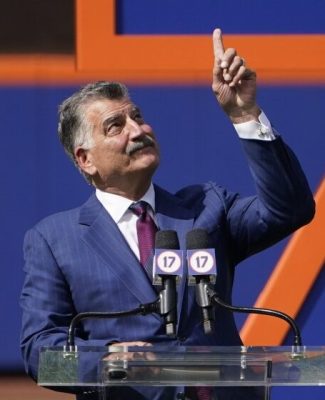
Now a respected, popular longtime Mets game broadcaster, Keith Hernandez points up to where his 17 hangs as a newly-retired Met uniform number.

It was hardly Hernandez’s fault that the Mets climbed the National League East ladder, reached the Promised Land, and finished his tenure with only one World Series ring and two pennants to show for a run of first or second place division finishes.

It wasn’t Hernandez’s idea to fool with Dwight Gooden’s repertoire in spring 1986, a foolery that would turn him in due course from beyond this earth to journeyman pitcher while he battled with his own drug addiction. It wasn’t Hernandez’s idea that Darryl Strawberry should spend most of the rest of his Mets life at war with himself, with substance abuse, and with his own team time and again.

It wasn’t Hernandez’s idea that Cashen should break the team apart little by little, or that he and Hall of Famer Gary Carter (Winning brings opposites together, Hernandez once said of Carter, an intelligent catcher but not in Hernandez’s cerebral league) should hit decline phases accelerated to somewhat warp speed by injuries atop their years of hard labour on the field.

Hernandez might have begun giving the Mets “a swashbuckling, devil-may-care, damn the torpedoes, full-speed ahead image,” as Lynch phrases it, an image New York loved but the rest of the league didn’t, but it didn’t exactly mean he wanted swashbuckling confused with recklessness as happened with too many of those 1986 Mets.

It took the Mets a very long time to come to terms with both the best and the most controversial team in their long, surrealistic history. The beginnings of those terms included bringing Hernandez into the broadcast booth, first as a part-time colour commentator, then a full-time partner to longtime mainstay Gary Cohen plus Hernandez’s 1980s Mets teammate, equally cerebral pitcher Ron Darling.

“You do the pitching, I do the hitting,” Hernandez told Darling when completing the trio.

The most vivid continuation of that coming to terms was the Mets retiring Hernandez’s uniform number 17 Saturday, before the Mets beat the Marlins in ten innings, 5-4, in a fashion that must have reminded Hernandez of his own good old days, almost: a two-out double sending the inning-opening zombie runner home; and, a throwing error on a dying ball on the front infield grass allowing the winning run to score.

“He asked for No. 37; that was his number with the Cardinals,” Lynch remembers of Hernandez’s original arrival. “And they told him no. He looked at them funny. And they said, ‘That’s Casey Stengel’s number.’ So now he comes over, he takes 17, and that’s getting retired also.”

“I never dreamed I’d be here this long, in the organization,” the Young Perfesser told a packed Citi Field Saturday. “I am absolutely humbled and proud that my number will be up in the rafters for eternity.” With the Ol’ Perfesser and The Franchise, among others.

Perhaps another humbling day will come Hernandez’s way, in due course, if the newly-aligned Contemporary Baseball Era Committee sees fit to give his career the thorough review it merits and gives first base’s greatest defender ever and one of its steadiest on-base machines a berth in the Hall of Fame.

“I got traded to a last-place team and no one at the ballpark,” Hernandez says. “And it turned out to be such a life-changing event for me in such a positive way.” For him and, for a few glorious if not always controversy-free seasons, New York itself.

A little hustle in the muscle

Dominic Smith

Dom Smith diving across first after Cardinals reliever Giovanny Gallegos (65) was late covering on Smith’s smash up the line and well behind the base in the top of the ninth Monday. Gallegos then tried but couldn’t nail trail runner Jeff McNeil at the plate, kicking the Mets’ overthrow win into overdrive.

It looked simple enough. Mets outfielder Mark Canha down to his and the Mets’ final strike Monday night with third baseman Eduardo Escobar aboard on a one-out base hit. Cardinals reliever Giovanny Gallegos 0-2 on Canha and ready to land the last punch(out).

The good news for the Mets is that they ended up landing the final punch with a two-run homer finishing a 5-2 overthrow into which they hustled themselves after they’d been down to their final strike. Aided and abetted unexpectedly by Gallegos a moment late and two bucks short covering first base on what could have been a game-ending dazzler.

Thus did the first showdown between the leaders of the National League East and Central grind, sprint, and launch its way to the finish in the Mets’ favour. You could almost feel the Cardinals bawling themselves out that it didn’t have to go that way the moment Mets reliever Edwin Diaz struck Cardinals outfielder Harrison Bader out after a two-out walk.

It came to this because the Mets wasted a delicious pitching duel between Max Scherzer and the Cardinals’ Miles Mikolas, trading shutouts for seven innings, after Mets reliever Tyler May couldn’t put Mendoza Line-hitting Tyler O’Neill away and surrendered a two-run single for his trouble with the bases loaded and one out in the bottom of the eighth.

But now Canha wasnt quite so ready, fighting back to a full count, before he hit a bouncer up the third base line to Nolen Arenado, the Cardinals’ third baseman to whom a play like this, even on the short run, was something he could do upside down if necessary.

Arenado on the not-so-hard run whipped a throw across the infield to first base. The ball soared right past first baseman Paul Goldschmidt and Escobar soared home to put the Mets on the board at last, with Canha taking second on the play and Jeff McNeil checking in at the plate.

Canha came out for pinch runner Travis Jankowski. McNeil sent an RBI double deep to right. And Mets manager Buck Showalter sent Dom Smith up to pinch hit for smart catching/modest-hitting Tomas Nido. Smith shot one up the first base line that Goldschmidt stopped one way or the other, diving across the line as he speared it fair.

But when Goldschmidt hustled a throw to the pad he had no target. Gallegos bounced off the mound a moment too late for the out as Smith dove onto the pad and Jankowski and McNeil cross the plate safely, McNeil himself diving home a split second before Cardinals catching insertion Andrew Kinzner could get a tag on him off Gallegos’s throw home.

“The second he hit it, I thought it was a foul ball,” said Gallegos post game. “Then I saw the ball bounce back to first, and that’s when I broke.”

“That’s a mental mistake,” said Cardinals manager Oliver Marmol. “Can’t excuse it. He knows it; we know it: He’s got to cover first.”

“Dom probably ran the fastest 90 (feet) of his life there,” said McNeil. “I knew it would be close at first base. I ended up scoring. It was a lot of fun.”

Smith wouldn’t exactly disagree. “You try to hustle as hard as you can to beat him,” he said. “I saw the closer didn’t get over right away. I just ran as hard as I could. I knew I had a step on him. I felt slow but I tried to run hard.” Don’t fight the feeling next time, either. It could be worth another pair of runs in another eleventh-hour effort.

It put the Mets up 3-2, brought lefthander T.J. McFarland in to relieve Gallegos for the Cardinals, and brought lefthanded-hitting Brandon Nimmo to the plate for the Mets. McFarland threw Nimmo a sinker that didn’t quite sink below the inner middle of the zone, and Nimmo sunk it on a high line inside the right field foul pole.

“It was worth the wait,” said Mets manager Buck Showalter after they banked the game. “It really was. It was fun to watch.”

“We’re a resilient team,” Smith said, “and I feel like we’re in it till the last pitch every night. Even the games that we don’t come up with a win, I feel like we make it tough on our opponents when they do beat us. I think it showed our DNA and what we’re about.”

And it almost (underline that) erased the pitching duel that kept Busch Stadium in thrall most of the night. Scherzer may have struck ten out in his seven innings but he appreciated his mound opponent just as much. Appropriately.

“Tip your hat off to Miles tonight,” he said of Mikolas, whose own seven-inning effort was five punchouts and four scattered hits. “That’s baseball. It was a great game. Sometimes you run into a buzz saw and he did his job tonight. I’m pitching on pins and needles there. I have to make every pitch. I was thinking even a solo shot might lose it.”

He didn’t have to worry as much as he thought. Monday night left Max the Knife number five on the career survey with his 106th double-digit-strikeout game, not to mention 33 punchouts and a measly eight walks in 25 innings pitched this season thus far.

If only he could pitch in Busch Stadium more often than he does. In his previous five gigs there, he’s gone seven innings or more each without a single run being pried out of him. He also has an ongoing 21-straight shutout inning streak against the Cardinals, and now that he has seven starts of ten strikeouts or more against them he’s behind only Hall of Famer Sandy Koufax in that department.

This is the pitcher the Cardinals have never tried to sign when he was on the open market despite his roots being in Missouri. Now they can look forward to this plus two more seasons of potential continuing torture at his right hand. Even if he might still need Met bats in the ninth to keep the bullpen from trashing his best efforts after he departs for the day or night.

“Everybody had a hand in that rally and that’s the cool thing,” he said of the Mets’ ninth-inning grind-out. “When you see your offense go off like that and just find a way to scratch across extra runs.” Catching one of the other guys asleep just enough when there’s first base to cover critically doesn’t exactly hurt, either.

It wasn’t over until it was over

Chris Taylor

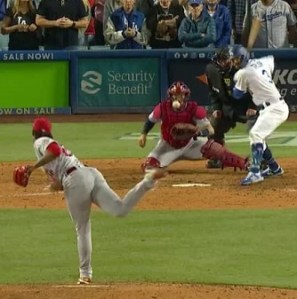
Chris Taylor, about to demolish Alex Reyes’s hanging slider and the Cardinals’ season in the bottom of the ninth . . .

If the postseason means anything, it means the biggest men on the field can come up as short as the least among them can come up Bunyanesque. You can watch the big men go hammer and tongs at it only to find the last or next-to-last man swung the wrecking ball that counted.

But if you thought a utility man who’d gone seven-for-September (well, seven hits in 71 plate appearances) would send the Dodgers to a National League division series after spending most of the NL wild card game riding the proverbial pine, you should be buying stocks, futures, and lottery tickets.

Infielder-outfielder Chris Taylor was sent into the game to open the seventh in left field, in a managerial double switch, and bat ninth in the order. And in the bottom of the ninth Wednesday night, with two outs, Cody Bellinger on second, and Alex Reyes on the mound for the Cardinals, Taylor with one swing reinforced two inviolable laws.

One was the Biblical admonition about the last being first. The other was Berra’s Law. The truest valedictory for this National League wild card game is that it most assuredly wasn’t over until it was over. It took a man who’d gone from All-Star in the season’s first half to also-ran in the second half, when a neck nerve issue contributed to making him almost literally half the player he’d been from April through July.

The number nine batter sent the Dodgers toward a division series showdown with their lifelong blood rivals, the Giants, with one swing, one two-run homer, and one moment in which the Elysian Fields angels decided the Red Sox deflating the Yankees in the American League wild card game just wasn’t quite enough.

Taylor turned on Reyes’s slider hanging a sliver under the belt and sent the ball about ten rows into the left field bleachers. He also sent Dodger Stadium into a racket that could have been heard practically across the state line separating California from Nevada.

Remember Hall of Fame broadcaster Jack Buck’s ancient holler after broken-bodied Kirk Gibson ended Game One of the 1988 World Series with a home run? Even home plate umpire Joe West—on the threshold of retirement at last—looked as though he wanted for once to come out from behind his cloak of professionalism, and beyond his reputation for inserting himself too much into games, to holler it.

I don’t believe—what I just saw!

Dodgers starting pitcher Max Scherzer believed it. Those who were there swear Scherzer turned to Dodger reliever Joe Kelly in the dugout as Bellinger checked in at the plate, telling Kelly, “I think Belli is going to get on here, and CT is gonna hit a homer.” If that’s true, maybe Scherzer should be buying stocks, futures, and lottery tickets himself.

Bellinger—whose regular season was laid waste by incomplete recovery from shoulder surgery last off-season and more than a few injuries nagging and otherwise including a broken bone or two—wrung himself into a full-count walk. Then, he stole second when Yadier Molina, the Cardinals’ grand old man behind the plate, couldn’t find a handle to throw against Bellinger’s big jump off first.

With the next pitch, Taylor made Scherzer into a prophet. Ending a game in which neither side could pry more than a single run out of either Scherzer or the Cardinals’ co-grand old man Adam Wainwright despite neither righthander having anything much resembling their truly vintage repertoires, other than a few tastes of Scherzer’s better sliders and Wainwright’s better curve balls.

“We’re going to need him,” Dodger manager Dave Roberts said about Taylor before the game. “I can’t predict what spot, whether it’s to get a bunt down, take an at-bat, play defense, start a game. I can’t predict that. I do know that he’s one of my favorite players. I trust him as a ballplayer, as a person. We’re going to need him this postseason.”

Need, meet net result. And, the newest member of a distinguished fraternity of modest men who step up immodestly in the postseason when it matters the most.

With the Dodgers’ season on the line—and TBS broadcasters Brian Anderson and Ron Darling having predicted two innings earlier that the game was liable to be won in the final at-bat—Taylor joined the like of Travis Ishikawa, Chris Burke, Aaron Boone, Todd Pratt, and Bucky Dent on the roll of the unlikeliest postseason bombers making the difference in win-or-be-gone games.

“[I]t’s been a grind for me,” Taylor said postgame. “I haven’t been playing my best. So to come through in the ninth, it felt really really good.”

Somehow, some way, Wainwright ground through five and a third innings with only Justin Turner’s leadoff launch to the rear of the Dodger bullpen in the fourth against him. Scherzer didn’t quite last that long. Despite his game-long wrestling matches with the Cardinal lineup, he was none too thrilled to get the hook in the fifth. He wouldn’t even give Roberts the ball as he left the mound.

Post-game, of course, Max the Knife was in his glory, interviewing shirtless and slightly inebriated from the party champagne. And, celebrating with his erstwhile Nationals teammate Juan Soto, who’d been in the field boxes—wearing Dodger shortstop Trea Turner’s Nats jersey, sitting next to Nats hitting coach Kevin Long in Scherzer’s Nats jersey.

“You gotta get rid of this echo,” Scherzer said on camera. “Can’t talk. I’m drunk, whatever.”

For all that the Cardinals made Scherzer wiggle into and out of jams as if it were par for the course, the only run they pried out of him was his own doing, when he wild-pitched Tommy Edman home on 0-2 to Nolen Arenado in the top of the first.

This was a game dominated by full counts, batters unable to cash gloriously positioned baserunners in, even with Scherzer and Wainwright looking like the elders they are on the mound. The Cardinals had the worst of that, going 0-for-11 with men in scoring position against Scherzer and four Dodger relievers—particularly resurgent closer Kenley Jansen, striking out the side in the ninth around Edman’s one-out single and theft of second.

Taylor also ended a too-brief battle between two men who’d gone from first-half boom to second-half bust. Like Taylor, Reyes was an All-Star for his first half. But he’d pitched his way out of the Cardinals’ closing job in the second. Just as Dodger manager Dave Roberts never once lost faith in his veteran Taylor, Cardinals manager Mike Schildt never really lost true faith in his still-young reliever.

Schildt isn’t the only one having Reyes’ back after Taylor broke his and the Cardinals’ backs Wednesday night.

“I just gave him gave him a huge hug,” said Adam Wainwright, the Cardinals’ other grand old man and wild card game starter. “Told him we love him, told him I loved him and gave him another big hug and just told him how special he was as a player and as a teammate, as a person.

“You know, it’s all you can say in a moment like that,” Wainwright continued. “He doesn’t probably want to hear any of it, but it’s all true. He’s a great teammate, is a great player. He’s a great pitcher. He’s a great friend, and I hate seeing anyone go through that, but he’s got an incredible future ahead of him.”

He’ll only have to shake off having thrown the pitch that ended a season in which the Cardinals lost a little too much—including their pitching ace-in-the-continuing-making Jack Flaherty—to the injured list and to deflated expectations for much of the season.

A season in which the Cardinals ironed up when it mattered most and rode a staggering seventeen-game winning streak, not to mention a fine young outfield, a mostly stingy defense overall, mostly solid hitting, and their elder anchorage of Wainwright and Molina,  toward the second National League wild card.

The Dodgers might have been humiliated more if they came up short. A 106 game-winning defending World Series winner, settling for the first National League wild card, after they couldn’t quite get that one game past the NL West-winning Giants? There wouldn’t be enough available space to hold all the variations on the implosion theme.

There may not be enough space to hold all the variations of Taylor-made sure to come forth now.