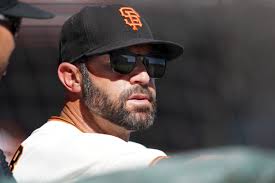
A star-spangled show of strength?

San Francisco Giants

The Giants crowd the dugout. The new skipper wants the dugout crammed before the national anthem now to show the other guys they mean business. But . . .

Tempted though I am to say “now I’ve heard everything” regarding “The Star-Spangled Banner” sounding before sports events, I don’t dare. That’s because every time I think and say I’ve heard it all, I get disabused rather rapidly. But you can’t help thinking it even for a moment when you see the Giants’ new manager’s explanation for why he’s mandating his players to stand for the National Anthem before a game.

Bob Melvin wants his entire team on the field, in the bullpen, in the dugout, standing for the anthem, whether spring training, the regular season, or the postseason to which the Giants are given +5000 odds of making this time around. And it has nothing to do with anything resembling patriotism, about which more anon.

“It’s all about the perception that we’re out there ready to play,” the manager told The Athletic‘s Andrew Baggarly. “That’s it. You want your team ready to play and I want the other team to notice it, too. It’s really as simple as that.” Seriously?

Seriously, says infielder Wilmer Flores. “It shows that we’re ready to play,” he says. “That’s the message we want to send to the other team. Even if you’re not playing, you’re engaged. You’re there to watch the game. It’s definitely something he wanted us to do. We’re here to play, right? I think it’s good. It doesn’t mean you’ll have a good result this season. But it’s a good way to start.”

But what if the National Anthem was no longer required playing and saluting before a ballgame? Is it impossible for a team to show it’s ready to play going in without it? Would a team be unable to stand en masse in the dugout or outside the bullpen while the starting lineup is announced without the anthem?

I get what the Giants say is the real thinking behind the rule. Not just a turnaround from previous manager Gabe Kapler’s stance, which Baggarly describes as a “‘no wrong answer’ situation” regarding the anthem, but a show of team strength after what outfielder Mike Yastrzemski described as a fend-for-yourself approach fostered by Kapler’s well-intentioned trust in his players to prepare.

That might be simple when you’re a team that won 107 games, as Kapler’s Giants did in 2021. It might not be all that simple when they spent the two seasons to follow going 160-164.

“I don’t know where it came from,” continues the grandson of Hall of Fame outfielder Carl Yastrzemski, “but it kind of took over where everybody felt like they could do their own thing and it made it feel like there wasn’t an entire group effort or a sense of unity. When you look at successful brands and successful teams, they have unity in a common goal. And I think that we need to refocus on that and to generate a very narrow window of where all of our eyesight should be.”

For better or worse, Kapler and his coaches trusted their players’ own preparation and swore that “‘eyewash,’ or going through the motions, would be kept to a minimum,” Baggarly writes. Melvin wants it known that quite the opposite will happen without him or his staff becoming tyrants about it if they can help it.

These Giants may not make the postseason this time around, but by gosh they’re going to come to play every day and they’re going to make a pre-game show of coming to play every day.

Somehow, this kind of going through the motion even in a crafted show of pre-game strength in the dugout, on the field, or outside the bullpen (relief pitchers and other bullpen personnel are now required to stand outside the pen in front of the fence under this mandate) is supposed to serve notice: These aren’t your lost 2022-2023 Giants, kiddies. At least, not until the umpire hollers, “Play ball!”

But the anthem is a tricky proposition for the Giants regardless. In 2022, Kapler elected to quit standing for the anthem in protest of the Robb Elementary School shootings in Uvalde, Texas and especially the Uvalde police who were present but did nothing to thwart them. Nobody wanted to condemn, hang, or guillotine Kapler for it, if you don’t count Tony La Russa. There was no Donald Trump in the White House that time to demand his firing post-haste, if not a firing squad.

“When I was the same age as the children in Uvalde,” blogged Kapler, once a World Series champion on the 2024 Red Sox, “my father taught me to stand for the pledge of allegiance when I believed my country was representing its people well or to protest and stay seated when it wasn’t. I don’t believe it is representing us well right now.”

Maybe this would be a good time to re-iterate something upon which I’ve stood since the National Football League elected to make it compulsory for its players to stand for the anthem unless they chose to remain in their locker rooms during its playing: stop playing it before every damn last baseball game of the year, already.

Save “The Star-Spangled Banner” for ballgames played on the national holidays that arrive during baseball season: Memorial Day, Flag Day, the Fourth of July, Labour Day. Save it for Opening Day. Save it for the All-Star Game. Save it for day one of the posteason (not the wild card games). Save it for Game One and (if it gets that far) Game Seven of the World Series.

(This could also apply to “O Canada” regarding Blue Jays home games: save that for Opening Day, the All-Star Game, day one of the postseason if the Jays make it, Games One and [if necessary] Seven of the World Series if the Jays make it, plus Victoria Day, Saint John Baptiste Day, Canada Day, Labour Day, National Day for Truth and Reconciliation, and Canada’s Thanksgiving Day.)

A nation whose first presidency ended with its first president warning against “the postures of pretended patriotism” should really have no issue with that.

“Compulsory patriotism is empty patriotism,” I wrote almost five years ago. “You probably don’t need me to tell you about those countries where patriotism was (and still is) enforced at actual or implicit gunpoint. Do you need me to remind you that there have been times enough in our own history where there’ve been those in the land of the free and the home of the brave who’ve favoured something as close to gunpoint patriotism as they could get away with?”

If we remove “The Star-Spangled Banner” from all but the aforementioned baseball season occasions, and Melvin really insists upon his Giants being all present and accountable before the game begins, he (and everyone else) might consider a fine, fine alternative. Here’s a hint: Put me in, coach, I’m ready to play . . .

Vida Blue, RIP: “You deserve it. But I ain’t gonna give it to you.”

I’m talkin’ baseball—like Reggie, Quisenberry
Talkin’ baseball—Carew and Gaylord Perry
Seaver, Garvey, Schmidt, and Vida Blue
If Cooperstown is calling, it’s no fluke—
they’ll be with Willie, Mickey and the Duke.

Terry Cashman, “Willie, Mickey and the Duke (Talkin’ Baseball),” 1981.

Vida Blue

A Time cover star one season, Vida Blue became a poster child for Charlie Finley’s caprice and cruelty the next.

Out of 24 major league rookies to throw no-hitters, Vida Blue had the greatest sophomore season of the group—including the only Hall of Famer among them, Christy Mathewson. That sophomore season made him a national phenomenon, a Time cover star, a Cy Young Award winner, the American League’s Most Valuable Player . . . and a particular victim of then-Athletics owner Charlie Finley’s notorious caprice.

Blue died at 73 Sunday. He’d never again equal that surrealistic 1971, after his owner left him feeling worthless during offseason contract talks that took a turn called nasty even by Finley’s contradictory standards. He’d be a good pitcher who never again got anywhere near the greatness his 1971 promised.

On 21 September 1970, Blue struck nine Twins out (including Hall of Famer Harmon Killebrew twice), walked one, and landed a 6-0 gem supported by a run-scoring double play in the first and a five-run eighth, finished when A’s shortstop Bert Campaneris—in the middle of a very unlikely 22-homer season (he averaged five per 162 games lifetime)—yanked a three-run bomb with two out off the Twins’ Jim Perry.

Slightly over a year later, Blue finished that Time season credited with his 24th win, before what looked like a certain American League Championship Series Game One triumph turned into disaster: leading the Orioles 3-1 entering the bottom of the seventh, Blue and the A’s were torn for four runs, two scored by Hall of Famers Frank and Brooks Robinson, en route a 5-3 loss that led to being swept out in three.

Still, Blue sat atop baseball’s mountain. No Show sophomore sat higher. As Time put it with a corner banner on his cover issue, the 21-year-old lefthander put “new zip in the old game.” He’d posted a staggering 1.82 earned run average, a 0.95 walks/hits per inning pitched rate, and a 2.20 fielding-independent pitching rate. On the mound he looked taller than his six feet with his knee-up, arm-whip delivery. And, with a fastball considered the hardest that didn’t belong to Hall of Famer Nolan Ryan.

As would be said of another ill-fated child prodigy, Dwight Gooden, over a decade later, Blue was great before he’d even had much chance just to be good. He stood at 22 as the youngest man ever to win an MVP and the youngest (until Gooden over a decade later) to win a Cy Young Award. Analysts determined that one out of every twelve tickets to American League games were sold for his starts.

Even President Richard Nixon got into the act, when learning Blue’s 1971 salary ($14,500) was barely above rhe rookie minimum. Nixon called Blue “the most underpaid player in baseball.”

Then it came time to talk contract for 1972, in the days before Curt Flood lost his reserve clause challenge at the U.S. Supreme Court and well before Andy Messersmith pitched contract-less and prevailed to finish what Flood started. No player that offseason would better evoke the once-fabled malaprop of radio comedy legend Jane Ace: “You’ve got to take the bitter with the better.”

Audaciously, Blue engaged an agent and asked for a $100,000 salary for 1972. It happened, according to Jason Turbow’s Dynastic, Bombastic, Fantastic: Reggie, Rollie, Catfish, and Charlie Finley’s Swingin’ A’s, when Blue’s veteran teammate Tommy Davis—seeing him drowning in endorsement offers—introduced him to a California attorney named Bob Gerst, who agreed to represent Blue for a flat fee instead of percentages per.

You can only imagine how little Finley loved that idea. The same Finley who’d crowed during Blue’s sensational season, “Don’t you worry about him making money. He is going to make money. He is going to get more than money. He is going to get great things from this game. I’m going to see that he gets great things. I’m going to protect him.”

Come 8 January 1972, Finley proved just how much he’d protect Blue. Aghast as it was that Blue had Gerst in tow, Finley simply couldn’t resist talking down to the earnest lefthander.

Well, I know you won twenty-four games. I know you led the league in earned-run average. I know you had three hundred strikeouts. [Actually, 301, but let’s not get technical.—JK.] I know you made the All-Star team. I know you were the youngest to win the Cy Young Award and the MVP. I know all that. And if I was you, I would ask for the same thing. And you deserve it. But I ain’t gonna give it to you.

“He said it with a smirk,” Blue would say later, “and, man, it made me want to slide under the table.” This was the kid who’d gone on a USO tour of Vietnam with comedy legend Bob Hope and, when Hope asked how come he didn’t get more money from Finley, cracked, “Well, Mr. Finley claimed I was only using one arm.” Who knows how much of a strand of truth that crack contained?

The talks became contentious enough that Finley took them public while Gerst helped swing a profitable non-baseball job for Blue to prove he wasn’t kidding around. A’s players were torn between believing Blue should get every dollar he thought he was worth and wishing he’d sign for Finley’s proffered $50,000 just to be among them.

Gene Tenace, Vida Blue

Vida Blue (right) with catcher/first baseman Gene Tenace, at a 40th anniversary celebration of Oakland’s first of three straight World Series championships.

Blue even announced he would leave baseball for that job with a successful bathroom fixtures manufacturer. (Wags suggested Blue was going down the toilet.) Finley’s pressures included making Davis—maybe the team’s most valuable bench player in 1971—a scapegoat for introducing Blue to Gerst, and rather nastily. He ordered a very unwilling manager Dick Williams to wait until the A’s arrived at the ballpark, for a spring exhibition game three hours from home, before telling Davis he was released—and leaving Davis to find his own way home. (Turbow recorded that the A’s traveling seceretary loaned Davis his car.)

Blue got some relief from baseball’s first-ever players strike, over a 17 percent pension hike, the players finally agreeing to settle for a little over half that. Finley kept the pressure up, acquiring once-glittering but shoulder-ruined righthander Denny McLain and trading popular outfielder Rick Monday to the Cubs for pitcher Ken Holtzman. Finally, commissioner Bowie Kuhn interceded.

“It wasn’t that Finley’s $50,000 offer was outrageous, the Commissioner said,” Turbow wrote, “but that ‘Finley had a way of making it seem so’.” Blue finally came away with a $63,000 1972 salary. “He treated me like a damn coloured boy,” the lefthander told two California newspapermen when the deal was done. “Charlie Finley has soured my stomach for baseball. Tonight isn’t tell it like it is. Tonight is tell it like I feel.”

After being part of three straight A’s World Series titles, after being one of the players whose sales post-Messersmith Finley tried but Kuhn foolishly blocked*, and after a trade to the Giants that saw him become the first pitcher to start All-Star Games for each league, Blue would move on to the Royals—and become one of five teammates sent to the slammer on drug charges after the 1983 season.

Blue struggled with cocaine addiction until he retired before the 1987 season. He became a pre- and postgame television analyst for Giants games; he became known for philanthropy in the Bay Area and as a role model for children he worked with through a Giants’ outreach program. His marriage (the couple walked under a an arc of bats held by Giants players as they walked to the Candlestick Park mound) ended in divorce; he may have beaten cocaine but struggled further with drinking.

Maybe the Finley contract contretemps roots it. He became “bitter and withdrawn,” noted John Helyar in The Lords of the Realm, “eventually developing a drug problem that landed him in court.” Except that, somehow, away from the field, Blue remained likeable and magnetic.

“Vida’s such a wonderful guy,” said Hall of Famer Orlando Cepeda to the San Francisco Chronicle’s John Shea in 2005, after Blue was dinged for driving under the influence. “He’s been through a lot, but he likes to keep things inside. I went through some tough times myself, and sometimes you’ve got to open up and accept help from your friends.”

And, your children. Blue had a son and two daughters; the son, Derrick, told Shea, “He’s got great people skills, and I think that’s been a downfall. People have let him get away with more. People come to me and say, ‘He’s a great guy. He took us out drinking and partying.’ I cringe. That’s what’s wrong with being professional athletes, my dad included.”

A one-time A’s teammate, ill-fated pitcher Mike Norris—one of the early 1980s “Five Aces” said to be ruined by temperamental manager Billy Martin’s callousness toward pitchers and their workloads and by his own issues with drugs—wondered to Shea just how much substance abuse ruined Blue when Finley hadn’t.

I wanted to be the best black pitcher in the history of baseball, the first to win thirty games, but I screwed it up. So you kick yourself in the ass about it. Maybe I could’ve been in the Hall of Fame. It sounds cocky, but winning twenty games wasn’t hard for me. [Substance abuse] led to my arm injury. Being addicted, you’re not going to eat or sleep. You can’t play this game without eating or sleeping. Vida had the best fastball I’ve ever seen, and that includes [Hall of Famer] Nolan Ryan or anyone else. It was inevitable he’d go to the Hall of Fame. I believe . . . Finley turned him off to baseball. If he left him alone, there’s no telling what would have happened to this beautiful person.

Most recently, Blue took part in an A’s celebration marking the half-centenary of their 1973 World Series winners. Who knows what went through Blue’s mind and heart, riding in a classic, antique Thunderbird convertible, around a ballpark left gone to seed, hosting an A’s team left in ruins by an owner who might, maybe, make Finley resemble a kindly grandfather by comparison?

“I know he hung on for that last anniversary celebration like the absolute gamer he was,” tweeted Dallas Braden, another ill-fated A’s pitcher, whose Mother’s Day perfect game was the highlight of a career rendered brief by a shredded shoulder, and who’s since been an A’s game analyst for NBC Sports Bay Area. “Rest easy, Mr. Blue.”

We wish Blue’s family comfort in knowing the man will be remembered for what he was, for what his boss did to him, and for how he tried every time his addiction demons flattened him to flatten them right back. And we wish Blue nothing less than a deserved rest in the Elysian Fields, with the Lord’s embrace, forgiveness, and love.

———————————————————————————-

* In The New Bill James Historical Baseball Abstract, James probably said it best about Bowie Kuhn’s quash of the notorious Charlie Finley fire sale bid of 1976:

[It] was an ignorant, bone-headed, destructive policy which had no foundation in anything except that Kuhn hated Charlie Finley and saw that he could drive Finley out of the game by denying him the right to sell his [star] players.

What Kuhn should have done, if he had been thinking about the best interests of the game, is adopt the Landis policy: rule that players could be sold for whatever they would bring, but 30% of the money had to go to the players. Had he done that, the effect would have been to allow the rich teams to acquire more of the best players, as they do now. But this policy would have allowed the rich teams to strengthen themselves without inflating the salary structure, and would have allowed the weaker teams, the Montreal-type teams, to remain financially competitive by profiting from developing young players.

“The Landis policy” refers to longtime commissioner Kenesaw Mountain Landis’s suggestion—un-acted upon, of course—after Pacific Coast League star Earl Averill refused to report to the Cleveland Indians unless he got a percentage of the sale price the Indians paid the San Francisco Seals to buy him. It may have been the single smartest idea Landis ever had, and it fell on the proverbial deaf ears.

The players on Finley’s fire-sale market were Blue, Hall of Fame relief pitcher Rollie Fingers, and outfielder Joe Rudi.

What a long, strange trip it’s been . . .

Carlos Correa

Correa took a medicals-inspired, coast-to-coast trip back to the Twins in the end.

This much we should understand about today’s typical Met fan, and it’s not the first time this lifelong (theirs) Met fan has said so: Today’s typical Met fan is ready to push the plunger on a season over one bad inning—in April. The least shocking thing when Carlos Correa didn’t go from likely signing to donning a Met jersey at an introductory press conference was any Met fan surrendering 2023.

From the moment the Twins with whom Correa played last year came back into play for the shortstop, when the Mets proved as alarmed over Correa’s long-term health as the Giants had previously, many Met fans did. Social media was as crowded with them as a major subway transfer station is crowded during a New York rush hour. But there were voices of reason to be heard if you knew where to listen.

And what those voices said, from the top down, possibly including the fellow lifelong Met fan who owns the team now, was, If this guy’s rebuilt lower leg betrays him when the deal is halfway finished or less, he’s going to become a fan target and we are going to resemble the village idiots for signing him. At least, at the full thirteen and $350 million originally planned.

Now the Twins—who weren’t exactly circumspect about wanting to have Correa back longer term—have brought him back for six years and $200 million. ESPN’s Jeff Passan broke that news aboard Twitter Tuesday. The deal is now official with the physical passed.  Even if it took Correa two long stops aboard what sometimes resembled the crazy train to get there.

Remember: The Giants had landed him—until they didn’t. They quaked over something in Correa’s medical profile, enough to let him walk right into the Mets’ open arms on the day they expected to present him at a presser climbing into a Giants jersey. First it was thought to be Correa’s back. Then, as the Mets were ready to wrap him up for Christmas, the discourse turned to that now-notorious rebuilt ankle.

The Mets had Correa ready to place under New York’s Christmas tree—until they didn’t. They, too, quaked over something in the medical profile. Unlike the Giants, the Mets were willing to adjust. We know now they worked up an adjusted deal for six years and $157.5 million (were willing to go six assured at $175.5 million (roughly $27 million annually), with additional years up to six to follow based upon annual physical examinations.

The Giants’ prudence (if that’s what it was) about Correa in the end still leaves them with more holes to fill. The Mets’ such prudence doesn’t leave them with more than maybe a dent or two to fix. Remember: the Mets won 101 games last season before they collapsed in postseason round one. They’re not exactly in terrible 2023 shape, either.

But it looks as though Steve Cohen isn’t going to be the wild free-spender the rest of baseball world believed and maybe feared. It also looks as though he’s not willing to be as risky as people thought when it comes to players with injury histories no fault of their own but profound enough. Even players he says publicly, as he did about Correa, might be necessary pieces for a full-distance championship team.

Remember: Cohen once let a shiny draft pick (pitcher Kumar Rocker) walk rather than sign him over concerns about shoulder issues. He’s the owner who let Jacob deGrom, the arguable best pitcher in baseball when healthy (underline those two words), walk. (To the Rangers, for five years and $185 million.) If he was willing to let the game’s best pitcher when healthy (underline those words) walk, he wasn’t going to fear letting one of its best left-side infielders walk over similar alarms.

Is it unrealistic to think that the Astros, who raised Correa in the first place and saw him shine with them for seven seasons, let him walk into free agency in the first place because they, too, had long-term concerns about his long-term health?

Cohen may be willing to open the vault wider than any other major league owner, but it doesn’t mean he’s going to be that drunk a sailor. Remember: He had a plan and executed it regarding deGrom, signing seemingly ageless future Hall of Famer Justin Verlander for two years.

He also locked down late-game relief ace Edwin Diáz and outfield mainstay Brandon Nimmo. Extending first base anchor Pete Alonso isn’t unrealistic, either, especially after letting talented but too-firmly blocked Dominic Smith walk into the Nationals’ arms. The plan for Correa was moving him to third to play aside uber-shortstop incumbent Francisco Lindor. Without Correa? They have a pair of talented third basemen, veteran Eduardo Escobar and sprout Brett Baty.

The Mets aren’t hurting without Correa. The Twins are risking that they won’t be hurting if and when Correa begins hurting. As it was, Correa on his 2022 deal—three years, $105.3 million, and three opt-outs, the first of which Correa exercised to play the market in the first place this winter—proved a second half godsend, when the Twins became injury riddled enough but Correa managed to stay the distance.

The Twins also liked Correa’s clubhouse leadership and prodding teammates to improve. “The vision he has,” assistant pitching coach Luis Ramirez told The Athletic, “the awareness, the anticipation about what is going to come next. When he needs to talk to a teammate about an adjustment that needs to be made, or just, to like, picking up a teammate, or paying attention to small details in the game that others don’t see—he makes us better in everything, in the field, everywhere.”

They’re also banking on Correa maturing further and further away from his Astrogate past. Correa was once the staunchest public defender of the Astros’ 2017 World Series title. Yet he said not so fast, more or less, at that notorious February 2020 word salad-bar presser; their illegal, off-field-based, electronic sign-stealing Astro Intelligence Agency was “an advantage. I’m not going to lie to you.”

If you know what’s coming, you get a slight edge. And that’s why [then-general manager Jeff Luhnow and then-manager A.J. Hinch] got suspended and people got fired because it’s not right. It’s not right to do that. It was an advantage. But . . . it’s not going to happen moving forward.

Correa also took the Astros’ superstar second baseman José Altuve off the Astrogate hook, insisting—and the evidence since brought forth backs it up—that Altuve not only declined to work with stolen signs transmitted to him but actively objected to the infamous trash can banging of the pilfered intelligence while he was at the plate.

“The man plays the game clean,” Correa insisted, after then-Dodger Cody Bellinger fumed that Altuve should return his 2017 American League MVP award. “That’s easy to find out. [Astrogate whistleblower] Mike Fiers broke the story. You can go out and ask Mike Fiers: ‘Did José Altuve use the trash can? Did José Altuve cheat to win the MVP?’ Mike Fiers is going to tell you, straight up, he didn’t use it. He was the one player that didn’t use it.”

That’s what SNY’s Andy Martino said, too, in his Astrogate book, Cheated. It’s what Evan Drellich—one of the two Athletic reporters (with Ken Rosenthal) to whom Fiers blew the Astrogate whistle—is liable to reiterate in his forthcoming (next month) Winning Fixes Everything: How Baseball’s Brightest Minds Created Sports’ Biggest Mess. It’s what too many fans continue to ignore.

Without Correa, and placing their shortstop present and future into Gold Glove-winning rookie Jeremy Peña, last year’s Astros were down to only four or five remaining from the notorious 2017-18 Astrogate roster, including Altuve. The facts didn’t stop fans from hammering Altuve along with the others with chea-ter! chea-ter! chants—all the way into the World Series they won straight, no chaser at last.

The Twins bring Correa back with a front-loaded deal that includes no opt-outs and a full no-trade clause. They’re still taking a big risk on his health even for six years. God help Correa if his ankle or anything else breaks down and reduces him to journeyman status if he can play at all. Fans never let facts get in the way of fuming rants against what they think are fragile goldbrickers. Ask any Yankee fan when it comes to Jacoby Ellsbury.

But would a cynic suggest that, maybe, just maybe, in his heart of hearts, Correa was happy enough in Minnesota to let this weird coast-to-coast, medicals-scripted swing bring him back there in the first place, for a few more dollars than the Mets were willing to go on the same six guaranteed years? Maybe a cynic would. Maybe enough Met fans would. Did I just repeat myself?

The realist knows that, as fine as he’s still going to be, Correa’s ancient ankle repair did cost him in the long run. That, and not his controversial uber-agent Scott Boras, wrote this costly script. Costly for Correa. As The Athletic also points out, he lost seven years and $150 million compared to the original Giants offer, ended up with a lower offer from the Mets (half that $315 million over half the time), and signed with the Twins for four years and $85 million less than the ten/$285 million they first offered.

But realism isn’t half as much fun as ranting your head off about a season blown because of a signing blown, is it? Such is one of the major headaches of being a Met fan since the day they were born.

All dressed up and no place to go

Carlos Correa

The Giants’ hesitation on sealing the deal sent Correa—the arguable best shortstop on this winter’s free agency market—into the Mets’ unhesitant arms for a twelve-year deal.

Well, now. A lot of teams this winter approached the free agency market like the proverbial children in the candy stores granted permission to raid the stock as they please until they can’t carry any more out. A lot of very wealthy ownerships have made a fair number of players of most ages very wealthy men going forward.

But at least one reasonably wealthy ownership, the group that owns the Giants, led by Charles Johnson but operated by his son, Greg, resembles Olympic hurdles champions who leapt and bounded their way to the gold medals without contact with even a single hurdle but tripped walking upstairs on their ways home.

They had erstwhile Astros/Twins shortstop Carlos Correa on board for thirteen years and $350 million. Then they didn’t. They had Correa in San Francisco, all dressed up and no place to go, instead of being at an Oracle Park podium ready to shoulder into a spanking new Giants jersey.

Over a week after the Giants and Correa agreed to the deal, the Giants quaked over a medical question and thus postponed the scheduled Tuesday introductory press conference. They said, essentially, “Not so fast.” The Mets, with single owner Steve Cohen bearing dollars unlimited and anything but shy about spending them, said, essentially, “Not fast enough.”

The Mets now have Correa for a mere twelve years and a mere $315 million. The Giants blinked. The Mets pounced.

The Giants pleaded a “difference of opinion” over Correa’s physical exam. Correa’s agent, Scott Boras, pleaded that the Giants got edgy over ancient medical issues, not present or coming ones. Enter Cohen, with Correa unexpectedly back on the open market, once Boras worked the phones and tracked Cohen down in Hawaii, where he and his wife are spending the Christnukah holidays.

Exit Correa from San Francisco. Enter Correa to New York. What began in San Francisco and continued with Boras and Correa over lunch probably telling each other, “Relax, brah,” ended at fifteen minutes past Simon & Garfunkel time.

That’s the time Correa agreed to become a Met, with his only immediate issue likely to have been jet lag from such a short turnaround in back-and-forth bi-coastal flights. Also pending a fresh physical, but without any apparent paranoia on Cohen’s or his organisation’s part over . . . just what, precisely?

“You’re talking about a player who has played eight major-league seasons,” Boras said. “There are things in his medical record that happened decades ago. These are all speculative dynamics. Every team has a right to go through things and evaluate things. The key thing is, we gave them medical reports at the time. They still wanted to sign the player and negotiate with the player.” Until they didn’t.

“It sounds as if there was a very old Correa injury—pre MLB—that was raised as a potential issue. It has not cropped up again,” tweeted Susan Slusser, the San Francisco Chronicle‘s Giants beat writer. “None of Correa’s other physical issues have required medical intervention or ongoing treatment.” She added that if it became cold feet, that’s usually on the owners and not their front office.

Last winter, the Twins signed Correa as a free agent to three years and $105 million, with an opt-out clause enabling Correa to terminate the deal after the 2022 or the 2023 season, his choice. He chose to exercise it after the 2022 season. They whispered about back issues last winter, until Correa had himself checked by one of the nation’s top spine surgeons, Robert Watkins, M.D.

“He said, ‘This dude is as stable, as healthy as he can be’.” Correa said then.

Hearing that from the best back doctor in the world, it was reassuring. I knew that already because I’ve been feeling great. But to get that expert opinion, after an MRI and the work I’ve been putting in . . .

This is what I tell people. There’s no way you can go out and win a Platinum Glove if your back is not right. There’s no way you can put up an .850 OPS if your back is not right against the elite pitching we’re facing nowadays. There’s no way you play 148 games—and I could have played more, but the COVID IL got me—if your back’s not right. There’s no way you sign a $105 million deal for three years, go through physicals for insurance and for the team if it’s not rightthere are a lot of people who make decisions when it comes to the Giants.

“Almost all of the small [decisions for the Giants] are no doubt made by [team president] Farhan Zaidi and/or [chief executive officer] Larry Baer,” writes Craig Calcaterra at Cup of Coffee.

When things get big—and a $350 million commitment is pretty big—I would guess that a lot more people have a say in that and I can’t help but wonder if there was some buyer’s remorse re: Correa on the part of the partnership at large in the past week. If so, it would not be hard for someone in-house to suggest, order, or otherwise put out there in the ether the notion that Correa’s medicals are scary as a pretext for scuttling things.

“The owners didn’t want to pay the contract,” Slusser added. “All this ‘we almost got Bryce [Harper] we almost got [Aaron] Judge’ is just cover for the owner to pretend he wanted to spend. He didn’t. He’s a cheapskate. How pathetic.”

Some think Cohen is channeling his inner George Steinbrenner, minus that George-bent toward turning the Mets’ atmosphere into a hybrid between the Mad Hatter’s tea party and a psychiatric ward. Those owners to whom spending is about as agreeable as a colonoscopy may think Cohen’s ignited a new, slow-burning slog liable to culminate in a future owner-provoked stoppage that translates, almost as usual, to a demand someone else (namely, the players) stop the owners before they overspend, mis-spend, or mal-spend yet again.

But then there’s the thought of a secondary method to Cohen’s apparent madness. While he puts a major league product on the field that glitters while going for the gusto, he has room aplenty to continue his oft-proclaimed intent to remake/remodel the Mets’ entire system.

Be reminded, please, that it’s not as though Cohen just went nuts on the sales floor when he went to market. He locked down incumbent relief ace Edwin Díaz to the largest deal ever for his Díaz’s line of work. Then he lost Jacob deGrom to free agency and the Rangers but replaced him with (so far) ageless future Hall of Famer Justin Verlander. He locked down incumbent center field centerpiece Brandon Nimmo and signed Japanese pitching gem Kodai Senga.

Now, pair Correa with his longtime friend Francisco Lindor on the left side of the infield, Correa slotting over to third, in a combination not alien to either player in other places. Thus, too, Cohen bumped the Mets’ offense up a few more rungs (they were good at working counts last year and Correa gives them extra there, too), behind a solid pitching staff and with a reasonable bench behind them.

The expectations now will be the Mets going deeper into the postseason next year than a round-one disappearing. Not to mention becoming first in line to shop at the booth of a certain unicorn wearing Angels silks until he reaches his first free agency next winter. The expectations for the Giants, by comparison, may only begin with a wisecrack from The Athletic‘s Giants writer, Tim Kawakami. “[L]et me suggest,” he writes, “that the Giants probably need a crisis manager as much as they need a general manager these days.”

They once said that almost annually about Correa’s new employers. But these are not your grandfather’s Mets. Sixty years ago, the Mets’ original owner told a writer that their maiden season of 120 losses begged for serious improvement. “We are going to cut those losses down,” insisted Joan Payson. “At least to 119.”

One of their fans was a Long Island kid named Steve Cohen. With the financial power to support it, he now behaves as though the Mets have just got to get the wins (regular and postseason) up at least to 119. (That’s a joke, son. Sort of.)

On Kapler, the Anthem, and the atrocity that provoked him

Gabe Kapler

Kapler’s intended National Anthem protest hasn’t provoked a flood of outrage—yet.

This time, a funny thing happened after Giants manager Gabe Kapler said the atrocity in Uvalde, Texas moves him to stay in the clubhouse until “The Star Spangled Banner” finishes playing before games, because he’s “not okay with the present state of the country.” The funny thing that happened was . . . nothing.

No flood of outrage. No choking social media to death with demands for Kapler’s termination, if not execution. No threatened boycotts of Giants games. No politicians from the top down demanding Kapler be run out of a job, run out of town, run out of the country. No mass demonstrations around AT&T Park. No thunderous editorials calling for a Giants organisational shakeup.

This time, the country seems very much united across all lines of race, ethnicity, and even political belief in outrage that nineteen Uvalde police officers were in or around the Robb Elementary School building and did nothing to thwart the eighteen-year-old shooter who killed nineteen young children, a pair of teachers, and whose murders may have caused the fatal heart attack of the husband of one of those slain teachers.

The outrage deepens when learning as we have that those Uvalde police even tried thwarting efforts by the adjacent Border Patrol and federal marshals to stop the massacre. “As sickening as it is,” writes Reason‘s Robby Soave, “this is worth repeating: With the children wounded, bleeding, dying, and frantically–quietly–calling [9-1-1 on cell phones] for help, the police stood by, waiting for even more assistance. They told the Border Patrol to hold off, and they actively restrained parents outside the school who begged them to help and even volunteered to do so themselves.”

“Second Amendment supporters often counter, ‘The only thing that stops a bad guy with a gun is a good guy with a gun.’ Except the hallway of Robb Elementary School had no shortage of good guys with guns, and yet they did not stop the massacre until it was far too late,” fumes an editorial by National Review, a publication not known to suffer criticism of law enforcement without a fight. “Perhaps that slogan should be revised, ‘The only thing that stops a bad guy with a gun is a good guy with a gun and the willingness to act.’ No Uvalde cops acted when it could have made a difference.”

From the atrocity of George Floyd’s murder at the hands of Minnesota police to the atrocity of Salvador Ramos at Robb Elementary, Kapler—one of baseball’s most articulate and genuinely sensitive managers—looked upon the state of these United States and discovered he simply couldn’t partake of a dubious pre-game ritual because Uvalde slams an exclamation point down upon a country in self-inflicted peril.

“When I was the same age as the children in Uvalde,” wrote Kapler in a blog entry last Friday, “my father taught me to stand for the pledge of allegiance when I believed my country was representing its people well or to protest and stay seated when it wasn’t. I don’t believe it is representing us well right now.”

About the only truly pronounced demurral Kapler incurred came from Hall of Fame manager Tony La Russa, who came out of retirement to take the White Sox bridge last year. “I think he’s exactly right to be concerned . . . with what’s happening in our country,” La Russa told reporters before a game against the Cubs. “He’s right there. Where I disagree is the flag and the anthem are not appropriate places to try to voice your objections.”

Apparently, La Russa forgot the anthem’s line about “the land of the free and the home of the brave.” The brave were thwarted actively and incompetently at Robb Elementary, the only people Ramos set free were nineteen children and two adults from their earthly lives, and those Uvalde, Texas pays to be brave in the presence of evil—to put it in the absolute most polite language available—didn’t exactly do what they’re paid to do last Tuesday.

We can debate La Russa’s demurral and Kapler’s quiet outrage all day long. La Russa thinks Kapler’s intended protest disrespects the men and women of the military who defend what the flag and anthem purport to mean. I fear La Russa dismisses the prospect that those very men and women would think, appropriately, that they didn’t put their hides on the line to defend either police becoming criminals or police doing nothing to prevent mass murder while blocking others from trying to prevent it or while allowing it to continue inexplicably.

Some of Kapler’s fellow skippers get it. “[He] is very passionate about things he believes in and that’s his way of protesting,” says his downstate rival, Dodgers manager Dave Roberts. “I don’t think any of us are happy with what’s going on in our country. I do respect people using whatever platforms they have to address that.”

Alex Cora, who played with Kapler on the 2005-06 Red Sox and now manages the Red Sox, gets it, too. “He’s a good friend of mine and the kind of guy I respect from afar for what he’s doing,” Cora says, “and if this is what he’s doing, good for him. I understand his reasons. He was very open about it and I know there’s a lot of people that are going to support him.”

One of those people is also Chris Woodward, the manager of the Rangers. “I think we’re all frustrated, especially in this country,” he says. “Nobody’s happy. It’s not about which side you’re on. It’s just we’ve got to get better as a society . . . I’m not going to really make comment either way on whether I would or wouldn’t do what he did.”

Kapler made a Memorial Day exception to his intended protest before today’s game against the Phillies. “While I believe strongly in the right to protest and the importance of doing so,” he said, “I also believe strongly in honoring and mourning our country’s service men and women who fought and died for that right. Those who serve in our military, and especially those who have paid the ultimate price for our rights and freedoms, deserve that acknowledgment and respect, and I am honored to stand on the line today to show mine.”

Maybe now it’s time to revisit an argument I made a few years ago: It’s time at last to re-think “The Star Spangled Banner” before sporting events.

What began as a spontaneous show of respect by a Red Sox third baseman, as a Navy band played “The Star Spangled Banner” during the seventh-inning stretch of a 1918 World Series game, has become at once a ritual of habit and—since the NFL’s Colin Kaepernick over police brutality in 2016—a flash point whenever professional athletes seize upon its playing to protest quietly, usually by kneeling, over assorted outrages.

The song wasn’t even the sanctioned National Anthem when Fred Thomas (on leave from the Navy to play in the 1918 Series) turned and saluted the flag. That didn’t happen until the 1930s. But the song’s playing before every last sporting event regardless of day, evening, or calendar significance, renders it meaningless except as pressuring crowds into a patriotic gesture.

I’ve suggested it before, but it’s worth repeating yet again: An everyday anthem during baseball season means nothing but false patriotism, compulsory patriotism, the sort of patriotism you see in countries unworthy of it but likely to execute those who say or behave so.

Faithful readers (all three of you) may remember my saying this in prior writings on the matter: I don’t write lightly about this. I’m the paternal grandson of a New York police officer, and I’m an Air Force veteran. My grandfather would have fumed over Uvalde police doing nothing and trying to stop others from doing something, anything to save those children and teachers. And though I wasn’t in a job requiring direct combat, I wore the Air Force uniform knowing well that I had sworn by implication to die if it came to that on behalf of defending these not always so United States.

I accepted and lived it proudly. And I damn well didn’t spend four and a half years of my life in a military uniform, doing a military job, on behalf of those engaged to protect us from the criminals either becoming the criminals themselves or living down to the admonition, “The only thing necessary for the triumph of evil is for good men to do nothing.”

Neither did the men and women we commemorate today who died in actual combat.

So, one more time. Save “The Star Spangled Banner”—and, while we’re at it, “God Bless America” in the seventh-inning stretch—for baseball games played on such national holidays as Memorial Day, Flag Day, the Fourth of July, and Labour Day. Save it otherwise for Opening Day, the All-Star Game, Game One of the World Series, and even Game Seven if the Series gets that far.

The rest of the season, can it.

We can live quite well without the National Anthem before every last game without losing the only patriotism that truly matters, that in and of the heart. Even when that patriotism is challenged as murderously as it was in Uvalde, Texas last week. A challenge so murderous that the manager of the Giants prefers no compulsion to false or diluted patriotism when his country is compromised by evil.

Note: The foregoing essay was written originally for publication by Sports Central.