NLDS Game Two: Awakening the sleeping Braves

Travis d'Arnaud, Zack Wheeler

Travis d’Arnaud was only too happy to remind people what can happen when a lineup gets a third crack at his old Mets teammate Zack Wheeler . . .

If you expect to keep the Atlanta threshing machine from threshing, you can’t let any of them see Zack Wheeler the third time around. Not even if he’s taking a one-hitter into the seventh. Not even if you’re about to have your next two National League division series games in your own yard. Not even if the lone run out of him to that point scored on a tough fielding mistake.

You just might end up awakening the sleeping Braves.

Which is just what happened Monday night in Atlanta, the Braves overthrowing a 4-1 Phillies lead to win, 5-4. Slamming an exclamation point home with one of the most daring game-ending double plays anyone could hope to see, at any time.

Wheeler lost his no-hit bid and the Phillies’ bid for a second straight shutout in the bottom of the sixth, on Braves shortstop Ozzie Albies’s two-out single, sending Ronald Acuña, Jr. (two-out walk) home after Phillies shortstop Trea Turner misplayed a one-hop throw in from right. Phillies manager Rob Thomson elected to send Wheeler back out for the seventh.

Brain fart. Wheeler lifetime came into Game Two with opposition OPSes that accelerated each time through an opposing lineup: .594 the first time, with 39 home runs; .638 the second time, with 37 home runs; but, .759 with 47 home runs the third time. He was already in his third round with the Braves lineup when he walked Acuña in the sixth.

So with the Phillies leading by three, Wheeler opened with Matt Olson singling up the pipe, Marcel Ozuna striking out swinging, but Travis d’Arnaud—Wheeler’s former Mets teammate in the bargain—hitting the first pitch into the left field seats. As Truist Park went nuts over the first extra-base hit by the Braves all set long, then Thomson lifted Wheeler for Jose Alvarado.

“I wanted him to go back out, and he said he was fine,” Thomson said of Wheeler postgame. “He still looked good, so I was all in.” Three batters in, Wheeler was all out and the Braves were back on the march.

They continued marching with one out in the bottom of the eighth. Alvarado yielded to Jeff Hoffman, who hit Acuña on the left arm with his first pitch before Albies pushed him to second with a ground out. But then Acuña stole third with Austin Riley at the plate, and Riley rewarded Acuña’s larceny with his own drive into those left field seats.

The Phillies hung four on the board in the first five innings against a clearly struggling Braves starter Max Fried and Braves reliever Kirby Yates. Alec Bohm singled Turner (one-out double to the back of center field) home in the first. With Bryce Harper (one-out single) in the third, J.T. Realmuto hit one the other way into the right center-field bullpen.

With one out in the fifth, and Yates on the mound, Nick Castellanos (single) stole second and took third when d’Arnaud’s throw went far enough offline while Bryson Stott waited at the plate. Then Stott lofted a fly to center sending Castellanos home on the sacrifice fly.

d’Arnaud at least got his shot at redemption two innings later. The Phillies might have had a fatter lead for the Braves to overcome but for stranding the bases loaded in the first, stranding Johan Rojas on second (after a one-out walk and an advance on a wild pitch) in the second, and stranding first and second in the fourth and the sixth.

The defending National League champions had one more grand opportunity in the ninth when Harper pried a leadoff walk out of Braves relief ace A.J. Minter, prompting Braves manager Brian Snitker to reach for closer Raisel Iglesias. After Realmuto flied out to center, Castellanos sent one to the rear end of right center. Center fielder Michael Harris II ran it down like a cop chasing a mugger.

“I knew off the bat it was going to be close to the fence,” he said postgame. “I knew once I went back I wasn’t stopping. I was going to do anything I could to get a glove on it. If my body had to go down because of that, I would have done that.” His body didn’t go down despite its rude meeting with the fence, but he caught the drive and winged a throw in that snuck past Albies and meant disaster. For about three seconds.

Riley backed the play alertly, with Harper having rounded second hell bent on getting as close to the plate with the tying run as he could. But Riley fired a strike across the infield to first, making Harper pay for being just a little over-aggressive.

“Usually, you don’t pass the base,” said Thomson postgame. “You stay in front of it, make sure it’s not caught. But he thought the ball was clearly over his head, didn’t think he was going to catch it. And Harris made a heck of a play. Unbelievable.” Heck of a play? The Elias Sports Bureau says it’s the first time a postseason game ever ended on a double play involving any outfielder.

You hate to say a series tied at one game each has become treacherous. But Philadelphia’s Citizens Bank Park is a haven for hitting, and re-awakening the Braves’ threshing machine, after they spent the series’ first fourteen innings scoreless, is not a sound idea. Especially when they hit a record 307 homers on the regular season—including 24 against the Phillies exactly half of which were put in the Bank.

Thomson said the split in Atlanta was disappointing but, what the hey, now the Phillies have the home field advantage. The Braves didn’t put their best 2023 road show on in the Bank. (That honour belonged to Cincinnati’s hitting haven of Great American Ballpark.) But they’re not exactly pushovers in Philadelphia, either.

NLDS Games One: The Atlanta Chop Slop, the Los Angeles funeral parlour

Truist Park

Trash talk? Have at it. Trash the field over a call going against you? What was this, Braves fan?

Neither the Dodgers nor the Phillies expected simple National League division series this time around. Not with both teams coming in with what some call patchwork pitching. But one came out looking better in their Game One while the other came out looking like the remnant of a nuclear attack.

The Phillies and their pitching managed to keep the Atlanta threshing machine from threshing Saturday afternoon, winning 3-0. Starting with a first-inning nuking of future Hall of Famer Clayton Kershaw, the Diamondbacks laid waste to the Dodgers Saturday night, 11-2. On the arms of big enough bats and a starting pitcher who was usually close enough to Dodger batting practise.

Letting starter Ranger Suárez go no more than three and two thirds, knowing they’d have a day off between Games One and Two, the Phillies went to a bullpen game, essentially. And that bullpen finished what Suárez started, shutting the Braves out over the remaining five and a third. The Braves who hit a record 307 home runs on the regular season looked as though they had paper towel tubes for bats.

None more glaring than the founding father of the 40/70 club. Ronald Acuña, Jr. went 0-for-3 with a walk, and his evening’s futility included an embarrassing called strikeout in the fifth, when—with first and third and one out—the second Phillies reliever of the evening, Seranthony Domínguez, planted a fastball right on the low inside corner.

Small wonder that Braves manager Brian Snitker could and did say, postgame, “I think it was more their pitching than our hitting.” Indeed.

Braves starter Spencer Strider pitched boldly enough, striking eight out and scattering five hits in seven innings’ work. But the Phillies still pried two runs out of him, both with Bryce Harper the big factor. First, Strider threw wild enough trying to pick Harper off first in the top of the fourth, enabling Bryson Stott to single him home with the first run. Then, Strider threw Harper enough of a meatball to disappear into the Chop House seats behind right field with one out in the top of the sixth.

“Strider, man, he’s one of the best in the game. You know he’s going to come at you and throw his best at you,” Harper said postgame. “So just trying to get a pitch over and was able to get the slider up and do some damage.”

Except for Acuña’s surprising silence, and the eighth-inning catcher’s interference call with J.T. Realmuto at the plate and the Phillies with the bases loaded, enabling the third Phillie run home, the Braves at least looked stronger in Game One defeat than the Dodgers did. Even Strider, who became the first postseason pitcher ever to lose twice against a team against whom he’s well undefeated in the regular season.

The Diamondbacks didn’t let Clayton Kershaw—all 35 years old of him, with possible lingering shoulder issues plus eight days of rest leaving him with little enough to offer—get out of the first alive. Their 35-year-old journeyman starter Merrill Kelly, who didn’t turn up in the Show until age 30 in the first place, manhandled them for six and a third after the Snakes bit Kershaw deep in the first.

For the regular season’s final two months, with a 2.23 ERA over eight starts, Kershaw seemed to tell age and his shoulder alike where to stuff it. Then Kershaw took the ball Saturday night. What’s the saying about too much rest being as hazardous to a pitcher as too little rest can be?

Ketel Marte opened with a double to the back of left center field, and Corbin Carroll began showing why he’s in the Rookie of the Year conversation with a prompte RBI single. Tommy Pham—the same Tommy Pham who called out the lack of work ethic among second-tier Mets teammates with whom he played before the trade deadline—rapped a short single to left for first and second.

Then Christian Walker, a veteran first baseman who hadn’t been anything much special before 2022, hit one so far to the back of the left field bleachers some wondered how the ball didn’t leave the ballpark structure. Just like that, Dodger Stadium resembled a funeral parlour. And, just like that, Kershaw resembled the corpse for whom the audience came to mourn.

A ground out by Lourdes Gurriel, Jr. and a walk to Alek Thomas later, Evan Longoria sent Thomas all the way home with a double to deep center field, hammering the final nails into Kershaw’s coffin.

“Embarrassing,” the lefthander said postgame. “You just feel like you let everybody down. The guys, a whole organization, that looked to you to pitch well in Game One. It’s just embarrassing, really. So I just feel like I let everybody down. It’s a tough way to start the postseason. Obviously, we still have a chance at this thing, but that wasn’t the way it should’ve started for me.”

Kershaw’s postseason history is a direct contrast to the regular-season career that guarantees him a place in Cooperstown. Until Saturday night, enough of that sad history came by way of leaving him in too long or by circumstances above and beyond his control.

Entering Game One with a 5.49 ERA against the Dodgers lifetime but a 7.03 ERA against them when pitching in Dodger Stadium, Kelly pitched six and a third shutout innings before turning it over to a bullpen that kept the Dodgers to one hit. The bad news: the hit was a two-run triple by Will Smith off Miguel Castro. The good news: The Snakes could afford such generosity by then, since it cut an 11-0 lead by a measly two runs.

Kelly’s keys included forgetting how the Dodgers treated him like a piñata in regular season play. “I’m watching our guys beat up on one of the best pitchers that we’ve ever seen in our lives and watching them do it in the first game I’ve ever pitched in the playoffs,” he said postgame. “I felt if I gave those games any attention I was going out there behind the eight-ball before I even stepped on the mound.”

This time, Kelly went out there with a six-run cushion, then saw it padded to nine by a three-run second including Carroll leading off against Dodger reliever Emmet Sheehan with a drive into the right field bleachers. Kelly was now comfortable enough that he could have pitched from a high-backed leather office chair and incurred no damage.

The only thing that should have and apparently did embarrass the Braves was the Truist Park crowd throwing drinks onto the field after catcher Sean Murphy’s mitt grazed Realmuto’s bat by a thin hair. You could hear it on replays that didn’t exactly show it too clearly, but Murphy’s lack of challenging the call affirmed it.

Trea Turner—who started a spectacular double play with Acuña (leadoff walk) on third to end the bottom of the eighth, diving left for Ozzie Albies’s ground smash and backhanding to second baseman Stott—scored on the interference. The rain of drinks into the outfield annoyed both the Braves and their manager.

“There’s no excuse for that,” Snitker snapped postgame. “It’s scary because those water bottles, when they come, they’re like grenades. It could really seriously injure one of our players.”

That’s what the miscreants don’t stop to think about. Against a team whose fan base is usually considered one of the worst in the game. (Remember the Philadelphia wedding: the clergyman pronounces the happy couple husband and wife before telling the gathering, “You may now boo the bride.”) Be better, Braves fans.

Only the silence in Dodger Stadium following the Diamondbacks’ early and often abuse of Kershaw and Sheehan kept the big National League division series headlines elsewhere from reading, “Chop Slop.”

Grand opening of the 40/70 Club

Ronald Acuña, Jr.

Ronald Acuña, Jr. channeled his inner Rickey Henderson after stealing the base that opened the 40/70 club Wednesday night. Some social media scolds plus a Cub broadcaster or two were not amused.

When A. Bartlett Giamatti died unexpectedly in 1989, eight days after pronouncing Pete Rose persona non grata from baseball, the New York Times columnist George Vecsey observed that investigating the Rose case kept the commissioner—a lifelong baseball fan—from sitting in the stands too often.

But Giamatti was there when Hall of Famer Nolan Ryan nailed career strikeout five thousand, Vecsey remembered in his sweet, sad elegy, “ticking off least one Oakland player who thought he detected Giamatti rooting for Ryan.”

Giamatti knew that baseball is about rooting, about caring. Let us envision him on the edge of his seat, a smile softening his gray beard and somber eyes, his fists itching to pump the air as Ryan blew his heater past Rickey Henderson.

The milestone strikeout happened 22 August 1989, in the top of the fifth, during a stretch drive game in Arlington. The Express was already the first man to strike four thousand batters out in his career, never mind even thinking of five thousand, before he opened the inning dispatching the Man of Steal after a full count.

Surely Giamatti appreciated that he was seeing two sides of baseball history in that moment, one Hall of Famer-to-be going where no pitcher had ever gone before, and doing it at the expense of another Hall of Famer-to-be while he was at it. In a pennant race, yet.

Henderson’s Athletics beat Ryan’s Rangers, 2-0, that day, keeping the Rangers ten back in the American League West while keeping a two-game lead over the Angels. But the ovation in Arlington Stadium for Ryan’s milestone drowned out the Rangers’ broadcasters on television and the stadium’s P.A. announcer.

There may have been an A’s player ticked to think Giamatti was rooting for Ryan to land the milestone, but I don’t recall anyone else complaining about the broken flow of the game while Rangers fans cheered Ryan loudly enough to be heard across the Rio Grande.

There was also no social media as we know it today to allow such complaints then. Thus did Ronald Acuña, Jr. break a precedent Wednesday night in his home ballpark in Atlanta and incur some social media heat the following day over the on-the-spot celebration breaking the flow of the Braves’ contest against the Cubs.

Just as Ryan was the first man to strike five thousand batters out, Acuña became the first Showman to hit forty home runs or more in a season and steal seventy bases in the same season. The founding father of the 40/70 club, who’d also founded the 40/50 and 40/60 clubs.

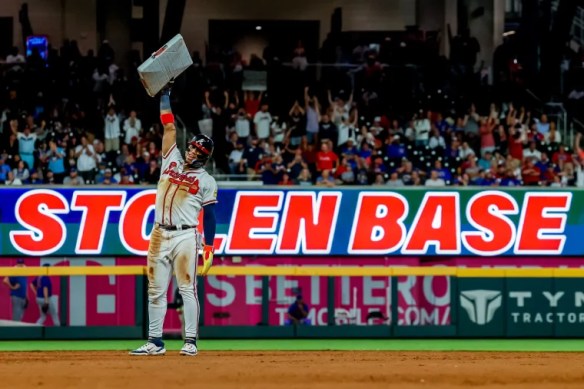
With Ozzie Albies at the plate for the Braves, after Acuña opened the bottom of the tenth with a base hit to send free inning-opening second base cookie Kevin Pillar home with the re-tying fifth Braves run. Acuña took off on Daniel Palencia’s first pitch and dove into second under catcher Yan Gomes’s throw.

Acuña raised his arms acknowledging the Truist Park crowd going berserk in celebration. Then, Acuña wrested the base out of the dirt and hoisted it above his head. Just the way Henderson did in his 1991 moment when he passed fellow Hall of Famer Lou Brock, stealing third as baseball’s all-time theft champion.

“That’s about as good as it gets,” said Braves manager Brian Snitker, ejected from the game in the second when he argued that the Cubs’ Jeimer Candelario fouled a pitch that was ruled a checked swing. (Television replays showed Snitker had the blown call right.) “I thought it was great when he picked up the bag. The fans had to love that. We all did because it was a special moment.”

Maybe the fact that Acuña opened the 40/70 club in the bottom of an extra inning, instead of midway through a game, as Ryan and Henderson had done previously, had an impact on the social media scolds wanting to spank the Braves’ center fielder for taking time to bask in smashing another precedent. (He’s already gone where no leadoff man has gone before, hitting 41 home runs in the number one lineup slot, eight of which were hit when he was the first batter of a game, and eighteen of which were hit when he opened an inning.)

But the Braves, already the NL East champions, had something significant to play for as well, the top seed in the coming postseason, giving them home field advantage through the entire National League Championship Series if they make it there. Once the theft celebration ended, Albies rapped the next pitch down the right field line to send Acuña home with the winning Braves run.

Had Acuña not stolen second in the first place, he wouldn’t have been likely to get past third since the ball was hit sharply enough and fielded swiftly enough.

“It’s crazy what he’s done,” said Albies post-game. “I told myself I need to come through right here. Whatever it takes. I’m happy I came through in that spot and we won that game.”

“It’s one of those numbers that wasn’t impossible but seemed impossible,” said Acuña, referencing that a player could hit forty bombs or steal seventy bases but good luck finding the one man who could do both. Until Wednesday night.

Maybe some of the scolds were Cub fans anxious that the game proceed apace, knowing the Cubs hung by the thinnest thread in the NL wild card race. It would be neither impossible nor incomprehensible. Cubs broadcasters Boog Sciambi and Jim Deshaies were unamused at both Acuña removing the base and the Truist Park scoreboard people showing a quick montage of Acuña’s run to the milestone. Which, in turn, incurred some social media heat sent Sciambi’s way.

Somehow, one couldn’t shake the thought that, if it was a Cub swiping a base in Wrigley Field to establish a new club, that Cub would have given in and done precisely as Acuña did to celebrate the milestone. And no Cub broadcaster would have dared to scold him for breaking the game flow, regardless of inning.

Baseball is indeed about rooting and caring. That includes individual milestones regardless of the hour, day, week, or month. From wherever he happened to be in the Elysian Fields, rest assured A. Bartlett Giamatti gave in and pumped his fist the moment Acuña arrived safe at second. Good for him. Good for baseball.

The phlinging, phlying, phlogging Phillies

Brandon Marsh

The Ides of Marsh—the Phillies’ center fielder launching the three-run homer that launched the Phillies toward burying the Braves and going to the NLCS Saturday afternoon.

“You’ve got to beat the champs to be the champs,” said Bryce Harper just minutes after the game ended. The Phillies aren’t exactly the champs just yet. But the way they dispatched the Braves once their National League division series shifted to Citizens Banks Park, it won’t be simple to bet against them now.

These are not the uncohesive, porous Phillies who were down 22-29 and threw out the first manager as June got underway. Since executing Joe Girardi and installing his bench coach Rob Thomson on the bridge, the Phillies were the third-winningest team in the National League, behind the Braves they just vanquished and the Mets who became 101 game-winning also-rans last weekend.

They ground their way to the postseason despite a key element or two missing significant injury time, a just-enough pitching reshuffle, and prognosticators who assumed the almighty Braves—who had to grind their own way back to snatch the National League East in the first place—would do to them what they just finished doing.

They flattened the Braves 8-3 Saturday afternoon. It’s rather amazing what a team who’d spent seventeen straight days for fourteen straight games on the road can do once they get to come home at last. By the time Phillies relief ace Seranthony Domínguez blew Travis d’Arnaud away with a wind-generating swinging strikeout to end the game, they’d outscored the Braves 17-4 in division series Games Three and Four.

The defending world champions who were second in the league in runs scored on the regular season couldn’t rent, buy, embezzle, or forge runs once they left their own playpen in this set. Their starting pitching, usually considered one of their deepest contingencies this year, had only Kyle Wright’s magnificent Game Two performance to show for it.

Once they got to playing Saturday afternoon, almost everything a Brave threw was found by a Phillie bat when it hurt the most, sometimes for measured-doses mischief and sometimes for long-distance landings. And, unless the Braves were hitting solo home runs, whatever they hit when not striking out to the tune of fifteen batters found a Phillie  glove.

This wasn’t exactly what the Braves planned to happen once they managed to overthrow the Mets and steal a division over half the world thought the Mets had in the safe deposit box.

“[T]he goal when we leave spring training is to win the division,” said manager Brian Snitker. “Until you win the division, you don’t have a chance to do anything special because you never know what’s going to happen, you don’t know what team’s going to get hot, what things have to go right for you to go deep into the postseason.”

The new postseason format may be the competition-diluting or compromising mishmash it happens to be, but one of the key reasons is that someone who doesn’t win the division—say, 25 or 6 someones in red or blue-on-red hats with big script Ps on the crowns—can do more than a few special things after they slip in through the second wild card door.

“They’re hitting on all cylinders at the right time,” said Snitker. “It’s a good club. They’ve got really good players, and they’re getting it going at the right time.”

Where to begin delineating the Braves’ engine seizure?

Maybe with poor Charlie Morton, who entered the game with a sub-one ERA in postseason elimination games but exited early with an elbow injury. But not before he was informed rudely that squirming out of one self-inflicted inning-opening jam is a reprieve, but squirming out of a second to follow immediately is not Phillies policy.

Bottom of the first—The wizened old righthander allowed the first two Phillies to reach base, Kyle Schwarber on an unintentional walk and Game Three hero Rhys Hoskins on a base hit, and escaped with his life and no score. Bottom of the second—Alec Bohm’s leadoff liner bounded off Morton’s forearm, then Morton struck Bryson Stott out before Jean Segura shot one past a diving Dansby Swanson at shortstop. First and third again.

No escape this time. Brandon Marsh, the Phillies center fielder whose long enough beard qualifies him well enough to audition for ZZ Top, saw a 2-2 curve ball arrive at the perfect level to send into the right field seats. One day after Hoskins hit a bat-spiking three-run homer to start the Phillie phun, Marsh equaled him for early drama if not for a celebratory gesture.

In the interim, Phillies starter Noah Syndergaard, last seen in postseason action throwing seven shutout innings at the Giants, in the 2016 NL wild card game the Mets ended up losing, didn’t let Orlando Arcia’s solo homer spoil his night. He sliced and diced the Braves  otherwise with a very un-Thor like array of breakers and three innings of shutout, three-strikeout ball.

As if to reward the remade/remodeled Syndergaard, who became a Phillie near the regular season trade deadline after a first half as a struggling free-agent Angel, his catcher J.T. Realmuto let Morton’s relief Collin McHugh—entering after Braves manager Brian Snitker saw Morton just uncomfortable enough warming back up to hook him—feel it where it really hurt.

Realmuto had a little help, admittedly, from Ronald Acuña, Jr. who either didn’t look in that big a hurry or misread the play. Acuña moved almost no muscle when Realmuto’s deep fly eluded Braves center fielder Michael Harris II, taking a carom off the lower portion of the State Farm sign on the center field fence and rolling almost halfway to the right field track.

It let Realmuto—maybe the fastest-running catcher in a game not known for swift-afoot backstops—run himself into an inside-the-park homer and a 4-1 Phillies lead. He also ran himself into becoming the eighteenth player and first catcher to deliver an inside-the-parker in postseason play.

He couldn’t contain himself when he dove home and sprang up whooping it up. “I’m not usually a guy that shows a lot of emotion,” he told reporters postgame. “When I slid into home, I couldn’t help myself. I was so excited. Excited for this city. Excited for this team. It was one of those moments I’ll definitely remember forever.” Him and everyone else including the concessionaires in the Bank.

Matt Olson made a small stand for the Braves in the top of the next inning, when he jerked the first pitch he saw from Phillies reliever Andrew Bellatti over the right field fence with one out, but Bellatti shook it off as if it were just a mildly annoying mosquito, striking both d’Arnaud and Austin Riley out swinging with remarkable aplomb.

The bullpens kept things quiet enough on the field, if not among the Bank crowd itching to see the Phillies take it the distance to the National League Championship Series, until the bottom of the sixth. With A.J Minter—whose fifth inning work was as lights-out as he’d been most of last year’s run to the Braves’ World Series title—taking on a second inning’s work. Uh-oh.

Segura rapped a single to center with one out and stole second almost too handily with Marsh at the plate. Minter caught Marsh looking at a third strike, but then his 2-2 changeup caught the Schwarbinator on the fingers around the bat and, after a review challenge, took his base.

Exit Minter, enter Raisel Igelsias. And enter the Phillies showing they could peck away at you with just as much ease and pleasure as they could detonate the nukes against you.

Hoskins fought one off to dump it into shallow right that fell for a base hit. When Acuña lost track of the ball after it bounded off his glove, Segura came home with the fifth Philadelphia run. Realmuto then bounced one slowly up the third base line, slow enough that Riley playing it in front of the base dirt on the grass couldn’t get a throw to first in time,   while Schwarber scored run number six and Hoskins held at second.

Then Bryce Harper—carrying a 1.674 series OPS to the plate with him—broke his bat while sneaking a base hit the other way left to send Hoskins home. Castellanos walked to load them up for Bohm but for the second time in the game the Phillies stranded the ducks on the pond. Not that it mattered. A 7-2 lead after a three-run pick-and-peck sixth was nothing to complain about.

D’Arnaud opened the Atlanta seventh with a first-pitch drive over the center field fence off Phillies reliever José Alvarado, starting a second inning’s work after a 32-minute rest during that bottom of the sixth. He then got two ground outs before yielding to Zack Eflin for the inning-ending swinging strikeout of William Contreras.

Eflin worked a one-two-three top of the eighth. Harper soon faced Kenley Jansen in an unusual-looking, from-far-enough-behind appearance, and had a that’s-what-you-think answer to d’Arnaud’s blast. He sliced Jansen’s fadeaway cutter the other way into the left field seats. Then it was time for Sir Anthony to ride in, dispatch the Braves by striking out the side, and let Philadelphia know the Phillies reached the next plateau.

“This is step two in what we’ve been through,” said Harper, whose regular season absence with a shoulder issue limiting him to the designated hitter role and then a thumb fracture could have deflated the Phillies but didn’t. “Step one being the wild card. This being step two and we’ve got two more (steps).”

Step three: either the Padres or the Dodgers in the NLCS. Step four: You have to ask? Taking things one step at a time works big for these Phillies hanging with the big boys. So far.

Good luck trying to “replace” Acuna

Ronald Acuna, Jr.

Three Braves trainers help Ronald Acuna, Jr. onto a medical cart, after Acuna landed awkwardly and tore his ACL trying to catch Jazz Chisholm’s high liner Saturday.

It can happen any time, any place. There’s no particular rule about when a simple running down of a drive to the back of right field will turn into a completely-torn anterior cruciate ligament that takes you out for the rest of a major league season.

It happened to Ronald Acuna, Jr. in Miami’s Ioan Depot Park Saturday. All he did in the bottom of the fifth was draw a bead on and run down Marlins second baseman Jazz Chisholm’s one-out, high liner toward the back of right field, take a leap trying to catch it before it hit the track near the wall, and land on his right knee hard and awkwardly enough to tear that ACL.

Acuna hit the track and the wall after the ball that eluded him by inches ricocheted back to the outfield grass as Chisholm finished running out an inside-the-park home run. Chisholm was anything but thrilled about getting it that way.

“For it to come at that expense, it kind of sucks for me and him, because the way that I got my home run is because he got hurt,” Chisholm told reporters following the 5-4 Braves win—and that was before he knew just how badly Acuna was injured on the play. “The baseball world is going to miss him if he’s out for long.”

The baseball world in general, and the Braves in particular. So sit down and shut up, you social media miscreants who think the same as one poster who said, ignorantly, “Sorry don’t feel sorry for any injury everyone gets them, next man, up.

If you think it’s that simple, let’s see you try to replace an effervescent clubhouse presence, and a guy who actually has as much fun playing the game as the Braves are going to sweat trying to replace a .900 OPS at the plate and twelve defensive runs saved above the National League average for right fielders this year so far.

Three Braves trainers tended Acuna on the track. He tried to get up and walk but could barely limp before the pain became too much. The trainers plus first base coach Eric Young, Sr. helped Acuna aboard the medical cart that drove out to him. Teammates talked to him like a fallen brother.

“It was more just trying to let him know that we love him and that we care about him, and we’re obviously with him throughout it all,” said shortstop Dansby Swanson post-game. “He didn’t really have anything else to say other than thank you for those words.”

This wasn’t a case of a player getting himself badly hurt doing what he wasn’t supposed to be doing. This wasn’t a baseball player attacking the game with a football mentality or playing the outfield as though the fences either didn’t exist or were there purely to surrender when he came barreling through.

This was a right fielder, maybe the best in the game this season, running down and leaping for a high liner he thought he had a chance to catch, landing with unexpected awkwardness followed at once by disaster.

This is also the game’s most dynamic leadoff hitter now gone for the year. Not to mention one of the classic current examples of reminding the Old Fart Contingent how foolish they look demanding players play the game like a business but remember it’s only a game when it comes down to its business.

“In his case,” writes The Athletic‘s David O’Brien, “there is even more substance than style, which is saying a lot considering he has style and swagger coming from his pores every moment he’s on the field . . . Though Freddie Freeman has been the undisputed captain of the Braves and the face of the franchise since Chipper Jones’ retirement, Acuna rivals him not just in terms of popularity among Braves fans but also in all-around performance and standing in the baseball world.”

Before Saturday night the only issue for Acuna seemed to be the Marlins having a particular penchant for hitting him with pitches. Acuna may like to take a couple of liberties with his batter’s box positioning, but the Marlins who’ve hit him with pitches twice this year and six lifetime—the most by any opponent in his career—have looked like headhunters when facing him.

It couldn’t possibly be that Acuna has more total bases against the Marlins (147) than any other team he’s played against in 50+ games, could it? It couldn’t possibly be that Acuna has a lifetime .736 real batting average (RBA: total bases + walks + intentional walks + sacrifice flies + hit by pitches, divided by total plate appearances) against the Marlins versus his .617 career mark to date, could it?

“This is actually the fourth time Acuna has had to make an early exit from a game this season due to an injury,” writes MLB Trade Rumors‘s Mark Polishuk, “but while those previous instances resulted in just a couple of missed games, [Saturday’s] injury appears to be much more serious in scope.”

That was just before how much more serious in scope came to pass. With a recovery time up to ten months, the Braves may well begin the 2022 season without Acuna for a spell, too.

“The only thing I can say,” Acuna himself said on a Sunday Zoom call, “is that I’m obviously going to put maximum effort to come back stronger than ever. If was giving 500 percent before, I’m about to start giving 1,000 percent.” The spirit is certainly willing. Unfortunately, the body may have other things to say about that. May.

“Acuna will be missed throughout baseball and especially by the Braves and their fans,” O’Brien writes. “Those fans scooped up Acuna jerseys and stood in line for Acuna bobbleheads and celebrated his every home run and bat flip, every stolen base and blazing dash from first to third—or home—and every cannon-armed throw to cut down a runner trying to take an extra base.”

Good luck trying to “replace” all that.