Kerkering Agonistes

Orion Kerkering

Kerkering’s mistake throw home sailing wide left of Phillies catcher J.T. Realmuto as Hyeseong Kim hits the plate with the Dodgers’ NLCS ticket punch. (ESPN broadcast capture.)

In Greek mythology, Orion is the mighty hunter who was felled by either the bow of the goddess of the hunt Artemis or by the sting of a giant scorpion. In National League division series Game Five, Orion was Kerkering, the Phillies relief pitcher stung in the bottom of the eleventh by the gravest mistake of any 21st century Phillie, ever.

If Kerkering wanted immediately to scream for help, you wouldn’t have blamed him. If the next place he really wanted to be was a Himalayan cave at altitude high enough to stop anyone from finding him, you wouldn’t have blamed him for that, either.

Baseball players and other professional athletes are human enough to make grave mistakes on the field. Many of them play for teams whose fans run the gamut from entitled to fatalistic to . . .

Well, put it this way. Again. Those playing in Phillies uniforms represent a city about which it’s said, often enough, that a typical wedding finishes with the clergyman pronouncing the happy couple husband and wife before telling the gathering, “You may now boo the bride.”

So let’s say a prayer, or three, or ten, for Kerkering. Let’s pray that, no matter how the rest of his baseball career goes, he has the heart and soul to stand up, count himself a man, acknowledge that he blew it bigtime enough, and stare the infamous Philadelphia boo birds down without giving in to the temptation to hunt them down for Thanksgiving dinner.

With the bases loaded and two outs Thursday evening, Kerkering served Dodgers center fielder Andy Pages a sinker that didn’t fall from the middle of the strike zone. Pages whacked a two-hop tapper back to the box. Kerkering sprang forward and knocked the ball down, then reached to retrieve it with his bare hand.

Phillies catcher J.T. Realmuto stood fully erect and pointed to first base, with Pages about halfway up the line and Dodgers pinch runner Hyeseong Kim hurtling down the third base line. In a single instant, Kerkering went for what he thought would be the quickest out, as opposed to what every soul in Dodger Stadium expected to be the sure, guaranteed-not-to-tarnish, twelfth-inning-securing out.

He threw home, where he had no shot at bagging Kim, instead of to first baseman Bryce Harper, where he still had a clean shot at bagging Pages. The throw went wide left of Realmuto at the moment Kim hit the plate with the Dodgers’ National League Championship Series ticket punched by his spikes.

Thus ended a game during which neither the Phillies nor the Dodgers flashed anything resembling their usually powerful offenses, while both teams fought a magnificent pitching duel. Whether the 2-1 final was the Phillies losing or the Dodgers winning, take your pick.

Kerkering didn’t duck, either, once he arose from his haunches in front of the mound while the Dodgers celebrated and then let a teammate urge him out of the dugout into the clubhouse for comfort. Then, facing reporters, Kerkering owned up without hesitation.

“I wouldn’t say the pressure got to me. I just thought it was a faster throw to J.T., a little quicker throw than trying to cross-body it to Bryce,” he said. “It was just a horse [manure]  throw . . . This really [fornicating] sucks right now.”

Until Kerkering’s mishap, the Dodgers’ sole score was a bases-loades walk Mookie Betts wrung out of Phillies reliever Jhoan Duran in the bottom of the seventh. And the Phillies’s sole score came in the top of that inning, when Nick Castellanos sent Realmuto home with a double down the left field line.

Other than that, neither side had any real solutions to the other guys’ effective starting pitchers, Tyler Glasnow for the Dodgers and Cristopher Sanchez for the Phillies. These lineups, full of MVPs and big boppers and rippers and slashers, never landed the big bop or rip or slash.

Until Pages swung at Kerkering’s second service of the plate appearance, the story of the game figured far more to be the Dodgers’s Roki Sasaki, the starter who ran into shoulder trouble early in the season, returned to finish the season as a reliever, and now found himself the jewel of a Dodger bullpen about which “suspect” was the most polite adjective deployed.

Sasaki merely spent the set appearing in three games, allowing not one Phillie run, and keeping his defense gainfully employed. The record says he pitched 4.1 innings in the series. He pitched three of them Thursday, the eighth, ninth, and tenth. Whatever he threw at them, not one Phillie reached base. Two struck out; four flied, lined, or popped out; three grounded out. If the Dodgers could have won it in the tenth, Sasaki had a case as a division series MVP candidate.

The Phillies’s usual closer, Jhoan Duran, found himself deployed earlier than usual, relieving Sanchez in the seventh. After Betts’s RBI walk, Duran settled, ended the seventh, and pitched a shutout eighth. Matt Strahm succeeded him for a shutout ninth, and Jesús Luzardo—who was supposed to have been the Phillie starter if the set got to a fifth game—worked a shutout tenth.

Alex Vesia took over for the Dodgers in the top of the eleventh. He walked Harper, then wild-pitched him to second with two outs. Then he fought Harrison Bader—usually the Phillies center fielder but reduced to pinch hitting thanks to a bothersome groin injury—to a full count and a tenth pitch before he pulled Bader into a swinging strikeout.

Luzardo went back out for the eleventh. The tone of the game still suggested it wasn’t going to end too soon. Then Tommy Edman rapped a one-out single down the left field line, with Dodger manager Dave Roberts sending Kim out to run for him. Will Smith lined out deep enough to center field, but Max Muncy grounded a base hit past the left side of second base, pushing Kim to third.

Phillies manager Rob Thomson lifted Luzardo in favour of Kirkering, the 24-year-old righthander who’d become one of their more important bullpen bulls as the postseason arrived. He’d gone from untrusted to unimportant to invaluable in one year.

Now the Phillies needed him to push this game to a twelfth inning in which both teams were all but guaranteed to throw what little they had left at each other until one of them cracked. First, he had to tangle with Enrique Hernández. While Muncy helped himself to second on fielding indifference, Hernández worked out a six-pitch walk.

Up stepped Pages. Into the night went the Phillie season.

J.T. Realmuto, Orion Kerkering

Realmuto was just one Phillies teammate trying to make sure Kerkering could shake it off and not do as Kyle Schwarber advised, let one bad moment define his career and life. (ESPN broadcast capture.)

Kerkering sank in front of the mound as the Dodgers poured out to celebrate around and behind. Nothing mattered to him or to the Phillies now. Not even the unlikely fact that the Phillies had kept Shohei Ohtani, the Dodgers’ best hitter and the best hitter in the game who isn’t named Aaron Judge this year, toothless, fangless, and clawless throughout the set, 1-for-18 with a single RBI hit and nine strikeouts.

The Dodgers weren’t sure what to think, either. “That,” Vesia said postgame, “was a badass baseball game.” Through ten and a half innings, yes. What to call the bottom of the eleventh would probably take time. Even “disaster” seemed like a disguise.

But Thomson and the rest of his players had no intention of throwing Kerkering under the proverbial bus. Realmuto made sure to be the first to embrace and try to comfort him. Castellanos, who’s endured his own share of trials and tribulations, sprinted in to get to Kerkering with brotherly comforts.

“I understand what he’s feeling,” said the Phillies right fielder. “I mean, not the exact emotions. But I can see that. I didn’t even have to think twice about it. That’s where I needed to run to.”

The same mind set overtook Schwarber, who’d done more than enough to push the Phillies toward Game Four after losing the first two in Philadelphia, especially his space launch of a home run in the fourth to tie the game and start the Phillies toward the 8-2 win. (He helped the piling-on with a second bomb, too.) “One play shouldn’t define somebody’s career,” said the Schwarbinator in the clubhouse. “I’ve had tons of failures in my life.”

Just how that team will be defined going forward is up in the air for now. Realmuto, Schwarber, and pitcher Ranger Suárez can become free agents come November. But the Phillies are expected to push to entice Schwarber to re-up, and Realmuto is still too valuable behind the plate for the team to let walk without trying to keep him, too, especially since the organisation is considered very lacking in catching depth.

“I’m thinking about losing a baseball game. That’s what it feels like right now,” said Realmuto after Game Four. “The last thing I’m thinking about is next year.”

Schwarber, too, preferred to stay in most of the moment. “This is a premier organization,” said the designated hitter who sent 56 home runs into orbit during the regular season.  “And a lot of people should feel very lucky that you’re playing for a team that is trying to win every single year, and you have a fan base that cares and ownership that cares and coaches that care. You have everyone in the room that cares. We’re all about winning, and it’s a great thing. That’s why it hurts as much as any other year.”

These Phillies lost the 2022 World Series in six games, the 2023 NLCS in seven, a division series last year in four, and a division series this year in four. What’s up in the air right now just might turn to finding where and making changes enough. Especially since the average age of their regulars this year was 31. (The two youngest regulars, Brandon Marsh and Bryson Stott, are 27.)

Right now, they’re entitled to lie down and bleed. None more so than one young reliever who may not find comfort in knowing that he wasn’t the sole reason the Phillies fell short yet again. He may not find comfort yet in knowing that his teammates outscored the Dodgers by two runs across the entire division series but still couldn’t cash more than one scoring chance in in Game Four to make a difference.

“I feel for him,” Thomson told the postgame press conference about Kerkering, “because he’s putting it all on his shoulders. But we win as a team and we lose as a team.”

His sole comfort for now might be his teammates having his back. “Just keep your head up,” he said was their collective message to him. “It’s an honest mistake. It’s baseball. S— happens. Just keep your head up, you’ll be good for a long time to come. Stuff like it’s not my fault—had opportunities to score. Just keep your head up.”

The question is whether the more notorious side of Philadelphia fandom will try to knock his head off while he tries keeping it up. Maybe—as happened so notoriously to Mitch (Wild Thing) Williams after he surrendered a 1993 World Series-losing home run to Joe Carter—Kerkering’s refusal to hide and willingness to own up should help.

Or not, unfortunately. Even if Kerkering didn’t throw a World Series-losing pitch but committed only a division series-losing error.

If not, it’ll come to whether the worst sides of Philadelphia fandom compel the Phillies  brain trusts to decide, however good his pitching future might be, that it’s not safe for him to see it in a Phillies uniform.

Maybe someone should find ways to ask those sides pre-emptively whether they would have had half the fortitude to own up to a grave on-the-job mistake made in front of 50,000+ fans in a ballpark, and a few million more watching on television, or streaming online, or listening to the radio.

As with too many others who hammered those I call Merkle’s Children—Fred Merkle himself, plus Williams, Ralph Branca, Bill Buckner, John McNamara, Donnie Moore, Don Denkinger, Tom Niedenfeuer, Gene Mauch, Johnny Pesky, Mickey Owen, Ernie Lombardi, Fred Snodgrass, maybe every St. Louis Brown ever—you might be lucky to find a very few who’d answer, “Yes.”

We’re in for one hell of a World Series ride

J.T. Realmuto

Realmuto’s leadoff launch in the top of the tenth held up for the Phillies to win opening this World Series. But he almost didn’t make it that far . . .

Listen up, you sore-losing Met, Dodger, and Yankee fans. At least, those among you who think that there’s nothing more worth watching until hot stove season since your heroes (anti-heroes?) got pushed, shoved, and slugged out of the postseason.

Yours aren’t the only heroes (anti-heroes?) who got turned aside. So you can just boil yourselves alive in your harrumphing that the World Series means nothing to you. Because if Game One was any indication, the rest of us—including this Met fan since the day they were born—are in for one hell of a Series ride.

For those of us who put aside our personal rooting disappointments and watched, we got to see a script flipped Friday night.

We went in knowing that assorted polls pretty much sketched the Phillies as America’s team this time around. We also went in knowing numerous oddsmakings sketched the Astros as liable to grind the brave little Philsies into hamburger, one way or the other.

But we came away from the Phillies’s 6-5 Game One upending knowing we’d seen a dogfight turned strategic bombing turned bullfight all in the space of ten must-see innings. And, with just a few little shruggings un-shrugged along the way.

Until Phillies catcher J.T. Realmuto hit an opposite-field home run leading off the top of the tenth, and Phillies reliever David Robertson shook off a one-out double and a two-out walk to make it stick, that is. And that’s when it might have hit, good and hard:

The ogres of the American League might have swept their way here in the first place, but they’re not exactly impenetrable or invincible. Last year’s Braves sure proved it, but some things need proving all over again. Come Friday night, the Phillies finally proved it. But it did take a little early survival to do so.

Astros right fielder Kyle Tucker got to within about a foot above several fans of pulling Realmuto’s drive back for what would have been a jaw-dropping out. He leaped, reached back, extended, everything short of a net springing from his gloves’ fingertips, but the ball eluded his reach by about a full visible foot.

“Honestly, I thought I got enough of it, but I kind of had flashbacks of the play that Tucker made on (Aaron) Judge’s ball [in the American League Championship Series],” Realmuto said postgame. “And once I saw him running back to the wall, I was thinking in my head, oh, please just don’t catch it, just don’t catch it. I knew it was going to be close.”

Nobody going in expected Game One itself to be that close.

I mean, admit it. Didn’t we think it was all but game over when Tucker took it upon himself to provide four-fifths of the Astros’ early scoring, staking future Hall of Famer Justin Verlander to a 5-0 lead after three innings?

Didn’t we think the Phillies might be a little demoralised after Aaron Nola—who’d pitched six and two-thirds perfect innings against the Astros to pull the Phillies towards their postseason berth clinch in the first place—got thumped by Tucker’s solo bomb halfway up the lower right field seats in the second and, when the game was still a manageable 2-0 Astro lead an inning later, his three-run blast a little further up those seatxs in the third?

Sure we did. We thought that, no matter how strong and deep would be the bullpen bulls for whom Phillies manager Rob Thomson would reach soon enough, the Astro machinery would either make that five-zip lead hold or pile another couple more on before the game was finally over.

We might even have thought Rhys Hoskins and Bryce Harper singling to set first and third up in the fourth, Nick Castellanos singling Harper home, then Alec Bohm lining a two-run double to left was just Verlander’s and the Astros’ way of toying with the Phillies, tossing them a couple of cookies before burying them alive.

Right?

We just didn’t quite bargain for Realmuto sending a two-run double of his own to the back of left center to tie it at five the very next inning. (For those to whom such things matter, in Minute Maid Park’s dimensions Realmuto’s double traveled 42 feet more than his tenth-inning bomb would.)

“No excuses,” Verlander said postgame. “I felt like I had some guys in good situations and just wasn’t able to quite make the pitches that I wanted to. A lot of credit to them as a lineup. They laid off some good pitches, and they were able to, when I did execute pitches, they were able to foul it off or put it in play and find a couple hits that way. Then when I did make a mistake, they hit it hard.”

“We knew they could hit when they came in here,” said Astros manager Dusty Baker. “They’re known for that. They just took it from us tonight.”

We didn’t quite bargain for five Phillies relief pitchers—including their scheduled Game Three starter Ranger Suarez—and four Astros relief pitchers keeping both sides scoreless, with a few hiccups along the way on both side.

We sure didn’t bargain for Castellanos, defying the Phillies’ season-long reputation as a defense-challenged team, running for his life in from deep right—where he’d positioned respecting Astros rookie Jeremy Peña’s power—to send the game to extras in the first place, taking it from Peña and the Astros with a past-textbook sliding, one-handed catch just short of the line.

“I felt like I read the swing pretty well,” Castellanos said postgame, “and as soon as I saw the direction of the ball I felt like I got a good jump on it. I just thought he had a better chance of trying to bloop something in there than torching something over my head. So that was kind of my thought process there, just thought of it on the fly.” Good thinking.

We didn’t quite bargain for Realmuto, either, squaring up Luis (Rock-a-Bye*) Garcia, usually a starter but pressed into relief duty this postseason—and a man Realmuto had never before faced in his life.

The count ran full. Then Garcia threw Realmuto a fastball reaching the outer edge of the strike zone. Realmuto reached, connected, and sent it on its way. Yet, for a few brief, shuddering moments four innings earlier, it was lucky for the Phillies he got that far in the first place.

Astros center fielder Chas McCormick foul-tipped a hard one straight back and straight into blasting Realmuto’s old school-style catcher’s mask right off his head. It also knocked the husky catcher backward and down. Those watching on the Fox Sports 1 telecast could hear plate umpire James Hoye say, “You all right? Stay there a minute.”

“Honestly, my head wasn’t the problem,” Realmuto said. “It just smoked my jaw pretty good. It’s probably not going to be very easy for me to eat dinner tonight, but as long as my head’s OK, I’ll be good to go.”

“I didn’t move,” said Phillies backup catcher Garrett Stubbs postgame. “That guy’s not coming out for anything.” He was right. He didn’t even move his pinkie as Thomson and Phillies trainer Paul Buchheit tended the temporarily fallen Realmuto.

These Phillies won’t come out for anything, either. Unless it’s for Game Two. And, maybe, another few steps toward their own October/November surprise. Listen up one more time, sore-losing Met/Dodger/Yankee fans. (Maybe even you, too, Padres fans.) You may end up missin’ a great Series.

————————————————————————-

* Just why is Luis Garcia’s rocking-the-baby motion while he does that little back-and-forth, samba-like step before delivering home just fine, while the Guardians’ Josh Naylor’s rocking-the-baby routine as he rounds the bases after hitting a home run is a capital crime

I don’t have an issue with either one, frankly. I’m still a big believer in letting the kids play and, if you want to see baseball played like Serious Business, find yourself a league where they play the game in three-piece suits.

But why isn’t Garcia accused of taunting the batters he faces with it while Naylor took heat for doing it to pitchers against whom he’s just gone the distance?

The Phlying Phillies

Bryce Harper

Bryce Harper launches his seventh-inning blast off the Miller Park scoreboard behind the center field fence Thursday. Would you have predicted a seven-game winning streak for the Phillies  including six straight since Joe Girardi’s execution?

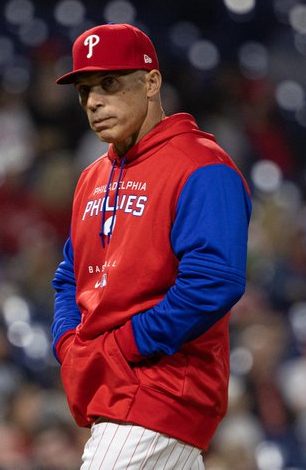
Don’t look now, but that’s a seven-game winning streak the Phillies have now posted, six of which—including Thursday’s 8-3 demolition of the Brewers in Milwaukee—have happened since Joe Girardi was thrown off the bridge in favour of his bench coach and longtime associate Rob Thomson.

From the moment they took down the Giants in what proved Girardi’s final game on the bridge, the Phillies’ thought-formidable offense went from sputtering to out-scoring the opposition 53-19. Living up at last to their preseason billing as a threshing machine at the plate, they posted an .877 team OPS entering Thursday’s game largely by way of hitting eighteen home runs during the streak.

They’ve also pitched above and beyond enough to make it matter. Entering Thursday, the Phillie streak showed a team 3.00 ERA and—better, yet, by far enough—a 2.38 team fielding-independent pitching (FIP) rate.

They even helped take another manager down while they were at it, sweeping the Angels last weekend and thus putting Joe Maddon into a guillotine that may have been built for him before the season began. Sweeping the National League Central-leading Brewers doesn’t measure their skipper Craig Counsell for beheading just yet. But still.

Before they beat the Giants last week the Phillies looked so lost, so unable to shake the late-inning deflations and bullpen arsons, that calling them by their ancient Phutile Phillies nickname seemed more than an exercise in phutility. Since beating those Giants, it looks as though it’s phun to be a Phillie again.

Even being out-hit by the Brewers 11-9 on Thursday, and opening by Brewers starter/defending Cy Young Award winner Corbin Burnes striking them out in order, the Phillies still found a way to turn a measly one-run lead after six full innings into a five-run margin of triumph.

It only began with Bryce Harper, whose UCL injury limits him to designated hitting, leading off the Philadelphia seventh with a parabolic home run banging off the scoreboard well behind the center field fence. Giving him three bombs in his past four games.

Then with outfielder Mickey Moniak aboard on a two-out walk in the top of the eighth, Kyle Schwarber hit a hanging 2-1 sinker 432 feet over the right center field fence. And in the top of the ninth, Harper set the table with a first-pitch base hit to right center and Odubel Herrera dined on a hovering changeup—after fouling off four straight—to prove practise makes perfect, sending it into the right field seats.

A first-inning blast from former Ray Willy Adames and a leadoff bomb in the sixth by Hunter Renfroe were the only damage the Brewers could do until former Phillie (and former longtime Pirate standout) Andrew McCutcheon singled Christian Yelich home with two outs, before Phillies reliever James Norwood got the game-ending ground out from Brewers third baseman Jace Peterson.

“Someone put the fear of God into them,” says a lady of my acquaintance regarding the suddenly Phlying Phillies. Considering Girardi’s reputation as a by-the-book, nuclear-intense martinet, perhaps it was more as though someone removed the fear of God from them. Most of it, anyway.

When they finished sweeping the Angels this past Sunday, the big blows were Harper’s grand slam and rookie third baseman Bryson Stott, Stott walking it off with a three-run blast against the Angels’ own wavering bullpen arsonists. Harper was almost beside himself over Stott’s blast.

“I’m so happy for the kid, man,” the defending National League Most Valuable Player crowed after that 9-7 win.

What an at-bat. What a situation for him. Being able to put our trust in our young guys the last couple days, and really let them just play . . . it’s been great. And it paid off today. The thing about Bryson is he’s got to play. He’s used to playing every day. From high school, to college, to minor league baseball, to now. He’s used to playing every day, and that’s what we’ve got to do for our young guys . . .

Our young guys have got to play. When you want your young guys to have success, they have to play everyday. And when they have those opportunities, I think they’re going to take full advantage of that. If that’s Bryson, if that’s [Nick] Maton, if that’s [Alec] Bohm-er or anybody else . . .

From Girardi’s difficulty in trusting his youth to Thomson’s apparent fearlessness in trusting the young guys to just play. There were those taking Harper’s commentary as a veiled shot at Girardi, and you can understand why to a small extent. On the other hand . . .

“We needed to get going,” Harper said after the Phillies finished sweeping the Brewers. “Everybody knew that. It’s just a different vibe. I think we’re just playing good ball right now.”

Maybe a change of managers doesn’t always ramp up into immediate winning streaks. But remember the 2009 Rockies pinking Clint Hurdle and installing former Dodger manager Jim Tracy on the bridge. Tracy took the gig with the Rockies when they were 18-28. They started 2-4 under him but then hit an eleven-game winning streak that turned into fourteen of fifteen and launched them toward the National League wild-card game.

Ironically enough, Hurdle took the Rockies bridge after Buddy Bell was executed in 2002 . . . and they won six straight to begin the Hurdle era. And, 107 years ago, Pat Moran took the Phillies bridge to open the season, went 8-0 out of the chute, and ended up in the World Series, where they lost to the Red Sox who featured a kid pitcher named Babe Ruth.

On the other hand, there were 81 mid-season manager switches from 1987-2010, eighty of which came courtesy of executions. Only nineteen of those teams changing skippers mid-season finished those seasons with .500 or better records for the year, and out of those nineteen only five—Tracy’s Rockies, the 2004 Astros, the 2003 Marlins, the 1989 Blue Jays, and the 1988 Red Sox—reached the postseason, with one (the ’03 Fish) going all the way to win the World Series.

Nobody wants to spoil the Phillies’ party now. But the precedents don’t favour them entirely, either. Savour it while you have it, Phillieppine Island. For however long it proves to last. And if the currently Phlying Phillies manage to make the postseason at all, count your blessings and your miracles. They don’t happen as often as we’d like.

The Phillies throw out the first manager

Joe Girardi

Girardi’s Philadelphia nightmare ends with his execution Friday morning.

Stop me if you’ve heard this one before: A front office builds a team with money no object and no other cohesive object in mind. They front-load the team with sluggers, leaving little room for defensive fortification, overtaxing a fine starting rotation, and discover they can’t out-slug the wasted defensive outs or the bullpen’s arson.

All of which leaves their third-year manager half lost for finding ways to prevent late-inning collapses, early-inning slaughters, and solving the riddle of how he could have been handed what amounts to a desperation roster built with no forward thinking and not even a nod toward replenishing the farm or delivering mid-season fortification.

Then, seeing that uncohesive, porous mess deliver a 22-29 season-opening record, they reach into their heart of hearts, pray hard, and decide it’s time answer all the last fortnight’s speculation and throw out the first manager of the season.

Ladies and gentlemen, your 2022 Phillies. Sitting twelve games behind the division-leading Mets in the National League East. Unlikely to improve even to a shot at one of the NL’s wild cards unless their fielders patch up the holes in their gloves and their defensive routes and their bullpen discovers more than just bull.

For openers. It’s not that Joe Girardi is any sort of managerial genius. He’s been a fairly overrated manager in his entire skippering career. But this one’s on that front office, led by Dave Dombrowski, an executive with a too-well-known tendency to sacrifice a future for a today that doesn’t always strike platinum. Not to mention the classic mealymouthed style of explaining why Girardi should have become the sacrificial lamb.

It has been a frustrating season for us up until this point, as we feel that our club has not played up to its capabilities. While all of us share the responsibility for the shortcomings, I felt that a change was needed and that a new voice in the clubhouse would give us the best chance to turn things around. I believe we have a talented group that can get back on track, and I am confident that [interim manager] Rob [Thomson], with his experience and familiarity with our club, is the right man to lead us going forward.

Translation: We still thought this team could slug more than enough to out-fly fielders who might as well be scrubwomen wearing oven mitts and save the asses of relief pitchers who forget to check the gasoline cans at the gates. And if you think we’re going to execute the people responsible for building that mess in the first place, you don’t know us vewwy well, do you?

Except that four of the Phillies’s sluggers (Nick Castellanos, Rhys Hoskins, J.T. Realmuto, and Kyle Schwarber) haven’t been slugging quite to the extent they were expected to slug, even if three of them dialed long distance during that ten-inning fall to the Giants last Monday.

The slugger who’s been hitting like the defending MVP he is and who just so happens to be their best defender, Bryce Harper, has a torn UCL in his throwing elbow that’s limited him to a DH role for long enough now. He’s been around the league average in right field when he played before the injury; he’s posting a .943 OPS/.166 OPS+ so far that are not too far under the numbers (1.044/181) with which he led the entire Show last year.

The Phillies have achieved the surrealistic feat of outscoring their opposition yet awakening this morning seven games below .500. The big reasons, as ESPN’s Bradford Doolittle reminds us, are a 4-10 record in one-run games and a fourth-highest-in-Show fourteen losses in games during which they held a lead at one or another point.

“Measures such as these are never wholly on the manager,” Doolittle writes, “but they are certainly not data points in his favor. The best embodiment of Girardi’s struggles is probably an early-May loss to the Mets in which Philadelphia blew a 7-1 lead it carried into the ninth inning. It sure seems the heat under his seat kept rising after that game.”

The Phillies also continued leaning upon Corey Knebel to close out games—but why? He spent May picking up four nebulous saves and earning very nebulous credit for one win during which he surrendered the game-tying run in the top of the ninth and was bailed out in the bottom by a two-run infield error.

Meanwhile, Seranthony Domínguez has been an assassin out of the pen through today: he has a 1.83 ERA and a 1.92 fielding-independent pitching rate in 19.2 innings’ work thus far. Knebel: 3.27 ERA/4.01 FIP. You tell me who should be getting the work when the games are squarely on the line—and screw the “save situations,” the real moments when a game needs saving aren’t limited to the ninth inning.

So maybe continuing to assign “roles” to his dubious-enough pen instead of training his eyes upon the best of the group falls on Girardi. He’s hardly the only manager who might still believe in “roles” instead of what the game moment and the records as they are tell him. Maybe his long-time associate Thomson will pay closer attention and move accordingly, even with the continuing dubious straitjacket of the three-batter minimum for relievers.

But everyone with eyes to see looked upon the stockpile of designated hitter-types Dombrowski and company assembled when the lockout ended and that hurry-up spring training began and said, with no sarcasm intended, just what Jayson Stark asked aloud in The Athletic: “Can a team as defensively challenged as the Phillies win anything?”

In one way Dombrowski did work with a hand tied behind his back. Last winter’s free agency market—rudely interrupted by the ridiculous owners’ lockout—offered him little enough chance to fix a dead-last defense (the 2021 Phillies were the Show’s worst for defensive runs saved) at all, never mind in one grand sweep. But there remains the sense that he didn’t have to go all the way the wrong way.

Fair play: There have been teams who could and did hit their way to even the World Series despite having defenses helpless even against a division of babies in carriages. Just ask the 2015 Mets, whose porous defense enabled them to lose a World Series in five games despite taking leads into the ninth inning in three of their four losses.

Maybe these Phillies have done their notoriously negative-think fan base a big favour. (Remember the Philadelphia wedding. Clergyman to the happy couple: I now pronounce you husband and wife. Clergyman to the gathering: You may now boo the bride.) Not by firing Girardi but by collapsing early and often under the weight of their slug-now/defend later construction. They’re not likely to make the postseason even as an outside entrant in the expanded wild card picture. They won’t be able to break the hearts the 2015 Mets broke.

But Girardi isn’t exactly innocent. Another Athletic writer, Britt Ghiroli, isolates the point. Again, stop me if you’ve heard this before, as in when his days managing the Yankees came to a halt, but make note of where Ghiroli places the core responsibility:

Two things seem to have sunk Girardi: recent bullpen-management moves that came under fire and players telling The Philadelphia Inquirer that it didn’t look like they were having any fun on the field. (They aren’t very fun to watch on the couch, either.) Girardi is known as a no-nonsense guy, and although clubhouse culture can be overrated, once players start mentioning it, it almost always spells doom for the manager. This is still a mess Dombrowski created, a defense far worse than anyone envisioned and a bullpen problem that just never seems to go away. Firing Girardi doesn’t make the Phillies a playoff team, or even a competitive unit. But it does quell the masses, at least temporarily.

The only thing missing now is Dombrowski saying, “I didn’t fire Joe. The players did.” The questions now include just how long before the Phillies’s administration gets what previous team regimes finally got and sends Dombrowski on his not-so-merry way, too, in favour of a builder whose materials aren’t limited to collapsible shelves.