Quit the nonsense, Commissioner

2020-08-02 RobManfred

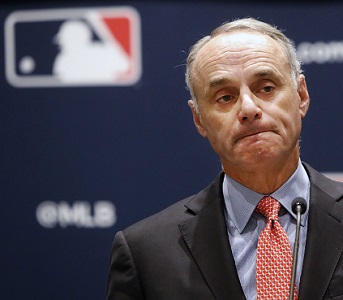
Rob Manfred, who doesn’t seem to grok the distinction between quitting and a strategic retreat.

The incumbent World Series most valuable player, who will hold that distinction until the next World Series is played, dealt with a nerve problem in his pitching hand, costing him one start but amplifying his sense of perspective. The long view matters as much to Stephen Strasburg as do such small details as whether to bust a fastball or a slider in on a hitter.

“To be frank,” the Washington Nationals righthander told reporters after his scratch against the New York Yankees, “this season is kind of a mess to begin with, so I got to think big picture here. It’s my career. I know that in the long run it’s important to try to make as many starts as you can, and by putting yourself in a compromising position now, I don’t really know if it’s the best way moving forward.”

A hand nerve issue in a normal regular season doesn’t cost a pitcher or his team as much as the issue does in a truncated, sixty-game season. Strasburg, however, isn’t an ordinary pitcher. He’s not just the defending World Series MVP, but he got to the career point where it became possible thanks to that “Strasburg Plan” that shut him down well before 2012 ended, in his first full season back from Tommy John surgery.

With the Nats headed for that postseason it seemed most of the world demanded they man up, compel Strasburg to do likewise, because who knew when they’d get another shot, right? Strasburg and his team decided a) they weren’t going to die if they didn’t go to the Promised Land then, and b) they’d get there sooner or later and they’d kinda sorta like Strasburg along for the ride.

Now it may turn out to be that Strasburg missing a little more 2020 time because of that nerve issue is the least controversial portion of this Twilight Zone of a season. Submitted for your further consideration, in case you began considering before I sat down to write:

Since last weekend, twenty-one Miami Marlins and four St. Louis Cardinals have tested COVID-19 positive, while a few Philadelphia Phillies may or may not have returned false positives. The real positives stranded the Marlins in Philadelphia after last weekend’s series, until a bus delivered the Fish to their Miami home waters at last.

They also provoked fifteen to seventeen scheduled games canceled, including this weekend’s set between the Cardinals and the Milwaukee Brewers. The latter’s outfielder Lorenzo Cain joined the list of the opting-out during the week while we were at it. So did Marlins second baseman Isan Diaz on Friday. Diaz wasn’t a COVID-19 positive Marlin but seeing so many told him some things really do come before baseball, after all.

“This has been a decision that I have discussed with my family, and I feel it’s the best one for me and my overall well-being,” he said in an Instagram post. “I will deeply miss my teammates and competing on the field. I wish my brothers the best and look forward to taking the field again with them soon!!”

Meanwhile, commissioner Rob Manfred, who rarely misses the proverbial opportunity to miss an opportunity, has channeled his inner Richard Nixon and harrumphed against quitting on whatever’s passing for this truncated major league season. “We are playing,” Manfred told ESPN’s Karl Ravech on Saturday. “The players need to be better, but I am not a quitter in general and there is no reason to quit now. We have had to be fluid, but it is manageable.”

In one sweep of his tongue Manfred implied the players who opted out of playing this season as they were granted the right to do were a bunch of quitters and implied players were to blame for the COVID-19 outbreaks among the Marlins and the Cardinals. As if the players scheduled the Fish for that final exhibition game in Atlanta, a city in a state where the coronavirus now is about as rare as oppressive July heat in Las Vegas.

Yes, a few Marlins went out on the town while in Atlanta. Not too bright if they weren’t masked and sanitising, but who put that game on the schedule and didn’t even think about calling it off when Georgia’s coronavirus presence metastasised? And who are the bubbleheads who couldn’t even think about finding an appropriate “bubble” in which to play major league baseball this year?

(Not to mention, who couldn’t even think about taking better steps to assure the Toronto Blue Jays wouldn’t have become the Show’s first strictly road team.)

For a couple of decades the Show has strained to get into what it thinks must be step with other leagues such as the National Basketball Association. The problem has been that it’s paid closest attention to the wrong things (championship-diluting, everyone-a-cookie playoffs) and ignored the right ones.

Once upon a time, knowing he’d be impeached over Watergate if he did otherwise, Nixon announced he’d resign the presidency by saying, among other things, “I have never been a quitter.” Which was jarring enough coming from the man who accepted his defeat in the 1962 California gubernatorial race by quitting politics altogether (so we thought), saying, “Gentlemen, you won’t have Nixon to kick around anymore.”

Manfred’s in no position to proclaim himself a non-quitter. He quit on the off-field-based, illegal electronic sign-stealing scandal, baseball’s biggest running story until the coronavirus world tour arrived in America in earnest, giving the cheating Houston Astros and Boston Red Sox players immunity to spill instead of ordering them to spill or be spilled no matter what Players Association grievance might have been filed.

He suspended two managers (one who’d been the Asterisks’ 2017 bench coach before managing the 2018 likewise World Series-winning Rogue Sox) and a general manager, and fined one owner what amounted to tip money. He might have bagged the Astro Intelligence Agency co-masterminds, as also the replay room operator in the Rogue Sox Reconnaissance Ring, but he still let the cheaters skate.

Maybe he thought public outrage—from victimised opponents to Astro and Red Sox fans alike who had to come to terms with their heroes being exposed as high-tech cheaters— would be punishment enough. Then the coronavirus world tour knocked Astrogate and Rogue Soxgate both into the yesterday’s news morgues.

Until Manfred dropped an eight-game hammer on Los Angeles Dodgers pitcher Joe Kelly for doing in spirit if also extreme action what the commissioner failed to do, a quarter of brushback pitches holding at least Alex Bregman and Carlos Correa to account. You don’t have to agree with Kelly throwing near Bregman’s head to get that.

The commissioner still hasn’t pressed the New York Yankees to obey a judge’s ruling that the detailed letter of reprimand over the illegal dugout phone and possible network camera sign-stealing be made public, either.

Manfred also quit on the people whom the fans normally buy tickets to see at the ballpark when, under the impetus of his bosses, the unimpoverished owners, he tried to strong-arm the players out of agreed-upon fully pro-rated 2020 salaries, for whenever a season might begin, then failed to help develop a far more reasonably safe way for the season to be played.

He quit on the game’s integrity with his bread-and-circuses rules experiments such as the free runner on second to open each extra half inning and the three-batter minimum for relief pitchers. When both collide in the extras, it can be (and has been, here and there) murder for the poor sap on the mound and his manager who can’t do a thing to stop the execution until after batter three.

Meanwhile, Commissioner Nero keeps fiddling while the health of the game—in the game’s actual playing terms and the physical health of enough of its players—keeps burning. No wonder Dodgers pitcher David Price, who opted out of pitching in 2020 before the truncated season began, fumed last week:

Now we REALLY get to see if MLB is going to put players health first. Remember when Manfred said players health was PARAMOUNT?! Part of the reason I’m at home right now is because players health wasn’t being put first. I can see that hasn’t changed.

If player health was paramount, Manfred and whatever’s passing for his brain trust—if canceling the 2020 season outright wasn’t to their taste—would have found a healthier mileu than just regionally based games where certain areas in the Show are COVID-heavier than others. And he wouldn’t have slapped even by implication those players who opted out of the season for the sake of their health and their families’ health as quitters.

Manfred may want to revisit his rhetoric if not necessarily reconfigure his mind. He may not have a choice but to cancel this truncated, surrealistic, Twilight Zone-meets-penny arcade season. There’s a difference between quitting outright and making a strategic retreat, which is exactly what canceling the rest of this loopy but risky season would be.

The moment Manfred sees and understands that distinction, the less he’ll look like the  man who misread the signposts up ahead. Less like the commissioner who fiddles while baseball burns, in . . .

DumbassZone01


Justice at last for high-tech cheaters?

2020-07-30 JoeKellyFightClub

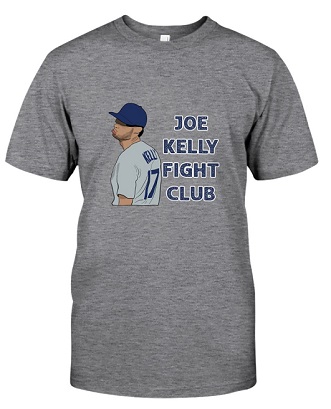
While such “Joe Kelly Fight Club” T-shirts became popular instantly, MLB and the players union finally agreed to let the commissioner hammer electronic cheaters. But are there catches?

Well, what do you know. Joe Kelly’s Tuesday night messages to Alex Bregman and Carlos Correa may have proven more than just worth an eight-game suspension (being appealed) and his canonisation as a saint in Los Angeles and elsewhere.

They have gotten both MLB’s dubious commissioner and the Major League Baseball Players Association on board with punishing future Astrogaters and Soxgaters. If they’re caught taking or transmitting such electronically-pilfered intelligence, they can be suspended without pay and lose the days of those suspensions in service time.

The news comes from one of the most unimpeachable sources—Evan Drellich, one of two writers for The Athletic (Ken Rosenthal was his teammate on it) to whom former Houston Astros pitcher Mike Fiers, an Oakland Athletic since August 2018 (after a stop in Detroit), blew the whistle on the Astro Intelligence Agency in the first place.

“MLB’s rules on the use of electronics and video grew significantly in the wake of penalties for the Astros and [Boston] Red Sox, according to a review of the document by The Athletic and conversations with officials familiar with it,” Drellich writes in an article published Thursday morning.

The league has newly hired an outside security firm to police the video replay room entrance and no later than next year plans to edit out the signs from the footage players look at in-game.

But no alteration may be as significant as the league’s ability to discipline. Commissioner Rob Manfred has the hammer, although the union can always appeal his decisions.

. . . Kelly was said by some to be delivering the justice to Astros players that MLB did not.

Whether MLB could have effectively administered that justice previously is a complicated question.

Technically, Manfred could have attempted to suspend Astros players had he not granted them immunity during his office’s investigations. But the punishments might not have stood up to expected grievances from the MLBPA because the league and union never before agreed how these specific issues would be handled. In fact, Manfred had declared in 2017, well before the Astros and Red Sox investigations, that he would hold club officials, not players, accountable for sign stealing.

No one condoned throwing at a batter’s head, as Kelly appeared to do when he threw such a pitch to walk Bregman with one out in the bottom of the sixth Tuesday, when they knew without being told that Kelly did only what it seemed at least half of major league baseball’s players—knowing how un-contrite both the Asterisks and the Rogue Sox seemed in spring training after the verdicts—thought was going to be done this season.

(It didn’t exactly take forever for a rash of T-shirts celebrating Kelly’s knockdown of Bregman and subsequent breaking-ball dustings of Carlos Correa, not to mention protesting his suspension, to go on sale online. “Free Joe Kelly” and “Joe Kelly Fight Club,” with or without Kelly’s image answering Correa’s huffing with a mock-crybaby face, seem the most popular.)

Until the coronavirus world tour knocked baseball as inside out as the rest of the world, Astrogate especially and Soxgate concurrently were the number one topic and scandal around the game. At times it was tough to determine which was more scandalous, the AIA and the Red Sox replay room reconnaissance ring, or Manfred having given players immunity instead of using his office’s powers to order them, “Spill, or be spilled.”

Not only did Chicago Cubs third baseman Kris Bryant say this was worse than the prior scandals around actual or alleged performance-enhancing substances, Dodger pitcher Alex Wood said, “I would rather face a player that was taking steroids than face a player that knew every pitch that was coming.”

Wood faced such players in the 2017 World Series. He had the lowest ERA (1.17) of any Dodger pitcher who pitched five or more innings in the set. He started Game Four in Minute Maid Park and surrendered George Springer’s two-out solo home run to break a scoreless tie and end his evening; he relieved Kenley Jansen for the Game Seven eighth and retired the side in order in Dodger Stadium.

Because the AIA’s apparatus involved either installing an additional and illegal real-time camera in Minute Maid Park, or taking an already-installed camera off the mandatory eight-second transmission delay, the 2017-18 Asterisks couldn’t run their sign-stealing scheme on the road. (In due course, it developed that Asterisk administrators tried but likely failed to urge scouts on the road to steal signs from the stands with cameras or field glasses.)

The 2018 Rogue Sox could operate their replay room reconnaissance ring in Fenway Park and elsewhere, anywhere, because it didn’t depend on altered or extra equipment. Basically, MLB handed them the keys to the candy store. Who knows how many other teams did as the Rogue Sox did, posting someone to decipher enemy pitch signs and signal them to a baserunner who’d then signal them to the hitter.

Remember: Sign-stealing on the field is as old a brand of gamesmanship as baseball itself. That’s why nobody went more than boo when New York Yankees right fielder Aaron Judge was recently seen as a runner on second looking as though sending a stolen sign to the hitter.

The 1951 New York Giants posted a coach in the clubhouse/offices above center field in the ancient Polo Grounds to steal signs telescopically and relay them to the bullpen from where signs were sent to hitters who wanted them. (The Giants stole the pennant! The Giants stole the pennant!) The verdict on their spectacular pennant race comeback forcing that fabled pennant playoff was left to history, alas.

The Red Sox married classic gamesmanship to off-field assistance handed to them (and anyone else who might have done likewise) in a gift-wrapped box. They didn’t install an extra camera and monitor in the room so far as is known. The new protocols now include prohibiting video room operators from communicating with players, coaches, and managers; and, outside security hired by MLB to guard the rooms, one guard for now and perhaps two after the coronavirus restrictions can be lifted.

Was Kelly punished too harshly for doing only what everyone with the proverbial two brain cells to rub together knew was likely to happen sooner or later, especially when the delayed season’s schedule included the surprise of the Astros facing the Dodgers in two sets? Another Athletic writer thinks so.

“When Manfred declined to punish the Astros, whether you agree with retaliation or not, he all but ensured opposing players would take matters into their own hands,” writes Molly Knight.

The Astros escaped their first series of this pandemic-shortened season against the Mariners without incident. But did anyone really expect none of the Dodgers to seek revenge?

MLB confirmed the Astros cheated their way through the 2017 World Series, and it still took them seven games to beat the Dodgers. It was as close as Los Angeles has come to winning it all since 1988. The scars from that series three years ago are still fresh for Dodgers fans, no matter how often Astros fans tell them to get over it. It’s hard to see how Astros fans would be over it if the trash can had been banged by the other team.

Considering that Kelly has a history as an erratic pitcher who rarely lets an actual or perceived offense go unanswered, it practically figured that he’d be the Dodgers’ version of the Green Hornet, flirting with crime to take down the grand theft felons. But keep in mind, too, that an eight-game drydock in a sixty-game season equals a 22-game suspension for a full 162-game season.

“Manfred may have thought he was sending a message about vigilante justice by giving Kelly an eight-game ban,” Knight writes. “But all he did was draw attention back to the absurdity that Astros players cheated to win a World Series and justice wasn’t served.”

Now Commissioner Nero has a hammer to swing on the high-tech off-field-based cheaters. Even if he catches another such intelligence/reconnaissance operation in the act—or another Fiers blows the whistle—and swing, and the Players Association files grievances on behalf of the hammered. He’d still send the message loud and strong that any more AIAs or Rogue Sox Reconnaissance Rings are verboten.

The question is whether he really will. And, whether the hammer will be a mallet or a marshmallow.


Commissioner Nero fiddles while MLB burns

2020-07-28 MarlinsPark

Marlins Park, which won’t host the Marlins vs. the Baltimore Orioles for a second day in a row after the Fish were flogged with COVID-19.

A month and a half ago, I wrote that Major League Baseball commissioner Rob Manfred had to go. The grounds already were several. Now, you can add that Manfred won’t even think about closing the Show for the season unless the coronavirus infects enough players on a team to rule it out of competitiveness.

Just when you thought you’d seen and heard everything from Manfred, the spectre of several Miami Marlins COVID-19 positive, of the Philadelphia Phillies’ clubhouses infected, and of games cancelled over positive tests, prompted this commissioner to put the competition ahead of health and safety.

MLB Network interviewer Tom Verducci, who normally writes for Sports Illustrated, asked Manfred just what it would take to close the Show, whose early performances have already run the gamut from farce to foolery and back under several Manfred-pushed rules experiments.

Those weren’t what the interviewer addressed, though. The issue was COVID-19 outbreaks among one team at minimum. Forget dropping the ball. Manfred threw it from the mound over the outfield wall. It only began with the commissioner saying the Marlins’ outbreak wasn’t “a nightmare,” before four more Marlins tested positive, raising the total number to seventeen—fifteen of whom are players.

“A team losing a number of players, making it completely noncompetitive, would be something we would have to address and have to think about making a change,” he said. “Our first concern is the health of the players and their families. And making sure we do everything possible to minimize the spread of the virus to our employees.”

Do you really need me to suggest that Manfred spoke out of both sides of his mouth while making clear enough that a team rendered futile on the field took even a slight priority over that “first concern” about player health and that of their families?

The Marlins outbreak, which may or may not have been seeded in Miami, prompted the Phillies to test en masse on Monday, while the same day’s scheduled Marlins home opener against the Baltimore Orioles was cancelled, as was the Phillies’ scheduled game against the New York Yankees. Tuesday morning came word that the tested Phillies tested negative. Their Tuesday game against the Yankees is postponed anyway. So is the second scheduled game between the Marlins and the Orioles.

Four of the Marlins’ infected were pulled away before the Sunday game against the Phillies, including scheduled starting pitcher Jose Urena. Manfred could and should have stepped in to cancel it if the Marlins’ administration didn’t. He didn’t, either. Indeed, that the game got played not after a call from competent medical and health observation but in a group text-message vote.

Last Friday, around the time the Fish began to flail, and two Atlanta Braves catchers were sent home showing symptoms but testing COVID-19 negative, Thomas Boswell fumed over the sense that Manfred already put the coffers of his bosses, the owners, ahead of the good of the game with his gimmicks such as a sixteen-team postseason, a free man on second to open each extra half-inning, and a three-batter minimum for relief pitchers.

Concurrently, though, Boswell hammered Manfred’s apparent lacking when it comes to his sport’s taking the pestiferous pandemic seriously enough to be the adult in the room when need be.

“You don’t measure disaster for a country — with refrigerator trucks lined up with corpses — the same way you measure it for a pro sport,” he wrote. “But how do you measure it for a sport? I don’t know . . . League bosses, who are not at risk, and athletes, who think they are invulnerable, are both going to be tempted — to keep playing chicken with the virus until it makes them stop.

“As most of the world already knows, by then it is usually disastrously too late.”

Manfred chose the media platform MLB itself owns to say he’d close the Show first and foremost if any team loses enough players to leave it non-competitive. (Resist the temptation to remind him of a pre-existing condition, Marlins fans.) He put that ahead of “our first concern” of the health and safety of players, their loved ones, and other MLB team employees.

A certain American president of dubious repute is often seen and even heard believing the coronavirus world tour has been nothing more (and nothing less) than a plot cooked up somewhere, anywhere, to thwart his re-election campaign. Now a baseball commissioner of dubious repute can be seen as possibly believing the pandemic has been a plot cooked up to keep the owners from making money.

Dave Martinez, the manager of the defending world champion Washington Nationals, looked upon the Marlins outbreak and shivered. “I’m going to be honest with you, I’m scared. I really am,” Martinez told Washington’s ABC news affiliate.

I go from here, home, back here every day, that’s all I do. I wash my hands, I went from 47 times a day to probably 99 times a day. Wear my mask everywhere I go. But there’s always that concern, you know. You don’t know, because of my heart condition, what happens to me if I do get it. I have to be extra careful. With that said, sometimes I tend to put myself aside and worry about other people more than me. I think that’s why I’m here, because I worry about those guys before I put myself first.

Martinez’s Nats were scheduled to travel to Miami to play the Marlins this coming weekend. “He says the players are his family, and he’s already lost a lot of sleep this month,” tweeted the Washington Post‘s Nats beat writer, Jesse Dougherty. “When asked about whether he has doubts about going to MIA this weekend: “Hopefully they make the right decision. That’s all I’m going to say.”

And, from among the players who opted out of playing this season over the pandemic, Los Angeles Dodgers pitcher David Price is probably more secure in believing he did the right thing. Especially considering baseball’s health and safety protocols have had issues and hiccups tracing back to the beginning of that delayed spring training called “summer camp.”

Now we REALLY get to see if MLB is going to put players health first,” the lefthander tweeted after the Marlins news exploded Monday. “Remember when Manfred said players health was PARAMOUNT?! Part of the reason I’m at home right now is because players health wasn’t being put first. I can see that hasn’t changed.”

That and more is what the commissioner says isn’t “a nightmare.”

Manfred and only too many within and without MLB thought any COVID-19 hits would strike maybe one, two, three players or MLB employees in just a sixty-game season. “Time to blow up that assumption,” Boswell wrote this morning.

If half of the Marlins team can test positive within a few days, then the scale of danger to health — the number of people who may get sick and the severity of the damage they may suffer, including prime-of-life pro athletes — just shot through the ceiling.

Our assumptions, while well-intentioned, have been blown to pieces. And in short order, so will the season of one, or perhaps several, of our sports.

So has been Manfred’s reputation, what’s left of it. The commissioner showed what kind of leader he was operationally, factually, and even morally before the coronavirus went on world tour. It wasn’t a great showing.

He’s never been able to bring himself to address complete umpire accountability. He slapped the Yankees and the Boston Red Sox on the wrists over illegal dugout phone and AppleWatch sign-stealing cheating in 2017 and handed down a nebulous directive rather than demand an immediate rule book change and clarification.

He let Red Sox and Houston Astros players walk in return for information rather than bring the powers of his office to bear on them over their off-field-based, illegal sign-stealing cheatings. He suspended two managers for this year (Carlos Beltran, a 2017 Astros player, was forced out of managing the New York Mets before he managed even a spring training game for them) but never even thought of holding the teams’ ownerships to real account.

The cheating players skated, their owners paid what amounted to tip money (for them) in fines, their fan bases were forced (sometimes kicking and screaming) to come to terms with chicanery that compromised each’s recent World Series titles, and Manfred dismissed the World Series championship trophy—which many thought should be stripped from both the Astros (2017) and the Red Sox (2018)—as just a hunk of metal.

He never quite suggested he might be interested in investigating whether the Astros and the Red Sox might be right in suggesting they weren’t exactly the only ones willing to flout rules against off-field-based electronic sign-stealing, either.

Nor did he demand the Yankees explain why they’re so desperate to challenge a judge’s ruling that a disciplinary letter over their 2017 sign-stealing cheating be made public, either, or said anything else about the letter itself. “[I]f the infractions cited by Manfred [in the letter] were as minor as originally claimed,” asked Beyond the Box Score writer Sheryl Ring in mid-June, “why are the Yankees so reticent to turn the letter over?”

Don’t forget Manfred’s push on behalf of his bosses, the un-impoverished owners, to try reneging on that March agreement and gaming the players out of their full pro-rated 2020 salaries if and when the season got underway.

Now that COVID-19 has taken out about half the Marlins’ playing team, Manfred is slightly more concerned for teams’ competitive ability—which can also be viewed as making money for the owners—than their health?

Here’s something on which the owners and the players might unite if put to them properly. Manfred’s successor, and every commissioner to follow, should be anyone except another owner, his hand-picked successor, or other baseball official. The successors should also be elected by representatives of all ownerships and by the players through their team player reps.

But I’m convinced even more that Manfred must go. Commissioner Nero’s been fiddling while MLB and the country that loves it burn. His music is cacophonous.

Be prepared for Show over

2020-07-27 MiamiMarlins

The Marlins players—not team management, not health/safety experts—elected to play Sunday despite COVID-19 already hitting some of them. Now eleven players at least plus two coaches are COVID-19 positive. Where were the adults in the room?

MLB and the players’ union,” tweeted ESPN’s Buster Olney early Monday morning, “made the mutual decision to try to play a season this year, and those two entities share the ethical responsibility of pausing, postponing or cancelling if that’s what is in the best interests of players and staffers. The Marlins’ situation tests this.”

The Miami Marlins’ situation is that fourteen people with the team, mostly players but a few coaches, tested COVID-19 positive while the Fish opened the truncated regular season in Philadelphia. Including their scheduled Sunday starter against the Phillies, Jose Urena. The team has postponed at least their Monday home opener against the Baltimore Orioles.

A series postponement may not be unlikely. Which might disappoint the Orioles purely on baseball terms, having just accomplished the unlikely feat of beating the Boston Red Sox two straight (7-4, 7-2) on opening weekend, after getting their brains beaten in 13-2 to open the set.

Exactly where the Marlins so affected caught the infections is still, pardon the expression, up in the air. They played an exhibition against the Braves in Atlanta the day before the regular season finally began, and the infected players and coaches could have been hit either in the Truist Park clubhouse or in the Citizens Bank Park clubhouse.

The New York Yankees were supposed to open in Philadelphia Monday night and station themselves in the same visitors clubhouse the Marlins just vacated. Says ESPN, “Sources told . . . Marly Rivera that the Yankees have been informed that the visitors’ clubhouse has been completely fumigated several times. The Yankees also brought their own clubhouse personnel down from New York City to work the game, if it happens. No decisions have been made yet, sources said.”

That was early Monday morning; now as I write it’s later Monday morning. A season postponement? It may happen. Major League Baseball convened an “emergency meeting” Monday in the wake of the Marlins’ situation. The Yankees-Phillies game for Monday is postponed, too. And, yes, this is getting quite out of hand.

But a season postponement may not happen yet, either. USA Today‘s Bob Nightengale reports, “There will be additional priority testing for teams who have an outbreak, MLB officials say, but no serious talks as of yet cancelling or pausing the season. In the words of one owner on the conference call: ‘Obviously, the situation is fluid’.”

How brave and bold of them.

With the coronavirus world tour still playing and only too many people still treating it from somewhere between carelessness and ignorance, getting a major league baseball season going from any point this summer was going to be tricky enough. We knew that right out of the proverbial chute, when young Washington Nationals star Juan Soto tested COVID-19 positive on Opening Day, though he’s asymptomatic just yet.

For all the fun and folly accompanying the season’s long-delayed opening, it’s no kind of fun when fourteen Marlins test positive over opening weekend. That followed two Braves sent home after testing positive but no symptoms showing yet.

When the Nats hosted the Yankees to open the delayed season, there was commissioner Rob Manfred sitting on national television talking more about . . . his sixteen-team postseason array. The designated hitter wasn’t even a millionth of the gimmick that idea is. It only begins with removing more than half the urgency of a regular season whose competitive urgency was already diluted by its wild card system.

Sure we’ve loved it when wild-card winners turn up the last team standing with the World Series trophy hoisted high. Including the Nationals, who did it last October after a staggering regular-season comeback. But we’re not fools. We know damn well that the wild card system has equaled asking fans to sit on edge over the thrills, spills, and chills of teams fighting to the last breath for . . . second place.

Manfred and his Major League Baseball Players Association counterpart Tony Clark have a genuine burden on their hands trying to navigate the sport through a terrible pandemic that’s yanked their country and half the world over, under, sideways, down. And the big thing for Manfred opening was a postseason array that might, maybe, probably see the sport’s best teams knocked out early and often.

“If Manfred’s judgment is this bad or if he is this pliant to the money lust of his bosses,” fumed the Washington Post‘s most valuable player, Thomas Boswell, “then what chance is there that he will have the backbone or the leadership skills to shut down this season if needed?”

Backbone? Leadership skills? Like the New York Police Department brass who sooner sent a few flunky cops to trial rather than root out the bottom-top corruption it took Frank Serpico and David Durk going to The New York Times to even try rooting it out, Manfred didn’t have the backbone to bring the powers of his office to bear and drop real hammers against the Houston Astros and the Boston Red Sox over their caught-red-handed, off-field-based, electronic sign-stealing cheatings.

Manfred slapped three managers and a general manager—whose teams executed them without Manfred—but the owners allowing it on their watches and the players availing themselves of it got away with it. You think that’s the Manfred who’s going to have the backbone to stop the season if the viral infections metastasise among the troops?

At his bosses’ behest, Manfred forced Clark and his charges to fight a ridiculous-sounding counter-battle against the owners using the coronavirus tour’s shutdown of spring training and the regular regular season to shove a de facto salary cap for the season down the players’ throats. That’s Manfred’s idea of backbone.

“The scary core of MLB’s predicament — and soon the NBA’s and NHL’s, too — is: Playing our sport is what we do, who we are and how we make our money,” Boswell wrote. “We’re going to try to do it until the virus stops us.”

From all over the world we’re learning the lesson that this is a terrible basic assumption. You get ahead of this virus before it even looks like a problem, or it ends up crushing you. South Korea, Japan, Australia, Canada and Germany, with a combined population of 325 million (the United States has 330 million) had 15 deaths Thursday. Arizona, with 7.2 million, had 89 dead.

You don’t measure disaster for a country — with refrigerator trucks lined up with corpses — the same way you measure it for a pro sport. But how do you measure it for a sport? I don’t know . . . League bosses, who are not at risk, and athletes, who think they are invulnerable, are both going to be tempted — to keep playing chicken with the virus until it makes them stop.

As most of the world already knows, by then it is usually disastrously too late.

You saw it yourself watching the games that finally arrived. Enough players, coaches, managers were playing chicken. Please. There’ve been how many ballplayers who played through injuries, “manning up,” earning their praises, and ultimately hurting their teams because they were fool enough to play through injuries? What’s trying to play unmasked and unsafe through a pestiferous pandemic, then? Supermanning up?

That was before the depth of the Marlins’ infections emerged. And now emerges, from the Philadelphia Inquirer, that deciding to play Sunday’s game in Philadelphia wasn’t decided by MLB, by Marlins team leadership, by the union, by health and safety experts, but by . . . Marlins players, by way of a group text message. Fish playing chicken. Bet the Phillies clucked, too, if not necessarily with unanimous approval.

I admit it. It was easy enough to bask in the Show’s return and either forget or keep as an aside the risk that the coronavirus would have innings enough to play among the games and the teams. Even while some of the worst ramifications of baseball’s gimmicky 2020 season experiments—the free runners on second to start each extra half-inning; the three-batter minimum for relief pitching appearances—delivered things uncomfortably between the rock of disaster and the hard place of farce.

Taking a few small but profound safety precautions doesn’t exactly mean the end of the world as we know it. No matter how many would-be God, Juniors in government from the top down really do want to use it as cover for their next nefarious real attacks on what remains of our freedom.

What a country. We were the “can-do” people for so many generations. When somebody told Ben Franklin to go fly a kite, Ol’ Ben said, “Hell, yes. Who cares if it looks like rain?” And lightning struck.

We gave the world the lightning rod, swivel chairs, automatic flour mills, suspension bridges, fire hydrants, compression refrigeration, coffee percolators, circular saws, dental floss, lathes, doorbells, lock-stitch sewing machines, combine harvesters, solar compasses, Morse code, circuit breakers, sleeping cars, ice cream makers, rotary printing presses, jackhammers, safety pins, dishwashers, fire alarm boxes, elevator brakes, burglar alarms, breast pumps, and submarines.

We gave it condensed milk, light bulbs, mass-produced toilet paper, electric stoves, escalators, vacuum cleaners, motorcycles, refrigerator cars, air brakes, fire sprinklers, mimeographs, synthesisers, air brushes, phonographs, cash registers, metal detectors, electric irons, electric fans, thermostats, photo film, electric mixers, fuel pumps, stop signs, smoke detectors, and zippers.

We gave it medical/surgical gloves, mufflers, remote control, batteries, the assembly line, hearing aids, air conditioning, offset printing, the powered airplane, automatic transmission, traffic lights, toggle light switches, hydraulic brakes, toasters, polygraphs, garage doors, radio arm saws, audiometers, instant cameras, electric razors, freon, sunglasses, car audio, electric guitars, bug zappers, and the Richter scale.

We gave it programming languages, fluorescent lamps, digital computers, fiberglas, xerography, Teflon, deodorant, cruise control, microwave ovens, space observatories, Tupperware, credit cards, transistors, defibrillators, supersonic aircraft, cable television, and correction fluid, a.k.a. Liquid Paper. (Hey, hey, she was a Monkee’s mother!)

We gave it bar codes, the artificial heart, voltmeters, lasers, LEDs, weather satellites, jumbo jets, personal computers, microprocessors, e-mail, cell phones, the Heimlich maneuver, digital cameras, ethernet, stealth aircraft, and the Internet.

For openers.

We fought and beat dreaded diseases past, and we made a few of them extinct while we were at it. We also fought and won a couple of world wars and finally defeated the most ruthless and bloody tyranny ever to rule anywhere on earth. We also invented baseball as the world’s known it roughly since the year before one of us invented pressure tape.

You’re telling me that the “can-do” people are now the “don’t-even-think-about-it” people? You’re telling me the people who invented all the above now consecrate and abet leadership and neighbourly luddism that tries to rule us without knowing a coronavirus from a computer virus?

All of a sudden it looks easier for the Cleveland Indians and the San Diego Padres to think about winning a World Series than it did for us to beat smallpox and polio. (You don’t want to know the bureaucratic loop-de-loops Edward Jenner and Jonas Salk would be put through today to get their vaccines to, you know, the people who need them.)

God forgive me, it was too easy to get lost in the thought that the Show was really back no matter what. Even with the piped-in crowd noise. Even with the cockamamie-looking empty ballparks other than cardboard cutouts of humans and other living creatures. It was even easier to laugh our fool heads off when Adam Duvall’s home run Saturday bopped the cutout of Jeff McNeil’s Alaskan malamute puppy right in the snoot.

Well, it was just as easy to anticipate the return and itch for major league ball no matter the lingering risks. It’s not so easy or funny anymore. As much as I might enjoy the games themselves, for all the gimmickry and all, I’d rather wait till next year than continue the risk that more than just a school of Marlins have to fight the damn virus.

Mr. Manfred, Mr. Clark, show some real backbone and be ready to just say no to the rest of the season. To pay the players their pro-rated 2020 salaries, thank them for giving it the old college try, and call it sick pay. Then—assuming more of them haven’t tested positive in the interim—to send them home to safety and their loved ones.

Don’t even think about how the owners can’t possibly afford it. Everyone from the rock-bound coast of Maine to the smoggy shores of California knows that’s only slightly less of a lie than anything out of a politician’s mouth.

We went almost four months without the Show. If we have to, we’ll survive without it the rest of the year. Because too many people still aren’t wising up and living safe just yet, and too many leaders are still using it as an excuse to play Gods, Jr. And, from the early look of it, too many players, coaches, and managers still do think or act as though they’re invulnerable.

In more than one way, the Marlins just told baseball world otherwise. “[H]ere we have it,” writes a rueful Stephanie Apstein for Sports Illustrated, “the least surprising possible outcome of MLB’s decision to fly some 1,500 people around the country, from one coronavirus hotspot to another, buttressed by a hope and a prayer and instructions not to spit, in service of playing baseball: They have to stop playing baseball.”

We have to have adults in the room. Now.

The Show will go on, but . . .

2020-06-23 ManfredBallsOK, so the universal designated hitter won’t be coming just yet. That ought to settle the more stubborn traditionalists, who forget often enough that there’ve been a few traditions baseball was better off without and moved to eliminate them appropriately.

But it looks like we’re going to have major league baseball this year, after all. It also looks like it’s going to be nerve wracking, not just because of a sixty-game season by itself but because the continuing coronavirus world tour may make a few more stops baseball isn’t going to like.

The Philadelphia Phillies and the Toronto Blue Jays have had to close their Florida camps when five Phillies-organisation players and one such Blue Jay tested COVID-19 positive. As of Sunday, according to USA Today‘s Bob Nightengale, forty players and/or team staffers have tested positive for the virus.

And when the Show teams return to work a quick-and-dirty delayed spring training, it looks like they’ll be doing it in their home cities instead of at their normal spring training camps in hard enough-hit Arizona and Florida. Which makes things perhaps a little simpler for most but a little trickier for the Miami Marlins, the Tampa Bay Rays, and the Arizona Diamondbacks.

That assumes the players can handle such a brief spring training. The Major League Baseball Players Association has until five o’clock Eastern time today to let MLB know the players can report for such abbreviated and re-located spring training by 1 July, with a projected 24 July season opening. Not exactly the (all things considered) ideal Fourth of July season opening many thought would have been big enough.

While you ponder how not-so-great both sides in the MLB impasse have looked, ponder concurently why there was such an impasse in the first place. The owners and commissioner Rob Manfred tried to renege on a late March deal with the players, plain enough and simple enough, for all the complications that followed. If you want a thumbnail sketch here and now, you won’t get much better than NBC Sports’s Craig Calcaterra:

The terms of that basic framework: the players earned the right to receive prorated pay for however many games played and Major League Baseball would get to decide how many games would, in fact, be played. In light of that, one might’ve assumed that when it came time to set up a 2020 season, it’d be a pretty straightforward thing: the owners, per the March Agreement, would simply say “we’ll play a season of X games” and it’d be done.

Except when the owners first spoke, and proposed an 82-game season in early May, it came with a catch: a demand that the players give up their previously-negotiated right to prorated pay and accept different financial terms. Legally speaking the owners had no right to ask for that and the players were under no obligation to negotiate that. They declined to do so and, instead, countered with various proposals on season length and did not negotiate pay rate. The owners, nonetheless, spent more than a month asking for the players to abandon their rights to prorated pay, proposing multiple alternative schemes. It was not until June 17 — after the players said they would no longer negotiate if MLB kept including pay concessions in their offers and, instead, simply demanded that MLB impose a season and be done with it — that MLB came back with its first offer that complied with the March Agreement.

In shorter words, it took the Show this long to start setting a season because the owners tried—in the middle of a pandemic scaring the hell out of a country that needed the Show to help keep morale alive when nobody knows just when the coronavirus world tour will end at last—to use it as a shield to pull a fast one on the players whose previous inconsistent unity came together the moment they smelled this rat.

Calcaterra also reminds us that relations between the owners and the players weren’t exactly friendly before the pandemic forced baseball’s limbo in March:

The owners had been eating the players’ lunch in recent years, having negotiated a couple of owner-friendly labor deals and, on top of that, putting the screws to players in free agency. In light of that there was already a lot of mistrust and, with the current Collective Bargaining Agreement set to expire in December 2021, each side was already beginning to mobilize for labor battle. Reacting to the pandemic and coming to some sort of an agreement to deal with it would’ve been difficult in even the best of circumstances, and the owners and the players were nowhere close to being in the best of circumstances as the 2020 season was about to get underway.

The players’ lesser cohesion between 2016 and March may have seduced the owners into thinking that, with their continuous tries at reneging on the March agreement, they “could, once again, exploit rifts in the union and get a favorable deal as a result.” Oops. The players hollered foul and stuck to it. For now.

The questions to come include whether they’ll stay so cohesive when it comes time to negotiate a new collective bargaining agreement after the 2021 season. Neither Manfred nor Players Association executive director Tony Clark come out of this mess looking better.

Manfred is exposed as a commissioner unwilling to translate his express power to act for the good of the game into acting as though that good is more than making or saving money for the owners . . . who also forgot what a horrible look it would be when they spent so much time trying to trash what they agreed to in March they were seen as ignoring health implications in MLB’s return.

Clark, though, is seen now as a union leader who doesn’t always read pulses properly and doesn’t always see the bigger picture, including the prospect of recent negotiations and owners’ maneuverings leaving free agency to face what some writers call a potential blood bath.

Or, as Cincinnati Reds pitcher Trevor Bauer tweeted Monday, “So we gave up shares of playoff money, eliminating the qualifying offer for 2021, paycheck advance forgiveness, Covid 19 protections, and protection for non guaranteed arb contracts for next year in order to hold on to our right to file a grievance.”

Bauer had tweeted earlier that the pandemic wasn’t the right time for a battle: “If there’s going to be a fight, the time for that fight is after the ’21 season when a new CBA is negotiated. … We’re doing irreparable damage to our industry right now over rules that last AT MOST 16 months. What kind of sense does that make?”

Nothing about 2020 has made any kind of sense so far. The owners looking terrible makes the same sad sense it always has. The players’ union looking foolish now doesn’t. Everyone in and around baseball knows that.

But at least they kept the universal DH from poisoning the pond, right?