No, Commissioner, you KEEP the universal DH

Commissioner Rob Manfred, donning a mask to attend a World Series game in Globe Life Field.

If it isn’t broken, call the repairman. If it is broken, it’ll fix itself. So seems to be the thinking (using the term very liberally) of Commissioner Nero. Apparently, he’s in no hurry to keep the universal designated hitter, but he’s in a big hurry to keep permanent the over-expanded postseason.

Tampa Bay Rays owner Stuart Steinberg, whose team is now playing in the World Series and is one of baseball’s most innovative, has it right about innovation actual and alleged when he likes to say, “Break a window, don’t burn down the house.” Rob Manfred seems to prefer burning down the house to save the broken window.

The DH would have “broken” the window in 1891 if then-Pirates owner William Chase Temple had his way. Yes, I’m going there again. The concept that drives today’s stubbornly ancient-school National League fans came originally out of a National League owner’s head.

Temple was fed up pitchers being unable to hit. Not “unwilling,” unable. So he proposed what we know as the DH. Temple’s contemporary and friend Albert Spalding wanted to see and raise. Spalding thought the pitcher’s lineup spot should have been erased entirely with eight-man lineups otherwise. Window-breaking? Spalding would have busted three for the price of one.

“Every patron of the game,” wrote Sporting Life about Temple and Spalding’s thoughts, “is conversant with the utter worthlessness of the average pitcher when he goes up to try and hit the ball. It is most invariably a trial, and an unsuccessful one at that. If fortune does favor him with a base hit it is ten to one that he is so winded in getting to first or second base on it that when he goes into the box it is a matter of very little difficulty to pound him all over creation.”

No need to review the history of the DH idea in detail. Suffice to say here that Temple brought it to a vote and lost in 1892. In 1906, Philadelphia Athletics owner/manager Connie Mack (whose pitchers hit a whole .201 that season) proposed it to see it go nowhere. The National League proposed it again in 1928 and the American League rejected it then. It took traction at last when the high minors adopted it in the 1960s and impressed Oakland Athletics owner Charlie Finley enough (as well it might considering his 1972 A’s pitchers hit a whopping .165) convinced his fellow AL owners to bring it in.

Looking for ways to make the pandemic-shortened irregular 2020 season as painless as possible, Manfred decided this would be an experimental season. The universal DH was one of the experiments. Would you like to know how it went? The batting slash line for major league pitchers all 2010s long is .130/.161/.165. The batting slash line for 2020 designated hitters is .231/.316/.408.

It gets better. Want to know whose DHs did the best this season? The Atlanta Braves. In the National League. With a .316/.411/.589 slash line. And, a 1.000 OPS. Hitting more home runs than everyone else (17) except the Minnesota Twins (19). Getting more base hits period (73) than everybody else’s DHs. With the highest DH batting average on balls in play (.403) by 44 points. Did I mention Braves DHs knocked in the most runs (55) of any team’s DHs?

Want to know how many National League teams’ DHs finished in the top ten for collective OPS around the 2020 Show? Six. (The Braves, the Philadelphia Phillies, the New York Mets, the Los Angeles Dodgers, the San Diego Padres, and the St. Louis Cardinals.) The top ten in DH on-base percentage is even-up between NL and AL teams (five each) with the Braves at the top. Braves’ DHs led a pack of five NL teams in the top ten for batting average at that lineup slot. They also led all teams’ DHs with 37 walks.

I’m going here, too: my Real Batting Average metric. RBA = total bases + walks + intentional walks + sacrifice flies + hit by pitches. Look how the National League’s DHs measured up against the American League’s:

2020 Real Batting Average – DHs

  PA TB BB IBB SF HBP RBA
National League 3724 1338 366 25 26 54 .486
American League 3768 1347 377 17 26 46 .481

The National League DHs batted five points higher in RBA than the American League despite batting 44 fewer times. (They took a lot more for their teams, too, if you noticed the hit-by-pitches.)

Do you still miss those .128-hitting pitchers with their .178 RBAs? Are you ready to listen to Thomas Boswell this time, if not a) almost two years ago; or, b) when I cited him again in June?

It’s fun to see Max Scherzer slap a single to right field and run it out like he thinks he’s Ty Cobb. But I’ll sacrifice that pleasure to get rid of the thousands of rallies I’ve seen killed when an inning ends with one pitcher working around a competent No. 8 hitter so he can then strike out the other pitcher. When you get in a jam in the AL, you must pitch your way out of it, not ‘pitch around’ your way out of it.

If you want to yell your head off at Commissioner Nero, there are better reasons. Bawl him out from San Diego to Boston and back about that ridiculous three-batter relief pitching minimum and, even more, against that free cookie on second base to start each extra half inning.

Rant your heads off against a permanently-expanded postseason. Sure it might have been mad, perverted fun to see the 29-31 Houston Astros meet the likewise 29-31 Milwaukee Brewers in the World Series this month. Only because it would have made a further chump out of Commissioner Nero seeing regular (well, irregular) season losers playing for that piece of metal.

Bellow like Falstaff that the real issue with postseason baseball’s ratings declines are and have long enough been saturation. Bad enough the era of the second wild card made for potentially-exhausting maximum 43 postseason games a year. Slightly worse was this year’s sixteen-team postseason making for a potential maximum 65 games (if each series went the distance) and an actuality of 52 postseason games so far.

Even fans such as myself who think there’s no such thing as too much baseball get wrung out by that. The good news is that, this time, championship won’t be diluted. The two best teams in 2020 baseball—when all was said and done about COVID-19 infections, disruptions and scheduling contortions—are going at it in the World Series. That’s now. Does Nero really want to risk a future full of losers playing for the Promised Land?

Or would wiser heads who aren’t sound asleep while Nero burns the house down in order to put a trash can fire out willing to suggest what I’ve suggested until I’m bluer in the face than the Rays’ jerseys. Dump the bloody wild cards. Give the winningest division champs a round-one bye and let the other division winners play a best-of-three. Let that winner meet the bye winner in a best-of-five League Championship Series. Leave the World Series best-of-seven and return it to its proper primacy.

As Groucho Marx once said, it’s so damn simple a child of five could do it. And, sit back, watch the tanking teams run out of excuses to tank because you either win or be gone, watch all those “competitive” teams realise they can’t settle anymore for stirring the blood and delivering the thrills, chills, and spills fighting to the last breath to see who finishes . . . in second place.

Now, somebody send for a child of five. (Thanks again, Groucho.) Then, send him or her to Nero with instructions to keep the universal DH. Which did you one of the biggest favours baseball was able to do for you this otherwise pandemically-putrid year. Even if you didn’t know it and didn’t want to hear about it.
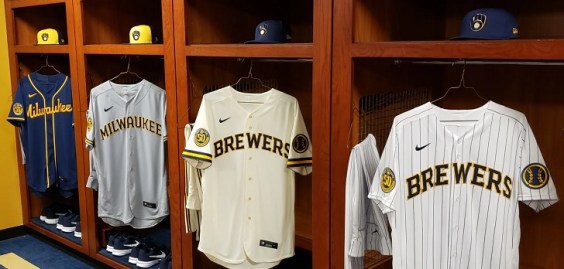
Mediocrity might get World Series representation

Yes, let’s root-root-root for the 29-31 Brewers to meet the 29-31 Astros in the World Series. Stop snarling, there is a method to such madness.

Almost half a century ago, U.S. Senator Roman Hruska of Nebraska offered a defense for Richard Nixon’s dubious Supreme Court nominee G. Harrold Carswell. It proved that with friends like Hruska the hapless Carswell didn’t need enemies. Just the way baseball proves that with friends or commissioners like Rob Manfred, it doesn’t need enemies, either.

“Even if [Carswell] were mediocre,” said Hruska, “there are a lot of mediocre judges and people and lawyers. They are entitled to a little representation, aren’t they? We can’t have all Brandeises and Frankfurters and Cardozos.”

Hruska, meet Manfred and today’s major league baseball owners. For the first time since 1981’s strike-resolution postseason experiment, at least one team with a losing record enters the rounds that will end in someone winning the World Series. This time, though, it turns out to be two such teams.

Ladies and gentlemen, your 29-31, final wild card-holding Houston Astros and Milwaukee Brewers. Whose joint appearance in the World Series to come (baseball law: anything can happen—and usually does) might be less hazardous to the nation’s health than a questionable Supreme Court justice.

Manfred and the owners dreamed up this sixteen-team/twelve wild-card postseason as a way to take the financial sting out of the owners agreeing to any sort of baseball season during a pandemic that’s stung the economy overall. So far as most of us knew, it would be a one-time thing.

Well, so was the postseason resolution of the 1981 strike. It put first-and-second-half division winners against each other in division series. But it also put the overall 50-53 Kansas City Royals (second-half American League West winners) into the postseason and kept the 66-42 Cincinnati Reds (neither-half National League West winners) and the best overall season record out.

Who knew then that, a decade and a half later, the owners and the players union alike would go all-in on three-division leagues and a wild card that took the first bite of championship dilution, allowing teams who didn’t finish in first place to play into the postseason in the first place?

Manfred’s predecessor, Bud Selig, then pushed for and got the second wild card in each league starting in 2012. Until this season, only two World Series featured combatants who got into the postseason by way of the wild card, in 2002 (the Anaheim Angels beat the San Francisco Giants) and 2014. (The Giants beat the Royals.) There’s an excellent chance of it happening again next month.

Almost two weeks ago, Manfred let slip that he’d like to see this sixteen-team postseason format stick past the anomaly of the pandemic-shortened season. That happened five days after Sports Illustrated writer Stephanie Apstein said she hoped as many losing teams as possible got here this time only.

The reasonings between the two couldn’t be more opposed. Manfred told a Hofstra University virtual panel that “there was a lot to commend” this setup “and it is one of those changes I hope will become a permanent part of our landscape,” adding that “an overwhelming majority” of the owners agree.

Apstein called the setup a disgrace: “This setup dissuades teams from trying to be good. The clearer that is this year, the more likely it is that we can go back to normal next year.” She dares to dream, as does her SI colleague, Emma Baccalieri, who said, “In a non-pandemic-restricted year, ‘tolerable weirdness’ shouldn’t be the bar.”

In absolute fairness, assorted teams this year didn’t look good for assorted reasons running the spread from aborted spring training and near rush-designed “summer camps” with a three-month-plus interruption to assorted injuries, health-related opt-outs, a few COVID-19 test panics and postponements, and the usual assortment of foul balls.

But assorted teams looked good in spite of those, too. More than a few teams made baseball fun and feel-good again. Atlanta’s Freddie Freeman went from scared to death that COVID might wipe him out to likely winning the National League’s Most Valuable Player award. The Reds, the Chicago White Sox, and the Slam Diego Padres made friends and fans all over.

Well, at least the White Sox did until they went from letting the kids play (Tim Anderson especially) to Fun Police, drilling Willson Contreras for the bat flip of the century last Friday night. Must be something in the franchise water. The White Sox may have an apparent institutional genius for going from fun-fun-fun to phooey-on-you in practically a blink.

So why on earth should we pray for a World Series featuring a pair of losing season records?  There’s still the outside chance that the very sight of two losing records playing for the Promised Land might yank even Commissioner Nero’s head out from being so far up his ass he can give you the live play-by-play of his own root canal procedure. Might.

With identical losing records, and assuming they both get past the earlier rounds on the theory that even the also-rans can and do go nuclear for short spells, the Astros and the Brewers could make real that once-infamous observation that mediocrity deserved “a little” representation, too.

The Supreme Court can’t have all Brandeises, Frankfurters, and Cardozos? Well, baseball can’t be all the A’s, the Braves, the Chicago Cubs, the Los Angeles Dodgers, the Minnesota Twins, and the Tampa Bay Rays, to name this pandemic season’s division winners, either.

They can’t even be all the White Sox, the Padres, the Cleveland Indians, or whoever—under normal two-card circumstances—might win a playoff game between the Reds and (surprise!) the Miami Marlins. (They’d have done it tying for the second National League wild card if this had been a normal season.)

Under normal conditions the rest of the pack, never mind the bottom of it, wouldn’t be entitled to play for a little representation before baseball’s highest court. Except in their wait-till-next-year dreams.

This year’s Astros and Brewers sank from winning 2019 teams (the Astros winning the AL West, the Brewers going to the NL wild card game) to 2020 also-rans. They were compromised predominantly by the injured list, particularly as it riddled their pitching staffs and a few key position players. If mediocrity deserves representation, their pandemic season’s records mean these two playing in the World Series would be as representative as it gets.

What if it leaves Manfred still giving the live play-by-play of his own root canal work? What if it doesn’t awaken him, and those owners he says are all-in, to the abject degeneracy of a baseball postseason that invited the mediocre to play on the same field (to open, anyway) as the teams who did overcome any and all pandemic or other disruptions to rise and shine?

What if Commissioner Nero and those supporters lack the brains to ask themselves, “What’s wrong with this picture? Why did the Dodgers, the Rays, the Twins, the A’s, the Braves, and the Cubs fight tooth, fang, claw, and coronavirus to finish on top, just to have to run through most of the rest of the lesser pack all over again to play in the World Series?” And, “Why did we remove the real incentives for teams to compete just so we could still make money and lots of it?”

It’s tempting to pray that the Astros and the Brewers do find ways to meet in the Series. (Tough openings: the Astros face the Twins in this wild card round; the Brewers have to survive the Dodgers. David had better odds pitching to Goliath.) Just for the outrage factor alone. An outrage factor that would be multiplied exponentially considering the scandal-ridden Astros in Year One following the exposure and non-disciplines of Astrogate.

It might make the Brewers—who haven’t been in the World Series since Epcot opened, Marvin Gaye released the final album of his lifetime, Cats started an eighteen-year run on Broadway, and then-Communist Poland barred the Solidarity labour union—objects of affection far beyond the Milwaukee that made Schlitz famous.

The Astros may have only eight men left (Justin Verlander, pitcher, is gone to undergo and recuperate from late-life Tommy John surgery) from the Astrogate teams of 2017 and part of 2018. But that hasn’t stopped the brickbats, catcalls, and stadium seat cutout punkings from reminding them it’s not nice to commit espionage above and beyond the temptations handed down by MLB itself in the replay rooms.

Maybe an Astros-Brewers World Series would leave Manfred and his minions to answer why they thought mediocrity deserved a little postseason representation, too. Big maybe. And maybe I’ll win the Nobel Prize.

But maybe it should also make you pray that the Indians find a way through this mess to play in and win the Series at long enough last. If 2020 were a normal season, the Indians—whose tenacious righthander Shane Bieber looks like the absolute lock for the American League’s Cy Young Award this pandemic season—might have played a 163rd game against the White Sox to see who got wild card numbers one and two. (The Yankees, the Buffalonto Blue Jays, and the Astros would have been out.)

Well, as Casey Stengel once said, now wait a minute fer crissakes. Suppose this pandemic postseason shakes out to the Indians playing the Padres in the Series. The Indians haven’t won the Series since the Berlin Airlift. The last time they got to try, they lost a Game Seven thriller to the Cubs—who hadn’t won a Series since the Roosevelt Administration. (Theodore’s.)

The Padres have yet to hoist their first piece of World Series metal. The last time they got to try, Jose Samarago became Portugal’s first Nobel literature laureate, Richard Pryor won the first Mark Twain Prize for humour, Bill Clinton faced impeachment, and the Yankees weren’t anywhere near as inclined to roll over and play dead for the Padres as the Senate was for Clinton.

These words appear after Yom Kippur, the Jewish Day of Atonement. It almost figures that the first entry into baseball’s book of life for the year to come could make the Mad Hatter’s tea party resemble a Social Register cotillion. This time, if the proverbial cream rises to the top, a Dodgers-Rays World Series would likely do nothing but compel Manfred to proclaim validation. Told ya!

So let’s root, root, root for an Astros-Brewers World Series, no matter how you feel about the Astros otherwise. Not because mediocrity deserves a little representation, but because it might re-awaken the owners. Maybe enough to stop Commissioner Nero from consecrating the poisonous precept that a franchise doesn’t even have to try to be particularly good to earn the right to play for the Promised Land.

Intolerable weirdness

Comissioner Rob Manfred presents that piece of metal to the 2019 World Series-winning Washington Nationals.

There it was. Sixteen paragraphs down, during Washington Post writer Dave Sheinin’s Tuesday morning analysis of commissioner Rob Manfred’s virtual panel conducted Monday night by Hofstra University’s business school. The main topic was the Show’s postseason, pandemic-inspired “bubble plan.” Then the real bomb detonated.

Sheinin revealed Manfred saying this pandemic season’s sixteen-team postseason “is likely to remain beyond 2020,” with “an overwhelming majority” of the owners endorsing it before the coronavirus world tour yanked baseball over, under, sideways, down.

“I think there’s a lot to commend it,” Sheinin quoted Manfred directly, “and it is one of those changes I hope will become a permanent part of our landscape.”

Back in February, Manfred got himself into a jam, dismissing thoughts of nullifying the Houston Astros’s illegal-sign-stealing-tainted 2017 World Series win, when he dismissed concurrently the World Series trophy itself (its official name is the Commissioner’s Trophy) as “just a piece of metal.” (His swift apology only helped a little.) Now he’s threatening to make the trophy exactly that, and not in rhetoric alone.

Last Friday, you may remember Sports Illustrated writer Emma Baccalieri saying a pandemically truncated baseball season such as this might make “tolerable weirdness” such as a losing-record team playing for a championship, well, tolerable. “In a non-pandemic-restricted year,” she said, “‘tolerable weirdness’ shouldn’t be the bar.”

Manfred has crossed the line into intolerable weirdness. It’s not that baseball wasn’t playing chicken at that line when it went to the wild card format in the first place, or when it added the second wild card in the second place. Playing chicken is one thing. Manfred wants the clucking birds to run roughshod over “our landscape.”

Baccalieri’s colleague Stephanie Apstein suggested in the same piece that having even one losing team in the postseason just might force Manfred to see how patently ridiculous the idea is in the first place. Apparently, the more ridiculous something is, the more stubborn Manfred becomes on its behalf.

Last Friday, the Astros—already trying to play through the continuing slings and arrows of Astrogate’s aftermath and the injured list—plus the Colorado Rockies and the Milwaukee Brewers sat within real wild card reach with records below .500 in the wild card standings. When I sat down to write this morning, the Astros had a wild card claim at precisely .500 while two National League teams (the San Francisco Giants, the St. Louis Cardinals) held claims with records one game below .500.

If the truncated season ended last night, those three teams would enter the postseason as wild cards. One .500 team and two losing teams. You tell me what would be wrong if that was the case at the end of a full, unimpeded regular season.

If the Show wanted to do what it could to let teams make up for the revenues lost because of COVID-19 shutting down spring training and the first almost half the regular season, you got that. But does Manfred really want to give .500 or below teams the right to enter baseball’s championship round after a full regular season that’s supposed to leave the best teams and no others going there?

Last Friday I ran down ten wild card era teams who entered October holding wild cards and ironed up going all the way to World Series wins. Some of them remained dubious even holding the trophy, and some of them actually made history to reach the Promised Land. (That would be you, O actual or alleged curse-busting 2002 Anaheim Angels and 2004 Boston Red Sox.)

Every one of those teams at least got there on winning records. Even their own fans knew in their hearts how ludicrous it was to have enjoyed the thrills, chills, and spills of watching their teams and others fighting to the last breath to see who’d finish . . . with the best second-place records in the game.

What’s Manfred looking for, really? The thrills, chills, and spills of a fight to the last breath to see who’d finish . . . as the best of the Show’s losing teams? Does he really think the good of the game is that powerfully defined by making money for the owners? Does he really hold the players in contempt so deep that he’d let them claim greatness when greatness isn’t required to have even the chance at a World Series title?

And where’s the Major League Baseball Players Association? Joining the owners in approving the coming postseason “bubble” is one thing. Why aren’t executive director Tony Clark (himself a former player), his board, and his thirty team player representatives standing up on their hind legs, athwart Commissioner Nero who fiddles while burning their game, yelling “Stop?”

Maybe the union, too, thinks the good of the game is defined that powerfully by making money for the players. Maybe the union thinks the more, the merrier, and the more postseason share dollars to divvy up. Maybe the union, like the commissioner and the owners, doesn’t think as deeply as they should.

Wasn’t the small epidemic of tanking teams bad enough without leaving them even more room to care little to nothing about competition on the field? Does anyone really think those owners with the tank mentality are going to shape up, re-discover what their fans really want to pay for, and build truly competitive teams knowing they don’t have to try all that hard to finish in . . . eighth place?

What about those owners (yes, they do exist) who don’t think like tankers? Who pour their dollars and souls into building and re-building competitive teams and systems for the long race year in, year out? Who field teams who finish seasons on top in their divisions? Who’d still have to run a small gamut of not-quites and not-belongings for the right to play for a world championship on behalf of which they busted their fannies all season long?

How useless it now feels to argue as I’ve argued for a very long time—that the wild cards must be eliminated on behalf of restoring genuine baseball championship, and that if we must have three-division leagues there’s a sensible and sane way to align a proper postseason.

That way would be to have the leagues’ division winners with the best regular season record getting round-one byes, while the leagues’ other two winners play best-of-threes, with the winner of those meeting the bye teams in League Championship Series returned to their original best-of-five formats. Keeping the World Series as a best-of-seven and leaving, ultimately, little to no doubt about the legitimacy of the team that reaches the Promised Land.

How useless, too, it now feels to argue that that would likely cure the number one issue that really dogs baseball’s postseason: over-saturation, the prospect that fans by their radios, in front of television sets, in front of Internet computers, can be exhausted by too much of a good thing.

I didn’t mind some of the rule changes the pandemic truncation invited. I’m all in on the universal designated hitter; few things warm my heart more than not having to see a lineup slot that hit .131 with a .161 on-base percentage all through the 2010s wasted on bats making Mario Mendoza resemble Mickey Mantle. The extremely occasional thrill of a pitcher hitting a home run isn’t. worth. it. Not even for the next Bartolo Colon.

I can also live very nicely with doubleheaders of seven-inning games each. (So can the players, seemingly.) The only problem I have with the idea is why it took over a century to consecrate.

I don’t like the three-batter minimum for relief pitchers. I still notice how many managers forget that minimum and still leave the poor saps in even if they’re already getting killed. Poor saps such as St. Louis righthander Jake Woodford. He got pried for two more runs tacked onto Cardinal ace Jack Flaherty’s jacket Tuesday night and had five of his own battered out of him on the way to the Brewers destroying the Cardinals 18-3. And don’t get me started on the free cookie on second base each team gets in each extra inning.

But I’d rather be stuck kicking and screaming with those than to see even one normal regular season in which half of each league gets to enter the championship rounds no matter how little their season records argue for their worthiness. A .500 or a sub-.500 team entering the championship round consecrates incompetence as virtue.

That’s something baseball’s mal-competent Commissioner Nero, and those owners agreeing with his intolerable weirdness, appear clueless to comprehend.

Who hit Manfred with the smart stick?

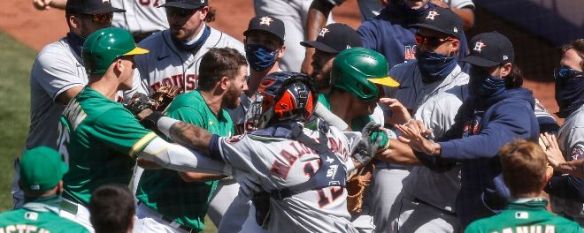
2020-08-11 BasebrawlAstrosAs

A second drill of Ramon Laureano Sunday, followed by a vulgar insult thrown his way by Alex Cintron (who ducked away when the rumble began), triggers the brawl above . . . and gets Cintron suspended 20 but Laureano, six.

Mark well today’s date on your calendar. 11 August 2020. Until further notice, it will stand as Rob Manfred’s finest hour.

Alex Cintron, the Houston Astros hitting coach who goaded Oakland Athletics outfielder Ramon Laureano into charging the Astro dugout with an expletive Latinos consider grounds for justifiable homicide at most—suspended twenty games with no right to appeal.

Laureano, who’d been hit by Astro pitches three times last weekend and twice on Sunday, then had to put up with chirping from the Astro dugout after he pantomimed a slider grip following the second Sunday plunk—six games with a right to appeal. (And he should.)

Commissioner Nero using the brains he was born with for once—priceless.

USA Today‘s Bob Nightengale broke the news of Cintron first, Laureano immediately to follow, at about mid-day today. And while you can think that a player missing six games is a lot more critical than a coach missing twenty, especially in a pandemic-truncated season that still seems more Alfred Hitchcockian than Billy Hitchcockian, Cintron hit with the heaviest hammer sends a huge message.

Several key Astros hitters aren’t exactly running the table at the plate so far this year. Jose Altuve, Kyle Tucker, and George Springer are hitting at or below the Mendoza Line. Alex Bregman is hitting more like Alex P. Keaton. Yuli Gurriel, Carlos Correa, and Michael Brantley are hitting like themselves, more or less, but those three aren’t always club carriers.

Wags, try to resist temptation to say you can’t hit what you don’t know in advance. But don’t let Cintron off the hook. A team who needs their hitting coach to hit their reset buttons at the plate needs to lose that hitting coach about as much as Mike Trout needs to lose his batting eye.

With one moment of abject stupidity, Cintron cost the Astros badly-needed resetting. Twenty games in a 162-game season is twelve percent of a long season. Twenty games in a truncated, 60-game season is a full third of a season that’s already been cast for an episode of The Outer Limits.

It’s not that charging the Astro dugout after Cintron uncorked his insult was necessarily brilliant on Laureano’s part, and Laureano knows it. But I’ll say it again: A Latino especially who knows that the vulgar version of “maternal fornicator” is a pair of fighting words to most Latino men is saying something at least as stupid as a certain American president saying the 1918 Spanish Flu pandemic ended World War II.

Hurling that insult at a Latino gets you pounded into hamburger at minimum. At maximum, it can get you a shot in the head, or any other portion of your body at which the gun might be aimed.

And what the hell did Cintron or the Astros expect Laureano to do when he’d been hit by a second pitch Sunday and a third all weekend long? Send flowers? Blow them to steak dinners with all the trimmings?

We’re not exactly taking Commissioner Nero all the way off the hook just yet. His handling of the Astrogate scandal was a masterpiece of deferred accountability. He suspended a manager and general manager, fined an owner what amounts to tip money, and let every Astro player availing himself of the Astro Intelligence Agency’s illegal electronic sign-stealing network off the hook in return for spilling the deets.

He had to know good and bloody well that the Astros versus the A’s might have potential sub-stories, considering it was an A’s pitcher (and former Astro), Mike Fiers, who finally got fed up at the absence of press interest, no matter how many reporters he and others in the know told, and blew the whistle to The Athletic‘s Ken Rosenthal and Evan Drellich last November.

You’d have to have been either a fool or a freshly-landed exile from the Klingon home world not to think that there was even a small chance that the Astros—who were only too notoriously un-apologetic about Astrogate this past aborted spring—might feel a little less remorse than repulsed that the A’s still harboured the big snitch.

Even if the A’s rotation setting meant Fiers wasn’t going to face them on the weekend. Even if the Astros’ pitching staff is injury-plagued enough that they lean as much on rookies such as the ones who did four-fifths of the weekend plunking. (Zack Greinke hit Robbie Grossman last Friday night.) Rookies aren’t immune to persuasions from their elders that one good way to make the team’s good graces is to send little messages in manners, however wrong or warped.

And, with everyone in baseball knowing that about seven-eighths of MLB players wanted if not demanded the proper Astrogate justice Manfred wouldn’t administer, Commissioner Nero looked even more foolish suspending Los Angeles Dodgers pitcher Joe Kelly eight games for sending message pitches to Bregman and Correa in the same inning.

Nobody disputes that throwing upside Bregman’s head was dangerous stuff. But nobody with a mind disputes that Manfred’s hammer on Kelly’s head—which is still under appeal at this writing—looked even more arbitraily punitive, with or without the truncated season, compared to the blanket amnesty he granted the Astrogaters.

He did likewise with the Boston Red Sox and their Replay Room Reconnaissance Ring, of course. And, just as the Astros’ 2017 World Series title became tainted forever, so does the Red Sox’s 2018 World Series title. (Managed by Astrogate co-mastermind Alex Cora, the ’17 Astros’ bench coach/spymater.)

But those who still think the Astros get an unfair greater volume of scorn should remember there was (and remains) a significant difference between the two. One more time: The Astros went a few dozen bridges farther with their Astro Intelligence Agency, either installing or altering a real-time camera to facilitate their underground sign-stealing television network.

The Rogue Sox merely used what was already made available, at home and on the road. Nobody supplied the replay rooms with multiple video monitors for cheating, of course, but those rooms amounted to handing teenage boys the keys to the hooch hutch and telling them to resist temptation until they were of legal age.

Our better angels would like to think Manfred figured a few things out after the Kelly hoopla. Not just because he soon got a hammer to drop on any future cheaters, but because the hoopla reminded him in his heart of hearts that he shouldn’t have let the cheaters in Houston, in Boston, in the south Bronx (the Yankees were merely reprimanded for some 2017 chicanery), and perhaps elsewhere, off the hook anyway.

If our better angels are right, then for once Commissioner Nero put his fiddle down and behaved like an honest-to-God, genuine leader. For once.

The adult in the room wasn’t

AlexCintronJoseAltuve

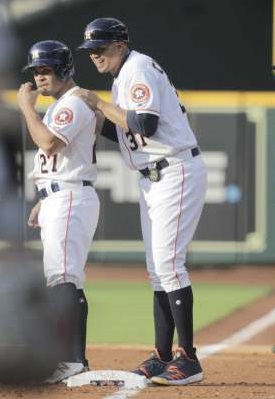
Alex Cintron (right) counsels Astros second baseman Jose Altuve after a hit. Cintron’s nasty, brawl-triggering  insult to Oakland’s Ramon Laureano Sunday shouldn’t go as lightly as Cintron got off for Astrogate.

It’s a shame, really, when something like Sunday afternoon’s basebrawl is what you need to discover a particular player is a decent-seeming fellow. Even when he’s willing to call a man who goaded him obscenely into a fight a loser. Now it still remains to be seen whom commissioner Rob Manfred will suspend more heavily.

Will the hammer fall harder on Oakland Athletics outfielder Ramon Laureano for charging the Houston Astros dugout? On Astros hitting coach Alex Cintron for climbing the dugout steps forward, urging Laureano to bring it, after calling Laureano something Latino men consider the most vile insult on earth?

Suspensions were expected Monday afternoon, so swiftly because the brief skirmish by the dugout violated MLB’s tightened COVID-19 safety protocols that enjoin against such rumbles no matter who did what.

By 7:30 pm Pacific time Monday, though, suspension lengths hadn’t even been rumoured, even if a host of observers expected if not hoped that Cintron would get the harder hammer drop for being the adult in the room who wasn’t.

On Monday, Laureano told reporters including ESPN’s Jeff Passan that despite being hit by pitches three times over the weekend including twice on Sunday he didn’t hold it against the Astros. Not even against Brandon Bailey, the Astros relief pitcher for whom Laureano was traded by the Astros to the A’s in the first place when they were minor leaguers in 2017.

Bailey drilled Laureano in the fifth on Sunday afternoon. Another Astros reliever, Humberto Castellanos, plunked Laureano on Friday night in extra innings and Sunday in the seventh. Laureano wasn’t exactly alone; his fellow A’s outfielder Robbie Grossman got it twice on Friday night. Laureano (five) and Grossman (four) lead the parade of A’s (fourteen) taking one for the team so far this truncated season.

The latter triggered Laureano to pantomime a proper slider grip toward Castellanos before he took first base and returned chirpings wafting from the Astros dugout. But the chirpings apparently included Cintron referring to Laureano as the crude euphemism for maternal fornicator.

“[Saying] in Spanish something you don’t say about my mother,” is how Laureano put it to Passan. In places where they don’t play professional baseball, saying that to most  Latino men can get you beaten senseless, assuming you can be beaten into a pre-existing condition. It can also get you stabbed or even shot.

Cintron being Latino himself should have known better. Suppose the reverse was true and it was Laureano who called Cintron a maternal fornicator? Would Cintron have resisted the urge to charge his fellow Latino with drawing and quartering on his mind?

We’ll never know what Laureano would have done if he could have reached Cintron Sunday afternoon. The coach who urged Laureano to bring it after the insult stepped aside and let other Astros do his dirty work. Except that Laureano’s former A’s teammate, Astros reserve catcher Dustin Garneau, tackled him specifically to keep him from getting bloodied.

The insult resonated with Laureano more than many of his peers, since his parents courageously enough sent him from the Dominican Republic to the United States alone so he could chase his baseball dreams. The chase has borne fruit; Laureano in three Show seasons has become something of a stealth star who’s thought to have the game’s best outfield throwing arm and showed some pop at the plate in the bargain last year.

Ask and he’ll tell you the only thing he hates about playing major league baseball is being away from his family. “Every day I wake up with the motivation to be with them,” he told Passan. “They sacrificed their life for me.”

They made the tough decision to let their own kid go to the States by himself and follow his own dreams. I’ve been away from my family for 10 years. It’s tough to be away from them. Any chance I have to be with them, I feel like I’m in heaven. So for [Cintron] to say that to me about my mom, it doesn’t sit well. I’ve got a fire inside me right away in that second.

A’s manager Bob Melvin swore to Cintron hurling the vile epithet at Laureano. Cintron denies he said that specific compound word. The A’s wouldn’t let Laureano tangle with the Astros alone. Their catcher Austin Allen took down Astros catcher Martin Maldonado, who was behind the plate calling every Astro pitch in the set, including the ones that drilled Laureano and Grossman.

Melvin said Monday that Laureano was remorseful about charging the dugout. “I’m a man, I’m a freaking man,” said Laureano, who accepts a suspension being likely. “Whatever happens, happens. I’ll take it. I couldn’t keep my cool and I should have. And I wasted my time with that guy.”

He even went out of his way to say he didn’t think any Astro pitcher who plunked him over the weekend did so with malice aforethought. “The other days I’ve been on base,” the ex-Astro product said, “we’ve been chitchatting, talking about life and family on the bases. Everything’s great. I get along with everybody on the Astros.”

That would make Laureano another kind of minority this season. Seven-eighths of MLB players, seemingly, wanted the justice Manfred didn’t exact when he immunised Astro players from the 2017-18 electro-cheating. Even if they didn’t dare suggest who’d be the first to deliver or how many would from there.

It might have been turned to one side over the coronavirus world tour, but then Los Angeles Dodgers relief pitcher Joe Kelly served four pungent reminders to two Astros a fortnight ago. Kelly’s eight-game suspension was thought too severe and remains under appeal.

Almost forgotten, too, in Sunday’s rumble by the Bay: Cintron turns out to be suspected of being one of the 2017 men who sent the Astro Intelligence Agency’s illegally pilfered sign intelligence from the monitors to the dugout and to the hitters at the plate. Like the players Manfred handed blanket immunity in return for the Astrogate deets, Cintron escaped the woodshed.

Let’s remind ourselves, too, that not a single Astro batter saw a brushback, knockdown, or plunk all weekend long, no matter how often Grossman and Laureano got dusted or drilled.

The Astros couldn’t possibly have been thrilled that A’s pitcher Mike Fiers, himself a former Astro, blew the whistle on Astrogate last November. The A’s may have been fortunate that their starting rotation schedule meant Fiers facing the Texas Rangers the night before the Astro set started and thus not scheduled to go again until this week against the Los Angeles Angels.

Intentional or no, five weekend Oakland plunks from four Astros pitchers (Zack Greinke plunked Grossman earlier in Friday’s game) was a terrible look for a team against the guys whose ranks include their whistleblower. Even if three of those pitchers are rookies.

Even if Laureano is too decent to entertain the prospect that veteran teammates or even a coach or two might have urged those Astros rooks, none of whose minor league jackets show immunity to hit batsmen, to send some messages meant to shoot the messenger’s enablers.

It’ll be a terrible look, too, if Manfred comes down harder on Laureano for charging the dugout than on Cintron for instigating the charge. But Commissioner Nero seems immune to the looks produced by his fiddling reign of error.