How not to strip the naughty sauce

Max Scherzer

Max the Knife wasn’t quite ready to perform a full strip tease over his third stop-and-frisk Tuesday night . . . but but perhaps some pitcher will, soon.

Long before she surrendered the newspaper columnist’s life for life as a novelist and eventual periodic Newsweek columnist, Anna Quindlen observed cheekily (in her early New York Times column, “Life in the 30s”) that basketball allowed women a sublime extracurricular pleasure. It was the only sport, she wrote, in which women got to watch men run around in their underwear.

Let’s be kind and allow that Quindlen thought boxing was as much of a sport as Charles Manson was a family counselor. But she wrote when the NBA’s uniforms still resembled something as close to men’s underwear as you could get away with in public without filming a comedy movie scene.

That was also then, and this is now. Major League Baseball’s ham-fisted mid-season bent on enforcing foreign-substance rules long on the books and long un-enforced may yet give women another such sublime pleasure. Baseball may yet be the first American sport in which women at the ballpark will get to watch men perform strip teases on or around the pitcher’s mounds.

Don’t be afraid to bet the rent or the mortgage on it. There just might be a pitcher ready to coordinate with the ballpark’s public address people and have David Rose’s ecdysiastical  classic “The Stripper” cued up and ready to go, hard and loud, at the split second he hands his hat to an umpire under orders to stop and frisk for naughty sauce.

It nearly happened at least twice on Tuesday night. First, Nationals ace Max Scherzer finally decided too much was enough with Phillies manager Joe Girardi’s harassment in the fourth inning—and thrust his hat and glove to the ground before yanking his belt open savagely enough that you thought he would drop trou on the spot.

Scherzer didn’t, of course. But Athletics reliever Sergio Romo almost did out in Oakland after finishing the seventh. Romo dropped trou just enough that his almost knee-length uniform jersey still kept his hind quarters covered well and good. He bent forward just so, leaving you the impression Romo was trying to moon the fools who imposed the current crackdown without quite being too cheeky about it.

So neither Max the Knife nor El Machon felt confident enough to perform baseball’s first known on-the-field striptease. Somebody just might, though. It could take long enough for Jacob deGrom to make plans, coordinate, then sail into it to David Rose’s tune at the moment he’s accosted and handed the search warrant.

When deGrom had the dubious honour of being the first under the fresh crackdown (or should that be crackup?) to be stopped and frisked Monday afternoon, he couldn’t stop grinning wide when he wasn’t laughing his head right off his shoulders. Maybe if Scherzer had been the first he’d have thought it was funny, too. Maybe.

But do you think a fellow like deGrom, who’d laugh his way through one of his sport’s most ridiculous over-compensatory gestures, would find it hard to resist a shot at making the Chippendales resemble the Chipmunks in order to send a counter-message to baseball’s garbled and clumsy one?

Commissioner Rob Manfred is a man with a ten-thumbed touch and a pronounced cognitive inability to recognise the true roots of crises that spring from his apparent need to demonstrate that Rube Goldberg should have been a baseball executive.

But even Manfred and his gang couldn’t ignore the ridiculously sublime message sent if and when baseball’s best pitcher decides the way to start putting a stop to this is to channel his inner Gypsy Rose Lee. Could they? They already seem somewhat immune to the concept that there might have been a better way to address the naughty sauce than this.

Resisting Manfred’s Rube Goldberg side to experiment with the baseballs themselves would have kept this issue from getting sticky in the first place. Pitchers normally have enough trouble just keeping their arms, elbows, and shoulders from breaking and tearing, whether they’re throwing speeding bullets, voluptuous breaking balls, or slop.

Not to mention their sides, swinging the bats, in the National League at least, since the designated hitter is not yet permanently universal as it should be.

(Don’t even think about it. Just as Nolan Ryan was an absolute outlier for his 27-season career and insane in the brain work loads—though it’s oft forgotten that Ryan had physical issues very early in his career, including missing all 1967 with one—Jacob deGrom and his .407/.407/.444 slash line as of Wednesday morning is an absolute outlier among this years pitchers hitting a whopping .112/.153/.142 slash line thus far.)

Of course, resisting Manfred’s Goldberg side would also require—what do you know—the immediate disappearance of the three-batter minimum for relief pitchers and the free cookie on second base to begin extra half-innings. Don’t say it as though disappearing them would be terrible things.

What has Manfred thought about his precious pace-of-play improvement campaign now that the mandatory stop-and-frisking for naughty sauce has gone from the ridiculous to the deranged and has probably delayed games by a few more minutes apiece?

What does he think’s going to happen to the pace of play when an indignant pitcher finally gets beyond Max Scherzer’s or Sergio Romo’s kind of annoyance and goes as full Ned Braden as a baseball player can go on grass and dirt?

(Who’s Ned Braden? As played by now-retired actor Michael Ontkean, Braden was the anomalously non-violent minor league hockey player diverting the bloodthirsties’ howling blood lust during an on-ice championship game brawl by performing a gracefully-skated strip tease around the rink—provoking the high school band in the stands to make with “The Stripper” and the ladies in the arena to go bonkers with delight—in the Paul Newman film Slap Shot.)

In absolute fairness, it doesn’t seem as though the umpires are necessarily thrilled about being under orders to stop and frisk for naughty sauce, either. Understandable. They have enough trouble with their current reputations for being only too human, with the almost-pandemic blown calls and enough in their ranks believing fans pay their hard earned dough to come to the park to see them behave as laws unto themselves.

They need to be the Commish’s Elite Guard about as badly as deGrom needs two more miles an hour on his best fastball. No member of the crew working the Yankees-Royals game Tuesday night could have felt thrilled about having to stop and frisk Yankee reliever Jonathan Loaisiga after coming out of an eighth inning in which he was slapped silly for four runs on five hits.

Some of us call that adding insult to injury. Others of us wondered if the umps were trying to tell him that, if he did have a little naughty sauce at hand (or anyplace else on his assorted anatomy), there was no excuse for getting pinata’d like that.

The crew working the Nats-Phillies game that got Scherzer’s underwear in a twist has the likewise dubious honour of having thrown out the first manager because of the naughty sauce crackdown.

Girardi called for the third Scherzer stop-and-frisk, just because a) he could, and b) there’s a too-fine line between real cheating alarm and bad-faith gamesmanship (which the memo says can get a manager suspended, folks), but when he tried goading Scherzer and several hollering Nats coaches into a fight Girardi got sent to bed without his supper for the night.

Clayton Kershaw thinks that’s not enough. “I think there should be a punishment if they don’t catch anything on the guy,” the future Hall of Famer said after he saw Max the Knife get knifed in the fourth. “I think Scherzer, you know, he’s one of the best pitchers of our generation. To see him get checked . . . and mess up his rhythm . . . you better find something if you’re going to call him out like that.”

So who’s it going to be, ladies and gentlemen? Who’s going to be the first pitcher to decide too much is enough and go Ned Braden on or around the mound before Manfred gets the a-ha! and addresses the naughty sauce—and the baseballs themselves—reasonably? Who’s going to be the first likewise indignant umpiring crew to let him?

Maybe make the Girardis strip tease if they’re going to cross the line between reasonable doubt and trying not to pay the rent to live in a pitcher’s head. (Oops. Better be judicious about that, especially if you’ve seen Tony La Russa lately.)

I wonder if someone makes breakaway baseball uniforms. If this keeps up, he or she may soon find themselves making such Mets, Nats, A’s, or other uniforms. Unless entire teams decide to play with nothing on but their briefs, jocks, and socks. Nothing to see there! Move on! David Rose, wherever you are, cue up the band.
Georgia on our minds

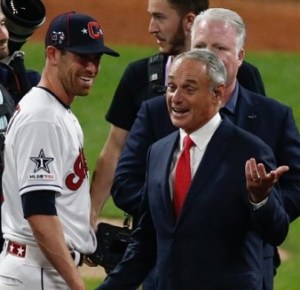
Commissioner Rob Manfred congratulating 2019 All-Star Game MVP Shane Bieber. Did he think deep or hard before moving this year’s All-Star Game out of Atlanta?

Most of us, generations be damned, grew up hearing the two most certain of life’s certainties are death and taxes. Everyone has candidates for the third certainty, including that which reminds us of one thing that crosses partisan lines even if the partisans forget the other side does it, too.

Translated to baseball terminology, that thing seems to be demanding a replay review when ball four is called in election races on what they think they threw for strike three. When such a review turns into something such as a new state election law, as in Georgia, there comes a fourth guarantee: somebody isn’t going to like it.

A lot of somebodies don’t like the law. Such somebodies as former Georgia state lawmaker Stacey Abrams and President Joseph Biden. A lot of not-so-much-somebodies don’t like the law, either, and their agitation as much as any other factors have prompted among other things major league baseball’s government moving this year’s All-Star Game and college draft out of Atlanta’s Truist Park.

Abrams had skin in the game going in. She lost Georgia’s 2018 gubernatorial race to Brian Kemp, who signed the omnibus bill into law earlier this month, by 50,000 votes, claiming then-Georgia secretary of state Kemp erased thousands from state voter rolls.

Kemp had skin in the current game going in, too. For the heinous offense of certifying that now-former president Donald Trump didn’t push the winning run across the state plate in the bottom of the twelfth, regardless that Kemp wasn’t exactly known to favour anyone other than Trump, Kemp faced Trump’s none-too-silent wish to see him thrown out of the league.

The most understandable result of Trump’s post-campaign campaign to overthrow his loss to Biden might have been Georgia and other states reviewing and tightening up their election laws. The only place where fury and back-and-forth charges of foul get more furious might be a baseball game decided (in truth or in allegation) by a close call for or against one or the other side at the final out.

Election shenanigans have been as common in American politics as yard signs, and they didn’t begin or end with such ancient players as New York’s Tammany Hall, Chicago’s Daley Machine, Kansas City’s Prendergast Machine, or Nassau County’s (Long Island) Margiotta/D’Amato Machine. Wherever you landed observing Trump vs. Biden, your least shocking revelation would have been one or another state addressing their election laws in the aftermath.

When Kemp signed the new Georgia election law, Abrams charged that it “suppresses voters, criminalizes compassion & seizes election authority from local + state officials.” That statement wasn’t half as incendiary as Biden’s prompt denunciation of the law as both un-American and as “Jim Crow on steroids.”

Georgia’s real history with Jim Crow is grotesque enough, from state poll taxes (1877) and literacy tests from which descendants from Confederate and Union soldiers were exempt (1907) to the “white primary” rule (1908) that prohibited non-white voting explicitly. Jim Crow in any southern states was (and remains) a portion of American history for which the nation can never be proud.

Now, about the new Georgia election law. Examine deeper than what you see excerpted in the press and aboard social media. Comparing it to Jim Crow is nebulous. It only begins with the fact that mandating seventeen days pre-election (two Saturdays included) for early voting—with mandatory eight-hour-minimum open times and allowance for twelve-hour (7 a.m.-7 p.m.) times—doesn’t exactly “suppress” voters.

A good number of states lack that allowance, including Biden’s home state Delaware which isn’t going to put it in place before the next Congressional election year 2022. Biden himself—with different priorities and a far less grotesque personality, he’s like Trump in showing you wisdom by standing athwart it—also said the Georgia law imposes limits on absentee voting that “effectively” (his word) deny voting to “countless” people. That’s not exactly what the law says or does.

For one thing, no-excuse absentee voting stays in place with just a couple of adjustments. I’d be hard pressed to think a voter is being “suppressed” because the absentee ballot application window is a “mere” 67 days, or because such applications you can now do online, because the state secretary of state is now required by law to offer them online. Or, because the absentee ballot must be received by election officials at least eleven days before Election Day.

Some of the new law’s critics harp about the voter identification portion, which has now shifted it from matching signatures to identification numbers from a voter’s driver’s license or free voter identification card. Lacking either, a Georgia voter can present a photocopy of a utility bill, a bank statement, a paycheck, a government check, or an official document that includes his or her name and address. All they have to do is include the last four digits of their Social Security numbers if they don’t have driver’s licenses or previous voter ID numbers.

If that’s “voter suppression,” I’m Willie Mays. And if that’s something designed to keep non-white voters from voting, I’m hard pressed to comprehend the 2016 Gallup survey that found 77 percent of non-white voters supporting photographic voter identification. You’d think (properly) that non-white voters have just as much stake in preventing real (not alleged) voter fraud as white voters have. And you’d be right.

The new Georgia election law also puts the famous drop boxes into law. They showed up in Georgia for the first time last year thanks to the pan-damn-ic, and now they’re legally mandatory with or without the coronavirus. The new law requires one drop box for every one hundred thousand registered voters or one for every advance vote location in any Georgia county, whichever number is smaller.

Abrams was right about one thing: the new law does “criminalise compassion,” sort of. Giving, offering, or helping give food and/or drinks to people within 150 feet of polling places or within 25 feet of voters in line to vote becomes a legal misdemeanor. Even, seemingly, when the benefactor isn’t discussing the election or particular favoured candidates.

The law also bars ordinary Georgians from photographing or recording their own votes. Guess who gets an exemption from that: the state secretary of state, whom the law requires to create “a pilot program for the posting of digital images of the scanned paper ballots created by the voting system,” with the images becoming “public records subject to disclosure.”

I’ve read about enough early proposals for inclusion in the law that were foolish at minimum, dangerous at most, and thrown out of the bill before it became a final product. But how the hell did that one slip in? How close do you think that one gets to the kind of thing you thought was reserved for the Third Reich, the Soviet Empire, and other authoritarian/totalitarian states who’ve used ballots when allowed at all against their citizens?

Kemp and any Georgia governor has a line-item veto power—but it affects only statewide and state executive budget items. Even he can’t be comfortable with the idea that his or any Georgia secretary of state can come that close to crossing the line from scanning paper ballots to making Georgians’ votes public.

You can bank it. Baseball commissioner Rob Manfred and his minions probably didn’t read the new Georgia law in almost any way, shape, or form. You can understand why, since the law’s volume is 68 percent (92 pages if you’re scoring at home) the length of Philip Roth’s legendary novella Goodbye, Columbus. But the mis- or mal-excerpting of the law did them no favours and puts baseball into a precarious position.

For one thing, the Atlanta Braves themselves aren’t thrilled with baseball pulling the All-Star Game out of their home playpen. Indeed, even Abrams herself has said Georgia companies shouldn’t jump all the way into boycotts but first “use the chance to publicly condemn the law, invest in voting rights expansion and support wide-ranging federal election legislation before they’re targeted with a boycott movement,” as the Atlanta Journal-Constitution puts it.

For another thing, former UN ambassador and Atlanta mayor Andrew Young demurs from any such boycott, especially involving Atlanta, whatever he thinks of the new law, telling The Athletic, “Everything doesn’t depend on sports. But if you hurt the sports, you hurt the hotels, you hurt the airport, you hurt every business in town . . . [Atlanta’s] the 44th largest economy in the world — and, you can quote me, I don’t know why anybody wants to [fornicate] with that.”

Manfred and his look more like knee-jerkers than thoughtful protesters who considered the whole thing reasonably. (They look, in other words, much the way Trump looked when thundering against Maximum Security’s 2019 Kentucky Derby qualification or on behalf of Pete Rose’s Hall of Fame entry without troubling himself with the deets on both rejections.) Lacking an immediate suggestion for an alternate All-Star Game site this year is the least of Commissioner Nero’s largely self-imposed problems.

On Wednesday night, some Republican lawmakers in Georgia’s state House of Representatives voted to cancel a tax break for Georgia-based Delta Air Lines, on the grounds that Delta objected to the new election law. “You don’t feed a dog that bites your hand,” said Georgia’s House speaker David Ralston. “You got to keep that in mind sometimes.”

Imagine the furies if Democratic officials behaved likewise. Oops . . . Lois Lerner, for openers, call your office.

Wherever you sit about the law itself, the thought of governing officials deciding a private entity needs to be punished for taking any position regarding any legislation or policy should scare the hell out of you. If they can do it to an airline, they can do it to anything, including the business of a game.

This commissioner gotta commission better

Commissioner Rob Manfred hands a piece of metal to 2020 World Series-winning Dodgers co-owner Mark Walter.

Once upon a time, when Ed Fitzgerald chaired the Milwaukee Brewers and former Red Sox star George Scott was their first baseman, Scott surveyed the lay of the team’s baseball land. Then, he offered Fitzgerald sage counsel which the chairman may or may not have taken above and beyond a shaft of Scott’s underappreciated wit.

“You know, Mr. Fitzgerald,” said the Boomer, “if we’re gonna win, the players gotta play better, the coaches gotta coach better, the manager gotta manage better, and the owners gotta own better.” It’s to wonder whether Scott, who died in 2013, might be surveying the lay of baseball’s land today from his seat in the Elysian Fields, adding, “And, the commissioner gotta commission better.”

Good luck with that. Commissioner Rob Manfred remains baseball’s Nero, fiddling while the game burns. The good news is, the fires are scattered and more vulnerable than the current edition of the Pirates. The bad news is, Manfred too often behaves as though this fire needs just a couple of sprinkles to quench while that fire requires gasoline. When he’s able to make up his mind in the first place.

The fact that there is confusion about whether or not there will be a universal DH in MLB for the upcoming season,” tweets former Dodgers and Mets player development official Nick Francona, perhaps channeling his inner George Scott, “is a reflection of how bad the commissioner is at doing commissioner things.”

Commissioner things include something outlined formally in the Major League Baseball Constitution: Section 2(b) and 2(c) let the commissioner investigate and remedy or punish “any act, transaction, or practise charged, suspected, or alleged not to be in the best interests of the national game of Baseball.”  Section 3 outlines the commissioner’s punitive remedies, including the maximum $2 million fine against a team, $500,000 fine against an owner or club executive, and “an amount consistent with the then-current basic agreement with the Major League Baseball Players Association.”

In other words, baseball commissioners have slightly broader powers over the game than presidents of the United States have over the country. But they don’t always use those powers when they should and ignore them when they shouldn’t.

Think of things this way: Presidents have itched for grander powers than that chintzy Constitution gave them in the first place. Sometimes they’ve gotten them; sometimes, Congress has handed them to the president on a platter. But even there the president has his (or her, perhaps, in the future) limits, even if he (she) accepts them kicking and screaming.

Richard Nixon once thought that if the president does it it’s not illegal–and was disabused of that idea profoundly enough. Bill Clinton and Barack Obama shamelessly believed, as Clinton’s aide Paul Begala once said, infamously, “Stroke of the pen, law of the land. Kinda cool,” regarding lawmaking which isn’t really the executive branch’s constituted function, though assorted Congresses past have pawned enough of their lawmaking off to the executive branch. Donald Trump once said, “Then I have an Article II, where I have the right to do whatever I want as president.”

Maybe those men should have sought to become baseball commissioners. Section 4 of the MLB Constitution says that, unless it’s something on which votes are required, the commish can’t be limited in acting in the game’s best interest.

Tanking teams? Guess what. Section 4 says the integrity of the game “shall include without limitation, as determined by the Commissioner, the ability of, and the public perception that, players and clubs perform and compete at all times to the best of their abilities.” (Emphasis added.) For clubs, you’d have to be naive at minimum or sight and hearing impaired at maximum to believe a club’s performance is limited to the play on the field.

Astrogate? Well, it was fully within Manfred’s right to decide the better part of valour was to hand players on the 2017-18 Astros blanket immunity in return for spilling about the how and why of the Astro Intelligence Agency. That doesn’t mean it was within his smarts. So the Astros got fined $5 million max, owner Jim Crane got fined five hundred large, Manfred threw in a couple of forfeited choice draft picks for good measure, and—except for general manager Jeff Luhnow—the cheaters got away with it officially, if not in the public eye.

If only the powers to act in the game’s best interest included the kind of intelligence test that would have required Manfred to remember the good of the game isn’t restricted to making or saving money for it. He could have told the tankers, “Nobody likes to lose, money or games, but if you didn’t get into this game to even try winning you might want to think about getting out.”

(P.S. The commissioner can force an ownership out, at least by way of calling for a vote to throw him or her out. There’s no “deprivation of property rights” involved, as someone of my former acquaintance tried to plead when Bud Selig finally forced Dodgers owner Frank McCourt to sell. Baseball’s a franchise business. Just like McDonald’s. Break the rules, abuse your franchise, you’re out, whether you’re making Big Macs or a baseball team.)

Manfred had the same power to tell the 2017-18 Astro players, “You’re going to spill, or I’m going to spill you.” The Astros might not have even thought about trying that non-apologetic apology/apologetic non-apology presser last year before the pan-damn-ic shut spring training down.

And Manfred could have made an effort toward more than near-boilerplate in denouncing cheating, the way A. Bartlett Giamatti—then president of the National League—did in upholding the suspension of ball-doctoring Phillies pitcher Kevin Gross, even if Manfred isn’t anywhere in Giamatti’s league as a writer, speaker, or thinker:

Acts of cheating . . . are secretive, covert acts that strike at and seek to undermine the basic foundation of any contest declaring the winner—that all participants play under identical rules and conditions. Acts of cheating destroy that necessary foundation and thus strike at the essence of a contest. They destroy faith in the games’ integrity and fairness; if participants and spectators alike cannot assume integrity and fairness and proceed from there, the contest cannot in its essence exist.

Manfred’s ham-handed bid to try tying the universal DH to the expanded postseason was so clumsy—though not quite as clumsy as his try at reneging on the pro-rated players’ pay deal before last year’s irregular season finally launched—that you couldn’t blame the players union from saying no, nein, and nyet. The commissioner also gives little indication that he understands the former’s benefit to the game on the field and the latter’s compromise of it.

Has anyone shown Manfred the historical futility of pitchers at the plate instead of throwing to it? (Does he even know the DH was a National League idea first?) Has anyone explained to him the universal DH isn’t going to add jobs as much as it’ll offer a fair number incumbent pine riders chances to get in the game, because they may not be leather virtuosi but they can sure swing the bat and create runs?

Has anyone really sat Manfred down to explain that the postseason was diluted and saturated already with the double wild cards in each league without his even thinking about making last year’s pan-damnic-ally inspired expansion/dilution a permanent thing? Has anyone explained to Manfred that the more postseason games, the more saturation, and the more general fan interest dissipates by the time the World Series rolls around?

All that and more might require something that seems beyond Manfred’s competence, if not his being. Whatever errors his predecessor and former boss Bud Selig committed, and Selig was baseball’s Fiorello La Guardia in that regard (the legendary New York City mayor: When I make a mistake, it’s a beaut), even his least flexible critics never questioned that Selig genuinely loved baseball.

Few fans and certainly no commissioner before or since have been as eloquently shameless in loving baseball as deeply as the ill-fated Giamatti loved the game. It’s not even close. But not even in anger would Selig refer to the World Series trophy as just a piece of metal, under any impetus. Dive into the voluminous published writings about his successor and you won’t go more than a few minutes without seeing questions as to whether Manfred even likes, never mind loves the game. One minute it seems yes, the next, no.

Baseball hasn’t been quite as irrevocably “traditional” as its self-appointed purists wish to think. Much like the country that is its home, the game has rid itself of dubious traditions in the past and created or allowed newer ones throughout its history. It takes a commissioner of vision to conjugate the distinctions and develop or promote the remedies required if and when required.

Manfred isn’t exactly a man of vision. Unless you consider monkeying around with the ball, awarding free cookies on second base to open extra half innings, imposing arbitrary limits on pitching changes, ignoring the real culprit of protracted games (hint: it takes less time to bring relief pitchers in and have them ready to face the next batters than to run the commercials that run during those changes), and fiddling while the tankers burn the their fans and the game itself visionary.

It’s enough to make you afraid of what’s going to happen when the current collective bargaining agreement finally does expire after this season. That is, unless Manfred and MLBPA executive director Tony Clark—himself not necessarily over-endowed with vision—decide at last to start thinking about the true good of the game above and beyond saving or making money for it.

Maybe it’s time to consider a different way to choose a baseball commissioner. From the beginning, the commissioner has been the owners’ pick alone. Maybe it’s finally (if not long past) time to bring the players into that process. Maybe it’s time for a commissioner to be chosen from a vote of thirty team ownership representatives and thirty team player representatives.

Quick: Name one fan who ever paid his or her hard earned dough for a day or night at the ballpark to see the team’s owner—except perhaps for lusty protest over protracted calamity. (Who else remembers the Yankee Stadium Banner Day winner of the late 1980s, wearing a monk’s outfit, carrying a Grim Reaper’s scythe, from which hung the placard, “Forgive him, Father, for he knows not what he does”—and ejected from the yard promptly on official orders?)

Manfred is in over his head holding the job. He shouldn’t have had the job in the first place. But so long as he does—barring an uprising among his employers, the owners, he has it through the end of 2024—this commissioner gotta commission better.

Formalising what people of heart, soul, and mind always knew

Monte Irvin and Willie Mays—major leaguers as Giants and as a Newark Eagle (Irvin) and Birmingham Black Baron (Mays).

When Ted Williams was inducted into the Hall of Fame in 1966, he kept it short, sweet, and shameless. One moment, Williams gave props to Willie Mays, who’d passed him on the all-time home run list days earlier: “[H]e’s pushing, and I say to him, ‘Go get ’em, Willie’.” Then, the Splinter hit a grand slam:

Baseball gives every American boy a chance to excel. Not just to be as good as someone else, but to be better. This is the nature of man and the name of the game. I hope that one day Satchel Paige and Josh Gibson will be voted into the Hall of Fame as symbols of the great Negro players who are not here only because they weren’t given the chance.

Gibson didn’t quite live long enough to receive his chance to play major league baseball; he died before Branch Rickey finally began the undoing of what should never have been done in the first place. But he was inducted into the Hall of Fame as a baseball immortal in 1972.

Paige did get his chance. Among other things, he kept Williams to a .222 hitting average and slugging percentage but a .364 on-base percentage, after joining the American League with the Cleveland Indians and in due course the St. Louis Browns—in his forties.

Unlike Gibson, Paige did live long enough to see himself inducted into the Hall of Fame, the first Negro Leagues player so inducted (in 1971) after a special committee was formed to determine, as best they could with what they had, whom among the Negro Leagues’ best belonged in Cooperstown.

Not long before then-commissioner Bowie Kuhn formed the committee, his predecessor William Eckert convened another committee to isolate which among the earliest professional leagues merited official major league status. Four leagues were given such formal recognition by that group: the American Association of 1882-91, the Union Association of 1884, the Players League of 1890, and the Federal League of 1914-1915.

The Negro Leagues weren’t even a topic then. Boy, are they a topic now, with commissioner Rob Manfred having pronounced that the seven professional Negro Leagues which played from 1920 to 1948 shall henceforth be known as major leagues. Did I say seven?

Manfred conferred formal major league status on the first Negro National League of 1920-31, the Eastern Coloured League of 1923-28, the American Negro League of 1929, the East-West League of 1932, the Negro Southern League of 1932, the second Negro National League of 1933-1948, and the Negro American League of 1937-1948.

That’s the formality. Any baseball fan with heart, soul, and mind coordinating properly didn’t need a formal proclamation to know the Negro Leagues were as good and sometimes better than the “official” major leagues. They knew down to their bone marrow that Ted Williams was dead right in his implication that the “official” Show’s pre-1947 segregation denied those leagues and a good number of their players their propers.

Why the 1948 cutoff? That was the year of the final Negro World Series, between the Homestead Grays of the NNL and the Birmingham Black Barons of the NAL. (The Grays flattened the Barons in five, despite the Barons’ sharp center fielder—a child prodigy named Willie Mays.) With Jackie Robinson having cracked the old, disgraceful major league segregation line a year earlier, and National and American League teams beginning to scout and sign Negro Leagues talent, however incrementally, the Negro Leagues’ days were numbered.

After that Series (the Grays won the last such major league-level championship in Washington until last year’s Nationals), the Negro National League folded, followed by the Grays themselves in 1951 after barnstorming proved financially untenable. With the two then-solely recognised major leagues continuing to bring black talent aboard, the Negro American League fell back to the equivalence of the highest minor league before folding in 1958.

Bob Kendrick, a man of impeccable intelligence and sensitivity who presides over the Negro Leagues Baseball Museum, knows the difference between conferring historical merit and validating the Negro Leagues and its players as major leaguers. “[T]hey never looked to Major League Baseball to validate them,” Kendrick tells MLB.com writer (and author of the splendid A Fan’s Guide to Baseball Analytics) Anthony Castrovince.

But for fans and for historical sake, this is significant, it really is. So we are extremely pleased with this announcement. And for us, it does give additional credence to how significant the Negro Leagues were, both on and off the field.

A writer for The Athletic, Marcus Thompson II, sees and raises. “‘Oh, so now they’re good?’ was my initial reaction,” he writes in a forum convened by the journal to discuss the Manfred pronouncement.

Josh Gibson doesn’t need validation from Major League Baseball. Oscar Charleston doesn’t need validation. Pop Lloyd ain’t suddenly legit now because MLB basically decided to include him in the fold. It reeked of baseball’s arrogance. It wasn’t so much the inclusion of Negro League players, but the idea that somehow they are being officialized by this inclusion. This, obviously, should have been done a long time ago. But the pretentiousness of believing this to somehow be an elevation of those players, as if they’re being knighted posthumously, is insane and offensive . . . Satchel Paige was already a Major Leaguer by every other possible definition. Cool Papa Bell’s been official. His name is Cool Papa Bell.

Did we really need Rob Manfred to tell us Satchel Paige (left) and Jackie Robinson were major league level in the Negro Leagues?

Indeed. And, what do you know, just one prowl of social media delivered enough of the half-witticisms of those who think any thought of the Negro Leagues as “official” major leagues carries the whiff of political correctness. One such miscreant sticks uncomfortably in my mind: “[T]hey didn’t play against ball players like Bob Feller and Ted Williams sooooo… they didn’t play against major league talent.”

Well, now. I’d have loved the miscreant to explain what he thinks of the Show’s willful exclusion of non-white talent prior to 1947. (Fair disclosure: I zapped him by answering his foolish remark with the aforequoted Williams valedictory. As I write, he hasn’t offered an answer.) Do he and others of (I hate to use a four-letter word when ladies might be reading) like mind think such “major leaguers” as Robinson, Mays, Larry Doby, Roy Campanella, Henry Aaron, and Ernie Banks were just another bunch of minor leaguers before “organised baseball” deigned to invite them aboard?

Those of us who love the game and share the concurrent strain that its statistics are its life blood face a pretty pickle, too: How to finalise the true statistics of Negro Leagues competition. For one thing, it was known long enough that the Negro Leagues didn’t keep complete statistics for assorted and largely unpleasant reasons tied in large part to the unconscionable segregation of the so-called National Pastime.

The legends yielded by the Negro Leagues have been fun as legends but problematic as statistical analysis. Josh Gibson hitting eight hundred home runs plus in his baseball life is great fun as a legend, but how many did Gibson actually hit in Negro Leagues competition against how many did he actually hit on the barnstorms?

Castrovince observes that Negro Leagues statistics from leagues competition in 1920-1948 will be the ones brought to account, for a couple of very good reasons: Trying to develop the leagues before 1920 weren’t successful “and lacked a league structure.” Fans black, white, brown, and paisley alike may be disappointed with the net result because the barnstorm and exhibition stats won’t be included.

It won’t be simple, says another Athletic forum participant, Marc Carig. “[T]here are still games missing from the historical record,” he begins.

As of now, researchers have documented 73 percent of Negro League games contested in the 1920-1948 window of inclusion. That figure will keep climbing. More and more newspapers are getting digitized, making it easier to search for documentation. But it is still unlikely it will ever get to 100 percent. That can be a challenge. Now begins the work of figuring out how to incorporate that existing data into the official records. That’s the next step in the process. It’s not an easy one. But it’s worthwhile.

Forget about whether Gibson knocks Aaron and Barry Bonds out of the home run record books. He’ll probably still look like the great bombardier of his legend. And, since Aaron’s Negro Leagues play came after 1948, any home runs he hit before joining the Braves’ organisation won’t change his career home run total. Or the magnitude of his career and of a certain night in April 1974.

But Mays will see some changes. Let’s look. He had 73 plate appearances for the 1948 Black Barons, with sixteen hits including two doubles, twelve runs batted in, and twelve walks.He hit .262 with a .384 on-base percentage but a .295 slugging percentage with the ’48 Black Barons. His OBP won’t change, but his hitting average (sorry, the traditional batting average is incomplete and mistreats hits) will fall . . . one point, to .301. His slugging percentage will also fall . . . one point, to .556.

Another Athletic forum participant, Jason Jones, understands the concurrent late symbolism and undercurrent shame in Manfred’s pronouncement. “[I]f it took this announcement for you to believe Josh Gibson was one of the best to ever swing a bat, shame on you,” Jones says. “This is clearly long overdue. I wish those players were here to see baseball finally do the right thing.”

It shouldn’t have taken us that pronouncement, either, to believe Satchel Paige was one of the best ever to take the mound. (Casey Stengel would hector his Yankees when he saw Paige throwing in the bullpen, “Get your runs now—Father Time is coming!” That was when Paige was in his 40s and not exactly in his prime.)

Or, that Buck Leonard was one of the best ever to play first base.

Or, that Monte Irvin may have been the actual best of the Negro League talents to cross into the Show when he finally did, and that he might have given the Show another decade of his best before an ankle injury compromised him while with the Giants. Among others. (Irvin’s lifetime major league hitting average might jump to .304 when the records are adjusted.)

Said Manfred in a formal statement, “All of us who love baseball have long known that the Negro Leagues produced many of our game’s best players, innovations and triumphs against a backdrop of injustice. We are now grateful to count the players of the Negro Leagues where they belong: as Major Leaguers within the official historical record.”

Where they always belonged.

Now, if only Manfred and his minions would take things from there to send the Show on a real, substantial mission to rekindle deeper interest in baseball among black youth around the country, whether inner city, suburbia, or the country life. Black people have elevated the game as men and as players, coaches, managers, and executives, even if the number  among the last three of those remains terribly low.

Today’s young black aspirants deserve to know the game belongs to them, too. Numerous localised organisations carry that mission splendidly. It would give them a badly needed lift, and further honour the Negro Leagues legacy, if Manfred and his get off the schneid and onto the hunt. It’d mean as much and maybe more than how Jackie Robinson’s Hall of Fame plaque would look with the addition of his seasons with the Kansas City Monarchs.

On roasting Manfred and redeeming Kershaw

How sweet it is for Clayton Kershaw at last.

Above and beyond the obvious, two sights and sounds in Globe Life Field tended to out-shine the rest after the Los Angeles Dodgers won the World Series. In order, they were commissioner Rob Manfred being booed while he spoke during postgame ceremonies, and Clayton Kershaw hoisting the World Series trophy with the biggest grin this side of Teeth Malloy.

Getting a season in at all in the time of coronavirus was somewhat miraculous, even if Manfred and his overlords did just about everything in their power to make it difficult, impossible, and don’t-even-think-about-it. Would it have been better to live without the Show at all this year? We’ll never know now.

Then Manfred and his masters decided to impose the sixty-game irregular season. And they couldn’t resist tinkering like the nutty professor going a hundred miles backward to go one mile forward. Manfred may be seen as just the owners’ messenger boy, but his office also allows him liberal latitude to act on behalf of the good of the game.

The good of the game does not include a free runner on second to start the extra innings. The good of the game does not include a three-batter minimum for relief pitchers except when they were brought in during disaster and got out of it. The good of the game does not include a postseason array that actually made room for two losing teams to even think about playing for a championship.

One out of four ain’t bad. The universal DH needs to stay. Period dot period. That one Manfred gets right. It only took 129 years for the National League to be made to catch up to the NL owner who thought of it in the first place because the pitchers in his day couldn’t hit, either.

God help us if Manfred decides the 29-31 Houston Astros getting to within one game of winning the pennant says, “See? We told you! Letting the losers in didn’t stop the cream from rising!” Even allowing the irregular, truncated regular season, there was only one reason to pray the Astros got to the World Series: if the likewise 29-31 Milwaukee Brewers somehow got there, too.

It would have made Manfred and his masters look like the fools they would have been if American baseball’s annual crowning achievement had been decided between (ir)regular season losers. Not that they needed that to look foolish, of course.

Pray that even one among the owners to whom the common good of the game is, was, and always will be making money for it otherwise hits Manfred with the wake-up-your-brain two-by-four. And, that 2021 will see a return to some semblance of normalcy. Just some will do. Would Steve Cohen, the brand-new owner of the New York Mets, like to be that stand-up guy? He’d make Branch Rickey the proudest man in the Elysian Fields.

Enough of that for now. Manfred getting booed is only a transient pleasure. Kershaw hoisting that piece of metal is transcendent. Especially after he pitched like the Hall of Famer-to-be that he is all postseason long. Especially after his manager finally figured out how to keep him from situations in which even the Greatest Pitcher of His Generation could get bushwhacked, bastinadoed, broiled, and basted.

The narrative of Kershaw looking like Sandy Koufax in his regular season career but Crazy Schmit in the postseason was always a little on the ridiculous side. It finally got exhausting to remind people that you could probably win a pennant fielding a team full of the Hall of Famers whose regular seasons put them in Cooperstown but whose World Series gigs compared to Blooperstown, often through no fault of their own.

Juan Marichal only got to appear in one Series at all and barely had the chance to strut his real stuff. Willie Mays had The Catch in 1954 but nothing much else to show for three Series. Ted Simmons reached one Series near the end of his career and showed the beginning of his decline phase. Ted Williams reached one Series, was throttled by an elbow injury, and never got another chance. Robin Roberts lost a tough game in his only World Series and never got another chance to try. Joe Morgan had the occasional moment but a modest overall Series jacket.

To them add these Hall of Famers: Luke Appling, Ernie Banks, Jim Bunning, Rod Carew, Andre Dawson, Ferguson Jenkins, George Kell, Ralph Kiner, Phil Niekro, Gaylord Perry, Ryne Sandberg, Ron Santo, and Billy Willams never got even a single taste of Series play.

“Baseball executives like to talk about how variance dictates the postseason,” Andy McCullough writes in The Athletic. Kershaw has pitched long enough in October to live that truism. It would be disingenuous to say his bad numbers stem from bad luck. Yet it would be foolish to ignore the breaks.”

Once upon a time, Kershaw’s handiwork got wrecked through little enough fault of his own. This time, whenever Kershaw needed the breaks the most he got them. Breaks like Cody Bellinger’s stupefying, back-to-the-wall, rising theft of a go-ahead bomb by Fernando Tatis, Jr. Like the Braves’ Austin Riley tripping into a key out. Like Victor Gonzalez in relief ending a troublesome inning by palming Mike Zunino’s speeding bullet.

Kershaw is a man whose teammates describe him as playful and a little goofy on the days he doesn’t pitch. He’s so unapologetically footloose when playing with his young children at the ballpark and elsewhere on his days off that it’s easy to ask who’s more fortunate, Kershaw for having such agreeably charming children or the children for having such an agreeable father.

He also prizes control of his work and his personal environment on the days he does pitch. Especially the past two seasons, when he’s had to remake his approach in part because of persistent back issues and in part because of the onset of baseball age. But he appreciates when he gets those little extras in a game that so often prove the equivalent of the World War II fighter pilot having nothing but a turning propeller between himself and disaster.

This time around, Kershaw didn’t have to be the most powerful engine on the Dodger aircraft. He just had to do what he could do with whatever he had. The Dodgers entered Game Four believing they’d finish one game from crossing the Jordan and ended up on the wrong end of maybe the single most berserk loss in World Series history.

All that meant was Kershaw pitching Game Five not to get to the Promised Land but to get to the Jordan’s banks after such a surreal throwback. Kershaw’s Game Five mastery got  them back to the banks. This time, Mookie Betts, Corey Seager, Austin Barnes, and the Dodger bullpen rowed them across in Game Six.

“Who knows how many times I’m going to get to go to the World Series?” Kershaw has been quoted as saying. “I know more than anybody how hard it is to get there.” He also knows a lot more than a lot of people forget how hard it really is to get across from the banks to the Promised Land.