The sounds of silence, ushered in by a lie

MLB lockout

Today was supposed to see pitchers and catchers reporting to start spring training. There went that idea, thanks to the owners and their Pinocchio. (CBS Sports photo.)

Say what you will about the Major League Baseball Players Association, but they haven’t pleaded poverty yet at all, never mind with the thought that they could say it without their noses growing. On the day pitchers and catchers would have reported to spring training but for the owners’ lockout, a five-day old lie by commissioner Rob Manfred still rattles through baseball’s sounds of silence.

George Burns once said of his logically illogical wife Gracie Allen, “All I had to do was ask, ‘Gracie, how’s your brother,’ and she talked for 38 years.” All you have to do is ask a question, and Manfred will talk out of so many corners of his mouth you’ll suspect it resembles a martial arts throwing star, while his nose grows long enough to cross the Verrazano Narrows Bridge.

Last Thursday, as an owners meeting concluded, somebody asked Manfred whether owning a baseball team was a sound investment. All Commissioner Pinocchio had to do was speak what’s not exactly a badly kept secret. He chose to play the poverty card, as the owners often enough have done during baseball labour disputes. This time, however, the joker in the deck isn’t very funny

“If you look at the purchase price of franchises,” Manfred began, citing what he’d been told by investment bankers without identifying just whom, “the cash that’s put in during the period of ownership and then what they’ve sold for, historically, the return on those investments is below what you’d get in the stock market, what you’d expect to get in the stock market, with a lot more risk.”

Hello, darkness, my old friend.

Commissioner Pinocchio knows very well that baseball franchises, even those mired out of the races and even those accused plausibly of tanking, increase in value as investments up to ten percent annually. Yahoo! Sports writer Hannah Keyser wasn’t going to let him get away with that kind of lie.

“Let’s get something out of the way: The owners cried poor during the negotiations to start the pandemic-suspended season in 2020 to justify demands that the players take a pay cut,” Keyser began.

And although the owners have been quieter about it during the current collective bargaining negotiations, the implicit entrenched position is the same — on the broadest scale, they don’t want to make all the economic concessions that the union is asking for and one of the reasons they’re citing is that they can scarcely afford it.

That’s why Manfred said what he did. It’s not that he’s stupid (he’s just hoping you are) or confused. It’s strategic. To concede on the record that the current economic system is working fabulously for owners—and increasingly so in recent years—would be chum to a union that’s angry, energized and determined to push the pendulum in the other direction.

Baseball and other sports teams’ owners, according to ProPublica, whom Keyser cited, and who managed to get IRS records to probe, “frequently report incomes for their teams that are millions below their real-world earnings, according to the tax records, previously leaked team financial records, and interviews with experts.” Tax code provisions and creative amortization use, Keyser noted, “allows owners to negate gains or claim losses, substantially reducing their tax obligations and saving them millions of dollars.”

If you still believe baseball’s owners are really going broke, that Antarctican beach club for sale is now a couple of hundred thousand less expensive. They want to continue playing the poverty card despite it being about as legitimate as Astrogate? Here’s what the players should say in return: nothing. Not one proposal, not one further concession, not even a syllable, until the owners open their books completely, honestly, and without further smoke blowing, sand throwing, or shuck jiving.

It wasn’t the players who elected to strike over the owners’ three-card monte games this time. There wasn’t any legitimate reason for the owners to lock the players out after the CBA expired instead of letting the game carry forth while they sat down to honest negotiations.

Fair play: the players aren’t exactly without dubious issues. Their proposal for a mere twelve-team postseason instead of the owners’ reputed push for a fourteen-team postseason is still an idea whose time should be put out of its misery. The already-expanded postseason has diluted championship meaning and created saturation to the point where the World Series becomes a burden to watch for too many fans, not the penultimate baseball pleasure.

The seeming sounds of silence thus far on Manfred’s shameful insistence that minor league spring campers remain unpaid because the “life skills” they gain is more important than earning their keep is deafening.

So are the continuing sounds of silence on redressing what their late union leader Michael Weiner only began to redress, the now-525 pre-1980, short-career major leaguers denied pensions in the 1980 re-alignment. Weiner plus then-commissioner Bud Selig gained those players $625 per 43 games’ major league roster time, up to $10,000 a year, in 2011.

The bad news further is that they can’t pass those monies on to their families should they pass away before collecting their final such dollars. Nor did they receive any cost-of-living adjustment in the last CBA. No less than Marvin Miller himself subsequently said the 1980 pension freeze-out for them was his biggest regret. Weiner at least began a proper redress.

But when Commissioner Pinocchio and his employers the owners look you in the eye and claim owning a baseball team isn’t profitable, you should be very tempted to demand polygraphs, if not sobriety tests.

“Do you know how else I know Manfred isn’t telling the truth?” Keyser asks, before answering. “Because if he were, he wouldn’t be a very good commissioner. If it was true, he would be failing in his de facto fiduciary duty to the owners. Say what you will about Bud Selig, but under his commissionership, team valuations skyrocketed. He made being a baseball owner into a very lucrative proposition. So Manfred is saying that during his reign, that has ceased to be the case. Or he’s lying.”

Once upon a time, a Brooklyn Dodgers pitcher caught by his wife en flagrante with a woman other than said wife ran down the stairs, pointed upward to where he’d been caught, and said, “It wasn’t me!” It’s not exactly unrealistic to suggest the owners and their wooden puppet are that kind of honest.

Hallelujah! Welcome the universal DH

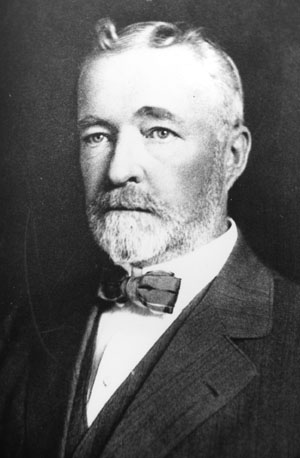
William Chase Temple

The news that the DH will now become universal makes today the day William Chase Temple—the owner of the 1891 Pirates who first conceived the idea—dreamed of.

If this is true, we can only say thank God for small favours. The last thing on earth we should do is nominate Rob Manfred for a Nobel Prize. But if he’s not kidding, and the designated hitter will come to stay in the National League, he and his employers who’ve locked players out since December began deserve a single cheer. But only that.

There’s plenty to be said for the better-late-than-never side of the argument, of course. There’s just as much to be said for the what-the-hell-took-you-so-long side of it. Writing as one of the formerly stubborn, who long insisted that I’d rather have seen revival of the AMC Gremlin than the DH in the National League, I can’t decide either right now.

But it’s about time. It’s long overdue. And I’ll be a nice guy about it and say, yes, better late than never.

No longer will we have to watch the suffocating majority of pitchers swinging pool-noodle bats at the plate accompanied by the very outside prayer than one of them might poke a base hit—if he gets lucky. You tantrum-throwing “traditionalists” can just sit in the corner. Pitchers who could hit were, are, and would always be outliers.

I’m going there one more time. This is the batting average of pitchers overall from the end of the dead ball era’s final decade to the end of last season: .162. As a class, they’re the most guaranteed out in baseball. At the plate, they make Mark Belanger resemble Mookie Betts.

“Gotcha!” the “traditionalist” hollers when I mention Belanger. Meaning, what’s the big deal about pitchers hitting below the Mendoza Line if there might be a Belanger in the lineup, too?

Here’s the big deal: Mark Belanger only got to play eighteen seasons of major league baseball because he was a human Electrolux who remains the second most prolific run-saving shortstop in baseball history behind Hall of Famer Ozzie Smith. The number one reason Belanger isn’t in the Hall of Fame is because he couldn’t hit even if it meant sparing his families’ lives from kidnappers.

The “traditionalist” who tells you so what, we’ve had how many middle infielders hitting that feebly, should be told one guy at or below the Mendoza Line in the lineup is pushing it already, but two for the sake of a “tradition” that should have gone the way of the Gremlin long before the Gremlin hit the road in the first place is malpractise.

I’m going here one more time, too. The DH wasn’t just a figment of a warped American League owner’s imagination. Almost a century before Charlie Finley persuaded then-commissioner Bowie Kuhn to let the American League give it a shot, Pirates owner William Chase Temple hatched the idea—after the key pitchers on his 1891 Pirates hit a collective .165.

The only reason Temple’s brainchild didn’t get signed into league law by his fellow NL owners was an incoming owner, Chris von der Ahe, bringing the original St. Louis Browns into the league after the collapse of the ancient American Association, reneging on a previous yes to vote no and deny the needed majority.

Now, concurrently, National League fans will no longer have to sit on edge because a pitcher at the plate might send himself to the injured list either swinging the bat or running the bases, doing what he’s not being paid to do primarily. Neither will they have to sit on edge over a rally in the making because the pitcher’s spot is due at the plate and that rally’s life expectancy might be zero.

Yes, I’m going there one more time, too, “there” being the wisdom of now-retired Thomas Boswell: “It’s fun to see Max Scherzer slap a single to right field and run it out as if he thinks he’s Ty Cobb. But I’ll sacrifice that pleasure to get rid of the thousands of rallies I’ve seen killed when an inning ends with one pitcher working around a competent No. 8 hitter so he can then strike out the other pitcher. When you get in a jam in the AL, you must pitch your way out of it, not ‘pitch around’ your way out of it.”

You think Boswell was nuts? That very situation happened in the bottom of the second in Atlanta, during Game Three of last year’s World Series. Braves catcher Travis d’Arnaud stood on second with a two-out double. The Astros ordered their starting pitcher Luis (Rock-a-Bye Samba) Garcia to signal Braves shortstop Dansby Swanson—a decent hitter—to first with a free pass . . . because due up behind Swanson was Braves starter Ian Anderson and his .54 cent regular-season batting average.

I’m sure you were (or will be, if you missed it) shocked, shocked, that Garcia struck Anderson out to end the threat and the inning. The Braves won the game 2-0 on a combined two-hit shutout. They might have had a shot at a precious third run if Anderson hadn’t had to hit in the second but a more competent bat was in the lineup as the DH in the National League park.

Last year’s pitchers batted a whopping .110 with a .150 on-base percentage. Scherzer, he who loves to run out his once-in-a-very-blue-moon base hits as if he thinks he’s Ty Cobb, went above and beyond contributing his fair share: Max the Knife went 0-for-2021.

Let’s just make sure, first, that Manfred and the owners aren’t going to pull a fast one and tie the universal DH to the suggested—and patently insane—idea of demanding a team surrender its DH if it has to lift its starting pitcher before pitching a minimum number of innings. Suppose the poor sap gets murdered early. Do you really want to force him to stay until he meets his minimum, because you can’t afford to lose your DH’s bat, and risk sinking your team so deep that the ocean floor will look like the ceiling?

Now, let me just say these, so you don’t persist in thinking I’ve gone totally and completely insane or been taken over by an invasion of a body snatcher:

Yes, it was fun learning as a kid that Hall of Fame pitcher Warren Spahn surrendered the first of Hall of Famer Willie Mays’s 660 lifetime home runs (in 1951) and the first (in 1962) of only two homers Hall of Fame pitcher Sandy Koufax would ever hit.

Yes, it was fun watching Jim (Mudcat) Grant park one in the seats during the 1965 World Series, it was fun watching Tony Cloninger smack two grand salamis in a single game in 1966, and it was fun watching Madison Bumgarner hit a pair out on one Opening Day.

Yes, it was hilarious fun watching Bartolo Colon hit one out in San Diego . . . in his 247th lifetime plate appearance during the seventeenth season of his major league career. It was even funnier watching Colon run it out knowing he’d lose a footrace againt a trash truck on two flat rear tires.

It’s always fun watching the outliers. But rather than watch them while seeing the suffocating majority of their peers swinging bats that might as well have been made by Ronzoni, I’d rather listen to one of them speaking wisely about the long, long, long-established reality.

“I’m always late to the on-deck circle, just because I need to unplug for a minute,” Braves pitcher Charlie Morton (lifetime batting average: .127) told the New York Times last fall, “and I like to worry about the job that I have to do on the mound. That’s what I’m paid to do, that’s what I’m prepared to do, spend the vast majority of my time doing. They’re paying guys lots of money and guys are working their tails off trying to be good hitters, and I’m up there taking at-bats.”

And I, like Boswell, would rather surrender the pleasure of the outliers to the greater pleasure of seeing pitchers preserved for the job they were signed to do in the first place, no longer slaughtering rallies or sending themselves to the injured list doing what they as a class have never been able to do since P.T. Barnum opened his first circus.

When the Army Air Force was broken away into a stand-alone military service in 1947, the Air Force Association’s magazine proclaimed it “The Day Billy Mitchell Dreamed Of,” referring to the pilot whose stubborn and too-often-verbally defiant advocacy for air power as the wave of the future got him court-martialed and rousted out of the Army two decades earlier.

Manfred declaring the designated hitter will be universal starting this season, whenever the season may begin, could be called likewise “The Day William Chase Temple Dreamed Of.”

Manfred must go. How and from whom to choose his successor?

Thomas Boswell

Should this man be baseball’s next commissioner—and none too soon?

Major league baseball’s lockout continues apace. So does the egg on commissioner Rob Manfred’s face, even if Manfred doesn’t acknowledge it.

Bad enough: Few involved in the lockout directly, and few observing it closely, comprehend what Steven Goldman, a Baseball Prospectus writer and (in Forging Genius) the most incisive analyst of Casey Stengel’s success as a Yankee manager, comprehends with little effort and lots of sense:

If one feels the owners have somehow been shortchanged by the players in the past or would be unfairly impacted by the players’ proposals, among them a shortening of the paths to arbitration and free agency, make an objective argument for why this is so. Similarly, if one believes the players do not currently receive their fair share of baseball’s revenues, then prove it as best one is able. Failing to do either is to admit to being a kneejerk partisan. Telling other people that they’re wrong and deserve less money than they’re asking for isn’t just something you can have an opinion on, like whether or not you like creamed spinach . . .

. . . As has been related here and elsewhere, the players’ share of revenue has been falling as owners emphasize younger players. The value of free agency has resultantly been diminished, and whereas some players are still cleaning up, there is an increasing number of players who don’t last long enough to escape Pittsburgh and get some of that sweet Dodgers swag. Simultaneously, not only do the owners not open their books to the players, many of them are clearly not trying. We know that without seeing the books because we as fans can see the teams, see the minimal payroll, note the revenue-sharing payments vanishing without a trace, not to mention the increasing amounts of online and non-baseball revenue that teams now collect. We have to be fair, but we don’t have to be stupid.

Worse: Major League Baseball-owned MLB Network’s summary dismissal of longtime baseball writer/television analyst Ken Rosenthal, over comparatively benign critiques of Manfred published elsewhere eighteen months earlier, has brought corresponding questions to a boil. None seems more glaring than the one asking not whether Manfred’s competent to continue, but whether baseball needs an entirely new way to choose his successors.

The owners hire a commissioner. They can fire him any old time they please, so long as they pay him over the remaining time for which his contract calls. But nobody else in the game has a vote on the hiring. This can and has created a few, shall we say, problems in the past. With the game in Manfred’s hands, it’s made those problems seem like brief if rude interruptions.

Manfred’s current contract expires in 2024. So long as the owners continue to believe he operates by the maxim that the good of the game equals making money for them, his job is safe. Never mind suppressing free agency’s cumulative value; never mind treating the play of the game as a perverse Rube Goldberg experiment to be bent toward the attention-and-thought-challenged; never mind monkeying around with basic equipment such as the baseballs themselves; never mind its owned-and-operated media franchise strong-arming a reporter daring to question Manfred’s competence.

The players have no say in choosing the game’s maximum steward and administrator. Neither do those who manage and coach them. Neither do those charged with keeping the games honest, the umpires, never mind that the umpires have their own issues that Manfred has proven distinctly disinterested in addressing too often. Hands up to everyone who thinks there’s something very wrong with that.

Very well, you holdouts. Allow me to ask you two questions I’ve raised or addressed in the past. 1) Do you buy tickets to baseball games for the distinct pleasure of seeing your team’s owner(s)? (You Yankee fans of the 1980s fed up with George Steinbrenner’s act and hoping to let him have it, sit down, you’re outliers.) 2) Do you believe the commissioner should quit trying to fix what isn’t broken but leave what is broken alone to fix itself?

If you answered no to both, good. Now, hear me out further.

There’s no valid reason on earth why the commissioner should be chosen among the owners alone. Imagine if the president of the United States could be elected solely by the nation’s state governors. That would be seen, rightly enough, as an abomination. Now, if you agree the presidency should be filled by the people acting through the electors chosen based upon the people’s votes, why would you agree that baseball’s commissioner should be chosen solely by the designated voters from thirty ownerships?

Major league baseball has not just thirty owners but approximately 1,200 players, based upon the 40-man rosters. It also has thirty managers overseeing their players and their coaching staffs, and 76 umpires spread among nineteen umpiring crews. There is no sensible reason anyone can exhume why voting for the commissioner shouldn’t include the player representatives for all thirty major league teams, their managers, and the nineteen chiefs representing their crews.

Perhaps, then, a commmissioner elected thus would be inclined better to see the complete picture and not just the portions that equal maximum revenues on which to base future owner shenanigans. And that provokes the next but just as critical question: from among whom should the game’s next commissioner be chosen?

The Selig-to-Manfred era has made plain enough that the next commissioner shouldn’t come from among the owners. Neither should the next commissioner come from among anyone who’s worked in a front office. Nor should the next commissioner come from among the players, the managers/coaches, or the umpires. The perception of certain preternatural biases would be overwhelming enough from among them, even to those who tend to forget those attached to those chosen by the owners alone.

Prior to the Selig-Manfred era, commissioners were a federal judge (Kenesaw Mountain Landis), a former governor and U.S. senator (Happy Chandler), a sportswriter turned president of the National League (Ford Frick), a retired Air Force general (Spike Eckert), a lawyer who’d been the National League’s attorney (Bowie Kuhn), a travel executive turned U.S. Olympics organiser (Peter Ueberroth), a Yale scholar-turned-president-turned National League president (A. Bartlett Giamatti), and an entertainment attorney turned president of Columbia Pictures (Fay Vincent).

Setting aside issues that may or may not have soiled those commissionerships, the deep record shows that only one of those pre-Selig-Manfred commissioners had little enough knowledge or even love of the game: The retired Air Force general (his hiring provoked a sportswriting wag to dub him the Unknown Soldier) played a very little baseball in his youth and was known otherwise to prefer squash, tennis, golf, polo and horse jumping.

The best you could say of him is that he hired the first African-American to hold a major job in the commissioner’s office. To his eternal credit, Eckert broke the colour line in baseball’s administration when he hired Hall of Famer Monte Irvin as assistant director of public relations and promotion operations. Eckert’s successor Kuhn put Irvin in full charge of it, a job Irvin did until he resigned when Kuhn did in 1984.

Since it’s not unprecedented to have a sportswriter/broadcaster become baseball’s commissioner when he grew up, never mind his inability a) to shake the presence of the man (Babe Ruth) for whom he once ghost-wrote or b) to act decisively as commissioner unless it threatened a) (Ford Frick might as well have been nicknamed “It’s a League Matter”), I can think of a very solid candidate.

No, silly, not Bob Costas, whom two-thirds of the world (including me, once upon a time) thought as strongly that he should have the job as Costas thought he shouldn’t, often vociferously. But the candidate I have in mind is a retired longtime baseball writer of impeccable talent, established insight, and genuine love of the game. (Why he hasn’t been elected to the writers’ wing of the Hall of Fame remains a mystery to me, too.)

He has a concurrent love for golf but is not otherwise sinister. He is known to have walked a very even line between the self-imploding fooleries of the owners and the sometimes self-defeating strategems of the players. He has been known to suffer neither fools nor malcompetent umpires gladly. His knowledge and love of the game is rivaled only by that of the commissioner least apologetic about expressing it ostentatiously if lyrically, the ill-fated Giamatti.

There are five books collecting his best work to present as evidence so far; God and an insightful publishing house willing, there’ll come a sixth. Commissioner Thomas Boswell, anyone?

L’affaire Rosenthal

Ken Rosenthal

Ken Rosenthal (right), shown interviewing Red Sox shortstop Xander Bogaerts for Fox Sports at All-Star festivities. MLB Network decided Rosenthal’s comparatively mild critiques of Commissioner Nero Goldberg were still a little too harsh for the bosses’ comfort–even if they were published elsewhere.

A very long time ago, the bellettrist Albert Jay Nock counseled a protege named Frank Chodorov about writing: “Frank, don’t pick your reader up by the back of his neck and throw him downstairs. Lead him gently.” Whether Ken Rosenthal is aware of either of those two quiet giants of libertarian thought, he has been that kind of baseball writer, observer, and commentator.

Though he’s not given to rapid and bundled shafts of mirth, Rosenthal rarely fails to inform, instruct, and delight. He was required reading for a very long time on the Fox Sports website; he has been required reading at The Athletic since just about the day that journal was born. His additional presence at the MLB Network simply meant that the network benefitted from a well-seasoned reporter going deep as a finely-composed sauce.

Until it didn’t, as of Monday. If you thought the government government can be petty with in-house critics, for once it looks downright sanguine about them compared to baseball’s government.

The owners of the MLB Network decided that they just can’t have a known non-rabble rousing reporter criticising baseball commissar Rob Manfred on their (read: his) dollar. Never mind that Rosenthal’s apparent thought crimes occurred in June 2020 and weren’t even committed aboard MLB Network.

Permit me to take you back to baseball in suspended animation during the early months of the pan-damn-ic. Manfred and the owners attempted to renege on a deal to pay players full pro-rated salaries for 2020 whenever it might begin, even as they still pondered whether there would be even an abbreviated season. From his roost at The Athletic, Rosenthal (with Evan Drellich, the reporter with whom Rosenthal blew Astrogate wide open upon Mike Fiers’s whistleblowing) was having none of that:

What he wants now, according to sources, is to stop bickering with the union, start negotiating and reach an agreement that will bring the sport at least temporary order.

Yet for a guy who suddenly is looking for peace, Manfred sure has a funny way of showing it.

He and the owners, supposed stewards of the game, are turning the national pastime into a national punch line, effectively threatening to take their ball and go home while the country struggles with medical, economic and societal concerns . . .

The best commissioners offer statesmanlike presence and superior vision. Few ascribe those qualities to Manfred, and few would argue baseball is in a better place since he took over for Selig on Aug. 14, 2014. Rather than simply enjoy the fruits of the 2016 CBA, a lopsided victory for the owners, the clubs have gorged on them, alienating the players. And once again, they are valuing their own short-term interests over the long-term interests of the sport.

As critiques of baseball’s government go, Rosenthal (and Drellich) were mild sauce compared to numerous lights of varying statures. God and His servant Henry Aaron only know that when I want to compliment Manfred I’ve called him Commissioner Nero, fiddling while baseball burns. Or, Commissioner Goldberg, citing Manfred as a man giving an excellent if troublesome impression of how Rube Goldberg’s evil twin might have been, if Goldberg had had one.

Mild, schmild, MLB Network says. It iced Rosenthal for close to three months, while still paying his agreed-upon compensation, until the 2020 trade deadline at August’s end. When Rosenthal’s MLB Network contract expired at the end of 2021, the network decided not to renew him. Just why it merely iced him almost three months, then waited until his deal with them expired to let him go, is for mere speculation for now.

Under normal if no less tasteful circumstances, dumping actual or perceived in-house critics doesn’t require eighteen months to execute. The truly cynical might suggest MLB Network wanted to sustain a pretense of objectivity, even if it meant keeping Rosenthal on hand rather than dump him at once while honouring his contract otherwise. The less cynical might agree that dumping Rosenthal at once would have left MLB Network with a far worse look than it has now.

“The timing of this news could not be worse for MLB,” writes Sports Illustrated‘s Dan Gartland of Rosenthal’s purge. “The league’s status as a villain and a bully has been cemented during the ongoing lockout, and so even if Rosenthal’s departure was due to, as an MLB spokesperson told the [New York] Post, ‘natural turnover in our talent roster that takes place each year’ and not his 18-month-old criticism of Manfred, just the perception that the league has punished a well-liked and well-respected reporter for a fair critique of a widely despised authority figure is damaging to the network’s credibility.”

As the Boston Globe‘s Chad Finn notes, purging Rosenthal inflicted an unwarranted stain on the numerous reporters working there who lack Rosenthal’s profile:

[T]he decision to dump Rosenthal did their reputations no favors. Major League Baseball executives, particularly original network president and CEO Tony Pettiti, have insisted since the beginning that they want MLB Network to be editorially credible and they would not interfere with the journalistic duties of the correspondents.

Then, because the commissioner cannot accept that criticism comes with his job, the network goes and dumps the popular and respected Rosenthal for what were accurate rebukes? The perception is not fair, but Manfred’s actions implicitly suggest that the reporters who remain are in lockstep with how the commissioner’s office wants the league covered. At the very least, they now know what the consequences are for being critical of the boss.

Or, the bosses, if you remind yourself that Manfred serves at the owners’ pleasure and can be dumped by the owners any old time they choose it—provided, of course, that they pay the rest of his contracted-for salary. You know, just as the Yankees paid off in full all those decades ago, whenever George Steinbrenner decided to throw out the first manager of a season.

Since the lockout began, MLB Network has limited its live programming. MLB.com notoriously purged players’ faces from their stat pages. The site also published an FAQ on the collective bargaining agreement negotiations on day one of the lockout . . . entirely through the eyes of Manfred and his bosses, the owners.

Thus the most significant issue with professional sports leagues establishing their own media networks. They can be valuable resources for fans during off-seasons. But they can also become a league’s version of Izvestia. “No one is expecting Rosenthal to be allowed to bash Manfred on MLB Network,” writes Gartland, perhaps forgetting for the moment that Rosenthal’s bash wasn’t aboard the network, “but it’s refreshing when league-owned media outlets publish less-than-flattering stories.”

Weep not for Rosenthal, whose roosts at The Athletic (as a writer) and Fox Sports (as an on-air reporter/commentator) are at least as secure as a bank vault. Weep instead for the thinking person’s sport that’s been used, misused, and abused by a commissioner and his paymasters for whom genuine thinking proves beyond their pay grades.

2021: Wanted—a Laundromat

Rob Manfred, baseball’s version of Rube Goldberg’s evil twin.

Once upon a time, when you could be sure . . . if it was Westinghouse, that once-ubiquitous home appliance maker trumpeted its angular front-loading washing machine thus: “You’ll love your Laundromat more every day!” There are those, and they may be legion, who think baseball today needs a Laundromat it can love more every day, too.

But the game may first need to remember where 2021’s laundry hamper is located. “[Major League Baseball]’s dirty laundry,” writes the irrepressibly irreverent Deadspin, “was only forgotten by the general public when some newer, shinier scandal made its way onto the scene.”

Deadspin thus began its proclamation of commissioner Rob Manfred as the eighth biggest idiot in 2021 sports. By the time you finish reading just that particular bill of particulars, you may come to think it’ll take an entire Laundromat—those vintage, Westinghouse-stocked,  self-service laundry versions of the very vintage self-service Horn & Hardart Automats, that is—to get MLB’s washing done.

Thanks to baseball’s owners and their off-season lockout, the keys to the Laundromat can’t and won’t re-open it for badly needed business. Thanks to Manfred’s determination to leave a legacy as having been baseball’s version of Rube Goldberg’s evil twin, baseball has continued calling the repairmen to fix what wasn’t broken while calling the dentist to set the limbs that were.

Manfred has dropped more balls than ever eluded the grasp of legnedary first base fumbler Dick (Dr. Strangeglove) Stuart. From almost the moment he succeeded Bud Selig in the commissioner’s chair, Manfred has seemed to administer baseball even further down the line Selig and his then-fellow owners once engineered while ignoring blissfully their roles laying the tracks: Baseball sucks! Bring the wife and kids! 

The Astros caught red-handed in an elaborate and illegal off-field-based electronic sign-stealing operation? The Red Sox caught using their replay room for sign-stealing reconnaissance assuming men on base to receive and transmit the purloined letters? By the rules, Manfred could only fine Astros owner Jim Crane $5 million, “which is roughly the price equivalent of a Nachos Bell Grande at Taco Bell to you or I,” Deadspin snarks. He couldn’t quite hit the Red Sox like that over turning what MLB itself provides each team at home or on the road.

But he could have imposed far more stern measures than stripping the Astros of a pair of key draft picks. He could also have imposed something more grave upon the Red Sox than letting them skate by suspending their manager and banishing their video room operator. As one presidential candidate once purred about the other’s party, in debate and on the campaign trail, he had his chance but he did not lead.

That was in 2020. Over a year later, all of that was almost (underline that) forgotten by your friendly neighbourhood Spider-Tack. As in, that new old-fashioned medicated goo pitchers deployed the better to get a grip on something upon which Manfred lacks a grip—making baseballs that are as viable for pitchers to throw as for hitters to hit. The inconsistent surfaces of the balls today compelled enough pitchers to seek medicated help. That some of them saw it as a fine shield for chicanery should have been anticipated, but wasn’t.

So Manfred cracked down . . . about a couple of months after he should have done so. It simply reinforced the suspicions of too many that this commissioner picks and chooses when to enforce particular rules. It also provoked them to ask why Manfred was more alarmed about potentially cheating pitchers than he was about the continuing lack of umpire accountability.

He certainly wasn’t all that alarmed about cheating baseballs. You read that right: after the season, it came forth from Business Insider that two types of balls were used during the year. One was a little more on the dead side, the other a little more on the lively side. The magazine cited an astrophysicist who analysed the balls, found them suspicious, and even spoke to an unidentified pitcher who thought, as I wrote elsewhere early this month, that baseball’s government might have engaged a little game chicanery of its own:

This pitcher thinks MLB was also looking to manipulate particular matchups with the variable balls: send the slightly more dead balls to such lesser sets as, say, the Detroit Tigers versus the Kansas City Royals, since nobody was going to be interested in them, but send the slightly livelier balls to the marquee sets such as the Boston Red Sox versus the New York Yankees.

If you’re looking for a thorough MLB investigation into what we might call Ballgate, save your vision. It hasn’t happened yet. Whether it will happen is only slightly more difficult to guess than it once was to guess which one among about eight different leg kicks and about sixteen different windups Hall of Fame pitcher Juan Marichal was likely to use to throw the next pitch your way.

(Which reminds me that the splendid staffers at Baseball Prospectus, in their book Extra Innings, once posited with splendid evidentiary supposition that the era of actual or alleged performance-enhancing substances might have been at least as much the era of actual or alleged performance-enhancing baseballs. So Commissioner Goldberg didn’t start ball chicanery, but it’s possible he’s presided over its current tricks and treats.)

After a few comical responses to on-the-spot Spider-Tack and other substance searches that could have and almost did provoke strip teases by the suspects under potential arrest, Manfred and his administration provided further evidence that today’s baseball handles scandal by engaging one somewhat worse than the incumbent. This time, the name was Trevor Bauer.

This time, Bauer was place on administrative leave over sexual misconduct  accusations described politely as salacious, with each period of leave extended going, going, going, until he was gone, goodbye, for the final two-thirds of the season. His Dodgers—who’d signed him big without doing complete due diligence last offseason; who won 106 games and still had to win the wild card game for postseason advancement (because their historic and division rival Giants won one game more)—almost went to the World Series without him.

Meanwhile, Manfred persisted with his COVID-shortened 2020 season’s tinkerings over the full 2021. On behalf of his often-questionable or at least mis-directed alarm over the length of baseball games, Manfred persisted with the free cookie on second base to open each extra half inning. He persisted with his rule that relief pitchers must face three batters at minimum before they can be relieved. The former remained a mere nuisance. The latter could have gotten someone killed.

That would be Bryce Harper, now the National League’s defending Most Valuable Player, but then taking an errant fastball off his nose and onto his batting-side wrist courtesy of Cardinals reliever Genesis Cabrera—on the first pitch of the top of the sixth. It could have knocked Harper’s block off. It did knock his batting helmet off. It scared the hell out of both teams and the Busch Stadium audience.

The next pitch Cabrera threw hit Phillies shortstop Didi Gregorius. The three-minimum rule still prevented Cardinals manager Mike Schildt from lifting a pitcher whose lack of control was obvious to all but the blind. Harper ended up suffering a terrible slump while he struggled to play through the wrist compromise yet recovered to post an MVP season. He also texted Schildt after the fateful game to say he knew Cabrera wasn’t trying to decapitate him.

“Whoever’s a fan of Bryce Harper, whoever has children that are fans of Bryce Harper, support that guy,” Schildt told reporters postgame. “Because what he sent over in a message today was completely a class act.” It was the diametric opposite of the commissioner’s act.

Commissioner Goldberg has also sought, ham-handedly, to make the game pay through the nose for any agreement to make the designated hitter universal. He wants a trade-off: I’ll give you the universal DH, but you give me an agreement that you lose your DH if you lift your starting pitcher sooner than six innings or thereabout. If you think he’s learned nothing from his three-batter relief minimum, wait until you see him flunk this one.

Just as relievers might enter a game having nothing left, for assorted reasons, starting pitchers often enough begin a game on the vulnerable side. If Manfred really thinks he’s doing the game a favour by forcing a team to sacrifice a game’s designated hitter, because the manager got his roughed-up starter out of there early enough before getting the guy killed to death, I think I may have found a buyer for that cut-rate Antarctican beach club.

If and when the owners and the players return to the negotiating table on behalf of ending this lockout, the players should give the owners and their barely-trained seal one answer to that:

Don’t even think about it. It’s long past time for the DH to be universal. Pitchers overall have never been hitters; those very few who were were outliers, and everyone with a brain knows it. We’re tired of wasting pitchers at the plate and watching rallies die. We’re really tired of losing pitchers to the injured list when they get hurt at the plate. The DH is long overdue in the National League, one of whose ancient owners dreamed it up in the first place. Deal with it. End of subject.

Manfred’s alarm at the length of baseball games has yet to address the truest of the culprits, broadcast advertising. You can look it up: Two minutes worth of commercials between half innings equals 36 minutes per nine-inning game. That’s before the commercials during in-inning pitching changes. (You might notice it takes less time for a relief pitcher to come in from the bullpen and throw eight game-mound pitches than it does to run the first minute’s commercial.) And, before extra innings, which are the two second-loveliest words in a true baseball fan’s vocabulary. (The loveliest, of course, are, “Play ball!”)

The next time you watch a game on television or listen on radio or online, make note of every commercial played during the broadcast from the first pitch to the final out. When you add the times of those commercials, you can’t say you weren’t warned that you might have seen a mere two hours’ worth of baseball for your trouble. Thus persists Manfred’s likeliest definition of the common good of the game: making money for it.

Thus, too, were soiled such luminous matters as the emergence of Shohei Ohtani as an international two-way major league mega-star. (And, the American League’s Most Valuable Player.) Such matters as the Braves picking themselves up from the loss of their franchise player-in-waiting Ronald Acuna, Jr. for the second half of the season, dusting themselves off with a trade deadline array of outfield-remaking deals, then wrestling their way to a sixth World Series game in which one of those newly-acquired outfielders, Jorge Soler, led the way bludgeoning the Astros home without another lease to the Promised Land.

Manfred presenting the Braves with the World Series trophy (you know, the one he once called a mere piece of metal) and Soler with the Series MVP award carried all the duplicity of Dmitri Muratov winning the Nobel Peace Prize for his fight to restore and enhance freedom of expression in Russia—and the Norwegian Nobel Committee enlisting Vladimir Putin to present it to him.

Is it going to take a one-hundred-washer Laundromat to clean up this mess? You can be sure . . . if it’s Manfredhouse.