
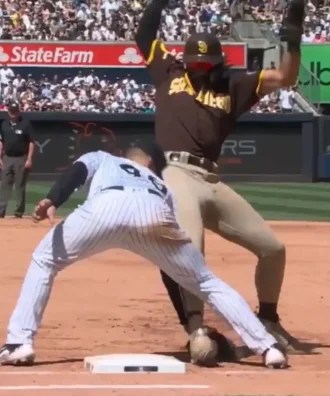
This is the 28 May collision—on a strike-’em’out/throw-’em-out double play—that turned Anthony Rizzo’s season into disaster whose cause nobody could figure out until this week.
Yankee and other fans now have the answer to what compelled a veteran first baseman with a jeweler’s eye for the strike zone to drop from an .880 OPS on 28 May to the arguable worst hitter in the game since. They should not like that nobody in his organisation could catch on sooner.
On that day, Anthony Rizzo took a bump on his head from the hip of the Padres’ Fernando Tatis, Jr., who was scrambling back to first on a strike-’em-out/throw-’em-out double play that ended the top of the sixth in Yankee Stadium. Watch the play from any angle you wish.
Yankee starting pitcher Gerrit Cole struck Xander Bogaerts out swinging, with Tatis well off the pad at first. A very alert Yankee catcher Kyle Higashioka whipped a throw up the first base line to an equally alert Rizzo. The throw went up the line low but Rizzo speared it cleanly to tag Tatis out on his lower right leg.
You should see clearly that, without intent, Tatis’s right hip caught the right side of Rizzo’s head hard as Rizzo bent down to apply that tag. Rizzo lost his hat, stood up as the ball fell from his mitt, then walked several steps toward second base before collapsing.
The Yankees thought it was a neck injury at first. They got Rizzo out of the game post haste, moving D.J. LeMahieu from third to first and Isiah Kiner-Falefa from left field to third, sending Greg Allen out to play left and to bat in Rizzo’s lineup slot. (The Yankees hung in to win the game, 10-7; Rizzo himself had pitched in with an RBI single prior to the fateful collision.)
Rizzo didn’t return to the lineup until the Yankees played the Dodgers on 2 June. In the interim, according to most reporting, he passed official concussion protocols. Yet, come Thursday, the Yankees let it be known that Rizzo was indeed dealing with post-concussion syndrome and that it was no questions asked traceable back to that 28 May play.
Nobody caught on after the original protocols passage. Rizzo himself says he began noticing “fogginess” last weekend, against the American League East-leading Orioles, where he’d previously couldn’t figure out how he dropped so far off the batting table.
“I remember talking to someone and they said, ‘Do you feel like you’re coming out of this soon?’” the first baseman finally told reporters. “I answered honestly that no I don’t because I couldn’t feel what you’re trying to feel as a hitter.”
I guess now we can link two and two together. Over the last few weeks, you just start going to different checklists of mechanics, timing, consistently being late. Why am I being consistently late? I’ve made these adjustments plenty of times in my career. I just didn’t forget how to do this all of a sudden. Everything (the doctors and I) talked about and everything they came back with basically came back on a silver lining of I’m not crazy for walking back to the dugout consistently thinking how I missed that pitch because I usually don’t miss that pitch.
The Yankees should be thinking about how they could have missed Rizzo dealing with and playing through both a concussion and its following syndrome for almost two months. They should be demanding answers from their own medical people and from baseball’s government itself.
All advanced knowledge coming forth over the last few decades doesn’t quite mitigate that baseball medicine is still not exactly sport’s equivalent to the Mayo Clinic. It still remains rare that a baseball team’s medical staff gets to the deepest heart of an injury issue before a career is compromised or ended.
And it still takes something such as Rizzo’s case to shake Joe and Jane Fan out of their smug dismissiveness toward slumping players to acknowledge that maybe, just maybe, there was a physical or neurological cause for the slump, as we now know was Rizzo’s case.
Ask Met fans who still dismiss Jason Bay as a mere bust. Signed to a four-year free agency deal, Bay was one of the game’s better outfielders and run producers . . . before he incurred two concussions as a Met, one hitting the outfield wall in 2010 and the second hitting one in 2012.
Never mind teammates and his manager praising his work ethic, nobody put two and two together and figured two concussions might have had something to do with his dying bat. Bay and the Mets parted under mutually acceptable terms; he signed with Seattle, was given a clean bill of health, but after one horrid season called it a career.
Last winter, Twins fans inexplicably poured phlegm, bile, and acid over the very idea that Joe Mauer should be on the next Hall of Fame ballot. Their rage was over that fat contract extension Mauer signed when he was still the best catcher in the American League . . . and before he suffered the first of two concussions when he took a hard foul tip off his mask behind the plate.
Those fools called Mauer a thief because the concussions wouldn’t let him play to his previous level. Never mind the Twins yanking him out from behind the plate after that hard foul tip. They weren’t taking chances, especially after seeing what concussions did to their former first base star Justin Morneau.
Does the name Pete Reiser ring any bells? It should. That Brooklyn Dodgers legend with Hall of Fame talent ended up a Hall of Fame might-have-been, thanks to an insane playing style that caused him one too many concussions when he still couldn’t learn a concrete outfield wall—like the one they had in Ebbets Field—didn’t suffer fools gladly and he couldn’t make them collapse on contact.
Pistol Pete may have been lucky that he ended up with a somewhat long post-playing life as a minor league manager and major league coach. He also had an impact on the game beyond his own self: the Dodgers made Ebbets Field the Show’s first ballpark to feature padded walls after they traded him to the Boston Braves following the 1948 season.
Ryan Freel had it even worse. That cheerful character of an outfielder got blasted into a concussion on a collision with both an outfield teammate and the warning track in 2007; then, a second one in 2009, when he was hit flush on the head by a pickoff throw. Career over a year later.
Baseball began its concussion protocols in 2011. A year later, troubled by assorted mental issues and possibly remaining aftereffects of his two concussions, Freel committed suicide. Knowing what he’d been through playing baseball, his family donated his brain to Boston University—for research into chronic traumatic encephalopathy (CTE). In due course, it was determined Freel had Stage 2 CTE.
It’s bad enough that too many fans and too many sportswriters who ought to know better continue to dismiss the injured as malfeasant, especially when the injured take what those people believe to be longer than needed to recover. Too many sports teams behave likewise even today, too.
And too many fans still can’t draw the proper line between hard nosed and bullheaded, any better than Pete Reiser and others did. Baseball players shouldn’t have to blast themselves to smithereens to prove they’re delivering maximum effort.
Even the Yankees couldn’t figure out how Rizzo cratered after that 28 May game. They thought he was fine physically. They knew he wasn’t laying down on the job. Manager Aaron Boone kept insisting his man was going through a particularly protracted patch of slumping.
Rizzo himself didn’t think about further testing even though he’s admitted to feeling foggy and having days where he felt he’d been “waking up feeling hung over and you didn’t drink at all.” He also has to figure out how to balance his health to his itch to compete. He’s only too well aware that too many people, including those with and against whom he plays the game, still think injuries and their impact are mere excuses for poor play.
“[W]hen people come up and (are) like, ‘You haven’t been the same since the collision,’ I want to go tell people off because that’s not who we are as competitors,” he admits.
Even still, I feel like being injured or playing through a back injury or ankle injury in the past, you just adapt. Your body adapts. Obviously with this, I did everything I could and it’s unfortunate. The hardest part is missing time because I want to be out there. I want to be playing, but also to the level that I know I’m capable of playing at.
Easier said than done, alas. Even in today’s advanced medical atmosphere, professional athletes still can’t let themselves have the time they absolutely require to return to complete health. Often as not, their teams can’t. More often than that, Joe and Jane Fan don’t want to hear it. More often than that, Joe and Jane Sportswriter whip them into that froth.
Maybe the Rizzo case will start waking them up at long enough last. Maybe.
 Throneberry Fields Forever