Danny Young, RIP: The hard climb and fall

Danny Young

It took Danny Young just over a decade to make the Show, and a shoulder injury following a harsh cup of coffee to return home.

The 21st Century’s first official grand slam wasn’t hit in the United States. The Mets and the Cubs opened the 2000 season on 30 March in Japan’s Tokyo Dome. The game went to an eleventh inning, and Cubs manager Don Baylor sent a longtime minor leaguer named Danny Young to the mound to pitch the top half.

The first student from Woodbury, Tennessee’s Cannon High School to make the Show in the first place, Young started auspiciously enough, getting two quick outs on a grounder to shortstop by Robin Ventura and a pop fly around the infield by Derek Bell. Then he surrendered a base hit to Todd Zeile before walking the bases loaded by way of Rey Ordóñez and Melvin Mora.

Mets manager Bobby Valentine sent Benny Agbayani out to pinch hit for relief pitcher Dennis Cook. Young’s first pitch to him missed for ball one. Agbayani hammered the lefthander’s second pitch over the center field fence. After Jay Payton’s followup double, Young escaped when Edgardo Alfonso flied out to center field.

“Even though I gave up a grand slam, I still looked around and it’s like, ‘That’s Mark Grace right there. I’ve got Sammy Sosa in the outfield’,” said Young—found dead at home at 51 Sunday—to Fox Sports. “They patted me on the back and let me know it was going to be all right. I had a lot of the guys come to me and say, ‘Welcome to the big leagues.’ They were like, ‘Things like this happen.’ I should have gotten out of the inning. It was just nerves and knowing within myself that something was wrong.”

It took Young long enough to get to the Show in the first place. Drafted by the Astros at nineteen in 1990, he played for nine minor league teams affiliated to three major league franchises over the decade to follow before he finally made the Cubs after the turn of the century. He never complained about being drafted in the 83rd round, either.

“If I was a first-rounder,” he once told Fox Sports writer Sam Gardner, “I might not have made it, because I had a thirst and a hunger to make it because of where I was drafted. If they’d have set a million dollars down in my hand at that time, there’s no telling where I would have ended up. So maybe that was just meant to be my turn.”

He simply didn’t expect to be on the wrong side of history when he finally got his turn in a Cub uniform in Tokyo.

He knew he’d had control issues from the outset—in his first minor league season he struck 41 batters out in 32.2 innings, but he also walked 39—but he also knew he could learn plenty enough about the game he loved but knew too little about. “I struggled just because it was a new process for me,” he told Gardner. “I still had this fear of making a mistake and the coaches just thought, at the time, ‘This guy is just having a hard time picking this stuff up’.”

Before they released him to be picked up by the Pirates organisation, the Astros even tried as radical a class as they could think of: they hired Hall of Fame pitcher Sandy Koufax, then working free-lance as a roving pitching instructor, to work with Young and with a kid named Billy Wagner in spring 1994.

Young had absolutely no idea who his new teacher was.

“Then I come to find out a couple years later,” Young said, “and people are looking at me like, ‘Dude do you know who you were with?’ I just didn’t know baseball, but they didn’t know that I didn’t know baseball. I just went out there and pitched.” Ever the gentleman, Koufax gave Young a signed ball that Young kept in a clear ceramic ball on a pedestal in his home.

“[I]t was overwhelmingly mind-blowing, the things that he knew about the directional part of pitching that I didn’t really grasp at first,” Young told Gardner of his Hall of Fame teacher. “And as I went along, it got better. I was a late bloomer, so I didn’t really understand the concepts that he was teaching me, but he taught me to find a comfort zone and how to tune out the crowd and what’s going on around me.”

The Pirates, too, remained as patient as possible as Young continued to struggle finding the comfort zone Koufax preached. As in the Astros organisation, Young tried everything he could think of, from changing deliveries and arm angles to changing speeds and back. Only when the Cubs picked him in the 1997 Rule 5 draft did Young begin to smell something close enough to success, or at least real major league potential.

He moved up the chain until he made the team in spring 2000. After Agbayani’s Tokyo blast, the Cubs returned Stateside and Young got into the next three straight games against the Cardinals. The first outing: two walks in two-thirds of an inning but no runs allowed. The second: a two-out double by Fernando Tatis, Sr. but another scoreless escape. Maybe Young was getting it at last.

The third: disaster—a pair of two-out walks, leaving a mess for his relief Brian Williams to clean up in the fourth inning, a mess that continued with a bases-loaded walk, a grand slam by J.D. Drew, and three runs charged to Young that he wasn’t on the mound to surrender himself.

The Cubs sent him back to Iowa after that. Young continued struggling until he finally spoke up further about an issue he’d felt in Tokyo, when he first mentioned to Mark Grace—after a pickoff throw that bounced to first—that he felt something wrong with his shoulder. It turned out his rotator cuff required major surgery, the first of five on the shoulder.

After 2000, Young retired from the game he’d never really had the chance to learn even rudimentarily in a Woodbury where baseball wasn’t exactly a well-taught sport. At least, not until Young returned home to spend the rest of his life raising his family and teaching and coaching the game to local kids.

“I played tee-ball, played Babe Ruth, played Dixie Youth Baseball and high school, but there was no real coaching,” he told Gardner. “And for the [coaches], that was no fault of their own. We hauled hay, we fished, we did whatever we did, and then we went out on the field and had fun. We had teams, but it wasn’t competitive. I mean, I ended up being a right-handed hitter because none of the coaches knew how to teach me how to hit left-handed.”

If only the Danny Young who went home to teach the game on his native ground had been available to the Danny Young who originally caught the Astros’ eyes, however deep in that 1999 draft. He might have had more to show for his long slog to the Show, and in the Show itself.

He never struck a major league hitter out, he walked six, he surrendered five hits, but he kept a big league attitude. For himself, and for his wife, Sarah, their six children, and their two grandchildren. The battler who surrendered this century’s first major league grand slam should only know peace and fulfillment in the Elysian Fields to which he was taken—cause unknown at this writing—too soon.

Frank Thomas, RIP: The needling and the damage done

Frank Thomas

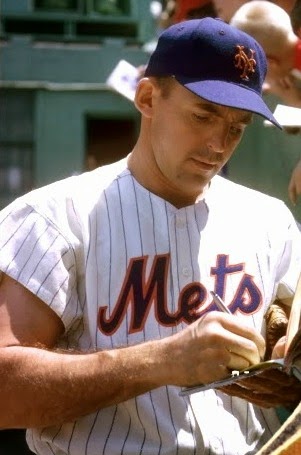
Frank Thomas, signing autographs in the Polo Grounds as an Original Met. As a Phillie, his 1965 fight with Dick Allen accelerated Allen’s undeserved war with Philadelphia racists.

Baseball’s best known Frank Thomas who isn’t the Hall of Fame bombardier died Monday at 93. The good news: That Thomas had a colourful history as one of the Original Mets, for whom he played from their 1962 birth through August 1964. The bad news is that he had a terrible history involving a teammate of colour on the 1965 Phillies.

It soiled a respectable major league career as a power-hitting outfielder/corner infielder, a three-time All-Star with the 1950s Pirates, and an Original Met who was grateful to have been remembered when the Mets reinstituted Old Timers Day last year and he fought through a neck injury to appear.

Thomas survived nasty contract battles with Branch Rickey, then running the Pirates, whose genius as a baseball thinker and courage as baseball’s colour line breaker in signing Jackie Robinson to the Dodgers was countered by his often devious and insulting penury when it came time to pay his players reasonably.

He also prospered somewhat with and survived the Original Mets, that expansion troupe remembered best as baseball’s version of . . . well, they really did have Abbott pitching to Costello with Who the Hell’s on first, What the Hell’s on second, You Didn’t Want to Know’s on third, and You Didn’t Even Want To Think About It at shortstop.

Thomas became the Mets’ first home run king, hitting 34 in 1962, a team record that stood until Dave Kingman smashed it by two in 1975. He also factored in one of the most typical of the inadvertent sketches that, perversely enough, endeared his Mets to a generation of New Yorkers bereft of the Dodgers’ and Giants’ moves west and drowning in a couple of generations of Yankee dominance and hubris.

Center fielder Richie Ashburn, eventually a Hall of Famer based on his long career with the Phillies, despaired of collisions between himself and shortstop Elio Chacón on pop flies to short left center and despaired of how to call Chacón off. Teammate Joe Christopher knew enough Spanish to tell Ashburn to holler Yo la tengo! (I got it!) Sure enough, the next such short pop to short left center had Chacón steaming out from short and Ashburn rumbling in from center.

Yo la tengo! Yo la tengo! Ashburn hollered. Chacón caught the drift at once and stopped dead. Ashburn was saved for about five seconds. Thomas had also come steaming in from left. He crashed into Ashburn and the ball fell safe. Someone forgot to hand Thomas the yo la tengo! memo.

(The pull-hitting Thomas also spent so much time trying to hit the “o” on a Howard Clothes sign on the Polo Grounds’s left field wall—because the New York clothier promised a luxury boat to the Met who hit it the most at season’s end—that manager Casey Stengel finally hollered at him, “If you want to be a sailor, go join the Navy!”)

That season proved Thomas’s final truly solid year at the plate. After a somewhat down 1963 and a 1964 that saw him in and out of the lineup with a few nagging injuries, the Mets traded Thomas to the pennant-contending Phillies that August. He hit respectably enough until he fractured his thumb on a hard slide into second base, ending his season just before the infamous collapse that cost the Phillies a pennant with which they seemed to be running away.

But now age 36, Thomas started too slowly in 1965 before the 3 July pre-game incident that ended his Phillie days in ignominy. Should-be Hall of Famer Dick Allen, the Phillies’ superstar in the making and the National League’s 1964 Rookie of the Year, was taking grounders at third while Thomas was in the batting cage and Phillies center fielder Johnny Callison came out to third to chat with Allen.

According to Phillies historian (and eventual Allen biographer) William C. Kashatus, in September Swoon, Callison suggested to Allen they give Thomas the business over a strikeout following three failed bunt attempts during a plate appearance the night before. In the batting cage now, Thomas took a big swing and miss. “Hey, Donkey!” Callison hollered. (Thomas’s nickname was the Big Donkey; he was also known as Lurch.) “Why don’t you try bunting?”

“Instead of responding to Callision,” Kashatus wrote, “Thomas glared down the third base line at Allen and shouted, ‘What are you trying to be, another Muhammad Clay, always running your mouth off?'”

Insulted by the comparison with Cassius Clay, the colourful but controversial heavyweight boxer who had recently changed his name to Muhammad Ali, Allen charged the cage, and the two players went at each other. Allen hit Thomas with a left hook to the jaw, sending him to the ground. When he got to his feet, Thomas was wielding a bat and connected with Allen’s left shoulder. By now the rest of the team was at home plate trying to restrain the two players.

In his memoir, Crash, Allen remembered Thomas knowing it was Callison who’d taunted him but aiming his return fire at Allen, wrongly.

The Muhammad Clay remark was meant to say a lot. It reminded me of how Frank would pretend to offer his hand in a soul shake to a young black player on the team. When the player would offer his hand in return, Thomas would grab his thumb and bend it back. To him, it was a big joke. But I saw too many brothers on the team with swollen thumbs to get any laughs. So I popped him. I just wanted to teach him a lesson. But after he hit me with the bat, I wanted to kill him.

Callison said hard feelings between Thomas and Allen were building well before the “Muhammad Clay” remark. One of the brothers to whom Allen referred was young outfielder Johnny Briggs, whom Kashatus quoted as saying Thomas “often made racially inflammatory comments.” But Kashatus also quoted Briggs as saying of Thomas, “Thomas agitated everybody on the team. He was just as abusive to the white guys. But the press turned that fight into a racial issue and refused to let up.”

The game that followed the ugly brawl included Allen slashing a three-run triple and Thomas hitting a pinch home run in the next inning. The Phillies lost 10-8 to the Reds . . . and Thomas was put on release waivers afterward. This, Kashatus noted, was despite Allen intervening on behalf of not letting Thomas go, pleading with manager Gene Mauch not to let it happen out of regard for Thomas’s wife and eight children. (Dolores Thomas died in 2012; one of his children, his daughter Sharon, also died before her father.)

Mauch’s fatal mistake otherwise was ordering one and all involved in the Thomas-Allen fight to keep their mouths shut or face fines: $1,000 each, except for $2,000 for Allen. That only enabled that capricious Philadelphia sports press of the time to help make life as a Phillie more miserable for Allen than the city’s racists already began making it, until he finally got the trade he’d been trying to force for long enough.

With Thomas’s release, Kashatus wrote, the veteran wasn’t bound by Mauch’s edict, and appeared on a Philadelphia radio show that often had him as a guest. “I’ve always tried to help him,” Thomas insisted. “I guess certain guys can dish it out, but can’t take it.” Said Tony Taylor, the Phillies’s talented Latino second baseman, “Since Dick was black and Thomas was white, [the Philadelphia writers] made it into a racial thing and gave Dick the label of trouble-maker. It wasn’t fair.”

“Thomas was going to go anyway,” Mauch eventually admitted about his further-fading veteran. “I should have shipped him sooner. Instead, the press came down on [Allen’s] head. If he did one little thing wrong, they would see it as so much worse because, in their heads, he was a bad guy.”

The Phillies dealt Thomas to the Astros, where he was further unhappy from knowing his baseball aging wasn’t going to reverse itself. (He’d move to the Braves and then the Cubs from there but retire in 1966.) “I would not say I enjoyed my time there,” he told an interviewer in 2017, “but not because of the city or the players.”

I was just in a bad place personally. I was an old fogey. When you reach your thirties in baseball, you’re an old man. Expendable. But I loved the guys in Houston. Joe Morgan, Rusty Staub, and my favorite Jimmy Wynn. I once got Wynn with the hidden ball trick. He was so angry with me. But what I remember most is that I hit two home runs and then they traded me! My last at-bat in Philadelphia was also a home run. I guess I just needed to stop hitting them!

Let the record show that Thomas spoke affectionately there of two black players, Hall of Famer Morgan and Wynn. Let it show further that, when the black Frank Thomas was inducted into the Hall of Fame, the first, white Frank Thomas—once one of four consecutive Braves to hit home runs in an inning, along with Hall of Famers Hank Aaron and Eddie Mathews, plus slugging first baseman Joe Adcock—was invited to join in the fun and accepted happily.

“I was the original, but he was better,” Thomas once said of his namesake. “We hold the record for most home runs hit by two players with the same name.” (Thomas is right: the two Frank Thomases actually combined for 25 more home runs than Ken Griffey, Sr. and Hall of Famer Jr. did.)

“I was told that his father was a fan of mine and named him after me,” he continued. “I have met him several times and I love him. I told him that I used to be The Big Hurt, but after meeting him I know that I was just The Little Hurt.”

Between those, and more than a few stories I’ve seen saying Thomas and Allen eventually buried the hatchet together, my better angel wants to believe that that 1965 fight and its immediate aftermath jolted the Big Donkey into a permanent awakening about human relations.

The squirrel and the blowout

PNC Park squirrel

This little fellow (or gal, who knew?) cops a proud squat on the PNC Park left field grass before leading three groundsmen on a warning track chase in the bottom of the second—and the Pirates into blowing out the Cubs Monday night.

Believe in the power of the Rally Squirrel? After Monday night’s doings, the Pirates may want to think about it. Hard.

The bushy-tailed rodent showed up to run around the PNC Park outfield and warning track as the bottom of the second got under way. After he disappeared at last, the Pirates dropped three in that inning, four the next, five in the seventh, and a 12-1 smothering of the further-sputtering Cubs.

For too long the Pirates have lived in the place where the nuts hunt the squirrels. It was lovely to see them upend things for an evening.

With Daniel Vogelbach on first, nobody out, and a 1-1 count on Michael Chavis against rookie Cubs starter Caleb Kilian, the bushy-tailed rodent scampered out onto the field from somewhere in the region of PNC Park’s third base seats.

The creature galloped toward the left field corner in a jagged route with three grounds crew in hot pursuit. One of the groundsmen carried a large washing bucket. A second carried a net whose weave was big enough to allow a human suspect to escape the moment it might be dropped over him.

The squirrel himself (or herself, who knew?) wasn’t exactly a model of precision running at first. Certainly not as swift or sure as the one who ran down the third base line as if stealing home in Coors Field eight years ago.

“[W]hat was his sprint speed?” Pirates manager Derek Shelton asked of the PNC squirrel  after the game. “We had to get that in the Statcast era. Definitely one of the worst rundowns I’ve seen. And I’ve seen a couple bad ones.”

After the three groundsmen chased him toward the deepest left field corner, the squirrel ran back and forth from the foul line to the mid-left field piece of the warning track, finally making for a passway under the center field seats’ edge and into the Cubs bullpen with the bucket man in hotter pursuit.

The Pirates in their dugout watched with bemusement. The Cubs’ relief corps looked uncertain as to whether the game was going nuts. Little did they know.

Chavis walked on five pitches. Touted Pirates rookie Oneil Cruz, all 6’7″ worth of him,  reached on a fielding error to load the pads. Fellow rookie Bligh Madris ripped a two-run single to right and stole second before Tyler Heineman struck out, but Hoy Park sent Madris home on a long sacrifice fly.

One inning later, the Pirates struck a lot more swiftly, loading the pads on Kilian with nobody out (back to back walks and an infield hit) before Kilian wild-pitched Bryan Reynolds home. Chavis waited out a four-pitch walk before Cruz sent a three-run double to the absolute rear of center field.

That ended Kilian’s evening but not the Cubs’ miseries. After the Cubs managed to sneak a run home in the top of the seventh on back-to-back singles, then an RBI single which followed back-to-back strikeouts, the Pirates got squirrely again in the bottom of the frame: a two-run double (Vogelbach), an RBI single (Cruz), an RBI double (Heineman), and a sacrifice fly (Park again).

Madris swung his way into the Pirates’ history books with his three-hit evening, the first Pirate to do it in his Show debut since Jason Kendall did it in 1996. He also became the first Pirate since Andrew McCutchen (2009) to debut with a hit, a run batted in, and a stolen base in a single game.

“That was a lot of fun and everything I could ask for,” he grinned postgame. “With [batting practice] getting canceled today, when I stepped in the box, it was really my first at-bat in the big leagues. The game threw a little bit of everything at me today. Thankful for the opportunity. It was awesome.”

Cruz, already the tallest shortstop in major league history, and ranked the Pirates’ number three prospect, got called up from Indianapolis (AAA) with Madris Monday. Madris has nothing but good to say about his Indy teammate, who poked his nose out of his hole at last season’s end and hit a home run almost from his knees.

“The guy’s unreal,” Captain Bligh told reporters. “He has tools that come around once every 100 years. He can hit pitches out of the ballpark that some guys are lucky to get out of the infield. Being here now is going to propel him to greater things.”

“What I can promise you,” said Cruz before Monday night’s game, “is you’re going to see it a lot more frequently. You’re going to see a lot of balls hit hard and a lot of balls traveling very far.” He kept the promise, too—his double was estimated to fly 112.9 mph off his bat. But he also has a howitzer of a throwing arm, throwing one grounder over to first at 96.7 mph.

Players like these are what the Pirates need to continue wrenching themselves out of tank mode and navigate the rash of injuries and illness that’s struck them of late. Not just because of their skills and prospective production, but because of . . . shall we say . . . no, let Chavis say it, as he did before Monday’s game.

“The quality guys that we’ve called up has been pretty significant,” the first baseman told reporters. “We’re not having those, um . . . we don’t have those assholes. There’s no better way to say it. You don’t have a guy with an attitude problem. Guys come up, ask questions, try to be good, stay out of the way of the older guys and are just happy to be here. I can’t say enough about all of them.”

For a team that’s just followed a ferocious nine-game losing streak by winning their next three of five including Monday’s massacre, that’s as large a light as you can ask to see facing the still-elongated end of their tunnel.

Just in case, though, the Pirates might not want to let the squirrel escape too soon. If at all.

The Cincinnati Dreads

Hunter Greene

Hunter Greene (here) and reliever Art Warren combined to keep the Pirates hitless—and the Pirates still found a way to win with a little help from the Reds themselves.

“Come an’ see my amazin’ Mets,” their original manager Casey Stengel liked to crow about his 1962 theater of the absurd. “I been in this game a hundred years but I see new ways to lose I never knew were invented yet.”

Reds manager David Bell isn’t that quick with a quip. Whatever his other virtues, he won’t occupy half the space in the quote anthologies that Stengel does. The Young Perfesser he ain’t. His team’s as funny as the eastbound end of a westbound horse.

Today’s Reds are compared a little too often to those embryonic Mets for futility. When the Original Mets won their very first game after nine straight life-opening losses, “Break up the Mets!” became a prompt wisecrack. These Reds have actually been 6-4 in their last ten games, but their 9-26 record hasn’t inspired such cracks as that. Red fans may yet just crack.

But even those Mets never figured out a way to no-hit the opposition and lose. This year’s Reds figured that out all by themselves in Pittsburgh on Sunday. Against the Pirates, who aren’t exactly out of the tank yet but have at least won in double digits by now. The franchise whose past includes a Big Red Machine have now become the Cincinnati Dreads.

The 1962 Mets (ha! you thought I’d avoid saying it again) had Abbott pitching to Costello with Who the Hell’s on First, What the Hell’s on Second, You Don’t Want to Know’s on third, and You Don’t Even Want to Think About It at shortstop. These Reds don’t even have the understudies for My Mother, the Car.

Those Mets finished their tragicomic maiden season with their first owner  insisting, as she entered 1963, “Let’s hope it is better this year. It has to be. I simply cannot stand 120 losses this year. If we can’t get anything, we are going to cut those losses down. At least to 119.”

This year’s Dreads have a team president who listened to his fan base’s lament over purging five key players on the threshold of Opening Day, thus leaping from competitiveness to tanking in a single bound, and replied, “Well, where you gonna go?”

Let’s start there. I mean, sell the team to who? I mean, that’s the other thing, I mean, you wanna have this debate? If you wanna look at what would you have this team do to have it be more profitable, make more money, compete more in the current economic system that this game exists, it would be to pick it up and move it somewhere else. And, so, be careful what you ask for. I think we’re doing the best we can do with the resources that we have.

Joan Payson had a wry sense of humour and a realistic assessment of her embryonic Mets and the unlikely, almost countercultural affection they stirred among New York fans bereft of two storied National League franchises, left with nothing but the smug hubris of a Yankee fan base spoiled by incessant success and blind to the Original Mets’ earthy appeal.

Phil Castellini thinks he can afford to be smug in a one-team baseball city, but he hasn’t learned that buying what you can afford doesn’t always mean you should buy it at all. Especially when you all but admit that the common good of your team and its game is nothing more than showing profit and making money for it.

Mrs. Payson—formerly the lone stockholder voting against the New York Giants moving west—became New York’s empathetic favourite grandma. Mr. Castellini, the son of the Reds’ owner, seems more like Cincinnati’s unapologetically distant, carping, authoritarian father.

Those Mets were a newborn team plucked from the flotsam and jetsam of the National League, in the league’s first expansion draft. These Reds may not even be that good. And that doesn’t stop at what might yet prove to be this year’s won-lost record.

Those Mets and their fans learned to laugh, like Figaro, that they might not weep. These Reds may have to learn to laugh that they might not fall to the temptation presented to 1988 Orioles manager Frank Robinson, late in that team’s season-opening 22-game losing streak. Robinson showed an empathetic reporter a button he’d been given saying, “It’s been lovely, but I have to scream now.”

It hasn’t been lovely for this year’s Dreads, but their fans have to scream now, anyway. The boss all but threw them under the proverbial bus. Among several major league fan bases about whom you can say frustration is a way of life, none of them are as rightfully frustrated as Red fans now.

Last year’s Reds finished third in the National League Central with a winning enough record and continuing hope for another solid race. Then Castellini’s general manager Nick Krall either sent or allowed to walk Nick Castellanos, Sonny Gray, Eugenio Suarez, and Jesse Winker. For the moment I struggle to remember the last time any team effected a fire sale on the threshold of Opening Day.

Castellanos signed with the Phillies and is having a solid season thus far. Gray is solid enough in the middle of the Twins’ starting rotation after his trade there for a spare bolt. Suarez and Winker have opened sleepily in Seattle for the most part, but the Reds could probably have received more in return than a middling pitcher and a few washers.

But nothing seems more telling about this year’s upended Reds than touted rookie howitzer Hunter Greene plus relief pitcher Art Warren combining to no-hit the almost-as-moribund Pirates but still losing, 1-0 Sunday. Thanks to the rule that proclaims no-hitters official only if the no-hit-pitching team throws nine no-ht innings, this one doesn’t even count—except as one further entry into the 2022 ledger of Reds roughing.

What a difference half a century plus eight years makes. On 23 April 1964, the Reds were no-hit by Ken Johnson (a former, very brief Red) and the Houston Colt .45s, but they won, 1-0 . . . and Johnson retains credit for a no-hitter. The game was played in Colt Stadium—about which Original Met (and Hall of Famer) Richie Ashburn observed, “This is the only park in the league where the women wear insect repellant instead of perfume.”

Thus did Johnson have to face the Reds in the top of the ninth. That’s where he lost the game but not the no-hitter. Johnson himself threw Pete Rose’s one-out bunt for a hit wild, allowing Rose to second. Rose took third on a ground out but scored when Hall of Fame second baseman Nellie Fox—approaching the end of his playing career—booted Vada Pinson’s grounder. Johnson retired Hall of Famer Robinson on a fly out to left for the side, but Reds pitcher Joe Nuxhall finished the shutout he started in the bottom of the ninth.

That was then, this was now. (Four other teams between 1964 and Sunday have thrown no-hit baseball but lost.) For Sunday’s eventual stinker, the good news was Greene striking nine out in seven and a third innings and 118 pitches. The bad news was Greene walking five while three Pirates pitchers kept the Reds to four hits and two walks. The worse news was Greene walking the next two men he faced after getting rid of Pirates right fielder Jack Suwinski on an eighth inning-opening ground out.

Exit Greene, enter Warren, who promptly walked Pirates left fielder Ben Gamel to load the pads before third baseman Ke’Bryan Hayes grounded into a run-scoring force out. Warren managed to induce an inning-ending infield pop out, but the Reds disappeared in order in the top of the ninth.

There wasn’t a Little Tramp, a Keystone Kop, a Marx Brother, or a Stooge among them, either.

By dint of their postgame comments, these Dreads don’t exactly have among them a Shelley Berman, a Lenny Bruce, a Godfrey Cambridge, a George Carlin, or even a Chester A. Riley. What a revoltin’ development that is.

And that single most frustrated fan base in the Show can only shrug, shake its heads, and not so much lament but accept, while quoting an ancient black spiritual that might yet become the Reds’ 2022 epitaph: “Were we really there, when this happened to us?”

Mistakes don’t equal murder

Will Craig, Javier Baez

Will Craig, after taking the errant throw pulling him down the first base line and into unexpected infamy . . .

“I guess I’m going to be on the blooper reels for the rest of my life,” said Pirates first baseman Will Craig last Friday, before the team’s game with the Rockies was postponed by rain. And, the day after Cubs shortstop Javier Baez deked him and his into a third-inning rundown that looked like the year’s funniest television moment in the moment.

It wasn’t all that funny in retrospect when Joe and Jane Fan plus Joke and Jerk Sportswriter/Talk Show Commentator started painting Craig as though he flunked the casting calls for Howard the Duck.

“It all boils down to me losing my brain for a second,” the 26-year-old Craig continued. “I take full responsibility for it and now will just try to keep moving forward. I know I’m a good defensive player and I can do a lot of good things on that side of the ball.”

The snarky side might suggest Craig and the Pirates who collaborated with him on the season’s most surrealistically slapstick play thus far handled things like men who’d learned their infield basics from the 1962 Mets.

Observing his coming place on eternity’s blooper reels indicates Craig—who won a Triple-A Gold Glove during his minor league life—has at least the sense of humour those ancient Mets needed just to get through that first calamitous season without losing their marble. Singular.

Maybe, too, the fact that neither the Pirates nor the Rockies look destined to reach this year’s postseason works in Craig’s favour. If he’d suffered last Thursday’s mishap in a postseason game, especially a World Series game, Joe, Jane, Joke, and Jerk alike would do everything in their power to make the rest of his baseball life—and maybe his life life—a living death.

Baez batted with two out and Cubs catcher Willson Contreras aboard in the top of the third, with the Cubs ahead 1-0. Baez whacked a sharp ground ball to Pirates third baseman Erik Gonzalez. He picked the ball cleanly. Then, he threw to first well enough off line to pull Craig forward, several feet down the line and in front of the pillow.

Craig had only to tag Baez or touch first for inning over. Then Baez got cute. Enough to break Craig’s concentration and prior knowledge for just long enough.

With about three feet between himself and Craig, he hit the brakes and went about-face back toward the plate, with Craig chasing him down the line instead of thinking about just tagging first. This is the kind of thinking lapse to which major league rookies are prone—even those with outstanding defensive reps in the minors, as Craig had—and into which even grizzled veterans can and do get caught sinking.

Contreras kept gunning it all the way home. Craig flipped to catcher Michael Perez. Contreras slid under the tag and Baez took off back to first. Perez threw past second baseman Adam Frazier looking to cover the base and Baez hit the afterburners for second.

I’m still trying to fathom how Craig ended up the sole goat on the play. Why does he wear the horns alone, when Gonzalez’s off-line throw started the whole megillah in the first place? Why does he wear the horns alone, when Perez threw well past first instead of bagging Baez there?

Baez basically had second on the house and the Cubs had a 2-0 lead. It became 3-0 when Cubs center fielder Ian Happ dumped a quail into short right center on which Baez with a good jump scored.

The official scoring on the play, according to Baseball-Reference, reads thus: Javier Baez—Reached on E3 (catch) (Ground Ball to Weak 3B to 3B); Contreras Scores/No RBI/unER; Baez out at 2B/Adv on E2 (throw).

Where were the Pirates to cover their rookie mate’s head and hide? Committing a pair of chargeable errors, that’s where. Where were the Pirates in the dugout to remind Craig in the immediate moment, step on first? Maybe they were as dumbstruck as everybody else in PNC Park when the thing began to unfurl. Maybe.

At least Craig’s manager had his post-game back. “He made a mistake and that’s it,” Pittsburgh manager Derek Shelton said. “You don’t option a guy [to the minors] because of the fact he made a mistake. We make mistakes in all realms of life. It just happened to be something nobody’s ever seen before.”

I didn’t mention the 1962 Mets just to be cute. Writing Can’t Anybody Here Play This Game? about that embryonic troupe, Jimmy Breslin swore the Mets infield lapsed almost likewise in the eighth inning of the first game of a doubleheader with the Cardinals.

Yes, I saw those Mets. They had Who the Hell was on First, What the Hell was on Second, You Didn’t Want To Know Who was on third, and You Didn’t Even Want To Think About It at shortstop. If it could have happened to anybody in the past, those Mets were them.

Breslin swore first baseman Marv Throneberry—the Original Mets’ original super-anti-hero—got so caught up trying to catch Cardinals third baseman Ken Boyer in a rundown (they had Boyer cold, according to Breslin) that he and fellow Met infielders Rod Kanehl and Charley Neal forgot about Hall of Famer Stan Musial on third—to Musial’s slack-jawed amazement, before The Man shot home with what proved the winning run.

That was Breslin’s story. I had to be a spoilsport and look it up. I looked at every game log involving the first games in every doubleheader between the Mets and the Cardinals in 1962. They played three doubleheaders against each other that year. That play never happened.

There ain’t much good you can write about us, but I don’t see where that gives people the right to make stuff up, lamented Hell’s Angels president Sonny Barger about their notoriety in the mid-to-late 1960s. All that bullshit, hell, ain’t the truth bad enough for ’em?

The ’62 Mets may not have pulled a mental mistake quite as grave as Craig’s, not against the Cardinals, anyway, but that didn’t give Breslin any more right to misremember than it gives Joe, Jane, Joke, and Jerk the right to make Craig resemble the most blundering bonehead on the block this side of . . .

No, we’re not going to exhume Bill Buckner’s corpse. Or John McNamara’s. Or those of Fred Merkle, Freddie Lindstrom, Ernie Lombardi, Mickey Owen, Johnny Pesky, Charlie Dressen, Ralph Branca, Casey Stengel, Gene Mauch, Willie Davis, Dick Williams, Curt Flood, Tommy Lasorda, or Donnie Moore.

We’re not going to haul the still-living among Tom Niedenfuer, Don Denkinger, Mitch Williams, Dusty Baker, Grady Little, Buck Showalter, Matt Weiters, the ’64 Phillies, the ’69 Cubs (and every Cub from the [Theodore] Roosevelt Administration through the Obama Administration), the ’78 Red Sox, the ’07 Mets, the ’17 Nationals, and maybe every St. Louis Brown who ever walked the face of the earth, before the court, either—kangaroo or otherwise.

They failed despite their efforts, often as not in baseball’s most broiling hours. They suffered momentary lapses of eyes, ears, and minds, too, and with a lot more at stake than what’ll yet prove a meaningless game between two National League bottom feeders.

Joe, Jane, Joke, and Jerk still don’t get what Thomas Boswell (whose pending retirement will still be a loss to baseball wisdom) wrote upon Moore’s 1989 suicide:

Nobody will ever be able to prove that the haunting memory of giving up Dave Henderson’s home run in the 1986 American League playoffs led Moore to commit suicide. Maybe, someday, we’ll learn about some other possible cause. [Alas, we did.–JK.] But right now, what some people are saying, and many are thinking, is that this “goat” business isn’t funny anymore . . .

The flaw in our attitude—perhaps it is even an American predisposition with Puritan roots—is to equate defeat with sin. The unspoken assumption is that those who lose must do so because of some moral flaw.

Rookies make mistakes. Well-seasoned veterans make mistakes, even if they’ll be misremembered by even the funniest and sharpest reporters. Even managers who win ten pennants and seven World Series (including five straight to open) in twelve years make mistakes—the way Hall of Famer Casey Stengel did, when he failed to plot his pitching to allow his Hall of Famer Whitey Ford three instead of two 1960 World Series starts.

Hall of Famer Bill Mazeroski and his Pirates still say thank you. Ford steamed quietly about it for years, until Stengel finally apologised to his old lefthander and earned Ford’s forgiveness. (Remember that when you think of a certain fan base’s unspoken motto, To err is human, to forgive must never be Yankee policy.)

Rookies and veterans alike also have things unexpected happen to them that turn routine plays into disasters you’d think made Hurricane Katrina seem like just a bathroom pipe break, the way Joe, Jane, Jerk, and Joke paint the poor souls.

Lucky for Craig that he does have that sense of humour about it. He’s already proven he’s made of better stuff than his critics and howlers, which doesn’t take all that much.