A stupid anniversary

Nolan Ryan

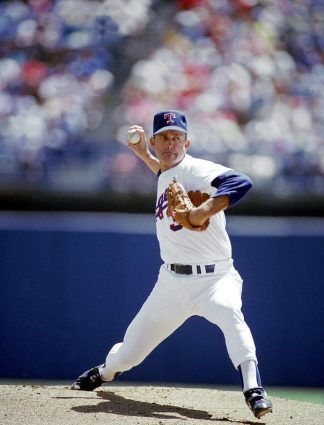
This is the way to remember Nolan Ryan—as a great pitcher, not the guy who got buried alive in a nasty brawl with the White Sox.

At the rate it turns up on social media discussions, and not merely on its anniversary, Hall of Fame pitcher Nolan Ryan is going to be remembered purely for the day he drilled Robin Ventura into charging the mound. As if nothing else he accomplished in a quarter-century plus pitching career mattered half as much as putting a temporarily brain-damaged third baseman in his “place.”

As if Ventura got the worst in a Ryan headlock that triggered a bench-clearing brawl between Ryan’s Rangers and Ventura’s White Sox in which Ryan got far worse than he inflicted upon Ventura. As if Ryan, in what proved his final season, was some sort of saint and Ventura some sort of bandit. As if there hadn’t been tension between the two teams for going on four full years.

It’s time to put the whole damn business to bed where it belongs. There were far more important things to think about to open this August. Things like Blake Snell’s no-hitter, Jack Flaherty’s Dodger debut, the sad end to yet another season from yet another injury to Hall of Famer-in-waiting Mike Trout. Things like the White Sox losing a twentieth straight game. Things like José Abreu hitting two bombs his first game back from his grandmother’s death and Freddie Freeman’s Guillain-Barre syndrome-afflicted little son home from the hospital.

But no. Who needs those when you can bring up the Ryan-Ventura brawl, a textbook exercise in celebrating false masculinity and baseball brain damage, on its anniversary, which is rendered meaningless anyway for how often it gets brought up all year long on one or another social media outlet?

Ryan was of the school of thought that taught the outer half of home plate was the pitcher’s exclusive property. You won’t find that anywhere in baseball’s written rules, of course. Generations of pitchers have been taught that; generations of hitters have been taught likewise. Well, now.

The Ryan-Ventura brawl was impregnated by a 1990 White Sox rookie named Craig Grebeck. He’d go on to make a useful career as a defense-first utility infielder. But in spring training 1990 he shocked a lot of people—probably including Ryan, probably including his own team—when he homered against the Rangers on a first pitch. He pumped his fists rounding the bases.

Come the regular season, Ryan faced Grebeck and surrendered one of (read carefully) the nineteen major league home runs Grebeck would ever hit in a twelve-season career. Again, Grebeck pumped his fists rounding the bases. Back on the bench, Ryan asked pitching coach Tom House about him.

Told that it was Grebeck, a not so tall player who looked then like a boy entering middle school, Ryan is said to have told then-Rangers pitching coach Tom House, according to Ryan biographer Rob Goldman, “Well, I’m gonna put some age on the little squirt. He’s swinging like he isn’t afraid of me.” The next time Grebeck faced him, Ryan hit him in the back with a pitch. “Grebeck was 0-for the rest of the year off him,” House remembered.

Fat lot of good that did The Express: Grebeck actually finished his career with a .273/.429/.545 slash line and a .974 OPS against the Hall of Famer. It wasn’t exactly a powerful one (three singles, two walks, three strikeouts, but four runs batted in, somehow), but Ryan didn’t exactly age Grebeck with the first of only two drills he’d hand Grebeck lifetime, either.

What it did, though, was begin some very tense times between Ryan’s Rangers and Grebeck’s White Sox. The White Sox’s batting coach, Walter Hriniak, was teaching his charges to cover that outer half of the plate. House insisted that was a root but Ventura himself said otherwise. “At the time in baseball the (strike) zone was low and away, and that was where pitchers were getting you out,”he said. “We weren’t the only team doing it. It was the kind of pitch that was getting called, so you just had to be able to go out and get it.”

What followed:

17 August 1990: Ryan hit Grebeck with one out in the third, Grebeck’s first plate appearance of the game. Two innings later, White Sox starter Greg Hibbard hit Rangers third baseman Steve Buechele with two outs. (The game went to extras and the Rangers won, 1-0, when Ruben Sierra walked it off with a line drive RBI single in the thirteenth.)

6 September 1991: Ryan hit Ventura in the back on 1-2, also in Arlington, three innings and a ground out after Ventura doubled Hall of Famer Tim Raines home with nobody out in the top of the first and scored on Lance Johnson’s subsequent two-out single. It started a rough day for Ryan, who surrendered two more runs (both on third-inning sacrifice flies) en route an 11-6 White Sox win.

2 August 1993: This was two days before Ryan and Ventura’s rumble in the jungle: Rangers pitcher Roger Pavlik hit White Sox catcher Ron Karkovice with one out in the third. (Ventura posted a first-inning RBI single to open the scoring; Rangers left fielder Juan Gonzalez answered with a two-run homer in the bottom of the first. Subsequently, White Sox relievers Bobby Thigpen and Jason Bere each hit Rangers third baseman Dean Palmer, while Rangers shortstop Mario Díaz also took one from Thigpen.

Ventura and assorted White Sox teammates of the time insisted Ryan was throwing at hitters and often hitting them on a routine bases. Two days later, Ryan and Ventura went at it. Among the pleasured by Ventura charging Ryan was Sox pitcher Black Jack McDowell: “Ryan had been throwing at batters forever, and no one ever had the guts to do anything about it. Someone had to do it. He pulled that stuff wherever he goes.”
Robin Ventura

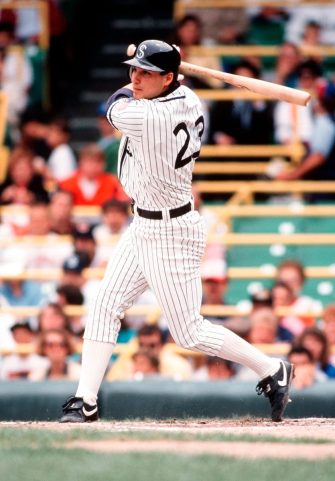
And this is the way to remember Robin Ventura—a great third baseman, not the guy who charged the mound indignantly when Ryan hit him with a 1993 pitch after a few seasons of White Sox-Ranger knockdown-and-plunk tensions.

“We had a lot of going back and forth that season,” says Ventura. “Guys were getting hit regularly, and it was just one of those things where something was going to eventually happen.” It probably involved other Rangers and White Sox pitchers, too.

Ryan was as notorious for his career-long wildness (he led his league six times and the entire Show three times in wild pitches, and averaged twelve per 162 games lifetime) as for his seven no-hitters, his 5,714 lifetime strikeouts, and his 2,795 walks. (They’re also number one on the Show hit parade.) He may have gotten away with throwing at hitters, but he was actually pretty stingy when it came to actually hitting them.

He retired averaging seven hit batsmen per 162 games. Seven. If he’d actually hit seven men a year for his entire career, it would give him 31 more drilled than he actually compiled (158). He actually had eleven seasons in which he hit five batters or fewer; hitting Ventura on that fine 4 August 1993 was the only hit batsman Ryan had in thirteen 1993 starts before he finally called it a career.

That doesn’t exactly sound like one of the most merciless drillers the game’s ever seen. Ryan only ever led his league in hit batsmen once (1982, when he was an Astro), and that’s one more than Hall of Famer Bob Gibson—too often the unjustified first name in, ahem, manly intimidation—ever did. Believe it, or not. Ryan is number sixteen at this writing on the all-time plunk parade. Gibson, you might care to note, is tied for 89th on the parade with (wait for it) 102. And he averaged (wait for it again!) . . . six per season.

“If you look at the replays, the ball wasn’t really that far inside,” House told Goldman.

It was just barely off the plate and it went off Ventura’s back. Robin was starting toward first base when he abruptly turns and charges the mound instead. And the closer he got to Nolan, the bigger he looked. If you watch it in stop action, you can see Ryan’s eyes were like a deer’s in a headlight. So everybody was surprised by what Nolan did next: Bam! Bam! Bam! Three punches right on Ventura’s noggin!

Actually it was about six. Now for the part everyone still gaping in awe over Ryan’s manly deliverance of a lesson to Ventura forgets: Both teams swarmed out of their dugouts, but the White Sox got to Ryan so swiftly that they drove him to the bottom of a pileup from which the White Sox’s Bo Jackson had to extricate Ryan before some serious damage was done to the veteran righthander.

“All I remember,” Ryan eventually told Goldman, “is that I couldn’t breathe. I thought I was going to black out and die, when all of a sudden I see two big arms tossing bodies off of me. It was Bo Jackson. He had come to my rescue, and I’m awful glad he did, because I was about to pass out. I called him that night and thanked him.” (The two were friendly rivals since then-Royal Jackson hit Ryan for a 1989 spring homer and his teammates hailed Ryan the next day—from the spot where Jackson’s bomb landed, as Ryan went through an exercise routine on the field.)

Ryan otherwise actually got the worst of it when all was said and done. Jackson extracted a man “visibly winded,” Goldman wrote. Ryan wasn’t the only one thankful for Jackson. “When Nolan didn’t come out of the pile, I got concerned,” said his wife, Ruth. “With his bad back, sore ribs, and other ailments, he could easily have suffered a career-ending injury.”

Somehow, Ryan remained in the game. Ventura was ejected for charging the mound. Of all people, his pinch runner was . . . Craig Grabeck. Ryan picked Grabeck off first before he threw a single pitch to the next batter, Steve Sax, who grounded out to end the inning.

The Rangers went on to win, 5-2. Ryan insists to this day that if Ventura had stopped shy of the mound rather than finish the pursuit and grab his jersey, “I wouldn’t have attacked him.” But he also felt embarrassed by the brawl. So much so that, Goldman recorded, when the Ryan family returned home from a postgame family dinner, Ryan declined when one of his sons—who’d videotaped the scrum—asked Dad if he wanted to see it again.

Ryan’s no, Goldman noted, was “firm.”

Said the Dallas Morning News headline the day after: Fight Gives Game a Big Black Eye.

Now, if rehashing that brawl isn’t to Nolan Ryan’s taste, it ought to be lacking likewise for the idiots who insist on reliving and re-viewing it on social media—and not just on its anniversary. I could be wrong, but it seems that social media outlets can’t last two weeks, and possibly less, without at least one jackass posting the video of the scrum.

Pitching to the inside part of the strike zone is part of the art, even if there’s no written rule saying the outer half of the plate is the pitcher’s exclusive property. You can delve as deep as you want and discover there were plenty of pitchers who lived so firmly on the inside that they, too, earned unfair reputations as headhunters.

Not everyone is as shameless as shameless as fellow Hall of Famer Early Wynn insisting he’d knock his grandmother down if she “dug in” against him. Well, guess what. Grandma’s Little Headhunter hit only 64 batters in a 23-season career and averaged only three per 162 games lifetime. He even had eleven seasons where he hit three batters or less.

Once upon a time, Bob Gibson signed an autograph for a fan who told him, in the earshot of baseball writer Joe Posnanski, “Oh, do I remember the way you pitched. I remember all those batters you hit. They were scared of you. The pitchers today, they couldn’t hold a candle to you.”

Gibson did want the edge every time he took the mound. He did look as ferocious as his reputation on the mound, though that may have been as much a byproduct of his nearsightedness as anything else he brought to the mound, including an innate and justifiable sense that a black pitcher in his time and place needed the edge just that much more. He did pitch inside as often as he thought he had to to keep batters off balance.

But when that fan departed with his autograph, Gibson turned to Posnanski and probably sounded wounded when he asked, “Is that all I did? Hit batters? Is that really all they remember?” (If it is, they didn’t see him pitch his way to the Hall of Fame.)

A few years ago, in another online forum, I was addressed directly by a fan who objected to my recording that, among other things, Gibson didn’t hit as many home run hitters after their bombs as people think they remember: He wasn’t just ‘brushing back’ batters—especially those who had hit a donga off him the time before. He was damn well trying to hit them. 

Well, I was crazy enough to look it up. Here’s what I wrote then:

Thirty-six times in 528 major league games Bob Gibson surrendered at least one home run and hit at least one batter in the same game. He only ever hit one such bombardier the next time the man batted in the game; he hit three such bombardiers not the next time up but in later plate appearances in games in which they homered first; and he surrendered home runs after hitting batters with pitches in fourteen lifetime games.

For the record, the one batter Gibson hit in the next plate appearance following the homer was Hall of Famer Duke Snider. The three bombers he’d hit later in those games but not in their most immediate following plate appearances: Hall of Famer Willie Stargell plus longtime outfielders Willie Crawford and Ron Fairly.

Is that all I did? Hit batters? Is that really all they remember?

Is that all I did? Sock Robin Ventura six times in a headlock before I got buried alive in the bottom of a pileup in my last year in the bigs and I needed Bo Jackson to save my sorry behind?

Ryan is a Hall of Fame pitcher. Ventura had an excellent career that shakes him out as the number 22 third baseman ever to play the game. They both deserve far better than to be remembered first for a hit-by-pitch and brawl that lowered both men’s dignity a few levels. The fans who “celebrate” the brawl every week or two, never mind on its anniversary? They deserve to be condemned.
“But . . . history, dammit!!!”

Clayton Kershaw

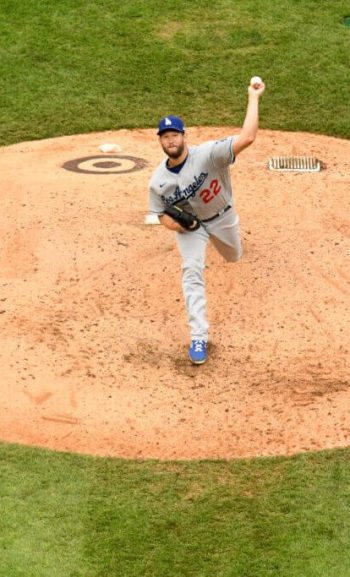
Clayton Kershaw pitching in Target Field, against the Twins, Wednesday. He was lifted after seven perfect innings and the world went nuclear.

Finally, Steven Kwan went hitless. It took his sixth major league game before somebody’s pitchers finally found ways to get him out all day long, if you don’t count the bases-loaded walk he took in the second to start the scoring in a 7-3 Guardians win.

Then Vladimir Guerrero, Jr. smashed three home runs against the Yankees in the south Bronx, including a pair off Yankee ace Gerrit Cole, en route a  6-4 Blue Jays win, a performance that had even the Yankees dropping their jaws in amazement.

Those might have been the top stories Wednesday if not for Clayton Kershaw and Dave Roberts.

Kershaw pitched seven perfect against the Twins in Minneapolis. Despite his having thrown “only” seventy pitches while striking thirteen Twins out including striking the side out in the sixth, Kershaw didn’t come back for the eighth inning. Roberts ended Kershaw’s day knowing both men agreed he’d be on a limited leash in his first season’s start at all, never mind pitching in temperatures in the thirties.

The world went nuclear over it.

Sometimes during the uproar it seemed nobody wanted to listen when Kershaw postgame explained, among other things, “I knew going in that my pitch count wasn’t going to be one hundred. It’s a hard thing to do, to come out of a game when you’re doing that. We’re here to win. This was the right choice.”

He’s Clayton Freaking Kershaw and he should have been entitled to finish that perfect game!

“Those are selfish goals. We’re trying to win,” said the lefthander who pitched a no-hitter in 2014 and whose black ink from ages 23-29 has already secured his reservation in the Hall of Fame.

That’s really all we’re here for. As much as I would’ve wanted to do it, I’ve thrown 75 pitches in a [simulated] game, and I hadn’t gone six innings, let alone seven. Sure, I would’ve loved to do it. But maybe I’ll get another chance.. . . I would have loved to have stayed, but bigger things, man, bigger things . . . Earlier in my career, I’d be built up to a hundred pitches. Blame it on the lockout. Blame it on me not picking up a baseball until January. My slider was horrible the last two innings. It didn’t have the bite. It was time.

Whaddabout history?!? Whaddabout entertainment?!? This is the way baseball brings the fans back?!?

What about the injury history of a 34-year-old pitcher, working in that 30-degree temperature range in crisp Minnesota, after an owners’ lockout-imposed badly abbreviated spring training, and coming off a season ended by forearm/elbow inflammation, accompanied by speculation he might even face Tommy John surgery? To say nothing of Kershaw not picking up a ball until January because of continued recovery from that forearm issue?

Goddam analytics!!!!!

Protecting a pitcher’s health—which is exactly what Roberts did, presiding over a starting rotation about whose long-term health Roberts has said on the record is the key to the Dodgers’ long-term seasonal health and success—has absolutely nothing to do with analytics. All the analytical information available to managers and players about their own and their oppositions’ tendencies isn’t going to tell you whether or when a player’s liable to incur injuries. Analytics aren’t that smart.

“It was a short spring training after a lockout,” reminded no less than Aaron Gleeman, who covers the Twins for The Athletic. “He’s not fully built up. Nothing to do with analytics.”

Nolan Ryan wouldn’t have come out after only seventy [fornicating] pitches, and his manager would have had a fight on his hands if he tried to lift Ryan!!!!

Any time any starting pitcher gets the early hook for any reason in any circumstance—never mind that most managers now have their starters on pitch limits in an admirable bid to compensate for the too-short spring training preparation and assure their long-term season’s health as best as possible—there still comes even one ignorant Ryan name-drop. This one delivered truckloads of them all around social media.

I’m going to let Athletic analyst Keith Law say it for me as I also did when reviewing the book in which he said it, The Inside Game: Bad Calls, Strange Moves, and What Baseball Behaviour Teaches Us About Ourselves, two years ago:

The center square on your [Pitch Count Bingo] card is Nolan Ryan, whose name is certain to come up in any attempt to discuss the limits of the human body to throw a projectile at 95 mph repeatedly over a three-hour span . . .

Nolan Ryan was a physical marvel, and an extreme outlier when it came to durability, although most discussions of the latter ignore the part where he missed 1967 and 1968 with persistent arm trouble. Ryan did things we will probably never see again, not now that pitchers throw harder than ever and play more than ever as kids, while teams work to keep their most gifted pitchers healthy until they reach the majors . . .

Nolan Ryan is the ultimate survivor, the survivor ne plus ultra, the übersurvivor when it comes to survivorship bias. Yes, Ryan defied everything we know now about pitch limits, and shouldered (pun intended) workloads that no MLB would ever allow a pitcher to carry [now], whether in individual games or entire seasons . . .

He is . . . an outlier, a great exception—not one that “proves” the rule, but one that causes many people to discard the rule. Most pitchers can’t handle the workloads that Ryan did; they would break down and suffer a major injury to their elbow or shoulder, or they would simply become less effective as a result of the heavy usage, and thus receive fewer opportunities to pitch going forward. Teams did try to give pitchers more work for decades, well into the early 2000s, but you don’t know the names of those pitchers because they didn’t survive: they broke down, or pitched worse, or some combination of the above. (Emphasis added.)

By the way, the Dodgers did finish the victory they began while Kershaw was in the game. They led 3-0 when he came out. With one out in the top of the eighth, Cody Bellinger, Gavin Lux, and Austin Barnes smashed back-to-back-to-back home runs off Dereck Rodriguez working his fourth inning of relief. Then Max Muncy greeted Rodriguez’s relief Griffin Jax by leading off the top of the ninth hitting a full-count fastball over the right field fence.

They also lost the perfecto when Kershaw’s relief Alex Vesia surrendered a one-out line single to former Yankee Gary Sanchez in the bottom of the seventh. Nobody saw Kershaw complain. If anything, he looked about as jovial and hail-fellow in the dugout as a man can look after being “robbed” of a shot at “history.” A man who knows his baseball immortality is already assured is far more sanguine in such circumstances than the world going nutshit about his “robbery.”

There were 233,345 major league baseball games before Wednesday, and only 23 of them were perfect. Thirteen (57 percent) were pitched by men who’d get to the Hall of Fame as visitors only. Only one—Hall of Famer Sandy Koufax’s jewel of 9 September 1965, after Koufax threw mere no-hitters in each of his three previous seasons—actually proved that practise makes perfect.

Should the Dodgers fail in their quest for one full-season World Series championship while Kershaw remains among them, it won’t be because he was lifted after seven perfect innings in his first season’s start. Should they succeed in that quest, it will be in considerable part because Roberts placed his pitcher’s long-term, season’s health—with his pitcher on board entirely—ahead of “history.”

“But who is a perfect game for, anyway?” asks Sports Illustrated writer Emma Baccelieri, who answers promptly. “It might be just as easy to conceive of it as selfless rather than selfish: a great communal gift as much as a great individual achievement. Everything on Wednesday made sense. But perhaps it is not selfish—not unreasonable—to wish that everything did not have to make so much sense all the time.”

Would I have loved to see Kershaw consummate a perfect game? You might as well ask if I still enjoy being alive. Just don’t ask me to list the roll of Hall of Fame pitchers who never got to pitch perfect games, either. They’d only begin with Walter Johnson, Christy Mathewson, Warren Spahn, Whitey Ford, Juan Marichal, Bob Gibson, Tom Seaver, and, yes, St. Ryan himself—who threw seven no-hitters but was never perfect even once.

You’re worried about “entertainment?” The single most entertaining things in baseball other than actual games and even World Series triumphs are arguments liable to last as long as baseball itself will last. Even when those arguments are as witless as the day is long.

Baseball takes the Fourth

2019-07-04 LouGehrig

Lou Gehrig, who said farewell eighty Fourths of July ago . . .

This year is a splendid one for baseball anniversaries, not all of them pleasant. A hundred years ago the Reds were cheated out of the thrill of World Series victory by the agony of the Black Sox’s chill of self-conscious defeat; fifty years ago, the eight-year-old, crazy Mets were crazy enough to win a division, a pennant, and a World Series. Just to name two.

Today America will have its annual red, white, and blue pyrotechnic racket celebrating the declaration without which this hardy if too often self-buffeted experiment would not be alive to watch twelve major league baseball games and a few hundred more minor league games.

And the Mets, crazy this year for reasons having too little to do with the craziness of 1969, get their first Fourth of July off in a non-strike-impacted season in their entire franchise history, after splitting a pair with the Yankees Tuesday and Wednesday. No such luck for the Empire Emeritus; they have landed in Florida to open a weekend with the freshly upstart but lately teetering (they’ve won 5 of 7 but lost 9 of 16 entering today) Rays.

Twenty seasons after the shenanigans of the 1919 World Series, America’s 4 July fireworks were handed a sober contrast in the old Yankee Stadium. Two weeks after receiving his diagnostic death sentence, the insidious disease that now bears his name, Lou Gehrig accepted the honour of his teammates past and present and did what he’d rarely done on the field prior to his self-imposed removal from the Yankee lineup.

He wore his heart on his sleeve. He also spoke without a script, without premeditation, without a speechwriter. You can hunt all you like but find no actual or alleged American leader that gifted by spontaneous soul:

Fans, for the past two weeks, you have been reading about the bad break I got. But today, I consider myself the luckiest man on the face of the earth.

I have been in ballparks for seventeen years and have never received anything but kindness and encouragement from you fans.

Look at these grand men. Which of you wouldn’t consider it the highlight of his career just to associate with them for even one day? Sure, I’m lucky.

Who wouldn’t consider it an honor to have known Jacob Ruppert? Also, the builder of baseball’s greatest empire, Ed Barrow?

To have spent six years with that wonderful little fellow, Miller Huggins? Then to have spent the next nine years with that outstanding leader, that smart student of psychology, the best manager in baseball today, Joe McCarthy? Sure, I’m lucky.

When the New York Giants, a team you would give your right arm to beat, and vice versa, sends you a gift—that’s something. When everybody down to the groundskeepers and those boys in white coats remember you with trophies—that’s something.

When you have a wonderful mother-in-law who takes sides with you in squabbles with her own daughter—that’s something. When you have a father and a mother who work all their lives so you can have an education and build your body—it’s a blessing. When you have a wife who has been a tower of strength and shown more courage than you dreamed existed—that’s the finest I know.

So I close in saying that I may have had a tough break, but I have an awful lot to live for.

Leave it to Hollywood to bowdlerise such transcendence the way it did when, despite availability’s freshness, they put a completely fictionalised version of Gehrig’s “Luckiest Man” speech into Gary Cooper’s mouth, the crowning insult from a film that insults more than embraces Gehrig’s actualities. In a later generation a Hell’s Angels president lamented their press coverage by wondering, “All that bullshit, hell, ain’t the truth bad enough for ’em?” Film students and baseball fans alike have every right to ask of The Pride of the Yankees, “All that bullshit, hell, ain’t the truth good enough for ’em?”

On the same day Gehrig graduated from baseball excellence to soul transcendence, Jim Tabor, a Red Sox third baseman, hit two grand slams in a doubleheader nightcap against the Philadelphia Athletics. (One of them was an inside-the-park number.) He became one of only thirteen players to perform that feat, on a day he driving in eleven runs over the entire doubleheader.

In 1983 a Yankee pitcher, Dave Righetti, subsequently a respected pitching coach, kept the Red Sox from making their own Fourth of July fireworks. He threw a no-hitter, the first Yankee to do it since Don Larsen’s perfect game in the 1956 World Series and the first Yankee lefthander to do it since George Mogridge—in 1917, while the world war alleged to be ending all wars continued apace.

Righetti finished his no-hitter with a flourish. In 1983 Hall of Fame third baseman Wade Boggs struck out a mere 36 times. The bad news is that one of those strikeouts completed Righetti’s masterwork. Which reminds me that sixteen pitchers have struck out 3,000 or more batters and only two of them secured number 3,000 on the Fourth of July: Nolan Ryan (1980; his victim: Cesar Geronimo) and Phil Niekro. (1984; his victim: Larry Parrish.)

One year after Knucksie’s milestone the Mets and the Braves played a game that started on the Fourth of July and ended on the fifth of July. The good news for the Mets: Keith Hernandez hit for the cycle. The better news for the Braves: pitcher Rick Camp tied the game with a home run—in the bottom of the eighteenth. (“If this team needs me to tie a game, they’re in trouble,” Camp remembered later.) The best news for the Mets: They scored three in the top of the nineteenth before Ron Darling—now a Mets broadcaster, then a starting pitcher pressed into survival relief—struck out Camp himself to end the 16-13 win.

The Braves said nuts to that and went ahead with their postgame fireworks show anyway. Nothing keeps some people from their red, white, and blue racket making—not even the fifth of July and nineteen innings of baseball.

Sixty years to the day before that Fourth, two Hall of Famers—Lefty Grove (Athletics) and Herb Pennock (Yankees)—tangled in a pitching duel that went fifteen innings before Grove surrendered the game-losing RBI to Yankee catcher Steve O’Neill. The bad news: It was one of only ten RBIs O’Neill would have all season long. The worse news: it was the first game of a doubleheader.

Today, the eyes of baseball will fall most likely upon the Dodgers, who enter a home game against the Padres on a streak of five consecutive games won in the final plate appearance of the inning. The last two of the streak were won by Cody Bellinger, the Dodger outfielder doing his level best to give Dodger fans a taste this season of what Angel fans have tasted since 2012 from Mike Trout.

On Tuesday night, Bellinger received the fifth consecutive walk of the bottom of the ninth to win, 5-4. On Wednesday night, having opened the scoring with a parabola over the center field fence, and with his parents in Dodger Stadium, Bellinger stepped up in the bottom of the tenth and sent one into the right center field bleachers. Winning again, 5-4.

The two Wednesday blasts put Bellinger into the Dodgers’ record book. He knocked two Brooklyn legends—Hall of Famer Duke Snider, and eventual Miracle Mets manager Gil Hodges—to one side for the most home runs by a Dodger in any season prior to the All-Star break.

But the eyes of baseball are just as likely to fall upon the Nationals, in Washington, when they host the Marlins in the nation’s capital. The Nats have gone from basket case in the making to winners of 15 out of 17 and a resurrected National League East threat, and even their once-lamented 2019 bullpen seems to be shaking off its early season penchant for throwing kerosene balls.

An American president-to-be fired the pronouncement heard ’round the world 243 years ago. (If you’re scoring at home, that’s one year more than the total home runs a former Nationals manager hit during his own playing career.)

May [our Declaration] be to the world, what I believe it will be (to some parts sooner, to others later, but finally to all) the Signal of arousing men to burst the chains, under which monkish ignorance and superstition had persuaded to bind themselves, and to assume the blessing & security of self government.

Let today’s American political (lack of) class sully America’s birthday all it wishes, if only because the formal legal holiday allows even a single day’s relief from their suffocating mischief. Immune as almost completely they are to America as an idea as well as a country, let them stew all they choose that they can’t really impose that immunity upon still-sovereign Americans, enough of whom will re-embrace America the idea in hand with America the country today.

Descended from stock as varied in international origin as baseball players are in performance, approach, and style, still-sovereign Americans will spend a fair portion of her birthday watching the game that above all others begins with the act of a sovereign individual but scores with the act America the idea embraces in the abstract and, at her best, the actuality. Enunciated best by the Yale scholar of renaissance literature (Dante in particular) who eventually became baseball’s overseer, if for a tragically brief term:

Baseball is quintessentially American in the way it tells us that much as you travel and far as you go, out to the green frontier, the purpose is to get home, back to where the others are, the pioneer ever striving to come back to the common place. A nation of migrants always, for all their wandering, remembers what every immigrant never forgets: that you may leave home but if you forget where home is, you are truly lost and without hope.

Mr. Jefferson, meet Professor Giamatti. Preferably behind home plate, but anywhere you might see America’s best annual birthday present, that roaming to the frontier, that hope of coming home, its starting cry the one with which you, Mr. Jefferson, might have finished your declaration and America’s, had you been clairvoyant enough to see its advent: Play ball!