The tip of the week

Aaron Judge

Judge shot this glance toward the Yankee dugout Monday night. On the next pitch—thrown by a Blue Jays reliever who admitted he’d handed the Yankees invaluable intelligence—the Leaning Tower of River Aenue hit the most powerful glancing blow of all time.

Say what you will about the Aaron Judge sideways glance Monday night in Toronto. You’re going to say it anyway, of course. But catcher-turned-Blue Jays broadcast analyst Caleb Joseph is way out of line suggesting that, if Judge was looking for a sign based on Blue Jays relief pitcher Jay Jackson tipping his pitches, the Yankee bombardier needs one thrown at his head post haste.

Because, you know, sign stealing the old-fashioned way—picking up on tipped pitches or signs from the field or the dugout, as opposed to an Astro Intelligence Agency off-field based espionage operation—is still a crime against nature. Never mind that that kind of sign stealing is almost as old as professional baseball itself. It may be a little unethical, but it doesn’t rise to the level of felonious grand theft.

Judge’s original response to questions after that game was that he’d heard more than a little chirping from the Yankee dugout, based on manager Aaron Boone being tossed over objections to plate umpire Clint Vondrak’s strike call on a low Jackson service. That bad call ran the count to 1-2.

That’s when Judge shot his now-infamous sideways glance toward the Yankee dugout. Before hitting a subsequent pitch 462 feet into the second deck behind the center field fence.

“I feel like after the manager does his thing, it’s like, ‘Fellas, our pitcher has still got to go out there and make some pitches’,” Judge said postgame. “We’ve got the lead, let’s just go to work here.’ I said a couple of things to some guys in the dugout and especially after the game. Hopefully it won’t happen again.”

The issue became compounded after Jackson admitted in due course that, yes, he just might have been tipping his pitches, a very common occupational hazard in his line of work. Players have sought little “tells” from pitchers from time immemorial. Even the greatest of pitch-shielding pitchers can be prone to giving one up from time to time without even realising it.

So what was with Judge speaking about Yankee dugout chirping? Easy enough. You don’t think he’s really going to give away how his mates picked up on Jackson’s tips, do you? Neither Judge nor the Yankees are going to commit treason if they can help it.

“From what I was told, I was kind of tipping the pitch,” Jackson told The Athletic. “It was  . . . the time it was taking me from my set position, from my glove coming from my head to my hip. On fastballs, I was kind of doing it quicker than on sliders. They were kind of picking up on it.”

Jackson didn’t sound even a fragment as outraged that the Yankees picked up on that tell as Joseph did during a pre-game show advancing Tuesday’s Yankees-Blue Jays contest.

“Everybody’s doing this, folks. Every team in the big leagues, they’re taking what’s handed to them,” Joseph began, giving what amounts to a confession that, yes, boys will still be boys and, so long as they’re not committing 2017-18 Astros-like black bag jobbing, it’s not exactly a call for outrage or vengeance.

Until it is, apparently.

“And it’s only bad until you get your hand caught in the cookie jar,” Joseph continued. “If I’m a mom or dad when I see my kid with their hand in that cookie jar, I’m slapping that hand. So I’m trying to send a message. And there was a time earlier in my career when, yes, messages were sent to me too. Right at my head when it wasn’t good. I would like to see Kevin Gausman come out and send a message.”

Gausman didn’t send any message Tuesday because none was called for. What he did do was get Judge to ground out and strike him out twice. The bad news for the Jays was Gausman’s relief Erik Swanson hanging a 1-0 slider that hung enough for Judge to send it almost as high past the center field fence as his glancing blast traveled Monday night.

Joseph was far less admirable demanding retribution than Jackson (optioned back to Triple-A afterward) was gracious when learning he’d handed the enemy a big break. “If they knew it was coming and he clipped me,” the righthander said, “he clipped me. I’m glad he hit it as far as he did.” The Yankees certainly were.

Jays manager John Schneider didn’t seem to think the Yankees committed Astrogate-style embezzlement, either. Even if he’d prefer his pitchers save their tipping generosity for the restaurant.

“If you’re doing things in plain sight,” Schneider said, “I think that you have to be able to correct them and you have to be willing to have the consequences be what they are. If it’s done fairly, yeah, that’s part of the game, everyone’s looking to help their teammates, everyone’s looking to pick up on tendencies, so anything that’s happening on the field in the right way, totally fair game.”

“In a very real sense,” wrote Paul Dickson in The Hidden Language of Baseball, “responsibility for tipping pitches or plays rests with the team, especially its coaching staff, so it amounts to a team error.” An unforced error at that. Something Mr. Joseph might want to ponder, before the next time he decides a tipped pitch caught, mugged, numbered, and murdered, deserves decapitation.

So what did Yankee pitcher Domingo German do on Tuesday night? He flunked a pre-inning sticky stuff test administered by umpire James Hoye and got himself tossed post haste and suspended ten games. This was after he’d already been warned, earlier in the season, about overdoing that good new fashioned medicated goo, and after he’d promised to use the rosin on the mound more.

“We all had the same opinion,” Hoye said of his umpiring crew about German’s suspect paw. “Shiny, extremely sticky, and it’s the worst hand we’ve ever felt during a game.” Worse than a busted flush.

Not brilliant, when the Yankees had to press Ian Hamilton into quick duty . . . and Hamilton ended up on the fifteen-day injured list after having to warm up too hastily. And when the Yankees just finished convincing those not disposed to believe them the root of all evil that there was nothing sneaky about catching and clobbering a tipped pitch.

It’s déjà vu all over again

Four years ago, the Yankees were so injury riddled that I couldn’t resist (half) joking that the team’s yearbook would be an issue of The New England Journal of Medicine. And, that Yankee Stadium would have to feature a banner above its main entrance:2019-04-21 YankeeStadium02

It’s déjà vu all over again. The Yankees are . . . injury-riddled. Again. They’re also two games above .500 as of Thursday morning’s standings, but they’re also fifth in a deceptively tough American League East. Just as in much of the past few seasons, The New England Journal of Medicine could be mistaken for the Yankee yearbook. And fans of the Broken Bombers are getting restless. Yet again.

The defending American League single-season home run record holder, Aaron Judge, hit the infirmary list when he injured his hip. Happy 31st birthday, Your Honour. Giancarlo Stanton suffered a hamstring injury in mid-April that may keep him out until early June. Josh Donaldson, Tommy Kahnle, Jonathan Loáisiga, Frankie Montas, Carlos Rodon, Luis Severino, Lou Trivino—infirmary list.

And that was before Harrison Bader—sprung from the injured list Tuesday—went right back onto it, taking Oswald Peraza with him, when they collided Tuesday night on a ninth-inning play enabling the Guardians to break a two-all tie in a game the Yankees finally won, 4-3.

Oh, sure, manager Aaron Boone made a point of saying postgame that Bader was in good spirits and even laughing about the crossroad collision as he came diving from one way as Peraza came diving from the other way. But it had to be laughter like Figaro’s, that the Yankees might not weep. Yankee fans, of course, don’t know whether to weep or call for summary executions.

The Yankees had Thursday off. At the rate they’re going so far, off days may be the only days guaranteed not to feature yet another Yankee off to sick call. But the Rays—those guys who opened the season with a thirteen-game winning streak, and still have a Show-beat 25-6 record—own the AL East after the first month plus. The Orioles (!) have twenty wins and sit ten games above .500, close enough to the franchise’s good old days. The Blue Jays are 18-13 and already took two out of three from the Broken Bombers. The Red Sox are 18-14, still have some kinks, but little enough compared to the Bronx’s orthopedic ward.

Maybe the Yankees aren’t in the game’s worst shape. Certainly not compared to the usual tankers and especially those in Oakland who’ve been driven into the tanks by an owner who’s all Three Stooges at once without being even a tenth as funny. But all you have to do is listen to enough Yankee fans. You’d think it was the end of the world as you knew it and you shouldn’t feel fine.

Do I really have to repeat myself and say there are scads of fans all around the Show who’d just love to be able to think a season without their team in or winning the World Series is an illegitimate season? Can you name one other team whose fans remain—by dint of having been there, or handed down as a smug legacy—wedded to the battle cry, “Wait till last century!”

‘Tis true that without its Goliaths baseball’s Davids would have nothing toward which to aspire. The Yankees in this century are anything but Goliaths. Once upon a time you couldn’t tune your memory to times when the Yankees were less than baseball’s Huns. Today the Yankees are only human, but their fans are still spoiled rotten.

Look yonder to the National League Central, where the Pirates—who’d been in the tank longer than the town drunk—sit prettily enough atop that division. The NL Central isn’t exactly the Third Army of World War II, but a 20-11 record isn’t necessarily dismissable.

Never mind that they’re one game above .500 against other contenders real or reputed. These Pirates are for real, for now. Their fans have a few glories from last century on which to lean, but they certainly don’t behave as though they’re entitled to a bloody thing. Maybe too many years in the tank does that for you.

The Orioles were long thought left for dead by their own ten-thumbed owners, but lo! They, too, were 20-10 as of Thursday morning. Camden Yard has gone from a ghost yard to a party yard. Never mind that they were exactly .500 against actual or alleged contenders. Don’t spoil Oriole fans’s fun just yet. The song of the Birds is the sweetest it’s been for eons.

But look, too, toward such twisted reaches of crazy sorrow as Cincinnati and Oakland. The Reds remain in the tank. The Athletics would only like to be in the tank—it would be a major upgrade from the sewage mistreatment plant they’ve been in for too long.

For decades, it seemed, Cub fans were rather like the one who whipped up a placard in the Wrigley Field bleachers saying “Wait ’till next year!”—as the Cubs’ Opening Day starting pitcher turned to throw the first pitch to the plate. Today’s Met fan thinks the season is lost upon one bad inning—in April.

The Yankees’ seemingly eternal general manager, Brian Cashman, has pleaded, “Don’t give up on us, that’s all I can tell you. Don’t count us out.” Between the blinding lack of moves during the offseason, other than securing Judge to his gigabucks extension and dealing for Franchy Cordero, his plea may yet fall upon ears sewn shut or suffering tinnitus.

“I don’t think there was anything on the table that I could have pulled down that would make a difference,” Cashman said of the Yankees’ comparatively quiet offseason. “I don’t see any missed opportunities with everything that was in play.”

Thus have they come to rely on Cordero (.684 OPS thus far), Willie Calhoun (likewise thus far), Isiah Kiner-Falefa (hits the price of a cheap cigar though he has a decent outfield glove), Aaron Hicks (making IKF resemble Hall of Famer Dave Winfield at the plate but in the negative in the field for run prevention), and a gang of straw arms behind Gerrit Cole. (Cole: 2.16 fielding-independent pitching; the rest of the starters: 4.75 FIP. ) Major league-ready talent down on the farm? Don’t ask.

The good news is, the previous decade including this season thus far isn’t even close to the Lost Decade of 1965-75 for Yankee futility, and at minimum there isn’t even a hint of the sort of executive insanity that was the 1980s Yankee hallmark. Principal owner Hal Steinbrenner isn’t even within transcontinental distance of his father for pushing panic buttons, throwing out the first manager of the year, or demanding summary executions every other bad inning.

But that exhausts the good news for now. That and the Yankees somehow taking two of three from the Guardians this week. Tonight, the Yankees begin a three-game visit to Tampa Bay. The Guards may sit in second place in the AL Central, but they do it at 14-17. The Rays, remember, are nobody’s pushovers this year thus far.

This weekend may not break the Yankees for good, the season remains too young for that. But wait till next year? If things continue as they have thus far, Yankee fans may yet come to lament, perhaps as early as the end of this month, “This year is next year.”

Joe Pepitone, RIP: The shakiest Yankee

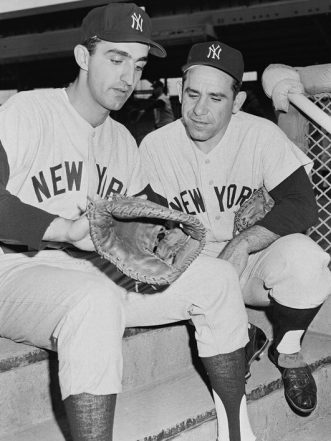
Joe Pepitone, Yogi Berra

Joe Pepitone (left) with Hall of Fame teammate (and 1964 Yankee manager) Yogi Berra. Pepitone once remembered Berra telling him, “I wish I could buy you for what you’re worth and sell you for what you think you’re worth.” (Yogi Berra Museum photo.)

No Yankee position player to emerge in the early post-Casey Stengel era was as talented as Joe Pepitone, who died Monday morning at 82. No Yankee of the same period was equally as self-immolating, either.

As a baseball player, Pepitone was a three-time All-Star and a three-time Gold Glove first baseman with a World Series grand slam on his resumé. As a man, to describe him as a mess was to be polite.

The slender kid from Brooklyn’s tough Park Slope section with a powerful bat, and sure hands and feet at first base, waged a war inside his heart and soul. He threw his career into a wild morass of long nights, reckless spending, wanton sex, and bouts of indifference. He may have been a fresh air blast through the staid Yankee image, but it sprang from and then dug its own tortuous well.

Pepitone was the oldest son of a violently abusive Brooklyn construction worker whom he worshiped and feared at once. The elder Pepitone didn’t seem to know or care about the distinctions between true misbehaviour and simple human error. The bruises and welts on his son’s body (he once clocked his son a shot that sent the kid’s head through the glass of a washing machine door) would prove nothing compared to those in the boy’s head and heart.

When Pepitone began attracting baseball scouts’ attention as a teenager, his father’s temper hit further verbal extremes; a heart attack forced the old man to stop beating him at last. But when the boy interceded in an argument between his parents, and the father lashed at him with particular malevolence, the boy blurted out to his mother, perhaps out of years of pain, “I really wish he’d die!”

Two days later, that’s just what happened, thanks to a second heart attack, sending Pepitone into a mental prison of guilt even as it spun him into a sense of liberation. In time, he’d sign with the Yankees and spend his entire signing bonus (including on a flashy Thunderbird convertible) en route his first spring training camp in 1958. (Stengel invariably called him “Pepperone.”)

He was lively and fun-loving, but he also used his Yankee affiliation to attract women who took him to their beds—even if it meant eventually trashing his first two marriages and costing himself three children. After a trip through the minors that was as randily adventurous as productive on the field, Pepitone reached the Yankees in spring 1962.

He’d show enough that the Yankees traded veteran incumbent Moose Skowron to the Dodgers for 1963. He would have his moments until the Yankees finally threw their hands up and traded him to the Astros after the 1969 season: a solid 1963; blasting a World Series grand slam (Game Six, 1964); a 31-homer season (1966); three Gold Gloves at first base.

He was fan friendly, and stories abound about his unfailing politeness and sincerity when meeting fans during and after his playing career. “To know Joe Pepitone,” wrote sportswriter Bill Madden in Pride of October: What It Was to Be Young and a Yankee, “was always to like Joe Pepitone . . . He just never felt secure enough to believe people could really like him for who he was, a genuinely giving person . . . whose only real weakness was the addiction to celebrity.”

His Yankee popularity was also his entree to such heavy spending bills that it wasn’t uncommon to discover process servers greeting him on the road and at home. The shakiest Yankee of his time, he sometimes disappeared without word and returned with remorse that lasted until the next party, the next bedmate, the next suspension, the next battle in his lifelong mental and spiritual war.

Exiled from the Yankees, Pepitone chafed under the more heavily-regimented Astro regime of the time, got himself suspended when he jumped the team to return to New York, and got himself picked up by the Cubs on the waiver wire in August 1970. A year later, he had arguably his best season as a player. While a Cub, he met a Playboy Bunny who’d become his third wife and with whom he had two more children.

Pepitone still couldn’t defeat his inner furies or avoid damaging his personal and familial relationships, alas. (The Yankees once sent him to an analyst, but he said he feared the analyst was far more interested in Yankee favour than in him.) Two businesses he co-formed failed; the second, a Chicago bar, lost clientele following a Chicago police investigation into rampant drug activity in the area, forcing Pepitone, its celebrity co-owner, to sell his share.

He retired, then un-retired in 1972, then was traded to the Braves in early 1973. Despite seeming to rediscover his form at the plate in four games as a Brave, Pepitone retired from the Show for good in May 1973. He went to Japan on a two-year contract with the Yakult Atoms (long since known as the Swallows).

After driving home the game winner against the Yomiuri Giants in his first game, he and his wife struggled enough to acclimate to Japan. His baseball passion waned; he claimed injuries to stay out of games while hitting the nightclubs or traveling to America and back regardless. Finally he asked for and obtained his release. His surname became Japanese vernacular for loafing.

Pepitone returned to New York, where he started an Italian delicatessen restaurant that also failed. He tried a brief baseball comeback in the Pacific Coast League before playing professional softball for a spell. By the end of the 1970s he’d become a Yankee minor league instructor, a role in which he was credited with helping a solid-hitting kid named Don Mattingly sharpen himself into an above-average defensive first baseman.

He coached first base for the Yankees briefly in 1982. He was arrested in 1985 with two other men when the driver ran a red light but drugs were found in the car. He spent time in New York’s notorious Riker’s Island jail in 1988 on misdemeanor drug convictions; he was busted for a 1992 fight in the Catskills after a man denounced him as “a washed-up nobody.” In 1995 he pleaded guilty to DUI after a crash in the Queens Midtown Tunnel. In the new century, his third marriage ended in divorce as well.

“I gave [my family] ample reason to be concerned about me, about my self-destructiveness, and I’m sorry about that. Truly sorry that I brought them down so many times,” he wrote in his 1975 memoir, Joe, You Coulda Made Us Proud. “I know now that you can’t [eff] over yourself without messing up the people you care about most, and with that knowledge comes the greatest pain of all. You do what you have to do, and you pay the price—but you pay it doubly when you see how it has hurt others you love.”

Joe Pepitone

Pepitone talking to reporters before a Yankees’ Old Timers’ Day event.

It only took three more decades from there before Pepitone—who once enticed Mantle and Whitey Ford into smoking marijuana, and who maintained a working relationship with the Yankees after his playing days and through all his future troubles—finally seemed to act on such truths. (He may or may not have been prodded, too, by a book written by two nephews, Soul of a Yankee, mixing biography with fantasy in a likely bid to shake and wake their uncle fully at last.)

“I began seeing a psychiatrist and I learned that I’m bipolar,” he told Society for American Baseball Research biographer David Krell in 2018, adding that he rebuilt relationships with his family, his second and third former wives, and three of his five children. Pepitone eventually moved to Kansas City to live with one of his daughters.

Abused children go forward in numerous ways. Not all dive as deeply into the demimonde and wreak the havoc upon their loved ones and their selves that Pepitone wreaked. He came from a time in which child abuse and bipolarity were little discussed, if at all. He chose the wrong salves without building or sustaining real support around him. If he truly rebuilt those relationships and finally came to full terms with his self-immolation, it speaks well of the man he became at long enough last.

But it could have been so much different, so much earlier, for those Pepitone loved and for himself, and in that order. May the Lord confer continued healing upon those he left behind, justice upon the father who so damaged him, and mercy upon himself.

You gotta have heart plus

Don Larsen

Nothing before or after indicated Don Larsen (here delivering with second baseman Billy Martin in the background, waiting) had even a no-hitter in him, never mind the only perfect game in World Series history.

Finding foolish social media threads is as difficult as finding foolish pronouncements from the political (lack of) class. You don’t even have to hunt them for them to find you. The Twitterpater who launched one Tuesday involving Don Larsen’s 1956 World Series perfect game is a perfect example.

“Imagine,” he begins, “telling Don Larsen he’s done after 6 innings because the analytics department won’t allow him to face the top of the order for a third time.” Imagine, too, telling such a gentleman that, on that fine afternoon in Yankee Stadium, Larsen was as outlier as an outlier can become.

In the World Series era (1903-present), Larsen’s is the only one of 21 perfect games to have been pitched in a World Series, of course. He could have disappeared entirely into oblivion from there, or he could have done what he actually did posting a journeyman pitcher’s fourteen-season career, and nobody can ever take that from him.

“The unperfect man pitched a perfect game,” led Joe Trimble of the New York Daily News. “The million-to-one shot came in,” led Shirley Povich of the Washington Post. They would not have led thus if someone such as Christy Mathewson, Lefty Grove, Bob Feller, or Warren Spahn had done first what Larsen did first. Those were Hall of Fame pitchers you might have expected reasonably to do it.

Larsen himself knew it. Until the day he died at 90 over two and a half years ago, those who found Larsen’s telephone number and rang it hoping to talk a little baseball would be greeted, almost invariably, with, “You want to talk about my year with the Orioles, right?”

Nothing in Larsen’s performances before and after Game Five of the ’56 World Series indicated he might have such a jewel in him. One thread respondent replied with evidence that batters facing Larsen usually hit above .250 facing him the third time around in a game. Oops.

The thread launcher snarked back, “Larsen’s perfect game—the most iconic pitching performance in postseason history—couldn’t have happened today. The game has a heartbeat, and [Yankee manager Casey] Stengel knew it. Today’s clinical, data-as-gospel approach totally discounts that.”

Where to begin? With the counterpoint that the approach itself discounts nothing of the sort but the manner in which it’s deployed might? With the point that Stengel himself was as much about advance knowledge and matchups as he was anything else as a manager,  ages before anyone put a name to that knowledge?

“Baseball is percentage, plus execution,” Stengel loved to say to anyone who would listen.  In that order. He knew in his mind as well as his gut that without the one, the other goes in with an arm missing. (Even as late as 1963, managing the hapless embryonic Mets, Stengel lectured reporters about on-base percentage, decades before it became a sabermetrics/analytics linch pin.)

Should we then begin with the point that all the heartbeat on earth won’t always ensure a result commensurate to it? With the point that if all you needed was heart this year’s Phillies might have pushed this year’s World Series to a seventh game they might have won with it or lost in spite of it? With the point that men of the stoutest heart can and do fail as often as they succeed, if not often enough more so?

Larsen’s World Series perfecto ended in a 2-0 Yankee win. The game’s key moment has long been recognised as Hall of Famer Mickey Mantle’s running catch of now-fellow Hall of Famer Gil Hodges’s sinking fly to deep left center. If you’re looking for prior indicators that Larsen had it in him, be reminded that he started Game Two but got hooked after an inning and a third despite surrendering a single hit.

Double oops: Handed an extremely early 6-0 lead to work with, Larsen also walked four batters in that inning-and-a-third, including two in the bottom of the second, before surrendering a sacrifice fly to Hall of Famer Roy Campanella. Small wonder Stengel hooked him that soon. He wasn’t going to risk Larsen walking the Dodgers right back into the game if he could help it.

The manager had no advance knowledge, of course, that the man he brought in after a foul pop out and a bases-reloading walk, sinkerball pitcher Johnny Kucks, would surrender a two-run single (Hall of Famer Pee Wee Reese), right before his relief, Tommy Byrne, surrendered a three-run homer (Hall of Famer Duke Snider).

Larsen threw 97 pitches in the perfecto, averaging 10.7 pitches per inning. Stengel was known both for his pitching management and his willingness to go to his bullpen the moment trouble arose enough. In fact, the Ol’ Perfesser’s Game Five plan was to start Larsen . . . but have his eventual ’58 Series MVP Bob Turley ready to go at the earliest sign of serious trouble.

(In due course, Stengel would execute that plan precisely: Larsen started Game Seven of the ’58 Series, but ran into trouble with an early one-run lead, prompting Stengel to bring Turley in. Turley went the rest of the way as the Yankees won.)

Would anyone really believe that Stengel—hooking Larsen early in Game Two when his control went AWOL, now with a World Series tied at two games each—wouldn’t have hooked Larsen even sixty-plus pitches in, if the Dodgers really began hitting him hard enough during the middle innings, even if those balls were hit for hard or long outs?

(Mantle’s catch was one of two very narrow escapes Larsen had in the same inning. The next Dodger batter, Sandy Amoros, running-catch hero of Game Seven the year before, securing their only World Series win as Brooklyn Dodgers, drove one into the upper deck that missed being a home run by inches past the foul pole.)

Looking at pitching wins and perfect games over a year ago, I drew a table to show just how much the perfecto pitchers were responsible for the outcomes by themselves. (My handicap: full game logs available for only nineteen of the perfect games.) Let me now isolate Larsen’s World Series perfecto according to that table of strikeouts, ground outs, fly outs, the win factor (WF) assigned to the pitcher—based on strikeouts divided by the sum of ground and fly outs—and the pitcher’s fielding-independent pitching rate on that season:

Pitcher Score K GB FB WF FIP
Don Larsen (1956 WS Gm Five) 2-0 7 6 14 .350 4.27

Larsen’s win factor of .350 is tied for fourteenth place among perfect game pitchers, with Tom Browning (Reds, 1988). Larsen was the beneficiary of fourteen fly outs including Mantle’s staggering catch. Among the ground outs was a second-inning smash to third by Hall of Famer Jackie Robinson that caromed off third baseman Andy Carey’s glove—and, in a marvelous stroke of fortune, right to shortstop Gil McDougald, who threw Robinson out by about the width of a hair.

What of that 4.27 FIP in 1956? Larsen is sixth from the bottom among the perfecto pitchers for the seasons in which they achieved those perfectos. Only one perfect game pitcher ever had a sub-2.00 FIP in the season during which he did it. In his case, too, having pitched a no-hitter in each of his three previous seasons, it really was a case of practise makes perfect:

Pitcher Score K GB FB WF FIP
Sandy Koufax (1965) 1-0 14 3 10 1.077 1.93

One of the thread respondents made note of Larsen’s lifetime performance against batters facing him the first, second, and third times in his starts: .228 the first time, .253 the second time, .278 the third time. A second made note of the OPS against Larsen in the same scenarios: .647 the first time, .711 the second, .788 the third. From there, I elected to look at how batters fared against Larsen in low, medium, and high-leverage situations:

Batters vs. Larsen, Career BA OBP SLG OPS OPS+
Low Leverage .239 .317 .360 .677 94
Medium Leverage .252 .336 .381 .716 105
High Leverage .255 .354 .363 .717 106

The higher the leverage, the better batters generally did against Larsen, even if the distinction between his medium- and high-leverage pitching was as slim as you see. His strikeout-to-walk ratio also worsened the more batters saw him during a game over his career: 1.27 the first time around the order; 1.05 the second time; 0.79 the third time. Lifetime, too, Larsen struck out about five batters per nine innings’ work but walked 4.2 per nine.

All the heart in him couldn’t make Don Larsen a great pitcher. (Did all the heart on earth keep the Dodgers from succumbing?) It took nine Yankee hearts including his (Stengel didn’t pinch hit for anyone during the game) to do what he did in Game Five, 1956.

He had an equal zest for living; in fact, he was known as a champion drinker who reported hung over to Yankee Stadium on the fateful day. Not until he remarried happily in 1960 did he abandon the wild-enough ways that once prompted teammates to nickname him Gooney Bird.

Larsen was a power pitcher with inconsistent control who was just good enough to pitch fourteen major league seasons including on five pennant winners and two world champion teams. He never again achieved anything within a light year or five of what he did that 1956 afternoon. He never pretended otherwise. He had no less heart lacking success than having success.

He also lived longer from that day forward than any other player, coach, or manager involved in his immortal afternoon. (He was also the last living St. Louis Brown before his death.) “The last one to go was Yogi in 2015,” he told a reporter in 2018. “It’s lonesome when you get to the top.”

Larsen more than anyone else knew that what he did in the ’56 Series made him and keeps him the all-time World Series outlier, whose record in depth before and after indicated no such performance—with or without his teammates’ aid and comfort—was even imaginable, never mind possible.

The unperfect man who threw the World Series’ only perfect game ever also did his eventual grandchildren a phenomenal favour. In 2012, Larsen auctioned his Yankee uniform from the game to pay for their college educations. Enough of social media might forget to remember that that’s stronger evidence of heart equaling result than any outing he ever had as a major league pitcher.

The Bronx is burning. Again.

Yankee Stadium

Nothing frustrated Yankee fans more than the pennant-winning Astros sweeping them out of the ALCS and celebrating in Yankee Stadium itself. Except maybe seventeen out of eighteen 21st century postseason push-outs and only one now fourteen-year-old World Series title.

Well. No wonder Yankee fans are somewhere between restless and roiled. Codify, a group whose specialty is “personalised game planning for greater pitching success” (their words, not mine), doesn’t restrict their observations to the mound alone. Two days ago, they noticed and shared something rather significant.

They noticed that, between 2010 and this year, the major league team that spends the most has gone to the World Series the least. That would be the team just flushed from the postseason by the ogres of the American League West in four straight American League Championship Series games.

Three out of six of, shall we say, the Show’s “thriftiest” teams (read: cheapest) have actually gone to the Series twice in that span. One was the team formerly known as the Indians, who fell to the Cubs (of all people) in seven in 2016. A second was the Rays, hosannaed perenially for the greatest ratio of competitiveness to roster payroll.

The third was the Royals, who went to the Series back to back and more or less had the second of them handed to them on a platter. (One more time: the Mets lost a 2015 Series that they could have won but for a defense that could have been tried by court martial for desertion.)

The Yankees, who spend almost habitually as though they’re the only baseball team authorised to operate their own mint presses, haven’t reached the World Series once in the same thirteen-year time frame. Only one other team within reach of their spending levels hasn’t, either, and that would be the fourth-highest spenders in Show over that span.

The Angels are a mess thanks to an owner who thought (erroneously) that baseball was marketing alone. (Said owner now plans to sell the team, which has Angel fans uncertain whether that’s a gift from the Elysian Fields gods or a reboot of My Mother, the Car in waiting.) The Yankees are a mess only in the terms by which their history and their fan base demands: if the Yankees aren’t in the Series, never mind winning it, the season is an abject failure and the Series is illegitimate.

Their 20th century success spoiled both the organisation and Yankee fans rotten. Their 21st century . . . well, you can’t really say a team that’s won ten AL East titles and gone to eighteen postseasons in 22 years is an abject failure. You can’t, I can’t, but Yankee fans can. And, do. Vociferously.

Across town, the Mets who haven’t enjoyed a quarter of the Yankees’ success have a fan base that gives cynicism a name rotten enough. The only thing needed to send too many Met fans into a spell of depression is a single bad inning in a game they might even win. In April.

They’re downright cheerful compared to the Yankee fan who thinks a single postseason game loss (never mind a postseason series loss) equals a mandate for summary executions. Preferably yesterday. (Remember: To err is human, to forgive is not necessarily Yankee fan’s policy.) Dodger fans are catching up to that rather rapidly.

Too many fan bases, what remains of them, would love to have those problems. Too many fan bases have been abused by tanking. Too many fan bases have been battered not by tanking but by brains gone to bed in the front offices of teams refusing to tank. A few make mythologies about of their teams’ signs of promise followed by surrealistic on-field calamties.

With or without blindfolding and spinning me, I could not find for you even one Yankee fan who would have believed, in his or her worst nightmares, that their historic rivals from New England would open a century with three more World Series rings than the Yankees have in the same century’s first 22 years.

That was then: The Red Sox opened the 20th century with four more Series rings than the Yankees in the century’s first 22 years, they now have their struggles and mishaps, but Red Sox Nation has graduated to a state of what you might call inverted bliss. They know the Red Sox will win again. They strain to avoid obnoxiousness when the Red Sox don’t.

This is now: 40 pennants, 27 World Series championships, and 58 postseason appearances can’t comfort the Yankee fan who believes to his or her soul that life was sweetness and light when it was only yesterday that the Yankees were never less than baseball’s practically annual masters of all they surveyed.

Yester-century’s Red Soxs fan believed extraterrestrial disaster was their birthright. This century’s Yankee fan believes postseason arrest is a miscarriage of justice—for which every other Yankee in uniform or in administration must pay with his life. The Yankees have had seventeen postseason arrests in eighteen tries since the turn of this century. There are teams who’d have loved to have half of eighteen tries over the entire 54-year history of divisional play.

A retired New Jersey school principal and blog editor of my acquaintance, who is also a Yankee fan of impeccable stubbornness, writes (in the Internet Baseball Writers Association of America’s Here’s the Pitch newsletter, to which I also have the honour of contributing) that Philadelphia’s man of the year (so far), Bryce Harper, is the one the Yankees let get away—having failed to even think of making him an offer when he hit the free agency market for what he swore would be the only time in his life.

You might think that a professional educator would know without being reminded that the one who got away gets away only if you bait the hook and cast it in the first place. In Harper’s first Philadelphia season the Yankees had an AL East winner that swept the Twins in the division series but fell in six ALCS games to (sound familiar?) the Astros.

Those Phillies had only begun to hit their reset button. They play for a fan base that’s inspired people to imagine a Philadelphia wedding ceremony concluding with the clergyman instructing the gathering, “You may now boo the bride.” Show me a New York wedding featuring a hapless bridegroom who misses when stomping the napkin-wrapped goblet for good fortune, and I’ll show you a Yankee fan among the gathering demanding an immediate marital annulment.

It wasn’t a lack of Harper that took the Yankees out, then or now; it was lack of figuring out how to figure out the Astros’ solid starting pitchers and redoubtable relief corps. A lack of Harper didn’t send the Yankees home in an ALCS sweep this time; an inability to compel the Astros changing their diet from near-constant breaking balls on which they couldn’t even feed intravenously to just enough fastballs on which to gorge, did.

Aside from which, the Yankees had a Harper of their own in-house already, then and now. This time, they broke Aaron Judge under the weight of compelling him to carry them in the second half, while he made history as they went from ruthless conquerors to skin-of-their-teeth division-title survivors.

They had little enough to pick it up when Judge was finally unable to carry that weight any longer. Now, they risk losing him to another team willing to break their bank to sign him as a free agent, after he bet the house, the yacht, and half of the Bronx on his future at the season’s opening tables and ended up throwing 62 passes for openers.

Not even the most unapologetic but objective Yankee hater wishes real ill to fall upon them. Without Goliaths, baseball’s Davids have no targets. (It’s difficult to conceive the Yankees as David. This ALCS was Goliath vs. Goliath. The Phillies will be the World Series’s Davids.) Baseball’s health depends upon its Davids making honest efforts to win, top down. But too many baseball Davids surrender before the season’s first shots are slung.

Enough are baseball’s Goliaths who meet their Davids deep and often enough in the postseason. Their fans become frustrated, understandably. Fan noise sometimes makes it difficult to determine which is worse. Is it teams that invest unapologetically only to come up too short, too often? Is it teams that could invest but elect premedidated failure, on behalf of building for futures that depend on wiser minds than their incumbents?

You get the latters’ fans more than you get the formers’. And among the formers’ fans, none seem half as disgusted as Yankee fans. Or—to fans of the Davids, whether those Davids become so honestly or by premeditated, decadent design—half as disgusting.