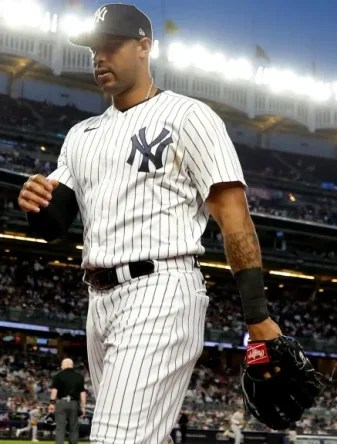
Mickey Mantle, as he actually was

Mickey Mantle

Even now it’s impossible to see discussions of Mickey Mantle without unfair laments over what the Hall of Famer wasn’t.

It’s almost three decades since Mickey Mantle’s death and it is a half century since he was elected to the Hall of Fame. Wouldn’t you think by now that the lamentations over what could have been, should have been, would have been, might have have been for Mantle had ceased and desisted? Isn’t what been been far more than enough?

Could have been one of the truly greats. Never quite lived up to his potential. Squandered so much of his enormous talent. Variations on those themes and more. All patent nonsense. I began getting that a-ha! when reading Allen Barra’s 2002 book, Clearing the Bases: The Greatest Baseball Debates of the Last Century.

Barra devoted a chapter to an in-depth comparison between Mantle and his transcendent contemporary Hall of Famer Willie Mays. Near the end of it, he ran down the foregoing laments, sort of, then asked, “But what about what Mantle did do?” to finish the chapter:

We spent so much of Mantle’s career judging him from [his longtime manager] Casey Stengel’s* perception as the moody, self-destructive phenom who never mastered his demons, and we spent much of the rest of Mantle’s life listening to a near-crippled alcoholic lament over and over about what he might have been able to accomplish. For an entire generation of fans and sportswriters who saw their own boyhood fantasies reflected in Mantle’s career and their worst nightmares fulfilled by his after-baseball life, Mantle’s decline became the dominant part of the story.

It’s time to dispel this myth . . . He was one of the most complete players ever to step on a big league field, a hitter with a terrific batting eye . . . spectacular power, blinding speed, and superb defensive ability. He could do things none of his contemporaries could do . . . He could switch-hit for high average and power, and he could bunt from either side of the plate, and no great power hitter in the game’s history was better at stealing a key base or tougher to catch in a double play . . . That his life is a cautionary tale on the dangers of success and excess can not be argued, but as a player he has a right to be remembered not for what he might have been but for what he was.

Of course Barra was and remains right. Even Mantle’s most unapologetically cynical observers buy that of course he’d have smashed Babe Ruth to smithereens, of course he’d have out-run Willie Mays in center field, of course he’d have out-stolen Ty Cobb first, of course he’d have left an impossible bar to clear, if only his lifelong-troublesome legs and a less young-death-present upbringing had left him the whole body and fully sound mind do it.

(For a contrast, hark back to Jim Bouton’s original lament in Ball Four: “Like everyone else on [the Yankees], I ached with Mantle when he had one of his numerous and extremely painful injuries. I often wondered, though, if he might have healed quicker if he’d been sleeping more and loosening up with the boys at the bar less. I guess we’ll never know.” Critics crucified Bouton over that, written in 1969-70. Whoops.)

If only. Enough.

When Barra wrote, no player—not Hall of Famers Lou Gehrig, Yogi Berra, Babe Ruth, nobody—played more games as a Yankee than Mantle’s 2,401. Hall of Famer Derek Jeter got to play two more seasons and 346 more. Jeter’s the only Yankee to suit up in the fabled pinstripes for more games than Mantle did.

If you want to lament what couldawouldashouldamighta been for Mantle, you should keep it to his center field play. That’s where his notorious legs really cost him. Sure, he could run a fly ball down with the best (he saved Don Larsen’s World Series perfect game with just such a running stab), but he finished his career ten fielding runs below his league average in center field—and only once was good for ten or more above it. (In 1955.)

Mantle had an excellent throwing arm but his legs kept his range factors at his league’s average as long as he played center field. He had twenty outfield assists in 1954 . . . and ten or more only twice more his entire career, both in the 1950s. His legs also hurt him on the bases: he did finish with an .801 stolen base percentage, but playing in the time when the running game returned he never stole more than 21 bases in a single season.

But . . . he did take extra bases on followup hits 54 percent of the time he reached base in the first place. Willie Mays out-stole him (and led the entire show annually from 1956-58), yet Mays finished with a slightly lower lifetime stolen base percentage. (.767.) In center field? No contest. Mays was worth +176 fielding runs lifetime.

So who was really better at the plate? I’m going to repeat a table I posted as a footnote a few days ago, when I assessed where Mike Trout sits among Hall of Fame center fielders who played all or most of their careers in the post-World War II/post-integration/night-ball era. The table looks at those center fielders according to my Real Batting Average metric: total bases + walks + intentional walks + sacrifice flies + hit by pitches, divided by total plate appearances:

Player PA TB BB IBB SF HBP RBA
Mickey Mantle 9907 4511 1733 148 47 13 .651
Willie Mays 12496 6066 1464 214 91 44 .631
Ken Griffey, Jr. 11304 5271 1312 246 102 81 .620
Duke Snider 8237 3865 971 154 54** 21 .615
Larry Doby 6299 2621 871 60 39** 38 .576
Andre Dawson 10769 4787 589 143 118 111 .534
Kirby Puckett 7831 3453 450 85 58 56 .524
Richie Ashburn 9736 3196 1198 40 30** 43 .463
AVG .576

Mantle’s RBA is twenty points higher than Mays. (Trout, I repeat, is 21 points higher than Mantle at this writing, believe it or not.) You might notice that he took almost two hundred more walks than Mays despite playing several seasons fewer. They actually finished with the same average home runs per 162 games (36), but Mays was the far more difficult strikeout: 66 per 162 games, compared to Mantle’s 115.

So where would Mantle finish with an RBA twenty points higher than Mays. Look deeper. Mantle hit into far fewer double plays than Mays did. Even with his badly-compromised legs, which you might think would get him thrown out at first a little more often in such situations, Mantle hit into 138 fewer double plays than Mays did.

Here’s a couldashouldawouldamighta for you: Imagine how many fewer double plays Mantle might have hit into if he had healthy or at least less-frequently-injured legs. Today’s blowhard fans, writers, and talking heads love to yap about the guys who strike out 100+ times a year. Ask them whether they’d take Mays’s 66 against 11 GIDPs a year . . . or Mantle’s 115 against six.

Try this on for size. Mantle was seen so often as lacking compared to the Hall of Famer he succeeded in center field, Joe DiMaggio. Yet, and Barra himself noted this in the aforementioned book, Mantle averaged 83 more strikeouts than DiMaggio . . . but DiMaggio hit into seventeen more double plays even playing five fewer seasons. When last I looked a strikeout was a single out. (Unless, of course, you swing into a strike-‘im-out/throw-’em-out double play, and we don’t know how many of those were involved in Mantle strikeouts.)

Here’s another: In the same era, only three players have win probability added numbers above 100. In descending order, they are: Barry Bonds (127.7), Ted Williams (103.7), and Mays (102.4). Henry Aaron’s 99.2 is just behind Mays; Mantle’s 94.2 is right behind Aaron. Those are the only five players from the same era with WPAs 90 or higher. (Did I forget to mention Teddy Ballgame whacked into 197 double plays?)

If you still want to tell me that a guy with a 94.2 win probability added factor “didn’t live up to his potential,” go right ahead. But then I’m going to tell you that we don’t have to wonder what couldawouldaashouldamighta been if Mantle’s physical and mental health allowed.

They didn’t calculate wins above replacement-level player [WAR] when Barra wrote Clearing the Bases, alas. Mays (156.1) has Mantle (110.2) beaten by ten miles. Mantle was 36 when he retired. Mays from 36-40 was still worth an average 5.0 WAR a season, which is actually still All-Star caliber. It’s not Mantle’s fault Mays’s body allowed him a longer useful baseball shelf life. Any more than it was Mays’s fault he didn’t get to play on more than four pennant winners and one World Series champion.

I don’t know if the foregoing will put a lid on the couldawouldamightashoulda stuff around Mantle once and for all. But I can dream at least as deeply as all those fans and sportswriters did when Mantle was in pinstripes doing things nobody else save one in his time did, and doing it for teams that won twelve pennants and seven World Series rings while he did them.

For me, I haven’t cared about how great he couldawouldamightashoulda been since I first read Barra’s book. I still don’t. Pending the final outcome of Mike Trout’s career (Trout, too, has had injury issues enough the past three seasons, and he’s right behind Mantle as the number five center fielder ever to play, according to Baseball Reference), Mantle and Mays remain the two single greatest all-around position players who ever suited up.

It’s still heartbreaking to remember Mantle apologising for and owning what he wasn’t in life itself not long before his death. But he owes nobody any apology for what he was on a baseball field in spite of his compromised health. Barra remains right: “as a player he has a right to be remembered not for what he might have been but for what he was.”

———————————————————————————-

* My personal favourite story about Mickey Mantle and Casey Stengel: When Mantle first became a Yankee, the team was scheduled to play an exhibition with the Dodgers in Ebbets Field before the regular season began. Stengel took Mantle to the once-fabled Ebbets Field wall from right field to center field, bisected by a giant scoreboard and beveled to create an angle toward the field in its lower half.

Stengel wanted to show Mantle the tricky angles made by the scoreboard and the bevel. “Now, when I played here,” Stengel began. He was cut off by Mantle exploding into laughter, hollering, “You played here?!?” (Stengel did, as a contact-hitting, base-stealing  outfielder with the Dodgers from 1912-1917, then with three other National League teams including the Giants from 1918-1925.)

“Boy never saw concrete,” the Ol’ Perfesser told a reporter who happened to overhear the exchange. “He thinks I was born sixty years old and started managin’ right away.”
It really was in Rizzo’s head, after all . . .

Anthony Rizzo, Fernando Tatis Jr.

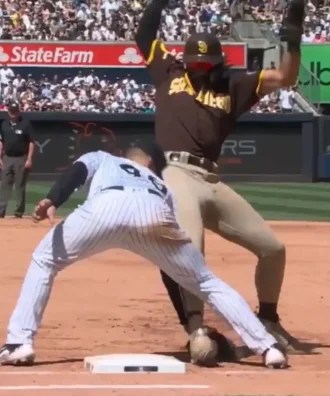
This is the 28 May collision—on a strike-’em’out/throw-’em-out double play—that turned Anthony Rizzo’s season into disaster whose cause nobody could figure out until this week.

Yankee and other fans now have the answer to what compelled a veteran first baseman with a jeweler’s eye for the strike zone to drop from an .880 OPS on 28 May to the arguable worst hitter in the game since. They should not like that nobody in his organisation could catch on sooner.

On that day, Anthony Rizzo took a bump on his head from the hip of the Padres’ Fernando Tatis, Jr., who was scrambling back to first on a strike-’em-out/throw-’em-out double play that ended the top of the sixth in Yankee Stadium. Watch the play from any angle you wish.

Yankee starting pitcher Gerrit Cole struck Xander Bogaerts out swinging, with Tatis well off the pad at first. A very alert Yankee catcher Kyle Higashioka whipped a throw up the first base line to an equally alert Rizzo. The throw went up the line low but Rizzo speared it cleanly to tag Tatis out on his lower right leg.

You should see clearly that, without intent, Tatis’s right hip caught the right side of Rizzo’s head hard as Rizzo bent down to apply that tag. Rizzo lost his hat, stood up as the ball fell from his mitt, then walked several steps toward second base before collapsing.

The Yankees thought it was a neck injury at first. They got Rizzo out of the game post haste, moving D.J. LeMahieu from third to first and Isiah Kiner-Falefa from left field to third, sending Greg Allen out to play left and to bat in Rizzo’s lineup slot. (The Yankees hung in to win the game, 10-7; Rizzo himself had pitched in with an RBI single prior to the fateful collision.)

Rizzo didn’t return to the lineup until the Yankees played the Dodgers on 2 June. In the interim, according to most reporting, he passed official concussion protocols. Yet, come Thursday, the Yankees let it be known that Rizzo was indeed dealing with post-concussion syndrome and that it was no questions asked traceable back to that 28 May play.

Nobody caught on after the original protocols passage. Rizzo himself says he began noticing “fogginess” last weekend, against the American League East-leading Orioles, where he’d previously couldn’t figure out how he dropped so far off the batting table.

“I remember talking to someone and they said, ‘Do you feel like you’re coming out of this soon?’” the first baseman finally told reporters. “I answered honestly that no I don’t because I couldn’t feel what you’re trying to feel as a hitter.”

I guess now we can link two and two together. Over the last few weeks, you just start going to different checklists of mechanics, timing, consistently being late. Why am I being consistently late? I’ve made these adjustments plenty of times in my career. I just didn’t forget how to do this all of a sudden. Everything (the doctors and I) talked about and everything they came back with basically came back on a silver lining of I’m not crazy for walking back to the dugout consistently thinking how I missed that pitch because I usually don’t miss that pitch.

The Yankees should be thinking about how they could have missed Rizzo dealing with and playing through both a concussion and its following syndrome for almost two months. They should be demanding answers from their own medical people and from baseball’s government itself.

All advanced knowledge coming forth over the last few decades doesn’t quite mitigate that baseball medicine is still not exactly sport’s equivalent to the Mayo Clinic. It still remains rare that a baseball team’s medical staff gets to the deepest heart of an injury issue before a career is compromised or ended.

And it still takes something such as Rizzo’s case to shake Joe and Jane Fan out of their smug dismissiveness toward slumping players to acknowledge that maybe, just maybe, there was a physical or neurological cause for the slump, as we now know was Rizzo’s case.

Ask Met fans who still dismiss Jason Bay as a mere bust. Signed to a four-year free agency deal, Bay was one of the game’s better outfielders and run producers . . . before he incurred two concussions as a Met, one hitting the outfield wall in 2010 and the second  hitting one in 2012.

Never mind teammates and his manager praising his work ethic, nobody put two and two together and figured two concussions might have had something to do with his dying bat. Bay and the Mets parted under mutually acceptable terms; he signed with Seattle, was given a clean bill of health, but after one horrid season called it a career.

Last winter, Twins fans inexplicably poured phlegm, bile, and acid over the very idea that Joe Mauer should be on the next Hall of Fame ballot. Their rage was over that fat contract extension Mauer signed when he was still the best catcher in the American League . . . and before he suffered the first of two concussions when he took a hard foul tip off his mask behind the plate.

Those fools called Mauer a thief because the concussions wouldn’t let him play to his previous level. Never mind the Twins yanking him out from behind the plate after that hard foul tip. They weren’t taking chances, especially after seeing what concussions did to their former first base star Justin Morneau.

Does the name Pete Reiser ring any bells? It should. That Brooklyn Dodgers legend with Hall of Fame talent ended up a Hall of Fame might-have-been, thanks to an insane playing style that caused him one too many concussions when he still couldn’t learn a concrete outfield wall—like the one they had in Ebbets Field—didn’t suffer fools gladly and he couldn’t make them collapse on contact.

Pistol Pete may have been lucky that he ended up with a somewhat long post-playing life as a minor league manager and major league coach. He also had an impact on the game beyond his own self: the Dodgers made Ebbets Field the Show’s first ballpark to feature padded walls after they traded him to the Boston Braves following the 1948 season.

Ryan Freel had it even worse. That cheerful character of an outfielder got blasted into a concussion on a collision with both an outfield teammate and the warning track in 2007; then, a second one in 2009, when he was hit flush on the head by a pickoff throw. Career over a year later.

Baseball began its concussion protocols in 2011. A year later, troubled by assorted mental issues and possibly remaining aftereffects of his two concussions, Freel committed suicide. Knowing what he’d been through playing baseball, his family donated his brain to Boston University—for research into chronic traumatic encephalopathy (CTE). In due course, it was determined Freel had Stage 2 CTE.

It’s bad enough that too many fans and too many sportswriters who ought to know better continue to dismiss the injured as malfeasant, especially when the injured take what those people believe to be longer than needed to recover. Too many sports teams behave likewise even today, too.

And too many fans still can’t draw the proper line between hard nosed and bullheaded, any better than Pete Reiser and others did. Baseball players shouldn’t have to blast themselves to smithereens to prove they’re delivering maximum effort.

Even the Yankees couldn’t figure out how Rizzo cratered after that 28 May game. They thought he was fine physically. They knew he wasn’t laying down on the job. Manager Aaron Boone kept insisting his man was going through a particularly protracted patch of slumping.

Rizzo himself didn’t think about further testing even though he’s admitted to feeling foggy and having days where he felt he’d been “waking up feeling hung over and you didn’t drink at all.” He also has to figure out how to balance his health to his itch to compete. He’s only too well aware that too many people, including those with and against whom he plays the game, still think injuries and their impact are mere excuses for poor play.

“[W]hen people come up and (are) like, ‘You haven’t been the same since the collision,’ I want to go tell people off because that’s not who we are as competitors,” he admits.

Even still, I feel like being injured or playing through a back injury or ankle injury in the past, you just adapt. Your body adapts. Obviously with this, I did everything I could and it’s unfortunate. The hardest part is missing time because I want to be out there. I want to be playing, but also to the level that I know I’m capable of playing at.

Easier said than done, alas. Even in today’s advanced medical atmosphere, professional athletes still can’t let themselves have the time they absolutely require to return to complete health. Often as not, their teams can’t. More often than that, Joe and Jane Fan don’t want to hear it. More often than that, Joe and Jane Sportswriter whip them into that froth.

Maybe the Rizzo case will start waking them up at long enough last. Maybe.

Riding the pine tar

George Brett

“I told [my kids] you better never make me this mad, and they never did.”—Hall of Fame third baseman George Brett.

The single most infamous moment in Hall of Famer George Brett’s career ended up becoming a tool in his fatherhood kit. “Showed it to my kids a whole bunch of times when they were young,” Brett told ESPN writer William Weinbaum in Cooperstown, where Brett spent the weekend including for the induction of Hall of Famers Fred McGriff and Scott Rolen.

“I wanted to see the look on their faces when I got mad,” Brett said of that day, forty years ago Monday, “and I told them you better never make me this mad, and they never did.”

One look at Dad’s face, bulging eyes and expanding mouth as he stormed from the dugout, seemingnly determined to amputate umpire Tim McClelland’s limbs if not his head, and the three children under Brett’s jurisdiction (he married in 1992, before his final season as a major league player) should have had no further doubt.

24 July 1983. Yankee Stadium. The Yankees and the Royals not exactly on friendly terms. Top of the ninth, two out, Brett’s Royals down a run, Royals infielder U.L. Washington on first, and Brett’s fellow Hall of Famer Goose Gossage on the mound in relief of Dale Murray. Knowing Gossage wouldn’t throw him anything but fastballs, Brett sat on one and drove it about seven or eight rows up the right field seats.

Brett barely finished rounding the bases when Yankee manager Billy Martin, a man who never missed an opportunity to deploy the rule book when it would work to his advantage above and beyond the actuality of a game, hustled out of the Yankee dugout demanding Brett’s bat be checked.

The Yankees noticed Brett’s bat had a visible excess of pine tar before the game, we learned in due course. Martin, typically, elected not to say or do something about it until or unless Brett did noticeably game-altering damage swinging it, as he did in the top of the ninth. After Martin asked rookie umpire McClelland to check the bat, McClelland and the umps confabbed, examined, confabbed more, laid the bat across the seventeen-inch width of the plate . . .

While talking to teammate Frank White in the dugout, awaiting the final call, Brett said he’d never before heard of too much pine tar, notwithstanding teammate John Mayberry checked for it in a 1975 game but ultimately surviving an Angels protest. But the usually jovial Brett knew just what he would do if McClelland and company ruled against his bat and thus his go-ahead home run. It wouldn’t be a parliamentary debate.

“I go, ‘Well, if they call me out for using too much pine tar, I’ll run out and kill one of those SOBs’,” he remembered telling White.

They called him out for using too much pine tar. Brett charged up from and out of the dugout like a bull who’d been shot with an amphetamine dart, resembling a man determined to part McClelland from his arms, legs, head, and any other extremity within reach. It took several teammates plus Royals manager Dick Howser and umpire Joe Brinkman to keep Brett from dismembering McClelland.

“I looked like a madman coming out,” Brett admitted to Weinbaum.

I think everything kind of got a little more dramatic than it should have. Because Joe Brinkman got behind me and started pulling me back, and I was trying to get away and he had a chokehold on me and just pulling me backwards and backwards and I was just trying to get free from him. I wasn’t going after Tim McClelland. I mean, as Timmy would always say, “George, what were you gonna do to me? I’m 6’5″, I’ve got shin guards on, I’ve got a bat in one hand, a mask in the other. What are you gonna do to me?” I said, “Timmy, I was just going to come out and yell at you, I wasn’t going to hit you. You would’ve kicked my ass.”

George Brett, Gaylord Perry

Fellow Hall of Famer Perry (right) advised Brett to stop using the infamous bat—because it was too valuable. It’s reposed in the Hall of Fame since 1987.

Brett’s Hall of Fame teammate, pitcher Gaylord Perry, a man who knew something about suspect substances (hee, hee), managed to get the bat away from the umps and into the Royals dugout striking for the clubhouse, until Yankee Stadium security retrieved the bat to submit to the American League offices. (This, children, was the time when the leagues weren’t yet placed under MLB’s direct, one-size-fits-all administration.)

Brett was ruled out over the bat. The Yankees won the game officially. Not so fast. AL president Lee MacPhail received the Royals’ appeal, ruled that the bat didn’t violate the pine tar rule’s actual intent (which was to keep baseballs from getting dirtier), and ordered the game continued in New York—on an off-day for both teams otherwise, 18 August. En route a Royals trip to Baltimore for a set against the Orioles.

“I was kicked out of the game,” Brett said, obviously over his raging bull charge and plunge after the nullified homer.

I was still gonna go to the [suspended] game, but [Howser] said don’t even go the stadium, it’ll be a circus. So me and the son of [actor] Don Ameche, Larry—he was a TWA rep, we always chartered TWA jets back then—we went to some restaurant in New Jersey, an Italian restaurant, and watched the game on a little ten-inch TV. And went back to the airport, the guys had to go there after finishing the game, and next thing you know we were flying to Baltimore.

The Royals and the Yankees re-convened from the point of Brett’s homer. Royals designated hitter Hal McRae faced Yankee pitcher George Frazier, himself familiar with actual or alleged foreign substances. (I don’t use foreign substances. Everything I use is made in the U.S. of A.) McRae struck out for the side. Then, the Royals’ often underrated closer, Dan Quisenberry, got two straight fly outs and a ground out to finish what was started almost a month earlier.

Brett continued using the bat until Perry advised him it was too valuable to risk damage. He sold the bat to fabled collector Barry Halper for $25,000—until he had a change of heart and refunded Halper’s money. The bat has reposed in the Hall of Fame since 1987. “Goose and I have had a lot of laughs over it since he got into the Hall of Fame,” Brett told Weinbaum.

Before a 2018 game celebrating their fiftieth season of life, the Royals handed out a Brett bobblehead showing him springing forth bent on manslaughter upon the home run nullification. Brett told Weinbaum a Royals A-level minor league affiliate saw and raised to make him, arguably, the first player depicted on a bobble-arm figurine—his arms waving as wildly as they did when he charged for McClelland.

Three years before the infamous pine tar homer, Brett was known concurrently as one of the American League’s great hitters (he nearly hit .400 that season) and, unfortunately, a man stricken by a pain in the ass after the Royals finally waxed the Yankees in an American League Championship Series: internal and external hemorrhoids.

Brett had to put up with crude jokes throughout that World Series, which the Royals lost to the Phillies (and his Hall of Fame third base contemporary, Mike Schmidt), but he tuned them out. The pine tar game knocked that onto its butt rather immortally.

“Seriously,” he told Weinbaum, “what would you rather be remembered for? Hitting a home run off Goose Gossage in the ninth inning to win a ballgame, or being the guy with hemorrhoids in the World Series?”

I think I’ll sit on that awhile.

The ten million-to-one shot comes in

Domingo Germán

German’s uniform number must have felt like adding insult to injury to the Athletics Wednesday night.

When the late Don Larsen pitched his perfect game in Game Five of the 1956 World Series, New York Daily News writer Joe Trimble was stuck for an opening line. His News colleague Dick Young handed one to him, practically in a glass case: The unperfect man pitched a perfect game.

That pretty much robs anyone of using it as a headline for Domingo Germán, who became the fourth Yankee pitcher to come away with a perfect game Wednesday night. Which is a shame, because Germán can be seen as having made Larsen resemble a saint.

Before he married in 1960, Larsen was a wild oat whom no less than Hall of Famer Mickey Mantle called the greatest drinker he’d ever known. That was saying something considering Mantle’s own prodigious taste for distilled spirits. The night before he went to a no-windup delivery and reached baseball immortality, Larsen went out—still steaming over an early Game Two hook—and got smashed.

Germán’s is a more grave backstory. He missed 2019’s final eighteen games plus the entire pan-damn-ically shortened 2020 after slapping his girlfriend during retiring Yankee legend CC Sabathia’s charity party late in the 2019 season. His 2021 return didn’t thrill all his teammates, even though there’d been Yankee fans swearing that a lack of formal criminal charges meant he should have been back in 2020.

“Sometimes,” relief pitcher Zack Britton said, before Germán’s 2021 return, “you don’t get to control who your teammates are.”

The Yankees entered spring training this year without figuring Germán in their starting rotation plans. Not until Frankie Montas needed shoulder surgery, Carlos Rodòn injured his forearm and then his back, and Luis Severino incurred a lat injury. And Germán himself—who has said he started undergoing treatment for depression following his 2019 incident and counseling to improve as a husband and father—dealt with shoulder inflammation last year.

Nothing in Germán’s 2023 entering Wednesday suggested he’d have anything coming such as what he’d do in Oakland’s RingCentral Coliseum—pitching the 24th perfect game in Show history and the fourth in Yankee history, following Larsen, David Wells, and—with Larsen and his Hall of Fame catcher Yogi Berra in attendance for a ceremonial pre-game first pitch—David Cone.

Germán was ejected, then suspended ten games, for too much of that new old-fashioned medicated goo on his hand after a May outing in Toronto. Before that, in April, he was suspected but allowed to wash his hands during a game against the Twins.

From early May through mid-June, Germán became, perhaps surprisingly, the best Yankee starting pitcher who wasn’t named Gerrit Cole, including a two-hit performance against the Guardians 1 May and six and two-thirds one-run ball against the Dodgers on a Sunday night game in June that was televised natinoally.

Then, his two outings prior to Wednesday night saw Germán abused by the Red Sox for seven runs in two innings; and, bushwhacked by the Mariners for ten runs including on four home runs.

I don’t know what Germán did on Tuesday night. I do know that he went out to the mound Wednesday night with absolutely nobody in the sparse-enough RingCentral house, perhaps including himself, expecting him to come away with the first perfect game ever pitched by a man whose previous start saw him take a ten-run beating.

That includes factoring that the A’s were the opposition. This year’s A’s have become such a pathetic set after long enough dismantling and disembowling under the all-thumbs hand of their owner that a perfect game against them might be considered doing it the easy way.

Especially since, during the top of the fifth, the Yankees made bloody well certain that Germán could go back out to the mound, pull up a lounge chair, and pitch from a sitting position serving up balls on tees without incurring serious damage.

They entered the inning with a mere 1-0 lead thanks to Giancarlo Stanton’s fourth-inning, two-out, first-pitch home run. They finished it with a 7-0 lead following an RBI double (Kyle Higashioka), a run home on a throwing error off a bunt (by Anthony Volpe, who stole third during the next at-bat), an RBI single (DJ LeMahieu), a two-run single (Stanton) after another A’s error enabled the bases loaded, and a two-out RBI single.

The Yankees then scored once in the top of the seventh (on Josh Donaldson’s sacrifice fly) and thrice in the top of the ninth (a run-scoring throwing error, an RBI double, a run-scoring ground out) to finish the 11-0 pile-on. It’s the fattest winning score in a perfect game since the Giants staked Matt Cain to a 10-0 conquest in 2012 and only the second time a perfect game pitcher had double-digit run support to work with.

All the while, Germán kept feeding the A’s things onto which they couldn’t attach sneaky eyes through the infield or wicked distractions in the outfield. He struck nine batters out, all before the eighth inning, and should have handed his defense at least equal credit for the perfecto as he might have accepted for himself. This is Germán’s gem with a win factor assigned, result of his strikeouts divided by the sum of his ground and fly outs:

  Score K GB FB WF FIP
Domingo Germán 11-0 9 8 10 .500 5.30

Essentially, Germán himself was responsible for half the game’s perfection. Which actually places him well enough ahead of Larsen’s perfecto (WF: .350) but behind those of Wells (.688) and Cone (.588).

Among the perfect games pitched in the World Series era (1903 forward) with available game logs, Germán’s win factor is higher than six perfecto pitchers (Larsen plus Charlie Robertson, Tom Browning, Dennis Martinez [the lowest at .227], Kenny Rogers, Mark Buehrle, Dallas Braden) but lower than eleven. (Cain, Wells and Cone, plus Jim Bunning, Sandy Koufax [tied for highest with Cain: 1.077], Catfish Hunter, Len Barker, Mike Witt, Randy Johnson, Roy Halladay, and Felix Hernández.)

You might care to know that Germán shares a .500 WF with one perfecto pitcher, one-time Yankee Philip Humber. But Germán’s curve ball, considered a sharp pitch when it’s thrown right, was responsible for nineteen of his 27 outs, including seven of his strikeouts.

“He threw that curveball in any count that he wanted to,” said A’s infielder Tony Kemp postgame. “It was spinning differently and moving differently. He put his fastball where he wanted to. Changeup as well. He just kind of mixed them.”

Larsen beat a somewhat aging but still formidable Dodgers team who’d ground their way to their final pennant during their Brooklyn life. Germán took on an A’s team that’s been compared often enough to the 1962 Mets—while lacking that team’s circumstantial popularity and flair for inadvertent ensemble comedy.

Those Mets merely got no-hit by Hall of Famer Koufax—who threw one of the most voluptuous curve balls in history himself—while Koufax’s Dodgers slapped eleven runs out of Met pitching . . . on 30 June 1962. These A’s accomplished something on 28 June 2023 that those Mets didn’t. They were victimised by Germán and the Yankees without the relief of the five walks Koufax surrendered.

Washington Post sportswriting legend Shirley Povich led his story of Larsen’s World Series perfecto with, “The million-to-one-shot came in.” It’s not unfair to suggest Germán was the ten million-to-one shot.

But you wonder whether his unusual uniform number—the only available single-digit number on the Yankees anymore, chosen when he gave Rodón his usual number 55 to indicate a new beginning for himself—didn’t look more swollen in the A’s eyes, adding insult to injury, than it looked on Germán’s back. Zero.

The Yankees aren’t “eating” Hicks’s remaining money

Aaron Hicks

The Yankees finally put the lime in the coconut over Aaron Hicks.

Extremely few things cause me indigestion. Talk about a team “eating” money to be rid of an unproductive or faded player is one of them. Such talk erupted again when the Yankees, come Saturday, designated outfielder Aaron Hicks for assignment. It isn’t just fans who don’t know better talking that way. It’s also professional analysts who should.

“You don’t have to understand or agree with the replacement-level concept to agree on this much: there are scores of minor-league outfielders who, given the opportunity, could provide the Yankees with more than Hicks has to date. Just eat the money already,” writes CBS Sports’s R.J. Anderson.

“It’ll be a costly move for the Yankees, with Hicks still owed $19.57MM by way of $9.8MM salaries in 2024-25, and a $1MM buyout on a $12.5MM club option for 2026. He’ll also be owed the remainder of his $10.8MM salary in 2023,” wrote MLB Trade Rumors‘s Simon Hampton. “Hicks will now be exposed to waivers, but his struggles this year and the remaining money owed make it a near certainty he goes unclaimed. Instead, the Yankees could offer to eat the remainder of his contract and try and trade him to another team, or he could be released once he clears waivers.”

Pass the Pepto-Bismol, please. For me. It’s too late for the Yankees regarding Hicks.

Remember when the Diamondbacks bit the bullet and released thoroughly collapsed pitcher Russ Ortiz? The Associated Press said flatly enough that the Snakes decided they’d rather “eat” the $22 million they still owed Ortiz than keep him taking up roster space. Remembering that, Keith Law (in The Inside Game) tried to remind us: they ate nothing.

“That salary was already somewhere in Arizona’s GI tract, likely causing indigestion but there nonetheless,” Law wrote. “Major League Baseball player contracts are guaranteed; there is no way to un-eat that meal.”

Notice that almost no one was talking about somebody eating Eric Hosmer’s contract after the Cubs designated the veteran but fading first baseman earlier the same week? Cynically, you could say it’s because $700,000+ (his MLB-minimum Cub salary) is a mere appetiser compared to the $144 million banquet to which the Padres signed Hosmer during spring training 2018.

That was an eight-year deal which has through the end of the 2016 to run. Some said the Padres elected to eat the rest when they traded Hosmer to the Red Sox last August and sent the Red Sox the last $44 million owed on the deal. Those with something more than mashed potatoes for brains could remind you: the Padres planted that meal down their tract the day they signed him in the first place.

The Yankees thought Hicks would be a good fit after landing him for the 2016 season because he looked like a solid hitter who didn’t strike out a lot compared to a lot of others at the time, and because he had a live-looking throwing arm in the outfield. They didn’t bargain on injury-disrupted seasons that came to bring forth the worst in Yankee fans still struggling with the presence of even more injury-battered Jacoby Ellsbury.

It didn’t help that Hicks wasn’t quite as good as his notices when he could play, though he did have his moments—and a 2018 season solid enough to encourage the Yankees to sign him to a seven-year, $70 million contract extension plus the aforementioned option years during spring training 2019. The fact that he had some pop, wasn’t shy about taking walks, and didn’t strike out in big volume didn’t hurt, either.

In the first three years of the deal, Hicks missed significant time with injuries (wrist, back, elbow) each of the three and, perhaps unsurprisingly, didn’t play particularly well when he could play. In center field he was about league average for run prevention and for getting to balls in the first place; at the plate, he might have prayed to improve all the way up to league average.

At 33 it might seem that history of injury and inconsistency might put paid to Hicks’s major league career soon enough. Unless he’s willing to accept a purely platoon role on a team needing inexpensive help against portside pitching. (Hicks is a switch hitter but he’s been a little stronger batting righthanded.)

The Yankees finally surrendered after swinging a trade with their most hated rivals (in Boston) to bring aboard outfielder Greg Allen and needing room for him on the roster. Allen isn’t much of a hitter but he’s considered a plus outfield defender and swift on the bases—if he gets there in the first place. (Lifetime on-base percentage: .299.)

The meal has been somewhere between the Yankee belly and the intestines since 2019. They finally, simply, put the lime in the coconut to relieve the bellyache.